



Abstract
Background and Aims
Total pancreatectomy with islet autotransplantation (TPIAT) can relieve pain for individuals with acute recurrent or chronic pancreatitis. However, TPIAT may increase the risk of poor nutritional status with complete exocrine pancreatic insufficiency, partial duodenectomy, and intestinal reconstruction. Our study’s objective was to evaluate nutritional status, anthropometrics, and vitamin levels before and after TPIAT.
Methods
The multicenter Prospective Observational Study of TPIAT (POST) collects measures including vitamins A, D, and E levels, pancreatic enzyme dose, and multivitamin (MVI) administration before and 1-year after TPIAT. Using these data, we studied nutritional and vitamin status before and after TPIAT.
Results
348 TPIAT recipients were included (68% adult, 37% male, 93% Caucasian). In paired analyses at 1-year follow-up, vitamin A was low in 23% (vs 9% pre-TPIAT, p < 0.001); vitamin E was low in 11% (vs 5% pre-TPIAT, p = 0.066), and 19% had vitamin D deficiency (vs 12% pre-TPIAT, p = 0.035). Taking a fat-soluble multivitamin (pancreatic MVI) was associated with lower risk for vitamin D deficiency (p = 0.002). Adults were less likely to be on a pancreatic MVI at follow-up (34% vs 66% respectively, p < 0.001). Enzyme dosing was adequate. More adults versus children were overweight or underweight pre- and post-TPIAT. Underweight status was associated with vitamin A (p = 0.014) and E (p = 0.02) deficiency at follow-up.
Conclusions
Prevalence of fat-soluble vitamin deficiencies increased after TPIAT, especially if underweight. We strongly advocate that all TPIAT recipients have close post-operative nutritional monitoring, including vitamin levels. Pancreatic MVIs should be given to minimize risk of developing deficiencies.
Keywords: Pancreatitis, Fat-soluble vitamin deficiencies, Supplementation, Underweight
Introduction
Individuals with acute recurrent pancreatitis (ARP) and chronic pancreatitis (CP) have multifactorial risk factors for poor nutritional status and fat-soluble vitamin (FSV) deficiencies. Key amongst those factors is the development of exocrine pancreatic insufficiency (EPI) and the resultant malabsorption it produces. In those with CP, the rate of vitamin E deficiency was up to 8 times higher and vitamin A deficiency was 2–4 times higher when compared to normative population data for children1 or a control cohort for adults.2 Vitamin D deficiency rates were similar between these groups and reflective of increased rates in the population as a whole.3 Increased rates of FSV deficiencies can be seen even when individuals are treated with appropriate doses of pancreatic enzyme replacement therapy (PERT).4,5
Total pancreatectomy with islet autotransplantation (TPIAT) can be considered for selected individuals with ARP or CP for whom maximal medical, endoscopic, and/or other surgical procedures have failed to improve chronic pain and impaired quality of life. While pain relief and improved quality of life have been demonstrated,6–9 few studies have addressed nutritional status after TPIAT. TPIAT may increase the risk of poor nutritional status due to complete iatrogenic EPI resulting from the pancreatectomy. Because TPIAT also involves partial duodenectomy and intestinal reconstruction, FSV deficiencies may also be more likely to occur if sites of absorption are largely bypassed as has been seen in certain bariatric surgeries.10,11 Therefore, lifelong PERT and FSV supplementation are needed.
Increasing prevalence of FSV deficiency after TPIAT has been demonstrated in a single-center cohort of pediatric TPIAT recipients,1 however, no official consensus has been reached regarding FSV monitoring. In addition, standard guidelines regarding vitamin supplementation after TPIAT do not exist and current practice is highly variable.
Using multicenter data from the Prospective Observational Study of TPIAT (POST), we studied nutritional outcomes and FSV status before and after TPIAT, with the goal to determine the frequency of, and risk factors for, nutritional deficiencies before and after TPIAT. We structured our analyses with two aims: 1) to compare nutritional status and FSV deficiencies in adults vs children before and at 6 months and 1 year after TPIAT; and 2) to determine the trajectories in nutritional status and FSV before and after TPIAT.
Methods
Study Design
The current study used available data from POST, a national multi-center registry study of pediatric and adult TPIAT recipients from 13 collaborating centers. POST prospectively collected data on pancreatitis and surgical related outcomes before TPIAT and after TPIAT as previously described.12 All participating centers followed their own center’s ethical committee guidelines and received approval from their institutional review board, with informed consent or parental consent plus patient assent as age-appropriate. For the current analyses, we included data from children (< 18 years old) and adult (≥ 18 years old) participants enrolled from 1/2017 to 8/2021 detailing age at transplant, sex, ethnicity, pancreatitis history, genetic risk factors for pancreatitis (when tested), anthropometric measurements, clinical diagnosis of EPI before surgery, FSV levels, PERT usage and dosing, and use of vitamin supplementation before TPIAT and at 6 months and 1 year after TPIAT. Children and adults were compared to each other first for better generalizability of results between pediatric vs adult care centers, but then also compared to themselves longitudinally (in paired analyses) pre- to post-TPIAT to meet our aims as stated above.
Categorization of Fat-soluble Vitamins
POST collects clinically available laboratory data for vitamin A, E, and 25(OH) D levels. Vitamin K is not routinely assessed in clinical care given variability of assay from intake, gut microbiome, and other factors; INR can be a useful functional assay, but is also non-specific. At each time point, FSV levels were classified as low or normal / high based on each institution’s laboratory-specific reference ranges (as absolute values may differ between laboratories), or as unknown.
Vitamin D status was additionally classified as insufficient (< 30 ng/mL) or deficient (< 20 ng/mL) as per the Institute of Medicine definition.13
Vitamin supplementation history was collected, and defined as being in one of four categories for analysis purposes: (1) taking a pancreatic-specific multivitamin (MVI) preparation, which contains water-soluble formations of the FSV specifically designed for improved absorption in the setting of pancreatic insufficiency and fat malabsorption; (2) taking a standard MVI; (3) taking any type of individual vitamin supplements without an MVI; or (4) taking no vitamin supplements. Participants were assigned to the first category they fit into according to the ordering (1)-(4); for example, a participant taking a pancreatic MVI and a standard MVI would be assigned to category (1).
Categorization of Nutritional Status
Body mass index (BMI) was used as a proxy for nutritional status. Adults were grouped according to absolute values into underweight (BMI < 18.5 kg/m2), normal weight (BMI ≥ 18.5 to < 25 kg/m2), or overweight (BMI ≥ 25 kg/m2) categories. Children were grouped according to percentiles into underweight (BMI < 5th%), normal weight (BMI ≥ 5th% to < 85th%), or overweight (≥ 85th%) categories.
Surgical Technique of TPIAT
Individuals were enrolled in POST based on each center’s assessment of eligibility for TPIAT. The surgical technique for TPIAT has been well-described,9,14 including removal of the pancreas, spleen, gallbladder, appendix, and duodenum (with or without pylorus preservation). The gastrointestinal tract is then reconstructed with a Roux-en-Y hepatico- or choledocho-jejunostomy and duodenojejunostomy or gastrojejunostomy.15 Isolated islets are generally infused into the portal vein to the liver, with some patients having islets infused elsewhere.
Statistical Analyses
Fisher’s exact test was used to compare categorical variables between groups and Welch’s t-test was used to compare numeric variables between groups. For analyses comparing groups at a single time point, individuals with data available at that time point were included. For comparing distributions at baseline versus 6 months and baseline versus 12 months, McNemar’s test and the paired t-test were used for categorical and numeric variables, respectively, to account for paired observations (observations from the same participant at two time points). For paired analyses, only individuals with data available at both time points were included. P-values less than 0.05 were considered significant.
Because of the ‘living’ nature of the POST database, not all participants have completed follow up at each time point and not all participants may have a full complement of biochemical assessments at each time point given variations in clinical practice. Total ‘n’ for each assessment is detailed in the results tables.
Results
Demographics
A total of 348 TPIAT recipients were included, with 235 (68%) adults and 113 children (Table 1). Overall, 37% of recipients were male and 93% were Caucasian.
Table 1.
Demographic Characteristics of the Entire Cohort
| Overall n = 348 |
Adults n = 235 |
Children n = 113 |
p-value | ||||
|---|---|---|---|---|---|---|---|
|
| |||||||
| Age | 27 (15, 42) | 38 (27, 49) | 12 (8, 14) | NA | |||
| Sex | 0.2 | ||||||
| Male | 129 | 37% | 81 | 34% | 48 | 42% | |
| Female | 219 | 63% | 154 | 66% | 65 | 58% | |
| Ethnicity | 0.4 | ||||||
| White/Caucasian | 322 | 93% | 216 | 92% | 106 | 94% | |
| Asian | 5 | 1% | 4 | 2% | 1 | 1% | |
| Black/African American | 8 | 2% | 7 | 3% | 1 | 1% | |
| Native Hawaiian/Pacific Islander | 2 | 1% | 2 | 1% | 0 | 0% | |
| American Indian/Alaska Native | 1 | 0.3% | 0 | 0% | 1 | 1% | |
| Mixed race | 9 | 3% | 6 | 3% | 3 | 3% | |
| Don’t know/declined to answer | 1 | 0.3% | 0 | 0% | 1 | 1% | |
| Chronic pancreatitis prior to TPIAT | 0.7 | ||||||
| Recurrent AP only | 41/339 | 12% | 26/226 | 12% | 15/113 | 13% | |
| Chronic pancreatitis | 298/339 | 88% | 200/226 | 88% | 98/113 | 87% | |
| Duration of pancreatitis (years)* | 4.6 | (2.4, 9.5) | 5.8 | (3.3, 12.7) | 2.8 | (1.4, 5.7) | < 0.001 |
| Exocrine pancreatic insufficiency** | 126/346 | 39% | 83/233 | 36% | 43/113 | 38% | 0.7 |
| Fecal elastase < 100ug/g | 54/160 | 34% | 30/85 | 35% | 24/75 | 32% | 0.7 |
| Genetic risk factors | |||||||
| Any genetic tests done | 274/339 | 81% | 161/226 | 71% | 113/113 | 100% | < 0.001 |
| Genetic risk factor*** | 203/339 | 60% | 107/226 | 47% | 96/113 | 85% | < 0.001 |
| PRSS1*** | 74/339 | 22% | 25/226 | 11% | 49/113 | 43% | < 0.001 |
| SPINK1*** | 62/339 | 18% | 35/226 | 15% | 27/113 | 24% | 0.073 |
| CFTR*** | 104/339 | 31% | 65/226 | 29% | 39/113 | 35% | 0.318 |
Results displayed as n (%) or median (IQR)
Bold values indicate p < 0.05
n = 339, 226, and 113 for overall, adults, and children
Exocrine pancreatic insufficiency or dysfunction diagnosed by the treating physician
Denominators include those not tested for genetic risk factors: 78 adults and 8 children were not tested for PRSS1; 80 adults and 14 children were not tested for SPINK1; 80 adults and 13 children were not tested for CFTR
The groups were largely similar except for a few key differences. Adults had a two-fold longer duration of diagnosed disease with median 5.8 years vs 2.8 years for children (p < 0.001). Adults were less likely to have genetic risk factors assessed (p < 0.001) and less likely to have a genetic risk factor present (p < 0.001) compared to children. The majority of children (85%) had underlying genetic risk factor(s), split between PRSS1, SPINK1, and CFTR.
Assessment of Nutritional Status in Children vs Adults before and after TPIAT
For each outcome of interest, we compared the nutritional outcomes in children and adults at each time point (pre-TPIAT, 6 months after TPIAT, and 1 year after TPIAT) using all available data.
BMI in Children and Adults
Before TPIAT, adults were more often overweight compared to children (52% vs 36% respectively) or underweight (4% vs 2% respectively), and fewer adults than children were normal weight (43% vs 62% respectively) (p = 0.004, Fig. 1).
Fig. 1.
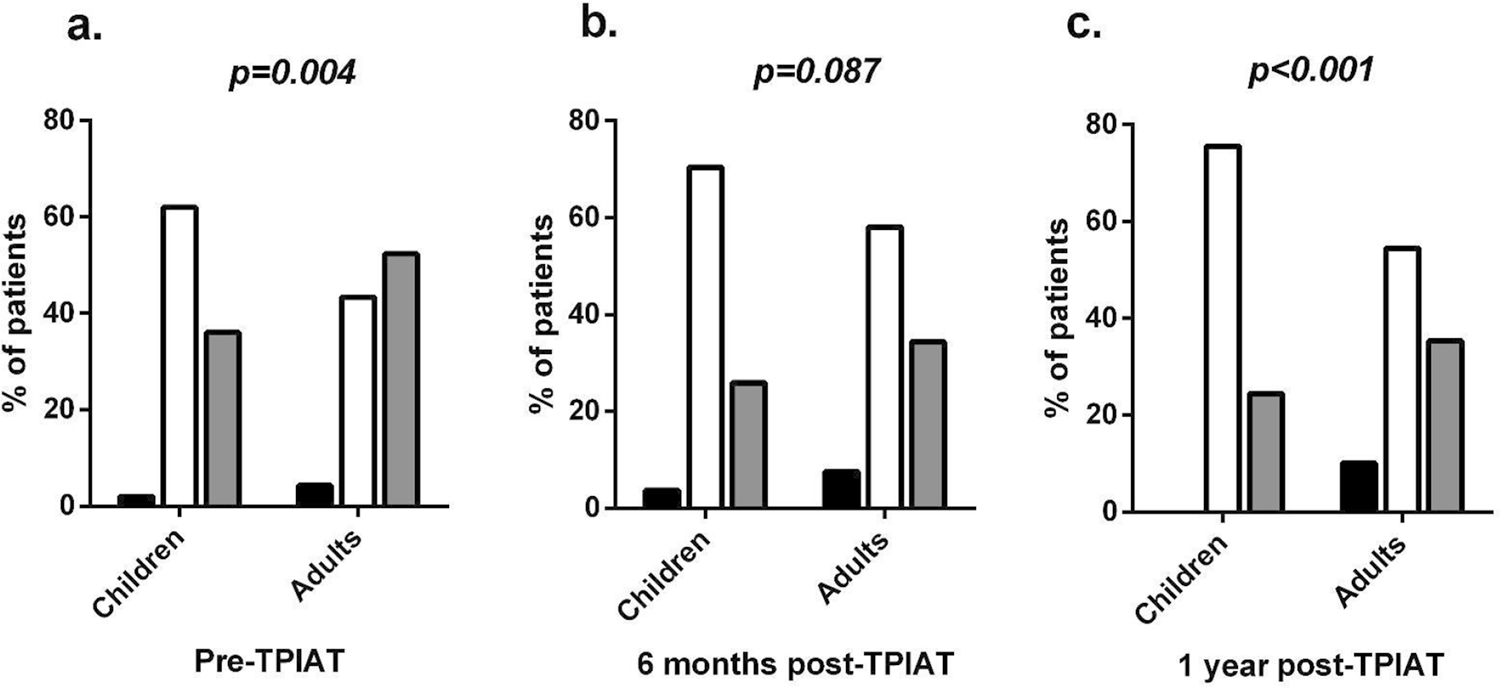
BMI in children and adults before and after TPIAT. P-values are for a test of the difference in weight distribution between children vs adults at each time. Adults were more often underweight or overweight at baseline and at 1 year after TPIAT vs children. Adults (≥ 18 years old), children (< 18 years old). Black columns: Underweight (adults BMI < 18.5 kg/m2, children BMI %ile < 5th). White columns: Normal weight (adults BMI ≥ 18.5 to < 25 kg/m2, children BMI %ile ≥ 5th to < 85th). Gray columns: Overweight (adults BMI ≥ 25 kg/m2, children BMI %ile ≥ 85th). BMI = body mass index. TPIAT = total pancreatectomy and islet autotransplantation
BMI status remained significantly different (p = 0.004) at 1-year follow-up (Fig. 1), with again more adults than children overweight (35% vs 24% respectively) or underweight (10% vs 2% respectively), and again fewer adults than children normal weight (54% vs 73% respectively).
Vitamin Deficiencies in Children and Adults
Prevalence of vitamin A deficiency did not differ significantly between children and adults at baseline, but prevalence was significantly higher in adults compared to children by 6 months and 1 year (p < 0.001) (Table 2). Prevalence of vitamin D deficiency was significantly higher among adults at baseline (p = 0.011) and 6-month follow-up (p = 0.043), but did not differ significantly between the two groups at 1-year follow-up due to the increased frequency of vitamin D deficiency in children. Vitamin E deficiency did not differ between groups.
Table 2.
Fat-soluble vitamin deficiencies in children vs adults at each time point
| adults | children | p-value | |||
|---|---|---|---|---|---|
|
| |||||
| Pre-TPIAT | |||||
| Low vitamin A | 19/201 | 10% | 6/101 | 6% | 0.4 |
| Low vitamin E | 14/204 | 7% | 6/99 | 6% | > 0.9 |
| Vitamin D insufficiency (< 30 ng/mL)* | 101/213 | 47% | 48/104 | 46% | > 0.9 |
| Vitamin D deficiency (< 20 ng/mL) | 34/213 | 16% | 6/104 | 6% | 0.011 |
| 6 months after TPIAT | |||||
| Low vitamin A | 47/152 | 31% | 9/98 | 9% | < 0.001 |
| Low vitamin E | 20/152 | 13% | 6/96 | 6% | 0.093 |
| Vitamin D insufficiency (< 30 ng/mL)* | 69/166 | 42% | 37/99 | 37% | 0.5 |
| Vitamin D deficiency (< 20 ng/mL) | 29/166 | 17% | 8/99 | 8% | 0.043 |
| 1 year after TPIAT | |||||
| Low vitamin A | 47/140 | 34% | 8/76 | 11% | < 0.001 |
| Low vitamin E | 19/139 | 14% | 5/77 | 7% | 0.12 |
| Vitamin D insufficiency (< 30 ng/mL)* | 65/144 | 45% | 42/79 | 53% | 0.3 |
| Vitamin D deficiency (< 20 ng/mL) | 27/144 | 19% | 15/79 | 19% | > 0.9 |
Bold values indicate p < 0.05
TPIAT total pancreatectomy and islet autotransplantation; adults (≥ 18 years old), children < 18 years old
includes insufficiency and deficiency together, thus all with vitamin D values below 30 ng/mL
Associations with FSV at 1 year after TPIAT
At the 1-year follow-up, those who were underweight were more likely to be vitamin A (p = 0.014) or vitamin E (p = 0.02) deficient (Table 3). TPIAT recipients on a pancreatic MVI had decreased rates of vitamin D deficiency compared to those on standard MVI, individual vitamins, or no supplementation (p = 0.002) (Table 3). Those on a pancreatic MVI also tended to have lower rates of vitamin A and E deficiency when compared to patients on no vitamins or a standard MVI, but tests for differences among all 4 groups were not statistically significant (Table 3).
Table 3.
Prevalence of fat-soluble vitamin deficiencies at 1 year after TPIAT by weight status and vitamin supplementation
| Underweight | Normal weight | Overweight | p-value for BMI | PancreaticMVI | Standard MVI | Individual vitamins only | No vitamins | p-value for MVI | |
|---|---|---|---|---|---|---|---|---|---|
|
| |||||||||
| Low vitamin A | 8/15 (53%) | 36/135 (27%) | 11/65 (17%) | 0.014 | 18/99 (18%) | 21/65 (32%) | 5/20 (25%) | 10/29 (34%) | 0.12 |
| Low vitamin E | 5/14 (36%) | 14/135 (10%) | 5/66 (8%) | 0.020 | 8/100 (8%) | 10/64 (16%) | 1/20 (5%) | 5/29 (17%) | 0.3 |
| Vitamin D insufficiency (< 30 ng/ mL)* | 8/15 (53%) | 64/139 (46%) | 35/68 (51%) | 0.7 | 43/101 (43%) | 33/67 (49%) | 9/21(43%) | 18/28 (64%) | 0.2 |
| Vitamin D deficiency (< 20 ng/ mL) | 4/15 (27%) | 27/135 (19%) | 11/68 (16%) | 0.6 | 12/101 (12%) | 11/67 (16%) | 6/21 (29%) | 12/28 (43%) | 0.002 |
Overweight (adults BMI ≥ 25 kg/m2, children BMI %ile ≥ 85th)
Normal weight (adults BMI ≥ 18.5 to < 25, children BMI %ile ≥ 5th to < 85th)
Underweight (adults BMI < 18.5 kg/m2, children BMI %ile < 5th)
Bold values indicate p < 0.05
MVI multivitamin
Includes insufficiency and deficiency together, thus all with vitamin D values below 30 ng/mL
Participants who had a pylorus-resecting surgery were more often vitamin A deficient (43%, vs 20% with pylorus-preserving surgery, p = 0.002) and underweight (13%, vs 4.5% in the pylorus-preserved group, p = 0.036). When limited to a sub-analysis of adults only, vitamin A deficiency remained significantly greater with pylorus resection (p = 0.025). Vitamin A deficiency occurred most frequently in those with Roux-en-Y gastrojejunostomy (49%) and least often with Roux-en-Y duodenojejunostomy (16%, p < 0.001) with similar findings when considering adults only (p = 0.009). There were no other statistically significant associations of surgical approach with FSV deficiency, although vitamin D deficiency tended to occur least often with Roux-en-Y duodenojejunostomy (p = 0.081).
Vitamin Supplementation
Similar usage rates of standard vs pancreatic MVI were observed at baseline before TPIAT in children and adults (Supplemental Table 1).
At 1-year follow-up, children were more likely to be using a pancreatic MVI (66% vs adults 34%; p < 0.001) while adults were more likely to be using a standard MVI (42% vs children 23%; p = 0.002). Adults were more likely to be on additional vitamin D (40% versus 24%, p= 0.013) than children.
PERT Usage
Adults trended towards higher PERT utilization before surgery for treatment of EPI or for treatment of pancreatitis, with 70% of adults vs 59% of children on PERT before TPIAT (p = 0.052). PERT dosage (as lipase units/kg/meal) was otherwise similar between the groups at baseline and follow-up, although doses were approximately 50% higher at follow-up. At 1 year after TPIAT, adults were on a median of 1525 (IQR 1074, 1984) lipase units/kg/meal while children were on a median of 1450 (IQR 1189, 1924) lipase units/kg/meal. High self-reported PERT utilization was seen in both adults (97%) and children (100%) at follow-up (Supplemental Table 1).
Changes in Nutritional Status after TPIAT, Compared to before TPIAT, in Children and Adults
For each outcome of interest, we compared the nutritional outcomes in children and adults separately post-TPIAT compared to before TPIAT. For these analyses, we included only those recipients with paired data for measures before TPIAT and after TPIAT.
Trend in BMI after TPIAT
BMI Trajectory in Children
Underweight was rare in children, affecting only 2% at baseline, 4% at the 6-month follow-up, and no children at 1 year (Table 4). The fraction with normal weight steadily improved from baseline (62%) to 6 months (70%) to 1 year (76%), while the fraction overweight steadily decreased from baseline (36%) to 6 months (26%) to 1 year (24%). Trends versus baseline were significant at 6 months (p = 0.015) but not at 1 year (p = 0.099).
Table 4.
Trajectory from pre-TPIAT to post-TPIAT analyzing paired pre-TPIAT and post-TPIAT (6 month or 1 year) results
| Pre-TPIAT | 6 months after TPIAT | p-valuea | 12 months after TPIAT | p-valueb | ||||
|---|---|---|---|---|---|---|---|---|
|
| ||||||||
| OVERALL COHORT | ||||||||
| BMI status | < 0.001 ** | < 0.001 | ||||||
| Underweight | 11/306 | 4% | 19/306 | 6% | 18/268 | 7% | ||
| Normal weight | 150/306 | 49% | 191/306 | 62% | 165/268 | 62% | ||
| Overweight | 145/306 | 47% | 96/306 | 31% | 85/268 | 32% | ||
| Fat-soluble vitamin status | ||||||||
| Low vitamin A | 20/232 | 9% | 52/232 | 22% | < 0.001 | 45/194 | 23% | < 0.001 |
| Low vitamin E | 11/230 | 5% | 23/230 | 10% | 0.038 | 22/193 | 11% | 0.066 |
| Vitamin D insufficiency (< 30 ng/mL)* | 118/251 | 47% | 96/251 | 38% | 0.020 | 100/209 | 48% | 0.6 |
| Vitamin D deficiency (< 20 ng/mL) | 29/251 | 12% | 33/251 | 13% | 0.6 | 39/209 | 19% | 0.035 |
| CHILDREN (< 18 YEARS) | ||||||||
| BMI status | 0.015 ** | 0.099** | ||||||
| Underweight | 2/108 | 2% | 4/108 | 4% | 0/90 | 0% | ||
| Normal weight | 67/108 | 62% | 76/108 | 70% | 68/90 | 76% | ||
| Overweight | 39/108 | 36% | 28/108 | 26% | 22/90 | 24% | ||
| Fat-soluble vitamin status | ||||||||
| Low vitamin A | 6/91 | 7% | 9/91 | 10% | 0.6 | 7/70 | 10% | > 0.9 |
| Low vitamin E | 4/87 | 5% | 5/87 | 6% | > 0.9 | 5/69 | 7% | 0.7 |
| Vitamin D insufficiency (< 30 ng/mL)* | 44/94 | 47% | 34/94 | 36% | 0.11 | 40/75 | 53% | 0.3 |
| Vitamin D deficiency (< 20 ng/mL) | 6/94 | 6% | 7/94 | 7% | > 0.9 | 15/75 | 20% | 0.016 |
| ADULTS (> / = 18 YEARS) | ||||||||
| BMI status | < 0.001 | < 0.001 | ||||||
| Underweight | 9/198 | 5% | 15/198 | 8% | 18/178 | 10% | ||
| Normal weight | 83/198 | 42% | 115/198 | 58% | 97/178 | 54% | ||
| Overweight | 106/198 | 54% | 68/198 | 34% | 63/178 | 35% | ||
| Fat-soluble vitamin status | ||||||||
| Low vitamin A | 14/141 | 10% | 43/141 | 30% | < 0.001 | 38/124 | 31% | < 0.001 |
| Low vitamin E | 7/143 | 5% | 18/143 | 13% | 0.029 | 17/124 | 14% | 0.1 |
| Vitamin D insufficiency (< 30 ng/mL)* | 74/157 | 47% | 62/157 | 39% | 0.12 | 60/134 | 45% | > 0.9 |
| Vitamin D deficiency (< 20 ng/mL) | 23/157 | 15% | 26/157 | 17% | 0.7 | 24/134 | 18% | 0.5 |
Adults (≥ 18 years old), children < 18 years old
Overweight (adults BMI ≥ 25 kg/m2, children BMI %ile ≥ 85th)
Normal weight (adults BMI ≥ 18.5 to < 25 kg/m2, children BMI %ile ≥ 5th to < 85th)
Underweight (adults BMI < 18.5 kg/m2, children BMI %ile < 5th)
Bold values indicate p < 0.05
TPIAT total pancreatectomy and islet autotransplantation
BMI body mass index
Includes insufficiency and deficiency together, thus all with vitamin D values below 30 ng/mL
: p-value comparing pre-TPIAT to 6 months
: p-value comparing pre-TPIAT to 1 year
p-value is for normal or underweight versus overweight
BMI Trajectory in Adults
The prevalence of underweight status increased after TPIAT in adults. At 1 year, twice as many were underweight compared to baseline (10% vs 5%, Table 4). Over half of adults were overweight at baseline (54%), with fewer adults overweight at 6 months (34%), with a stable rate at 1 year (35%). As a result, the prevalence of normal weight status in adults increased after TPIAT (from 42 to 54%). Trends at 6 months and 1 year versus baseline were significant (both p < 0.001). For both children and adults, change in weight category from pre-TPIAT is displayed in Supplemental Table 2.
Trend in FSV Deficiencies
FSV Levels in Children
Prevalence of vitamin A and E deficiencies did not change significantly from baseline in children (Table 4). Changes in the prevalence of vitamin D insufficiency were not statistically significant from baseline to 6-month and to 1-year follow-up but vitamin D insufficiency was generally common (36–53% at each time point). Prevalence of vitamin D deficiency significantly increased from baseline to 1-year follow-up (6% at baseline vs 20% at 1 year, p = 0.016).
FSV Levels in Adults
Prevalence of vitamin A deficiency was 3 times more common at 6 months (30%) and 1 year (31%) compared to pre-TPIAT baseline (10%) (p < 0.001) (Table 4). Prevalence of vitamin E deficiency also increased from baseline to 6 months (5% vs 13%, p = 0.029), but did not change significantly from baseline to 1 year. Prevalence of vitamin D insufficiency and vitamin D deficiency were high and did not differ post-TPIAT compared to baseline (39–47% prevalence for insufficiency, 15–18% prevalence for deficiency). For both children and adults, change in fat-soluble vitamin status from pre-TPIAT is displayed in Supplemental Table 3.
Discussion
This analysis from POST is the first multicenter study to evaluate nutritional status in children and adults undergoing TPIAT, including their outcomes after surgical intervention. Adults were more likely to be overweight or underweight, both before and after TPIAT, and had a higher rate of vitamin A deficiency after surgery compared to children. Fat-soluble vitamin deficiencies were overall common and increased after TPIAT, despite adequate enzyme replacement, likely due to the complete pancreatic exocrine insufficiency and alterations in gastrointestinal anatomy based on surgical technique. Taking a pancreatic-specific multivitamin reduced the risk for FSV deficiencies, particularly vitamin D deficiency. Overall, these findings support the importance of close nutritional monitoring after TPIAT, including regular biochemical assessments of FSV, appropriate pancreatic enzyme supplementation, and the need for adequate administration of fat-soluble multivitamins designed for use in pancreatic insufficiency. Our general recommendations for monitoring and supplementation are included (Table 5) and guided by previous recommendations and research for people with cystic fibrosis.16–18
Table 5.
TPIAT nutritional monitoring and vitamin recommendations
| Component | Timeframe |
| Anthropometrics: weight, height, BMI at minimum | Baseline; 3, 6, 12 months and then annually post-op; sooner if concerns |
| Fat soluble vitamins: dosing, adherence, serum levels | Baseline; 3, 6, 12 months and then annually post-op; plus every 2–3 months as deficiencies are identified and treated |
| Pancreatic enzymes: regimen, dosing, adherence | 3, 6, 12 months and then annually post-op; sooner if concerns |
| Individual vitamins | Daily dosing recommendations |
| A* | 1–3 years: 1500 mcg; 4–8 years: 1500 – 3000 mcg; > 8 years: 3000 mcg |
| E* | 1–3 years: 80 – 150 mg; 4–8 years: 100 – 200 mg; > 8 years: 200 – 400 mg |
| D** | 1–10 years: 20 – 25 mcg (800 – 1000 units); > 10 years: 20 – 50 mcg (800 – 2000 units) |
| K* | 1–3 years: 0.3 – 0.5 mg; 4–8 years: 0.3 – 0.5 mg; > 8 years: 0.3 – 0.5 mg |
BMI body mass index
mcg micrograms
mg milligrams
See Borowitz D, Baker RD, Stallings V. J Pediatr Gastroenterol Nutr 2002; 35: 246 Yankaskas JR, Marshall BC, Sufian B, et al. Chest 2004; 125 (1 Suppl):1S
See Tangpricha V, Kelly A, Stephenson K, et al. J Clin Endocrinol Metab 2012; 97:1082
The prevalence of fat-soluble vitamin deficiencies increased after TPIAT. At 1 year after TPIAT, nearly half of all patients were insufficient or deficient in vitamin D, with about 1 in 5 having a deficiency (vitamin D < 20 mcg/dL). Vitamin A deficiency was present in 34% of adults and 11% of children, and vitamin E deficiency in 14% of adults and 7% of children. Rates of vitamin A deficiency in adults tripled while rates of vitamin D deficiency in children more than tripled. The increasing risk for fat-soluble vitamin deficiency after TPIAT is likely attributable to the complete exocrine pancreatic insufficiency induced by the pancreatectomy, with possible other contributing factors including altered gastrointestinal anatomy. Children were less likely to have low vitamin A and trended towards having low vitamin E less often. This might be attributable to different surgical approaches in children,15 with pylorus resection and gastrojejunostomy performed more often in adults, vs pylorus-sparing duodenojejunostomy in most children. Pyloric resection and more rapid intestinal transit due to dumping syndrome may decrease absorption.19 It could also be due to closer nutritional monitoring and more aggressive supplementation with pancreatic-specific multivitamin preparations by pediatric practitioners.
Pancreatic-specific multivitamin preparations, which contain water-soluble formulations of the fat-soluble vitamins, are specifically designed for improved absorption of these micronutrients in patients with EPI. Several companies currently have preparations available; dosing will depend on brand, formulation, and patient age. Only one-third of adults and two-thirds of children were on pancreatic-specific multivitamins at follow-up, with the remainder on standard multivitamins or no vitamin supplementation at all. Those taking pancreatic-specific multivitamin preparations were least likely to have vitamin D deficiency, and also trended toward lower rates of vitamin A and E deficiency, particularly compared to standard MVI users. It is unclear why more patients were not treated with pancreatic-specific MVI preparations, but this could be related to high cost, varying insurance coverage, and/or lack of provider awareness regarding the advantages of pancreatic-specific MVIs for those with EPI.
Fat-soluble vitamin deficiencies were common despite the median PERT dosing (as lipase units/kg/meal) in the middle range of recommended, and nearly universal self-reported PERT usage or adherence. PERT will never be a perfect replacement for the natural enzymatic output of the pancreas that can respond more precisely to the macronutrient content of food entering the duodenum; therefore, some degree of malabsorption will always occur with PERT, increasing the risk for fat-soluble vitamin deficiencies. At baseline, even though over one-third of the overall cohort had severe EPI, < 10% of children and adults were on a pancreatic multivitamin; correction of deficiencies prior to TPIAT should be pursued as this will be more difficult post-operatively in the setting of now complete EPI.
In assessing nutritional status, at baseline almost half the cohort was overweight/obese, similar to other studies in CP.20 BMI was used as a proxy of nutritional status, with recognition that this is an imperfect assessment, as are other biochemical markers. Triceps skin fold measurements and mid upper arm circumference were not routinely captured or monitored. Improvement in BMI (particularly in adults) was seen over time with fewer overweight and more normal weight individuals. While a small increase in the number of underweight individuals was seen, most patients are not grossly underweight before or after TPIAT. However, 10% of adults were underweight 1 year after TPIAT, and these individuals were much more likely to have low vitamin A and vitamin E.
This study has some limitations, including its ongoing prospective and observational nature, with these results reflective of interim analyses. Not all participants had completed follow-up, nor had full complement of vitamin levels, at each follow-up time point. However, given the large amount of data already available with about two-thirds of the cohort completing follow-up, we anticipate that these results will be reasonably reflective of the entire study population. While all available data were used for comparing adults and children, analyses of change from baseline to after TPIAT was restricted to those with paired pre and post assessments. POST is capturing data from TPIAT recipients at 13 major tertiary referral centers, with inherent differences in practice and potential center biases. Further analyses regarding interactions between sex and outcomes were not conducted, and could be considered for future studies. BMI as above was used as a proxy of nutritional status, which does not always correlate with lean body mass; other measures to study lean body mass should be included in future research. Children and adults were compared in some analyses without adjusting for variations in surgical technique, BMI, underlying etiology of pancreatitis, among others. PERT and vitamin supplementation data were also reliant on participant self-reported information, and may overestimate usage or adherence. This study does not capture the season of measurement for vitamin D assays, nor does it contrast vitamin E measurements against lipid profiles. Centralized analysis of fat-soluble vitamin levels was beyond the scope of the current study, and thus the current analyses relied upon categorical characterization of FSV as normal or low. Future research could assess clinical manifestations of deficiencies that we were unable to include in this short-term study.
Conclusions
The now complete EPI and altered intestinal anatomy after TPIAT increases the risk for poor nutritional status and fat-soluble vitamin deficiencies. This was seen in our large multicenter cohort even with adequate and near-universal usage of pancreatic enzyme replacement therapy. Risk was further exacerbated by surgical techniques including pylorus resection and/or Roux-en-Y gastrojejunostomy, decreased utilization of pancreatic-specific multivitamin preparations after TPIAT, and for those that were underweight at follow-up.
Adults were more likely to be overweight or underweight, both before and after TPIAT, and had a higher rate of vitamin A deficiency after surgery compared to children.
We would strongly advocate that all TPIAT recipients be monitored regularly for fat-soluble vitamin deficiencies after TPIAT and be administered a multivitamin with FSV formulations designed for use in pancreatic insufficiency to minimize risk of developing deficiencies.
Supplementary Material
Grant Support / Source of Funding
Prospective Observational Study of TPIAT (POST) consortium, supported by the National Institutes of Diabetes and Digestive and Kidney Diseases (NIDDK, R01-DK109124, PI Melena Bellin).
Abbreviations
- ARP
Acute recurrent pancreatitis
- BMI
Body mass index
- CP
Chronic pancreatitis
- EPI
Exocrine pancreatic insufficiency
- FSV
Fat-soluble vitamin(s)
- MVI
Multivitamin
- PERT
Pancreatic enzyme replacement therapy
- POST
Prospective Observational Study of TPIAT
- TPIAT
Total pancreatectomy with islet autotransplantation
Footnotes
Competing Interest MDB discloses the following: research support from Viacyte and Dexcom; advisory role (DSMB) for Insulet. LFL discloses the following: research support from Abbvie, consultant for Abbvie, speaker for Abbvie and Nestle. SJS discloses funding from Gilead and UpToDate. VKS is a consultant for Abbvie and Nestle, and he receives research support from Orgenesis and Theraly.
All other authors: none declared.
Supplementary Information The online version contains supplementary material available at https://doi.org/10.1007/s11605-023-05770-1.
Data Transparency Statement
Data and study materials will not be made available to other researchers.
References
- 1.McEachron KR, Downs EM, Schwarzenberg SJ, Chinnakotla S, and Bellin MD, “Fat-soluble Vitamin Deficiency is Common in Children With Chronic Pancreatitis Undergoing Total Pancreatectomy With Islet Autotransplantation,” J. Pediatr. Gastroenterol. Nutr, vol. 72, no. 1, pp. 123–126, 2021, 10.1097/MPG.0000000000002950. [DOI] [PMC free article] [PubMed] [Google Scholar]
- 2.Duggan SN, Smyth ND, O’Sullivan M, Feehan S, Ridgway PF, and Conlon KC, “The prevalence of malnutrition and fat-soluble vitamin deficiencies in chronic pancreatitis,” Nutr. Clin. Pract. Off. Publ. Am. Soc. Parenter. Enter. Nutr, vol. 29, no. 3, pp. 348–354, 2014, 10.1177/0884533614528361. [DOI] [PubMed] [Google Scholar]
- 3.Forrest KYZ and Stuhldreher WL, “Prevalence and correlates of vitamin D deficiency in US adults,” Nutr. Res. N. Y. N, vol. 31, no. 1, pp. 48–54, 2011, 10.1016/j.nutres.2010.12.001. [DOI] [PubMed] [Google Scholar]
- 4.Dutta SK, Bustin MP, Russell RM, and Costa BS, “Deficiency of fat-soluble vitamins in treated patients with pancreatic insufficiency,” Ann. Intern. Med, vol. 97, no. 4, pp. 549–552, 1982, 10.7326/0003-4819-97-4-549. [DOI] [PubMed] [Google Scholar]
- 5.Sikkens ECM et al. , “The prevalence of fat-soluble vitamin deficiencies and a decreased bone mass in patients with chronic pancreatitis,” Pancreatol. Off. J. Int. Assoc. Pancreatol. IAP Al, vol. 13, no. 3, pp. 238–242, 2013, 10.1016/j.pan.2013.02.008. [DOI] [PubMed] [Google Scholar]
- 6.Bellin MD et al. , “Total Pancreatectomy With Islet Autotransplantation Resolves Pain in Young Children With Severe Chronic Pancreatitis,” J. Pediatr. Gastroenterol. Nutr, vol. 64, no. 3, pp. 440–445, 2017, doi: 10.1097/MPG.0000000000001314. [DOI] [PMC free article] [PubMed] [Google Scholar]
- 7.Bellin MD et al. , “Quality of Life Improves for Pediatric Patients After Total Pancreatectomy and Islet Autotransplant for Chronic Pancreatitis,” Clin. Gastroenterol. Hepatol, vol. 9, no. 9, pp. 793–799, 2011, 10.1016/j.cgh.2011.04.024. [DOI] [PMC free article] [PubMed] [Google Scholar]
- 8.Morgan K, Owczarski SM, Borckardt J, Madan A, Nishimura M, and Adams DB, “Pain Control and Quality of Life After Pancreatectomy with Islet Autotransplantation for Chronic Pancreatitis,” J. Gastrointest. Surg, vol. 16, no. 1, pp. 129–134, 2012, 10.1007/s11605-011-1744-y. [DOI] [PubMed] [Google Scholar]
- 9.Chinnakotla S et al. , “Total Pancreatectomy and Islet Auto-Transplantation in Children for Chronic Pancreatitis. Indication, Surgical Techniques, Post Operative Management and Long-Term Outcomes,” Ann. Surg, vol. 260, no. 1, pp. 56–64, 2014, 10.1097/SLA.0000000000000569. [DOI] [PMC free article] [PubMed] [Google Scholar]
- 10.Zarshenas N, Tapsell LC, Batterham M, Neale EP, and Talbot ML, “Investigating the prevalence of nutritional abnormalities in patients prior to and following bariatric surgery,” Nutr. Diet. J. Dietit. Assoc. Aust, 2022, 10.1111/1747-0080.12747. [DOI] [PMC free article] [PubMed] [Google Scholar]
- 11.Araújo MM et al. , “Frequency of Vitamin D Deficiency and Associated Factors in Long-term Bariatric Surgery Patients: a Cross-sectional Study,” Obes. Surg, vol. 32, no. 7, pp. 2386–2396, 2022, 10.1007/s11695-022-06090-0. [DOI] [PubMed] [Google Scholar]
- 12.Bellin MD et al. , “A multicenter study of total pancreatectomy with islet autotransplantation (TPIAT): POST (Prospective Observational Study of TPIAT),” Pancreatol. Off. J. Int. Assoc. Pancreatol. IAP Al, vol. 18, no. 3, pp. 286–290, 2018, 10.1016/j.pan.2018.02.001. [DOI] [PMC free article] [PubMed] [Google Scholar]
- 13.Holick MF et al. , “Evaluation, treatment, and prevention of vitamin D deficiency: an Endocrine Society clinical practice guideline,” J. Clin. Endocrinol. Metab, vol. 96, no. 7, pp. 1911–1930, 2011, 10.1210/jc.2011-0385. [DOI] [PubMed] [Google Scholar]
- 14.Balamurugan AN, Elder DA, Abu-El-Haija M, and Nathan JD, “Islet cell transplantation in children,” Semin. Pediatr. Surg, vol. 29, no. 3, p. 150925, 2020, 10.1016/j.sempedsurg.2020.150925. [DOI] [PubMed] [Google Scholar]
- 15.Nathan JD et al. , “Surgical approach and short-term outcomes in adults and children undergoing total pancreatectomy with islet autotransplantation: A report from the Prospective Observational Study of TPIAT,” Pancreatol. Off. J. Int. Assoc. Pancreatol. IAP Al, vol. 22, no. 1, pp. 1–8, 2022, 10.1016/j.pan.2021.09.011. [DOI] [PMC free article] [PubMed] [Google Scholar]
- 16.Borowitz D, Baker RD, and Stallings V, “Consensus report on nutrition for pediatric patients with cystic fibrosis,” J. Pediatr. Gastroenterol. Nutr, vol. 35, no. 3, pp. 246–259, 2002, 10.1097/00005176-200209000-00004. [DOI] [PubMed] [Google Scholar]
- 17.Yankaskas JR, Marshall BC, Sufian B, Simon RH, and Rodman D, “Cystic fibrosis adult care: consensus conference report,” Chest, vol. 125, no. 1 Suppl, pp. 1S–39S, 2004, doi: 10.1378/chest.125.1_suppl.1s. [DOI] [PubMed] [Google Scholar]
- 18.Tangpricha V et al. , “An update on the screening, diagnosis, management, and treatment of vitamin D deficiency in individuals with cystic fibrosis: evidence-based recommendations from the Cystic Fibrosis Foundation,” J. Clin. Endocrinol. Metab, vol. 97, no. 4, pp. 1082–1093, 2012, 10.1210/jc.2011-3050. [DOI] [PubMed] [Google Scholar]
- 19.Radigan AE, “Post-gastrectomy: managing the nutrition fallout,” Practical Gastroenterology, vol. 28, no. 6, pp. 63–75, 2004. [Google Scholar]
- 20.Harindhanavudhi T et al. , “Body Composition is Associated With Islet Function After Pancreatectomy and Islet Autotransplantation for Pancreatitis,” J. Clin. Endocrinol. Metab, no. dgaa790, 2020, 10.1210/clinem/dgaa790. [DOI] [PMC free article] [PubMed] [Google Scholar]
Associated Data
This section collects any data citations, data availability statements, or supplementary materials included in this article.
Supplementary Materials
Data Availability Statement
Data and study materials will not be made available to other researchers.