



Abstract
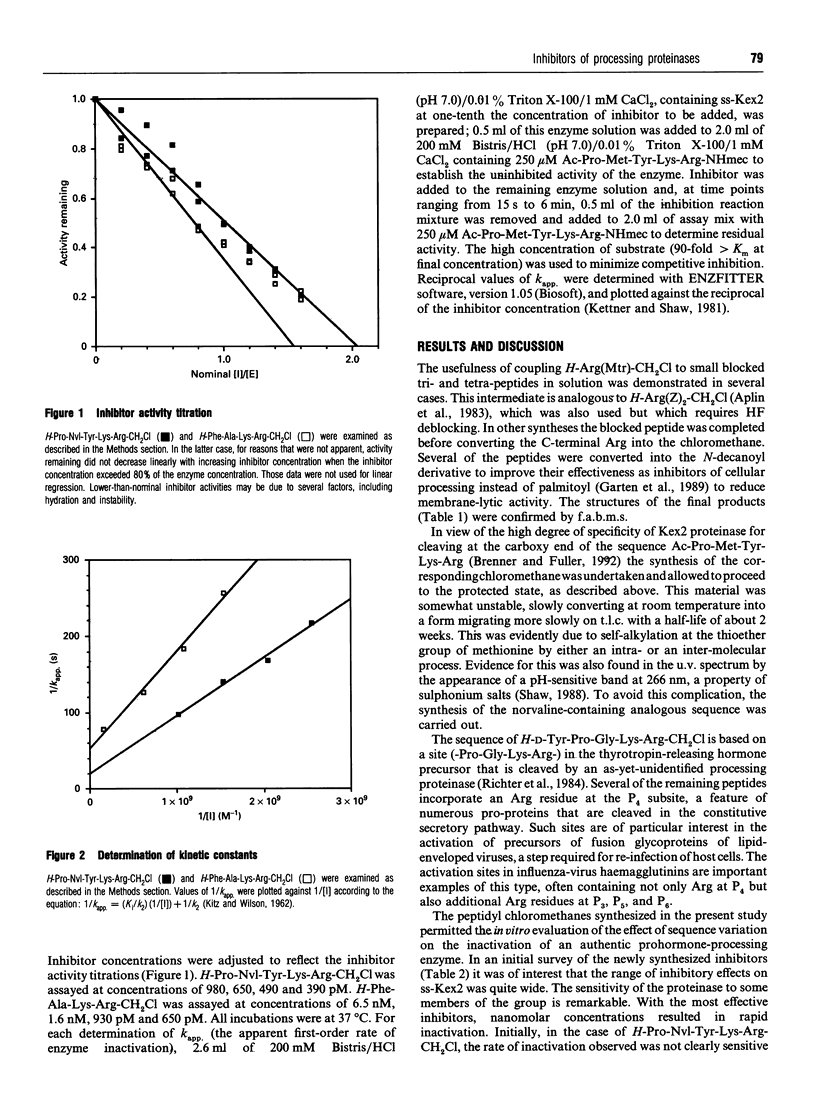
Peptidyl chloromethane and sulphonium salts containing multiple Arg and Lys residues were synthesized as potential inhibitors of prohormone and pro-protein processing proteinases. The potencies of these compounds were assayed by measuring the kinetics of inactivation of the yeast Kex2 proteinase, the prototype of a growing family of eukaryotic precursor processing proteinases. The most potent inhibitor, Pro-Nvl-Tyr-Lys-Arg-chloromethane, was based on cleavage sites in the natural Kex2 substrate pro-alpha-factor. This inhibitor exhibited a Ki of 3.7 nM and a second-order inactivation rate constant (k2/Ki) of 1.3 x 10(7) M-1.s-1 comparable with the value of kcat./Km obtained with Kex2 for the corresponding peptidyl methylcoumarinylamide substrate. The enzyme exhibited sensitivity to the other peptidyl chloromethanes over a range of concentrations, depending on peptide sequence and alpha-amino decanoylation, but was completely resistant to peptidyl sulphonium salts. Kinetics of inactivation by these new inhibitors of a set of 'control' proteinases, including members of both the trypsin and subtilisin families, underscored the apparent specificity of the compounds most active against Kex2 proteinase.
Full text
PDF



Selected References
These references are in PubMed. This may not be the complete list of references from this article.
- Aplin R. T., Christiansen J., Young G. T. Amino-acids and peptides. Part 48. Synthesis of bradykinyl-chloromethane. Int J Pept Protein Res. 1983 May;21(5):555–561. [PubMed] [Google Scholar]
- Barr P. J. Mammalian subtilisins: the long-sought dibasic processing endoproteases. Cell. 1991 Jul 12;66(1):1–3. doi: 10.1016/0092-8674(91)90129-m. [DOI] [PubMed] [Google Scholar]
- Benjannet S., Rondeau N., Day R., Chrétien M., Seidah N. G. PC1 and PC2 are proprotein convertases capable of cleaving proopiomelanocortin at distinct pairs of basic residues. Proc Natl Acad Sci U S A. 1991 May 1;88(9):3564–3568. doi: 10.1073/pnas.88.9.3564. [DOI] [PMC free article] [PubMed] [Google Scholar]
- Bennett D. L., Bailyes E. M., Nielsen E., Guest P. C., Rutherford N. G., Arden S. D., Hutton J. C. Identification of the type 2 proinsulin processing endopeptidase as PC2, a member of the eukaryote subtilisin family. J Biol Chem. 1992 Jul 25;267(21):15229–15236. [PubMed] [Google Scholar]
- Betzel C., Pal G. P., Struck M., Jany K. D., Saenger W. Active-site geometry of proteinase K. Crystallographic study of its complex with a dipeptide chloromethyl ketone inhibitor. FEBS Lett. 1986 Mar 3;197(1-2):105–110. doi: 10.1016/0014-5793(86)80307-6. [DOI] [PubMed] [Google Scholar]
- Brenner C., Fuller R. S. Structural and enzymatic characterization of a purified prohormone-processing enzyme: secreted, soluble Kex2 protease. Proc Natl Acad Sci U S A. 1992 Feb 1;89(3):922–926. doi: 10.1073/pnas.89.3.922. [DOI] [PMC free article] [PubMed] [Google Scholar]
- Ebeling W., Hennrich N., Klockow M., Metz H., Orth H. D., Lang H. Proteinase K from Tritirachium album Limber. Eur J Biochem. 1974 Aug 15;47(1):91–97. doi: 10.1111/j.1432-1033.1974.tb03671.x. [DOI] [PubMed] [Google Scholar]
- Ermer A., Baumann H., Steude G., Peters K., Fittkau S., Dolaschka P., Genov N. C. Peptide diazomethyl ketones are inhibitors of subtilisin-type serine proteases. J Enzyme Inhib. 1990;4(1):35–42. doi: 10.3109/14756369009030386. [DOI] [PubMed] [Google Scholar]
- Fittkau S., Smalla K., Pauli D. Thermitase--eine thermostabile Serinprotease IV. Kinetische Untersuchungen der Bindung von N-Azylpeptidketonen als substratanaloge Inhibitoren. Biomed Biochim Acta. 1984;43(7):887–899. [PubMed] [Google Scholar]
- Fuller R. S., Brake A. J., Thorner J. Intracellular targeting and structural conservation of a prohormone-processing endoprotease. Science. 1989 Oct 27;246(4929):482–486. doi: 10.1126/science.2683070. [DOI] [PubMed] [Google Scholar]
- Fuller R. S., Brake A., Thorner J. Yeast prohormone processing enzyme (KEX2 gene product) is a Ca2+-dependent serine protease. Proc Natl Acad Sci U S A. 1989 Mar;86(5):1434–1438. doi: 10.1073/pnas.86.5.1434. [DOI] [PMC free article] [PubMed] [Google Scholar]
- Fuller R. S., Sterne R. E., Thorner J. Enzymes required for yeast prohormone processing. Annu Rev Physiol. 1988;50:345–362. doi: 10.1146/annurev.ph.50.030188.002021. [DOI] [PubMed] [Google Scholar]
- Garten W., Stieneke A., Shaw E., Wikstrom P., Klenk H. D. Inhibition of proteolytic activation of influenza virus hemagglutinin by specific peptidyl chloroalkyl ketones. Virology. 1989 Sep;172(1):25–31. doi: 10.1016/0042-6822(89)90103-7. [DOI] [PMC free article] [PubMed] [Google Scholar]
- Hallenberger S., Bosch V., Angliker H., Shaw E., Klenk H. D., Garten W. Inhibition of furin-mediated cleavage activation of HIV-1 glycoprotein gp160. Nature. 1992 Nov 26;360(6402):358–361. doi: 10.1038/360358a0. [DOI] [PubMed] [Google Scholar]
- Hosaka M., Nagahama M., Kim W. S., Watanabe T., Hatsuzawa K., Ikemizu J., Murakami K., Nakayama K. Arg-X-Lys/Arg-Arg motif as a signal for precursor cleavage catalyzed by furin within the constitutive secretory pathway. J Biol Chem. 1991 Jul 5;266(19):12127–12130. [PubMed] [Google Scholar]
- Hutton J. C. Subtilisin-like proteinases involved in the activation of proproteins of the eukaryotic secretory pathway. Curr Opin Cell Biol. 1990 Dec;2(6):1131–1142. doi: 10.1016/0955-0674(90)90167-d. [DOI] [PubMed] [Google Scholar]
- Julius D., Brake A., Blair L., Kunisawa R., Thorner J. Isolation of the putative structural gene for the lysine-arginine-cleaving endopeptidase required for processing of yeast prepro-alpha-factor. Cell. 1984 Jul;37(3):1075–1089. doi: 10.1016/0092-8674(84)90442-2. [DOI] [PubMed] [Google Scholar]
- KITZ R., WILSON I. B. Esters of methanesulfonic acid as irreversible inhibitors of acetylcholinesterase. J Biol Chem. 1962 Oct;237:3245–3249. [PubMed] [Google Scholar]
- Kettner C., Shaw E. D-Phe-Pro-ArgCH2C1-A selective affinity label for thrombin. Thromb Res. 1979;14(6):969–973. doi: 10.1016/0049-3848(79)90014-8. [DOI] [PubMed] [Google Scholar]
- Klenk H. D., Rott R. The molecular biology of influenza virus pathogenicity. Adv Virus Res. 1988;34:247–281. doi: 10.1016/S0065-3527(08)60520-5. [DOI] [PMC free article] [PubMed] [Google Scholar]
- Lottenberg R., Christensen U., Jackson C. M., Coleman P. L. Assay of coagulation proteases using peptide chromogenic and fluorogenic substrates. Methods Enzymol. 1981;80(Pt 100):341–361. doi: 10.1016/s0076-6879(81)80030-4. [DOI] [PubMed] [Google Scholar]
- Mizuno K., Nakamura T., Ohshima T., Tanaka S., Matsuo H. Characterization of KEX2-encoded endopeptidase from yeast Saccharomyces cerevisiae. Biochem Biophys Res Commun. 1989 Feb 28;159(1):305–311. doi: 10.1016/0006-291x(89)92438-8. [DOI] [PubMed] [Google Scholar]
- Mizuno K., Nakamura T., Ohshima T., Tanaka S., Matsuo H. Yeast KEX2 genes encodes an endopeptidase homologous to subtilisin-like serine proteases. Biochem Biophys Res Commun. 1988 Oct 14;156(1):246–254. doi: 10.1016/s0006-291x(88)80832-5. [DOI] [PubMed] [Google Scholar]
- Morihara K., Tsuzuki H., Oka T. Comparison of various types of subtilisins: size and properties of the active site. Biochem Biophys Res Commun. 1971 Mar 19;42(6):1000–1006. doi: 10.1016/0006-291x(71)90002-7. [DOI] [PubMed] [Google Scholar]
- Rauber P., Wikstrom P., Shaw E. Iodination of peptidyl chloromethyl ketones for protease affinity labels. Anal Biochem. 1988 Feb 1;168(2):259–264. doi: 10.1016/0003-2697(88)90316-8. [DOI] [PubMed] [Google Scholar]
- Rhodes C. J., Zumbrunn A., Bailyes E. M., Shaw E., Hutton J. C. The inhibition of proinsulin-processing endopeptidase activities by active-site-directed peptides. Biochem J. 1989 Feb 15;258(1):305–308. doi: 10.1042/bj2580305. [DOI] [PMC free article] [PubMed] [Google Scholar]
- Richter K., Kawashima E., Egger R., Kreil G. Biosynthesis of thyrotropin releasing hormone in the skin of Xenopus laevis: partial sequence of the precursor deduced from cloned cDNA. EMBO J. 1984 Mar;3(3):617–621. doi: 10.1002/j.1460-2075.1984.tb01857.x. [DOI] [PMC free article] [PubMed] [Google Scholar]
- Schalken J. A., Roebroek A. J., Oomen P. P., Wagenaar S. S., Debruyne F. M., Bloemers H. P., Van de Ven W. J. fur gene expression as a discriminating marker for small cell and nonsmall cell lung carcinomas. J Clin Invest. 1987 Dec;80(6):1545–1549. doi: 10.1172/JCI113240. [DOI] [PMC free article] [PubMed] [Google Scholar]
- Shaw E., Green G. D. Inactivation of thiol proteases with peptidyl diazomethyl ketones. Methods Enzymol. 1981;80(Pt 100):820–826. doi: 10.1016/s0076-6879(81)80064-x. [DOI] [PubMed] [Google Scholar]
- Shaw E. Peptidyl sulfonium salts. A new class of protease inhibitors. J Biol Chem. 1988 Feb 25;263(6):2768–2772. [PubMed] [Google Scholar]
- Steiner D. F., Clark J. L., Nolan C., Rubenstein A. H., Margoliash E., Aten B., Oyer P. E. Proinsulin and the biosynthesis of insulin. Recent Prog Horm Res. 1969;25:207–282. doi: 10.1016/b978-0-12-571125-8.50008-9. [DOI] [PubMed] [Google Scholar]
- Stieneke-Gröber A., Vey M., Angliker H., Shaw E., Thomas G., Roberts C., Klenk H. D., Garten W. Influenza virus hemagglutinin with multibasic cleavage site is activated by furin, a subtilisin-like endoprotease. EMBO J. 1992 Jul;11(7):2407–2414. doi: 10.1002/j.1460-2075.1992.tb05305.x. [DOI] [PMC free article] [PubMed] [Google Scholar]
- Stone S. R., Dennis S., Hofsteenge J. Quantitative evaluation of the contribution of ionic interactions to the formation of the thrombin-hirudin complex. Biochemistry. 1989 Aug 22;28(17):6857–6863. doi: 10.1021/bi00443a012. [DOI] [PubMed] [Google Scholar]
- Thomas L., Leduc R., Thorne B. A., Smeekens S. P., Steiner D. F., Thomas G. Kex2-like endoproteases PC2 and PC3 accurately cleave a model prohormone in mammalian cells: evidence for a common core of neuroendocrine processing enzymes. Proc Natl Acad Sci U S A. 1991 Jun 15;88(12):5297–5301. doi: 10.1073/pnas.88.12.5297. [DOI] [PMC free article] [PubMed] [Google Scholar]
- Wright C. S., Alden R. A., Kraut J. Structure of subtilisin BPN' at 2.5 angström resolution. Nature. 1969 Jan 18;221(5177):235–242. doi: 10.1038/221235a0. [DOI] [PubMed] [Google Scholar]
- Zumbrunn A., Stone S., Shaw E. The synthesis and properties of peptidylmethylsulphonium salts with two cationic residues as potential inhibitors of prohormone processing. Biochem J. 1988 Dec 15;256(3):989–994. doi: 10.1042/bj2560989. [DOI] [PMC free article] [PubMed] [Google Scholar]
- van den Ouweland A. M., van Duijnhoven H. L., Keizer G. D., Dorssers L. C., Van de Ven W. J. Structural homology between the human fur gene product and the subtilisin-like protease encoded by yeast KEX2. Nucleic Acids Res. 1990 Feb 11;18(3):664–664. doi: 10.1093/nar/18.3.664. [DOI] [PMC free article] [PubMed] [Google Scholar]