



Abstract
The potential of comprehending and managing microscale flows to enhance energy processes, especially in heat transfer and propulsion applications, remains largely untapped particularly for supercritical fluids, which have gained increased interest over the past years due to the higher power and thermodynamic efficiencies they provide. This work, therefore, presents the first comprehensive, open-source dataset carefully curated and structured for studying microconfined high-pressure transcritical fluid channel flows under various regimes. Particularly, the dataset contains 18 direct numerical simulations of carbon dioxide at different bulk pressures and velocities confined between differentially-heated walls. For all cases, the thermodynamic conditions selected impose the fluid to undergo a transcritical trajectory across the pseudo-boiling region. The data collection comprises an array of physical quantities that enable comprehensive parametric analyses spanning laminar, transitional, and turbulent flow regimes. This data repository is poised to provide access to the detailed study and modeling of the complex flow physics observed in high-pressure transcritical fluids, especially those closely linked to improving microfluidics performance.
Subject terms: Mechanical engineering, Energy modelling
Background & Summary
Over the past decades, the field of microfluidics has experienced rapid expansion driven by its extraordinary high surface-to-volume ratios, precise flow control, and well-matched length scales for interacting with microscopic elements1. However, typical microfluidic systems face limitations in terms of flow mixing and heat transfer due to their inherent operation under laminar flow regimes as a result of their characteristic small dimensions (H ∼1−1000 μm) and relatively low bulk velocities ( m/s). Specifically, at atmospheric pressure conditions, the bulk Reynolds numbers encountered in microfluidics fall within the approximate range 0.1–100, where the bulk kinematic viscosity typically ranges from 10−6 to 10−4 m2/s. In this regard, mixing within microdevices stands as one of the pivotal technologies for enabling miniaturized analysis and mass & energy transfer/conversion solutions. For instance, selected microfluidic applications in which their performance depends upon how rapidly homogeneous mixing is generated include high-throughput chemical synthesis, preparation of emulsions, protein folding, flash chemistry, and high-pressure chromatography. In this context, a crucial field of study in microfluidics revolves around enhancing molecular diffusion within laminar flows through various strategies, like the fabrication of microchannels with serpentine patterns2. Nonetheless, this technique frequently introduces significant complexities in manufacturing, without delivering remarkable increases in mixing and transfer rates. Alternative strategies that have been extensively investigated, for example in the works of Wang et al.3 & Nan et al.4, attempt to enhance chaotic mixing through electrokinetic forcing. This type of approaches, however, requires the utilization of fluids with significantly different electric properties. A different (brute-force) strategy is to extraordinarily increase the volumetric flow rate (large sizes/velocities) in microdevices to reach incipient turbulent flow conditions5–7. Although interesting for some applications, for instance high throughput liquid-liquid extraction8, this approach presents two main drawbacks: (i) there is no intrinsic mechanism to trigger flow destabilization, and (ii) the volumetric flow rates required are notably high in contradiction to the small rates typically sought in microfluidic applications. Finally, an interesting approach recently proposed is the utilization of cross-flow micro-jets9 to enhance the generation of large-scale (laminar) vortices in microfluidic systems, which aids in increasing mixing and heat transfer.
Nonetheless, a different promising strategy, which differs from conventional microfluidic practices, has been recently proposed10,11 based on inducing microconfined turbulence by operating under high-pressure transcritical conditions to harness the unique thermophysical properties of supercritical fluids. Supercritical fluids, which exist at pressures above the critical pressure , undergo a complex second-order phase transition characterized by substantial property changes across the pseudo-boiling region, i.e., transcritical trajectory10,12. This transition, which occurs at the pseudo-boiling temperature and is responsible for flow destabilization through baroclinic torque effects13, divides the fluid into two distinct regions marked by non-ideal behavior. Specifically, this behavior is characterized by significant deviations from the ideal-gas law, where the compressibility factor Z deviates from unity, caused by the modification of the molecular structure of the fluid resulting from the phase change. In detail, at temperatures below the pseudo-boiling temperature (), the fluid behaves as a supercritical liquid-like state characterized by: (i) high density ρ; (ii) low isothermal compressibility ; and (iii) decreasing dynamic viscosity μ and thermal conductivity κ with temperature. Conversely, when the temperature exceeds the pseudo-boiling point (), the fluid is at supercritical gas-like state and exhibits opposite characteristics/behaviors. Furthermore, as discussed in previous studies12,14, it is worth noting that the utilization of high-pressure conditions is not limited to microfluidic research but also extends to a broad spectrum of engineering applications, such as supercritical water-cooled reactors and liquid rocket engines. This underscores the broader significance of the unconventional method discussed earlier and its potential impact on diverse technological solutions. In this regard, studying supercritical fluids experimentally poses considerable challenges, primarily because of the elevated pressures typically required, which complicate optical and sensing access. The thermophysical complexity of such systems is further heightened by the interest to operate under microfluidic conditions. Hence, the accurate characterization and prediction of high-pressure transcritical turbulent flows typically necessitate the use of computational scale-resolving approaches, such as direct numerical simulation (DNS) and large-eddy simulation (LES). Several notable examples of scale-resolving studies in the field include DNS investigations of supercritical heat transfer in pipe flows conducted by Bae et al.15, studies of transcritical flows near the critical point carried out by Sengupta et al.16, and research by Kawai17 involving DNS of transcritical turbulent boundary layers.
In the context of microconfined supercritical fluids, Bernades et al.13 conducted a DNS of channel flow using Nitrogen as the working fluid. Differently to the thermodynamic regimes considered in this work, the study focused only on 2 specific differentially-heated scenarios at atmospheric (ideal gas) and high-pressure (real gas) conditions. The simulations aimed to achieve a friction Reynolds number of at the cold/bottom wall to explore the possibility of inducing turbulence under these conditions. In this regard, motivated by the lack of sufficient research data and the escalating scientific interest on high-pressure transcritical flows at microfluidic conditions, the present work aims to carefully compute a set of DNSs to generate a curated database of 18 microconfined high-pressure transcritical channel cases encompassing laminar, transitional, and turbulent flow regimes. To that end, the numerical methods utilized for the simulations are presented, along with a comprehensive description of the framework employed for the modeling of supercritical fluids. In doing so, the first curated and logically structured computational microconfined high-pressure transcritical channel flow dataset is presented for immediate use, enabling researchers to analyze and explore the intricacies of such complex flows, along with the availability of data for the replication of computational experiments.
Methods
The mathematical modeling utilized for studying microconfined supercritical fluids in terms of (i) equations of fluid motion, (ii) real-gas thermodynamics, (iii) high-pressure transport coefficients, and (iv) numerical methods is described below. This framework has been previously utilized to investigate the physics of high-pressure transcritical flows11,13,18,19, develop advanced numerical schemes20,21, and perform data-driven analysis22,23. The section culminates with an in-depth exposition of the specific computational experiments featured in the dataset.
Equations of fluid motion
The motion of high-pressure transcritical fluids is described by the conservation of mass, momentum, and total energy, which in dimensionless form are written as
| 1 |
| 2 |
| 3 |
where superscript denotes normalized quantities, t is the time, u is the velocity vector, ρ is the density, P is the pressure, is the viscous stress tensor with μ the dynamic viscosity and I the identity matrix, and e are the total and internal energy, respectively, T is the temperature, and κ is the thermal conductivity. The obtention of these dimensionless equations is fundamented on the following set of inertial-based scalings23,24
| 4 |
with subscript b indicating bulk quantities, x the position vector, H the total channel height, and U the time-averaged streamwise velocity. The resulting set of scaled equations includes three dimensionless numbers: (i) bulk Reynolds number characterizing the ratio between inertial and viscous forces; (ii) bulk Prandtl number , where cP is the isobaric heat capacity, quantifying the ratio between momentum and thermal diffusivity; and (iii) bulk Eckert number accounting for the ratio between advective mass transfer and heat dissipation potential.
Real-gas thermodynamics
The thermodynamic space of solutions for the state variables pressure P, temperature T, and density ρ of a monocomponent fluid is described by an equation of state. In this work, therefore, the Peng-Robinson equation of state25, which is suitable for high-pressure thermodynamic conditions as provided in the work by Jofre & Urzay12, is utilized to close the equations of fluid motion above. In general form, it can be expressed in terms of the compressibility factor with the specific gas constant of CO2, which in dimensionless form is written as
| 5 |
where is an approximated real-gas heat capacity ratio26 with cV the isochoric heat capacity. As it can be noted, the dimensionless bulk Mach number appears, where cb is the bulk speed of sound, which represents the ratio of flow velocity to the local speed of sound. In addition, real-gas equations of state need to be supplemented with the corresponding high-pressure thermodynamic variables (e.g., internal energy, heat capacities) based on departure functions27 calculated as a difference between two states. In particular, their usefulness is to transform thermodynamic variables from ideal-gas conditions (low pressure - only temperature dependant) to supercritical conditions (high pressure). The ideal-gas parts are calculated by means of the NASA 7-coefficient polynomial28, while the analytical departure expressions to high pressures are derived from the Peng-Robinson equation of state12.
High-pressure transport coefficients
The high pressures involved in the analyses conducted in this work prevent the use of simple relations for the calculation of dynamic viscosity μ and thermal conductivity κ. In this regard, standard methods for computing these coefficients for Newtonian fluids are based on the correlation expressions proposed by Chung et al.29,30. These correlation expressions are mainly function of critical temperature Tc and density ρc, molecular weight W, acentric factor ω, association factor κa and dipole moment , and the NASA 7-coefficient polynomial28; further details can be found in dedicated works, like for example Poling et al.31 and Jofre and Urzay12.
Numerical method
The equations of fluid motion are computationally solved by means of the in-house flow solver RHEA32. A standard semi-discretization procedure is adopted in which they are firstly discretized in space and then integrated in time. In particular, spatial operators are treated using second-order central-differencing schemes, and time-advancement is explicitly performed by means of a third-order strong-stability preserving (SSP) Runge-Kutta approach33 coupled with an artificial compressibility method (ACM)34. The convective terms are expanded according to the Kennedy-Gruber-Pirozzoli (KGP) splitting35,36, which has been recently extended to high-pressure transcritical fluids turbulence in previous works20,37,38. The method preserves kinetic energy by convection, and is locally conservative for mass, momentum, and total energy. This numerical framework provides stable computations without the need of any form of artificial dissipation or stabilization procedures.
Computational experiments
As portrayed in Fig. 1, a high-pressure transcritical microfluidic channel flow at low-Mach-number conditions is chosen for the dataset generation. The selected fluid is CO2 with its critical thermophysical conditions and properties outlined in Table 1. The microchannel is operated at three distinctive supercritical bulk pressures , 2 and 5, with the fluid enclosed between two parallel isothermal walls at cold (cw) and hot (hw) temperatures expressed as Tcw/Tc and Thw/Tc, respectively. These temperature values lie within the specified intervals ΔT/Tc = (Thw − Tcw)/Tc = 0.8–1.4, 0.9–1.2 and 0.95–1.1. The separation between walls is equal to H = 2δ, with δ = 100 μm representing half of the channel height. The fluid flows from left to right in the streamwise direction with bulk velocities Ub = 0.5 and 1 m/s, which is imposed through a body force controlled by a proportional feedback loop with gain kp = 0.1 aimed at reducing the difference between the desired and measured (numerical) values; the relative errors achieved are below 0.5% for all cases. This range of parameters compels the fluid to undergo varying flow conditions as it traverses the pseudo-boiling line through a transcritical thermodynamic trajectory13,22. In particular, as detailed in Table 2 and qualitatively represented in Fig. 2, the resulting dataset comprises a total of 18 simulations encompassing laminar (non-symmetric), transitional and turbulent flow regimes39. It is important to highlight that, although it is difficult to observe from the streamwise velocity colormaps of Fig. 2, none of the cases presented are trivially symmetric as they present spanwise oscillations/fluctuations of flow quantities and fluid properties. In detail, the baroclinic-type instabilities generated at the pseudo-boiling region modulate the flow in the three directions, and consequently no complete symmetry is observed for any case.
Fig. 1.
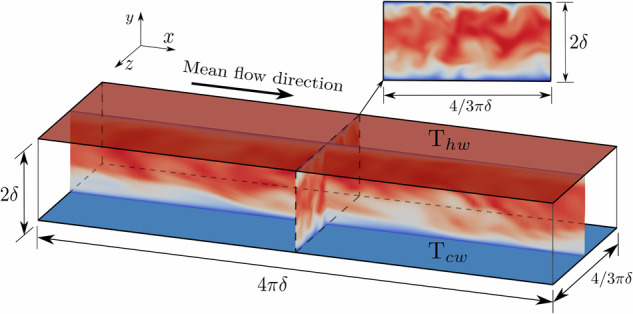
Schematic of a microconfined channel flow domain with cold (cw) and hot (hw) isothermal walls. The illustration also shows the domain dimensions and the mean flow direction.
Table 1.
Critical pressure, temperature and density, molecular weight and acentric factor for CO2 from NIST data44.
| Fluid | Pc[MPa] | Tc[K] | ρc[kg/m3] | W[kg/mol] | ω |
|---|---|---|---|---|---|
| CO2 | 7.38 | 304.13 | 467.60 | 0.04401 | 0.0372 |
Table 2.
Input parameters and dimensionless numbers of the database cases.
| No. | Pb/Pc | Tcw/Tc | Thw/Tc | Ub [m/s] | Reb | Prb | Ecb | Mab |
|---|---|---|---|---|---|---|---|---|
| 1 | 1.5 | 0.95 | 1.1 | 0.50 | 1168 | 2.76 | 2.08E-07 | 0.015 |
| 2 | 1.5 | 0.90 | 1.2 | 0.50 | 1059 | 2.28 | 2.56E-07 | 0.014 |
| 3 | 1.5 | 0.80 | 1.4 | 0.50 | 843 | 1.85 | 3.27E-07 | 0.013 |
| 4 | 1.5 | 0.95 | 1.1 | 1.00 | 2385 | 2.83 | 8.16E-07 | 0.029 |
| 5 | 1.5 | 0.90 | 1.2 | 1.00 | 2108 | 2.27 | 1.04E-06 | 0.029 |
| 6 | 1.5 | 0.80 | 1.4 | 1.00 | 2030 | 2.34 | 1.06E-06 | 0.024 |
| 7 | 2.0 | 0.95 | 1.1 | 0.50 | 1108 | 2.06 | 2.77E-07 | 0.012 |
| 8 | 2.0 | 0.90 | 1.2 | 0.50 | 1047 | 2.00 | 2.87E-07 | 0.013 |
| 9 | 2.0 | 0.80 | 1.4 | 0.50 | 857 | 1.77 | 3.35E-07 | 0.012 |
| 10 | 2.0 | 0.95 | 1.1 | 1.00 | 2221 | 2.05 | 1.13E-06 | 0.025 |
| 11 | 2.0 | 0.90 | 1.2 | 1.00 | 2084 | 2.01 | 1.17E-06 | 0.025 |
| 12 | 2.0 | 0.80 | 1.4 | 1.00 | 1693 | 1.77 | 1.37E-06 | 0.024 |
| 13 | 5.0 | 0.95 | 1.1 | 0.50 | 832 | 1.41 | 4.25E-07 | 0.008 |
| 14 | 5.0 | 0.90 | 1.2 | 0.50 | 835 | 1.41 | 4.16E-07 | 0.009 |
| 15 | 5.0 | 0.80 | 1.4 | 0.50 | 775 | 1.45 | 4.12E-07 | 0.009 |
| 16 | 5.0 | 0.95 | 1.1 | 1.00 | 1666 | 1.41 | 1.71E-06 | 0.017 |
| 17 | 5.0 | 0.90 | 1.2 | 1.00 | 1676 | 1.41 | 1.70E-06 | 0.017 |
| 18 | 5.0 | 0.80 | 1.4 | 1.00 | 1531 | 1.45 | 1.67E-06 | 0.017 |
Fig. 2.

Snapshots of instantaneous streamwise velocity in wall units μ+ on a - slice for the 18 cases.
The computational domain is in the streamwise (x), wall-normal (y), and spanwise (z) directions, respectively, which is large enough to represent the largest flow scales of the problem40. The streamwise and spanwise boundaries are set periodic, and no-slip conditions are imposed on the horizontal boundaries (x-z planes). The resulting DNS grid contains 96 × 96 × 96 points uniformly distributed in the streamwise and spanwise directions. In particular, the mesh resolutions in cw-units fall within the ranges , and (using hw-units the resolutions correspond to , and ), while the mesh is stretched towards the walls in the wall-normal direction such that the first grid point is at from the cold wall and from the hot wall, with the latter being the most critical one; extensive details of the resolutions in wall units can be found in the technical validation section. For the temporal time stepping, a Courant-Friedrichs-Lewy number of CFL = 0.1 is selected. For each case, the computational strategy starts from a linear velocity profile with random fluctuations41, which is advanced in time for approximately 6 and 11 flow-through-time (FTT) units for the Ub = 0.5 m/s and Ub = 1 m/s cases, respectively, after achieving statistically steady-state flow conditions (approximately 10 FTTs); based on the bulk velocity Ub and the length of the channel , a FTT is defined as .
Data Records
The dataset is available online on Figshare40, a commonly used platform for sharing large datasets. The data is structured in a manner where individual cases are allocated in dedicated folders, facilitating in this way convenient access and data processing. Each case folder is structured in different FTT subfolders, which contain 10 snapshot files of the corresponding FTT uniformly spaced in time. Additionally, there is a README.txt file in each case folder that provides essential information about the individual case, such as (i) key independent parameters, (ii) dimensionless numbers, (iii) details on the calculation of the stretching factor in the y-direction, and (iv) the time advancement technique. The dataset files within the FTT subfolders are stored in the Hierarchical Data Format version 5 (h5)42, an open-source file format capable of handling complex and diverse data. There is also an associated xdmf file that contains data descriptions for these files, which can be visualized with, for example, the open-source software Paraview43. Finally, each case folder also includes a configuration file and a substances library file in YAML format. Likewise, there are C++ files in both .cpp and .hpp formats, allowing users to replicate the simulations for further investigation and/or verification.
The dataset includes an extensive array of input features and corresponding labels, as outlined in Table 2. It has been meticulously organized to facilitate the extraction of two distinct categories of data: (i) base output variables, and (ii) derived quantities. The base output variables entail critical parameters that are directly generated by the simulations, serving as essential prerequisites for the computation of other derived quantities. These base outputs primarily consist of instantaneous flow parameters. In contrast, the derived quantities comprise various statistical measures, including first- and second-order Reynolds- and Favre-averaged statistical quantities. For a given quantity, denoted as , the Reynolds-averaged mean and its fluctuation are defined as , with the condition that the average of equals zero. Similarly, the Favre-averaged mean and its fluctuation are defined as with . A summary of the primary base output fields available within the dataset is provided in Table 3, while Tables 4, 5, and 6 furnish concise overviews of the derived output fields.
Table 3.
Base output quantities of the database cases.
| Description | RHEA Quantity | Symbology | Units |
|---|---|---|---|
| Mesh coordinate in x-direction | x | x | m |
| Mesh coordinate in y-direction | y | y | m |
| Mesh coordinate in z-direction | z | z | m |
| Instantaneous streamwise velocity | u | μ | m/s |
| Instantaneous wall-normal velocity | v | v | m/s |
| Instantaneous spanwise velocity | w | w | m/s |
| Total energy | E | E | J/kg |
| Pressure | P | P | Pa |
| Temperature | T | T | K |
| Thermal conductivity | kappa | κ | W/(m·K) |
| Dynamic viscosity | mu | μ | Pa s |
| Density | rho | ρ | kg/m3 |
| Speed of sound | sos | c | m/s |
| Specific isochoric heat capacity | c_v | cv | J/(kg·K) |
| Specific isobaric heat capacity | c_P | cP | J/(kg·K) |
Table 4.
Derived time-averaged quantities of the database cases.
| Description | Field name | Symbology | Units | Expression |
|---|---|---|---|---|
| Time-averaged density | avg_rho | kg/m3 | ||
| Time-averaged conserved streamwise momentum | avg_rhou | kg/(s·m2) | ||
| Time-averaged conserved wall-normal momentum | avg_rhov | kg/(s·m2) | ||
| Time-averaged conserved spanwise momentum | avg_rhow | kg/(s·m2) | ||
| Time-averaged conserved total energy | avg_rhoE | J/m3 | ||
| Time-averaged conserved pressure | avg_rhoP | Pa·kg/m3 | ||
| Time-averaged conserved temperature | avg_rhoT | K·kg/m3 | ||
| Time-averaged streamwise velocity | avg_u | m/s | ||
| Time-averaged wall-normal velocity | avg_v | m/s | ||
| Time-averaged spanwise velocity | avg_w | m/s | ||
| Time-averaged total energy | avg_E | J/m3 | ||
| Time-averaged pressure | avg_P | Pa | ||
| Time-averaged temperature | avg_T | K | ||
| Time-averaged speed of sound | avg_sos | m/s | ||
| Time-averaged dynamic viscosity | avg_mu | Pa·s | ||
| Time-averaged thermal conductivity | avg_kappa | W/(m·K) | ||
| Time-averaged specific isochoric heat capacity | avg_c_v | J/(kg·K) | ||
| Time-averaged specific isobaric heat capacity | avg_c_P | J/(kg·K) |
Table 5.
Derived Reynolds-averaged root-mean-square fluctuations of the database cases.
| Description | Field name | Symbology | Units | Expression |
|---|---|---|---|---|
| Root-mean-square density fluctuations | rmsf_rho | kg/m3 | , where | |
| Root-mean-square conserved streamwise momentum fluctuations | rmsf_rhou | kg/(s·m2) | , where | |
| Root-mean-square conserved wall-normal momentum fluctuations | rmsf_rhov | kg/(s·m2) | , where | |
| Root-mean-square conserved spanwise momentum fluctuations | rmsf_rhow | kg/(s·m2) | , where | |
| Root-mean-square conserved total energy fluctuations | rmsf_rhoE | J/m2 | , where | |
| Root-mean-square streamwise velocity fluctuations | rmsf_u | m/s | , where | |
| Root-mean-square wall-normal velocity fluctuations | rmsf_v | m/s | , where | |
| Root-mean-square spanwise velocity fluctuations | rmsf_w | m/s | , where | |
| Root-mean-square total energy fluctuations | rmsf_E | J/kg | , where | |
| Root-mean-square pressure fluctuations | rmsf_P | Pa | , where | |
| Root-mean-square temperature fluctuations | rmsf_T | K | , where | |
| Root-mean-square speed of sound fluctuations | rmsf_sos | kg/(s·m2) | , where | |
| Root-mean-square dynamic viscosity fluctuations | rmsf_mu | Pa·s | , where | |
| Root-mean-square thermal conductivity fluctuations | rmsf_kappa | W/(m·K) | , where | |
| Root-mean-square specific isochoric heat capacity fluctuations | rmsf_c_v | J/(kg·K) | , where | |
| Root-mean-square specific isobaric heat capacity fluctuations | rmsf_c_P | J/(kg·K) | , where |
Table 6.
Derived Favre-averaged fluctuations of the database cases.
| Description | Field name | Symbology | Units | Expression |
|---|---|---|---|---|
| Favre-averaged streamwise velocity squared fluctuations | favre_uffuff | m2/s2 | ||
| Favre-averaged streamwise and wall-normal velocity fluctuations | favre_uffvff | m2/s2 | ||
| Favre-averaged streamwise and spanwise velocity fluctuations | favre_uffwff | m2/s2 | ||
| Favre-averaged wall-normal velocity squared fluctuations | favre_vffvff | m2/s2 | ||
| Favre-averaged wall-normal and spanwise velocity fluctuations | favre_vffwff | m2/s2 | ||
| Favre-averaged spanwise velocity squared fluctuations | favre_wffwff | m2/s2 | ||
| Favre-averaged streamwise velocity and total energy fluctuations | favre_uffEff | J·m/(kg·s) | ||
| Favre-averaged wall-normal velocity and total energy fluctuations | favre_vffEff | J·m/(kg·s) | ||
| Favre-averaged spanwise velocity and total energy fluctuations | favre_wffEff | J·m/(kg·s) |
Technical Validation
The computational framework utilized in this work is comprehensively described by Bernades et al.20. Additionally, the flow solver RHEA32 has been extensively validated against canonical flows at ideal-gas and high-pressure transcritical conditions in the works by Abdellatif, Barea, Masclans & Monteiro et al.18,19,22,34. In particular, the high-pressure thermophysical framework implemented in RHEA32, comprising the Peng-Robinson25 real-gas equation of state and thermodynamic potentials, as well as the transport coefficients modeled by Chung et al.29,30, is validated through a comparison with the intermediate pressure scenario of the dataset cases at . This validation is conducted across a range of temperatures that are available in the reference NIST44 database. Figure 3 illustrates that the continuous solution in RHEA, for the temperature range , closely matches the reference data for density and dynamic viscosity. Notably, the thermophysical model effectively captures the rapid variations in these properties across the pseudo-boiling region at , which corresponds to a second-order phase transition from supercritical liquid-like to gas-like fluid.
Fig. 3.

Comparison between NIST data44 and RHEA results of density normalized by critical density (a) and dynamic viscosity normalized by critical dynamic viscosity (b) for CO2 at in the range .
Additionally, when creating the dataset, a key consideration is achieving adequate mesh resolution in the three spatial directions. In this regard, as shown in Fig. 4, the grid resolution is comparable to the Kolmogorov scale , which is determined as with the turbulent kinetic energy dissipation rate defined as , and the Batchelor scale calculated as . It is important to note that the resolution values fall significantly below the accepted ranges for channel flow with highly temperature-dependent thermophysical properties45–47, which suggests that resolutions of , and are sufficient for capturing all the relevant flow scales. In particular, for the low Reynolds numbers considered in this database, by utilizing resolutions that are finer than the ones employed by reference research works, like for example Yang et al.48, it is ensured that even high-intensity wall-shear stress events are resolved with 99% of accuracy. Likewise, Kim et al.49 mentioned that , , with , and , , with is sufficient to ensure third-order convergence of flow statistics. Similarly, Li et al.50 utilized a mesh similar to the one in this study to investigate up to fourth-order moments of fluctuations for high-pressure transcritical fluid flows with .
Fig. 4.

Local mesh resolution in the three directions normalized by mean Kolmogorov (a) and Batchelor (b) scales along the wall-normal direction .
Usage Notes
A post-processing script designed to facilitate the output of main variables alongside the computation of derived quantities is available in the main folder. The diligently curated dataset is perfectly tailored for direct use, providing easily accessible quantities extracted from the HDF5 files of each snapshot. Each field within the dataset constitutes a 3D array comprising 98 × 98 × 98 data points. It is worth noting that the initial and final cells in every direction, designated as boundary cells, are reserved for wall calculations. Additionally, users possess the flexibility to navigate the mesh in accordance with their individual computational needs, with the understanding that the mesh coordinates are denoted as (k, j, i), where the x, y, and z coordinates correspond to the i, j, and k directions respectively, as depicted in Fig. 5. An illustrative example of harnessing the dataset to formulate a straightforward computation of the bulk Reynolds number Reb can be found in Fig. 6. This example serves as a practical demonstration of how to effectively employ various field formats and navigate through the multiple directions of the mesh. In this illustrative case, it is imperative to note that, owing to the implementation of a stretching discretization methodology at non-slip boundaries, the precise computation of the bulk value requires the application of a volume-weighted average to the relevant quantities.
Fig. 5.

Schematic of a microconfined channel flow mesh domain with detail of the spatial discretization approach.
Fig. 6.

Snippet from the Python code accessing data and calculating the bulk Reynolds number from output data files.
Acknowledgements
This work is funded by the European Union (ERC, SCRAMBLE, 101040379). Views and opinions expressed are however those of the authors only and do not necessarily reflect those of the European Union or the European Research Council. Neither the European Union nor the granting authority can be held responsible for them. The authors gratefully acknowledge the SGR program (2021-SGR-01045) of the Generalitat de Catalunya (Spain), the Beatriz Galindo program (Distinguished Researcher, BGP18/00026) of the Ministerio de Educación y Formación Profesional (Spain), and the computer resources at FinisTerrae III & CTE-AMD and the technical support provided by CESGA & Barcelona Supercomputing Center (RES-IM-2023-1-0005, RES-IM-2023-2-0005).
Author contributions
Ahmed Abdellatif: Conceptualization, Data Curation, Formal analysis, Investigation, Writing – original draft; Carlos Monteiro: Conceptualization, Investigation, Writing – review & editing; Marc Bernades: Conceptualization, Investigation, Writing – review & editing. Lluís Jofre: Conceptualization, Investigation, Funding acquisition, Writing – review & editing.
Code availability
All source code for RHEA is made available through GitLab as open-source at https://gitlab.com/ProjectRHEA/flowsolverrhea. A release version of the code is available on Zenodo51.
Competing interests
The authors declare no competing interests.
Footnotes
Publisher’s note Springer Nature remains neutral with regard to jurisdictional claims in published maps and institutional affiliations.
References
- 1.Nguyen, N., Wereleyand, S. & Shaegh, S. Fundamentals and Applications of Microfluidics (Artech house, 2019), 3rd edn.
- 2.Hardt, S. & Schönfeld, F. Microfluidic Technologies for Miniaturized Analysis Systems (Springer, Cambridge (USA), 2007), 1st edn.
- 3.Wang, G. R., Yang, F. & Zhao, W. Microelectrokinetic turbulence in microfluidics at low Reynolds number. Phys. Rev. E.93, 013106, 10.1103/PhysRevE.93.013106 (2016). 10.1103/PhysRevE.93.013106 [DOI] [PubMed] [Google Scholar]
- 4.Nan, K. et al. Large-scale flow in micro electrokinetic turbulent mixer. Micromachines11, 813, 10.3390/mi11090813 (2020). 10.3390/mi11090813 [DOI] [PMC free article] [PubMed] [Google Scholar]
- 5.Sharp, K. V. & Adrian, R. J. Transition from laminar to turbulent flow in liquid filled microtubes. Exp. Fluids36, 741–747, 10.1007/s00348-003-0753-3 (2004). 10.1007/s00348-003-0753-3 [DOI] [Google Scholar]
- 6.Wibel, W. & Ehrhard, P. Experiments on the laminar/turbulent transition of liquid flows in rectangular microchannels. Heat Transf. Eng.30, 70–77, 10.1080/01457630802293449 (2009). 10.1080/01457630802293449 [DOI] [Google Scholar]
- 7.You, J. B. et al. PDMS-based turbulent microfluidic mixer. Lab Chip15, 1727, 10.1039/C5LC00070J (2015). 10.1039/C5LC00070J [DOI] [PubMed] [Google Scholar]
- 8.Camargo, C. L. et al. Turbulence in microfluidics: cleanroom-free, fast, solventless, and bondless fabrication and application in high throughput liquid-liquid extraction. Anal. Chim. Acta940, 73–83, 10.1016/j.aca.2016.08.052 (2016). 10.1016/j.aca.2016.08.052 [DOI] [PubMed] [Google Scholar]
- 9.Gorodetsky, A., Rozenfeld, T., Haustein, H. D. & Ziskind, G. Flow and heat transfer analysis of hybrid cooling schemes: Adding micro-jets to a micro-gap. Int. J. Therm. Sci.138, 367–383, 10.1016/j.ijthermalsci.2019.01.015 (2019). 10.1016/j.ijthermalsci.2019.01.015 [DOI] [Google Scholar]
- 10.Jofre, L. & Urzay, J. A characteristic length scale for density gradients in supercritical monocomponent flows near pseudoboiling. Annual Research Briefs, Center for Turbulence Research, Stanford University 277–282 (2020).
- 11.Bernades, M. & Jofre, L. Thermophysical analysis of microconfined turbulent flow regimes at supercritical fluid conditions in heat transfer applications. J. Heat Transfer144, 082501, 10.1115/1.4054554 (2022). 10.1115/1.4054554 [DOI] [Google Scholar]
- 12.Jofre, L. & Urzay, J. Transcritical diffuse-interface hydrodynamics of propellants in high-pressure combustors of chemical propulsion systems. Prog. Energy Combust. Sci.82, 100877, 10.1016/j.pecs.2020.100877 (2021). 10.1016/j.pecs.2020.100877 [DOI] [Google Scholar]
- 13.Bernades, M., Capuano, F. & Jofre, L. Microconfined high-pressure transcritical fluids turbulence. Phys. Fluids35, 015163, 10.1063/5.0135388 (2023). 10.1063/5.0135388 [DOI] [Google Scholar]
- 14.Yoo, J. Y. The turbulent flows of supercritical fluids with heat transfer. Annu. Rev. Fluid Mech.45, 495–525, 10.1146/annurev-fluid-120710-101234 (2013). 10.1146/annurev-fluid-120710-101234 [DOI] [Google Scholar]
- 15.Bae, J. H., Yoo, J. Y. & McEligot, D. M. Direct numerical simulation of heated CO2 flows at supercritical pressure in a vertical annulus at Re = 8900. Phys. Fluids20, 055108, 10.1063/1.2927488 (2008). 10.1063/1.2927488 [DOI] [Google Scholar]
- 16.Sengupta, U., Nemati, H., Boersma, B. J. & Pecnik, R. Fully compressible low-Mach number simulations of carbon-dioxide at supercritical pressures and trans-critical temperatures. Flow Turbul. Combust.99, 909–931, 10.1007/s10494-017-9872-4 (2017). 10.1007/s10494-017-9872-4 [DOI] [PMC free article] [PubMed] [Google Scholar]
- 17.Kawai, S. Heated transcritical and unheated non-transcritical turbulent boundary layers at supercritical pressures. J. Fluid Mech.865, 563–601, 10.1017/jfm.2019.13 (2019). 10.1017/jfm.2019.13 [DOI] [Google Scholar]
- 18.Barea, G., Masclans, N. & Jofre, L. Multiscale flow topologies in microconfined high-pressure transcritical fluid turbulence. Phys. Rev. Fluids8, 054608, 10.1103/PhysRevFluids.8.054608 (2023). 10.1103/PhysRevFluids.8.054608 [DOI] [Google Scholar]
- 19.Monteiro, C. & Jofre, L. Flow regime analysis of high-pressure transcritical fluids in microducts. Int. J. Heat Mass Trans.224, 125295, 10.1016/j.ijheatmasstransfer.2024.125295 (2024). 10.1016/j.ijheatmasstransfer.2024.125295 [DOI] [Google Scholar]
- 20.Bernades, M., Jofre, L. & Capuano, F. Kinetic-energy- and pressure-equilibrium-preserving schemes for real-gas turbulence in the transcritical regime. J. Comput. Physics493, 112477, 10.1016/j.jcp.2023.112477 (2023). 10.1016/j.jcp.2023.112477 [DOI] [Google Scholar]
- 21.Bernades, M., Jofre, L. & Capuano, F. A priori analysis for high-fidelity large-eddy simulation of wall-bounded transcritical turbulent flows. J. Supercrit. Fluids207, 106191, 10.1016/j.supflu.2024.106191 (2024). 10.1016/j.supflu.2024.106191 [DOI] [Google Scholar]
- 22.Masclans, N., V’azquez-Novoa, F., Bernades, M., Badia, R. M. & Jofre, L. Thermodynamics-informed neural network for recovering supercritical fluid thermophysical information from turbulent velocity data. Int. J. Thermofluids20, 100448, 10.1016/j.ijft.2023.100448 (2023). 10.1016/j.ijft.2023.100448 [DOI] [Google Scholar]
- 23.Jofre, L., Bernades, M. & Capuano, F. Dimensionality reduction of non-buoyant microconfined high-pressure transcritical fluid turbulence. Int. J. Heat Fluid Flow102, 109169, 10.1016/j.ijheatfluidflow.2023.109169 (2023). 10.1016/j.ijheatfluidflow.2023.109169 [DOI] [Google Scholar]
- 24.Jofre, L., del Rosario, Z. R. & Iaccarino, G. Data-driven dimensional analysis of heat transfer in irradiated particle-laden turbulent flow. Int. J. Multiph. Fl.125, 103198, 10.1016/j.ijmultiphaseflow.2019.103198 (2020). 10.1016/j.ijmultiphaseflow.2019.103198 [DOI] [Google Scholar]
- 25.Peng, D. Y. & Robinson, D. B. A new two-constant equation of state. Ind. Eng. Chem. Fundam.15, 59–64, 10.1021/i160057a011 (1976). 10.1021/i160057a011 [DOI] [Google Scholar]
- 26.Firoozabadi, A. Thermodynamics and Applications in Hydrocarbon Energy Production (McGraw-Hill Education, New York (USA), 2016), 1st edn.
- 27.Reynolds, W. C. & Colonna, P. Thermodynamics: Fundamentals and Engineering Applications (Cambridge University Press, Cambridge (UK), 2019), 1st edn.
- 28.Burcat, A. & Ruscic, B. Third millennium ideal gas and condensed phase thermochemical database for combustion with updates from active thermochemical tables. Tech. Rep., Argonne National Laboratory (2005).
- 29.Chung, T. H., Lee, L. L. & Starling, K. E. Applications of kinetic gas theories and multiparameter correlation for prediction of dilute gas viscosity and thermal conductivity. Ind. Eng. Chem. Fund.23, 8–13, 10.1021/i100013a002 (1984). 10.1021/i100013a002 [DOI] [Google Scholar]
- 30.Chung, T. H., Ajlan, M., Lee, L. L. & Starling, K. E. Generalized multiparameter correlation for nonpolar and polar fluid transport properties. Ind. Eng. Chem. Fund.27, 671–679, 10.1021/ie00076a024 (1988). 10.1021/ie00076a024 [DOI] [Google Scholar]
- 31.Poling, B. E., Prausnitz, J. M. & O’Connell, J. P. Properties of Gases and Liquids (McGraw Hill, New York (USA), 2001), 5th edn.
- 32.Jofre, L., Abdellatif, A. & Oyarzun, G. RHEA - an open-source Reproducible Hybrid-architecture flow solver Engineered for Academia. J. Open Source Softw.8, 4637, 10.21105/joss.04637 (2023). 10.21105/joss.04637 [DOI] [Google Scholar]
- 33.Gottlieb, S., Shu, C.-W. & Tadmor, E. Strong stability-preserving high-order time discretization methods. SIAM Review43, 89–112, 10.1137/S003614450036757X (2001). 10.1137/S003614450036757X [DOI] [Google Scholar]
- 34.Abdellatif, A., Ventosa-Molina, J., Grau, J., Torres, R. & Jofre, L. Artificial compressibility method for high-pressure transcritical fluids at low Mach numbers. Comput. Fluids270, 106163, 10.1016/j.compfluid.2023.106163 (2023). 10.1016/j.compfluid.2023.106163 [DOI] [Google Scholar]
- 35.Coppola, G., Capuano, F., Pirozzoli, S. & de Luca, L. Numerically stable formulations of convective terms for turbulent compressible flows. J. Comput. Phys.382, 86–104, 10.1016/j.jcp.2019.01.007 (2019). 10.1016/j.jcp.2019.01.007 [DOI] [Google Scholar]
- 36.Coppola, G., Capuano, F. & de Luca, L. Discrete energy-conservation properties in the numerical simulation of the Navier-Stokes equations. Appl. Mech. Rev.71, 010803, 10.1115/1.4042820 (2019). 10.1115/1.4042820 [DOI] [Google Scholar]
- 37.Bernades, M., Capuano, F., Trias, F. X. & Jofre, L. Energy-preserving stable computations of high-pressure supercritical fluids turbulence. In 8th European Congress on Computational Methods in Applied Sciences and Engineering (ECCOMAS), 1–12 (2022).
- 38.Bernades, M., Jofre, L. & Capuano, F. Investigation of a novel numerical scheme for high-pressure supercritical fluids turbulence. Proceedings of the Summer Program 2022, Center for Turbulence Research, Stanford University 225–234 (2022).
- 39.Linstrom, P. Nist chemistry webbook, nist standard reference database 69, 10.18434/T4D303 (1997).
- 40.Abdellatif, A., Monteiro, C. & Jofre, L. Microconfined High-Pressure Transcritical Channel Flow Dataset. Figshare10.25452/figshare.plus.24486904 (2023). 10.25452/figshare.plus.24486904 [DOI]
- 41.Lee, M. & Moser, R. D. Direct numerical simulation of turbulent channel flow up to Reτ ≈ 5200. J. Fluid Mech.774, 395–415, 10.1017/jfm.2015.268 (2015). 10.1017/jfm.2015.268 [DOI] [Google Scholar]
- 42.The HDF Group. Hierarchical Data Format 5 (2022).
- 43.The Paraview Group. ParaView - Open-source, multi-platform data analysis and visualization application based on Visualization Toolkit (2022).
- 44.Nelson, K. S. & Fringer, O. Reducing spin-up time for simulations of turbulent channel flow. Phys. Fluids29, 105101, 10.1063/1.4993489 (2017). 10.1063/1.4993489 [DOI] [Google Scholar]
- 45.Zonta, F., Marchioli, C. & Soldati, A. Modulation of turbulence in forced convection by temperature-dependent viscosity. J. Fluid Mech.697, 150–174, 10.1017/jfm.2012.67 (2012). 10.1017/jfm.2012.67 [DOI] [Google Scholar]
- 46.Lee, J., Jung, S. Y., Sung, H. J. & Zaki, T. A. Effect of wall heating on turbulent boundary layers with temperature-dependent viscosity. J. Fluid Mech.726, 196–225, 10.1017/jfm.2013.211 (2013). 10.1017/jfm.2013.211 [DOI] [Google Scholar]
- 47.Patel, A., Boersma, B. J. & Pecnik, R. The influence of near-wall density and viscosity gradients on turbulence in channel flows. J. Fluid Mech.809, 793–820, 10.1017/jfm.2016.689 (2016). 10.1017/jfm.2016.689 [DOI] [Google Scholar]
- 48.Yang, X. I. A., Hong, J., Lee, M. & Huang, X. L. D. Grid resolution requirement for resolving rare and high intensity wall-shear stress events in direct numerical simulations. Phys. Rev. Fluids6, 10.1103/physrevfluids.6.054603 (2021).
- 49.Kim, K., Hickey, J.-P. & Scalo, C. Pseudophase change effects in turbulent channel flow under transcritical temperature conditions. J. Fluid Mech.871, 52–91, 10.1017/jfm.2019.292 (2019). 10.1017/jfm.2019.292 [DOI] [Google Scholar]
- 50.Li, F., Guo, J., Bai, B. & Ihme, M. Analysis of real-fluid thermodynamic effects on turbulent statistics in transcritical channel flows. Phys. Rev. Fluids8, 024605, 10.1103/PhysRevFluids.8.024605 (2023). 10.1103/PhysRevFluids.8.024605 [DOI] [Google Scholar]
- 51.Jofre, L., Abdellatif, A. & Oyarzun, G. RHEA - an open-source Reproducible Hybrid-architecture flow solver Engineered for Academia. Zenodo10.5281/zenodo.7525883 (2023). 10.5281/zenodo.7525883 [DOI]
Associated Data
This section collects any data citations, data availability statements, or supplementary materials included in this article.
Data Citations
- Abdellatif, A., Monteiro, C. & Jofre, L. Microconfined High-Pressure Transcritical Channel Flow Dataset. Figshare10.25452/figshare.plus.24486904 (2023). 10.25452/figshare.plus.24486904 [DOI]
- Jofre, L., Abdellatif, A. & Oyarzun, G. RHEA - an open-source Reproducible Hybrid-architecture flow solver Engineered for Academia. Zenodo10.5281/zenodo.7525883 (2023). 10.5281/zenodo.7525883 [DOI]
Data Availability Statement
All source code for RHEA is made available through GitLab as open-source at https://gitlab.com/ProjectRHEA/flowsolverrhea. A release version of the code is available on Zenodo51.