



Abstract
BACKGROUND
We assessed the relationship of liver fibrosis score with incident dementia in a large, national sample.
METHODS
For this retrospective cohort study, data of dementia‐free individuals aged 40‐69 years were derived from electronic records of the largest healthcare provider in Israel. The association between liver fibrosis score (FIB‐4), assessed from routine laboratory measurements, and incident dementia was explored through multivariate cox regression models.
RESULTS
Of the total sample (N = 826,578, mean age 55 ± 8 years at baseline), 636,967 (77%) had no fibrosis, 180,114 (21.8%) had inconclusive fibrosis status and 9497 (1.2%) had high risk for advanced fibrosis. Over a median follow‐up of 17 years, 41,089 dementia cases were recorded. Inconclusive liver fibrosis and advanced fibrosis were associated with increased dementia risk (HR = 1.09, 95%CI: 1.07–1.11 and HR = 1.18, 95%CI: 1.10–1.27, respectively). This association remained robust through seven sensitivity analyses.
CONCLUSIONS
Liver fibrosis assessed through a serum‐based algorithm may serve as a risk factor for dementia in the general population.
Highlights
Liver fibrosis may predict dementia diagnosis in the general population.
Inconclusive liver fibrosis was associated with 9% increased dementia risk.
Advanced liver fibrosis was associated with 18% increased dementia risk.
Findings remained robust in sensitivity analyses and after adjustments.
Keywords: cohort study, dementia, liver fibrosis, risk factors
1. INTRODUCTION
Dementia is an increasing public health concern. 1 Because treatment options for dementia are limited, there is a growing need to establish modifiable risk factors for this condition. 2
Increasing evidence points to the role of chronic liver diseases (CLD) in dementia pathogenesis, through multiple mechanisms beyond that of encephalopathy. 3 CLD represents a common pathological outcome of several etiologies, including chronic infection by hepatotropic viruses (mainly hepatitis B and C) and chronic toxic injury, mainly due to excessive alcohol consumption. Yet the most prevalent etiology of CLD is metabolic dysfunction‐associated steatotic liver disease (MASLD), with an estimated global prevalence of 38% among adults. 4 MASLD, previously known as non‐alcoholic fatty liver disease (NAFLD), has been associated with multiple health outcomes, including cardiometabolic diseases 5 and neurodegeneration. 6 However, within the spectrum of MASLD, the presence of liver fibrosis has been shown to constitute the most important factor in determining liver‐related complications 7 as well as multiple extrahepatic conditions. 8
The advanced stages of liver fibrosis are most often undiagnosed because liver disease in these stages is usually clinically silent. However, accumulating evidence suggests that liver fibrosis, mostly associated with MASLD, is prevalent among individuals in the general population without known liver disease, with estimates ranging between 5.6% and 7.5%. 9 , 10 Yet, fibrosis is reversible through weight reduction and pharmacological interventions. 11 Hence, screening for liver fibrosis in the general population has been considered. 10 , 12
Assessment of liver fibrosis has been conducted using liver biopsy, which is invasive and costly and may be inaccurate due to sampling error. 13 Over the last few years, noninvasive methods of assessing liver fibrosis have been developed, including imaging techniques such as transient elastography and serum‐based scores. 14 Specifically, serum‐based fibrosis scores show promise for screening of liver fibrosis in the general population because they require serum measures that are usually already available or rely on a simple blood draw and have low costs compared to other assessment methods. 12 FIB‐4 is the serum‐based score primarily utilized in clinical practice for risk stratification and exclusion of advanced fibrosis among individuals with MASLD and is endorsed as a first‐line screening tool in clinical practice. 15 , 16 Compared to liver biopsy, FIB‐4 shows a summary area under the receiver operating characteristic (AUROC) of 84% for diagnosing advanced fibrosis. 17
RESEARCH IN CONTEXT
Systematic review: A literature review was conducted to identify studies assessing the implications of chronic liver disease for brain health. Recent evidence suggests that chronic liver disease, and liver fibrosis in particular, may be related to cognitive function, imaging markers of neurodegeneration, and Alzheimer's disease pathology. Few studies have explored the association of liver fibrosis with dementia incidence, and their findings are conflicting.
Interpretation: Our findings from a national, population‐based cohort suggest that liver fibrosis, assessed through a validated serum‐based algorithm (FIB‐4), may serve as a predictor of incident dementia in the general population.
Future directions: Future research is required to validate the predictive value of FIB‐4 in diverse populations and to clarify the biological mechanisms that underlie the association between liver fibrosis and dementia. Future exploration is also warranted to examine whether improvement in liver fibrosis through lifestyle and pharmacological interventions may ameliorate dementia risk.
Although many studies have focused on the implications of liver fibrosis among individuals with confirmed MASLD, 18 accumulating data stress the utility of liver fibrosis as a predictor of multiple health outcomes in the general population. This includes cardiometabolic risk factors, 19 cardiovascular and cerebrovascular morbidity and mortality, 20 , 21 , 22 and postoperative mortality. 23 Evidence additionally suggests a relationship between liver fibrosis and reduced cognitive performance, neurodegeneration, 24 , 25 , 26 and amyloid beta (Aβ), and tau brain pathology, 27 thus stressing the possible contribution of liver fibrosis in the general population to dementia pathogenesis. Moreover, liver fibrosis, particularly due to MASLD, shares common risk factors with brain aging, including obesity, hypertension, and systemic atherosclerosis. 28 Some recent studies additionally assessed the link between liver fibrosis and dementia risk; however, findings are contradictory. 24 , 29 , 30
We aimed to examine the associations between liver fibrosis and incident dementia in a population‐based national cohort study using a digital dataset from Clalit Health Services (CHS), the largest health maintenance organization (HMO) in Israel. The National Health Insurance law in Israel mandates all residents in the country to join one of the four official HMOs and prohibits discrimination based on any background or circumstances in the provision of healthcare services. This ensures equitable access to healthcare and minimizes selection bias in research based on CHS data. Moreover, loss to follow‐up from CHS due to transfer to a different HMO is negligible. In addition, the use of health records from an HMO enabled the longest follow‐up for the association between liver fibrosis and incident dementia to date. We hypothesize that liver fibrosis will be related to increased dementia risk in this “real‐world” setting of Israeli adults.
2. METHODS
2.1. Study sample
The CHS is the largest HMO in Israel, providing a broad array of private and public healthcare services for nearly 5 million enrollees, representing ∼52% of the general Israeli population. The CHS electronic health registry continuously harmonizes individual‐level information from clinical encounters, laboratory tests, and medication claims.
The initial study population included all 1,098,582 CHS members aged 40 to 69 years who were enrolled for at least 1 year on January 1, 2006 (index date; follow‐up initiation). Of those, 854,096 had information on all the laboratory measures needed to calculate the FIB‐4 score. We further excluded 3341 who had already been diagnosed with dementia at cohort entry. Additionally, we excluded 9069 with recorded excessive alcohol consumption and those with liver and gastrointestinal diseases (eg, hepatitis B and C, ulcerative colitis) to focus on the MASLD etiology and minimize an effect of these conditions on the serum measures included in the FIB‐4 algorithm. Hence, our final sample included 826,578 participants (Figure 1). The follow‐up period ended on December 31, 2022.
FIGURE 1.
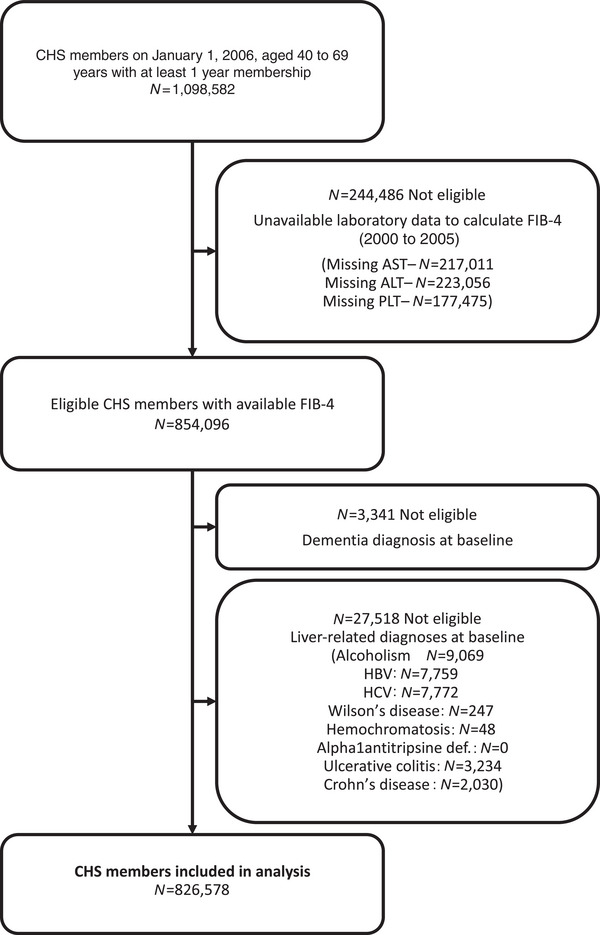
Flow diagram of study sample.
The study protocols were approved by the CHS ethical review board.
2.2. Assessment of liver fibrosis
To calculate FIB‐4, we used the most recent laboratory information available 5 years prior to the index date (ie, between January 1, 2001 and December 31, 2005). The FIB‐4 index was used to estimate participants' risk for advanced liver fibrosis using the following formula: Age(years) × AST[U/L]/(platelets [109/L] × (ALT[U/L])1/2). 31 The FIB‐4 score has been widely validated 32 and recommended by the European Association for the Study of the Liver (EASL). 14 All the FIB‐4 components were measured during routine blood tests conducted periodically in the CHS. Extreme values were treated as valid, and there were no erroneous values (ie, ≤0). Participants were classified into three levels of fibrosis using established cut‐off values: FIB‐4 < 1.3 indicated no fibrosis, FIB‐4 1.3 to 2.66 was inconclusive with regard to the presence of advanced fibrosis, and FIB‐4 ≥ 2.67 indicated high risk of advanced fibrosis. 33
2.3. All‐cause dementia ascertainment
Dementia diagnosis was based on the internal dementia registry of CHS. In this registry, dementia is recorded if at least one of the following criteria is met: (1) chronic diagnosis of dementia according to ICD‐9 codes; (2) a diagnosis of dementia in a hospital discharge letter; (3) purchase of at least four monthly prescriptions of an anti‐dementia medication within 12 months (based on ACT codes N06DA02 and No6DA03). A list of International classifiaction of disease, 9th revision (ICD‐9) codes included for the dementia diagnoses is presented in Supplementary Table 1.
2.4. Covariate ascertainments
Potential confounders were assessed at baseline and included sociodemographic, lifestyle, and health factors. Age was categorized into 5‐year bands. For ethnicity, participants were grouped as either Arab, Orthodox Jew, or Jew. Since no direct measure of ethnicity exists in CHS, a proxy measure was ascertained according to the majority ethnic group residing in the catchment area of each primary care clinic based on periodic Israeli Central Bureau of Statistics reports. 34 The peripherality index was constructed based on the Israeli Bureau of Statistics' “Peripherality Index of Localities and Local Authorities,” which takes into account population size, proximity to other local authorities in the country, and the proximity to the Tel‐Aviv District. 35 Participants were grouped into the following peripherality categories: 1 to 4, 5 to 7, and 8 to 10, indicating distant peripherality, proximate peripherality, and centrality, respectively.
Socioeconomic status designation, grouped into four categories, was based on members' listed home address. The POINTS Location Intelligence Company uses commercial propriety information to continuously augment neighborhood‐level socioeconomic information gathered during a 2008 Israel Central Bureau of Statistics census. Participants were grouped into the following categories: 1 to 3, 4 to 5, 6 to 7, and 8 to 10, indicating lowest, medium‐low, medium‐high, and highest status, respectively.
Baseline morbidity was based on pre‐existing diagnoses specified in the Clalit chronic disease register. The CHS epidemiology unit applies disease‐specific algorithms to compile and maintain electronic health registers for over 100 chronic conditions, combining community and hospital‐discharge diagnoses, laboratory data, medication claims, and linkage with Ministry of Health national registers. 36
2.5. Statistical analysis
Sociodemographic, clinical, and laboratory characteristics were evaluated in the total sample and by FIB‐4 categories. Normally distributed values were presented as mean ± SD, skewed variables were presented as median (Q1, Q3), and categorical variables were presented as N (%). We used Cox regression models to assess the relationship between FIB‐4 categories and incident dementia. Participants who did not develop dementia were censored at the date of death, upon leaving the HMO, or at the end of follow‐up.
We initially adjusted for sociodemographic characteristics, namely, age, sex, ethnicity, and peripherality, and additionally adjusted for lifestyle and health characteristics, namely, smoking, obesity, and prevalence of the following health conditions: hyperlipidemia, ischemic heart disease (IHD), coronary heart failure, hypertension, stroke, carotid artery stenosis, diabetes, depression, anxiety, and Parkinson's disease.
Further, we tested whether age, sex, socioeconomic status, ethnicity, obesity, smoking, prevalent diabetes, IHD, and history of stroke modified the link between estimated liver fibrosis and incident dementia by including interaction terms in the models. When interaction terms showed a p for interaction < 0.05 in our fully adjusted models, we further conducted subgroup analyses stratifying the analyses by the modifier. Seven sensitivity analyses were performed: (1) using a cut‐off of 2.0 instead of 1.3 for differentiation between no fibrosis and inconclusive fibrosis among individuals aged ≥65 years; these age‐specific thresholds have been proposed to increase specificity for advanced fibrosis in this age group 37 ; (2) including only individuals with non‐alcoholic fatty liver disease (NAFLD) diagnosis; (3) excluding participants who were diagnosed with dementia during the first 5 years of follow‐up (2005 to 2009); (4) excluding individuals who purchased glucocorticoid in 2005 and between 2000 and 2005; (5) excluding individuals with a breast cancer diagnosis at baseline or tamoxifen claims between 2000 and 2005; (6) excluding prevalent stroke or carotid stenosis diagnosis at baseline; and (7) only those whose FIB‐4 scores were based on laboratory data from 2005 (rather than 2000 to 2005). Supplementary Table 2 outlines the rationale behind the selection of potential confounding variables and sensitivity analyses.
All p values were based on likelihood‐ratio tests. All statistical analyses were performed using Stata version 16.0 (StataCorp).
3. RESULTS
Baseline characteristics of the study sample overall and by fibrosis level are presented in Table 1. The mean age of the study participants at cohort entry was 55 ± 8 years, and 468,737 (56.7%) were women. Among the total sample, 86.7% were Jews and 11.8% were Arabs, and the majority of participants were at medium‐high socioeconomic status (30.9%). Furthermore, NAFLD was present in 1.8% of the sample, and the FIB‐4 score indicating advanced fibrosis was present in 9497 subjects (1.1%), while the mean FIB‐4 score was 1.07 ± 1.05. The baseline characteristics of the subsample of participants who were not included in our analyses are presented in Supplementary Table 3.
TABLE 1.
Baseline sociodemographic and clinical characteristics of study participants by fibrosis status (N = 826,578).
| FIB‐4 score categories | ||||
|---|---|---|---|---|
| No fibrosis (<1.3) | Inconclusive (1.3 to 2.66) | Fibrosis (≥2.67) | Total population | |
| Characteristics | N = 636,967 | N = 180,114 | N = 9,497 | N = 826,578 |
| Sex, female | 373,419 (58.62%) | 90,849 (50.44%) | 4,469 (47.06%) | 468,737 (56.71%) |
| FIB‐4 score | 0.86 [0.69 to 1.05] | 1.55 [1.41 to 1.80] | 3.21 [2.88 to 4.00] | 0.97 [0.74 to 1.27] |
| Age, years | 52.95 ± 7.76 | 59.99 ± 7.13 | 60.91 ± 7.33 | 54.58 ± 8.18 |
| Age, years, categories | ||||
| 35 to 44 | 118,205 (18.56%) | 6,402 (3.55%) | 364 (3.83%) | 124,971 (15.12%) |
| 45 to 54 | 272,339 (42.76%) | 37,359 (20.74%) | 1,712 (18.03%) | 311,410 (37.67%) |
| 55 to 64 | 191,919 (30.13%) | 81,393 (45.19%) | 3,849 (40.53%) | 277,161 (33.53%) |
| 65 to 74 | 54,504 (8.56%) | 54,960 (30.51%) | 3,572 (37.61%) | 113,036 (13.68%) |
| Ethnicity, Arab * | 80,043 (12.58%) | 16,192 (9.00%) | 1,009 (10.63%) | 97,244 (11.78%) |
| Peripherality index | ||||
| Distant periphery | 101,790 (15.98%) | 28,166 (15.64%) | 1,627 (17.13%) | 131,583 (15.92%) |
| Proximate periphery | 282,873 (44.41%) | 78,735 (43.71%) | 4,290 (45.17%) | 365,898 (44.27%) |
| Centrality | 249,916 (39.24%) | 72,673 (40.35%) | 3,554 (37.42%) | 326,143 (39.46%) |
| Socioeconomic status | ||||
| Lowest | 94,334 (14.81%) | 22,081 (12.26%) | 1,481 (15.59%) | 117,896 (14.26%) |
| Medium‐low | 171,487 (26.92%) | 48,787 (27.09%) | 2,844 (29.95%) | 223,118 (26.99%) |
| Medium‐high | 195,574 (30.70%) | 57,123 (31.71%) | 2,747 (28.92%) | 255,444 (30.90%) |
| Highest | 138,122 (21.68%) | 42,585 (23.64%) | 1,833 (19.30%) | 182,540 (22.08%) |
| AST, IU/L | 19.40 ± 6.34 | 25.08 ± 11.00 | 46.38 ± 56.75 | 20.95 ± 10.36 |
| ALT, IU/L | 22.07 ± 12.88 | 22.83 ± 17.81 | 34.33 ± 63.12 | 22.38 ± 15.64 |
| GGT, IU/L | 27.56 ± 31.05 | 30.33 ± 42.85 | 62.37 ± 119.25 | 28.65 ± 36.79 |
| AFP, ng/mL | 2.50 (1.80 to 3.70) | 2.60 (1.90 to 3.91) | 3.30 (2.30 to 5.00) | 2.51 (1.90 to 3.88) |
| Ferritin, ng/mL | 76.07 ± 143.35 | 99.67 ± 152.81 | 155.64 ± 355.37 | 82.75 ± 151.83 |
| Platelets, 109/L | 271.10 ± 63.46 | 200.53 ± 41.73 | 141.53 ± 57.77 | 254.24 ± 67.19 |
| Non‐alcoholic fatty liver disease | 10,773 (1.69%) | 4,024 (2.23%) | 408 (4.30%) | 15,205 (1.84%) |
| Prevalent malignancy | 37,798 (5.93%) | 17,996 (9.99%) | 1,574 (16.57%) | 57,368 (6.94%) |
| Prevalent breast cancer | 10,390 (1.63%) | 5,280 (2.93%) | 362 (3.81%) | 16,032 (1.94%) |
| Tamoxifen use | 4,823 (%) | 2,911 (%) | 241 (%) | 7,975 (%) |
| Glucocorticoid use | 175,754 (27.59%) | 56,085 (31.14%) | 3,426 (36.07%) | 235,265 (28.46%) |
| Prevalent diabetes | 87,819 (13.79%) | 28,828 (16.01%) | 2,151 (22.65%) | 118,798 (14.37%) |
| Obesity | 82,670 (12.98%) | 21,236 (11.79%) | 1,341 (14.12%) | 105,247 (12.73%) |
| Hyperlipidemia | 214,069 (33.61%) | 75,701 (42.03%) | 3,818 (40.20%) | 293,588 (35.52%) |
| History of depression | 35,329 (5.55%) | 11,051 (6.14%) | 624 (6.57%) | 47,004 (5.69%) |
| History of anxiety | 27,775 (4.36%) | 9,249 (5.14%) | 476 (5.01%) | 37,500 (4.54%) |
| History of alcohol abuse | 0 (0.00%) | 0 (0.00%) | 0 (0.00%) | 0 (0.00%) |
| Ever smoking | 186,879 (29.34%) | 49,011 (27.21%) | 2,657 (27.98%) | 238,547 (28.86%) |
| History of drug abuse | 2,604 (0.41%) | 562 (0.31%) | 60 (0.63%) | 3,226 (0.39%) |
| Parkinson's disease | 3,786 (0.59%) | 1,427 (0.79%) | 154 (1.62%) | 5,367 (0.65%) |
| Ischemic heart disease | 52,428 (8.23%) | 30,331 (16.84%) | 2,223 (23.41%) | 84,982 (10.28%) |
| Congestive heart failure | 5,353 (0.84%) | 3,725 (2.07%) | 481 (5.06%) | 9,559 (1.16%) |
| Hypertension | 177,265 (27.83%) | 70,976 (39.41%) | 4,178 (43.99%) | 252,419 (30.54%) |
| History of stroke | 16,073 (2.52%) | 7,624 (4.23%) | 575 (6.05%) | 24,272 (2.94%) |
Notes: Values are presented as mean ± SD, median [Q1, Q3] or N (%).
Abbreviations: AFP, alpha–fetoprotein; ALT, alanine transaminase; AST, aspartate transaminase; GGT, gamma‐glutamyltransferase.
Otherwise Jews.
During a mean follow‐up time of 15.2 ± 4.0 years and a median of 17 years, 41,089 (5%) were diagnosed with dementia. Statistically significant differences in dementia incidence were observed between the three liver fibrosis categories (Figure 2). After adjustment for age, sex, ethnicity, and peripherality, inconclusive fibrosis status was related to a 5% increase in dementia risk, and high risk for advanced fibrosis was associated with an 18% greater risk for dementia compared to the risk of those with no fibrosis (hazard ratio [HR] = 1.05, 95% confidence interval [CI]: 1.03 to 1.07 and HR = 1.18, 95% CI: 1.10 to 1.26, respectively). Further adjustment for sociodemographic, lifestyle, and health factors resulted in similar associations (HR = 1.09, 95% CI: 1.07 to 1.11 and HR = 1.18, 95% CI: 1.10 to 1.27, for inconclusive and high risk of fibrosis vs no fibrosis, respectively) (Table 2).
FIGURE 2.
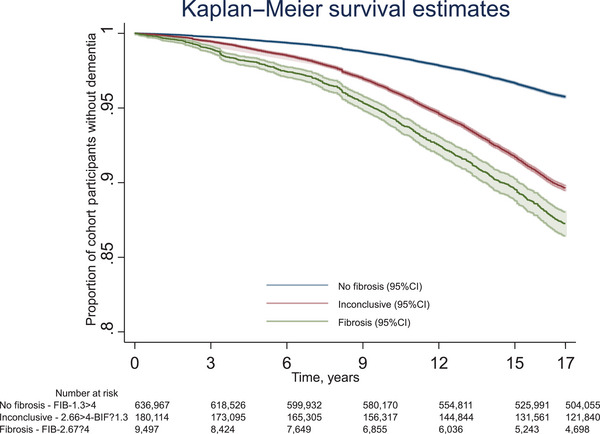
Kaplan–Meier curves for cumulative risk of dementia by liver fibrosis status.
TABLE 2.
Association between liver fibrosis and dementia risk in total sample.
| Model 1 | Model 2 | |||||
|---|---|---|---|---|---|---|
| Fibrosis category * | N | Events/person years | HR (95% CI) | N | Events/person years | HR (95% CI) |
| No fibrosis | 598,216 | 22,991/9,837,282 | 1.00 (ref.) | 598,216 | 22,991/9,837,282 | 1.00 (ref.) |
| Inconclusive | 170,287 | 15,245/2,641,322 | 1.05 (1.03 to 1.07) | 170,287 | 15,245/2,641,322 | 1.09 (1.07 to 1.11) |
| Fibrosis | 8,897 | 826/118,811 | 1.18 (1.10 to 1.26) | 8,897 | 826/118,811 | 1.18 (1.10 to 1.27) |
Notes: Model 1: Adjusted for age, sex, ethnicity, and peripherality.
Model 2: Additionally adjusted for smoking, obesity, hyperlipidemia, ischemic heart disease, hypertension, history of stroke, carotid artery stenosis, congestive heart failure, diabetes, depression, anxiety, and Parkinson's disease.
Bold font indicates p value ≤ 0.05.
FIB‐4 < 1.3, 1.3 to 2.66, and ≥2.67 indicating no fibrosis, inconclusive, and fibrosis, respectively.
We found statistically significant interactions of fibrosis status with sex, age, socioeconomic status, ethnicity, prevalent diabetes, IHD, and stroke with regard to their relationship with dementia risk (Table 3). Stratified models revealed that the association between estimated liver fibrosis status and dementia risk was somewhat higher in women compared to men; however, these differences were small and may not have clinical significance (HR = 1.11, 95% CI: 1.08 to 1.14 and HR = 1.22, 95% CI: 1.10 to 1.35 for inconclusive and high risk of advanced fibrosis, respectively, compared to no fibrosis in women compared to HR = 1.08, 95% CI: 1.04 to 1.11 and HR = 1.17, 95% CI: 1.06 to 1.29 in men). The strongest associations between estimated liver fibrosis and dementia incidence were in the 45‐ to 54‐year age group, where compared to individuals with no fibrosis, those with inconclusive fibrosis had 18% (HR = 1.18, 95% CI: 1.08 to 1.30) increased dementia risk, and those at high risk of advanced fibrosis had more than two‐fold risk for dementia (HR = 2.17; 95% CI: 1.61‐2.93). Lastly, we found significant interactions between prevalent diabetes, IHD and stroke history and estimated liver fibrosis status. Compared to individuals with no fibrosis, those with inconclusive score or at high risk of advanced fibrosis had a higher risk of dementia in those without prevalent diabetes (HR = 1.11, 95% CI: 1.09 to 1.14 and HR = 1.24, 95% CI: 1.14 to 1.34, respectively) but not in those with prevalent diabetes (HR = 1.02, 95% CI: 0.98 to 1.07 and HR = 1.04, 95% CI: 0.91 to 1.19, respectively). Similarly, only individuals with no history of stroke showed significant associations between estimated liver fibrosis status and dementia risk (HR = 1.10, 95% CI: 1.08 to 1.13 and HR = 1.18, 95% CI: 1.10 to 1.27 in participants with no stroke history vs HR = 0.96, 95% CI: 0.89 to 1.03 and HR = 1.16, 95% CI: 0.94 to 1.43 in those with stroke history, comparing inconclusive and advanced fibrosis to no fibrosis, respectively). Lastly, stronger associations were observed in individuals without IHD (HR = 1.10, 95% CI: 1.08 to 1.13 and HR = 1.20, 95% CI: 1.10 to 1.30) than in those with IHD (HR = 1.05, 95% CI: 1.00 to 1.10 and HR = 1.15, 95% CI: 1.01 to 1.31 for inconclusive and advanced fibrosis compared to no fibrosis, respectively) (Table 3).
TABLE 3.
Association between liver fibrosis and dementia risk stratified by participants’ characteristics.
| Model 1 | Model 2 | |||||||
|---|---|---|---|---|---|---|---|---|
| Fibrosis category1 | N | Events/person years | HR (95% CI) | P for interaction | N | Events/person years | HR (95% CI) | P for interaction |
| Sex | ||||||||
| Men | ||||||||
| No fibrosis | 247,307 | 9,067/4,004,074 | 1.00 (ref.) | <0.0001 | 247,307 | 9,067/4,004,074 | 1.00 (ref.) | <0.0001 |
| Inconclusive | 84,244 | 7,077/1,287,877 | 1.04 (1.01 to 1.08) | 84,244 | 7,077/1,287,877 | 1.08 (1.04 to 1.11) | ||
| Fibrosis | 4,690 | 417/62,207 | 1.16 (1.05 to 1.28) | 4,690 | 417/62,207 | 1.17 (1.06 to 1.29) | ||
| Women | ||||||||
| No fibrosis | 350,909 | 13,924/5,833,208 | 1.00 (ref.) | 350,909 | 13,924/5,833,208 | 1.00 (ref.) | ||
| Inconclusive | 86,043 | 8,168/1,353,445 | 1.07 (1.04 to 1.10) | 86,043 | 8,168/1,353,445 | 1.11 (1.08 to 1.14) | ||
| Fibrosis | 4,207 | 409/56,604 | 1.22 (1.11 to 1.35) | 4,207 | 409/56,604 | 1.22 (1.10 to 1.35) | ||
| Age, years | ||||||||
| 35 to 44 | ||||||||
| No fibrosis | 109,899 | 406/1,889,307 | 1.00 (ref.) | <0.0001 | 109,899 | 406/1,889,307 | 1.00 (ref.) | 0.0002 |
| Inconclusive | 5,892 | 31/100,921 | 1.41 (0.97 to 2.03) | 5,892 | 31/100,921 | 1.42 (0.99 to 2.05) | ||
| Fibrosis | 332 | 3/5,305 | 2.56 (0.82 to 7.97) | 332 | 3/5,305 | 2.20 (0.70 to 6.86) | ||
| 45 to 54 | ||||||||
| No fibrosis | 255,256 | 3,142/4,325,314 | 1.00 (ref.) | 255,256 | 3,142/4,325,314 | 1.00 (ref.) | ||
| Inconclusive | 35,083 | 562/585,562 | 1.16 (1.06 to 1.27) | 35,083 | 562/585,562 | 1.18 (1.08 to 1.30) | ||
| Fibrosis | 1,590 | 44/23,561 | 2.35 (1.74 to 3.16) | 1,590 | 44/23,561 | 2.17 (1.61 to 2.93) | ||
| 55 to 64 | ||||||||
| No fibrosis | 181,330 | 10,446/2,900,400 | 1.00 (ref.) | 181,330 | 10,446/2,900,400 | 1.00 (ref.) | ||
| Inconclusive | 77,046 | 5,260/1,216,806 | 1.06 (1.02 to 1.09) | 77,046 | 5,260/1,216,806 | 1.09 (1.05 to 1.13) | ||
| Fibrosis | 3,616 | 249/48,812 | 1.23 (1.08 to 1.39) | 3,616 | 249/48,812 | 1.21 (1.06 to 1.37) | ||
| 65 to 74 | ||||||||
| No fibrosis | 51,731 | 8,997/722,262 | 1.00 (ref.) | 51,731 | 8,997/722,262 | 1.00 (ref.) | ||
| Inconclusive | 52,266 | 9,392/738,033 | 1.04 (1.01 to 1.07) | 52,266 | 9,392/738,033 | 1.08 (1.04 to 1.11) | ||
| Fibrosis | 3,359 | 530/41,133 | 1.12 (1.02 to 1.22) | 3,359 | 530/41,133 | 1.12 (1.03 to 1.23) | ||
| Diabetes | ||||||||
| Yes | ||||||||
| No fibrosis | 81,650 | 7,100/1,217,716 | 1.00 (ref.) | <0.0001 | 81,650 | 7,100/1,217,716 | 1.00 (ref.) | <0.0001 |
| Inconclusive | 27,016 | 3,701/370,094 | 1.03 (0.99 to 1.07) | 27,016 | 3,701/370,094 | 1.02 (0.98 to 1.07) | ||
| Fibrosis | 1,992 | 224/22,544 | 1.08 (0.94 to 1.23) | 1,992 | 224/22,544 | 1.04 (0.91 to 1.19) | ||
| No | ||||||||
| No fibrosis | 516,566 | 15,891/8,619,566 | 1.00 (ref.) | 516,566 | 15,891/8,619,566 | 1.00 (ref.) | ||
| Inconclusive | 143,271 | 11,544/2,271,229 | 1.11 (1.08 to 1.14) | 143,271 | 11,544/2,271,229 | 1.11 (1.09 to 1.14) | ||
| Fibrosis | 6,905 | 602/96,267 | 1.25 (1.15 to 1.36) | 6,905 | 602/96,267 | 1.24 (1.14 to 1.34) | ||
| Ischemic heart disease | ||||||||
| Yes | ||||||||
| No fibrosis | 49,129 | 3,863/720,337 | 1.00 (ref.) | <0.0001 | 49,129 | 3,863/720,337 | 1.00 (ref.) | 0.0001 |
| Inconclusive | 28,611 | 3,377/399,094 | 1.00 (0.96 to 1.05) | 28,611 | 3,377/399,094 | 1.05 (1.00 to 1.10) | ||
| Fibrosis | 2,077 | 238/24,573 | 1.13 (0.99 to 1.29) | 2,077 | 238/24,573 | 1.15 (1.01 to 1.31) | ||
| No | ||||||||
| No fibrosis | 549,087 | 19,128/9,116,945 | 1.00 (ref.) | 549,087 | 19,128/9,116,945 | 1.00 (ref.) | ||
| Inconclusive | 141,676 | 11,868/2,242,228 | 1.06 (1.03 to 1.08) | 141,676 | 11,868/2,242,228 | 1.10 (1.08 to 1.13) | ||
| Fibrosis | 6,820 | 588/94,238 | 1.17 (1.08 to 1.27) | 6,820 | 588/94,238 | 1.20 (1.10 to 1.30) | ||
| Stroke history | ||||||||
| Yes | ||||||||
| No fibrosis | 15,101 | 2,068/199,232 | 1.00 (ref.) | <0.0001 | 15,101 | 2,068/199,232 | 1.00 (ref.) | <0.0001 |
| Inconclusive | 7,206 | 1,273/90,503 | 0.92 (0.85 to 0.99) | 7,206 | 1,273/90,503 | 0.96 (0.89 to 1.03) | ||
| Fibrosis | 528 | 91/5,173 | 1.21 (0.98 to 1.49) | 528 | 91/5,173 | 1.16 (0.94 to 1.43) | ||
| No | ||||||||
| No fibrosis | 583,115 | 20,923/9,638,049 | 1.00 (ref.) | 583,115 | 20,923/9,638,049 | 1.00 (ref.) | ||
| Inconclusive | 163,081 | 13,972/2,550,819 | 1.07 (1.04 to 1.09) | 163,081 | 13,972/2,550,819 | 1.10 (1.08 to 1.13) | ||
| Fibrosis | 8,369 | 735/113,639 | 1.17 (1.09 to 1.26) | 8,369 | 735/113,639 | 1.18 (1.10 to 1.27) | ||
Notes: Model 1: Adjusted for age, sex, ethnicity, and peripherality.
Model 2: Additionally adjusted for smoking, obesity, hyperlipidemia, ischemic heart disease, hypertension, history of stroke, carotid artery stenosis, congestive heart failure, diabetes, depression, anxiety, and Parkinson's disease.
Bold font indicates p value ≤ .05.
The results of our sensitivity analyses are presented in Table 4. Similar findings were obtained in analyses using age‐specific cut‐offs and when excluding subjects with dementia diagnosis in the first 5 years of follow‐up, persons receiving glucocorticoids and those with breast cancer or receiving tamoxifen, persons with a history of stroke or carotid stenosis, and when restricting to those whose serum measures for the FIB‐4 calculation were obtained from laboratory tests done in 2005 only (Table 4). Despite similar or even larger estimates of the associations, the analysis among individuals with NAFLD was nonsignificant, probably due to the small subsample of participants with both NAFLD and high risk of advanced fibrosis (n = 40).
TABLE 4.
Association between liver fibrosis and dementia risk, sensitivity analyses.
| Model 1 | Model 2 | |||||
|---|---|---|---|---|---|---|
| N | Events/person years | HR (95% CI) | N | Events/person years | HR (95% CI) | |
| 1. Using age‐specific cutoffs | ||||||
| No fibrosis | 640,989 | 30,629/10,445,061 | 1.00 (base) | 640,989 | 30,629/10,445,061 | 1.00 (base) |
| Inconclusive | 127,514 | 7,607/2,033,543 | 1.08 (1.05 to 1.11) | 127,514 | 7,607/2,033,543 | 1.11 (1.08 to 1.14) |
| Fibrosis | 8,897 | 826/118,811 | 1.17 (1.09 to 1.25) | 8,897 | 826/118,811 | 1.16 (1.08 to 1.24) |
| 2. Include only those with NAFLD at baseline | ||||||
| No fibrosis | 10,142 | 578/166,041 | 1.00 (ref.) | 10,142 | 578/166,041 | 1.00 (ref) |
| Inconclusive | 3,796 | 391/59,095 | 1.01 (0.88 to 1.15) | 3,796 | 391/59,095 | 1.02 (0.89 to 1.16) |
| Fibrosis | 381 | 40/4,803 | 1.37 (0.99 to 1.89) | 381 | 40/4,803 | 1.32 (0.95 to 1.83) |
| 3. Exclude incident dementia cases occurring in the first 5 years of follow‐up | ||||||
| No fibrosis | 595,264 | 20,039/9,828,082 | 1.00 (ref.) | 595,264 | 20,039/9,828,082 | 1.00 (ref.) |
| Inconclusive | 168,330 | 13,288/2,635,176 | 1.05 (1.03 to 1.08) | 168,330 | 13,288/2,635,176 | 1.09 (1.06 to 1.11) |
| Fibrosis | 8,734 | 663/118,332 | 1.12 (1.03 to 1.21) | 8,734 | 663/118,332 | 1.13 (1.04 to 1.22) |
| 4a. Exclude those with glucocorticoid claims 2005 | ||||||
| No fibrosis | 542,038 | 20,142/8,932,669 | 1.00 (ref.) | 542,038 | 20,142/8,932,669 | 1.00 (ref.) |
| Inconclusive | 152,668 | 13,446/2,377,859 | 1.05 (1.03 to 1.08) | 152,668 | 13,446/2,377,859 | 1.09 (1.07 to 1.12) |
| Fibrosis | 7,654 | 708/104,422 | 1.16 (1.08 to 1.25) | 7,654 | 708/104,422 | 1.16 (1.08 to 1.25) |
| 4b. Exclude those with glucocorticoid claims 2000 to 2005 | ||||||
| No fibrosis | 434,201 | 15,046/7,155,105 | 1.00 (ref.) | 434,201 | 15,046/7,155,105 | 1.00 (ref.) |
| Inconclusive | 117,456 | 9,816/1,833,944 | 1.04 (1.02 to 1.07) | 117,456 | 9,816/1,833,944 | 1.09 (1.06 to 1.12) |
| Fibrosis | 5,721 | 509/78,419 | 1.15 (1.05 to 1.25) | 5,721 | 509/78,419 | 1.17 (1.07 to 1.27) |
| 5. Exclude those with breast cancer at baseline or tamoxifen claims 2000 to 2005 | ||||||
| No fibrosis | 587,943 | 22,430/9,682,849 | 1.00 (ref.) | 587,943 | 22,430/9,682,849 | 1.00 (ref.) |
| Inconclusive | 165,040 | 14,795/2,567,637 | 1.05 (1.03 to 1.08) | 165,040 | 14,795/2,567,637 | 1.09 (1.07 to 1.12) |
| Fibrosis | 8,538 | 801/115,016 | 1.19 (1.10 to 1.27) | 8,538 | 801/115,016 | 1.19 (1.11 to 1.28) |
| 6. Exclude those with history of stroke or carotid stenosis | ||||||
| No fibrosis | 578,439 | 20,506/9,566,410 | 1.00 (ref.) | 578,439 | 20,506/9,566,410 | 1.00 (ref.) |
| Inconclusive | 160,718 | 13,644/2,516,046 | 1.07 (1.04 to 1.09) | 160,718 | 13,644/2,516,046 | 1.10 (1.08 to 1.13) |
| Fibrosis | 8,219 | 716/111,797 | 1.17 (1.09 to 1.26) | 8,219 | 716/111,797 | 1.18 (1.10 to 1.27) |
| 7. Include only those with FIB‐4 scores bases on labs in 2005 | ||||||
| No fibrosis | 361,712 | 15,892/5,921,081 | 1.00 (ref.) | 361,712 | 15,892/5,921,081 | 1.00 (ref.) |
| Inconclusive | 117,709 | 11,327/1,811,781 | 1.04 (1.01 to 1.07) | 117,709 | 11,327/1,811,781 | 1.08 (1.05 to 1.11) |
| Fibrosis | 6,510 | 646/84,710 | 1.20 (1.11 to 1.30) | 6,510 | 646/84,710 | 1.20 (1.11 to 1.30) |
Notes: Model 1: Adjusted for age, sex, ethnicity and peripherality.
Model 2: additionally adjusted for smoking, obesity, hyperlipidemia, Ischemic heart disease, hypertension, history of stroke, carotid artery stenosis, congestive heart failure, diabetes, depression, anxiety, and Parkinson's disease.
Abbreviations: HR, hazard ratio; NAFLD, non‐alcoholic fatty liver disease.
Bold font indicates p value ≤ 0.05.
4. DISCUSSION
In this retrospective cohort study, we examined the associations between estimated liver fibrosis and dementia risk in a nationally representative sample of middle‐age and older adults in Israel. Our findings demonstrated that individuals with advanced liver fibrosis according to FIB‐4 had an 18% higher risk of dementia compared to those without liver fibrosis, and those with an inconclusive result of liver fibrosis had a 9% higher risk. The association between estimated liver fibrosis and dementia risk was significantly modified by sex, age, and the presence of comorbidities, with slightly stronger associations among women, middle‐aged individuals, and those free of diabetes, cardiovascular disease, and stroke. The observed associations remained robust in seven sensitivity analyses, including after restriction to participants with NAFLD and exclusion of dementia cases occurring in the first years of follow‐up.
Previous findings regarding the link between liver fibrosis and dementia risk are sparse and conflicting. Like our exploration, a prior study among the UK Biobank participants that was comparable to our study with regard to the ascertainment of liver fibrosis and incident dementia, as well as the mean age of the participants, found an excessive dementia risk of 52% in those with liver fibrosis compared to those without, an estimate larger compared to the 18% found in our study. 38 In contrast, a Rotterdam study found no associations between liver fibrosis assessed through elastography and dementia risk. 29 Lastly, in an Italian longitudinal study on aging, liver fibrosis according to NAFLD fibrosis score (NFS), another serum‐based algorithm, was not associated with increased risk of all‐cause dementia overall; however, a four‐fold increased risk was observed among those who were physically frail. 30 Of note, our estimate of liver fibrosis in the study sample was 1.1%, much lower compared to the estimates of 2.2%, 5.8%, and 15.7% in the UK Biobank, Rotterdam, and Italian studies, respectively. This discrepancy in fibrosis rates could reflect real differences in estimated liver fibrosis prevalence between the distinct populations, or it may be attributed to methodological differences and sample selection, particularly the fact that our study participants represented the total Israeli population.
In the context of prior literature, our research adds to the existing knowledge base by highlighting the importance of liver fibrosis as a possible risk factor for dementia in a “real‐world” setting of middle‐aged and older adults in Israel. Compared to the general Israeli population, the representation of men and Arabs was somewhat lower in our sample (ie, 56.7% vs 50.3% and 11.8% vs 15%, respectively). 35 Because there was no selection for our study, we postulate that this discrepancy may reflect genuine sex and ethnic differences in utilization of healthcare services and routine check‐ups. Moreover, to our knowledge, our study is the largest and has the longest follow‐up duration. This is of particular importance when assessing potential risk factors for dementia, which is characterized by a long prodromal phase. In addition, when addressing the link between liver fibrosis and dementia incidence, reverse causality may occur particularly during the first years of follow‐up and may dilute or even reverse the associations, as was the case in the Rotterdam study exploration. In that prior study, the researchers hypothesized that the reversed association could be explained by the possible weight loss that often accompanies the preclinical phase of dementia 39 and in turn can reduce liver fibrosis. 40 In that context, the exclusion of dementia cases occurring in the first 5 years of follow‐up yielded similar findings in our exploration, thereby strengthening our hypothesis of an association between estimated liver fibrosis and dementia risk.
Additional secondary analysis showed that a high risk of advanced liver fibrosis according to FIB‐4 was associated with dementia risk among individuals with a diagnosis of NAFLD, although the findings were not statistically significant, probably due to limited statistical power. Of note, the predictive utility of the FIB‐4 score has been studied mostly among individuals with NAFLD, not in the general population, and showed high validity compared to liver biopsy, which remains the gold standard. 32 Although some studies among the general population showed only modest performance in predicting liver morbidity and mortality, 41 accumulating investigations highlight the possible role of FIB‐4 as a predictor of cardiovascular diseases 21 and other health outcomes 42 , 43 in the general population. In addition to the advantage of being non‐invasive, requiring readily available serum measures from routine blood tests, our results, together with previous findings, underscore the possible utility of FIB‐4 as a useful biomarker for dementia risk in a broad population at high risk.
The link between liver fibrosis and dementia incidence is supported by prior studies demonstrating an association of liver fibrosis with cognitive impairment 24 , 26 and brain atrophy. 6 , 24 The effects on brain health could stem from vascular damage as prior evidence also demonstrated a link between liver fibrosis and endothelial dysfunction, 44 subclinical atherosclerosis, 45 cerebral small vessel disease, 46 and clinical stroke. 47 Yet recent evidence also shows that hepatic dysfunction may impair clearance of peripheral Aβ 48 and therefore enhance Alzheimer's disease pathology. 27 Inflammation, which characterizes liver fibrosis, 49 is a possible underlying mechanism that explains our finding as it affects both vascular 50 and neurodegenerative pathologies. 49 , 51 , 52 The gut microbiome may additionally play a role in the observed link between liver fibrosis and incident dementia. Indeed, significant differences in gut composition were observed comparing individuals with and without liver fibrosis, 53 with recent hypotheses considering intestinal permeability and gut dysbiosis as a main trigger for fibrinogenesis. 54 , 55 Similarly, recent literature points to a correlation between the gut microbiota composition and Alzheimer's disease pathology and suggests that gut dysbiosis may be present even in individuals with preclinical dementia. 56
Our findings imply that the association between estimated liver fibrosis and dementia risk may be strongest when fibrosis was assessed in midlife rather than later life. This is in line with consistent evidence from well‐established risk factors for dementia, such as vascular and behavioral factors, which are also known to have the strongest associations with incident dementia when measured at midlife rather than in older ages. 57 , 58 In addition, our results demonstrate an association between estimated liver fibrosis and dementia incidence, particularly among individuals who were free of diabetes, IHD, and history of stroke, with the most pronounced difference shown between subjects with and without diabetes. Because these are age‐related health conditions, the latter observation may simply echo our age‐stratified results showing a stronger association when liver fibrosis is measured at midlife, before these conditions were diagnosed. Alternatively, these results may stem from the differential performance of the FIB‐4 algorithm in individuals with and without these health conditions. Indeed, prior literature points to a decreased performance of non‐invasive tests for liver fibrosis, 59 particularly FIB‐4, 60 in subjects with diabetes.
The main strength of this study is the retrospective cohort design with a population‐based nationally representative sample, which reduces the risk for recall and selection biases. Additional strengths are the large sample with a long follow‐up, the use of detailed information from electronic health records, and the multiple sensitivity analyses. Yet several limitations are worth acknowledging. First, because the dementia definition relied on ICD‐9 codes, an over‐ or underestimation of dementia incidence may have occurred. Yet we extended the dementia definition to further include information from hospital‐discharge letters and purchase of medications. Furthermore, because liver fibrosis is largely underdiagnosed, it may be assumed that misclassification of dementia diagnosis would be non‐differential and, hence, can result only in an underestimation of the true association. Second, dementia severity and subtypes could not be ascertained because this information is not recorded in the health records. Lastly, despite the adjustment for multiple covariates, the presence of residual confounding is plausible. For example, data on moderate alcohol consumption are not being routinely recorded in the CHS database. However, alcohol consumption in Israel is overall low. 61
In conclusion, we demonstrate a robust association between estimated liver fibrosis and dementia risk in a nationally representative sample of middle‐aged and older adults. These findings contribute further support to the importance of liver fibrosis as a newly recognized risk factor for dementia. Moreover, our findings stress the possible utility of a non‐invasive, simply measured tool in dementia risk stratification of high‐risk individuals from the general population and, hence, may guide timely intervention strategies for dementia prevention. Future observational studies are warranted to validate our findings in additional populations using clinically based assessments of dementia and its subtypes and while considering the presence of cardiometabolic comorbidity. Lastly, future research is needed to deepen our understanding of the underlying mechanisms of the liver–brain axis, as well as to identify effective lifestyle and pharmaceutical interventions to reduce dementia risk through the amelioration of liver fibrosis.
CONFLICT OF INTEREST STATEMENT
The authors declare no conflicts of interest. Author disclosures are available in the Supporting information.
CONSENT STATEMENT
Due to the retrospective nature of this study, the requirement for consent statement has been waived.
Supporting information
Supporting Information
Supporting Information
ACKNOWLEDGMENTS
This research received no external funding.
Weinstein G, Schonmann Y, Yeshua H, Zelber‐Sagi S. The association between liver fibrosis score and incident dementia: A nationwide retrospective cohort study. Alzheimer's Dement. 2024;20:5385–5397. 10.1002/alz.14033
Galit Weinstein and Yochai Schonmann are equal contributors.
REFERENCES
- 1. Organization WH . Global action plan on the public health response to dementia 2017‐2025. 2017.
- 2. Livingston G, Huntley J, Sommerlad A, et al. Dementia prevention, intervention, and care: 2020 report of the Lancet Commission. Lancet. 2020;396:413‐446. [DOI] [PMC free article] [PubMed] [Google Scholar]
- 3. Bassendine MF, Taylor‐Robinson SD, Fertleman M, et al. Is Alzheimer's disease a liver disease of the brain? J Alzheimers Dis. 2020;75:1‐14. [DOI] [PMC free article] [PubMed] [Google Scholar]
- 4. Wong VW‐S, Ekstedt M, Wong GL‐H, et al. Changing epidemiology, global trends and implications for outcomes of NAFLD. J Hepatol. 2023;79:842‐852. [DOI] [PubMed] [Google Scholar]
- 5. Stefan N, Häring HU, Cusi K. Non‐alcoholic fatty liver disease: causes, diagnosis, cardiometabolic consequences, and treatment strategies. Lancet Diabetes Endocrinol. 2019;7:313‐324. [DOI] [PubMed] [Google Scholar]
- 6. Weinstein G, O'Donnell A, Frenzel S, et al. Nonalcoholic fatty liver disease, liver fibrosis, and structural brain imaging: the Cross‐Cohort Collaboration. Eur J Neurol. 2024;31:e16048. [DOI] [PMC free article] [PubMed] [Google Scholar]
- 7. Angulo P, Kleiner DE, Dam‐Larsen S, et al. Liver fibrosis, but no other histologic features, is associated with long‐term outcomes of patients with nonalcoholic fatty liver disease. Gastroenterology. 2015;149:389‐397. e310. [DOI] [PMC free article] [PubMed] [Google Scholar]
- 8. Li AA, Ahmed A, Kim D. Extrahepatic Manifestations of Nonalcoholic Fatty Liver Disease. Gut Liver. 2020;14:168‐178. [DOI] [PMC free article] [PubMed] [Google Scholar]
- 9. Caballería L, Pera G, Arteaga I, et al. High prevalence of liver fibrosis among European adults with unknown liver disease: a population‐based study. Clin Gastroenterol Hepatol. 2018;16:1138‐1145. .e1135. [DOI] [PubMed] [Google Scholar]
- 10. Ginès P, Graupera I, Lammert F, et al. Screening for liver fibrosis in the general population: a call for action. Lancet Gastroenterol Hepatol . 2016;1:256‐260. [DOI] [PubMed] [Google Scholar]
- 11. Zhang CY, Liu S, Yang M. Treatment of liver fibrosis: past, current, and future. World J Hepatol. 2023;15:755‐774. [DOI] [PMC free article] [PubMed] [Google Scholar]
- 12. Coste P, Llop E, Perelló C, et al. Comparison of non‐invasive fibrosis scores to predict increased liver stiffness in the general population with unknown liver disease: searching for the primary physician's best friend. Dig Liver Dis. 2022;54:1209‐1214. [DOI] [PubMed] [Google Scholar]
- 13. Janiec DJ, Jacobson ER, Freeth A, et al. Histologic variation of grade and stage of non‐alcoholic fatty liver disease in liver biopsies. Obes Surg. 2005;15:497‐501. [DOI] [PubMed] [Google Scholar]
- 14. EASL Clinical Practice Guidelines on non‐invasive tests for evaluation of liver disease severity and prognosis ‐ 2021 update. J Hepatol. 2021;75:659‐689. [DOI] [PubMed] [Google Scholar]
- 15. Rinella ME, Neuschwander‐Tetri BA, Siddiqui MS, et al. AASLD Practice Guidance on the clinical assessment and management of nonalcoholic fatty liver disease. Hepatology. 2023;77:1797‐1835. [DOI] [PMC free article] [PubMed] [Google Scholar]
- 16. Berzigotti A, Tsochatzis E, Boursier J, et al. EASL Clinical Practice Guidelines on non‐invasive tests for evaluation of liver disease severity and prognosis – 2021 update. J Hepatol. 2021;75:659‐689. [DOI] [PubMed] [Google Scholar]
- 17. Xiao G, Zhu S, Xiao X, et al. Comparison of laboratory tests, ultrasound, or magnetic resonance elastography to detect fibrosis in patients with nonalcoholic fatty liver disease: a meta‐analysis. Hepatology. 2017;66:1486‐1501. [DOI] [PubMed] [Google Scholar]
- 18. Angulo P, Machado MV, Diehl AM. Fibrosis in nonalcoholic Fatty liver disease: mechanisms and clinical implications. Semin Liver Dis. 2015;35:132‐145. [DOI] [PubMed] [Google Scholar]
- 19. Long MT, Zhang X, Xu H, et al. Hepatic fibrosis associates with multiple cardiometabolic disease risk factors: the Framingham heart study. Hepatology. 2021;73:548‐559. [DOI] [PMC free article] [PubMed] [Google Scholar]
- 20. Ostovaneh MR, Ambale‐Venkatesh B, Fuji T, et al. Association of liver fibrosis with cardiovascular diseases in the general population: the multi‐ethnic study of atherosclerosis (MESA). Circ Cardiovasc Imaging. 2018;11:e007241. [DOI] [PMC free article] [PubMed] [Google Scholar]
- 21. Schonmann Y, Yeshua H, Bentov I, et al. Liver fibrosis marker is an independent predictor of cardiovascular morbidity and mortality in the general population. Dig Liver Dis. 2021;53:79‐85. [DOI] [PubMed] [Google Scholar]
- 22. Parikh NS, VanWagner LB, Elkind MSV, et al. Association between nonalcoholic fatty liver disease with advanced fibrosis and stroke. J Neurol Sci. 2019;407:116524. [DOI] [PMC free article] [PubMed] [Google Scholar]
- 23. Zelber‐Sagi S, O'Reilly‐Shah VN, Fong C, et al. Liver fibrosis marker and postoperative mortality in patients without overt liver disease. Anesth Analg. 2022;135:957‐966. [DOI] [PubMed] [Google Scholar]
- 24. Parikh NS, Kamel H, Zhang C, et al. Association of liver fibrosis with cognitive test performance and brain imaging parameters in the UK Biobank study. Alzheimers Dement. 2023;19:1518‐1528. [DOI] [PMC free article] [PubMed] [Google Scholar]
- 25. Parikh NS, Kumar S, Rosenblatt R, et al. Association between liver fibrosis and cognition in a nationally representative sample of older adults. Eur J Neurol. 2020;27:1895‐1903. [DOI] [PubMed] [Google Scholar]
- 26. Weinstein G, Davis‐Plourde K, Himali JJ, et al. Non‐alcoholic fatty liver disease, liver fibrosis score and cognitive function in middle‐aged adults: the Framingham Study. Liver Int. 2019;39:1713‐1721. [DOI] [PMC free article] [PubMed] [Google Scholar]
- 27. Weinstein G, O'Donnell A, Davis‐Plourde K, et al. Non‐alcoholic fatty liver disease, liver fibrosis, and regional amyloid‐β and tau pathology in middle‐aged adults: the Framingham study. J Alzheimers Dis. 2022;86:1371‐1383. [DOI] [PMC free article] [PubMed] [Google Scholar]
- 28. Medina‐Julio D, Ramírez‐Mejía MM, Cordova‐Gallardo J, et al. From liver to brain: how MAFLD/MASLD impacts cognitive function. Med Sci Monit. 2024;30:e943417. [DOI] [PMC free article] [PubMed] [Google Scholar]
- 29. Xiao T, van Kleef LA, Ikram MK, et al. Association of nonalcoholic fatty liver disease and fibrosis with incident dementia and cognition: the Rotterdam study. Neurology. 2022;99:e565‐e573. [DOI] [PMC free article] [PubMed] [Google Scholar]
- 30. Solfrizzi V, Scafato E, Custodero C, et al. Liver fibrosis score, physical frailty, and the risk of dementia in older adults: the Italian Longitudinal Study on Aging. Alzheimers Dement (N Y). 2020;6:e12065. [DOI] [PMC free article] [PubMed] [Google Scholar]
- 31. Vallet‐Pichard A, Mallet V, Nalpas B, et al. FIB‐4: an inexpensive and accurate marker of fibrosis in HCV infection. comparison with liver biopsy and fibrotest. Hepatology. 2007;46:32‐36. [DOI] [PubMed] [Google Scholar]
- 32. Lee J, Vali Y, Boursier J, et al. Prognostic accuracy of FIB‐4, NAFLD fibrosis score and APRI for NAFLD‐related events: a systematic review. Liver Int. 2021;41:261‐270. [DOI] [PMC free article] [PubMed] [Google Scholar]
- 33. Anstee QM, Lawitz EJ, Alkhouri N, et al. Noninvasive tests accurately identify advanced fibrosis due to NASH: baseline data from the STELLAR trials. Hepatology. 2019;70:1521‐1530. [DOI] [PubMed] [Google Scholar]
- 34. Falah G. Living together apart: residential segregation in mixed Arab‐Jewish cities in Israel. Urban Stud. 1996;33:823‐857. [Google Scholar]
- 35. Population—Statistical Abstract of Israel 2023 ‐ No. 74 [online]. Available at: https://www.cbs.gov.il/en/publications/Pages/2023/Population‐Statistical‐Abstract‐of‐Israel‐202‐No‐74.aspx
- 36. Rennert G, Peterburg Y. Prevalence of selected chronic diseases in Israel. Isr Med Assoc J. 2001;3:404‐408. [PubMed] [Google Scholar]
- 37. McPherson S, Hardy T, Dufour JF, et al. Age as a confounding factor for the accurate non‐invasive diagnosis of advanced NAFLD fibrosis. Am J Gastroenterol. 2017;112:740‐751. [DOI] [PMC free article] [PubMed] [Google Scholar]
- 38. Parikh NS, Kamel H, Zhang C, et al. Association between liver fibrosis and incident dementia in the UK Biobank study. Eur J Neurol. 2022;29:2622‐2630. [DOI] [PMC free article] [PubMed] [Google Scholar]
- 39. Albanese E, Taylor C, Siervo M, et al. Dementia severity and weight loss: a comparison across eight cohorts. The 10/66 study. Alzheimers Dement. 2013;9:649‐656. [DOI] [PMC free article] [PubMed] [Google Scholar]
- 40. Romero‐Gómez M, Zelber‐Sagi S, Trenell M. Treatment of NAFLD with diet, physical activity and exercise. J Hepatol. 2017;67:829‐846. [DOI] [PubMed] [Google Scholar]
- 41. Hagström H, Talbäck M, Andreasson A, et al. Ability of noninvasive scoring systems to identify individuals in the population at risk for severe liver disease. Gastroenterology. 2020;158:200‐214. [DOI] [PubMed] [Google Scholar]
- 42. Lampignano L, Niro A, Castellana F, et al. Liver fibrosis and retinal features in an older Mediterranean population: results from the Salus in Apulia study. Front Neurosci. 2022;16:1048375. [DOI] [PMC free article] [PubMed] [Google Scholar]
- 43. Liu M, Mei K, Tan Z, et al. Liver fibrosis scores and hospitalization, mechanical ventilation, severity, and death in patients with COVID‐19: a systematic review and dose‐response meta‐analysis. Can J Gastroenterol Hepatol. 2022;2022:7235860. [DOI] [PMC free article] [PubMed] [Google Scholar]
- 44. You SC, Kim KJ, Kim SU, et al. Hepatic fibrosis assessed using transient elastography independently associated with coronary artery calcification. J Gastroenterol Hepatol. 2015;30:1536‐1542. [DOI] [PubMed] [Google Scholar]
- 45. Jamalinia M, Zare F, Lankarani KB. Systematic review and meta‐analysis: association between liver fibrosis and subclinical atherosclerosis in nonalcoholic fatty liver disease. Aliment Pharmacol Ther. 2023;58:384‐394. [DOI] [PubMed] [Google Scholar]
- 46. Petta S, Tuttolomondo A, Gagliardo C, et al. The presence of white matter lesions is associated with the fibrosis severity of nonalcoholic fatty liver disease. Medicine (Baltimore). 2016;95:e3446. [DOI] [PMC free article] [PubMed] [Google Scholar]
- 47. Xiong S, Yin S, Deng W, et al. Impact of liver fibrosis score on the incidence of stroke: a cohort study. Liver Int. 2022;42:2175‐2185. [DOI] [PubMed] [Google Scholar]
- 48. Wang YR, Wang QH, Zhang T, et al. Associations between hepatic functions and plasma amyloid‐beta levels‐implications for the capacity of liver in peripheral amyloid‐beta clearance. Mol Neurobiol. 2017;54:2338‐2344. [DOI] [PubMed] [Google Scholar]
- 49. Kershenobich Stalnikowitz D, Weissbrod AB. Liver fibrosis and inflammation. A review. Ann Hepatol. 2003;2:159‐163. [PubMed] [Google Scholar]
- 50. Walker KA, Power MC, Hoogeveen RC, et al. Midlife systemic inflammation, late‐life white matter integrity, and cerebral small vessel disease: the atherosclerosis risk in communities study. Stroke. 2017;48:3196‐3202. [DOI] [PMC free article] [PubMed] [Google Scholar]
- 51. Heneka MT, Carson MJ, El Khoury J, et al. Neuroinflammation in Alzheimer's disease. Lancet Neurol. 2015;14:388‐405. [DOI] [PMC free article] [PubMed] [Google Scholar]
- 52. McGrath ER, Himali JJ, Xanthakis V, et al. Circulating ceramide ratios and risk of vascular brain aging and dementia. Ann Clin Transl Neurol. 2020;7:160‐168. [DOI] [PMC free article] [PubMed] [Google Scholar]
- 53. Boursier J, Mueller O, Barret M, et al. The severity of nonalcoholic fatty liver disease is associated with gut dysbiosis and shift in the metabolic function of the gut microbiota. Hepatology. 2016;63:764‐775. [DOI] [PMC free article] [PubMed] [Google Scholar]
- 54. De Minicis S, Rychlicki C, Agostinelli L, et al. Dysbiosis contributes to fibrogenesis in the course of chronic liver injury in mice. Hepatology. 2014;59:1738‐1749. [DOI] [PubMed] [Google Scholar]
- 55. Nicoletti A, Ponziani FR, Biolato M, et al. Intestinal permeability in the pathogenesis of liver damage: from non‐alcoholic fatty liver disease to liver transplantation. World J Gastroenterol. 2019;25:4814‐4834. [DOI] [PMC free article] [PubMed] [Google Scholar]
- 56. Ferreiro AL, Choi J, Ryou J, et al. Gut microbiome composition may be an indicator of preclinical Alzheimer's disease. Sci Transl Med. 2023;15:eabo2984. [DOI] [PMC free article] [PubMed] [Google Scholar]
- 57. Gottesman RF, Albert MS, Alonso A, et al. Associations between midlife vascular risk factors and 25‐year incident dementia in the atherosclerosis risk in communities (ARIC) cohort. JAMA Neurol. 2017;74:1246‐1254. [DOI] [PMC free article] [PubMed] [Google Scholar]
- 58. Lafortune L, Martin S, Kelly S, et al. Behavioural risk factors in mid‐life associated with successful ageing, disability, dementia and frailty in later life: a rapid systematic review. PLoS One. 2016;11:e0144405. [DOI] [PMC free article] [PubMed] [Google Scholar]
- 59. Boursier J, Canivet CM, Costentin C, et al. Impact of type 2 diabetes on the accuracy of noninvasive tests of liver fibrosis with resulting clinical implications. Clin Gastroenterol Hepatol. 2023;21:1243‐1251. .e1212. [DOI] [PubMed] [Google Scholar]
- 60. Kim RG, Deng J, Reaso JN, et al. Noninvasive fibrosis screening in fatty liver disease among vulnerable populations: impact of diabetes and obesity on FIB‐4 score accuracy. Diabetes Care. 2022;45:2449‐2451. [DOI] [PMC free article] [PubMed] [Google Scholar]
- 61. Alcohol, total per capita (15+) consumption (in litres of pure alcohol) (SDG Indicator 3.5.2) [online]. April 19, 2024. Available at: https://www.who.int/data/gho/data/indicators/indicator‐details/GHO/total‐(recorded‐unrecorded)‐alcohol‐per‐capita‐(15‐)‐consumption
Associated Data
This section collects any data citations, data availability statements, or supplementary materials included in this article.
Supplementary Materials
Supporting Information
Supporting Information