



Abstract

The magnetic properties of disordered Nd0.5Ba0.5Mn0.5Fe0.5O3−δ/2 and ordered NdBaMnFeO6−δ perovskites were investigated through temperature- and field-dependent DC-magnetization measurements. The temperature dependence of magnetic susceptibilities revealed that antiferromagnetic ordering occurs at temperatures below 185 K for the disordered Nd0.5Ba0.5Mn0.5Fe0.5O3-δ/2 sample, whereas the ordered NdBaMnFeO6−δ perovskite exhibited a paramagnetic state throughout the entire temperature range examined. Notably, the disordered sample exhibited a glassy state, even at room temperature, which transformed into an antiferromagnetic state under higher applied magnetic fields. The magnetic ordering in the disordered Nd0.5Ba0.5Mn0.5Fe0.5O3-δ/2 perovskite and the magnetic-disordering state in the structurally ordered NdBaMnFeO6-δ perovskite could be attributed to the alteration of the oxidation state of Mn.
1. Introduction
Perovskite oxides are versatile materials known for their unique magnetic and electronic properties.1 They are widely studied for several modern applications due to their interesting properties.2−4 The study of Ln0.5Ba0.5MnO3 perovskites, where Ln represents a rare earth element, has garnered considerable interest from both the scientific and engineering communities. This interest is primarily due to the intriguing physical properties exhibited by these materials, which are a result of their A-site ordered-disordered structure.5−8 However, simple perovskite and corresponding A-site ordered double perovskites have attracted significant attention due to their promising applications in photovoltaics, photocatalysis, and microsensors for gas detection.9−13 Similarly, these materials also have been studied for their potential as cathode materials in solid oxide fuel cells (SOFCs) due to their mixed ionic-electronic conductivity and high catalytic activity for oxygen reduction reactions.14,15 The partial substitution of 3d metals can enhance the materials’ conductivity and stability at high temperatures, making it a promising candidate for efficient energy conversion. These double perovskite oxides, with a tetragonal structure and space group P4/mmm, exhibit diverse magnetic and electronic properties due to the interplay between structure, charge, and spin ordering.16 These properties make them valuable for spintronics, an emerging field with potential major impacts on electronics.17
The 112-type ordering of these perovskites induces a distortion in the MnO6 octahedra, which in turn influences the physical properties of the materials, including colossal magnetoresistance (CMR), charge ordering, orbital ordering, phase separation, and the Jahn–Teller effect.18,19 The Goodenough–Kanamori (GK) rule suggests a strong ferromagnetic Mn3+(d4)—O–Fe3+(d5) interaction in LaMn0.5Fe0.5O3. However, experimental observations have indicated a cluster-glass-like behavior with significant thermomagnetic irreversibility below 260 K.20,21 The compound LaMn1–xFexO3 (x ≤ 0.4) has been reported to exhibit ferromagnetism due to double exchange between Mn3+(d4) and Fe3+(d5). The transition temperature (from ferromagnetic to paramagnetic) gradually increases with barium doping of La1–xBaxMnO3, reaching 339 K for La0.5Ba0.5MnO3.22 However, substituting lanthanum with neodymium reduces the magnetic transition temperature to approximately 80 K.23 NdMn0.5Fe0.5O3 has been reported to exhibit magnetic ordering with a G-type antiferromagnetic structure (slightly above room temperature) and spin-glass behavior at low temperatures.23
A-site ordered manganites prepared under reduction conditions
have
been found to require smaller magnetic fields to induce larger changes
in electrical resistivity compared to disordered manganites synthesized
in air.24 This has led to a 10-fold increase
in negative magnetoresistance for ordered LnBaMn2O6 (Ln = Pr, Nd, and Sm) compared to the disordered variant.24 This ordering also results in an increase in
the magnetic transition temperature, as evidenced by the increase
in magnetic ordering temperature from 80 to 310 K in NdBaMn2O6−δ due to the ordering of Nd3+ and Ba2+.25 The 112-type ordered
NdBaMnFeO6-δ perovskite was first synthesized
via a topotactic reaction from the Nd0.5Ba0.5Mn0.5Fe0.5O3−δ/2 perovskite.26 The initial perovskite, Nd0.5Ba0.5Mn0.5Fe0.5O3−δ/2, exhibited a cubic structure with a space group (sp.gr.)  and a unit cell parameter a = 3.898(7) Å at room temperature. The resulting A-site ordered
NdBaMnFeO5.09 perovskite possessed a tetragonal structure
with sp. gr. P4/mmm and unit cell
parameters a = 3.9889(1) Å and c = 7.6924(1) Å at room temperature. It was found that the maximum
oxygen content in NdBaMnFeO6−δ was limited
to approximately 5.45, compared to 6 and 5.792 for NdBaMn2O6−δ and NdBaFe2O6−δ, respectively, due to the higher distortion of the square-pyramidal/octahedral
surrounding of 3d-metals.26
In this study, our objective is to investigate the magnetic properties of disordered Nd0.5Ba0.5Mn0.5Fe0.5O3−δ/2 and ordered NdBaMnFeO6−δ perovskites with a specific focus on assessing the influence of A-site ordering on the magnetic behavior exhibited by these perovskite materials. The combustion technique is followed for synthesizing the materials due to its rapid and efficient process that reduces reaction times and produces highly pure and homogeneous powders. This method is also cost-effective, energy-efficient, and offers better control over particle size and morphology, making it suitable for both laboratory and industrial-scale production.27−29 By comparing the magnetic properties of the disordered and ordered perovskites, we aim to gain insights into the role of structural disorder and A-site ordering in modulating the magnetic characteristics of these materials. Such an investigation holds significance for understanding the interplay among structural distortions, magnetic ordering, and the resulting physical properties in complex perovskite systems.
2. Experimental Procedure
2.1. Synthesis
The synthesis of the disordered Nd0.5Ba0.5Mn0.5Fe0.5O3−δ/2 perovskite was achieved using the citrate-nitrate combustion technique, as described in previous studies.30−32 This method involves combustion of a citrate-nitrate gel to produce the desired compound. Subsequently, an A-site ordered NdBaMnFeO6-δ sample was prepared by annealing the disordered Nd0.5Ba0.5Mn0.5Fe0.5O3−δ/2 powder (Figure 1). The annealing process was conducted at a temperature of 840 °C for a duration of 8 h. This was carried out in a controlled atmosphere of a N2/H2 gas mixture using a Netzsch STA 409 PC Luxx instrument. The samples were confirmed to be phase pure and cation stoichiometric, with the oxygen content determined as per the methods outlined in ref (26).
Figure 1.

(Left) Crystal structure of disordered Nd0.5Ba0.5Mn0.5Fe0.5O3-δ/2; (right) ordered NdBaMnFeO6−δ perovskite.
2.2. Characterizations
The phase compositions of both the disordered Nd0.5Ba0.5Mn0.5Fe0.5O3−δ/2 and the ordered NdBaMnFeO6-δ samples were analyzed at room temperature using X-ray powder diffraction (XRD) on an XRD-7000 Maxima instrument (Shimadzu). The XRD analysis was performed using Cu–Kα radiation (fwhm ∼0.01° at 2θ). Field and temperature-dependent DC-magnetization measurements were performed using a Superconducting Quantum Interference Device (SQUID) from Quantum Design, USA.
3. Results and Discussion
The XRD patterns for Nd0.5Ba0.5Mn0.5Fe0.5O3−δ and NdBaMnFeO5.09 perovskites refined by the Rietveld method are shown in Figure 2. Detailed characterization of the materials is reported elsewhere.26
Figure 2.

XRD patterns for (a) Nd0.5Ba0.5Mn0.5Fe0.5O3−δ and (b) NdBaMnFeO5.09 refined by the Rietveld method. Inset shows their corresponding crystal structure.
The DC magnetization data, as a function of temperature, for Nd0.5Ba0.5Mn0.5Fe0.5O3−δ/2 and NdBaMnFeO6−δ, measured under an applied magnetic field of 100 Oe and within the temperature range of 2–390 K, is presented in Figure 3. The data was collected under both zero-field cooled (ZFC) and field cooled (FC) conditions. For Nd0.5Ba0.5Mn0.5Fe0.5O3-δ/2, two distinct anomalies were observed at 10 and 185 K and are indicative of a complex magnetic nature. The anomaly at 185 K is associated with antiferromagnetic ordering, as depicted in Figure 3b. At high temperatures, superexchange interactions between various cations are possible such as Fe–Fe, Mn–Mn, and Fe–Mn. The competition among these various interactions can lead to antiferromagnetic or spin glass magnetism. Here, an interesting point to refer to is that NdFeO3, BaMnO3, NdMn0.5Fe0.5O3, and Nd0.5Ba0.5MnO3 compounds exhibit antiferromagnetic ordering in the temperature range TN = 200–260 K.20,21 Therefore, it can be plausible that the title compound also can exhibit antiferromagnetic ordering around 185 K. The reduction in the transition temperature can be expected as a consequence of competing interactions between Fe3+, Mn3+, and Mn4+. Further, spin reorientation transition is possible at a low temperature of 10 K upon the magnetic ordering of Nd3+ spins. Previously, similar behavior was reported in rhombohedral Bi0.5Sr0.5Fe0.5Mn0.5O3 where glassy state appeared at T < TN = 226 K.33 A large thermomagnetic irreversibility in ZFC-FC data for Nd0.5Ba0.5Mn0.5Fe0.5O3−δ/2 is evident even at T > 300 K, as shown in Figure 3a suggests the presence of an inhomogeneous magnetic state. The observed behavior may be attributed to the coexistence of competing antiferromagnetic and weak ferromagnetic interactions due to the random substitution of Mn4+, Mn3+, and Fe3+ ions at the B-site.23
Figure 3.

Temperature-dependent magnetization of disordered Nd0.5Ba0.5Mn0.5Fe0.5O3-δ/2 perovskite (a) M(T), (b) χ–1 (T), and (c) dM/dT (T) and ordered NdBaMnFeO6-δ perovskite (d) M(T), (e) χ–1 (T), and (f) dM/dT (T).
The susceptibility of the material above the Curie temperature (TC) follows the Curie–Weiss law, as shown in Figure 3b. The positive sign of the Weiss constant indicates weak ferromagnetic interactions between Fe3+ and Mn4+ ions. The behavior of the ZFC and FC data above 350 K suggests the presence of transition/additional magnetic phenomena occurring in the material at higher temperatures. The Weiss constant and the experimental effective paramagnetic moment for Nd0.5Ba0.5Mn0.5Fe0.5O3−δ/2 were determined to be approximately θCW ≈ 300 K and μexpeff = 8.04 μB, respectively. To estimate the theoretical magnetic moment, the oxygen content value reported in ref (31) for the same sample was used, assuming that the majority of iron cations are in the Fe3+ state. Based on this, the chemical formula of the oxide at room temperature can be written as Nd3+0.5Ba2+0.5Fe3+0.5Mn3+0.28Mn4+0.22O2–2.86. The calculated value of the magnetic moment (μtheff) was found to be 7.12 μB. The experimental magnetic moment is higher than the theoretical value, which could be attributed to short-range interactions between ferromagnetic clusters above TC.34 Another possible reason for the discrepancy is the fitting procedure conducted near the transition temperature. Additionally, the anomaly observed at 10 K is associated with the antiferromagnetic ordering of rare earth Nd3+ ions.
The ZFC and FC data for the ordered NdBaMnFeO6−δ perovskite are shown in Figure 3d. The observed bifurcation between the ZFC and FC curves can be attributed to the presence of rare-earth Nd3+ ions. The behavior depicted in Figure 3d suggests the absence of interactions between magnetic clusters and the existence of a paramagnetic state at temperatures above 50 K. Figure 3e demonstrates that the magnetic susceptibility of NdBaMnFeO5.09 follows the Curie–Weiss law above 50 K. The negative Weiss constant (θ ≈ −318 K) indicates the possibility of dominant antiferromagnetic interactions. The effective paramagnetic moment for NdBaMnFeO5.09 is measured to be 8.07 μB, which closely aligns with the theoretical value (μtheff = 7.76 μB). Significant changes in the dM/dT derivatives below 50 K, as observed in both the ordered and disordered samples (Figure 3c,f), suggest the antiferromagnetic ordering of rare-earth Nd3+ ions.35
Figure 4 illustrates the field dependence magnetization of the synthesized samples, measured at both 3 and 300 K. The M vs H curves in Figure 4a display a linear behavior, indicative of antiferromagnetic ordering in the disordered Nd0.5Ba0.5Mn0.5Fe0.5O3−δ/2 sample, in line with previous studies.34 The shape of the M – H curves for this sample suggests a glassy state at lower fields. However, this glassy feature disappears at higher fields, presumably due to the forced alignment of all the frozen moments toward the externally applied magnetic field, demonstrating the influence of external fields on the magnetic state of the sample. At 3 K, the observed nonlinear behavior can be attributed to the meta magnetism of Nd ions. At 300 K, the hysteresis behavior of the disordered sample supports the ferromagnetic-paramagnetic transition, as detected from temperature-dependent magnetization (Figure 4d).
Figure 4.

M–H curves for (a) Nd0.5Ba0.5Mn0.5Fe0.5O3−δ/2 and (b) NdBaMnFeO6−δ at (c) 3 and (d) 300 K.
According to the iodometric titration results reported in ref (26), the calculated average oxidation state of 3d-metals in Nd0.5Ba0.5Mn0.5Fe0.5O3−δ/2 is 3.22. If we assume the oxidation state of iron as Fe3+, then the ratio of Mn3+ and Mn4+ is approximately 4:3. In this case, the possible interactions for Nd0.5Ba0.5Mn0.5Fe0.5O3−δ/2 are Fe3+–O–Mn3+, Mn3+–O–Mn4+, Fe3+–O–Fe3+, Mn3+–O–Mn3+, and Fe3+–O–Mn4+. According to the GK rule, Fe–O–Fe and Mn–O–Mn super exchange interactions are antiferromagnetic, whereas Fe–O–Mn is ferromagnetic. The competition between these magnetic interactions can be illustrated by the Figure 5. This dichotomy of magnetic interactions suggests a potential competition, which could be responsible for the observed glassy nature in the Nd0.5Ba0.5Mn0.5Fe0.5O3-δ/2 compound.36 Further studies could focus on understanding the dynamics of these competing interactions and their role in the overall magnetic behavior of the compound.
Figure 5.
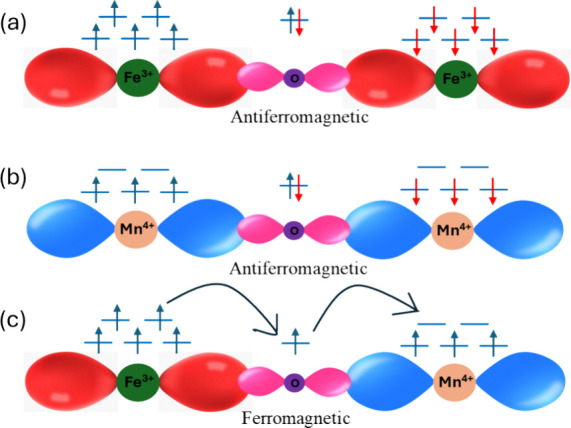
Schematic illustration showing (a, b) superexchange interactions favoring antiferromagnetic coupling and (c) double exchange interaction favoring ferromagnetic coupling between Fe and Mn ions, which is mediated via O ion lying between Fe and Mn.
The M–H curves for the ordered NdBaMnFeO6−δ perovskite, as shown in Figure 4b, reveal the absence of a hysteresis loop even at 3 K, suggesting a paramagnetic state of spin. This finding aligns well with the data reported for La0.5Ba0.5Fe0.5Mn0.5O3.6 This suggests that the structural order in the perovskite influences its magnetic properties, leading to a paramagnetic state. Iodometric titration results indicate that the average oxidation state for NdBaMnFeO6-δ is 2.59.31 Assuming that iron is in the Fe3+ state, the majority of the manganese cations appear to be in the +2 oxidation state for NdBaMnFeO6−δ, as inferred from the titration results. This suggests that the reduction of Mn4+ and Mn3+ to Mn2+ could be responsible for the differing magnetic behaviors observed between disordered Nd0.5Ba0.5Mn0.5Fe0.5O3δ/2 and structurally ordered NdBaMnFeO6−δ perovskite.
4. Conclusions
The temperature-dependent magnetic susceptibilities revealed that the disordered Nd0.5Ba0.5Mn0.5Fe0.5O3-δ/2 perovskite exhibited antiferromagnetic ordering below temperatures of T < 185 K, whereas the ordered NdBaMnFeO6-δ perovskite remained in a paramagnetic state across the entire temperature range investigated. The ZFC-FC data for Nd0.5Ba0.5Mn0.5Fe0.5O3−δ/2 indicated thermoirreversibility at temperatures below 385 K, suggesting a glassy nature arising from frustrated interactions between the ferromagnetic and antiferromagnetic states. The linear behavior observed in the M-H curves further supported the presence of antiferromagnetic ordering. However, additional comprehensive investigations are necessary to validate the occurrence of antiferromagnetic ordering and to characterize the complex spin glass behavior exhibited by the disordered compound. Future studies should aim to provide a more detailed understanding of the magnetic properties and underlying mechanisms in these materials, potentially through advanced characterization techniques and theoretical modeling.
Acknowledgments
A.H., E.A.M., and A.V.S. acknowledge the financial support by the Ministry of Science and Higher Education of the Russian Federation (State assignment in the field of scientific activity, no. FENW-2023-0019). A.R.G. and V.A.C. acknowledge financial support from the Indo-Russian project (RFBR grant No 16-53-45010). A.S. acknowledges financial support from the Indo-Russian project (INT/RUS/RFBR/P-239), the Department of Science and Technology (DST), Government of India. A.K.M.A.U. dedicates his contribution to this work to the memory of the martyrs of the July−August 2024 revolution in Bangladesh.
Author Present Address
# Max Planck Institute for Chemical Physics of Solids, 01187 Dresden, Germany
The authors declare no competing financial interest.
References
- Supriya S. Electric field assisted spark plasma sintering of ABO3 perovskites: Crystal structure, dielectric behavior and future challenges. Open Ceramics 2024, 18, 100608 10.1016/j.oceram.2024.100608. [DOI] [Google Scholar]
- Alom M. S.; Kananke-Gamage C. C. W.; Ramezanipour F. Perovskite oxides as electrocatalysts for hydrogen evolution reaction. ACS Omega 2022, 7 (9), 7444–7451. 10.1021/acsomega.1c07203. [DOI] [PMC free article] [PubMed] [Google Scholar]
- Supriya S. Crystal Structure Engineered Non-toxic Bi0.5Na0.5TiO3 Based Thin Films-Fabrication Process, Enhanced Electrical Performance, Challenges and Recent Reports. Journal of Inorganic and Organometallic Polymers and Materials 2023, 33 (10), 3013–3026. 10.1007/s10904-023-02765-y. [DOI] [Google Scholar]
- Meera M. S.; Abhirami B.; Hossain A.; Bhagya T. C.; Geethanjali C. V.; Shibli S. M. A. Development of Sustainable Catalyst Coating of Ni2P Engineered SrTiO3 Nanocubes for Hydrogen Generation. ACS Appl. Eng. Mater. 2022, 1, 530. 10.1021/acsaenm.2c00127. [DOI] [Google Scholar]
- Nakajima T.; Kageyama H.; Yoshizawa H.; Ohoyama K.; Ueda Y. Ground State Properties of the A-site Ordered Manganites, R BaMn2O6 (R= La, Pr and Nd). J. Phys. Soc. Jpn. 2003, 72 (12), 3237–3242. 10.1143/JPSJ.72.3237. [DOI] [Google Scholar]
- Dutta U.; Hossain A.; Walke P. S.; Ghosh D.; Mordvinova N. E.; Lebedev O. I.; Haque A.; Pal K.; Gayen A.; Kundu A. K.; Seikh M. M. Synthesis, structure and magnetic properties of nanodimensional La1-xBaxFe0. 5Mn0. 5O3 perovskites. J. Alloys Compd. 2019, 777, 1396–1402. 10.1016/j.jallcom.2018.11.101. [DOI] [Google Scholar]
- Hossain A.; Gilev A. R.; Yanda P.; Cherepanov V. A.; Volegov A. S.; Sakthipandi K.; Sundaresan A. Optical, magnetic and magneto-transport properties of Nd 1-xAxMn0. 5Fe0. 5O3-δ (A= Ca, Sr, Ba; x= 0, 0.25). J. Alloys Compd. 2020, 847, 156297 10.1016/j.jallcom.2020.156297. [DOI] [Google Scholar]
- Qadir I.; Singh S.; Sharma S.; Manhas U.; Atri A. K.; Singh D. New Rare Earth-Doped Bilayered Perovskite Oxide Photocatalysts Sr2La0. 5R0. 5FeMnO7 (R= La, Nd, Sm, Gd, Dy) for the Degradation of Highly Toxic Methylene Blue Dye in Wastewater under Visible Light: Structural, Optical, and Magnetic Properties. ACS Omega 2023, 8 (2), 2010–2026. 10.1021/acsomega.2c05221. [DOI] [PMC free article] [PubMed] [Google Scholar]
- Seok J.; Molina Villarino A.; Shi Z.; Yang Y.; Ahmadi M.; Muller D. A.; DiSalvo F. J.; Abruña H. D. La-Based Perovskite Oxide Catalysts for Alkaline Oxygen Reduction: The Importance of Electrochemical Stability. J. Phys. Chem. C 2022, 126 (6), 3098–3108. 10.1021/acs.jpcc.2c00108. [DOI] [Google Scholar]
- Ata S.; Shaheen I.; Aslam H.; Mohsin I. U.; Alwadai N.; Al Huwayz M.; Iqbal M.; Younas U. Barium and strontium doped La-based perovskite synthesis via sol-gel route and photocatalytic activity evaluation for methylene blue. Results Phys. 2023, 45, 106235 10.1016/j.rinp.2023.106235. [DOI] [Google Scholar]
- Gu H.; Yang G.; Hu Y.; Liang M.; Chen S.; Ran R.; Xu M.; Wang W.; Zhou W.; Shao Z. Enhancing the oxygen reduction activity of PrBaCo2O5+δ double perovskite cathode by tailoring the calcination temperatures. Int. J. Hydrogen Energy 2020, 45, 25996–26004. 10.1016/j.ijhydene.2019.12.171. [DOI] [Google Scholar]
- Humayun M.; Ullah H.; Usman M.; Habibi-Yangjeh A.; Tahir A. A.; Wang C.; Luo W. Perovskite-type lanthanum ferrite based photocatalysts: Preparation, properties, and applications. J. Energy Chem. 2022, 66, 314–338. 10.1016/j.jechem.2021.08.023. [DOI] [Google Scholar]
- Ma Y. J.; Xiao J. Y.; Zhang Q. Y.; Ma C. Y.; Jiang X. N.; Wu B. Y.; Zeng X. Y. Single-crystal perovskite LaBaCo2O6-δ micro-sensors for gas detection in humid environment. J. Alloys Compd. 2019, 801, 360–366. 10.1016/j.jallcom.2019.06.148. [DOI] [Google Scholar]
- Gu H.; Chen H.; Gao L.; Guo L. Electrochemical properties of LaBaCo2O5+δ−Sm0.2Ce0.8O1.9 composite cathodes for intermediate-temperature solid oxide fuel cells. Electrochim. Acta 2009, 54, 7094–7098. 10.1016/j.electacta.2009.07.040. [DOI] [Google Scholar]
- Pang S.; Jiang X.; Li X.; Su Z.; Xu H.; Xu Q.; Chen C. Characterization of cation-ordered perovskite oxide LaBaCo2O5+δ as cathode of intermediate-temperature solid oxide fuel cells. Int. J. Hydrogen Energy 2012, 37, 6836. 10.1016/j.ijhydene.2012.01.056. [DOI] [Google Scholar]
- Coey J. M. D.; Viret M.; Von Molnár S. Mixed-valence Manganite. Adv. Phys. 1999, 48 (2), 167–293. 10.1080/000187399243455. [DOI] [Google Scholar]
- Nazir S. Insulator-to-half metal transition and enhancement of structural distortions in Lu 2 NiIrO 6 double perovskite oxide via hole-doping. Sci. Rep. 2021, 11 (1), 1240. 10.1038/s41598-020-80265-6. [DOI] [PMC free article] [PubMed] [Google Scholar]
- Singh A.; Jain A.; Ray A.; Padmanabhan B.; Yadav R.; Nassif V.; Husain S.; Yusuf S. M.; Maitra T.; Malik V. K. Spin reorientation in NdFe 0.5 Mn 0.5 O 3: Neutron scattering and ab initio study. Phys. Rev. B 2017, 96 (14), 144420 10.1103/PhysRevB.96.144420. [DOI] [Google Scholar]
- Das R.; Chaudhuri U.; Chanda A.; Mahendiran R. Broadband electron spin resonance study in a Sr2FeMoO6 double perovskite. ACS Omega 2020, 5 (28), 17611–17616. 10.1021/acsomega.0c02070. [DOI] [PMC free article] [PubMed] [Google Scholar]
- De K.; Ray R.; Panda R. N.; Giri S.; Nakamura H.; Kohara T. The effect of Fe substitution on magnetic and transport properties of LaMnO3. J. Magn. Magn. Mater. 2005, 288, 339–346. 10.1016/j.jmmm.2004.09.118. [DOI] [Google Scholar]
- Das S.; Mali B.; Ganesan R.; Elizabeth S. Observation of griffiths phase and ferromagnetism in LaFe0. 5Mn0. 5O3. Mater. Res. Bull. 2023, 160, 112128 10.1016/j.materresbull.2022.112128. [DOI] [Google Scholar]
- Iqbal M.; Khan M. N.; Khan A. A.; Zaka I.; Mehmood A.; Ahmad I. Investigation of magnetic, magnetocaloric, and critical properties of La 0.5 Ba 0.5 MnO 3 Manganite. J. Supercond. Novel Magn. 2018, 31, 3535–3544. 10.1007/s10948-018-4603-1. [DOI] [Google Scholar]
- Troyanchuk I. O.; Bushinsky M. V.; Szymczak H.; Baran M.; Bärner K. Magnetic structure of the manganites heavily doped by Fe and Cr ions. J. Magn. Magn. Mater. 2007, 312 (2), 470–475. 10.1016/j.jmmm.2006.11.214. [DOI] [Google Scholar]
- Moritomo Y.; Asamitsu A.; Kuwahara H.; Tokura Y. Giant magnetoresistance of manganese oxides with a layered perovskite structure. Nature 1996, 380 (6570), 141–144. 10.1038/380141a0. [DOI] [Google Scholar]
- Trukhanov S. V.; Troyanchuk I. O.; Hervieu M.; Szymczak H.; Bärner K. Magnetic and electrical properties of L BaMn 2 O 6– γ (L= Pr, Nd, Sm, Eu, Gd, Tb) manganites. Phys. Rev. B 2002, 66 (18), 184424 10.1103/PhysRevB.66.184424. [DOI] [Google Scholar]
- Gilev A. R.; Kiselev E. A.; Mychinko M. Y.; Cherepanov V. A. Topotactic synthesis, crystal structure and oxygen non-stoichiometry of ordered NdBaMnFeO6-δ. Mater. Res. Bull. 2019, 113, 1–5. 10.1016/j.materresbull.2018.12.037. [DOI] [Google Scholar]
- Hezam A.; Namratha K.; Ponnamma D.; Drmosh Q. A.; Saeed A. M. N.; Sadasivuni K. K.; Byrappa K. Sunlight-driven combustion synthesis of defective metal oxide nanostructures with enhanced photocatalytic activity. ACS Omega 2019, 4 (24), 20595–20605. 10.1021/acsomega.9b02564. [DOI] [PMC free article] [PubMed] [Google Scholar]
- Supriya S. Synthesis mechanisms and effects of BaTiO3 doping on the optical properties of Bi0. 5Na0. 5TiO3 lead-free ceramics. J. Solid State Chem. 2022, 308, 122940 10.1016/j.jssc.2022.122940. [DOI] [Google Scholar]
- Supriya S., Research progress, doping strategies and dielectric-ferroelectric anomalies of rare earth-based Bi0. 5Na0. 5TiO3 perovskites. J. Rare Earths, 2023. 10.1016/j.jre.2023.10.009. [DOI] [Google Scholar]
- Gilev A. R.; Hossain A.; Kiselev E. A.; Korona D. V.; Cherepanov V. A. High-temperature studies on crystal structure, properties and electrochemical performance of Nd0. 5Ba0. 5Mn0. 5Fe0. 5O3– δ. Mater. Lett. 2019, 238, 298–300. 10.1016/j.matlet.2018.11.179. [DOI] [Google Scholar]
- Gilev A. R.; Hossain A.; Kiselev E. A.; Cherepanov V. A. A-site substitution effect on crystal structure and properties of Nd1– xAxMn0. 5Fe0. 5O3– δ (ACa, Sr, Ba; x= 0, 0.25). Solid State Ionics 2018, 323, 64–71. 10.1016/j.ssi.2018.05.012. [DOI] [Google Scholar]
- Hossain A.; Volegov A. S.; Sakthipandi K.; Kiselev E. A.; Cherepanov V. A.; Mukhanova E. A.; Soldatov A. V. Tuning of the optical and magnetic properties of Nd2Ni1-xCoxMnO6– δ (0.2≤ x≤ 0.5) perovskite by cobalt doping. Ceram. Int. 2023, 49 (17), 29229–29236. 10.1016/j.ceramint.2023.06.209. [DOI] [Google Scholar]
- Mandal P.; Bhat S. S.; Sundarayya Y.; Sundaresan A.; Rao C. N. R.; Caignaert V.; Raveau B.; Suard E. Structure and complex magnetic behavior of disordered perovskite (Bi 0.5 Sr 0.5)(Fe 0.5 Mn 0.5) O 3. RSC Adv. 2012, 2 (1), 292–297. 10.1039/C1RA00744K. [DOI] [Google Scholar]
- Biswal H.; Senapati T. R.; Haque A.; Sahu J. R. Beneficial effect of Mn-substitution on magnetic and magnetocaloric properties of La0. 5Sr0. 5CoO3 ceramics. Ceram. Int. 2020, 46 (8), 11828–11834. 10.1016/j.ceramint.2020.01.217. [DOI] [Google Scholar]
- Woodward P. M.; Suard E.; Karen P. Structural tuning of charge, orbital, and spin ordering in double-cell perovskite series between NdBaFe2O5 and HoBaFe2O5. J. Am. Chem. Soc. 2003, 125 (29), 8889–8899. 10.1021/ja034813+. [DOI] [PubMed] [Google Scholar]
- Hossain A.; Ghosh D.; Dutta U.; Walke P. S.; Mordvinova N. E.; Lebedev O. I.; Sinha B.; Pal K.; Gayen A.; Kundu A. K.; Seikh M. M. Synthesis, structure and magnetic properties of nanostructured La1– xAxFe0. 5Mn0. 5O3 (A= Ca, Sr and Pb; x= 0 & 0.25) perovskites. J. Magn. Magn. Mater. 2017, 444, 68–76. 10.1016/j.jmmm.2017.07.087. [DOI] [Google Scholar]