



Abstract
Cancer is a deadly disease that affects millions of people worldwide and is a source of great difficulty, stress, and trauma not only for patients but also for their caregivers. The physical and emotional suffering that patients experience by patients can lead their caregivers to cope with constant anxiety, sadness, and uncertainty. Moreover, during the cancer treatment process, caregivers must make a great effort to meet the needs of patients and support them. This situation may negatively affect the quality of life and psychological health of cancer patients’ caregivers and may lead them to experience trauma. The aim of this cross-sectional study was to examine posttraumatic growth’s relationship with age, the transformative power of suffering, and hope in family caregivers of cancer patients. Participants consisted of 314 Turkish family caregivers of cancer patients (73.2% women; Mage = 39.89 years) selected by using convenience sampling method. Participants answered a data collection tool consisting of a demographic information form, the Posttraumatic Growth Inventory, Trait Hope Scale, and Transformative Power of Suffering Scale. Data were analyzed using descriptive statistics, the Pearson product-moment correlation coefficient analysis, simple mediation analysis, and moderated mediation analysis. The results of this study revealed that hope mediated the association between the transformative power of suffering and posttraumatic growth in family caregivers of cancer patients, whereas age moderated this relationship. Psychosocial support programs for cancer caregivers could benefit from incorporating interventions that explore the transformative potential of suffering and cultivate hope. Tailoring these interventions to address the specific needs of different age groups may enhance their effectiveness. Future researchers should investigate the factors associated with posttraumatic growth in caregivers across diverse cultures, age ranges, and cancer diagnoses.
Keywords: Family members of cancer patients, Posttraumatic growth, Age, Transformative power of suffering, Hope
Subject terms: Psychology, Health care
Cancer is a deadly disease that affects millions of people worldwide, with significant consequences for their caregivers. According to global cancer statistics, over 19 million people were newly diagnosed with cancer worldwide, and approximately 10 million died of cancer in 20201. A significant burden of cancer is also evident in Türkiye. Data from the Turkish Ministry of Health2 indicate that an estimated 210,000 individuals received a cancer diagnosis in 2018, with cancer accounting for one in five deaths within the same period. The management and treatment of cancer can induce a range of side effects, detrimentally impacting patients’ quality of life and consequently elevating their care requirements3. Therefore, cancer can be a source of great difficulty, stress, and trauma not only for patients but also for their caregivers.
Cancer caregivers assist patients in various aspects, including providing physical, emotional, medical, and logistical support3,4. Their responsibilities encompass aiding with daily activities, monitoring patients’ health, facilitating communication with health care professionals, managing medication, providing physical care, performing household chores, mitigating treatment side effects, handling financial and insurance matters, and offering emotional and spiritual support. Research suggests that witnessing the physical and emotional suffering of cancer patients can impose considerable challenges on caregivers, such as anxiety, sadness, and uncertainty4–6. Thus, a cancer diagnosis affects not only the patient but also their family caregivers. The diagnosis and treatment processes of cancer also constitute a traumatic experience for both patients and their caregivers7. The time and effort invested, the utilization of financial and emotional resources, and the compromises in social lives can lead to a deterioration in caregivers’ quality of life5,6,8.
Cancer can disrupt a family’s identity, roles, and daily functioning, with the impact of such changes being intense and long-lasting, irrespective of the disease outcome4. Although the stress of cancer adversely affects individuals and families’ mental health, it can also facilitate the development of positive psychological changes9. Researchers have conceptualized this positive psychological transformation in cancer patient caregivers, resulting from grappling with traumatic or highly challenging life circumstances, as posttraumatic growth (PTG;10). PTG emerges from the struggle following a major life crisis, focusing on the positive changes that occur in individuals after the event, rather than reactions during the difficult event itself. These positive changes may manifest in interpersonal relationships, self-perception, and philosophy of life9,10. PTG can occur in both cancer patients and their caregivers, with studies indicating high levels of PTG among cancer patient caregivers9,11–13.
Research indicates that PTG plays a critical role in facilitating better coping with difficulties, maintaining subjective well-being, reducing caregiver burden, fostering psychological resilience, improving relationships with care recipients, facilitating self-discovery in caregivers, decreasing caregivers’ psychological distress, and promoting physical and mental health among cancer patients and their caregivers9,11,13,14. Therefore, determining the factors associated with PTG levels in caregivers of cancer patients can contribute significantly to the development of support services tailored to their needs, improving their quality of life and informing the design of caregiver training and intervention programs. These contributions may positively impact the overall health of individuals and society, assisting policymakers in realizing the goal of providing comprehensive and effective support to families affected by cancer.
One variable that may be associated with PTG in cancer patient caregivers is the transformative power of suffering. Suffering involves enduring something unpleasant and inappropriate15, a state of significant distress individuals feel under threat and persisting until the threat is eliminated or the person’s entirety is restored16. For a situation to be considered suffering, it must hold profound meaning for the individual, interfering with other activities and affecting their enjoyment of life during that period17. Becoming stronger through suffering necessitates a reevaluation of the self after distressing events, with the individual understanding this new sense of self in light of the difficult and painful losses experienced18. The transformative power of suffering refers to the potential for personal growth, development, and positive change resulting from suffering, rooted in various philosophical, psychological, and religious traditions that suggest enduring hardship, pain, or suffering can lead to better self-understanding, increased empathy and compassion, meaning-making, personal growth, and a reassessment of values and priorities18,19. Therefore, the transformative power of suffering may relate to PTG levels among cancer patient caregivers, with studies indicating a positive association between these constructs among clinical and nonclinical samples20,21.
Another variable potentially related to PTG levels in family caregivers of cancer patients is hope. Hope is the anticipation of positive outcomes or the expectation that potentially harmful or negative circumstances will either not occur or will eventually lead to a favorable situation22. Hope is expressed as a positive feeling and perception that desired goals are achievable and plays an important role in psychological adaptation to challenging life events such as loss and sickness23. It is a feature that helps individuals cope with stressful situations, such as caring for cancer patients, and is an essential element of motivation for achieving goals24,25. Higher levels of hope can facilitate the reevaluation of negative situations and the development of alternative and meaningful goals26. When faced with a problematic situation, hopeful individuals can predict obstacles and produce alternative solutions23. Research suggests that hope plays a crucial role in improving physical and psychological conditions, increasing quality of life, and combating stress26, with more realistic hope being more effective and efficient in problem-solving7. Researchers have found a positive association between higher levels of hope and PTG among patients and caregiver samples7,12,24.
Mediation analysis is a multivariate statistical technique researchers use to examine the effect of an independent variable on a dependent variable through a mediating variable or variables27. This statistical method provides researchers with a deeper understanding of the underlying processes and mechanisms through which the independent variable influences the dependent variable. In the context of the present study, hope may serve as a mediating variable, elucidating how and under what conditions the transformative power of suffering impacts PTG among cancer patient caregivers. Moderated mediation analysis is another statistical technique researchers employ to investigate the process by which an independent variable affects the dependent variable through a mediating variable, while also examining the role of a moderator that may influence the strength and direction of the mediation effect. This analysis allows for the identification of specific levels of the moderator variable at which the mediating effect occurs27. Research indicates that age is a crucial factor in cognitive and emotional development28. Therefore, age may modulate how individuals respond to and process suffering. With increasing age, individuals may exhibit enhanced capacities for introspection, psychological resilience, and meaning-making. Consequently, older individuals may be better equipped to integrate challenging caregiving experiences into their lives compared to their younger counterparts. Despite their suffering, their levels of hope may increase, potentially leading to greater PTG. In this study we aim to examine the mediating effect of hope and the moderating effect of age on the relationship between the transformative power of suffering and PTG in family caregivers of cancer patients. In line with this purpose, we formulated and tested the following research hypotheses in this study:
The transformative power of suffering will be positively associated with hope in family caregivers of cancer patients.
Hope will be positively associated with PTG in family caregivers of cancer patients.
The transformative power of suffering will be positively associated with PTG in family caregivers of cancer patients.
Hope will mediate the relationship between the transformative power of suffering and PTG in family caregivers of cancer patients.
Age will moderate the mediating effect of hope in the relationship between the transformative power of suffering and PTG in family caregivers of cancer patients.
Method
Research design
In this study we employed a cross-sectional research design to investigate the associations between PTG, age, the transformative power of suffering, and hope in family caregivers of cancer patients. PTG served as the dependent variable and the transformative power of suffering as the independent variable. We investigated hope as a potential mediating variable and age as a moderating variable.
Participants
We conducted a priori power analysis to determine the minimum sample size we needed to detect a medium effect size (R2 = 0.13) with a power of 0.99 and a significance level of 0.01, considering the inclusion of three independent variables in moderated mediation analysis. We calculated the minimum required sample size to be 205 in this study29. To better represent the sample and account for possible missing values, we aimed to recruit a minimum of 300 participants. We recruited 314 family caregivers of cancer patients using convenience sampling. Among the participants, a significant proportion of caregivers (n = 130; 41.4%) were providing care for individuals admitted to the Hematology Service at Çanakkale Mehmet Akif Ersoy State Hospital. We recruited the remaining caregivers through social media platforms and forums (e.g., Facebook, Instagram, and X) targeting family caregivers (n = 184; 58.6%).
Measures
Demographic characteristics
We used the demographic information form that the researchers developed to obtain information about the participants’ gender, age, education level, and degree of closeness to the person diagnosed with cancer.
PTG
The Post Traumatic Growth Inventory (PTGI) developed by Tedeschi and Calhoun30 was used to assess positive psychological changes experienced following a stressful life event. Kağan et al.31 conducted the scale’s adaptation, validity, and reliability studies into Turkish. The PTGI consists of 21 items. Participants rate each item using a 6-point Likert-type scale (0 = I did not experience this change as a result of my crisis to 5 = I experienced this change to a very great degree as a result of my crisis). Possible total scores range from 0 to 105, with higher scores indicating greater perceived PTG. The internal consistency of Cronbach’s alpha of PTGI that Tedeschi and Calhoun30 reported in an adult sample was 0.90. The reliability value of Cronbach’s alpha that we calculated in this study was 0.94, indicating a very high degree of internal consistency among the items on the scale32. A sample item from the PTGI is ‘‘I changed my priorities about what is important in life.’’
The transformative power of suffering
Transformative Power of Suffering Scale (TPSS; Joshanloo33) was employed to assess participants’ beliefs regarding the potential of suffering to contribute to positive psychological development and maturation. Di̇nçer et al.34 conducted the TPSS’s adaptation, validity, and reliability studies into Turkish. The TPSS is a unidimensional scale comprising five items each rated on a 7-point Likert-type scale (1 = strongly disagree to 7 = strongly agree). Possible total scores can range from 5 to 35, with higher scores indicating a stronger belief in the transformative power of suffering. The scale’s reliability coefficient of Cronbach’s alpha that Joshanloo33 reported in two different university student samples ranged from 0.69 to 0.73. The reliability coefficient of the TPSS that we calculated in this study was 0.83, indicating a high degree of internal consistency among the items on the scale32. A sample item from the scale is “If suffering is taken with patience and gratitude, it gets converted to happiness.”
Hope
The Dispositional Hope Scale (DHS; Snyder et al.25) was employed to measure the hope levels of the participants. Tarhan and Bacanlı35 conducted the adaptation, validity, and reliability studies of the scale into Turkish. The DHS comprises 12 items, among which four are filler items not used in scoring. Participants respond to each item on an 8-point Likert scale ranging from 1 (definitely false) to 8 (definitely true). Possible total scores range from 8 to 64, with higher scores indicating greater dispositional hope. Snyder et al.25 reported that the internal consistency coefficient of the scale in eight different samples ranged from 0.74 to 0.84. The scale’s reliability coefficient of Cronbach’s alpha that we calculated in this study was 0.86, indicating a high level of internal consistency among the items on the scale32. A sample item from the DHS is “I can think of many ways to get out of a jam.”
Procedure
Prior to commencing the study, ethical approval was obtained from the Çanakkale University Social and Human Sciences Research Ethics Committee. We collected data over 6 months through self-report measures administered face-to-face or online to family caregivers of cancer patients. To assess the applicability and clarity and identify potentially ambiguous items in the measures, we conducted a pilot study with six family caregivers of cancer patients. All participants reported no difficulties in understanding the questionnaire items. They completed a questionnaire packet consisting of a brief cover letter explaining the study’s aim, a written informed consent form, and a copy of the measures. We gathered face-to-face research data from family caregivers of cancer patients seeking treatment at Çanakkale Mehmet Akif Ersoy State Hospital. In accordance with ethical research principles, we informed participants about confidentiality, the right to withdraw, the study’s purpose and significance, and the voluntary nature of participation. We obtained informed consent from all participants before data collection. They voluntarily took part in the study. The time required to complete the questionnaire ranged from 10 to 15 min.
Statistical analysis
All statistical analyses were performed with IBM SPSS 23 data analysis software. We performed preliminary analyses to assess the accuracy of variables, missing values, univariate and multivariate outliers, and assumptions of correlation, simple mediation, and moderated mediation analysis36,37. We evaluated the accuracy of variables by examining the minimum and maximum values and frequency distributions, ensuring all variables fell within the expected range. However, we regrouped the education level variable based on the frequency distributions. Because online data collection involved mandatory responses and face-to-face administrations that the researcher checked, we found no missing values in the data set. We identified univariate outliers using the z-score criterion and detected multivariate outliers through Cook’s distance values. We found no univariate or multivariate outliers in the data set36,37.
Descriptive statistics were used to provide information about the sociodemographic characteristics of the participants. Pearson product-moment correlation analysis (point-biserial correlation analysis for dichotomous variables such as gender, caregiver status, and education level) was conducted to determine the strength and direction of the linear relationship between gender, age, education level, caregiver status (mother, father, sibling, spouse), the transformative power of suffering, hope, and PTG. The point-biserial correlation coefficient is a specific form of the Pearson product-moment correlation coefficient, employed to measure the strength and direction of the association between a continuous variable and a dichotomous variable38. We dichotomized the caregiver status (mother, father, sibling, or spouse) as nominal variables and entered it as a dummy variable for correlation and mediation analyses, with spousal caregivers serving as the reference category in mediation analyses. For example, we operationalized maternal caregiving status as a dichotomous variable (0 = non-caregiver, 1 = caregiver for mother) in correlation and mediation analyses. A simple mediation analysis (Model 4; Hayes27) was conducted to investigate the mediating role of hope in the relationship between the transformative power of suffering and PTG. Subsequently, a moderated mediation analysis (Model 7; Hayes27) was performed to examine whether the potential indirect effect of the transformative power of suffering on PTG through hope varied as a function of age. We used gender, education level, and caregiver status as control variables in mediation analyses.
Simple mediation analysis and moderated mediation analysis were conducted using PROCESS 4.2 for SPSS27. We evaluated the significance of indirect effects using 95% bias-corrected bootstrap confidence intervals based on 10,000 bootstrap samples27,36. We mean-centered age and the transformative power of suffering for the moderated mediation analysis. Mean-centering predictor variables prior to testing interaction effects is a recommended practice to mitigate multicollinearity issues36,37. This procedure does not alter the unstandardized or standardized regression coefficients, standard errors, or significance tests associated with the regression model27,37. A significant indirect effect was indicated by the absence of zero in the 95% bootstrap confidence intervals in both the simple mediation and moderated mediation analysis27. If the moderation effect of age was significant, we conducted simple slope analyses and Johnson-Neyman significance region analyses to identify the specific age groups where the moderating effect was prominent. We also performed preliminary analyses to examine the assumptions of normality, linearity, homoscedasticity in relevant analyses, and found them to be met36,37. Data underlying this article are available from the Open Science Framework (osf.io/dz2s3). We employed Cohen’s39 effect size classification to interpret the correlation coefficients and the proportion of explained variance in both the simple and moderated mediation analysis. We used a significance level of p ˂ 0.05 for all inferential statistics.
Results
Family caregiver characteristics
Of the 314 family caregivers, 230 (73.2%) were women and 84 (26.8%) were men. The age of caregivers ranged from 18 to 73 years, with a mean age of 39.89 years (SD = 10.45). Regarding caregiving responsibilities, 142 (45.2%) were caring for mothers, 110 (35.0%) were caring for fathers, 41 (13.1%) were caring for siblings, and 21 (6.7%) were caring for spouses. With regard to education level, 83 (26.4%) family caregivers had attained an associate degree or lower, whereas 231 (73.6%) family caregivers held a bachelor’s degree or higher.
Pearson product-moment correlation coefficient analyses
Table 1 shows the results of the Pearson product-moment correlation coefficient and descriptive statistics including the minimum, maximum, mean, and standard deviation of the study variables. As shown in Table 1, being a caregiver to the mother (r = 0.12), the transformative power of suffering (r = 0.26), hope (r = 0.24), and the transformative power of suffering and age interaction scores (r = 0.26) are weakly and positively associated with PTG scores, whereas gender (r = -0.12) is weakly and negatively associated with PTG scores. In addition, a weak and positive correlation exists between the transformative power of suffering and hope (r = 0.16) and between hope and the interaction of the transformative power of suffering and age (r = 0.20) among family caregivers of cancer patients. These findings suggest that women caregivers, individuals caring for their mothers, and those with higher levels of hope and belief in the transformative power of suffering tend to have higher levels of PTG compared to their counterparts. Additionally, stronger belief in the transformative power of suffering is associated with higher levels of hope among family caregivers of cancer patients.
Table 1.
Results of Pearson product-moment correlation coefficient analyses.
| 1 | 2 | 3 | 4 | 5 | 6 | 7 | 8 | 9 | 10 | 11 | |
|---|---|---|---|---|---|---|---|---|---|---|---|
| 1. PTG | |||||||||||
| 2. Gender | − 0.12* | ||||||||||
| 3. Age | 0.05 | 0.03 | |||||||||
| 4. Level of education | − 0.10 | − 0.11* | − 0.17** | ||||||||
| 5. Mother | 0.12* | − 0.17*** | − 0.18** | − 0.02 | |||||||
| 6. Father | − 0.05 | 0.08 | − 0.09 | 0.09 | − 0.67*** | ||||||
| 7. Sibling | − 0.05 | 0.04 | 0.12* | 0.06 | − 0.35*** | − 0.29*** | |||||
| 8. Spouse | − 0.08 | 0.13* | 0.36*** | − 0.22*** | − 0.24*** | − 0.20*** | − 0.10 | ||||
| 9. The transformative power of suffering | 0.26*** | − 0.01 | − 0.07 | − 0.06 | 0.06 | 0.03 | − 0.07 | − 0.10 | |||
| 10. Hope | 0.24*** | − 0.04 | 0.08 | − 0.05 | 05 | 0.04 | − 0.10 | 0.10 | 0.16** | ||
| 11. Age × the transformative power of suffering | 0.26*** | − 0.01 | 0.52*** | − 0.15** | − 0.05 | − 0.02 | 0.02 | 0.09 | 0.79*** | 0.20*** | |
| Mean | 52.96 | 0.27 | 39.89 | 0.74 | 0.45 | 0.35 | 0.13 | 0.07 | 22.23 | 49.44 | 881.09 |
| Standard deviation | 21.63 | 0.44 | 10.45 | 0.44 | 0.50 | 0.48 | 0.34 | 0.25 | 7.75 | 8.24 | 397.73 |
| Minimum | 0.00 | 0.00 | 18.00 | 0.00 | 0.00 | 0.00 | 0.00 | 0.00 | 15.00 | 5.00 | 125.00 |
| Maximum | 105.00 | 1.00 | 73.00 | 1.00 | 1.00 | 1.00 | 1.00 | 1.00 | 64.00 | 35.00 | 2170.00 |
We coded the gender variable as 0 = women, 1 = men. We denote the education level variable as 0 = associate degree or below, 1 = bachelor’s degree and above. In the mother variable, 0 = those who do not care for their mothers, 1 = those who care for their mothers. In the father variable, 0 = those who do not provide care to their father, 1 = those who provide care to their father. In the sibling variable, 0 = those who do not provide care to their sibling, 1 = those who provide care to their sibling. In the spouse variable, 0 = those who do not provide care to their spouse, 1 = those who provide care to their spouse. p < 0.05*, p < 0.01**, p < 0.001***.
Simple mediation analysis
Table 2 presents the results of the simple mediation analysis conducted to examine the mediating role of hope in the relationship between the transformative power of suffering and PTG among family caregivers of cancer patients.
Table 2.
Results of PTG simple mediation analysis.
| B | SE | t | p | 95% Confidence interval | ||
|---|---|---|---|---|---|---|
| LL | UL | |||||
| Model components | ||||||
| The transformative power of suffering → hope | 0.17 | 0.06 | 2.84 | 0.005** | 0.05 | 0.29 |
| Hope → PTG | 0.53 | 0.14 | 3.74 | 0.001*** | 0.25 | 0.81 |
| Direct effect | ||||||
| The transformative power of suffering → PTG | 0.59 | 0.15 | 3.86 | 0.001*** | 0.29 | 0.88 |
| Indirect effect | ||||||
| The transformative power of suffering → hope → PTG | 0.09 | 0.05 | 0.01 | 0.20 | ||
| Total effect | ||||||
| The transformative power of suffering → PTG | 0.68 | 0.15 | 4.42 | 0.001*** | 0.38 | 0.98 |
We included gender, education level, and caregiver status (mother, father, sibling, spouse) in the analysis as control variables. We used spousal caregiver status as the reference category in the caregiver status variable. LL = lower limit of 95% confidence interval, UL= upper limit of 95% confidence interval. We calculated 95% confidence interval lower and upper limits of indirect effect using percentile bootstrap confidence intervals based on 10,000 bootstrap samples, p < .01**, p < .001***.
As shown in Table 2, the total effect of the transformative power of suffering on PTG was statistically significant (B = 0.68, SE = 0.15, p ˂ 0.001, 95% CI = [0.38, 0.98]). Furthermore, the direct effect of the transformative power of suffering on PTG remained statistically significant when family caregivers’ hope and sociodemographic factors were controlled (B = 0.59, SE = 0.15, p < 0.001, 95% CI = [0.29, 0.88]). Finally, the indirect effect of the transformative power of suffering on PTG through hope was also statistically significant (B = 0.09, SE = 0.05, 95% CI = [0.01, 0.20]) because the 95% confidence interval does not include zero. Hope explains approximately 13% of the total effect of the transformative power of suffering on PTG. Furthermore, the simple mediation regression model had a low effect size and explained approximately 10% of the changes in PTG scores (F (6, 307) = 5.64, ΔR2 = 0.10, p ˂ 0.001). The results of the mediation analysis suggest that hope plays a mediating role in the relationship between the transformative power of suffering and PTG among family caregivers of cancer patients. Specifically, an increase in belief in the transformative power of suffering is associated with higher levels of hope, which in turn are associated with increased PTG among family caregivers of cancer patients.
Moderated mediation analysis
Table 3 presents the results of the moderated mediation analysis conducted to examine the conditional effect of age on the mediating role of hope in the relationship between the transformative power of suffering and PTG.
Table 3.
The results of moderated mediation analysis.
| B | SE | t | p | 95% Confidence Interval | ||
|---|---|---|---|---|---|---|
| LL | UL | |||||
| PTG (R2 = 0.14) | ||||||
| Model components | ||||||
| The transformative power of suffering x age → hope | 0.02 | 0.01 | 2.65 | 0.008** | 0.00 | 0.03 |
| Young adult (29.43; − 1 SD) | − 0.02 | 0.09 | − 0.27 | 0.788 | − 0.21 | 0.16 |
| Middle-aged adults (39.89; Mean age) | 0.14 | 0.06 | 2.28 | 0.023* | 0.02 | 0.26 |
| Older adults (50.34; + 1 SD) | 0.30 | 0.08 | 3.93 | 0.001*** | 0.15 | 0.45 |
| Hope → PTG | 0.53 | 0.14 | 3.74 | 0.001*** | 0.25 | 0.81 |
| Results of Johnson–Neyman analyses | ||||||
| Conditional effect of the transformative power of suffering on hope at different values of the age | ||||||
| 18.00 | − 0.21 | 0.15 | − 0.1.33 | 0.184 | − 0.51 | 0.10 |
| 20.75 | − 0.16 | 0.14 | − 1.16 | 0.246 | − 0.44 | 0.11 |
| 23.50 | − 0.12 | 0.12 | − 0.95 | 0.342 | − 0.36 | 0.13 |
| 26.25 | − 0.08 | 0.11 | − 0.68 | 0.495 | − 0.29 | 0.14 |
| 29.00 | − 0.03 | 0.10 | 0.33 | 0.739 | − 0.22 | 0.16 |
| 31.75 | 0.01 | 0.08 | 0.13 | 0.900 | − 0.16 | 0.18 |
| 34.50 | 0.05 | 0.07 | 0.73 | 0.468 | − 0.09 | 0.20 |
| 37.25 | 0.10 | 0.07 | 1.48 | 0.141 | − 0.03 | 0.23 |
| 38.87 | 0.12 | 0.06 | 1.97 | 0.050* | 0.00 | 0.24 |
| 40.00 | 0.14 | 0.06 | 2.32 | 0.021* | 0.02 | 0.26 |
| 42.75 | 0.18 | 0.06 | 3.08 | 0.002** | 0.07 | 0.30 |
| 45.50 | 0.23 | 0.06 | 3.61 | 0.001*** | 0.10 | 0.35 |
| 48.25 | 0.27 | 0.07 | 3.87 | 0.001*** | 0.13 | 0.41 |
| 51.00 | 0.31 | 0.08 | 3.93 | 0.001*** | 0.16 | 0.47 |
| 53.75 | 0.36 | 0.09 | 3.91 | 0.001*** | 0.18 | 0.53 |
| 56.50 | 0.40 | 0.10 | 3.84 | 0.001*** | 0.19 | 0.60 |
| 59.25 | 0.44 | 0.12 | 3.76 | 0.001*** | 0.21 | 0.67 |
| 62.00 | 0.49 | 0.13 | 3.68 | 0.001*** | 0.22 | 0.75 |
| 64.75 | 0.53 | 0.15 | 3.60 | 0.001*** | 0.24 | 0.82 |
| 67.50 | 0.57 | 0.16 | 3.53 | 0.001*** | 0.25 | 0.89 |
| 70.25 | 0.61 | 0.18 | 3.47 | 0.001*** | 0.27 | 0.96 |
| 73.00 | 0.66 | 0.19 | 3.42 | 0.001*** | 0.28 | 1.04 |
| Direct effect | ||||||
| The transformative power of suffering → PTG | 0.59 | 0.15 | 3.86 | 0.001*** | 0.29 | 0.88 |
| Conditional indirect effect | ||||||
| The transformative power of suffering → hope → PTG | ||||||
| Young Adult (29.43; − 1 SD) | − 0.01 | 0.05 | − 0.13 | 0.09 | ||
| Middle-aged adults (39.89; Mean age) | 0.07 | 0.04 | 0.00 | 0.17 | ||
| Older adults (50.34; + 1 SD) | 0.16 | 0.07 | 0.03 | 0.33 | ||
We included gender, education level, and caregiver status (mother, father, sibling, spouse) in the analysis as control variables. We used spousal caregiver status as the reference category in the caregiver status variable. LL = lower limit of 95% confidence interval, UL = upper limit of 95% confidence interval. We calculated 95% confidence interval lower and upper limits of indirect effect using percentile bootstrap confidence intervals based on 10,000 bootstrap samples. p < 0.05*, p < 0.01**, p < 0.001***.
As shown in Table 3, the results of moderated mediation analysis revealed that the interaction between the transformative power of suffering and age was a significant positive predictor of hope (B = 0.02, SE = 0.01, p < 0.01, 95% CI = [0.00, 0.03]). We conducted simple slope analyses to examine the nature of this interaction further. Simple slope analyses indicated that the transformative power of suffering is not a significant predictor of hope among young adult family caregivers of cancer patients (− 1 SD below age; B = − 0.02, SE = 0.09, p > 0.05, 95% CI = [0.00, 0.03]). However, for middle-aged (Mean age; B = 0.14, SE = 0.06, p < 0.05, 95% CI = [0.02, 0.26]) and older caregivers (+ 1 SD above age; B = 0.30, SE = 0.08, p < 0.001, 95% CI = [0.15, 0.41]), the transformative power of suffering emerged as a significant positive predictor of hope (Fig. 1).
Fig. 1.
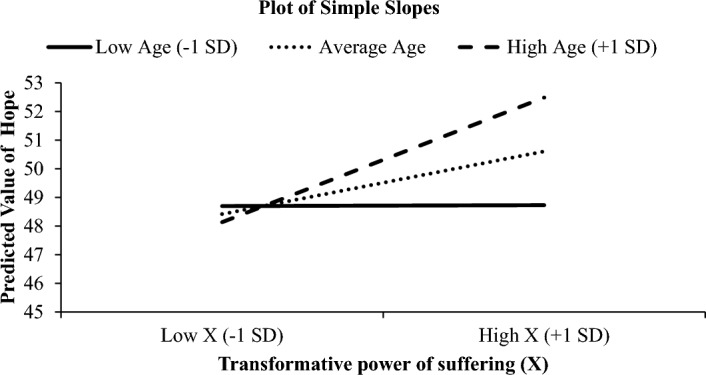
Results of simple slope analyses.
Moreover, Johnson-Neyman analysis revealed that the relationship between the transformative power of suffering and hope strengthened with increasing age, becoming statistically significant from approximately 39 years old (Fig. 2). Consistent with this finding, the index of moderated mediation was significant (B = 0.008, SE = 0.004, 95% CI = [0.001, 0.02]). These results indicate that the indirect effect of the transformative power of suffering on PTG through hope varies as a function of age.
Fig. 2.
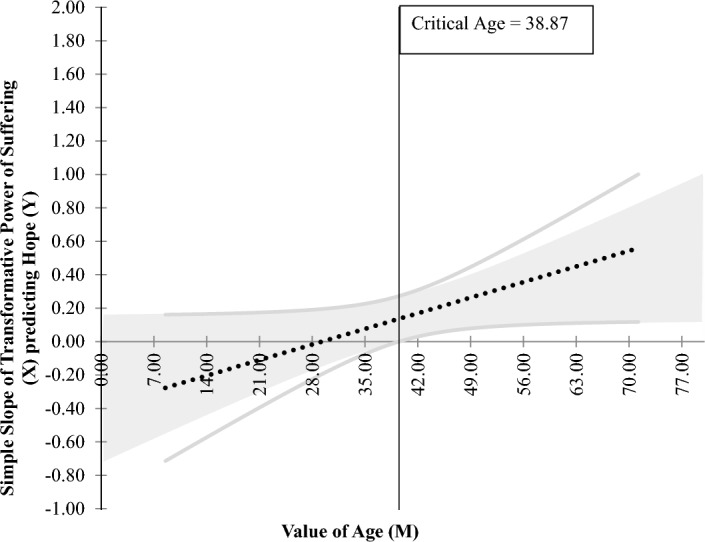
Results of Johnson–Neyman analyses.
Further analysis demonstrated variability in the conditional mediating effect of the transformative power of suffering across different age groups. As shown in Table 3, the conditional mediating effect of the transformative power of suffering was nonsignificant in one standard deviation below the mean age (B = − 0.01, SE = 0.06, 95% CI = [− 0.13, 0.09]), but significant at the mean age (B = 0.07, SE = 0.04, 95% CI = [0.00, 0.18]) and one standard deviation above the mean age (B = 0.16, SE = 0.07, 95% CI = [0.04, 0.32]). Additionally, pairwise contrast analyses of the conditional indirect effects demonstrate that the mediation effect of hope is significantly higher in older adults compared to middle-aged adults (Contrast = 0.19, SE = 0.10, 95% CI = [0.02, 0.43]), and young adults (Contrast = 0.10, SE = 0.05, 95% CI = [0.01, 0.21]). In addition, in middle-aged adults, the mediating effect of hope was significantly higher than in young adults (Contrast = 0.10, SE = 0.05, 95% CI = [0.01, 0.21]). The moderated mediation regression model had a moderate effect size and accounted for approximately 14% of the variance in PTG scores (F (7, 306) = 7.03, ΔR2 = 0.14, p ˂ 0.001).
The results of the moderated mediation analysis suggest that hope serves as a mediator in the relationship between the transformative power of suffering and PTG among caregivers of cancer patients, with age acting as a moderator variable. Specifically, an increase in belief in the transformative power of suffering among middle-aged and older adults is associated with higher levels of hope, which in turn are linked to increased PTG. However, hope does not play a mediating role in the relationship between the transformative power of suffering and PTG among young adults.
Discussion
In this study we examined the mediating role of hope and the moderating effect of age in the relationship between the transformative power of suffering and PTG among family caregivers of cancer patients. Consistent with our first research hypothesis, results of this study indicated that the transformative power of suffering positively associated with hope in family caregivers of cancer patients. Although researchers have not directly explored this relationship in the caregiving context, study findings are consistent with predictions of hope theory and logotherapy as well as Turkish society’s cultural underpinnings. According to hope theory, when faced with adversities such as caring for a cancer patient, individuals can uncover their latent strengths, develop new skills and abilities, and utilize their existing resources in novel ways26. Logotherapy posits that caregivers can reframe their experiences with cancer patients as opportunities for love, compassion, and personal growth, thereby creating a positive narrative around their patients’ suffering40,41. This positive reframing may shape caregivers’ perspectives and enhance their levels of hope by focusing on the meaningful aspects of their caregiving role.
In the Turkish cultural context, influenced by Islamic beliefs, the concepts of submission to God’s will and patience may shed light on the relationship between the transformative power of suffering and hope. Islamic teachings emphasize that ease and hardship are tests from God42, view suffering as a trial from God, and encourage believers to exercise patience and trust in God’s wisdom and mercy. Suffering can also serve as a means of purification, forgiveness, and reward in the hereafter. Although Islam encourages believers to seek relief from suffering through prayer, charity, and medical treatment, it also emphasizes accepting God’s judgment with contentment and gratitude. Accepting suffering as part of God’s divine plan (lillah) can foster patience and enable caregivers to overcome difficulties with hope and confidence. This sense of acceptance does not negate cancer caregivers’ efforts but can increase their sense of hope by reframing their experiences in accordance with God’s will.
Results of this study suggest that a positive association exists between hope and PTG levels among cancer patient caregivers. These findings are consistent with our research hypothesis as well as previous studies conducted across different patient groups and their caregivers7,12,24. For example, Byra24 found that basic hope is positively associated with PTG among spinal cord patients. Similarly, Nouzari et al.7 reported that hope is a significant positive predictor of PTG among family caregivers of cancer patients. Hope is a critical personality trait that enables individuals to respond adaptively to novel situations and conditions that challenge their existing beliefs24,25. It serves as a crucial resource for psychological adaptation, empowering individuals in the aftermath of traumatic experiences26. Furthermore, in the face of challenging life circumstances and adversities, higher levels of hope help individuals to solve problems effectively, reappraise distressing events, and seek alternative solutions by diverting attention from the trauma and its negative consequences23. Consequently, hope can foster the belief that positive outcomes are attainable despite the challenges that cancer patient caregivers face, encouraging them to seek opportunities for growth and development. Thus, hope may play a crucial role in facilitating the positive psychological changes that cancer patient caregivers experience and can contribute positively to their PTG levels.
We found a positive association between the transformative power of suffering and PTG in family caregivers of cancer patients. These findings are consistent with our research hypothesis as well as previous studies conducted with nurses and mental health professionals, which demonstrated a positive relationship between the transformative power of suffering and PTG20,21. For instance, Sarıalioğlu et al.20 reported that the transformative power of suffering was a significant positive predictor of PTG in nurses diagnosed with COVID-19. However, we extend these previous findings to a new population, suggesting that the relationship between the transformative power of suffering and PTG is generalizable to family caregivers of cancer patients. Research indicates that when individuals encounter painful experiences, they often engage in a meaning-making process by attributing positive meanings to these experiences40,43. The experience of caring for a loved one with cancer may serve as a catalyst that facilitates PTG by enabling caregivers to derive a positive sense of meaning and purpose from their caregiving role. This meaning-making process may involve perceiving their suffering as an opportunity for personal growth, strengthening connections with others, or developing a greater appreciation for life, which in turn can lead to higher PTG among family caregivers of cancer patients.
In this study we identified hope as a mediating variable in the relationship between the transformative power of suffering and PTG. The findings suggest a positive association between caregivers’ belief in the transformative power of suffering and their levels of hope, which in turn, is positively linked to greater PTG. In other words, caregivers who maintain a hopeful outlook are more likely to experience meaningful growth from challenging caregiving experiences. These results align with numerous studies demonstrating the role of hope as a mediator or potential correlate in enhancing coping skills, improving psychological resilience and adaptation, promoting mental and emotional well-being, and enhancing quality of life across various patient and caregiver populations44–47. Hope may facilitate caregivers’ ability to reframe their painful experiences and focus on positive aspects, such as learning, developing compassion, or cultivating a greater appreciation for life26. Within the Turkish cultural context, influenced by Islamic teachings, the concepts of patience (sabır) and belief in divine destiny (kader) may facilitate caregivers’ meaning-making processes, enabling them to find acceptance and purpose in their painful caregiving experiences, which could consequently enhance their levels of hope and promote PTG.
Finally, we identified age as a moderating factor in the mediating role of hope in the relationship between the transformative power of suffering and PTG among cancer patient caregivers. Specifically, an increased belief in the transformative power of suffering was positively associated with higher levels of hope, which in turn, were positively linked to greater PTG in middle-aged and older caregivers. However, we did not observe this mediating role of hope among young adult caregivers. Furthermore, the positive association between the transformative power of suffering and hope became significant from approximately 39 years of age. Research indicates that participation in religious activities and religious beliefs tends to increase with advancing age across various religions48,49, and Türkiye is no exception50. Consequently, middle-aged and older adults’ deepening religious beliefs may provide them with a framework for coping with and understanding suffering. Within the Islamic context, life is viewed as a test and trial, and suffering is considered a means of purification and personal growth. Islamic teachings emphasize that suffering can serve as a catalyst for growth and an opportunity for submission to God’s will. Additionally, these teachings encourage individuals to seek God’s mercy, guidance, and support during times of suffering42. Such religious beliefs may serve as a powerful source of hope for middle-aged and older adults, enabling them to find meaning in their experiences of suffering and maintain a positive outlook on life.
Limitations
The present study is subject to several limitations that warrant consideration when interpreting the research findings. First, the sample mostly consisted of female caregivers of adult cancer patients with various types of cancer living in Türkiye. It is also important to note that our sample did not include any parents caring for children with cancer. Therefore, the generalizability of the findings to caregivers of specific cancer types (e.g., lung, liver, pancreatic, colon), male caregivers, nonfamilial caregivers, and parents caring for children with cancer may be limited. Additionally, although the sample size exceeded the calculated minimum requirement for this study, future research could benefit from a more rigorous sample selection process to enhance the study population’s representativeness. Second, although we examined age as a moderator and hope as a mediator in the relationship between the transformative power of suffering and PTG, we did not investigate other potential moderators or mediators. The focus on only one moderating and one mediating variable limits the comprehensive understanding of the complex relationships among these constructs. Future researchers could explore additional mediating and moderating roles of variables such as the care recipient’s cancer stage, cancer type, religiosity level, coping strategies, perceived social support, and sense of meaning in life in the context of PTG among cancer caregivers. Third, the use of self-report questionnaires to assess hope, the transformative power of suffering, and PTG in this study introduces inherent limitations associated with using self-report measures, such as social desirability, response bias, and memory and feeling influences. Finally, the cross-sectional design of the study precludes the establishment of causal relationships among the examined variables.
Practical implications
Despite the aforementioned limitations, our findings have important practical implications for policymakers, health care professionals, and mental health practitioners in identifying individuals at risk and developing effective intervention services for caregivers of cancer patients. Because PTG is a critical psychological construct that can enhance cancer caregivers’ well-being, identifying those with low levels of PTG is essential in safeguarding their mental health. The results suggest that middle-aged and older caregivers with low levels of hope and belief in the transformative power of suffering may be at risk for diminished PTG. Health care providers and researchers can utilize this information to develop screening tools for early identification of family caregivers of cancer patients at risk.
Although existing research has demonstrated the positive effects of psychosocial interventions for caregivers in reducing psychological distress, burden, and improving quality of5,6,8, there is a lack of consensus on the components of effective interventions. Our findings suggest that age-specific psychosocial interventions targeting PTG may be beneficial. For middle-aged and older caregivers, incorporating activities related to the transformative power of suffering and hope could potentially enhance the effectiveness of such interventions.
Mental health professionals can also facilitate PTG in middle-aged and older cancer caregiver clients by implementing interventions focused on fostering hope and recognizing the transformative potential of suffering. They could employ cognitive behavioral techniques, such as positive reframing, to increase hope and help caregivers perceive challenges as opportunities for growth and learning51. Additionally, mental health professionals can give caregivers expressive writing assignments, such as journal writing exercises, to encourage them to discover meaning and purpose in their negative experiences and recognize how their caregiving experiences contribute to personal development52.
Furthermore, mental health professionals can use mindfulness-based exercises to assist caregivers to accept their painful experiences without negative emotions and to promote a nonjudgmental attitude toward their thoughts and feelings52. The research findings also indicate that policymakers should consider promoting initiatives aimed at helping caregivers find meaning and purpose in their roles. Additionally, policymakers could facilitate the development of age-specific PTG interventions and training programs for cancer caregivers. Such initiatives should incorporate activities designed to enhance hope and facilitate the recognition of the transformative power of suffering.
Conclusion
The present study investigated the mediating role of hope and the moderating effect of age in the relationship between the transformative power of suffering and PTG among family caregivers of cancer patients. The findings revealed positive associations between the transformative power of suffering, hope, and PTG in this population. Furthermore, hope emerged as a mediator in the relationship between the transformative power of suffering and PTG, whereas age moderated this mediating effect. These results may contribute to our understanding of factors associated with PTG in cancer caregivers within predominantly Muslim countries, such as Türkiye. Future researchers should explore other potential mediators and moderators related to PTG among caregivers of patients with different cancer types. Examining variables such as cancer stage, religiosity, coping strategies, perceived social support, and sense of meaning in life could provide valuable insights into the complex interplay of factors influencing PTG in caregiving contexts. Longitudinal studies are also necessary to establish causal relationships and elucidate these associations’ temporal dynamics.
Informed consent
Online or written informed consent was obtained from all individual participants included in this study.
Ethical approval
All procedures performed in this study were in accordance with the ethical standards of the institutional and/or national research committee and with the 1964 Declaration of Helsinki and its later amendments or comparable ethical standards.
Author contributions
S.G. Project administration, Conceptualization, Resources, Writing-original draft, Writing-review & editing, Methodology, Investigation, Data curation, Formal analysis N.T. Project administration, Conceptualization, Resources, Writing-original draft, Writing-review & editing, Methodology, Investigation, Data curation, Formal analysis. E.Ş. Writing–original draft, Writing- review & editing, Methodology, Investigation, Data curation, Formal analysis. N.Y.A. Conceptualization, Resources, Writing-original draft, Writing-review & editing.
Funding
The author(s) received no financial support for the research, authorship, and/or publication of this article.
Data availability
Data underlying this article are available from the Open Science Framework (osf.io/dz2s3).
Competing interests
The authors declare no competing interests.
Footnotes
Publisher's note
Springer Nature remains neutral with regard to jurisdictional claims in published maps and institutional affiliations.
References
- 1.Sung, H. et al. Global Cancer Statistics 2020: GLOBOCAN Estimates of Incidence and Mortality Worldwide for 36 Cancers in 185 Countries. CA. Cancer J. Clin.71, 209–249 (2021). 10.3322/caac.21660 [DOI] [PubMed] [Google Scholar]
- 2.Türkiye Cumhuriyeti Sağlık Bakanlığı Halk Sağlığı Genel Müdürlüğü. Türkiye Kanser İstatistikleri, 2018. (Türkiye Cumhuriyeti Sağlık Bakanlığı, Ankara, 2022).
- 3.Hart, N. H. et al. Unmet supportive care needs of people with advanced cancer and their caregivers: A systematic scoping review. Crit. Rev. Oncol. Hematol.176, 103728 (2022). 10.1016/j.critrevonc.2022.103728 [DOI] [PubMed] [Google Scholar]
- 4.Bisht, J., Rawat, P., Sehar, U. & Reddy, P. H. Caregivers with cancer patients: Focus on Hispanics. Cancers15, 626 (2023). 10.3390/cancers15030626 [DOI] [PMC free article] [PubMed] [Google Scholar]
- 5.Chow, R. et al. Interventions to improve outcomes for caregivers of patients with advanced cancer: a meta-analysis. JNCI J. Natl. Cancer Inst.115, 896–908 (2023). 10.1093/jnci/djad075 [DOI] [PMC free article] [PubMed] [Google Scholar]
- 6.Lee, J. Z. J., Chen, H.-C., Lee, J. X. & Klainin-Yobas, P. Effects of psychosocial interventions on psychological outcomes among caregivers of advanced cancer patients: a systematic review and meta-analysis. Support. Care Cancer29, 7237–7248 (2021). 10.1007/s00520-021-06102-2 [DOI] [PubMed] [Google Scholar]
- 7.Nouzari, R., Najafi, S. S. & Momennasab, M. Post-traumatic growth among family caregivers of cancer patients and its association with social support and hope. Int. J. Community Based Nurs. Midwifery7, 319–328 (2019). [DOI] [PMC free article] [PubMed] [Google Scholar]
- 8.Cheng, Q., Xu, B., Ng, M. S. N., Duan, Y. & So, W. K. W. Effectiveness of psychoeducational interventions among caregivers of patients with cancer: A systematic review and meta-analysis. Int. J. Nurs. Stud.127, 104162 (2022). 10.1016/j.ijnurstu.2021.104162 [DOI] [PubMed] [Google Scholar]
- 9.Teixeira, R. J. & Pereira, M. G. Factors contributing to posttraumatic growth and its buffering effect in adult children of cancer patients undergoing treatment. J. Psychosoc. Oncol.31, 235–265 (2013). 10.1080/07347332.2013.778932 [DOI] [PubMed] [Google Scholar]
- 10.Tedeschi, R. G., Shakespeare-Finch, J., Taku, K. & Calhoun, L. G. Posttraumatic Growth: Theory, Research, and Applications. (Routledge, 2018).
- 11.Cormio, C. et al. Psychological well-being and posttraumatic growth in caregivers of cancer patients. Front. Psychol.5, 116223 (2014). 10.3389/fpsyg.2014.01342 [DOI] [PMC free article] [PubMed] [Google Scholar]
- 12.Hullmann, S. E., Fedele, D. A., Molzon, E. S., Mayes, S. & Mullins, L. L. Posttraumatic growth and hope in parents of children with cancer. J. Psychosoc. Oncol.32, 696–707 (2014). 10.1080/07347332.2014.955241 [DOI] [PMC free article] [PubMed] [Google Scholar]
- 13.Liu, Y. et al. Relationships between family resilience and posttraumatic growth in breast cancer survivors and caregiver burden. Psychooncology.27, 1284–1290 (2018). 10.1002/pon.4668 [DOI] [PubMed] [Google Scholar]
- 14.Prati, G. & Pietrantoni, L. Optimism, social support, and coping strategies as factors contributing to posttraumatic growth: A meta-analysis. J. Loss Trauma14, 364–388 (2009). 10.1080/15325020902724271 [DOI] [Google Scholar]
- 15.Chapman, C. R. & Gavrin, J. Suffering: The contributions of persistent pain. Lancet353, 2233–2237 (1999). 10.1016/S0140-6736(99)01308-2 [DOI] [PubMed] [Google Scholar]
- 16.Cassell, E. J. The Nature of Suffering and the Goals of Medicine (Oxford University Press, 2004). [Google Scholar]
- 17.Edwards, S. D. Three concepts of suffering. Med. Health Care Philos.6, 59–66 (2003). 10.1023/A:1022537117643 [DOI] [PubMed] [Google Scholar]
- 18.Kidd, I. J. & Carel, H. Suffering as transformative experience. in The Philosophy of Suffering (eds. Bain, D., Brady, M. S. & Corns, J.) 165–179 (Routledge, 2020).
- 19.Chirico, A. et al. Defining transformative experiences: A conceptual analysis. Front. Psychol.13, (2022). [DOI] [PMC free article] [PubMed]
- 20.Sarıalioğlu, A., Çiftçi, B. & Yıldırım, N. The transformative power of pain and posttraumatic growth in nurses with Covid-19 PCR positive. Perspect. Psychiatr. Care58, 2622–2630 (2022). 10.1111/ppc.13102 [DOI] [PMC free article] [PubMed] [Google Scholar]
- 21.Uğur, A. & Sarı, T. Covid-19 salgın döneminde okul psikolojik danışmanlarında travma sonrası büyüme: Bilinçli farkındalık ve acının dönüştürücü gücünün rolü. Humanist. Perspect.4, 227–248 (2022). 10.47793/hp.1075810 [DOI] [Google Scholar]
- 22.VandenBos, G. R. APA Dictionary of Psychology (American Psychological Association, 2015). [Google Scholar]
- 23.Laslo-Roth, R., George-Levi, S. & Margalit, M. Social participation and posttraumatic growth: The serial mediation of hope, social support, and reappraisal. J. Community Psychol.50, 47–63 (2022). 10.1002/jcop.22490 [DOI] [PubMed] [Google Scholar]
- 24.Byra, S. Posttraumatic growth in people with traumatic long-term spinal cord injury: predictive role of basic hope and coping. Spinal Cord54, 478–482 (2016). 10.1038/sc.2015.177 [DOI] [PubMed] [Google Scholar]
- 25.Snyder, C. R. et al. The will and the ways: Development and validation of an individual-differences measure of hope. J. Pers. Soc. Psychol.60, 570–585 (1991). 10.1037/0022-3514.60.4.570 [DOI] [PubMed] [Google Scholar]
- 26.Rand, K. L. & Touza, K. K. Hope theory. in Handbook of positive psychology (eds. Snyder, C. R., Lopez, S. J., Edwards, L. M. & Marques, S. M.) 425–442 (Oxford University Press, 2021).
- 27.Hayes, A. Introduction to Mediation, Moderation, and Conditional Process Analysis: A Regression-Based Approach (The Guilford Press, 2022). [Google Scholar]
- 28.Santrock, J. W. Lifespan Development (Mcgraw Hill, 2018). [Google Scholar]
- 29.Tests for correlation and regression analyses. Faul, F., Erdfelder, E., Buchner, A. & Lang, A.-G. Statistical power analyses using G*Power 3.1. Behav. Res. Methods41, 1149–1160 (2009). 10.3758/BRM.41.4.1149 [DOI] [PubMed] [Google Scholar]
- 30.Tedeschi, R. G. & Calhoun, L. G. The Posttraumatic Growth Inventory: Measuring the positive legacy of trauma. J. Trauma. Stress9, 455–472 (1996). 10.1002/jts.2490090305 [DOI] [PubMed] [Google Scholar]
- 31.Kağan, M., Güleç, M., Boysan, M. & Çavuş, H. Hierarchical factor structure of the Turkish version of the Posttraumatic Growth Inventory in a normal population. TAF Prev. Med. Bull.11, 617–624 (2012). 10.5455/pmb.1-1323620200 [DOI] [Google Scholar]
- 32.Yockey, R. D. SPSS Demystified: A Simple Guide and Reference (Routledge, 2023). [Google Scholar]
- 33.Joshanloo, M. Differences in the endorsement of various conceptions of well-being between two Iranian groups. Psychol. Relig. Spiritual.6, 138–149 (2014). 10.1037/a0035510 [DOI] [Google Scholar]
- 34.Geçerlik ve güvenirlik çalışması. Di̇nçer, D., Ekşi, H., Demirci, İ. & Kardaş, S. Acının Dönüştürücü Gücü Ölçeği. J. Acad. Soc. Sci. Stud.9, 409–421 (2015). [Google Scholar]
- 35.Tarhan, S. & Bacanlı, H. Sürekli Umut Ölçeği’nin Türkçe’ye uyarlanması: Geçerlik ve güvenirlik çalışması. J. Happiness Well-Being3, 1–14 (2015). [Google Scholar]
- 36.Hair, J. F., Black, W. C., Babin, B. J. & Anderson, R. E. Multivariate Data Analysis (Cengage Learning, 2018). [Google Scholar]
- 37.Tabachnick, B. G. & Fidell, L. S. Using Multivariate Statistics (Pearson, 2019). [Google Scholar]
- 38.Field, A. P. Discovering Statistics Using IBM SPSS Statistics (SAGE, 2024). [Google Scholar]
- 39.Cohen, J. A power primer. Psychol. Bull.112, 155–159 (1992). 10.1037/0033-2909.112.1.155 [DOI] [PubMed] [Google Scholar]
- 40.Breitbart, W. S., Lichtenthal, W. G. & Applebaum, A. J. Meaning-centered psychotherapy. in Psychological Aspects of Cancer: A Guide to Emotional and Psychological Consequences of Cancer, Their Causes, and Their Management (eds. Steel, J. L. & Carr, B. I.) 399–409 (Springer International Publishing, Cham, 2022).
- 41.Schulenberg, S. E., Hutzell, R. R., Nassif, C. & Rogina, J. M. Logotherapy for clinical practice. Psychother. Theory Res. Pract. Train.45, 447–463 (2008). 10.1037/a0014331 [DOI] [PubMed] [Google Scholar]
- 42.Nasr, S. H. Islam: Religion, History, and Civilization (HarperOne, 2003). [Google Scholar]
- 43.Applebaum, A. J. et al. A qualitative exploration of the feasibility and acceptability of meaning-centered psychotherapy for cancer caregivers. Palliat. Support. Care20, 623–629 (2022). [DOI] [PMC free article] [PubMed] [Google Scholar]
- 44.Feldman, D. B. & Corn, B. W. Hope and cancer. Curr. Opin. Psychol.49, 101506 (2023). 10.1016/j.copsyc.2022.101506 [DOI] [PubMed] [Google Scholar]
- 45.Peh, C. X. et al. Emotion regulation and emotional distress: The mediating role of hope on reappraisal and anxiety/depression in newly diagnosed cancer patients. Psychooncology.26, 1191–1197 (2017). 10.1002/pon.4297 [DOI] [PubMed] [Google Scholar]
- 46.Toussaint, L., Barry, M., Angus, D., Bornfriend, L. & Markman, M. Self-forgiveness is associated with reduced psychological distress in cancer patients and unmatched caregivers: Hope and self-blame as mediating mechanisms. J. Psychosoc. Oncol.35, 544–560 (2017). 10.1080/07347332.2017.1309615 [DOI] [PubMed] [Google Scholar]
- 47.Wu, X. et al. Self-efficacy, hope as mediators between positive coping and resilience among patients with gastric cancer before the first chemotherapy. Cancer Nurs.44, 79–85 (2021). 10.1097/NCC.0000000000000753 [DOI] [PubMed] [Google Scholar]
- 48.Ababou, M. The impact of age, generation and sex variables on religious beliefs and practices in Morocco. Soc. Compass52, 31–44 (2005). 10.1177/0037768605050147 [DOI] [Google Scholar]
- 49.Schwadel, P. Age, period, and cohort effects on religious activities and beliefs. Soc. Sci. Res.40, 181–192 (2011). 10.1016/j.ssresearch.2010.09.006 [DOI] [Google Scholar]
- 50.Zübeyir, N. & Ümmügülsüm, A. Socio-demographic and socio-cultural predictors of religiosity in Turkey. İstanbul Univ. J. Sociol.39, 303–328 (2019). [Google Scholar]
- 51.Bannink, F. Practicing Positive CBT: From Reducing Distress to Building Success (Wiley-Blackwell, 2012). [Google Scholar]
- 52.Siegel, R. D. The Mindfulness Solution: Everyday Practices for Everyday Problems (The Guilford Press, 2009). [Google Scholar]
Associated Data
This section collects any data citations, data availability statements, or supplementary materials included in this article.
Data Availability Statement
Data underlying this article are available from the Open Science Framework (osf.io/dz2s3).