



Abstract
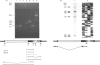
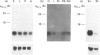
In the fruitfly Drosophila, as in all eukaryotes examined so far, some ubiquitin-coding sequences appear fused to unrelated open reading frames. Two of these fusion genes have been previously described (the homologues of UBI1-UBI2 and UBI4 in yeast), and we report here the organization and expression of a third one, the DUb80 gene (the homologue of UBI3 in yeast). This gene encodes a ubiquitin monomer fused to an 80-amino-acid extension which is homologous with the ribosomal protein encoded by the UB13 gene. The 5' regulatory region of DUb80 shares common features with another ubiquitin fusion gene, DUb52, and with the ribosomal protein genes of Drosophila, Xenopus and mouse. We also find helix-loop-helix protein-binding sequences (E-boxes). The DUb80 gene is transcribed to a 0.9 kb mRNA which is particularly abundant under conditions of high protein synthesis, such as in ovaries and exponentially growing cells.
Full text
PDF


Images in this article
Selected References
These references are in PubMed. This may not be the complete list of references from this article.
- Anthony-Cahill S. J., Benfield P. A., Fairman R., Wasserman Z. R., Brenner S. L., Stafford W. F., 3rd, Altenbach C., Hubbell W. L., DeGrado W. F. Molecular characterization of helix-loop-helix peptides. Science. 1992 Feb 21;255(5047):979–983. doi: 10.1126/science.1312255. [DOI] [PubMed] [Google Scholar]
- Baker R. T., Board P. G. The human ubiquitin-52 amino acid fusion protein gene shares several structural features with mammalian ribosomal protein genes. Nucleic Acids Res. 1991 Mar 11;19(5):1035–1040. doi: 10.1093/nar/19.5.1035. [DOI] [PMC free article] [PubMed] [Google Scholar]
- Ball E., Karlik C. C., Beall C. J., Saville D. L., Sparrow J. C., Bullard B., Fyrberg E. A. Arthrin, a myofibrillar protein of insect flight muscle, is an actin-ubiquitin conjugate. Cell. 1987 Oct 23;51(2):221–228. doi: 10.1016/0092-8674(87)90149-8. [DOI] [PubMed] [Google Scholar]
- Bishoff S. T., Schwartz L. M. Characterization of a ubiquitin-fusion gene from the tobacco hawkmoth, Manduca sexta. Nucleic Acids Res. 1990 Oct 25;18(20):6039–6043. doi: 10.1093/nar/18.20.6039. [DOI] [PMC free article] [PubMed] [Google Scholar]
- Blackwell T. K., Weintraub H. Differences and similarities in DNA-binding preferences of MyoD and E2A protein complexes revealed by binding site selection. Science. 1990 Nov 23;250(4984):1104–1110. doi: 10.1126/science.2174572. [DOI] [PubMed] [Google Scholar]
- Brown S. J., Rhoads D. D., Stewart M. J., Van Slyke B., Chen I. T., Johnson T. K., Denell R. E., Roufa D. J. Ribosomal protein S14 is encoded by a pair of highly conserved, adjacent genes on the X chromosome of Drosophila melanogaster. Mol Cell Biol. 1988 Oct;8(10):4314–4321. doi: 10.1128/mcb.8.10.4314. [DOI] [PMC free article] [PubMed] [Google Scholar]
- Cabrera y Poch H. L., Arribas C., Izquierdo M. Sequence of a Drosophila cDNA encoding a ubiquitin gene fusion to a 52-aa ribosomal protein tail. Nucleic Acids Res. 1990 Jul 11;18(13):3994–3994. doi: 10.1093/nar/18.13.3994. [DOI] [PMC free article] [PubMed] [Google Scholar]
- Cabrera H. L., Barrio R., Arribas C. Structure and expression of the Drosophila ubiquitin-52-amino-acid fusion-protein gene. Biochem J. 1992 Aug 15;286(Pt 1):281–288. doi: 10.1042/bj2860281. [DOI] [PMC free article] [PubMed] [Google Scholar]
- Callis J., Raasch J. A., Vierstra R. D. Ubiquitin extension proteins of Arabidopsis thaliana. Structure, localization, and expression of their promoters in transgenic tobacco. J Biol Chem. 1990 Jul 25;265(21):12486–12493. [PubMed] [Google Scholar]
- Finley D., Bartel B., Varshavsky A. The tails of ubiquitin precursors are ribosomal proteins whose fusion to ubiquitin facilitates ribosome biogenesis. Nature. 1989 Mar 30;338(6214):394–401. doi: 10.1038/338394a0. [DOI] [PubMed] [Google Scholar]
- Finley D., Ozkaynak E., Varshavsky A. The yeast polyubiquitin gene is essential for resistance to high temperatures, starvation, and other stresses. Cell. 1987 Mar 27;48(6):1035–1046. doi: 10.1016/0092-8674(87)90711-2. [DOI] [PubMed] [Google Scholar]
- Gausing K., Jensen C. B. Two ubiquitin-long-tail fusion genes arranged as closely spaced direct repeats in barley. Gene. 1990 Oct 15;94(2):165–171. doi: 10.1016/0378-1119(90)90383-3. [DOI] [PubMed] [Google Scholar]
- Ghosh P. K., Reddy V. B., Piatak M., Lebowitz P., Weissman S. M. Determination of RNA sequences by primer directed synthesis and sequencing of their cDNA transcripts. Methods Enzymol. 1980;65(1):580–595. doi: 10.1016/s0076-6879(80)65061-7. [DOI] [PubMed] [Google Scholar]
- Graham R. W., Jones D., Candido E. P. UbiA, the major polyubiquitin locus in Caenorhabditis elegans, has unusual structural features and is constitutively expressed. Mol Cell Biol. 1989 Jan;9(1):268–277. doi: 10.1128/mcb.9.1.268. [DOI] [PMC free article] [PubMed] [Google Scholar]
- Gregor P. D., Sawadogo M., Roeder R. G. The adenovirus major late transcription factor USF is a member of the helix-loop-helix group of regulatory proteins and binds to DNA as a dimer. Genes Dev. 1990 Oct;4(10):1730–1740. doi: 10.1101/gad.4.10.1730. [DOI] [PubMed] [Google Scholar]
- Hall R. K., Taylor W. L. Transcription factor IIIA gene expression in Xenopus oocytes utilizes a transcription factor similar to the major late transcription factor. Mol Cell Biol. 1989 Nov;9(11):5003–5011. doi: 10.1128/mcb.9.11.5003. [DOI] [PMC free article] [PubMed] [Google Scholar]
- Jolliff K., Li Y., Johnson L. F. Multiple protein-DNA interactions in the TATAA-less mouse thymidylate synthase promoter. Nucleic Acids Res. 1991 May 11;19(9):2267–2274. doi: 10.1093/nar/19.9.2267. [DOI] [PMC free article] [PubMed] [Google Scholar]
- Jones N. Transcriptional regulation by dimerization: two sides to an incestuous relationship. Cell. 1990 Apr 6;61(1):9–11. doi: 10.1016/0092-8674(90)90207-u. [DOI] [PubMed] [Google Scholar]
- Larson D. E., Zahradka P., Sells B. H. Control points in eucaryotic ribosome biogenesis. Biochem Cell Biol. 1991 Jan;69(1):5–22. doi: 10.1139/o91-002. [DOI] [PubMed] [Google Scholar]
- Lassar A. B., Davis R. L., Wright W. E., Kadesch T., Murre C., Voronova A., Baltimore D., Weintraub H. Functional activity of myogenic HLH proteins requires hetero-oligomerization with E12/E47-like proteins in vivo. Cell. 1991 Jul 26;66(2):305–315. doi: 10.1016/0092-8674(91)90620-e. [DOI] [PubMed] [Google Scholar]
- Lee H. S., Simon J. A., Lis J. T. Structure and expression of ubiquitin genes of Drosophila melanogaster. Mol Cell Biol. 1988 Nov;8(11):4727–4735. doi: 10.1128/mcb.8.11.4727. [DOI] [PMC free article] [PubMed] [Google Scholar]
- Leung D. W., Spencer S. A., Cachianes G., Hammonds R. G., Collins C., Henzel W. J., Barnard R., Waters M. J., Wood W. I. Growth hormone receptor and serum binding protein: purification, cloning and expression. Nature. 1987 Dec 10;330(6148):537–543. doi: 10.1038/330537a0. [DOI] [PubMed] [Google Scholar]
- Levinger L., Varshavsky A. Selective arrangement of ubiquitinated and D1 protein-containing nucleosomes within the Drosophila genome. Cell. 1982 Feb;28(2):375–385. doi: 10.1016/0092-8674(82)90355-5. [DOI] [PubMed] [Google Scholar]
- Levy S., Avni D., Hariharan N., Perry R. P., Meyuhas O. Oligopyrimidine tract at the 5' end of mammalian ribosomal protein mRNAs is required for their translational control. Proc Natl Acad Sci U S A. 1991 Apr 15;88(8):3319–3323. doi: 10.1073/pnas.88.8.3319. [DOI] [PMC free article] [PubMed] [Google Scholar]
- Lund P. K., Moats-Staats B. M., Simmons J. G., Hoyt E., D'Ercole A. J., Martin F., Van Wyk J. J. Nucleotide sequence analysis of a cDNA encoding human ubiquitin reveals that ubiquitin is synthesized as a precursor. J Biol Chem. 1985 Jun 25;260(12):7609–7613. [PubMed] [Google Scholar]
- Mager W. H. Control of ribosomal protein gene expression. Biochim Biophys Acta. 1988 Jan 25;949(1):1–15. doi: 10.1016/0167-4781(88)90048-6. [DOI] [PubMed] [Google Scholar]
- Millar S. E., Lader E., Liang L. F., Dean J. Oocyte-specific factors bind a conserved upstream sequence required for mouse zona pellucida promoter activity. Mol Cell Biol. 1991 Dec;11(12):6197–6204. doi: 10.1128/mcb.11.12.6197. [DOI] [PMC free article] [PubMed] [Google Scholar]
- Mount S. M., Burks C., Hertz G., Stormo G. D., White O., Fields C. Splicing signals in Drosophila: intron size, information content, and consensus sequences. Nucleic Acids Res. 1992 Aug 25;20(16):4255–4262. doi: 10.1093/nar/20.16.4255. [DOI] [PMC free article] [PubMed] [Google Scholar]
- Murre C., McCaw P. S., Vaessin H., Caudy M., Jan L. Y., Jan Y. N., Cabrera C. V., Buskin J. N., Hauschka S. D., Lassar A. B. Interactions between heterologous helix-loop-helix proteins generate complexes that bind specifically to a common DNA sequence. Cell. 1989 Aug 11;58(3):537–544. doi: 10.1016/0092-8674(89)90434-0. [DOI] [PubMed] [Google Scholar]
- Müller-Taubenberger A., Graack H. R., Grohmann L., Schleicher M., Gerisch G. An extended ubiquitin of Dictyostelium is located in the small ribosomal subunit. J Biol Chem. 1989 Apr 5;264(10):5319–5322. [PubMed] [Google Scholar]
- O'Connell P. O., Rosbash M. Sequence, structure, and codon preference of the Drosophila ribosomal protein 49 gene. Nucleic Acids Res. 1984 Jul 11;12(13):5495–5513. doi: 10.1093/nar/12.13.5495. [DOI] [PMC free article] [PubMed] [Google Scholar]
- Ohmachi T., Giorda R., Shaw D. R., Ennis H. L. Molecular organization of developmentally regulated Dictyostelium discoideum ubiquitin cDNAs. Biochemistry. 1989 Jun 13;28(12):5226–5231. doi: 10.1021/bi00438a046. [DOI] [PubMed] [Google Scholar]
- Ozkaynak E., Finley D., Solomon M. J., Varshavsky A. The yeast ubiquitin genes: a family of natural gene fusions. EMBO J. 1987 May;6(5):1429–1439. doi: 10.1002/j.1460-2075.1987.tb02384.x. [DOI] [PMC free article] [PubMed] [Google Scholar]
- Ozkaynak E., Finley D., Varshavsky A. The yeast ubiquitin gene: head-to-tail repeats encoding a polyubiquitin precursor protein. Nature. 1984 Dec 13;312(5995):663–666. doi: 10.1038/312663a0. [DOI] [PubMed] [Google Scholar]
- Planta R. J., Raué H. A. Control of ribosome biogenesis in yeast. Trends Genet. 1988 Mar;4(3):64–68. doi: 10.1016/0168-9525(88)90042-x. [DOI] [PubMed] [Google Scholar]
- Prendergast G. C., Ziff E. B. A new bind for Myc. Trends Genet. 1992 Mar;8(3):91–96. doi: 10.1016/0168-9525(92)90196-b. [DOI] [PubMed] [Google Scholar]
- Qian S., Zhang J. Y., Kay M. A., Jacobs-Lorena M. Structural analysis of the Drosophila rpA1 gene, a member of the eucaryotic 'A' type ribosomal protein family. Nucleic Acids Res. 1987 Feb 11;15(3):987–1003. doi: 10.1093/nar/15.3.987. [DOI] [PMC free article] [PubMed] [Google Scholar]
- Redman K. L., Rechsteiner M. Extended reading frame of a ubiquitin gene encodes a stable, conserved, basic protein. J Biol Chem. 1988 Apr 5;263(10):4926–4931. [PubMed] [Google Scholar]
- Redman K. L., Rechsteiner M. Identification of the long ubiquitin extension as ribosomal protein S27a. Nature. 1989 Mar 30;338(6214):438–440. doi: 10.1038/338438a0. [DOI] [PubMed] [Google Scholar]
- Rigby P. W., Dieckmann M., Rhodes C., Berg P. Labeling deoxyribonucleic acid to high specific activity in vitro by nick translation with DNA polymerase I. J Mol Biol. 1977 Jun 15;113(1):237–251. doi: 10.1016/0022-2836(77)90052-3. [DOI] [PubMed] [Google Scholar]
- Salvesen G., Lloyd C., Farley D. cDNA encoding a human homolog of yeast ubiquitin 1. Nucleic Acids Res. 1987 Jul 10;15(13):5485–5485. doi: 10.1093/nar/15.13.5485. [DOI] [PMC free article] [PubMed] [Google Scholar]
- Sanger F., Nicklen S., Coulson A. R. DNA sequencing with chain-terminating inhibitors. Proc Natl Acad Sci U S A. 1977 Dec;74(12):5463–5467. doi: 10.1073/pnas.74.12.5463. [DOI] [PMC free article] [PubMed] [Google Scholar]
- Schneider I. Cell lines derived from late embryonic stages of Drosophila melanogaster. J Embryol Exp Morphol. 1972 Apr;27(2):353–365. [PubMed] [Google Scholar]
- Siegelman M., Bond M. W., Gallatin W. M., St John T., Smith H. T., Fried V. A., Weissman I. L. Cell surface molecule associated with lymphocyte homing is a ubiquitinated branched-chain glycoprotein. Science. 1986 Feb 21;231(4740):823–829. doi: 10.1126/science.3003913. [DOI] [PubMed] [Google Scholar]
- Snyder M., Hunkapiller M., Yuen D., Silvert D., Fristrom J., Davidson N. Cuticle protein genes of Drosophila: structure, organization and evolution of four clustered genes. Cell. 1982 Jul;29(3):1027–1040. doi: 10.1016/0092-8674(82)90466-4. [DOI] [PubMed] [Google Scholar]
- Stewart M. J., Denell R. Mutations in the Drosophila gene encoding ribosomal protein S6 cause tissue overgrowth. Mol Cell Biol. 1993 Apr;13(4):2524–2535. doi: 10.1128/mcb.13.4.2524. [DOI] [PMC free article] [PubMed] [Google Scholar]
- Sun X. H., Baltimore D. An inhibitory domain of E12 transcription factor prevents DNA binding in E12 homodimers but not in E12 heterodimers. Cell. 1991 Jan 25;64(2):459–470. doi: 10.1016/0092-8674(91)90653-g. [DOI] [PubMed] [Google Scholar]
- Swindle J., Ajioka J., Eisen H., Sanwal B., Jacquemot C., Browder Z., Buck G. The genomic organization and transcription of the ubiquitin genes of Trypanosoma cruzi. EMBO J. 1988 Apr;7(4):1121–1127. doi: 10.1002/j.1460-2075.1988.tb02921.x. [DOI] [PMC free article] [PubMed] [Google Scholar]
- Tamura T., Mikoshiba K. Role of a GC-rich motif in transcription regulation of the adenovirus type 2 IVa2 promoter which lacks typical TATA-box element. FEBS Lett. 1991 Apr 22;282(1):87–90. doi: 10.1016/0014-5793(91)80450-h. [DOI] [PubMed] [Google Scholar]
- Thorne A. W., Sautiere P., Briand G., Crane-Robinson C. The structure of ubiquitinated histone H2B. EMBO J. 1987 Apr;6(4):1005–1010. doi: 10.1002/j.1460-2075.1987.tb04852.x. [DOI] [PMC free article] [PubMed] [Google Scholar]
- Torres R., Schreiber-Agus N., Morgenbesser S. D., DePinho R. A. Myc and Max: a putative transcriptional complex in search of a cellular target. Curr Opin Cell Biol. 1992 Jun;4(3):468–474. doi: 10.1016/0955-0674(92)90013-3. [DOI] [PubMed] [Google Scholar]
- Tyler B. M., Harrison K. A Neurospora crassa ribosomal protein gene, homologous to yeast CRY1, contains sequences potentially coordinating its transcription with rRNA genes. Nucleic Acids Res. 1990 Oct 11;18(19):5759–5765. doi: 10.1093/nar/18.19.5759. [DOI] [PMC free article] [PubMed] [Google Scholar]
- Varshavsky A., Levinger L., Sundin O., Barsoum J., Ozkaynak E., Swerdlow P., Finley D. Cellular and SV40 chromatin: replication, segregation, ubiquitination, nuclease-hypersensitive sites, HMG-containing nucleosomes, and heterochromatin-specific protein. Cold Spring Harb Symp Quant Biol. 1983;47(Pt 1):511–528. doi: 10.1101/sqb.1983.047.01.061. [DOI] [PubMed] [Google Scholar]
- Wiborg O., Pedersen M. S., Wind A., Berglund L. E., Marcker K. A., Vuust J. The human ubiquitin multigene family: some genes contain multiple directly repeated ubiquitin coding sequences. EMBO J. 1985 Mar;4(3):755–759. doi: 10.1002/j.1460-2075.1985.tb03693.x. [DOI] [PMC free article] [PubMed] [Google Scholar]
- Yarden Y., Escobedo J. A., Kuang W. J., Yang-Feng T. L., Daniel T. O., Tremble P. M., Chen E. Y., Ando M. E., Harkins R. N., Francke U. Structure of the receptor for platelet-derived growth factor helps define a family of closely related growth factor receptors. Nature. 1986 Sep 18;323(6085):226–232. doi: 10.1038/323226a0. [DOI] [PubMed] [Google Scholar]