



Abstract
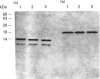
Three isotoxins (SP I-III) of the beta-bungarotoxin family were purified to homogeneity via a series of isolation procedures including a final step of h.p.l.c. on an SP column washed with a linear gradient of 0.2-0.6 M sodium acetate at pH 7.4. Their proportions varied greatly with the batch of venom. Each isotoxin was demonstrated by SDS/PAGE to contain a phospholipase A2 subunit and a non-phospholipase A2 subunit. The three proteins were reductively alkylated with 4-vinylpyridine and the alkylated derivatives of the two subunits of each isotoxin were separated. N-Terminal sequence analysis of the alkylated derivatives revealed that the three isotoxins probably share a common phospholipase A2 subunit but differ in their non-phospholipase A2 subunits. The non-phospholipase A2 subunits of SP II and SP III were identical with those of beta 2- and beta 1-toxin respectively, except that there was an additional valine inserted between Thr-18 and Val-19 in beta 2-toxin and Pro-18 and Val-19 in beta 1-toxin. The non-phospholipase A2 subunit of SP I differed greatly from that of SP III but was almost identical with that of SP II, except that Lys-14 and Ala-29 in SP II were replaced by Arg-14 and Glu-29 in SP I. Analysis of the effect of CaCl2 on protein fluorescence showed the existence of a low- and a high-affinity site on the different domains of each isotoxin for Ca2+ binding. The three isotoxins showed no great difference in their ability to bind Ca2+ on both the high- and low-affinity site. They had slightly different phospholipase A2 activities but differed to a great extent with respect to their neurotoxic effects. LD50 values increased in the order SP I > SP II > SP III. In contrast, the ability to inhibit the indirectly evoked contraction of chick biventer cervicis muscle was in the order SP III > SP II > SP I.
Full text
PDF


Images in this article
Selected References
These references are in PubMed. This may not be the complete list of references from this article.
- Abe T., Alemá S., Miledi R. Isolation and characterization of presynaptically acting neurotoxins from the venom of Bungarus snakes. Eur J Biochem. 1977 Oct 17;80(1):1–12. doi: 10.1111/j.1432-1033.1977.tb11849.x. [DOI] [PubMed] [Google Scholar]
- Breeze A. L., Dolly J. O. Interactions between discrete neuronal membrane binding sites for the putative K+-channel ligands beta-bungarotoxin, dendrotoxin and mast-cell-degranulating peptide. Eur J Biochem. 1989 Jan 2;178(3):771–778. doi: 10.1111/j.1432-1033.1989.tb14508.x. [DOI] [PubMed] [Google Scholar]
- Caratsch C. G., Maranda B., Miledi R., Strong P. N. A further study of the phospholipase-independent action of beta-bungarotoxin at frog end-plates. J Physiol. 1981;319:179–191. doi: 10.1113/jphysiol.1981.sp013900. [DOI] [PMC free article] [PubMed] [Google Scholar]
- Chang C. C. Neurotoxins with phospholipase A2 activity in snake venoms. Proc Natl Sci Counc Repub China B. 1985 Apr;9(2):126–142. [PubMed] [Google Scholar]
- Chang L. S., Yang C. C. Separation and characterization of the A chain and B chain in beta 1-bungarotoxin from Bungarus multicinctus (Taiwan banded krait) venom. J Protein Chem. 1993 Aug;12(4):469–475. doi: 10.1007/BF01025047. [DOI] [PubMed] [Google Scholar]
- Chu S. T., Chen Y. H. Role of the N-terminal region of phospholipase A2 subunit of beta 1-bungarotoxin in the toxin-Ca2+ complex-formation. Biochem J. 1991 Sep 1;278(Pt 2):481–486. doi: 10.1042/bj2780481. [DOI] [PMC free article] [PubMed] [Google Scholar]
- Chu S. T., Chu C. C., Tseng C. C., Chen Y. H. Met-8 of the beta 1-bungarotoxin phospholipase A2 subunit is essential for the phospholipase A2-independent neurotoxic effect. Biochem J. 1993 Nov 1;295(Pt 3):713–718. doi: 10.1042/bj2950713. [DOI] [PMC free article] [PubMed] [Google Scholar]
- Clark D. G., Macmurchie D. D., Elliott E., Wolcott R. G., Landel A. M., Raftery M. A. Elapid neurotoxins. Purification, characterization, and immunochemical studies of -bungarotoxin. Biochemistry. 1972 Apr 25;11(9):1663–1668. doi: 10.1021/bi00759a020. [DOI] [PubMed] [Google Scholar]
- Dufton M. J. Proteinase inhibitors and dendrotoxins. Sequence classification, structural prediction and structure/activity. Eur J Biochem. 1985 Dec 16;153(3):647–654. doi: 10.1111/j.1432-1033.1985.tb09349.x. [DOI] [PubMed] [Google Scholar]
- Epstein M., Levitzki A., Reuben J. Binding of lanthanides and of divalent metal ions to porcine trypsin. Biochemistry. 1974 Apr 9;13(8):1777–1782. doi: 10.1021/bi00705a034. [DOI] [PubMed] [Google Scholar]
- Eterovic V. A., Hebert M. S., Hanley M. R., Bennett E. L. The lethality and spectroscopic properties of toxins from Bungarus multicinctus (Blyth) venom. Toxicon. 1975 Feb;13(1):37–48. doi: 10.1016/0041-0101(75)90156-7. [DOI] [PubMed] [Google Scholar]
- Harvey A. L., Karlsson E. Protease inhibitor homologues from mamba venoms: facilitation of acetylcholine release and interactions with prejunctional blocking toxins. Br J Pharmacol. 1982 Sep;77(1):153–161. doi: 10.1111/j.1476-5381.1982.tb09281.x. [DOI] [PMC free article] [PubMed] [Google Scholar]
- Kini R. M., Evans H. J. Structure-function relationships of phospholipases. The anticoagulant region of phospholipases A2. J Biol Chem. 1987 Oct 25;262(30):14402–14407. [PubMed] [Google Scholar]
- Kondo K., Narita K., Lee C. Y. Amino acid sequences of the two polypeptide chains in beta1-bungarotoxin from the venom of Bungarus multicinctus. J Biochem. 1978 Jan;83(1):101–115. doi: 10.1093/oxfordjournals.jbchem.a131881. [DOI] [PubMed] [Google Scholar]
- Kondo K., Toda H., Narita K., Lee C. Y. Amino acid sequence of beta 2-bungarotoxin from Bungarus multicinctus venom. The amino acid substitutions in the B chains. J Biochem. 1982 May;91(5):1519–1530. doi: 10.1093/oxfordjournals.jbchem.a133843. [DOI] [PubMed] [Google Scholar]
- Kondo K., Toda H., Narita K., Lee C. Y. Amino acid sequences of three beta-bungarotoxins (beta 3-, beta 4-, and beta 5- bungarotoxins) from Bungarus multicinctus venom. Amino acid substitutions in the A chains. J Biochem. 1982 May;91(5):1531–1548. doi: 10.1093/oxfordjournals.jbchem.a133844. [DOI] [PubMed] [Google Scholar]
- Laemmli U. K. Cleavage of structural proteins during the assembly of the head of bacteriophage T4. Nature. 1970 Aug 15;227(5259):680–685. doi: 10.1038/227680a0. [DOI] [PubMed] [Google Scholar]
- Lee C. Y., Chang S. L., Kau S. T., Luh S. H. Chromatographic separation of the venom of Bungarus multicinctus and characterization of its components. J Chromatogr. 1972 Oct 5;72(1):71–82. doi: 10.1016/0021-9673(72)80009-8. [DOI] [PubMed] [Google Scholar]
- Lin W. Z., Chu S. T., Chen Y. H. Optical activity and conformation of beta-bungarotoxin in solution. Proc Natl Sci Counc Repub China B. 1984 Apr;8(2):113–118. [PubMed] [Google Scholar]
- Rehm H., Betz H. Binding of beta-bungarotoxin to synaptic membrane fractions of chick brain. J Biol Chem. 1982 Sep 10;257(17):10015–10022. [PubMed] [Google Scholar]
- Rosenberg P., Ghassemi A., Condrea E., Dhillon D., Yang C. C. Do chemical modifications dissociate between the enzymatic and pharmacological activities of beta bungarotoxin and notexin? Toxicon. 1989;27(2):137–159. doi: 10.1016/0041-0101(89)90128-1. [DOI] [PubMed] [Google Scholar]