



Abstract
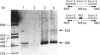
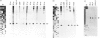
We have examined the genomic organization and the transcription unit for the human link protein gene from genomic clones and RNA prepared from human cartilage over a wide age range. Five exons cover the gene which is greater than 60 kbp. Primer extension and S1 nuclease protection analysis revealed transcription initiation to be 315 bases upstream from the translation initiation codon in RNA derived from cartilage samples ranging from fetal to 53 years of age. The first exon size therefore is 289 bp and examination of the 5' flanking sequence indicated a lack of a TATA box in close proximity to the transcription start, although a TATAA-like motif (TCTAA) was present at -75 bp. Such a sequence at a similar distance can serve as a promoter in the chicken link protein gene. The large first exon of 289 bp is similar to that of the chicken but contrasts with that described previously for human (96 bp) and rat (62 bp). We also analysed human link protein mRNA by PCR for the presence of an alternatively spliced exon that is present in rat mRNA in low abundance, but could not detect such transcripts. Equine and porcine mRNA contained this spliced form but the results suggested that this was expressed as a rare transcript.
Full text
PDF


Images in this article

Selected References
These references are in PubMed. This may not be the complete list of references from this article.
- Chomczynski P., Sacchi N. Single-step method of RNA isolation by acid guanidinium thiocyanate-phenol-chloroform extraction. Anal Biochem. 1987 Apr;162(1):156–159. doi: 10.1006/abio.1987.9999. [DOI] [PubMed] [Google Scholar]
- De Luca S., Heinegård D., Hascall V. C., Kimura J. H., Caplan A. I. Chemical and physical changes in proteoglycans during development of chick limb bud chondrocytes grown in vitro. J Biol Chem. 1977 Oct 10;252(19):6600–6608. [PubMed] [Google Scholar]
- Deák F., Barta E., Mestric S., Biesold M., Kiss I. Complex pattern of alternative splicing generates unusual diversity in the leader sequence of the chicken link protein mRNA. Nucleic Acids Res. 1991 Sep 25;19(18):4983–4990. doi: 10.1093/nar/19.18.4983. [DOI] [PMC free article] [PubMed] [Google Scholar]
- Deák F., Kiss I., Sparks K. J., Argraves W. S., Hampikian G., Goetinck P. F. Complete amino acid sequence of chicken cartilage link protein deduced from cDNA clones. Proc Natl Acad Sci U S A. 1986 Jun;83(11):3766–3770. doi: 10.1073/pnas.83.11.3766. [DOI] [PMC free article] [PubMed] [Google Scholar]
- Doege K. J., Sasaki M., Kimura T., Yamada Y. Complete coding sequence and deduced primary structure of the human cartilage large aggregating proteoglycan, aggrecan. Human-specific repeats, and additional alternatively spliced forms. J Biol Chem. 1991 Jan 15;266(2):894–902. [PubMed] [Google Scholar]
- Doege K., Sasaki M., Horigan E., Hassell J. R., Yamada Y. Complete primary structure of the rat cartilage proteoglycan core protein deduced from cDNA clones. J Biol Chem. 1987 Dec 25;262(36):17757–17767. [PubMed] [Google Scholar]
- Dudhia J., Hardingham T. E. The primary structure of human cartilage link protein. Nucleic Acids Res. 1990 Mar 11;18(5):1292–1292. doi: 10.1093/nar/18.5.1292. [DOI] [PMC free article] [PubMed] [Google Scholar]
- Fife R. S., Caterson B., Myers S. L. Identification of link proteins in canine synovial cell cultures and canine articular cartilage. J Cell Biol. 1985 Apr;100(4):1050–1055. doi: 10.1083/jcb.100.4.1050. [DOI] [PMC free article] [PubMed] [Google Scholar]
- Fogh J., Fogh J. M., Orfeo T. One hundred and twenty-seven cultured human tumor cell lines producing tumors in nude mice. J Natl Cancer Inst. 1977 Jul;59(1):221–226. doi: 10.1093/jnci/59.1.221. [DOI] [PubMed] [Google Scholar]
- Goetinck P. F., Stirpe N. S., Tsonis P. A., Carlone D. The tandemly repeated sequences of cartilage link protein contain the sites for interaction with hyaluronic acid. J Cell Biol. 1987 Nov;105(5):2403–2408. doi: 10.1083/jcb.105.5.2403. [DOI] [PMC free article] [PubMed] [Google Scholar]
- Hardingham T. E., Fosang A. J., Dudhia J. The structure, function and turnover of aggrecan, the large aggregating proteoglycan from cartilage. Eur J Clin Chem Clin Biochem. 1994 Apr;32(4):249–257. [PubMed] [Google Scholar]
- Hardingham T. E., Fosang A. J. Proteoglycans: many forms and many functions. FASEB J. 1992 Feb 1;6(3):861–870. [PubMed] [Google Scholar]
- Hardingham T. E., Muir H. The specific interaction of hyaluronic acid with cartillage proteoglycans. Biochim Biophys Acta. 1972 Sep 15;279(2):401–405. doi: 10.1016/0304-4165(72)90160-2. [DOI] [PubMed] [Google Scholar]
- Hardingham T. E. The role of link-protein in the structure of cartilage proteoglycan aggregates. Biochem J. 1979 Jan 1;177(1):237–247. doi: 10.1042/bj1770237. [DOI] [PMC free article] [PubMed] [Google Scholar]
- Heinegård D., Hascall V. C. Aggregation of cartilage proteoglycans. 3. Characteristics of the proteins isolated from trypsin digests of aggregates. J Biol Chem. 1974 Jul 10;249(13):4250–4256. [PubMed] [Google Scholar]
- Liu J., Cassidy J. D., Allan A., Neame P. J., Mort J. S., Roughley P. J. Link protein shows species variation in its susceptibility to proteolysis. J Orthop Res. 1992 Sep;10(5):621–630. doi: 10.1002/jor.1100100504. [DOI] [PubMed] [Google Scholar]
- Mallein-Gerin F., Kosher R. A., Upholt W. B., Tanzer M. L. Temporal and spatial analysis of cartilage proteoglycan core protein gene expression during limb development by in situ hybridization. Dev Biol. 1988 Apr;126(2):337–345. doi: 10.1016/0012-1606(88)90144-3. [DOI] [PubMed] [Google Scholar]
- Martin H., Dean M. An N-terminal peptide from link protein is rapidly degraded by chondrocytes, monocytes and B cells. Eur J Biochem. 1993 Feb 15;212(1):87–94. doi: 10.1111/j.1432-1033.1993.tb17636.x. [DOI] [PubMed] [Google Scholar]
- Mort J. S., Poole A. R., Roughley P. J. Age-related changes in the structure of proteoglycan link proteins present in normal human articular cartilage. Biochem J. 1983 Jul 15;214(1):269–272. doi: 10.1042/bj2140269. [DOI] [PMC free article] [PubMed] [Google Scholar]
- Mount S. M. A catalogue of splice junction sequences. Nucleic Acids Res. 1982 Jan 22;10(2):459–472. doi: 10.1093/nar/10.2.459. [DOI] [PMC free article] [PubMed] [Google Scholar]
- Nguyen Q., Liu J., Roughley P. J., Mort J. S. Link protein as a monitor in situ of endogenous proteolysis in adult human articular cartilage. Biochem J. 1991 Aug 15;278(Pt 1):143–147. doi: 10.1042/bj2780143. [DOI] [PMC free article] [PubMed] [Google Scholar]
- Nguyen Q., Murphy G., Roughley P. J., Mort J. S. Degradation of proteoglycan aggregate by a cartilage metalloproteinase. Evidence for the involvement of stromelysin in the generation of link protein heterogeneity in situ. Biochem J. 1989 Apr 1;259(1):61–67. doi: 10.1042/bj2590061. [DOI] [PMC free article] [PubMed] [Google Scholar]
- Oudet C., Heilig R., Mandel J. L. An informative polymorphism detectable by polymerase chain reaction at the 3' end of the dystrophin gene. Hum Genet. 1990 Feb;84(3):283–285. doi: 10.1007/BF00200576. [DOI] [PubMed] [Google Scholar]
- Perkins S. J., Nealis A. S., Dudhia J., Hardingham T. E. Immunoglobulin fold and tandem repeat structures in proteoglycan N-terminal domains and link protein. J Mol Biol. 1989 Apr 20;206(4):737–753. doi: 10.1016/0022-2836(89)90580-9. [DOI] [PubMed] [Google Scholar]
- Perkins S. J., Nealis A. S., Dudhia J., Hardingham T. E. Immunoglobulin fold and tandem repeat structures in proteoglycan N-terminal domains and link protein. J Mol Biol. 1989 Apr 20;206(4):737–753. doi: 10.1016/0022-2836(89)90580-9. [DOI] [PubMed] [Google Scholar]
- Périn J. P., Bonnet F., Thurieau C., Jollès P. Link protein interactions with hyaluronate and proteoglycans. Characterization of two distinct domains in bovine cartilage link proteins. J Biol Chem. 1987 Sep 25;262(27):13269–13272. [PubMed] [Google Scholar]
- Rhodes C., Doege K., Sasaki M., Yamada Y. Alternative splicing generates two different mRNA species for rat link protein. J Biol Chem. 1988 May 5;263(13):6063–6067. [PubMed] [Google Scholar]
- Rhodes C., Savagner P., Line S., Sasaki M., Chirigos M., Doege K., Yamada Y. Characterization of the promoter for the rat and human link protein gene. Nucleic Acids Res. 1991 Apr 25;19(8):1933–1939. doi: 10.1093/nar/19.8.1933. [DOI] [PMC free article] [PubMed] [Google Scholar]
- Sharp P. A. Speculations on RNA splicing. Cell. 1981 Mar;23(3):643–646. doi: 10.1016/0092-8674(81)90425-6. [DOI] [PubMed] [Google Scholar]
- Tsonis P. A., Goetinck P. F. Expression of cartilage-matrix genes and localization of their translation products in the embryonic chick eye. Exp Eye Res. 1988 May;46(5):753–764. doi: 10.1016/s0014-4835(88)80061-7. [DOI] [PubMed] [Google Scholar]
- Watt F. M., Dudhia J. Prolonged expression of differentiated phenotype by chondrocytes cultured at low density on a composite substrate of collagen and agarose that restricts cell spreading. Differentiation. 1988 Jul;38(2):140–147. doi: 10.1111/j.1432-0436.1988.tb00208.x. [DOI] [PubMed] [Google Scholar]