



Abstract
Parents vary in conversational goals and style when discussing events with their children—two aspects of parent socialization that may be related, or exert opposing influence on the development of young children’s report accuracy (a critical factor in children’s eyewitness reports). In a sample of 116 parent-child dyads (Mage = 53.17 months, range: 36–72 months), we examined the roles of parent social conversation goals (parent-reported and experimentally manipulated) and parent cognitive elaboration in children’s ability to accurately report about a laboratory event. Parent cognitive elaboration varied by conversation goal and was positively associated with child accuracy across age but only when parents strongly endorsed social conversation goals. Parent questioning strategies and children’s response accuracy varied with age. This work has implications for how we understand short- and long-term impacts caregivers exert on children’s event reporting and suggests that even very young children are sensitive to variations in parent questioning practices.
Keywords: Conversation goal, Parent-child conversation, Structure, Reporting, Accuracy
Beginning in toddlerhood, parents and children frequently discuss children’s experiences together, which influences the development of autobiographical memory (McGuigan & Salmon, 2004). In these conversations, parents directly and indirectly communicate their perspective about what is important to report and how one should interpret and discuss events. Parents vary in both their overarching goals for discussing events with their children and in the extent to which they provide structure for children’s reports. This conversational structuring is commonly referred to as parent elaboration and individual parents may fall anywhere on a scale from low to high elaboration (Fivush & Fromhoff, 1988). Individual differences in parent conversation goals and elaboration shape how children discuss their experiences, particularly during early childhood, such that children internalize elements of their parents’ conversational practices over time (Nelson & Fivush, 2004). Researchers have argued that conversation goal and elaboration may be related, but also that they may exert opposing influence on the accuracy of preschool-aged children’s event reporting (Kulkofsky & Klemfuss, 2008). Both arguments need empirical assessment, particularly given the theoretical and applied importance of understanding how to elicit accurate accounts of children’s experiences. For example, when parents or other adults suspect a child has been victimized, there is a vested interest in understanding precisely what has occurred in order to intervene or pursue justice. Eliciting complete and accurate reports can be particularly challenging in early childhood when narrative and autobiographical memory skills are just beginning to emerge (Nelson & Fivush, 2004).
There is now extensive evidence that parental elaboration during parent-child reminiscing leads to lengthier, more detailed reports of young children’s past experiences (Benjamin et al., 2010; Boland et al., 2003; Clarke-Stewart & Beck, 1999; Cleveland & Reese, 2005; McGuigan & Salmon, 2004). However, more research is needed to examine how parent conversation goals relate to elaboration and how these factors independently and jointly influence the accuracy of children’s reports—both within parent-child conversations about past experiences, and in later formal interviews with others given that this is a common reporting pattern for child eyewitnesses (Lawson, Rodriguez-Steen, & London, 2018). The majority of extant research on parent-child conversations about the past has examined conversations about events with either low, or ambiguous accuracy demands (e.g., conversations about positive, unverifiable events or self-nominated shared experiences). However, accuracy is paramount in conversations about negative events that children may have experienced or witnessed (e.g., transgressions like victimization).
In recent years, there has begun to be cross-over between the fields of parent-child conversations about the past and child forensic interviewing such that researchers have started asking how the former literature may inform the latter and give insight into individual differences in children’s eyewitness abilities (see Principe & London, 2022). However, the extent to which the conversation literature, as it stands, can inform forensic contexts is the subject of debate given that studies of parent-child conversations tend to focus on positive, or neutral conversations about primarily positive events (see commentaries in response to Principe & London, 2022). It is unclear whether the current literature can be applied to these important contexts, particularly given that there are documented differences in how parents reminisce, and in what children remember, within socially-focused conversations relative to fact-focused conversations involving a transgression (Slonecker & Klemfuss, 2020). Thus, consideration of these varying conversation goals and contexts is needed to compare findings with previous work, to further unpack how parent socialization may vary and differentially impact children’s narrative development in fact-focused contexts, and to understand how these factors may apply in informal parent-child conversations and later formal interviews about negative events children have witnessed, especially in important real-world contexts like children’s eyewitness testimony.
The present study design allowed for novel insight into the independent and combined impact of parent conversation goals and style on children’s report accuracy when recalling a verifiable, standardized event with a parent, and independently with an unfamiliar interviewer. This study is also unique in that we experimentally manipulated parent conversation goals and event context in addition to assessing parents’ typical socialization goals. Prior work has included experimental manipulation of conversation goals (Cleveland et al., 2007; Kulkofsky, 2011; Slonecker & Klemfuss, 2020), or measures of parents’ typical conversation goals (Kulkofsky & Koh, 2009), but not both.
1. Developmental considerations in the study of parent-child reminiscing and children’s recounting
The preschool years are a particularly dynamic period for studying parental socialization through conversation, and children’s report accuracy. Early in the preschool years parents and children begin to meaningfully engage in conversations about events in children’s lives and children begin to adopt characteristics of their parents’ conversational style (Nelson & Fivush, 2004). Across early childhood, parental elaboration becomes increasingly reflected in children’s independent retelling of their experiences. Similarly, children may be internalizing the goals their parents prioritize when discussing their experiences. Thus, parent-child conversations about children’s lives socialize the structure and content of children’s independent reports (Nelson & Fivush, 2004).
In conjunction with the developmental process of internalizing parental socialization, substantial cognitive development occurs during early childhood, in terms of linguistic and mnemonic processes, such that the amount of accurate information, as well as the proportion of accurate to inaccurate information, children are able to provide about their experiences increases (Klemfuss & Ceci, 2009). The proportion of accurate to inaccurate details in children’s reports is often most pronounced in response to more direct, closed-ended questions (e.g., Did X happen?) relative to more open-ended prompts (e.g., Tell me what happened), especially when the direct questions are leading or suggestive (e.g., X happened, right?; Klemfuss, 2015). These prompt types (open-ended, closed-ended, leading/suggestive) entail somewhat different cognitive processes, ranging from recall, to recognition, to resisting assent to inaccurate information. To best understand the role of parent socialization in children’s ability to accurately describe their experiences, research is needed that examines preschool-aged children’s report accuracy in light of these varied demands on children’s reporting, all which are likely to be tapped when children are questioned as eyewitnesses to transgressions.
2. Parent conversation goals
Prior research stemming from the functionalist perspective has identified important distinctions between social, directive, and self goals in past event conversations (Kulkofsky & Koh, 2009). Social goals are those that focus on relationship building and maintenance and on discussing the past for conversational purposes. For example, a parent who prioritizes social goals may talk about the past with their child to enhance their relationship with their child (i.e., to “bond”), to help their child understand or repair relationships with others, and/or for entertainment purposes. Directive goals are intended to help children understand, learn from, and modify behaviors. Directive goals include behavioral control (e.g., teaching the child how to behave), teaching and problem solving (e.g., preparing the child for an upcoming event), and emotion regulation (e.g., teaching the child how to control emotions). Self goals include building a child’s identity, enhancing their self-esteem, and helping them understand their connection to a larger social group.
Evidence of all three primary goals may be present within the same past event conversation. For example, a parent-child conversation about a recent birthday party may be entertaining for the parent and/or child (social), might involve discussion about how the child should improve their behavior at future birthday parties (directive), and might highlight an aspect of the child’s personality that was unique amongst the children attending the party (self). Although these goals can and do co-occur, there are differences in the extent to which caregivers endorse each unique goal at the individual and cultural levels (Klemfuss et al., 2021; Kulkofsky & Koh, 2009).
The present work focused on the role of social goals in preschool-aged children’s report accuracy (relative to directive and self goals) in a Western sample. We focused on social goals because elements of social goals have been considered in opposition to accuracy goals (i.e., focusing on accurately recounting details of an event) in previous research and theorizing on past event reporting. In fact, in Western culture, exaggeration and embellishment may be considered not only permissible but expected in stories told to engage and entertain a social partner (Cole & Beike, 2019). Indeed, adults in Western cultures feel closer to conversational partners who exaggerate the truth relative to those who discuss their past experiences accurately, even when ground truth is known, making it apparent that the speaker is being inaccurate (Cole & Beike, 2019). As such, it appears that inaccuracies in recounting of past experiences may serve to enhance social bonds, at least in adults. This aspect of event recounting may therefore be particularly modeled or encouraged by caregivers who emphasize social goals for talking about the past. In contrast, we suspect that caregivers on the other end of the spectrum may focus on attaining accurate reports from children about their past experiences perhaps by asking more specific questions in an attempt to control their children’s responding.
Further, some evidence shows that six- to eight-year-old children who are instructed to recount a past event to entertain a conversational partner, are significantly less accurate than children instructed to talk about the event factually (Kulkofsky et al., 2011). Thus, children in early-middle childhood understand that they should shift the accuracy of their recounting depending on whether the context is more socially-focused or accuracy focused. A number of open questions remain, though. For example, it is unknown whether caregivers who endorse social goals of reminiscing effectively socialize their preschool-aged children to de-emphasize accuracy more than those with less robust social goals, when in development these socialization effects emerge, whether caregivers with an immediate goal of eliciting factual information from their child attempt to constrain their conversation to focus on the facts relative to caregivers with immediate social goals, and whether caregiver strategies shift by child age.
3. Parent conversation style
Like parent conversation goals, parent conversation style has been linked to the accuracy of children’s responses and there is some evidence that conversation goals and elaboration may be linked. Parent elaboration (Fivush & Fromhoff, 1988) entails a host of conversational practices that function to encourage children to report as much information as possible about their experiences. Broadly speaking, more elaborative parents ask more open-ended WH-questions (e.g., “What did we do?”, “Who was there?”), prompt children for details, introduce new information, and sometimes, provide more evaluations of children’s input (Cleveland & Reese, 2005).
Parent elaboration is proposed to teach children how to organize their memories of past events in order to better understand and remember them (Harley & Reese, 1999; Reese & Fivush, 1993). Indeed, there is a large body of accumulated evidence showing that more elaborative parents have children who report more information about their past experiences in conversations with others (Harley & Reese, 1999; Reese & Fivush, 1993). Their children also tend to report a greater number of correct details about their experiences (Cleveland et al., 2007; Leichtman et al., 2000; Leichtman et al., 2017) and can better resist misleading questions about their experiences (Klemfuss, Rush, & Quas, 2016)—except when the caregiver with whom they discuss a past event is the source of misinformation (Principe et al., 2013).
Parent elaboration has also been proposed to teach children that conversing about the past should be a social process that entails incorporating the perspectives of one’s conversational partner in order to create a prolonged, entertaining conversation (Bauer, 2007; Fivush & Reese, 1992). However, there is minimal existing evidence to suggest that conversation goals and elaboration are linked. Kulkofsky et al. (2009) asked parents to describe the reasons they reminisce with their four- to five-year-old children and coded their responses for categories of social goals. Parents also engaged their children in a reminiscing conversation about a recent, shared past event and these conversations were coded for elaboration. Reminiscing for the goal of having conversations about past experiences—one category of social goals—was associated with parent elaboration. Parent elaboration during the conversation, but not social goals, was associated with children’s provision of more details about shared experiences with their caregivers. In this study, however, accuracy could not be assessed given that ground truth regarding the shared experience was unknown.
In the present study we focused on a global scoring of the cognitive dimension of parent elaboration (“parents questions and statements that allow the conversation to progress”, Zaman & Fivush, 2013) in order to separately examine the structural functions of parental elaboration and parental social goals. We extended previous research by testing relations between social goals and cognitive elaboration in terms of general practices and in the context of our experimental manipulation. We then examined the nature of the relations between caregiver social goals and cognitive elaboration and both parent questioning behavior and children’s accuracy when discussing the lab activity in a context that was either socially-focused (i.e., a fun discussion about a hiding game with a toy) or more forensically relevant and accuracy focused (i.e., a factual conversation about finding a “kidnapped” toy). This research was therefore poised to examine how parental conversation practices might affect children’s accuracy in contexts similar to those used in previous research, but perhaps more importantly, also in contexts where accuracy is paramount.
4. Present study
In the present study we tested the roles of parental cognitive elaboration, and conversation goals both in general and across experimentally manipulated goal contexts, in preschool-aged children’s ability to accurately report about a controlled laboratory event in which ground truth was known. Dyads were randomly assigned to either a fact-focused or social-focused context condition. All children completed a scripted play activity with a research assistant without their caregiver present, discussed the play activity with their caregiver, and then discussed it again in a forensic-style interview with a trained interviewer. The context children were given for the play activity and the context parents were given for the parent-child conversation varied by condition such that one condition paralleled paradigms in the majority of previous research, such that there were no obvious accuracy demands, and one was more forensically relevant, such that it involved a more serious interpretation of the activity and specific instructions for parents to find out what happened. Parents completed a standardized assessment of typical conversation goals and their cognitive elaboration was assessed in the parent-child conversation. Children’s report accuracy was assessed in both the parent-child conversation and interviewer-child conversation. We hypothesized that:
social goals would be positively associated with cognitive elaboration given prior theorizing and research connecting the two.
parents would adjust to the experimental manipulation of conversation goal such that in the fact-focused condition, they would be more leading and less elaborative in order to focus children’s responding compared to the social-focused condition.
parent social conversation goals would be associated with children providing a lower proportion of accurate responses in the parent-child conversation, except when parents were high in cognitive elaboration, given that (a) social goals have been pitted against accuracy goals in the literature and that by six years of age (slightly older than the current sample) children are already quite sensitive to the context of retelling and (b) elaboration has been primarily associated with children’s report accuracy.
children of parents with typically high social goals in the Social-focused condition would be least accurate.
Finally, we explored whether effects seen in the parent-child conversations would carry over into the interviewer-child conversations. We examined these research questions in preschool-aged children and considered developmental effects across our research questions given that children are particularly receptive to parent conversation style in this age range (Nelson & Fivush, 2004), due to vast advances in autobiographical memory development in the preschool years (Schneider & Ornstein, 2015) and because maternal reminiscing style becomes relatively stable by three years of age and generalizes to children by the end of the preschool years (Cleveland & Reese, 2005).
5. Method
5.1. Participants
A total of 117 parent-child dyads participated. Of these, one parent reported their child’s age to be outside the study age range and four children asked to have their parent present during the play activity, the interviewer-child interview, or both. All analyses were conducted with the child who was out of the study age range excluded, and were conducted with and without the children who had their parent present for the play activity or interviewer-child interview included. The pattern of findings across all primary analyses were consistent with and without the latter four participant dyads included. As such, these participants were included in the reported analyses for a final sample size of 116 children (52% female, Mage = 53.17 months, range: 36–72 months; n = 39 3-year-olds, n = 40 4-year-olds, n = 36 5-year-olds, and n = 1 6-year-old) and their parent (87% biological mothers, 11% biological fathers, 2% parent’s partner living in the home). G*Power (Faul & Erdfelder, 1992) was used to perform an a priori power analysis (power = 0.80) for an independent samples t-test and a multiple regression (R2 increase with 3 main predictors) to determine the minimum sample size needed to detect a small-medium effect (f2 =.10). The power analysis revealed that a minimum sample of N = 114 was sufficient.
The final sample was diverse in terms of racial/ethnic identity, reflecting the locations from which the sample was drawn. Children were 34% Latinx, 23% Caucasian, 12% African American, 8% Asian, and 23% reported “other” or multiple racial/ethnic identities. Parents were 37% Latinx, 32% Caucasian, 14% African American, 14% Asian, and 3% reported “other” or multiple racial/ethnic identities. The majority of participating parents were college graduates (78%). Participants were screened so that the entire sample was English-fluent given that the study involved aspects of parent-child communication that were expected to vary across languages, but that cross-language variation was not a focus of the present study.
5.2. Procedure
All study procedures were reviewed and approved by the Institutional Review Boards (IRBs) at [institution blinded for review] [protocol # blinded for review] and [institution blinded for review][protocol # blinded for review]. After the primary interviewer conducted consent and assent procedures, a second research assistant engaged children in a laboratory play activity while caregivers completed study questionnaires in a separate room. Next, the second research assistant left the room and the parent entered to question the child about the play activity using instructions provided by the primary interviewer. Finally, the parent left the room and the primary interviewer entered to question the child about the play activity and conduct a language assessment with the child. At the conclusion of the study session the parent and child were thanked and given a small payment. The parent-child conversation and interviewer-child interview were audio recorded for later transcription and coding.
Prior to each study session, dyads were randomly assigned to one of two experimental conditions: Fact-focused (n = 59) or Social-focused (n = 57). While all participants engaged in structurally identical study procedures, the associated context of those procedures varied by condition, such that the Fact-focused condition emphasized reporting accurately and the Social-focused condition emphasized reporting in an entertaining, fun way. The context was manipulated at the level of the dyad to parallel real-world contexts in which caregivers might question children about a transgression, i.e., contexts in which a child might witness a transgression or play event without the caregiver and then the caregiver would engage the child in a conversation about the event. However, the activity it-self was identical and pleasant for children across conditions. The condition differences are explained in more detail in the relevant sections below.
5.3. Laboratory play activity
All child participants engaged in an identical scripted activity in which a research assistant helped them follow a series of clues to find a toy elephant. Before the activity, children in the Fact-focused condition were told that the elephant had been kidnapped and it was their job to act as a detective and follow the clues and rescue the elephant. Children in the Social-focused condition were told that the elephant wanted to play hide and seek with them and had hidden clues to help the child find its hiding place. Children were never told and did not see who kidnapped the elephant (Fact-focused condition) or helped the elephant hide (Social-focused condition). All children followed the same series of three clues in the same order. When the elephant was discovered, children returned it to its bed and were given a sticker. The length of the elephant play activity was uniform across conditions.
5.4. Parent-child conversation
While children engaged in the play activity the primary interviewer gave parents instructions about the parent-child conversation that would follow. All parents were told that their child was engaging in a play activity that involved finding a toy animal. They were instructed to have a conversation with their child about the play activity. Parents in the Fact-focused condition were told that their child had acted as a detective to solve the kidnapping of the toy animal and that they should try to elicit as many factual details as possible when questioning their child. Parents in the Social-focused condition were told that their child had played hide-and-seek with the toy animal and were instructed to elicit a fun and entertaining account of the event from their child. In order to examine the effects of parent questioning about elements of the event of which children had no knowledge, all parents were told that we were particularly interested in whether they could find out who kidnapped the animal (Fact-focused condition) or helped it hide (Social-focused condition). After the play activity, children were returned to their parent to engage in the Parent-Child Conversation according to the parent instructions. There was no time limit on the Parent-Child Conversation.
Manipulation Check. To assess the conversation goal manipulation, we developed and employed a scale to measure the extent to which caregivers prioritized fact gathering throughout the caregiver-child interview. Blinded transcripts containing no information about dyads’ condition assignments were coded using a 5-point scale (1 = low focus on facts, 5 = high focus on facts). Two researchers (one was blind to the study design and hypotheses) independently coded 20% of the transcripts to establish inter-rater reliability and reliability was good (ICC =0.88, 95% CI =0.73 to.95; McGraw & Wong, 1996). Any discrepancies in the reliability set were discussed and resolved for final coding.
5.5. Interviewer-child conversation
Trained interviewers questioned children about the play activity using a set of standardized prompts. First, interviewers asked children to recall everything they could about the play activity and followed up with neutral prompts (e.g., “okay”, “what else”) until the child indicated that they could recall no further information. This conversation always followed the parent-child conversation to parallel situations in which children first make informal reports to their parent before making formal statements to investigators, for example, when children disclose to a parent before being interviewed about an alleged transgression as part of legal proceedings.
5.6. Interviewer direct questions
Then, the interviewer asked twelve closed-ended questions (10 yes/no [e.g., “Did you see another stuffed animal in the room?”], 2 short answer [e.g., “Where was the elephant hidden?”]). Five of the yes/no questions were misleading or suggestive (e.g., “Dan kidnapped the stuffed animal, right?”).
5.7. Conversation coding
Parent-child conversations were coded for parent cognitive elaboration, leading and non-leading questions, and children’s accuracy. Interviewer-child conversations were coded for children’s accuracy. Each variable was coded by teams of two trained coders who independently coded randomly selected subsamples of approximately 20% of the total sample until acceptable reliability was achieved. Final codes were then agreed upon and the remaining sample was randomly divided between the two coders to complete final coding for each variable. Reliability for variables coded with numerical or continuous measurements (parent cognitive elaboration, child correct and incorrect responses) were analyzed using Intraclass Correlation Coefficients (ICCs; Koo & Li, 2016) in SPSS version 23 based on a consistency, 2-way mixed-effects model across two raters. Reliability for parent questions was analyzed using Cohen’s kappa given that this variable was coded into dichotomous categories.
Parent Cognitive Elaboration.
Cognitive elaboration was assessed using a global 5-point scale (ICC =0.95). Global elaboration coding using a 5-point scale was first developed by Laible (2004) as a valid alternative to the original elaboration coding approach (e.g., Fivush & Vasudeva, 2002; Reese & Fivush, 1993), and then modified to target cognitive elaboration (Zaman & Fivush, 2013). The cognitive elaboration scale ranges from low cognitive elaboration (1 = “The parent does not let their child contribute much to the conversation. They mostly repeated the same information, negate and/or ignore the child’s contributions, and often switch rapidly between topics”) to high cognitive elaboration (5 = “The parent almost always encourages their child to contribute to the conversation. They ask almost exclusively open-ended, wh-questions and request new information about the event during the majority of their turns. When their child contributes to the conversation, the parent usually confirms the response, elaborates on the event, and then asks a question about another aspect of the event they haven’t discussed yet”).
Parent Questions.
All parent questions in the parent-child conversations were identified and coded as leading or not leading (Cohen’s kappa =0.75). Leading questions included items that communicated an expected response or assumed details the child did not already mention (e.g., The elephant was kidnapped, right?) and questions that were repeated after the child had already provided a response.
Child Accuracy.
Details were first segmented into verifiable units of meaning (actions, objects, descriptors, places, other [e.g., confederate name]) and then coded by two research assistants for accuracy (i.e., whether the unit of meaning was accurate or inaccurate). Child accuracy was then converted to a proportional score, whereby the number of correct details was divided by the number of correct and incorrect details in both the parent-child conversation and interviewer-child conversation (ICCs =0.86;0.90).
5.8. Measures
5.8.1. Parent conversation goals
To assess participating parents’ typical conversation goals when discussing past events, parents completed the Caregiver-child Reminiscing Scale (CRS; Kulkofsky & Koh, 2009). Parents were asked their level of endorsement of a series of items using a 7-point scale ranging from 1 = very rarely to 7 = very often. The scale includes 17 items asking about social goals (e.g., I engage in past talk about events with my child in order to bond with my child), 13 items about directive goals (e.g., I engage in past talk with my child in order to teach my child moral lessons), and five self goal items (e.g., I engage in past talk with my child in order to build my child’s sense of self). Items within categories were then averaged to create a single score for each goal category ranging from 1 to 7, with 7 indicating ceiling endorsement of that category.
5.8.2. Expressive vocabulary (control variable)
After the interviewer-child interview the primary interviewer administered the Expressive Vocabulary Test, 2nd Edition (EVT-2; Williams, 2007) as a measure of children’s English language ability. The EVT-2 is appropriate for children in the study age range and is a highly reliable and valid language assessment. Reliability ranges from.87 to.94 and the EVT-2 is correlated with the Peabody Picture Vocabulary Test, 4th Edition (Dunn & Dunn, 2007), r = 0.82. Age normed scores were used as a control variable in the primary analyses and were within normal range (M = 106.23, SD = 16.61).
5.9. Missing data
From our main study and control variables, data were missing for conversation goals (2.6% across self, directive, and social) because these participating parents skipped this questionnaire. Data were missing for accuracy in the parent-child conversation (2.6%) because one child opted to terminate the study before this portion and because of technical and/or experimenter errors. Data were missing for children’s accuracy in the interviewer-child conversation (19.8%) due to children’s unresponsiveness (n = 11), off topic or inaudible responding (n = 8), and technical and/or interviewer errors (n = 4). Accuracy in the interviewer direct questions (1.7%) from two children were missing because they terminated the study before this section. Finally, data were missing for children’s expressive vocabulary (8.6%) because a total of ten children terminated the study session before this final portion.
We ran Little’s (1988) MCAR (missing completely at random) test to assess patterns of missingness across study variables. The test was significant, χ2 (57) = 100.05, p < .001; thus, indicating that the pattern of missing data was associated with observed scores across the study variables. Follow-up analyses revealed that younger children and children in the fact condition were more likely to have missing accuracy data in the interviewer-child interview. We therefore estimated missing data in our regression models under the missing-at-random (MAR) assumption using full information maximum likelihood estimation (FIML) with robust standard errors.
5.10. Analytic plan
We conducted descriptive analyses to examine means, standard deviations, and correlations between our main study and control variables in SPSS 27. We then tested condition differences (between the Fact-focused and Social-focused conditions) in parent cognitive elaboration, question type (total, leading, and non-leading questions), and in children’s accuracy. We accounted for the correlation between our two dependent variables (r = 0.44, p < .001). Finally, we conducted three multiple regressions to test how parent cognitive elaboration and conversation goals were associated with children’s accuracy in the parent-child interview, the interviewer-child interview, and the interviewer direct questions. We controlled for child age and expressive vocabulary as previous research has shown age and vocabulary differences in children’s report accuracy (Klemfuss, 2015). We also controlled for non-focal conversation goals (i.e., self and directive conversation goals) in our models when assessing social goals as they are typically highly correlated, and we wanted to test the unique role of social goals in children’s accuracy.
6. Results
6.1. Preliminary analyses
A post-hoc manipulation check to assess parents’ compliance to condition instructions during the caregiver-child interview confirmed that caregivers in the Fact-focused condition were significantly more fact-focused (M = 3.36) than caregivers in the Social-focused condition (M = 2.89), t(109) = 2.22, p = 0.029, d = 0.42. The average duration of the parent-child conversations was 4 min and 27 s (Fact-focused = 4 min 54 s and Fun focused condition = 3 min 56 s, t(82) = 1.51, p = 0.14). Means, standard deviations, and bivariate correlations between study variables are presented in Table 1. As expected, child age was positively associated with children’s accuracy in the parent-child interview and in response to the interviewer’s direct questions. Parents also asked fewer leading questions with older children. There were no other significant correlations between age and our main study variables. Given these findings and the theoretical importance of child age, age was included as a variable in all primary analyses and age-interactions were tested amongst our main study predictors.
Table 1.
Descriptive statistics and correlations for study variables.
| n | Observed Range | M | SD | 1 | 2 | 3 | 4 | 5 | 6 | 7 | 8 | 9 | 10 | |
|---|---|---|---|---|---|---|---|---|---|---|---|---|---|---|
| Control Variables | ||||||||||||||
| 1. Age | 116 | 36.00–72.00 | 53.17 | 9.91 | - | |||||||||
| 2. EVT2 | 106 | 48.00–147.00 | 106.23 | 16.61 | 0.05 | - | ||||||||
| 3. Self Goals | 113 | 2.20–7.00 | 5.19 | 1.08 | 0.17 | 0.19 | - | |||||||
| 4. Directive Goals | 113 | 6.62–21.00 | 16.37 | 2.89 | 0.21 * | 0.02 | 0.67 * ** | - | ||||||
| Parent Variables | ||||||||||||||
| 5. Social Goals | 113 | 5.18–13.91 | 9.99 | 2.00 | 0.01 | 0.10 | 0.63 * ** | 0.55 * ** | - | |||||
| 6. Cognitive Elaboration | 116 | 1.00–5.00 | 3.33 | 0.72 | 0.18 | 0.04 | −0.07 | −0.04 | −0.16 | - | ||||
| 7. Non-leading Questions | 116 | 6.00–179.00 | 31.86 | 24.56 | −0.13 | −0.05 | −0.20 * | −0.17 | −0.12 | −0.05 | - | |||
| 8. Leading Questions | 116 | 0.00–25.00 | 5.28 | 4.86 | −0.23* | −0.13 | −0.17 | −0.15 | −0.11 | −0.12 | 0.44 * ** | - | ||
| Child Accuracy | ||||||||||||||
| 9. PCI | 113 | 0.20–1.00 | 0.86 | 0.15 | 0.20 * | 0.10 | 0.10 | −0.11 | −0.02 | 0.26 * * | −0.24 * | −0.26 * * | - | |
| 10. ICI | 93 | 0.57–1.00 | 0.96 | 0.08 | 0.10 | −0.18 | 0.02 | −0.02 | 0.08 | 0.02 | 0.01 | 0.08 | 0.28 * * | - |
| 11. IDQ | 114 | 0.00–1.00 | 0.62 | 0.26 | 0.64 * ** | 0.33 * * | 0.04 | 0.01 | −0.17 | 0.11 | 0.00 | −0.16 | 0.22 * | 0.04 |
Note: EVT2 = Expressive Vocabulary Test, Second Edition; PCI = Parent-Child Interview; ICI = Interviewer-Child Interview; IDQ = Interviewer Direct Questions; Accuracy = proportion of accurate responses out of total responses.
p < .05,
p < .01,
p < .001.
Amongst our main study variables, all conversation goals were strongly positively correlated and parent non-leading questions were positively associated with leading questions. Parent cognitive elaboration was positively associated with children’s accuracy in the parent-child conversation and both leading and non-leading questions were associated with decreased accuracy in the parent-child conversation such that the more questions parents asked overall, the lower children’s proportion of accurate responses. Finally, children’s accuracy in the parent-child conversation was associated with accuracy in the interviewer-child conversation. Next, A MANOVA was conducted to test gender differences in our main study variables; however, no significant differences were found between boys and girls and thus we omitted gender from further analyses.
6.2. Condition differences in parent question types, cognitive elaboration, and child accuracy
When assessing condition differences in parent questions (total number, leading and non-leading) in the parent-child interview, independent samples t-tests revealed that parents asked more questions, Welch’s t(99.21) = 2.45, p = 0.016, and asked more leading questions, Welch’s t(94.40) = 3.90, p < 0.001, in the Fact-focused condition than the Social-focused condition. Parents used more cognitive elaboration in the Social-focused condition than the Fact-focused condition, t(114) = −2.46, p = 0.015. Children’s accuracy did not vary by condition.
6.3. Condition differences in the associations between parent cognitive elaboration, social goals and children’s accuracy
Table 2 displays the findings for our models organized by interview type. To ease the interpretability of findings and maintain model parsimony, we dropped nonsignificant interactions (Cohen et al., 2014). Regarding our main predictors, we found that higher parent cognitive elaboration was associated with higher child accuracy in the parent-child interview. This effect was qualified by a significant cognitive elaboration by social goal interaction, such that for parents with high social conversation goals (1 SD above the mean of social goals), cognitive elaboration was positively associated with accuracy in the parent-child conversation, b = 0.10, SE = 0.03, p < 0.001. This effect was non-significant for parents with low social conversation goals (1 SD below the mean of social goals), b = 0.002, SE = 0.03, p = 0.94 (see Fig. 1).
Table 2.
Linear regressions predicting accuracy across interviews.
| Accuracy in PCI |
Accuracy in ICI |
Accuracy in IDQ |
||||||||||
|---|---|---|---|---|---|---|---|---|---|---|---|---|
| 95% CI |
95% CI |
95% CI |
||||||||||
| Variables | β | SE | LL | UL | β | SE | LL | UL | β | SE | LL | UL |
| Controls | ||||||||||||
| Age | 0.15† | 0.09 | −0.02 | 0.32 | 0.12 | 0.11 | −0.09 | 0.32 | 0.65 * ** | 0.06 | 0.54 | 0.76 |
| EVT-2 | 0.03 | 0.09 | −0.16 | 0.21 | −0.20† | 0.11 | −0.41 | 0.01 | 0.32 * ** | 0.07 | 0.19 | 0.45 |
| Directive Goals | −0.33 * * | 0.12 | −0.57 | −0.09 | −0.15 | 0.15 | −0.46 | 0.15 | −0.01 | 0.09 | −0.19 | 0.17 |
| Self Goals | 0.33 * * | 0.13 | 0.08 | 0.58 | 0.03 | 0.18 | −0.31 | 0.37 | 0.01 | 0.10 | −0.19 | 0.20 |
| Main Predictors | ||||||||||||
| Condition | −0.00 | 0.09 | −0.18 | 0.17 | 0.03 | 0.11 | −0.18 | 0.24 | −0.05 | 0.07 | −0.18 | 0.09 |
| Social Goals | −0.05 | 0.12 | −0.28 | 0.18 | 0.17 | 0.13 | −0.09 | 0.42 | −0.20 * | 0.09 | −0.37 | −0.04 |
| Cognitive Elaboration | 0.25 * * | 0.09 | 0.07 | 0.42 | 0.04 | 0.11 | −0.15 | 0.23 | −0.03 | 0.07 | −0.17 | 0.10 |
| Cognitive Elaboration x Social Functions | 0.21 * | 0.09 | 0.04 | 0.38 | - | - | - | - | - | - | - | - |
| Total R2 | 0.22 | 0.06 | 0.56 | |||||||||
Note. EVT-2 = Expressive Vocabulary Test, second edition; PCI = Parent-Child Interview; ICI = Interviewer-Child Interview; IDQ = Interviewer Direct Questions. β = standardized regression coefficient. SE = standard error of the mean based on standardized estimates. CI = confidence interval. LL = lower limit. UL = upper limit.
p < .10,
p < .05,
p < .01,
p < .001
Fig. 1.
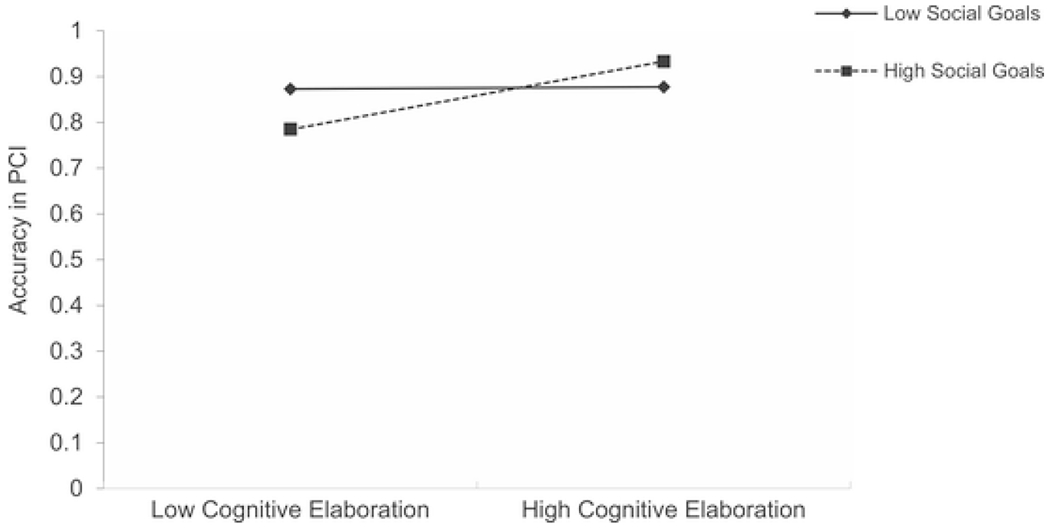
Interaction between cognitive elaboration and social goals in predicting accuracy in the parent-child interview.
When predicting children’s accuracy in the interviewer-child interview, there were no main effects nor interaction effects between our main predictors. When predicting children’s accuracy in the interviewer direct questions, social goal endorsement was negatively associated with children’s accuracy. No interaction effects were found.
7. Discussion
The present study extended prior work on parent-child conversations by testing links between parent conversation goals, cognitive elaboration, and children’s ability to accurately report about a laboratory activity with both a caregiver and a novel interviewer. We tested these associations in children spanning the preschool years given that (a) this is a developmental period during which children are particularly sensitive to parent socialization via past event conversations and (b) there are developmental shifts in internalization of parental conversation strategies across this period (Fivush & Nelson, 2004). The design allowed for examination of the relative roles of typical socialization strategies (i.e., conversation goals) and situation-specific practices (i.e., experimentally manipulated conversation goal; cognitive elaboration when discussing the laboratory activity) on children’s responding across the preschool age range. The approach was also novel in that, rather than examining parent-child conversations in an exclusively social-focused or ambiguous context, we experimentally manipulated social-focused versus fact-focused goals to test effects on children’s reporting.
Our first hypothesis, that social goals would be associated with cognitive elaboration, was somewhat supported. Parents in the Social-focused condition used more cognitive elaboration in the parent-child conversation relative to those in the Fact-focused condition. However, parents who reported emphasizing social goals in typical conversations were no more likely to provide cognitive elaboration in the parent-child conversation. Thus, these results indicate that parents increased cognitive elaboration to meet social goals when talking about past events with their children, or conversely, that they decreased cognitive elaboration to meet accuracy goals. The former explanation suggests that parents may attempt to elicit lengthier, more detailed reports from their children when they have social goals and may try to restrict children’s responding to factual content when they have fact-finding goals.
These results are in line with previous work showing that caregivers sometimes shift their conversation style, for example, depending on child characteristics such as age and language abilities (Reese & Fivush, 1993). However, the findings diverge from some previous work in which conversation context was manipulated. Cleveland and colleagues (2007) had parents observe their preschool-aged child complete a play activity and then dyads were randomly assigned to discuss the play activity either focusing on the child’s experience of the event or on helping the child remember the event. In that study, there were no observed differences in parent elaboration across conditions. One key difference between Cleveland and colleagues’ findings and those of the present study, other than the difference in context conditions, was that parents in Cleveland et al. (2007) had direct and detailed knowledge of the event under discussion. Perhaps parents rely less on shifts in questioning style to elicit content from children when they already know what took place.
In line with our second hypothesis, caregivers shifted their conversational approach based on the experimentally manipulated goal context and by their child’s age. They asked more questions overall, and especially more leading questions, in the Fact-focused condition relative to the Social-focused condition, and asked more leading questions when their child was younger. We theorize that parents asked more questions overall in the Fact-focused condition in an attempt to elicit as much content as possible to understand the facts of the event and that they relied on leading questions to focus children’s responses on the factual content the parent found most relevant. This somewhat aligns with the finding that parents of younger children used more leading questions, perhaps because younger children tend to provide less information about their experiences (Schneider & Ornstein, 2015). The finding that parents used more cognitive elaboration in the Social-focused conversation relative to the Fact-focused condition is also in line with the second hypothesis. Cognitive elaboration encourages children to report as much information as possible. This strategy may be at odds with the goal of constraining children’s responses to accurate factual content in which the parent is interested.
The finding that caregivers used more leading questions with younger children is in line with work showing that attorneys ask more suggestive questions of younger children across the 5–18-year-old range (Klemfuss et al., 2014). These findings, combined with those showing that leading questions were more frequent in the Fact-focused condition, suggest that adults may use leading questions in an attempt to control younger children’s responding. However, as expected, accuracy in the parent-child conversation increased with age, older children were more accurate to the interviewer’s later direct questions, and children were less accurate when their caregivers asked more leading questions, demonstrating the ineffectiveness of this strategy.
Our third study hypothesis was that social goals would predict lower accuracy in children’s contributions to the parent-child conversation except when parents also showed high cognitive elaboration. In fact, however, social goals were not directly related to children’s accuracy in the parent-child interview. However, cognitive elaboration only predicted accuracy when parents endorsed using social goals in typical past event conversations with their child. We suspect this interaction was driven by lower accuracy in children whose parents had high social goals and low cognitive elaboration. In other words, children of parents who strongly endorsed social goals and who used low cognitive elaboration in the parent-child conversation, were the least accurate. This finding suggests that parent cognitive elaboration may have driven children’s accuracy, as evidenced by a main effect of cognitive elaboration on children’s accuracy in the parent-child conversation, and in line with previous research showing that cognitive elaboration increases children’s provision of correct details (Cleveland et al., 2007; Leichtman et al., 2000; Leichtman et al., 2017). When there was minimal cognitive elaboration to aid children’s reporting, however, children who were socialized by parents who emphasized social goals were least accurate. And further, we found that children of parents who emphasized social goals were least accurate in response to the interviewer’s direct questions later in the procedure. This finding further points to the potential of some negative impact of social goals on children’s accuracy. However, these patterns should be further examined in studies that manipulate context for the caregiver independent of context for the child to more directly test whether variations in children’s responding result from context-driven variations in caregivers’ conversational strategies.
Along this vein, we also hypothesized that children who were socialized by a parent who typically emphasized social goals, and who were assigned to the Social-focused condition in the present study, would be the least accurate of all children. Namely, we expected that the intensified focus on social goals would work against accuracy goals given that as adults we prefer stories told with a social focus to contain inaccuracies (Cole & Beike, 2019) and given that stories told by older children (6- to 8-year-olds) who are directly instructed to use a social focus (i.e., entertainment), are less accurate than stories told by children instructed to focus on accuracy (Kulkofsky et al., 2011). However, this was not the case. There was no main effect of condition on children’s accuracy and no interaction between condition and social goals. There were also no differences by age, so there was no evidence that prolonged exposure to caregiver’s socialization impacted children’s accuracy.
The lack of condition effect on children’s accuracy suggests that these young children either did not detect their parent’s shift in goals or did not adapt their responding to reflect the shift. Future work should directly compare preschool-aged children’s reporting when the conversation goal is manipulated indirectly through the parent, as in the present study, and when children are directly instructed to retell an event for fact-focused versus social-focused purposes (Kulkofsky et al., 2011), and should do so across a broader developmental range. This design would reveal whether preschool-age children, who are considered especially receptive to their parents’ conversation style, are not able to infer conversations goals indirectly or whether they are not yet able to shift the accuracy of their responding based on conversational goal as successfully as school aged children (Kulkofsky et al., 2011). Given the lack of condition effect on children’s accuracy and given that social goals predicted accuracy only when cognitive elaboration was low, it was then unsurprising that we did not find our predicted interaction between condition and social goals on children’s accuracy.
It may also be the case that effects were muted in the present study given that the event conversations occurred immediately following the to-be-discussed event. Future work should consider implementing a time delay between the child event and interviews to test parent socialization and condition effects on children’s long-term memory. A delay would also increase this paradigm’s applicability to forensic contexts. With a time-delay, we would expect a greater range in children’s reporting accuracy and thus potentially amplified results in line with the present study’s hypotheses.
Finally, this study was unique in that we examined the impacts of parent socialization and conversation strategies on independent reporting with an interviewer in addition to examining their responses in the parent-child conversation. There was minimal carryover of effects into the interviewer-child interactions. However, accuracy in the parent-child interview did predict accuracy in the interviewer-child interview. The direction of this result is unclear. Children who had the opportunity to recall and rehearse accurate details in the parent-child conversation may have had the highest accuracy in the subsequent interviewer-child interview or children with stronger memories of the play activity may have had the highest accuracy with both the parent and interviewer. To directly address this question future research should counterbalance the order of the parent-child and interviewer-child conversations. We kept the order consistent in the current study to parallel situations in which children formally report incidents to an unfamiliar interviewer (e.g., allegations of maltreatment) after they have already discussed the event with a parent or other close caregiver. However, if the results of future work reveal that children are equally accurate in the interviewer-child conversation regardless of whether they have discussed the event with their parent first, this would suggest that variations in the parent-child conversation are less influential on children’s responding with an unfamiliar interviewer than is children’s independent event memory.
To summarize the results of the present study, the context manipulation influenced parents’ conversation behavior, but did not directly impact children’s responding. Parents’ typical conversation goals and in-the-moment cognitive elaboration were unrelated to each other, however parent long-term and short-term behaviors predicted children’s accuracy. As expected, cognitive elaboration alone predicted increased accuracy in the parent-child conversation, and children of parents who emphasized social functions but provided minimal cognitive elaboration when discussing the play activity were the least accurate. Findings held across age and there was no direct evidence of spillover of parent conversation goals or cognitive elaboration to the interviewer-child interview.
This work has implications for how we understand both short-term and long-term impacts caregivers exert on children’s event reporting and has important potential for informing future studies of how parents question children in contexts where accuracy is paramount, such as when children may be victimized when the caregiver is not present. In terms of the broader debate regarding the extent to which context impacts children’s eyewitness abilities, the present results are less clear. While parents varied their questioning style based on the context instructions, the immediate context manipulation did not appear to impact children’s accuracy with the parent or interviewer. Future research with stronger manipulations and more forensically-relevant designs should further unpack the role of context, and how its impact varies across development, before attempting to translate or apply empirical findings to real-world settings like forensic interviewing.
Acknowledgments
This work was supported by the Florida International University Center for Children and Families Intramural Award and by the Eunice Kennedy Shriver National Institute of Child Health & Human Development of the National Institutes of Health under award number R01HD101627.
Footnotes
Conflict of interest
We have no conflicts of interest to disclose.
References
- Bauer PJ (2007). Remembering the Times of Our Lives: Memory in Infancy and Beyond. Psychology Press,. [Google Scholar]
- Cleveland ES, Reese E, & Grolnick WS (2007). Children’s engagement and competence in personal recollection: Effects of parents’ reminiscing goals. Journal of Experimental Child Psychology, 96(2), 131–149. 10.1016/j.jecp.2006.09.003. [DOI] [PubMed] [Google Scholar]
- Cohen P, Cohen P, West SG, & Aiken LS (2014). Applied multiple regression/correlation analysis for the behavioral sciences. Applied Multiple Regression/Correlation Analysis for the Behavioral Sciences. 10.4324/9781410606266. [DOI] [Google Scholar]
- Cole HE, & Beike DR (2019). Tall tales make fast friends: Exaggerating when retelling previous experiences fosters relational closeness. Journal of Social and Personal Relationships, 36(8), 2287–2306. 10.1177/0265407518787344. [DOI] [Google Scholar]
- Faul F, & Erdfelder E (1992). GPOWER: A priori, post-hoc, and compromise power analyses for MS-DOS [Computer program]. Bonn, FRG: Bonn University, Department of Psychology. [Google Scholar]
- Fivush R, & Fromhoff FA (1988). Style and structure in mother-child conversations about the past. Discourse Processes, 11(3), 337–355. 10.1080/01638538809544707. [DOI] [Google Scholar]
- Fivush R, & Nelson K (2004). Culture and language in the emergence of autobiographical memory. Psychological science, 15(9), 573–577. [DOI] [PubMed] [Google Scholar]
- Fivush R, & Reese E (1992). The social construction of autobiographical memory. In Conway MA, Rubin DC, Spinnler H, & Wagenaar WA (Eds.), Theoretical Perspectives on Autobiographical Memory (pp. 115–132). Springer. [Google Scholar]
- Fivush R, & Vasudeva A (2002). Remembering to relate: Socioemotional correlates of mother-child reminiscing. Journal of Cognition and Development, 3(1), 73–90. [Google Scholar]
- Harley K, & Reese E (1999). Origins of autobiographical memory. Developmental Psychology, 35(5), 1338–1348. 10.1037/0012-1649.35.5.1338. [DOI] [PubMed] [Google Scholar]
- Klemfuss JZ (2015). Differential contributions of language skills to children’s episodic recall. Journal of Cognition and Development, 16(4). 10.1080/15248372.2014.952415. [DOI] [Google Scholar]
- Klemfuss JZ, & Ceci S (2009). Normative memory development and the child witness. In Kuehnle K, & Connell M (Eds.), The Evaluation of Child Sexual Abuse Allegations: A Comprehensive Guide to Assessment and Testimony (pp. 153–180). John Wiley & Sons Inc. [Google Scholar]
- Klemfuss JZ, Quas JA, & Lyon TD (2014). Attorneys’ questions and children’s productivity in child sexual abuse criminal trials. Applied Cognitive Psychology, 28(5), 780–788. 10.1002/acp.3048. [DOI] [PMC free article] [PubMed] [Google Scholar]
- Klemfuss JZ, Rush EB, & Quas JA (2016). Parental reminiscing style and children’s suggestibility about an alleged transgression. Cognitive Development, 40, 33–45. 10.1016/j.cogdev.2016.08.003. [DOI] [Google Scholar]
- Klemfuss JZ, Slonecker EM, Akhavein K, & Dhruve DM (2021). Subcultural, ideological, and valence-based differences in caregiver reminiscing functions. Memory, 29(2), 210–223. 10.1080/09658211.2021.1879153. [DOI] [PubMed] [Google Scholar]
- Koo TK, & Li MY (2016). A guideline of selecting and reporting intraclass correlation coefficients for reliability research. Journal of Chiropractic Medicine, 15(2). 10.1016/j.jcm.2016.02.012. [DOI] [PMC free article] [PubMed] [Google Scholar]
- Kulkofsky S (2011). Characteristics of functional joint reminiscence in early childhood. Memory, 19(1), 45–55. 10.1080/09658211.2010.535542. [DOI] [PubMed] [Google Scholar]
- Kulkofsky S, & Klemfuss JZ (2008). What the stories children tell can tell about their memory: narrative skill and young children’s suggestibility. Developmental Psychology, 44(5). 10.1037/a0012849. [DOI] [PubMed] [Google Scholar]
- Kulkofsky S, & Koh JBK (2009). Why they reminisce: Caregiver reports of the functions of joint reminiscence in early childhood. Memory, 17(4). 10.1080/09658210902729509. [DOI] [PubMed] [Google Scholar]
- Kulkofsky S, Principe GF, Debaran FB, & Stouch A (2011). Just the facts or just for fun? Children’s understanding of and sensitivity to retelling contexts. Applied Cognitive Psychology, 25(5), 727–738. 10.1002/acp.1744. [DOI] [Google Scholar]
- Kulkofsky S, Wang Q, & Koh BK (2009). Functions of memory sharing in mother-child reminiscing behaviors: Individual and cultural variations. Journal of Cognition and Development, 10(1–2), 92–114. 10.1080/15248370903041231. [DOI] [Google Scholar]
- Laible DJ (2004). Mother-Child Discourse Surrounding a Child’s Past Behavior at 30 Months: Links to Emotional Understanding and Early Conscience Development at 36 Months. Merrill-Palmer Quarterly, 50(2). 10.1353/mpq.2004.0013. [DOI] [Google Scholar]
- Lawson M, Rodriguez-Steen L, & London K (2018). A systematic review of the reliability of children’s event reports after discussing experiences with a naïve, knowledgeable, or misled parent. Developmental Review, 49, 62–79. 10.1016/j.dr.2018.06.003. [DOI] [Google Scholar]
- Leichtman MD, Camilleri KA, Pillemer DB, Amato-Wierda CC, Hogan JE, & Dongo MD (2017). Talking after school: Parents’ conversational styles and children’s memory for a science lesson. Journal of Experimental Child Psychology, 156, 1–15. 10.1016/j.jecp.2016.11.002. [DOI] [PubMed] [Google Scholar]
- Leichtman MD, Pillemer DB, Wang Q, Koreishi A, & Han JJ (2000). When Baby Maisy came to school. Cognitive Development, 15(1), 99–114. 10.1016/S0885-2014(00)00019-8. [DOI] [Google Scholar]
- McGraw KO, & Wong SP (1996). Forming inferences about some intraclass correlation coefficients. Psychological Methods, 1(1), 30. [Google Scholar]
- Nelson K, & Fivush R (2004). The emergence and early development of autobiographical memory. Psychological Review, 111, 3. [DOI] [PubMed] [Google Scholar]
- Principe GF, DiPuppo J, & Gammel J (2013). Effects of mothers’ conversation style and receipt of misinformation on children’s event reports. Cognitive Development, 28(3), 260–271. 10.1016/j.cogdev.2013.01.012. [DOI] [Google Scholar]
- Principe GF, Trumbull J, Gardner G, van Horn E, & Dean AM (2017). The role of maternal elaborative structure and control in children’s memory and suggestibility for a past event. Journal of Experimental Child Psychology, 163, 15–31. 10.1016/j.jecp.2017.06.001. [DOI] [PubMed] [Google Scholar]
- Reese E, & Fivush R (1993). Parental styles of talking about the past. Developmental Psychology, Vol. 29, 3. [Google Scholar]
- Schneider W, & Ornstein PA (2015). The development of children’s memory. Child Development Perspectives, 9(3), 190–195. [Google Scholar]
- Zaman W, & Fivush R (2013). Gender differences in elaborative parent–child emotion and play narratives. Sex roles, 68(9), 591–604. [Google Scholar]