



Abstract
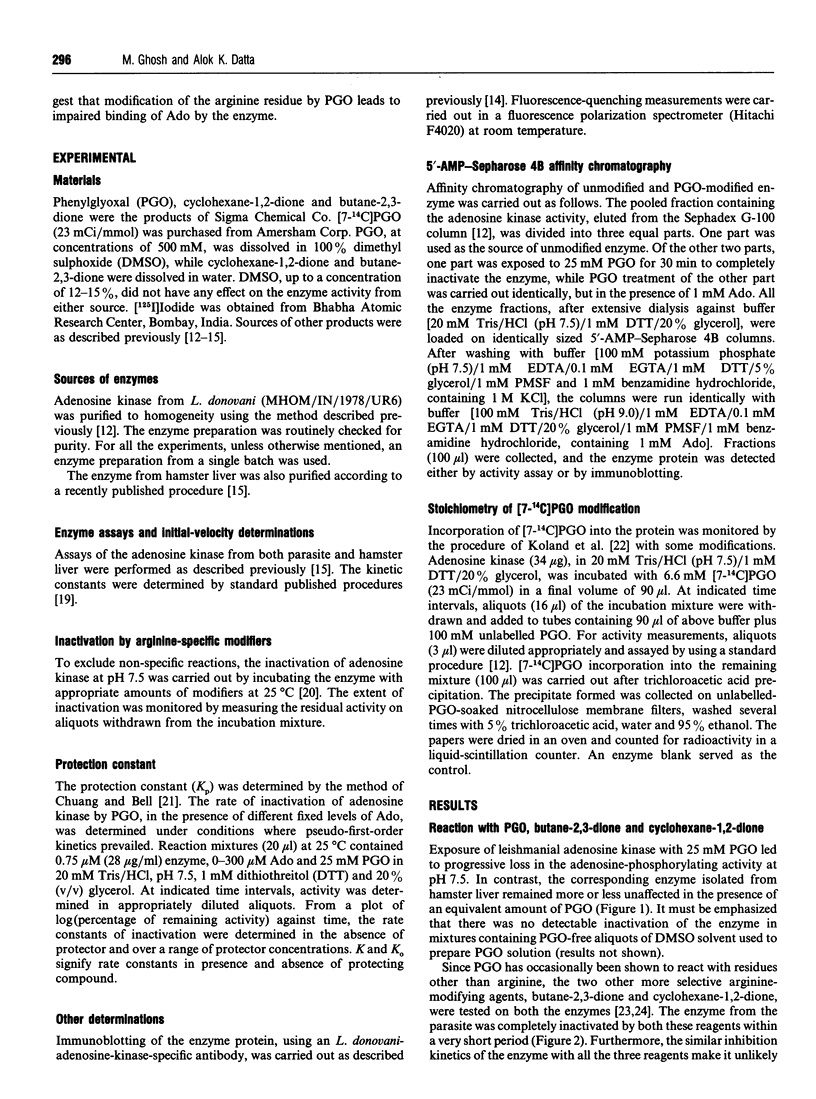
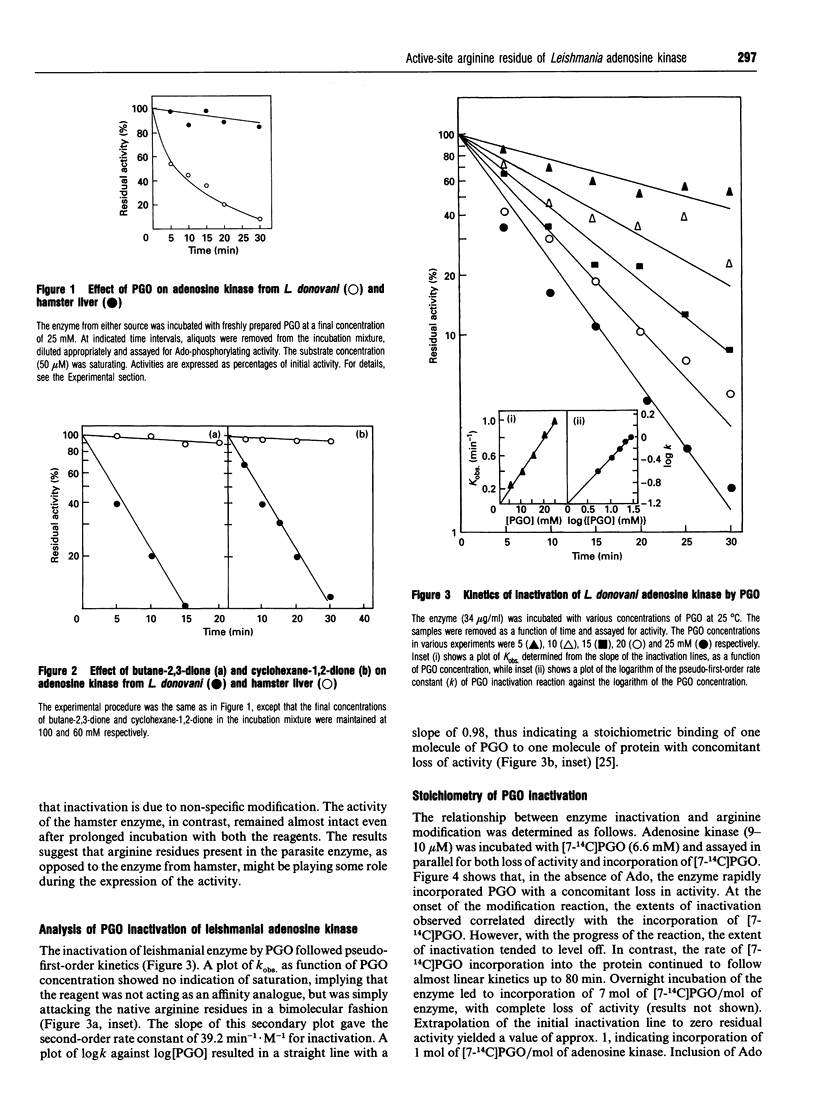
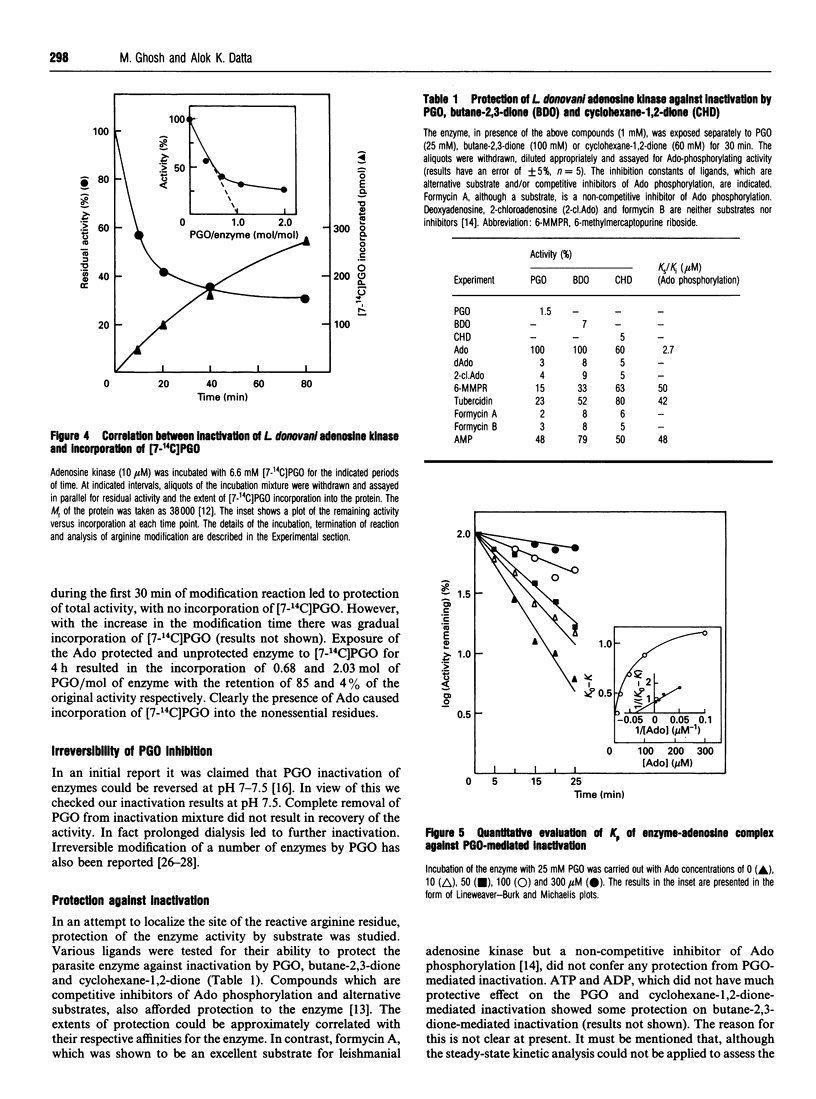
The presence of arginine at the active site of Leishmania donovani adenosine kinase was studied by chemical modification, followed by the characterization of the modified enzyme. The arginine-specific reagents phenylglyoxal (PGO), butane-2,3-dione and cyclohexane-1,2-dione all irreversibly inactivated the enzyme. In contrast, adenosine kinase from hamster liver was insensitive to these reagents. The inactivation of the enzyme by PGO followed pseudo-first-order kinetics, with a second-order rate constant of 39.2 min-1.M-1. Correlation between the stoichiometry of PGO modification and extent of inactivation indicated that modification of a single residue per molecule suffices for the loss of activity. Reactivity of the essential arginine residue towards PGO was affected by the presence of adenosine (Ado) and other competing alternative substrates, consistent with an arginine residue located proximal to the Ado-binding site. The enzyme showed an intrinsic fluorescence with an emission maximum at 340 nm when excited at 295 nm. The protein fluorescence was partially quenched on addition of Ado. PGO modification also led to significant quenching of the fluorescence. However, the fluorescence of the Ado-protected enzyme, which displayed 82% of the original activity after PGO treatment, was retained. The kinetic analyses of the partially modified enzyme showed an increase in the Km for Ado from 14 to 55 microM. Furthermore, the inability of the modified enzyme to bind to 5'-AMP-Sepharose 4B affinity column provided additional evidence that modification is attended by decrease in affinity of the enzyme for Ado. The results are consistent with the interpretation that modification of the active-site arginine residue affects activity by interfering with the binding of the substrate to the active site.
Full text
PDF
Images in this article
Selected References
These references are in PubMed. This may not be the complete list of references from this article.
- Bennet L. L., Jr, Hill D. L., Allan P. W. Inosine analogs as substrates for adenosine kinase--influence of ionization of the N-1 proton on the rate of phosphorylation. Biochem Pharmacol. 1978 Jan 1;27(1):83–87. doi: 10.1016/0006-2952(78)90260-5. [DOI] [PubMed] [Google Scholar]
- Bhaumik D., Datta A. K. Active site thiol(s) in Leishmania donovani adenosine kinase: comparison with hamster enzyme and evidence for the absence of regulatory adenosine binding site. Mol Biochem Parasitol. 1992 May;52(1):29–38. doi: 10.1016/0166-6851(92)90033-g. [DOI] [PubMed] [Google Scholar]
- Bhaumik D., Datta A. K. Immunochemical and catalytic characteristics of adenosine kinase from Leishmania donovani. J Biol Chem. 1989 Mar 15;264(8):4356–4361. [PubMed] [Google Scholar]
- Bhaumik D., Datta A. K. Reaction kinetics and inhibition of adenosine kinase from Leishmania donovani. Mol Biochem Parasitol. 1988 Apr;28(3):181–187. doi: 10.1016/0166-6851(88)90002-3. [DOI] [PubMed] [Google Scholar]
- Bone R., Cheng Y. C., Wolfenden R. Inhibition of adenosine and thymidylate kinases by bisubstrate analogs. J Biol Chem. 1986 Dec 15;261(35):16410–16413. [PubMed] [Google Scholar]
- Chang C. H., Cha S., Brockman R. W., Bennett L. L., Jr Kinetic studies of adenosine kinase from L1210 cells: a model enzyme with a two-site ping-pong mechanism. Biochemistry. 1983 Feb 1;22(3):600–611. doi: 10.1021/bi00272a012. [DOI] [PubMed] [Google Scholar]
- Chuang H. Y., Bell F. E. Use of a thermal inactivation technique to obtain binding constants for the Escherichia coli valyl-tRNA synthetase. Arch Biochem Biophys. 1972 Oct;152(2):502–514. doi: 10.1016/0003-9861(72)90245-7. [DOI] [PubMed] [Google Scholar]
- Datta A. K., Bhaumik D., Chatterjee R. Isolation and characterization of adenosine kinase from Leishmania donovani. J Biol Chem. 1987 Apr 25;262(12):5515–5521. [PubMed] [Google Scholar]
- Fersht A. R. Relationships between apparent binding energies measured in site-directed mutagenesis experiments and energetics of binding and catalysis. Biochemistry. 1988 Mar 8;27(5):1577–1580. doi: 10.1021/bi00405a027. [DOI] [PubMed] [Google Scholar]
- Ferti C., Curti B., Simonetta M. P., Ronchi S., Galliano M., Minchiotti L. Reactivity of D-amino acid oxidase with 1,2-cyclohexanedione: evidence for one arginine in the substrate-binding site. Eur J Biochem. 1981 Oct;119(3):553–557. doi: 10.1111/j.1432-1033.1981.tb05643.x. [DOI] [PubMed] [Google Scholar]
- Foster M., Harrison J. H. Selective chemical modification of arginine residues in mitochondrial malate dehydrogenase. Biochem Biophys Res Commun. 1974 May 7;58(1):263–267. doi: 10.1016/0006-291x(74)90921-8. [DOI] [PubMed] [Google Scholar]
- Fox I. H., Kelley W. N. The role of adenosine and 2'-deoxyadenosine in mammalian cells. Annu Rev Biochem. 1978;47:655–686. doi: 10.1146/annurev.bi.47.070178.003255. [DOI] [PubMed] [Google Scholar]
- Glew R. H., Saha A. K., Das S., Remaley A. T. Biochemistry of the Leishmania species. Microbiol Rev. 1988 Dec;52(4):412–432. doi: 10.1128/mr.52.4.412-432.1988. [DOI] [PMC free article] [PubMed] [Google Scholar]
- Gottlieb M. The surface membrane 3'-nucleotidase/nuclease of trypanosomatid protozoa. Parasitol Today. 1989 Aug;5(8):257–260. doi: 10.1016/0169-4758(89)90259-7. [DOI] [PubMed] [Google Scholar]
- Hayman S., Colman R. F. Effect of arginine modification on the catalytic activity and allosteric activation by adenosine diphosphate of the diphosphopyridine nucleotide specific isocitrate dehydrogenase of pig heart. Biochemistry. 1978 Oct 3;17(20):4161–4168. doi: 10.1021/bi00613a009. [DOI] [PubMed] [Google Scholar]
- Huang W. Y., Tang J. Modification of an arginyl residue in pepsin by 2,3-butanedione. J Biol Chem. 1972 May 10;247(9):2704–2710. [PubMed] [Google Scholar]
- Iovannisci D. M., Goebel D., Allen K., Kaur K., Ullman B. Genetic analysis of adenine metabolism in Leishmania donovani promastigotes. Evidence for diploidy at the adenine phosphoribosyltransferase locus. J Biol Chem. 1984 Dec 10;259(23):14617–14623. [PubMed] [Google Scholar]
- KORNBERG A., PRICER W. E., Jr Enzymatic phosphorylation of adenosine and 2,6-diaminopurine riboside. J Biol Chem. 1951 Dec;193(2):481–495. [PubMed] [Google Scholar]
- Koland J. G., O'Brien T. A., Gennis R. B. Role of arginine in the binding of thiamin pyrophosphate to Escherichia coli pyruvate oxidase. Biochemistry. 1982 May 25;21(11):2656–2600. doi: 10.1021/bi00540a012. [DOI] [PubMed] [Google Scholar]
- Kremer A. B., Egan R. M., Sable H. Z. The active site of transketolase. Two arginine residues are essential for activity. J Biol Chem. 1980 Mar 25;255(6):2405–2410. [PubMed] [Google Scholar]
- LEVY H. M., LEBER P. D., RYAN E. M. INACTIVATION OF MYOSIN BY 2,4-DINITROPHENOL AND PROTECTION BY ADENOSINE TRIPHOSPHATE AND OTHER PHOSPHATE COMPOUNDS. J Biol Chem. 1963 Nov;238:3654–3659. [PubMed] [Google Scholar]
- Lange L. G., 3rd, Riordan J. F., Vallee B. L. Functional arginyl residues as NADH binding sites of alcohol dehydrogenases. Biochemistry. 1974 Oct 8;13(21):4361–4370. doi: 10.1021/bi00718a019. [DOI] [PubMed] [Google Scholar]
- Looker D. L., Berens R. L., Marr J. J. Purine metabolism in Leishmania donovani amastigotes and promastigotes. Mol Biochem Parasitol. 1983 Sep;9(1):15–28. doi: 10.1016/0166-6851(83)90053-1. [DOI] [PubMed] [Google Scholar]
- Miller R. L., Adamczyk D. L., Miller W. H. Adenosine kinase from rabbit liver. I. Purification by affinity chromatography and properties. J Biol Chem. 1979 Apr 10;254(7):2339–2345. [PubMed] [Google Scholar]
- Pal P. K., Colman R. F. The importance of arginine residues in the catalytic and regulatory functions of bovine-liver glutamate dehydrogenase. Eur J Biochem. 1976 Sep 15;68(2):437–443. doi: 10.1111/j.1432-1033.1976.tb10831.x. [DOI] [PubMed] [Google Scholar]
- Parkin D. W., Horenstein B. A., Abdulah D. R., Estupiñn B., Schramm V. L. Nucleoside hydrolase from Crithidia fasciculata. Metabolic role, purification, specificity, and kinetic mechanism. J Biol Chem. 1991 Nov 5;266(31):20658–20665. [PubMed] [Google Scholar]
- Patthy L., Smith E. L. Reversible modification of arginine residues. Application to sequence studies by restriction of tryptic hydrolysis to lysine residues. J Biol Chem. 1975 Jan 25;250(2):557–564. [PubMed] [Google Scholar]
- Riordan J. F. Functional arginyl residues in carboxypeptidase A. Modification with butanedione. Biochemistry. 1973 Sep 25;12(20):3915–3923. doi: 10.1021/bi00744a020. [DOI] [PubMed] [Google Scholar]
- Riordan J. F., McElvany K. D., Borders C. L., Jr Arginyl residues: anion recognition sites in enzymes. Science. 1977 Mar 4;195(4281):884–886. doi: 10.1126/science.190679. [DOI] [PubMed] [Google Scholar]
- Schimandle C. M., Tanigoshi L., Mole L. A., Sherman I. W. Purine nucleoside phosphorylase of the malarial parasite, Plasmodium lophurae. J Biol Chem. 1985 Apr 10;260(7):4455–4460. [PubMed] [Google Scholar]
- Schloss J. V., Norton I. L., Stringer C. D., Hartman F. C. Inactivation of ribulosebisphosphate carboxylase by modification of arginyl residues with phenylglyoxal. Biochemistry. 1978 Dec 26;17(26):5626–5631. doi: 10.1021/bi00619a007. [DOI] [PubMed] [Google Scholar]
- Scrutton M. C., Utter M. F. Pyruvate carboxylase. V. Interaction of the enzyme with adenosine triphosphate. J Biol Chem. 1965 Oct;240(10):3714–3723. [PubMed] [Google Scholar]
- Smith E. L. Reversible blocking at arginine by cyclohexanedione. Methods Enzymol. 1977;47:156–161. doi: 10.1016/0076-6879(77)47019-8. [DOI] [PubMed] [Google Scholar]
- Stole E., Meister A. Interaction of gamma-glutamyl transpeptidase with glutathione involves specific arginine and lysine residues of the heavy subunit. J Biol Chem. 1991 Sep 25;266(27):17850–17857. [PubMed] [Google Scholar]
- Takahashi K. The reaction of phenylglyoxal with arginine residues in proteins. J Biol Chem. 1968 Dec 10;243(23):6171–6179. [PubMed] [Google Scholar]
- Vlahos C. J., Ghalambor M. A., Dekker E. E. Evidence for an essential arginine residue in the active site of Escherichia coli 2-keto-4-hydroxyglutarate aldolase. Modification with 1,2-cyclohexanedione. J Biol Chem. 1985 May 10;260(9):5480–5485. [PubMed] [Google Scholar]
- Zakim D., Hochman Y., Kenney W. C. Evidence for an active site arginine in UDP-glucuronyltransferase. J Biol Chem. 1983 May 25;258(10):6430–6434. [PubMed] [Google Scholar]