



Abstract
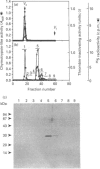
Rat peritoneal mast cells were shown to inactivate thrombin rapidly. The thrombin-inactivating activity was purified to homogeneity by a combination of anion-exchange chromatography and h.p.l.c. on a Superdex 75 column. The purified thrombin inactivator had an apparent molecular mass of 29 kDa and an N-terminal amino acid sequence identical to rat mast-cell protease 1 (RMCP-1). After labelling of the mast cells in vivo with 35SO4(2-), RMCP-1 was recovered in a macromolecular complex with [35S]heparin proteoglycans. Dissociation of RMCP-1 from the heparin proteoglycans by Superdex 75 chromatography in the presence of 2 M NaCl resulted in a marked loss of the thrombin-inactivating activity displayed by the enzyme. When RMCP-1 was reconstituted with either endogenous [35S]heparin proteoglycans or standard pig mucosal heparin, the enzyme regained its thrombin-inactivating properties. Affinity chromatography of endogenous [35S]heparin on matrix-linked RMCP-1 demonstrated that all of the heparin molecules contained high-affinity binding sites for the mast-cell protease. In contrast, the endogenous mast-cell heparin showed low affinity for antithrombin, a protease inhibitor involved in the regulation of coagulation enzymes.
Full text
PDF


Images in this article
Selected References
These references are in PubMed. This may not be the complete list of references from this article.
- Bar-Shavit R., Kahn A., Fenton J. W., 2nd, Wilner G. D. Chemotactic response of monocytes to thrombin. J Cell Biol. 1983 Jan;96(1):282–285. doi: 10.1083/jcb.96.1.282. [DOI] [PMC free article] [PubMed] [Google Scholar]
- Benfey P. N., Yin F. H., Leder P. Cloning of the mast cell protease, RMCP II. Evidence for cell-specific expression and a multi-gene family. J Biol Chem. 1987 Apr 15;262(11):5377–5384. [PubMed] [Google Scholar]
- Bourin M. C., Lindahl U. Glycosaminoglycans and the regulation of blood coagulation. Biochem J. 1993 Jan 15;289(Pt 2):313–330. doi: 10.1042/bj2890313. [DOI] [PMC free article] [PubMed] [Google Scholar]
- Bromley M., Fisher W. D., Woolley D. E. Mast cells at sites of cartilage erosion in the rheumatoid joint. Ann Rheum Dis. 1984 Feb;43(1):76–79. doi: 10.1136/ard.43.1.76. [DOI] [PMC free article] [PubMed] [Google Scholar]
- Carney D. H., Cunningham D. D. Role of specific cell surface receptors in thrombin-stimulated cell division. Cell. 1978 Dec;15(4):1341–1349. doi: 10.1016/0092-8674(78)90059-4. [DOI] [PubMed] [Google Scholar]
- Clohisy D. R., Erdmann J. M., Wilner G. D. Thrombin binds to murine bone marrow-derived macrophages and enhances colony-stimulating factor-1-driven mitogenesis. J Biol Chem. 1990 May 15;265(14):7729–7732. [PubMed] [Google Scholar]
- DuBuske L., Austen K. F., Czop J., Stevens R. L. Granule-associated serine neutral proteases of the mouse bone marrow-derived mast cell that degrade fibronectin: their increase after sodium butyrate treatment of the cells. J Immunol. 1984 Sep;133(3):1535–1541. [PubMed] [Google Scholar]
- Enerbäck L., Kolset S. O., Kusche M., Hjerpe A., Lindahl U. Glycosaminoglycans in rat mucosal mast cells. Biochem J. 1985 Apr 15;227(2):661–668. doi: 10.1042/bj2270661. [DOI] [PMC free article] [PubMed] [Google Scholar]
- Everitt M. T., Neurath H. Rat peritoneal mast cell carboxypeptidase: localization, purification, and enzymatic properties. FEBS Lett. 1980 Feb 11;110(2):292–296. doi: 10.1016/0014-5793(80)80095-0. [DOI] [PubMed] [Google Scholar]
- Frey W. H., 2nd, Utter M. F. Binding of acetyl-CoA to chicken liver pyruvate carboxylase. J Biol Chem. 1977 Jan 10;252(1):51–56. [PubMed] [Google Scholar]
- Gervasoni J. E., Jr, Conrad D. H., Hugli T. E., Schwartz L. B., Ruddy S. Degradation of human anaphylatoxin C3a by rat peritoneal mast cells: a role for the secretory granule enzyme chymase and heparin proteoglycan. J Immunol. 1986 Jan;136(1):285–292. [PubMed] [Google Scholar]
- Gibson S., Miller H. R. Mast cell subsets in the rat distinguished immunohistochemically by their content of serine proteinases. Immunology. 1986 May;58(1):101–104. [PMC free article] [PubMed] [Google Scholar]
- Habuchi H., Suzuki S., Saito T., Tamura T., Harada T., Yoshida K., Kimata K. Structure of a heparan sulphate oligosaccharide that binds to basic fibroblast growth factor. Biochem J. 1992 Aug 1;285(Pt 3):805–813. doi: 10.1042/bj2850805. [DOI] [PMC free article] [PubMed] [Google Scholar]
- Hattori R., Hamilton K. K., Fugate R. D., McEver R. P., Sims P. J. Stimulated secretion of endothelial von Willebrand factor is accompanied by rapid redistribution to the cell surface of the intracellular granule membrane protein GMP-140. J Biol Chem. 1989 May 15;264(14):7768–7771. [PubMed] [Google Scholar]
- Hawkins R. A., Claman H. N., Clark R. A., Steigerwald J. C. Increased dermal mast cell populations in progressive systemic sclerosis: a link in chronic fibrosis? Ann Intern Med. 1985 Feb;102(2):182–186. doi: 10.7326/0003-4819-102-2-182. [DOI] [PubMed] [Google Scholar]
- Huang R. Y., Blom T., Hellman L. Cloning and structural analysis of MMCP-1, MMCP-4 and MMCP-5, three mouse mast cell-specific serine proteases. Eur J Immunol. 1991 Jul;21(7):1611–1621. doi: 10.1002/eji.1830210706. [DOI] [PubMed] [Google Scholar]
- Hök M., Björk I., Hopwood J., Lindahl U. Anticoagulant activity of heparin: separation of high-activity and low-activity heparin species by affinity chromatography on immobilized antithrombin. FEBS Lett. 1976 Jul 1;66(1):90–93. doi: 10.1016/0014-5793(76)80592-3. [DOI] [PubMed] [Google Scholar]
- Kido H., Fukusen N., Katunuma N. Chymotrypsin- and trypsin-type serine proteases in rat mast cells: properties and functions. Arch Biochem Biophys. 1985 Jun;239(2):436–443. doi: 10.1016/0003-9861(85)90709-x. [DOI] [PubMed] [Google Scholar]
- Kokkonen J. O., Vartiainen M., Kovanen P. T. Low density lipoprotein degradation by secretory granules of rat mast cells. Sequential degradation of apolipoprotein B by granule chymase and carboxypeptidase A. J Biol Chem. 1986 Dec 5;261(34):16067–16072. [PubMed] [Google Scholar]
- Laemmli U. K. Cleavage of structural proteins during the assembly of the head of bacteriophage T4. Nature. 1970 Aug 15;227(5259):680–685. doi: 10.1038/227680a0. [DOI] [PubMed] [Google Scholar]
- Le Trong H., Parmelee D. C., Walsh K. A., Neurath H., Woodbury R. G. Amino acid sequence of rat mast cell protease I (chymase). Biochemistry. 1987 Nov 3;26(22):6988–6994. doi: 10.1021/bi00396a020. [DOI] [PubMed] [Google Scholar]
- Lindahl U., Pejler G., Bøgwald J., Seljelid R. A prothrombinase complex of mouse peritoneal macrophages. Arch Biochem Biophys. 1989 Aug 15;273(1):180–188. doi: 10.1016/0003-9861(89)90177-x. [DOI] [PubMed] [Google Scholar]
- McNeil H. P., Reynolds D. S., Schiller V., Ghildyal N., Gurley D. S., Austen K. F., Stevens R. L. Isolation, characterization, and transcription of the gene encoding mouse mast cell protease 7. Proc Natl Acad Sci U S A. 1992 Dec 1;89(23):11174–11178. doi: 10.1073/pnas.89.23.11174. [DOI] [PMC free article] [PubMed] [Google Scholar]
- Miller J. S., Westin E. H., Schwartz L. B. Cloning and characterization of complementary DNA for human tryptase. J Clin Invest. 1989 Oct;84(4):1188–1195. doi: 10.1172/JCI114284. [DOI] [PMC free article] [PubMed] [Google Scholar]
- Mizutani H., Schechter N., Lazarus G., Black R. A., Kupper T. S. Rapid and specific conversion of precursor interleukin 1 beta (IL-1 beta) to an active IL-1 species by human mast cell chymase. J Exp Med. 1991 Oct 1;174(4):821–825. doi: 10.1084/jem.174.4.821. [DOI] [PMC free article] [PubMed] [Google Scholar]
- Morrissey J. H. Silver stain for proteins in polyacrylamide gels: a modified procedure with enhanced uniform sensitivity. Anal Biochem. 1981 Nov 1;117(2):307–310. doi: 10.1016/0003-2697(81)90783-1. [DOI] [PubMed] [Google Scholar]
- Olson S. T., Halvorson H. R., Björk I. Quantitative characterization of the thrombin-heparin interaction. Discrimination between specific and nonspecific binding models. J Biol Chem. 1991 Apr 5;266(10):6342–6352. [PubMed] [Google Scholar]
- Pejler G., David G. Basement-membrane heparan sulphate with high affinity for antithrombin synthesized by normal and transformed mouse mammary epithelial cells. Biochem J. 1987 Nov 15;248(1):69–77. doi: 10.1042/bj2480069. [DOI] [PMC free article] [PubMed] [Google Scholar]
- Pejler G., Karlström A. Thrombin is inactivated by mast cell secretory granule chymase. J Biol Chem. 1993 Jun 5;268(16):11817–11822. [PubMed] [Google Scholar]
- Pejler G., Seljelid R. Inactivation of thrombin by murine peritoneal macrophages. J Biol Chem. 1992 Feb 15;267(5):3136–3142. [PubMed] [Google Scholar]
- Qureshi R., Jakschik B. A. The role of mast cells in thioglycollate-induced inflammation. J Immunol. 1988 Sep 15;141(6):2090–2096. [PubMed] [Google Scholar]
- Razin E., Baranes D., Marx G. Thrombin-mast cell interactions. Binding and cell activation. Exp Cell Res. 1985 Oct;160(2):380–386. doi: 10.1016/0014-4827(85)90184-3. [DOI] [PubMed] [Google Scholar]
- Reilly C. F., Schechter N. B., Travis J. Inactivation of bradykinin and kallidin by cathepsin G and mast cell chymase. Biochem Biophys Res Commun. 1985 Mar 15;127(2):443–449. doi: 10.1016/s0006-291x(85)80180-7. [DOI] [PubMed] [Google Scholar]
- Reilly C. F., Tewksbury D. A., Schechter N. M., Travis J. Rapid conversion of angiotensin I to angiotensin II by neutrophil and mast cell proteinases. J Biol Chem. 1982 Aug 10;257(15):8619–8622. [PubMed] [Google Scholar]
- Reynolds D. S., Gurley D. S., Stevens R. L., Sugarbaker D. J., Austen K. F., Serafin W. E. Cloning of cDNAs that encode human mast cell carboxypeptidase A, and comparison of the protein with mouse mast cell carboxypeptidase A and rat pancreatic carboxypeptidases. Proc Natl Acad Sci U S A. 1989 Dec;86(23):9480–9484. doi: 10.1073/pnas.86.23.9480. [DOI] [PMC free article] [PubMed] [Google Scholar]
- Reynolds D. S., Stevens R. L., Lane W. S., Carr M. H., Austen K. F., Serafin W. E. Different mouse mast cell populations express various combinations of at least six distinct mast cell serine proteases. Proc Natl Acad Sci U S A. 1990 Apr;87(8):3230–3234. doi: 10.1073/pnas.87.8.3230. [DOI] [PMC free article] [PubMed] [Google Scholar]
- Sayama S., Iozzo R. V., Lazarus G. S., Schechter N. M. Human skin chymotrypsin-like proteinase chymase. Subcellular localization to mast cell granules and interaction with heparin and other glycosaminoglycans. J Biol Chem. 1987 May 15;262(14):6808–6815. [PubMed] [Google Scholar]
- Schechter N. M., Choi J. K., Slavin D. A., Deresienski D. T., Sayama S., Dong G., Lavker R. M., Proud D., Lazarus G. S. Identification of a chymotrypsin-like proteinase in human mast cells. J Immunol. 1986 Aug 1;137(3):962–970. [PubMed] [Google Scholar]
- Schwartz L. B., Bradford T. R., Littman B. H., Wintroub B. U. The fibrinogenolytic activity of purified tryptase from human lung mast cells. J Immunol. 1985 Oct;135(4):2762–2767. [PubMed] [Google Scholar]
- Schwartz L. B., Bradford T. R. Regulation of tryptase from human lung mast cells by heparin. Stabilization of the active tetramer. J Biol Chem. 1986 Jun 5;261(16):7372–7379. [PubMed] [Google Scholar]
- Schwartz L. B., Kawahara M. S., Hugli T. E., Vik D., Fearon D. T., Austen K. F. Generation of C3a anaphylatoxin from human C3 by human mast cell tryptase. J Immunol. 1983 Apr;130(4):1891–1895. [PubMed] [Google Scholar]
- Serafin W. E., Dayton E. T., Gravallese P. M., Austen K. F., Stevens R. L. Carboxypeptidase A in mouse mast cells. Identification, characterization, and use as a differentiation marker. J Immunol. 1987 Dec 1;139(11):3771–3776. [PubMed] [Google Scholar]
- Sterk A. R., Ishizaka T. Binding properties of IgE receptors on normal mouse mast cells. J Immunol. 1982 Feb;128(2):838–843. [PubMed] [Google Scholar]
- Stevens R. L., Austen K. F. Recent advances in the cellular and molecular biology of mast cells. Immunol Today. 1989 Nov;10(11):381–386. doi: 10.1016/0167-5699(89)90272-7. [DOI] [PubMed] [Google Scholar]
- Thunberg L., Bäckström G., Lindahl U. Further characterization of the antithrombin-binding sequence in heparin. Carbohydr Res. 1982 Mar 1;100:393–410. doi: 10.1016/s0008-6215(00)81050-2. [DOI] [PubMed] [Google Scholar]
- Woodbury R. G., Everitt M. T., Neurath H. Mast cell proteases. Methods Enzymol. 1981;80(Pt 100):588–609. doi: 10.1016/s0076-6879(81)80047-x. [DOI] [PubMed] [Google Scholar]
- Yurt R., Austen K. F. Preparative purification of the rat mast cell chymase: characterization and interaction with granule components. J Exp Med. 1977 Nov 1;146(5):1405–1419. doi: 10.1084/jem.146.5.1405. [DOI] [PMC free article] [PubMed] [Google Scholar]