



Abstract
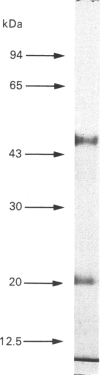
Human glucuronate 2-sulphatase (GAS), which is involved in the degradation of the glycosaminoglycans heparan sulphate and chondroitin 6-sulphate, was purified almost 2,000,000-fold to homogeneity in 8% yield from liver with a four-step six-column procedure, which consists of a concanavalin A-Sepharose/Blue A-agarose coupled step, a DEAE-Sephacel/octyl-Sepharose coupled step, CM-Sepharose chromatography and gel-permeation chromatography. Although more than 90% of GAS activity had a pI of greater than 7.5, other forms with pI values of 5.8, 5.3, 4.7 and less than 4.0 were also present. The pI greater than 7.5 form of GAS had a native molecular mass of 63 kDa. SDS/polyacrylamide-gel-electrophoretic analysis resulted in two polypeptide subunits of molecular mass 47 and 19.5 kDa. GAS was active towards disaccharide substrates derived from heparin [O-(beta-glucuronic acid 2-sulphate)-(1----4)-O-(2,5)-anhydro[1-3H]mannitol 6-sulphate (GSMS)] and chondroitin 6-sulphate [O-(beta-glucuronic acid 2-sulphate-(1----3)-O-(2,5)-anhydro[1-3H]talitol 6-sulphate (GSTS)]. GAS activity towards GSMS and GSTS was at pH optima of 3.2 and 3.0 respectively with apparent Km values of 0.3 and 0.6 microM respectively and corresponding Vmax values of 12.8 and 13.7 mumol/min per mg of protein respectively. Sulphate and phosphate ions are potent inhibitors of enzyme activity. Cu2+ ions stimulated, whereas EDTA inhibited enzyme activity. It was concluded that GAS is required together with a series of other exoenzyme activities in the lysosomal degradation of glycosaminoglycans containing glucuronic acid 2-sulphate residues.
Full text
PDF


Images in this article
Selected References
These references are in PubMed. This may not be the complete list of references from this article.
- Bame K. J., Rome L. H. Acetyl coenzyme A: alpha-glucosaminide N-acetyltransferase. Evidence for a transmembrane acetylation mechanism. J Biol Chem. 1985 Sep 15;260(20):11293–11299. [PubMed] [Google Scholar]
- Bienkowski M. J., Conrad H. E. Structural characterization of the oligosaccharides formed by depolymerization of heparin with nitrous acid. J Biol Chem. 1985 Jan 10;260(1):356–365. [PubMed] [Google Scholar]
- Clements P. R., Brooks D. A., Saccone G. T., Hopwood J. J. Human alpha-L-iduronidase. 1. Purification, monoclonal antibody production, native and subunit molecular mass. Eur J Biochem. 1985 Oct 1;152(1):21–28. doi: 10.1111/j.1432-1033.1985.tb09158.x. [DOI] [PubMed] [Google Scholar]
- Clements P. R., Mahuran D. J., Hopwood J. J. Improved concanavalin A-Sepharose elution by specific readsorption of glycoproteins. J Chromatogr. 1983 May 20;261(1):77–82. doi: 10.1016/s0021-9673(01)87920-6. [DOI] [PubMed] [Google Scholar]
- Fedarko N. S., Conrad H. E. A unique heparan sulfate in the nuclei of hepatocytes: structural changes with the growth state of the cells. J Cell Biol. 1986 Feb;102(2):587–599. doi: 10.1083/jcb.102.2.587. [DOI] [PMC free article] [PubMed] [Google Scholar]
- Freeman C., Clements P. R., Hopwood J. J. Human liver N-acetylglucosamine-6-sulphate sulphatase. Purification and characterization. Biochem J. 1987 Sep 1;246(2):347–354. doi: 10.1042/bj2460347. [DOI] [PMC free article] [PubMed] [Google Scholar]
- Freeman C., Hopwood J. J. Human liver N-acetylglucosamine-6-sulphate sulphatase. Catalytic properties. Biochem J. 1987 Sep 1;246(2):355–365. doi: 10.1042/bj2460355. [DOI] [PMC free article] [PubMed] [Google Scholar]
- Freeman C., Hopwood J. J. Human liver sulphamate sulphohydrolase. Determinations of native protein and subunit Mr values and influence of substrate agylcone structure on catalytic properties. Biochem J. 1986 Feb 15;234(1):83–92. doi: 10.1042/bj2340083. [DOI] [PMC free article] [PubMed] [Google Scholar]
- Gallagher J. T., Lyon M., Steward W. P. Structure and function of heparan sulphate proteoglycans. Biochem J. 1986 Jun 1;236(2):313–325. doi: 10.1042/bj2360313. [DOI] [PMC free article] [PubMed] [Google Scholar]
- Gibson G. J., Saccone G. T., Brooks D. A., Clements P. R., Hopwood J. J. Human N-acetylgalactosamine-4-sulphate sulphatase. Purification, monoclonal antibody production and native and subunit Mr values. Biochem J. 1987 Dec 15;248(3):755–764. doi: 10.1042/bj2480755. [DOI] [PMC free article] [PubMed] [Google Scholar]
- Hopwood J. J., Elliott H. Detection of Morquio A syndrome using radiolabelled substrates derived from keratan sulphate for the estimation of galactose 6-sulphate sulphatase. Clin Sci (Lond) 1983 Sep;65(3):325–331. doi: 10.1042/cs0650325. [DOI] [PubMed] [Google Scholar]
- Hopwood J. J., Elliott H. Detection of the Sanfilippo type B syndrome using radiolabelled oligosaccharides as substrates for the estimation of alpha-N-acetylglucosaminidase. Clin Chim Acta. 1982 Mar 26;120(1):77–86. doi: 10.1016/0009-8981(82)90079-1. [DOI] [PubMed] [Google Scholar]
- Hopwood J. J., Elliott H. Diagnosis of Sanfilippo type A syndrome by estimation of sulfamidase activity using a radiolabelled tetrasaccharide substrate. Clin Chim Acta. 1982 Aug 18;123(3):241–250. doi: 10.1016/0009-8981(82)90168-1. [DOI] [PubMed] [Google Scholar]
- Hopwood J. J., Elliott H., Muller V. J., Saccone G. T. Diagnosis of Maroteaux-Lamy syndrome by the use of radiolabelled oligosaccharides as substrates for the determination of arylsulphatase B activity. Biochem J. 1986 Mar 15;234(3):507–514. doi: 10.1042/bj2340507. [DOI] [PMC free article] [PubMed] [Google Scholar]
- Hopwood J. J., Elliott H. N-acetylglucosamine 6-sulfate residues in keratan sulfate and heparan sulfate are desulfated by the same enzyme. Biochem Int. 1983 Feb;6(2):141–148. [PubMed] [Google Scholar]
- Hopwood J. J., Muller V. J. Selective depolymerisation of dermatan sulfate: production of radiolabelled substrates for alpha-L-iduronidase, sulfoiduronate sulfatase, and beta-D-glucuronidase. Carbohydr Res. 1983 Oct 28;122(2):227–239. doi: 10.1016/0008-6215(83)88334-7. [DOI] [PubMed] [Google Scholar]
- Hopwood J. J., Muller V., Pollard A. C. Post- and pre-natal assessment of alpha-L-iduronidase deficiency with a radiolabelled natural substrate. Clin Sci (Lond) 1979 Jan;56(6):591–599. doi: 10.1042/cs0560591. [DOI] [PubMed] [Google Scholar]
- Hopwood J. J. alpha-L-iduronidase, beta-D-glucuronidase, and 2-sulfo-L-iduronate 2-sulfatase: preparation and characterization of radioactive substrates from heparin. Carbohydr Res. 1979 Mar;69:203–216. doi: 10.1016/s0008-6215(00)85765-1. [DOI] [PubMed] [Google Scholar]
- Ishihara M., Fedarko N. S., Conrad H. E. Transport of heparan sulfate into the nuclei of hepatocytes. J Biol Chem. 1986 Oct 15;261(29):13575–13580. [PubMed] [Google Scholar]
- Laemmli U. K. Cleavage of structural proteins during the assembly of the head of bacteriophage T4. Nature. 1970 Aug 15;227(5259):680–685. doi: 10.1038/227680a0. [DOI] [PubMed] [Google Scholar]
- Lim T. W., Leder I. G., Bach G., Neufeld E. F. An assay for iduronate sulfatase (Hunter corrective factor). Carbohydr Res. 1974 Oct;37(1):103–109. doi: 10.1016/s0008-6215(00)87067-6. [DOI] [PubMed] [Google Scholar]
- Mahuran D., Clements P., Carrella M., Strasberg P. M. A high recovery method for concentrating microgram quantities of protein from large volumes of solution. Anal Biochem. 1983 Mar;129(2):513–516. doi: 10.1016/0003-2697(83)90585-7. [DOI] [PubMed] [Google Scholar]
- Mahuran D., Clements P., Hopwood J. A rapid four column purification of 2-deoxy-D-glucoside-2-sulphamate sulphohydrolase from human liver. Biochim Biophys Acta. 1983 Jun 9;757(3):359–365. doi: 10.1016/0304-4165(83)90062-4. [DOI] [PubMed] [Google Scholar]
- Marcum J. A., Atha D. H., Fritze L. M., Nawroth P., Stern D., Rosenberg R. D. Cloned bovine aortic endothelial cells synthesize anticoagulantly active heparan sulfate proteoglycan. J Biol Chem. 1986 Jun 5;261(16):7507–7517. [PubMed] [Google Scholar]
- Merril C. R., Goldman D., Sedman S. A., Ebert M. H. Ultrasensitive stain for proteins in polyacrylamide gels shows regional variation in cerebrospinal fluid proteins. Science. 1981 Mar 27;211(4489):1437–1438. doi: 10.1126/science.6162199. [DOI] [PubMed] [Google Scholar]
- Muller V. J., Hopwood J. J. Radiolabelled disaccharides for the assay of beta-D-glucuronidase activity and the detection of mucopolysaccharidosis type VII. Clin Chim Acta. 1982 Aug 18;123(3):357–360. doi: 10.1016/0009-8981(82)90182-6. [DOI] [PubMed] [Google Scholar]
- Shaklee P. N., Conrad H. E. The disaccharides formed by deaminative cleavage of N-deacetylated glycosaminoglycans. Biochem J. 1986 Apr 1;235(1):225–236. doi: 10.1042/bj2350225. [DOI] [PMC free article] [PubMed] [Google Scholar]
- Shaklee P. N., Glaser J. H., Conrad H. E. A sulfatase specific for glucuronic acid 2-sulfate residues in glycosaminoglycans. J Biol Chem. 1985 Aug 5;260(16):9146–9149. [PubMed] [Google Scholar]
- Yamagata M., Kimata K., Oike Y., Tani K., Maeda N., Yoshida K., Shimomura Y., Yoneda M., Suzuki S. A monoclonal antibody that specifically recognizes a glucuronic acid 2-sulfate-containing determinant in intact chondroitin sulfate chain. J Biol Chem. 1987 Mar 25;262(9):4146–4152. [PubMed] [Google Scholar]