



Abstract
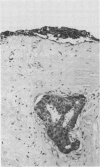
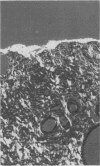
The performance of carbon and metallic inks, silver nitrate solution, and artists' pigments mounted in acetone was compared for marking the surface of surgical biopsy specimens. Using India ink is an unsatisfactory procedure because of slow drying, messiness, and spreading of the ink. It is concluded that use of artists' pigments has many advantages over other reagents, because of their rapid drying, resistance to tissue processing, and the ability to mark simultaneously many different planes of excision. Furthermore, the pigments are readily visible, are distinguishable from each other on microscopical examination, and the method entails little extra cost.
Full text
PDF


Images in this article
Selected References
These references are in PubMed. This may not be the complete list of references from this article.
- Davies J. D., Young E. W., Mera S. L., Barnard K. Lysozyme is a component of human vascular elastic fibers. Experientia. 1983 Apr 15;39(4):382–383. doi: 10.1007/BF01963135. [DOI] [PubMed] [Google Scholar]
- Hellman S., Harris J. R., Levene M. B. Radiation therapy of early carcinoma of the breast without mastectomy. Cancer. 1980 Aug 15;46(4 Suppl):988–994. doi: 10.1002/1097-0142(19800815)46:4+<988::aid-cncr2820461323>3.0.co;2-o. [DOI] [PubMed] [Google Scholar]