



Abstract
Autosomal dominant polycystic kidney disease (ADPKD) is a major cause of end-stage kidney disease (ESKD). Vasopressin plays a pivotal role in ADPKD progression; therefore, the selective vasopressin V2 receptor antagonist tolvaptan is used as a key drug in the management of ADPKD. On the other hand, sodium–glucose cotransporter-2 inhibitors (SGLT2i), which may possibly stimulate vasopressin secretion due to the diuretic effect of the drug, have been shown to have both renal and cardioprotective effects in various populations, including those with non-diabetic chronic kidney disease. However, the effect of SGLT2i in patients with ADPKD have not been fully elucidated. Herein, we report the case of a patient with ADPKD on tolvaptan who was administered the SGLT2i dapagliflozin. The patient was a Japanese woman diagnosed with ADPKD at age 30. Despite the treatment with tolvaptan, eGFR was gradually declined from 79.8 to 50 ml/min/1.73 m2 in almost 5 years and 10 mg of dapagliflozin was initiated in the hope of renoprotective effects. Although a small increase in vasopressin levels was observed, eGFR decline rate was moderated after dapagliflozin initiation. This case suggested an additional renoprotective effect of dapagliflozin in patient with ADPKD receiving tolvaptan. Although there is no evidence about the renal protective effect of SGLT2i in patients with ADPKD, we hereby report a case successfully treated with dapagliflozin for approximately 2 years. Further research, including clinical trials, is needed to evaluate whether SGLT2i are effective in patients with ADPKD.
Keywords: ADPKD, SGLT2 inhibitors, Tolvaptan, Vasopressin, PCK
Background
Autosomal dominant polycystic kidney disease (ADPKD) is a major cause of end-stage kidney disease (ESKD). To slow cyst growth, cyst genesis, and decline in kidney function, the selective vasopressin V2 receptor antagonist tolvaptan is widely used as a key drug in the management of ADPKD [1].
Sodium–glucose cotransporter-2 inhibitors (SGLT2i), which target the proximal tubule in the kidney and induce glycosuria, have been shown to have renal and cardioprotective effects in diabetic kidney disease [2]. Although there is accumulating evidence that SGLT2i also slow the progression of non-diabetic chronic kidney disease, large clinical trials such as the DAPA-CKD trial and the EMPA-KIDNEY trial have excluded patients with ADPKD [3, 4]. Therefore, the effect of SGLT2i in patients with ADPKD have not been elucidated [5, 6]. Recently, Morioka and Nakatani et al. reported that administration of dapagliflozin was associated with decreased eGFR and increased total kidney volume [7, 8]. Although their report is concerning, the effects of the SGLT2i on the progression of ADPKD should be evaluated over a longer period of time. Herein, we report the case of a patient with ADPKD on tolvaptan who was administered the SGLT2i dapagliflozin for almost 2 years.
Case presentation
The patient is a Japanese woman who are diagnosed with ADPKD at age 30. She has a history of hypertension and has been receiving the angiotensin receptor blocker losartan 50 mg daily for several years. Otherwise, she does not have a significant medical history such as diabetes, obesity, or cardiovascular disease. The diagnosis of ADPKD was based on the presence of typical multiple cysts in the kidney and liver, consistent with ADPKD (Fig. 1). At diagnosis, her eGFR and total kidney volume (TKV) were 79.8 ml/min/1.73 m2 and 1471 ml (height adjusted TKV was 913.7 ml/m), corresponding to class 1E of Mayo imaging classification [9], tolvaptan was started to slow the progression of cystic growth. The dose of tolvaptan was up titrated from 60 to 120 mg per day in a year without apparent liver injury or hypernatremia. Although TKV increase were relatively controlled after the administration of tolvaptan, eGFR was gradually declined to 50 ml/min/1.73 m2 in almost 5 years (Fig. 2). At that time, she had been taking the angiotensin receptor neprilysin inhibitor sacubitril–valsartan 200 mg per day and the calcium channel blocker cilnidipine 10 mg per day for 6 months to achieve tight blood pressure control (target systolic blood pressure was under 110 mmHg), which has been shown to slow cyst enlargement [10]. In the hope of additional renoprotective effects, 10 mg of dapagliflozin was added. Although eGFR showed an initial decline from 49.5 to 45.2 ml/min/1.73 m2 1 month after initiation, which was considered a reversible acute drop after SGLT2i initiation, dapagliflozin was well tolerated without apparent adverse effect including the worsening of polyuria, and rapid decline in eGFR was not observed thereafter. There were no noticeable changes in body weight, lipid profile, or urine osmolarity before or after the addition of the drug, and there was an improvement in hemoglobin, hematocrit and uric acid levels (Table 1, Fig. 3). Systolic blood pressure was well controlled at nearly 110 mmHg throughout the course. The annual follow-up CT revealed that the TKV was almost unchanged compared to that of the previous year. We also evaluated plasma vasopressin concentrations before and after dapagliflozin administration. A small increase in vasopressin levels from 3.9 to 6.7 picogram/ml was observed after dapagliflozin initiation and average vasopressin levels for 12 months after initiation was mildly higher than that for 12 months before initiation (4.4 ± 0.61 picogram/ml vs 5.8 ± 0.58 picogram/ml). Two years after starting dapagliflozin, the eGFR was 43.2 ml/min/1.73 m2, hence the slope of eGFR after dapagliflozin initiation was moderate compared with that of before initiation. The annual eGFR slope calculated from the regression line was − 4.90 ml/min/1.73 m2 per year before and − 1.44 ml/min/1.73 m2 per year after the initiation of dapagliflozin. Despite a small increase in vasopressin levels, a renoprotective effect of SGLT2i was observed in this patient.
Fig. 1.

CT imaging of the patient at diagnosis. A, B Non-contrasted CT revealed typical multiple bilateral renal cysts and liver cysts. C, D Bilateral kidneys including cysts were traced and total kidney volume was calculated using 3D-reconstruction images
Fig. 2.

Clinical course of the patient. eGFR estimated glomerular filtration rate, TKV total kidney volume
Table 1.
Laboratory and clinical data before and after dapagliflozin initiation
| Just before initiation of dapagliflozin | 1 month after initiation of dapagliflozin | 1 year after initiation of dapagliflozin | |
|---|---|---|---|
| Body weight, kg | 50.0 | 50.0 | 50.5 |
| Body mass index, kg/m2 | 19.1 | 19.1 | 19.3 |
| Hemoglobin, g/dL | 12.3 | 13.0 | 13.8 |
| Hematocrit, % | 36.9 | 39.7 | 41.4 |
| Total protein, g/dL | 6.8 | 7.2 | 7.2 |
| Albumin, g/dL | 3.7 | 3.8 | 3.9 |
| AST, U/L | 20 | 19 | 18 |
| ALT, U/L | 13 | 14 | 11 |
| Triglyceride, mg/dL | 96 | 95 | 92 |
| Total cholesterol, mg/dL | 169 | 185 | 192 |
| HDL cholesterol, mg/dL | 83 | 81 | 86 |
| LDL cholesterol, mg/dL | 60 | 73 | 77 |
| Blood glucose, mg/dL | 99 | 88 | 93 |
| BUN, mg/dL | 16.3 | 18.2 | 17.8 |
| Creatinine, mg/dL | 1.04 | 1.13 | 1.21 |
| eGFR_creatinine, ml/min/1.73m2 | 49.5 | 45.2 | 41.6 |
| Uric acid, mg/dL | 6.2 | 4.9 | 5.3 |
| Na, mmol/L | 142 | 142 | 141 |
| K, mmol/L | 4.2 | 3.9 | 4.1 |
| Cl, mmol/L | 110 | 108 | 106 |
| Urine specific gravity | 1.003 | 1.005 | 1.003 |
| Urine osmolarity, mOsm/kgH2O | 106 | 146 | 99 |
| Urine protein | Negative | Negative | Negative |
| Urine glucose | Negative | 3 + | 2 + |
| Urine glucose, mg/dL | – | 377 | 278 |
| Urine occult blood | Negative | Negative | Negative |
Fig. 3.
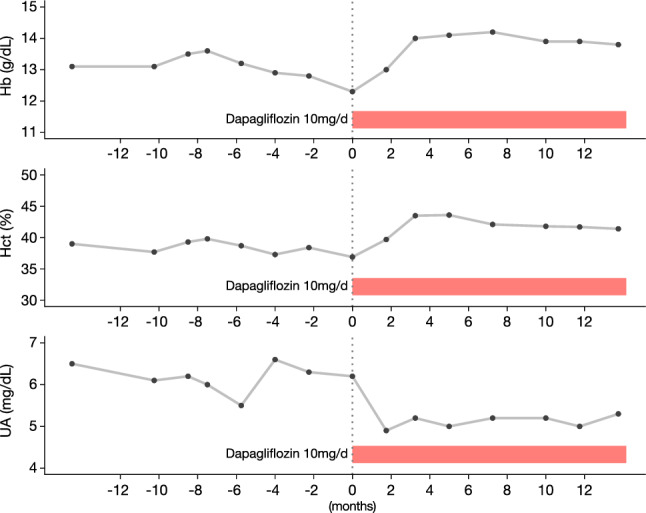
Changes in hemoglobin, hematocrit, and uric acid before and after dapagliflozin initiation. Hb hemoglobin, Hct hematocrit, UA uric acid
Discussion and conclusions
The present case was a patient with ADPKD receiving tolvaptan who was additionally treated with Dapagliflozin. Although the Mayo imaging classification of this patient was class 1E, i.e. very fast progressor with curvilinear decline in eGFR trajectory [11], eGFR decline was attenuated after dapagliflozin initiation, suggesting a renal protective effect. To our knowledge, this is the first case report of a patient with ADPKD receiving both SGLT2i and tolvaptan for approximately 2 years during tolvaptan treatment.
Cysts growth and cysts genesis, which leads to an increase in TKV, is directly regulated by vasopressin via intracellular increase in cyclic adenosine monophosphate [12]. Several studies reported that the concentration of copeptin, a surrogate marker of vasopressin, is associated with disease severity and progression [13–15]. Therefore, tolvaptan which inhibits the vasopressin signaling by antagonizing vasopressin V2 receptor is a reasonable treatment for patients with ADPKD. In contrast, SGLT2i cause an increase in the circulating vasopressin concentration to correct the mild hypernatremia caused by the drug-induced osmotic diuresis [16]. Since tolvaptan monotherapy induce significantly increased urine volume, combination therapy of tolvaptan and SGLT2i raise concern about hypovolemia and elevation in plasma vasopressin concentrations, which could stimulate cyst growth and cyst genesis. Some reports have evaluated the effect of SGTL2i in rodent models of polycystic kidney (PCK) disease. Wang et al., reported that SGLT2i phlorizin inhibited cystic disease progression in a rat model of PCK [17]. Conversely, Kapoor et al., revealed that SGLT2i dapagliflozin caused osmotic diuresis, hyperfiltration, albuminuria, and an increase in cyst volume in PCK rats [18]. Although the results in rodent models were conflicting, Morioka et al. recently reported decreased eGFR and increased kidney volume after administration of dapagliflozin in patients with ADPKD [7]. Their report raised concerns about the use of SGLT2i in patients with ADPKD. However, approximately half of the cohort (45%) was not taking oral tolvaptan in their study. A case recently reported by Nakatani et al. also revealed a deterioration in both eGFR and TKV subsequent to the initiation of dapagliflozin. Notably, this patient also did not receive tolvaptan concurrently throughout the 1-year duration of dapagliflozin treatment. The presence or absence of oral tolvaptan would have a significant impact on changes after initiation of SGLT2i because tolvaptan inhibits the vasopressin signaling as mentioned above. We speculate that the adverse effects to renal cysts caused by the increase in vasopressin after initiation of dapagliflozin were suppressed by tolvaptan. In support of this, Gansevoort reported that the change in copeptin after initiation of tolvaptan did not contribute to the increase in TKV and was even inversely associated with the increase in TKV and decrease in eGFR [15].
Although the renoprotective mechanisms of SGLT2i have been well documented, such as reduction in intraglomerular pressure through increased tubuloglomerular feedback, improved glycemic control through glycosuria, body weight loss, improvement in anemia, and reduction in plasma uric acid, the exact mechanism by which SGLT2i worked in this case was not clear [19]. In the present case, she does not have proteinuria, diabetes, and obesity. Although overweight significantly affects cyst enlargement in patients with ADPKD and weight loss through caloric restriction has been suggested to have potential efficacy [20, 21], her body weight was unchanged after initiation of dapagliflozin. We speculated that the improvement in hemoglobin and hematocrit levels had some contribution to the renoprotective effect in this patient. It is reported that anemia was poor prognosis factor in patients with ADPKD [22]. SGLT2i are known to reduce renal hypoxia and improve anemia by stimulating erythropoietin production. This drug has also been reported to suppress hypoxia-inducible factor (HIF)-1α, which correlates with cyst burden in ADPKD [6, 23–25]. Management of uric acid may also have contributed to renoprotective effect; although not shown in patients with ADPKD, uric acid concentration has been reported to be an independent risk factor for kidney failure in earlier stages of CKD [26, 27].
In the present case, we added dapagliflozin since the eGFR declined progressively despite administration of tolvaptan. Although a small increase in vasopressin levels was observed, the eGFR slope appeared to be moderated after the initiation of dapagliflozin. The administration of dapagliflozin may have stimulated the secretion of vasopressin, however, given that the annual changes in eGFR were attenuated, we hypothesized that vasopressin secretion stimulated by dapagliflozin had limited contribution to the disease progression in this patient receiving tolvaptan.
Although there is no robust evidence about the renal protective effect of SGLT2i in patients with ADPKD, we hereby report a case successfully treated with both dapagliflozin and tolvaptan. Further research, including large-scale clinical trials, is needed to evaluate the net effect of SGLT2i on ADPKD progression.
Author contributions
Study conception and design: S.M., H.H.; Data acquisition: S.M.; Visualization: S.M.; Writing—original draft: S.M.; Writing—review and editing: S.M., H.H; Study supervision: S.K., M.H., N.T.
Funding
H.H. received lecture fee from AstraZeneca Co., Ltd., Otsuka Pharmaceutical Co., Ltd. N.T. received lecture fee from AstraZeneca Co., Ltd., research funding from Otsuka Pharmaceutical Co., Ltd.
Data availability
Not applicable.
Declarations
Conflict of interest
The remaining author has nothing to disclose.
Ethical approval and consent to participate
Due to the nature of a case report, ethics approval was not applicable.
Consent for publication
Written informed consent was obtained from the patient for publication of this case report and accompanying images.
Footnotes
Publisher's Note
Springer Nature remains neutral with regard to jurisdictional claims in published maps and institutional affiliations.
References
- 1.Müller R-U, Messchendorp AL, Birn H, Capasso G, Cornec-Le Gall E, Devuyst O, et al. An update on the use of tolvaptan for autosomal dominant polycystic kidney disease: consensus statement on behalf of the ERA working group on inherited kidney disorders, the European rare kidney disease reference network and polycystic kidney disease international. Nephrol Dial Transplant. 2022;37:825–39. [DOI] [PMC free article] [PubMed] [Google Scholar]
- 2.Perkovic V, Jardine MJ, Neal B, Bompoint S, Heerspink HJL, Charytan DM, et al. Canagliflozin and renal outcomes in type 2 diabetes and nephropathy. N Engl J Med. 2019;380:2295–306. [DOI] [PubMed] [Google Scholar]
- 3.Heerspink HJL, Stefánsson BV, Correa-Rotter R, Chertow GM, Greene T, Hou F-F, et al. Dapagliflozin in patients with chronic kidney disease. N Engl J Med. 2020;383:1436–46. [DOI] [PubMed] [Google Scholar]
- 4.The EMPA-KIDNEY Collaborative Group, Herrington WG, Staplin N, Wanner C, Green JB, Hauske SJ, et al. Empagliflozin in patients with chronic kidney disease. N Engl J Med. 2023;388:117–27. [DOI] [PMC free article] [PubMed] [Google Scholar]
- 5.Afsar B, Afsar RE, Demiray A, Altay S, Korkmaz H, Yildiz A, et al. Sodium–glucose cotransporter inhibition in polycystic kidney disease: fact or fiction. Clin Kidney J. 2022;15:1275–83. [DOI] [PMC free article] [PubMed] [Google Scholar]
- 6.Patel DM, Dahl NK. Examining the role of novel CKD therapies for the ADPKD patient. Kidney360. 2021;2:1036–41. [DOI] [PMC free article] [PubMed] [Google Scholar]
- 7.Morioka F, Nakatani S, Uedono H, Tsuda A, Mori K, Emoto M. Short-term dapagliflozin administration in autosomal dominant polycystic kidney disease-a retrospective single-arm case series study. J Clin Med Res. 2023. 10.3390/jcm12196341. [DOI] [PMC free article] [PubMed] [Google Scholar]
- 8.Nakatani S, Morioka F, Uedono H, Tsuda A, Mori K, Emoto M. Dapagliflozin administration for 1 year promoted kidney enlargement in patient with ADPKD. CEN Case Rep. 2023. 10.1007/s13730-023-00840-4. [DOI] [PMC free article] [PubMed] [Google Scholar]
- 9.Irazabal MV, Rangel LJ, Bergstralh EJ, Osborn SL, Harmon AJ, Sundsbak JL, et al. Imaging classification of autosomal dominant polycystic kidney disease: a simple model for selecting patients for clinical trials. J Am Soc Nephrol. 2015;26:160. [DOI] [PMC free article] [PubMed] [Google Scholar]
- 10.Schrier RW, Abebe KZ, Perrone RD, Torres VE, Braun WE, Steinman TI, et al. Blood pressure in early autosomal dominant polycystic kidney disease. N Engl J Med. 2014;371:2255–66. [DOI] [PMC free article] [PubMed] [Google Scholar]
- 11.Yu ASL, Shen C, Landsittel DP, Grantham JJ, Cook LT, Torres VE, et al. Long-term trajectory of kidney function in autosomal-dominant polycystic kidney disease. Kidney Int. 2019;95:1253–61. [DOI] [PMC free article] [PubMed] [Google Scholar]
- 12.Wang X, Wu Y, Ward CJ, Harris PC, Torres VE. Vasopressin directly regulates cyst growth in polycystic kidney disease. J Am Soc Nephrol. 2008;19:102–8. [DOI] [PMC free article] [PubMed] [Google Scholar]
- 13.Meijer E, Bakker SJL, van der Jagt EJ, Navis G, de Jong PE, Struck J, et al. Copeptin, a surrogate marker of vasopressin, is associated with disease severity in autosomal dominant polycystic kidney disease. Clin J Am Soc Nephrol. 2011;6:361. [DOI] [PMC free article] [PubMed] [Google Scholar]
- 14.Gansevoort R, van Gastel M, Chapman A, Copeptin BJ. A surrogate for vasopressin, predicts disease progression and tolvaptan treatment efficacy in ADPKD. results of the TEMPO 3 4 trial. J Am Soc Nephrol. 2016;27:34A. [Google Scholar]
- 15.Gansevoort RT, van Gastel MDA, Chapman AB, Blais JD, Czerwiec FS, Higashihara E, et al. Plasma copeptin levels predict disease progression and tolvaptan efficacy in autosomal dominant polycystic kidney disease. Kidney Int. 2019;96:159–69. [DOI] [PMC free article] [PubMed] [Google Scholar]
- 16.Masuda T, Ohara K, Vallon V, Nagata D. SGLT2 inhibitor and loop diuretic induce different vasopressin and fluid homeostatic responses in nondiabetic rats. Am J Physiol Renal Physiol. 2022;323:F361–9. [DOI] [PMC free article] [PubMed] [Google Scholar]
- 17.Wang X, Zhang S, Liu Y, Spichtig D, Kapoor S, Koepsell H, et al. Targeting of sodium–glucose cotransporters with phlorizin inhibits polycystic kidney disease progression in han:SPRD rats. Kidney Int. 2013;84:962–8. [DOI] [PubMed] [Google Scholar]
- 18.Kapoor S, Rodriguez D, Riwanto M, Edenhofer I, Segerer S, Mitchell K, et al. Effect of sodium-glucose cotransport inhibition on polycystic kidney disease progression in PCK rats. PLoS One. 2015;10: e0125603. [DOI] [PMC free article] [PubMed] [Google Scholar]
- 19.Palmer BF, Clegg DJ. Kidney-protective effects of SGLT2 inhibitors. Clin J Am Soc Nephrol. 2023;18:279–89. [DOI] [PMC free article] [PubMed] [Google Scholar]
- 20.Hopp K, Catenacci VA, Dwivedi N, Kline TL, Wang W, You Z, et al. Weight loss and cystic disease progression in autosomal dominant polycystic kidney disease. iScience. 2022;25:103697. [DOI] [PMC free article] [PubMed] [Google Scholar]
- 21.Nowak KL, You Z, Gitomer B, Brosnahan G, Torres VE, Chapman AB, et al. Overweight and obesity are predictors of progression in early autosomal dominant polycystic kidney disease. J Am Soc Nephrol. 2018;29:571–8. [DOI] [PMC free article] [PubMed] [Google Scholar]
- 22.Ushio Y, Kataoka H, Sato M, Manabe S, Watanabe S, Akihisa T, et al. Association between anemia and renal prognosis in autosomal dominant polycystic kidney disease: a retrospective study. Clin Exp Nephrol. 2020;24:500–8. [DOI] [PubMed] [Google Scholar]
- 23.Packer M. Mechanisms leading to differential hypoxia-inducible factor signaling in the diabetic kidney: modulation by SGLT2 inhibitors and hypoxia mimetics. Am J Kidney Dis. 2021;77:280–6. [DOI] [PubMed] [Google Scholar]
- 24.Packer M. Alleviation of anemia by SGLT2 inhibitors in patients with CKD: mechanisms and results of long-term placebo-controlled trials. Clin J Am Soc Nephrol. 2023. 10.2215/CJN.0000000000000362. [DOI] [PMC free article] [PubMed] [Google Scholar]
- 25.Kraus A, Peters DJM, Klanke B, Weidemann A, Willam C, Schley G, et al. HIF-1α promotes cyst progression in a mouse model of autosomal dominant polycystic kidney disease. Kidney Int. 2018;94:887–99. [DOI] [PubMed] [Google Scholar]
- 26.Srivastava A, Kaze AD, McMullan CJ, Isakova T, Waikar SS. Uric acid and the risks of kidney failure and death in individuals with CKD. Am J Kidney Dis. 2018;71:362–70. [DOI] [PMC free article] [PubMed] [Google Scholar]
- 27.Brosnahan GM, You Z, Wang W, Gitomer BY, Chonchol M. Serum uric acid and progression of autosomal dominant polycystic kidney disease: results from the HALT PKD trials. Curr Hypertens Rev. 2021;17:228–37. [DOI] [PMC free article] [PubMed] [Google Scholar]
Associated Data
This section collects any data citations, data availability statements, or supplementary materials included in this article.
Data Availability Statement
Not applicable.