



Abstract
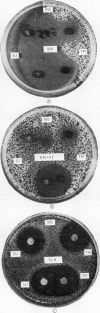
Synergy between sulphadiazine and trimethoprim against Escherichia coli has been demonstrated in culture media not containing lysed horse blood despite the presence of pus or a pus extract which inhibited the action of each drug separately. Synergy may therefore be important where pus is present in vivo.
Full text
PDF


Images in this article
Selected References
These references are in PubMed. This may not be the complete list of references from this article.
- Bushby S. R. Combined antibacterial action in vitro of trimethoprim and sulphonamides. The in vitro nature of synergy. Postgrad Med J. 1969 Nov;45(Suppl):10–18. [PubMed] [Google Scholar]
- Darrell J. H., Garrod L. P., Waterworth P. M. Trimethoprim: laboratory and clinical studies. J Clin Pathol. 1968 Mar;21(2):202–209. doi: 10.1136/jcp.21.2.202. [DOI] [PMC free article] [PubMed] [Google Scholar]
- Greenwood D., O'Grady F. Activity and interaction of trimethoprim and sulphamethoxazole against Escherichia coli. J Clin Pathol. 1976 Feb;29(2):162–166. doi: 10.1136/jcp.29.2.162. [DOI] [PMC free article] [PubMed] [Google Scholar]
- Lewis E. L., Anderson J. D., Lacey R. W. A reappraisal of the antibacterial action of cotrimoxazole in vitro. J Clin Pathol. 1974 Feb;27(2):87–91. doi: 10.1136/jcp.27.2.87. [DOI] [PMC free article] [PubMed] [Google Scholar]