



ABSTRACT
Objectives:
The primary objective of the study was to assess the factors that influenced the increased failure rate among first-year Indian medical students who appeared for the Maharashtra University of Health Science (MUHS) summative university examination, having experienced the competency-based medical education (CBME) curriculum for the first time amid the coronavirus disease (COVID-19) pandemic.
Methods:
A retrospective cross-sectional online questionnaire-based study was undertaken between July 2021 and November 2021, in which first-year Indian medical students who were enrolled in the Bachelor of Medicine, Bachelor of Surgery (MBBS) program in the year 2019 and appeared for the MUHS summative university examination in February 2021 were invited to participate. Analysis was done using JASP (v0.16.0.0), and the odds ratio for failure was calculated at a significance level of P < 0.05.
Results:
Responses were obtained from 360 individuals, of whom 74.5% had passed and 25.5% had failed (n = 360). The odds of failure in first-year MBBS summative university examination was higher in students with irregular Internet access, irregular device access, an unsupportive peer environment in college, a National Entrance cum Eligibility Test score below 500, an unsupportive family environment during the lockdown, severe stress, severe depression, testing positive for COVID-19 before the exam, death in the family during the exam, and failing in terms and prelims and students of male gender (P < 0.01).
Conclusion:
The total failure rate of 27% in the MUHS examination was mainly attributed to interplay between the student’s mental health, lack of devices or Internet, and the changed assessment part of the CBME curriculum. Surprisingly, lecture frequencies, teaching patterns, and study resources did not influence the failure rate. These results can be used to formulate interventions that will help to improve academic performance and mental health students and thus help them adapt to the new curriculum.
KEY WORDS: Assessment, competency-based education, COVID-19, online, undergraduate medical education
Introduction
Bachelor of Medicine, Bachelor of Surgery (MBBS) is an undergraduate medical degree program in India with 19 subjects divided over the course of 5 years including 1 year of internship at the teaching hospital. The first professional year includes subjects like Anatomy, Physiology, and Biochemistry; the second includes Pharmacology, Pathology, and Microbiology; the third includes Community Medicine, Forensic Medicine, Ophthalmology, and Otorhinolaryngology; and the fourth includes Surgery, Medicine, Pediatrics, Obstetrics, and Gynecology along with the allied subjects.[1,2] In the year 2019, the competency-based medical education (CBME) curriculum was introduced in the MBBS program by the Medical Council of India (now the “National Medical Commission”), which included new elements like the Foundation Course, Early Clinical Exposure and Attitudes, Ethics and Communication (AETCOM), Electives, Alignment and Integration, and Learner Doctor Method of Clinical Training.[1,2] The curriculum also introduced a more clinical application-based approach to learning and assessment, along with the addition of brief answer questions (BAQs) that tested minute concepts in the written examinations.[1,2] The students were also required to perform certain certifiable skills during their skills assessment. The assessment program now followed a pass/fail approach to internal assessments, and new passing criteria were announced for the summative university examination. Competency-based assessment, as a part of the new CBME curriculum, operates within the framework of competencies and includes periodic internal assessment conducted by the college and summative assessment at the end of each year conducted by the University. The summative assessment comprises written and skills assessment examinations. Each written examination is for 100 marks with each subject having 2 written papers, which accounts to 6 written examinations, followed by 3 skills assessment examinations of 100 marks each.[1,2] The summative examinations are spaced over the course of 2 months, with 12–15 days for written examinations and 6–7 days of skills assessment examinations. There is a preparatory gap of 1 day between each examination and a gap of 10–30 days between written and skills assessment examinations.
Students who get enrolled in the medical colleges of India come from a wide range of social, cultural, and economic backgrounds. Having undergone rigorous training to clear the National Entrance cum Eligibility Test (NEET-UG) Entrance Examination to enter the field of medicine, these students share attributes like intelligence, logical reasoning, skill, discipline, and immense diligence. On entering their respective medical colleges, they are greeted with a diverse range of academic, social, and cultural opportunities aimed at developing an all-round medical graduate. Apart from all these changes, many students also have to change cities, face economic issues, and cope with their newly acquired independence.
The Indian medical education was affected adversely by the global pandemic of coronavirus disease 2019 (COVID-19), when a country-wide lockdown was announced on March 24, 2020.[3,4] The first-year Indian medical students who were enrolled in the MBBS program in August 2019 were forced to switch to an online mode of teaching–learning from April 2020.[4] This may have negatively impacted their academic schedule as they had to deal with a lack of anatomical dissection, ineffective online lectures, a lack of devices to access online teaching, lack of guidance, and inadequate study materials.[5,6] Additionally, in India, the medical faculty is involved in medical education and patient care. With the patient load increasing during the pandemic, the faculty might have found it difficult to dedicate enough time to teaching. Furthermore, the final summative university examinations which were scheduled to be held in December 2020 were repeatedly postponed and were finally held in February 2021. These factors may have affected the students’ mental health as they struggled with stress due to uncertainty, loneliness, and lack of peer/senior guidance.[7,8]
It was seen that there was an increased failure rate in first-year MBBS summative university examination conducted by Maharashtra University of Health Sciences (MUHS). The failure rate increased from an average of 15% to 27%. The failure rate in a few medical colleges was a staggering 50%.[9,10] Literature suggests that factors such as teaching strategies, the student’s motivation, the student’s approach to studying, the interaction between students and the academic and social systems of the University, cultural expectations, and psychosocial factors are likely to affect a student’s performance in examinations.[11,12,13,14] This study aims to analyze and categorize all these factors and their impact on the academic outcome of the first-year Indian medical students who appeared for the MUHS summative University examination. Moreover, we aim to determine whether this increase in failure rate was mainly due to student factors like their approach to learning and mental health, due to online teaching patterns, due to the changed CBME curriculum, or due to the impact of the COVID-19 pandemic.
The primary objective of the study was to assess the factors that influenced the increased academic failure rate among first-year Indian medical students who appeared for the MUHS summative university examination, having experienced the CBME curriculum for the first time amid the COVID-19 pandemic. The secondary objectives were to assess and compare the teaching–learning pattern adopted by the medical colleges and the students during their first-year MBBS program, which was taught by CBME curriculum for the first time amid the COVID-19 pandemic.
Methods
A retrospective cross-sectional online questionnaire-based study was undertaken between July and November 2021. First-year Indian medical students who were enrolled in the MBBS program in the year 2019 and appeared for the MUHS summative university examination in February 2021 were included. Students who did not consent to participate in the study were excluded. The study was conducted among the 43 medical colleges affiliated with the MUHS, India.
Sampling technique and calculations
The sample size of 340 was calculated using Cochran formula:
Considering p = 0.27, with a confidence level of 95% (z = 1.96) and a confidence interval (margin of error) of 5% (e = 0.05) for a population size of 6300 and having a nonresponse rate of 15%, 289/0.85 = 340.

Participants were recruited by the quota sampling technique at two stages. First, 43 Class Representatives (CRs), one from each medical college affiliated to the MUHS, were approached, out of whom 39 consented to participate in the study. The distribution of CRs was 24 from Government and 15 from private colleges. Based on regions of Maharashtra, CRs were 12 from Vidarbha, 13 from Marathwada, and 14 from the Rest of Maharashtra region. Second, these CRs were asked to share the online questionnaire with the students of their batch who appeared for the February 2021 summative university examination. Students were recruited such that there were a proportionate number of students from each region and type of medical college.
Definitions
According to the assessment pattern of the CBME curriculum,[1,2] a student is considered to be academically successful when he/she secures the minimum marks required to pass the summative university examinations. A student is required to pass all three subjects (Anatomy, Biochemistry, and Physiology) in the first year (each subject has two written papers of 100 marks each and one skills assessment examination of 100 marks) by meeting the following criteria in each subject:
Minimum 40% in each written examination.
Combined 50% in both written examinations.
Minimum 50% in skills assessment examination.
In this study, the students who failed to secure the minimum marks according to the above criteria have been considered under the criteria for academic failure.
Study tools
The study questionnaires were developed by conducting a pilot study in the form of unstructured telephonic interviews among 10 students (5 passed and 5 failed) belonging to 5 different colleges affiliated to MUHS. These interviews were conducted to gather their perceptions regarding the reasons that led to high failure rates. Two structured online questionnaires were drafted after analyzing their responses. The questionnaires were validated by faculty experts, which included first professional year subject Professors, and the content validity ratio was calculated to be 0.96. After validation, the questionnaire was pilot-tested in 10% of the sample.
–Two online questionnaires were administered via google forms. The first questionnaire was for only the CRs which consisted of 20 items and included multiple choice questions, Likert scales, and open-ended questions. The second questionnaire was for all the students, which consisted of 47 items and included multiple choice questions, Likert scales, yes/no type questions, and one open-ended question to include their qualitative opinions. To retrospectively assess the mental health of the students before the summative university examinations, we used the Depression Anxiety Stress Scale (DASS-21). It is a prevalidated and reliable self-administered 21-item 4-point Likert scale (03), that is available in the open-source domain, designed to measure clinically significant depression, anxiety, and stress.[15,16] The DASS-21 was incorporated as a subsection in the main survey instrument, which was administered simultaneously. DASS-21 scores were interpreted based on the predetermined cutoffs.[16] All the outcome variables assessed in the study are summarized in Table 1. The questionnaire along with the cutoff is available in Supplement 1 (932KB, pdf) .
Table 1.
Outcome variables assessed in the online questionnaire
| Factors | Outcome assessed |
|---|---|
| Sociodemographic factors | 1. Gender |
| 2. Age | |
| 3. College | |
| 4. Place of stay during lockdown | |
| 5. Socioeconomic class | |
| 6. Medium of instruction in school, college | |
| 7. NEET score | |
| Teaching–learning-related factors | 1. Frequency of attending lectures |
| 2. Frequency of studying | |
| 3. Study approach | |
| 4. Participation in extracurricular activities | |
| 5. Preferred learning resource | |
| 6. Perceived level of adequacy of study resources | |
| 7. Perceived level of knowledge regarding the syllabus | |
| 8. Perceived level of preparedness for exams | |
| 9. Self-study before exams | |
| Mental health-related factors | 1. Peer environment in college |
| 2. Family environment during lockdown | |
| 3. Mode of recreation during lockdown | |
| 4. Depression 1 month before examinations | |
| 5. Anxiety 1 month before examinations | |
| 6. Stress 1 month before examinations | |
| COVID-19 pandemic-related factors | 1. Access to Internet connection and devices for online learning |
| 2. If self/family member detected positive for COVID-19 1 month before or during the examinations | |
| 3. Demise in the family 1 month before or during the examinations | |
| Factors related to the changed assessment pattern in the CBME curriculum | 1. Similarity of assessment pattern in the preliminary exams |
| 2. Awareness about change in the pattern | |
| 3. Perceived level of difficulty of examination for each subject | |
| 4. Perceived level of difficulty for each section of the written examinations and skills assessment | |
| 5. Sufficiency of time to attempt the paper | |
| 6. Subject-wise score in written assessment | |
| 7. Subject-wise score in skills assessment | |
| 8. Marks scored in preliminary exams |
Ethics
The study commenced after being approved by the Institutional Ethics Committee III of Seth GS Medical College and KEM Hospital, Mumbai, India (EC/OA-102/2021). Online signed informed consent was obtained using Google forms. The informed consent document was attached to the form, which was digitally signed and submitted online by the participants.
Statistical analysis
The data were entered into an Excel sheet and analyzed using the JASP (v0.16.0.0) software. The descriptive data were shown in numbers, percentages, and mean ± SD. The Chi-square test, McNemar’s test, and Wilcoxon’s sign-rank test were used for finding the associations, and the odds ratio with 95% CIs was calculated. P < 0.05 was considered statistically significant.
Results
Responses were obtained from 360 individuals, of whom 74.5% had passed and 25.5% had failed to pass the examination. Samples consisted of 34.4% females and 65.6% males. The mean age of the individuals was 20.59 ± 0.966 years at the time of the examination. The participant samples consisted of 34.44% responses from the Marathwada region, 27.77% responses from the Vidarbha region, and 37.77% responses from the Rest of Maharashtra region.
Factors associated with failure and their odds ratios are summarized in Tables 2 and 3, respectively. With respect to demographic factors, the odds of failure among male was 2.28 times that of females (P = 0.003). Interestingly, an individual was 3.83 times more likely to fail if he/she had a NEET UG examination score of <500, which was used as a surrogate indicator of intelligence in our study (P < 0.001). Regarding the mental health, students who experienced severe stress (OR = 2.23, P < 0.001) or severe depression (OR = 2.23, P < 0.001) had higher odds of failure. Students who did not experience a comfortable peer environment (OR = 2.9125, P < 0.001) in college and have an unsupportive family environment at home during the lockdown (OR = 1.9, P < 0.001) also had increased odds of failing the examinations.
Table 2.
Association between various factors and academic failure in first-year MBBS MUHS Summative University Examinations
| Variable | Fail | Pass | Total | Chi-square value | P | |
|---|---|---|---|---|---|---|
| Gender | Male | 72 (30.5%) | 164 (69.5%) | 236 | 8.835 | 0.003 |
| Female | 20 (16.12%) | 104 (83.87%) | 124 | |||
| Medium of instruction in school | English | 68 (26.15%) | 192 (73.84%) | 260 | 0.175 | 0.675 |
| Vernacular | 24 (24%) | 76 (76%) | 100 | |||
| Medium of instruction in college | English | 76 (24.67%) | 232 (75.32%) | 308 | 0.868 | 0.351 |
| Vernacular | 16 (30.76%) | 36 (69.23%) | 52 | |||
| Low NEET score | Above 500 | 32 (15.09%) | 180 (84.90%) | 212 | 29.664 | <0.001 |
| Below 500 | 60 (40.54%) | 88 (59.45%) | 148 | |||
| Study approach | Conceptual | 32 (22.85%) | 108 (77.14%) | 140 | 0.877 | 0.349 |
| Exam Oriented | 60 (27.27%) | 160 (72.72%) | 220 | |||
| Regular study pattern | Yes | 4 (14.28%) | 24 (85.71%) | 28 | 2.021 | 0.155 |
| No | 88 (26.50%) | 244 (73.49%) | 332 | |||
| Extracurricular activities affected academic progress | Yes | 28 (28%) | 72 (72%) | 100 | 0.435 | 0.510 |
| No | 64 (24.61%) | 196 (75.38%) | 260 | |||
| Was comfortable with peer environment in college | Yes | 52 (19.69%) | 212 (80.30%) | 264 | 17.861 | <0.001 |
| No | 40 (41.66%) | 56 (58.33%) | 96 | |||
| Family environment during lockdown hindered learning | Yes | 48 (33.33%) | 96 (66.66%) | 144 | 7.631 | 0.006 |
| No | 44 (20.37%) | 172 (79.62%) | 216 | |||
| Common mode of recreation during the lockdown | Practicing/learning a hobby/skill | 20 (25%) | 60 (75%) | 80 | 0.017 | 0.897 |
| Screen-based activities: Binge watching/gaming/social media | 72 (25.71%) | 208 (74.28%) | 280 | |||
| Depression 1 month before exams | Severe depression | 48 (35.29%) | 88 (64.70%) | 136 | 10.896 | <0.001 |
| Nonsevere depression | 44 (19.64%) | 180 (80.35%) | 224 | |||
| Stress | Severe stress | 36 (37.5%) | 60 (62.5%) | 96 | 9.817 | 0.002 |
| 1 month before exams | Nonsevere stress | 56 (21.21%) | 208 (78.78%) | 264 | ||
| Anxiety | Severe anxiety | 44 (28.20%) | 112 (71.79%) | 156 | 1.016 | 0.314 |
| One month before exams | Nonsevere anxiety | 48 (23.52%) | 156 (76.47%) | 204 | ||
| Tested positive for COVID 1 month before exams | Yes | 28 (35%) | 52 (65%) | 80 | 4.822 | 0.028 |
| No | 64 (22.85%) | 216 (77.14%) | 280 | |||
| Tested positive for COVID during Exam | Yes | 8 (33.33%) | 16 (66.66%) | 24 | 0.818 | 0.366 |
| No | 84 (25%) | 252 (75%) | 336 | |||
| Family member tested positive for COVID 1 month before exams | Yes | 44 (39.28%) | 68 (60.71%) | 112 | 16.110 | <0.001 |
| No | 48 (19.35%) | 200 (80.64%) | 248 | |||
| Family member tested positive for COVID during exam | Yes | 20 (35.71%) | 36 (64.28%) | 56 | 3.597 | 0.058 |
| No | 72 (23.68%) | 232 (76.31%) | 304 | |||
| Death in close family 1 month before exams | Yes | 28 (46.66%) | 32 (53.33%) | 60 | 16.867 | <0.001 |
| No | 64 (21.33%) | 236 (78.66%) | 300 | |||
| Death in close family during exam | Yes | 12 (60%) | 8 (40%) | 20 | 13.206 | <0.001 |
| No | 80 (23.52%) | 260 (76.47%) | 340 | |||
| Death of relative or friend 1 month before exams | Yes | 28 (31.81%) | 60 (68.18%) | 88 | 2.401 | 0.121 |
| No | 64 (23.52%) | 208 (76.47%) | 272 | |||
| Death of relative or friend during exams | Yes | 20 (55.55%) | 16 (44.44%) | 36 | 18.923 | <0.001 |
| No | 72 (22.22%) | 252 (77.77%) | 324 | |||
| Continuous Internet access | Yes | 28 (13.20%) | 184 (86.79%) | 212 | 41.329 | <0.001 |
| No | 64 (43.24%) | 84 (56.75%) | 148 | |||
| Continuous device access | Yes | 48 (18.75%) | 208 (81.25%) | 256 | 21.573 | <0.001 |
| No | 44 (42.30%) | 60 (57.69%) | 104 | |||
Table 3.
Factors that increased the academic failure in first-year MBBS MUHS Summative University Examinations
| Variable | Odds Ratio | 95% CI | P |
|---|---|---|---|
| Male gender | 2.28 | 1.31-3.96 | <0.001 |
| NEET score below 500 | 3.83 | 2.32-6.31 | <0.001 |
| Unsupportive peer environment in college | 2.9125 | 1.75-4.83 | <0.001 |
| Severe stress 1 month before exams | 2.23 | 1.34-3.96 | <0.001 |
| Severe depression 1 month before exams | 2.23 | 1.37-3.61 | <0.001 |
| Unsupportive family environment during lockdown | 1.9 | 1.21-3.11 | <0.001 |
| Tested positive for COVID 1 month before exams | 1.82 | 1.061-3.11 | <0.001 |
| Family member tested positive for COVID 1 month before exams | 2.70 | 1.65-4.41 | <0.001 |
| Death in close family 1 month before exams | 3.23 | 1.81-5.75 | <0.001 |
| Death in close family during exam | 5.00 | 1.63-4.71 | <0.001 |
| Death of relative or friend during exams | 4.38 | 2.16-16.67 | <0.001 |
| Irregular Internet access | 5.00 | 2.99-8.36 | <0.001 |
| Irregular device access | 3.17 | 1.19-5.23 | <0.001 |
Online teaching-specific factors like Internet and device availability had a significant influence on the failure rate. 69.5% of individuals who failed had no Internet access (OR = 5.00, P < 0.001), and 47.8% did not have the devices to study online (OR = 3.17, P < 0.001). COVID-19-specific factors like the death of a family member/friend during exams (P < 0.001) and self or a family member testing positive one before exams (P < 0.001) were found to be significantly associated and had higher odds of failure.
Even though the frequency of attending lectures, skills training, and self-study significantly decreased during the lockdown with students relying more on online videos and e-books (P < 0.001) [Figure 1a and b], no significant association between frequency of self-study, study approach, resources used, lecture attending frequency, or teaching methods was found (P > 0.05). Also, participation in college extracurricular activities had no significant association with failure in examination (P > 0.05).
Figure 1.

(a) Change in lecture attending and studying frequency before and during the COVID-19 lockdown; (b) Change in study resources used by the students before and during the COVID-19 lockdown
Concerning the new curriculum and changed pattern of assessment, 23% of individuals stated that their preliminary examination assessment pattern was different compared to that in the summative university examination. 17% of students were unaware of clinical vignettes, and 15% were unaware of BAQs to be answered in the examinations. 56% of students felt that the completion of the syllabus was delayed and the time provided for self-study and exam preparation was inadequate. The students reported that they found the multiple-choice questions (MCQs) section (31%) and the BAQs (38%) of both the papers of Anatomy difficult along with 38% of students who found the short answer questions (SAQs) and clinical-based questions of Anatomy paper II difficult. 60% of the students who failed the summative examination also perceived that the time given to attempt Anatomy Paper II was inadequate. The students did find not any sections of either Physiology or Biochemistry written examination difficult with respect to questions asked and time given.
Discussion
Multiple factors have contributed to an increased failure rate of first-year Indian medical students who experienced the CBME curriculum during the COVID-19 Pandemic. The student-related factors that influenced the failure rate were predominantly related to their mental health. This is in line with previous studies which indicate that there was a positive relationship between the mental health and academic achievement of adolescents.[8] Significant odds of academic failure were reported among the students having severe depression, severe stress, and unsupportive peer or family environment. Poor mental health could be attributed to the ongoing pandemic and lockdown situation.[7] Additionally, due to COVID-19 pandemic, the summative university examination being postponed multiple times would have added to the uncertainty and stress among the students.
During the lockdown, teaching sessions shifted from an offline to online mode and the majority of students who did not pass lacked the availability of a regular device and Internet access. Although it was seen that changes in self-study patterns, lecture attendance, screen time, and extracurricular activities did not significantly affect the failure rate of students, unavailability of devices or the Internet would have prevented students from even accessing recordings of video lectures and e-books. During the peak of the pandemic, it was observed that students and their families tested positive 1 month before and during exams, which also included death of a family member. This situation would have taken a significant physical and mental toll on the students, which eventually increased their odds of failure.
While discussing the assessment-related factors, lack of exposure to the updated CBME curriculum and awareness about the changed assessment pattern was evident, which students perceiving MCQs and BAQs as difficult. Perceived difficulty of these sections in each of the subjects was also in line to the proportion of students who failed in that particular subject, especially in Anatomy.
Studies conducted internationally show similar results wherein worsened mental health, the pandemic situation and its effects on access to learning and a modified learning environment, socioeconomic factors including family factors, and a changed curriculum have individually contributed to the increased failure and drop-out rates.[8,11,17,18,19,20,21] However, none of these studies have considered all these factors together and assessed the interplay between them. The interplay of these factors found by our study is summarized in Figure 2.
Figure 2.
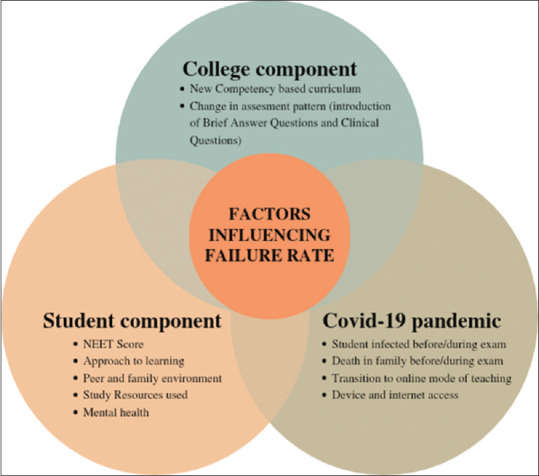
Interplay of factors influencing academic failure rate among first-year Indian medical students who experienced CBME curriculum during the COVID-19 pandemic
Strengths and limitations
To our knowledge, this is the first study in the Indian setting to assess how the various factors during the COVID-19 pandemic affected the academic outcome of students. Previous studies have usually focused on assessing either just the mental health or online education but not on how they influenced the academic outcomes of students. We assess our study outcomes using a validated and tailor-made tool which was designed conducting in-depth interviews with students. We also maintained maximum representativeness while recruiting our sample, which provides strong external validity to our study. However, there were several limitations to our study. Since the study was retrospective, there is a chance of recall bias. The study was conducted for a single University Examination, that is, MUHS in the state of Maharashtra. There are several medical universities in different states of India, and our results cannot be generalized to them. The results of the study cannot be considered as the primary evaluation of the CBME curriculum as online education and COVID-19 also influenced the academic failure rate. Though the validation for the study questionnaire was done, its reliability was not assessed as part of pilot testing. The data of this study were collected in 2021, and the students interviewed are now in the fourth year of their MBBS curriculum. However, even after the pandemic, when the routine offline teaching–learning has resumed, the failure rates have been found to be consistently high among the said batch in the subsequent years of their MBBS program and among the subsequent first-year MBBS batches since the introduction of CBME curriculum.[22] This indicates that there are factors additional to those found in our study, which require further evaluation to completely understand the overall impact of CBME curriculum over the academic performance of the Indian medical student.
Conclusion
The rise in the failure rate of first-year Indian medical students was attributed to multiple factors, which can mainly be divided into student-, medical college-, and COVID-19-related. Student-related factors included demographics, poor mental health, and peer and family environment. COVID-19-related factors like device/Internet unavailability and COVID-19 infection of self or family before or during the examinations also played a critical role. In addition, the failure rate was also affected by a lack of knowledge and exposure to the assessment pattern of new CBME curriculum and its difficulty level. Surprisingly, lecture frequencies, teaching patterns, and study resources did not influence the failure rate irrespective of switching to online modes. These results can be used to formulate interventions that will help to improve academic performance and mental health of the students and thus help them adapt to the new curriculum.
Ethics approval and consent to participate
The study approved by the Institutional Ethics Committee III of Seth GS Medical College and KEM Hospital, Mumbai, India (EC/OA-102/2021). Online signed informed consent was obtained using Google forms. The informed consent document was attached to the form, which was digitally signed and submitted online by the participants.
Financial support and sponsorship
Nil.
Conflicts of interest
There are no conflicts of interest.
References
- 1.UG Curriculum |NMC. [[Last accessed on 2024 Apr 15]]. Available from: https://www.nmc.org.in/information-desk/for-colleges/ug-curriculum/
- 2.Sarkar S, Badyal D, Sharma R, Patki M, Khan T, Oberoi L. Navigating through the newer components of the Indian competency based medical education. J Med Sci Health. 2022;8:236–45. [Google Scholar]
- 3.Timeline: WHO's COVID-19 response. [[Last accessed on 2024 Apr 15]]. Available from: https://www.who.int/emergencies/diseases/novel-coronavirus-2019/interactive-timeline .
- 4.Rohila J, Kapoor K, Singh J, Rohilla R, Bansal P, Chhabra P. Online medical teaching during COVID-19: Perspectives from teachers and taught. J Educ Health Promot. 2022;11:247. doi: 10.4103/jehp.jehp_691_21. [DOI] [PMC free article] [PubMed] [Google Scholar]
- 5.Dissabandara LO, Nirthanan SN, Khoo TK, Tedman R. Role of cadaveric dissections in modern medical curricula: A study on student perceptions. Anat Cell Biol. 2015;48:205–12. doi: 10.5115/acb.2015.48.3.205. [DOI] [PMC free article] [PubMed] [Google Scholar]
- 6.Chandra A, Nongkynrih B, Gupta S. Role of smartphone technology in medical education in India. Indian J Community Fam Med. 2019;5:103. [Google Scholar]
- 7.Saraswathi I, Saikarthik J, Senthil Kumar K, Madhan Srinivasan K, Ardhanaari M, Gunapriya R. Impact of COVID-19 outbreak on the mental health status of undergraduate medical students in a COVID-19 treating medical college: A prospective longitudinal study. PeerJ. 2020;8:e10164. doi: 10.7717/peerj.10164. [DOI] [PMC free article] [PubMed] [Google Scholar]
- 8.Bas G. Relation between student mental health and academic achievement revisited: A meta-analysis. 2021. [[Last accessed on 2024 Apr 15]]. Available from: https://examlearning.co.in/default2.aspx .
- 9.EXAM DEPT. [[Last accessed on 2024 Apr 15]]. Available from: https://examlearning.co.in/Default2.aspx .
- 10.Maharashtra: Passing rate of first-year medical batch dips. Mumbai News - Times of India. [[Last accessed on 2024 Apr 15]]. Available from: https://timesofindia.indiatimes.com/city/mumbai/mumbaipassing-rate-of-first-year-medical-batch-dips/articleshow/81500492.cms .
- 11.Najimi A, Sharifirad G, Amini MM, Meftagh SD. Academic failure and students'viewpoint: The influence of individual, internal and external organizational factors. J Educ Health Promot. 2013;2:22. doi: 10.4103/2277-9531.112698. [DOI] [PMC free article] [PubMed] [Google Scholar]
- 12.Bartz DE, Miller LK. 12 teaching methods to enhance student learning. What research says to the teacher. NEA Professional Library. 1991. [[Last accessed on 2024 Apr 15]]. Available from: https://eric.ed.gov/?id=ED340686 .
- 13.Talbot GL. Personality correlates and personal investment of college students who persist and achieve. J Res Dev Educ. 1990;24:53–7. [Google Scholar]
- 14.Meyer JHF, Parsons P, Dunne TT. Individual study orchestrations and their association with learning outcome. High Educ. 1990;20:67–89. [Google Scholar]
- 15.Henry JD, Crawford JR. The short-form version of the Depression Anxiety Stress Scales (DASS-21): Construct validity and normative data in a large non-clinical sample. Br J Clin Psychol. 2005;44:227–39. doi: 10.1348/014466505X29657. [DOI] [PubMed] [Google Scholar]
- 16.Lan HTQ, Long NT, Hanh NV. Validation of depression, anxiety and stress scales (DASS-21): Immediate psychological responses of students in the E-learning environment. Int J High Educ. 2020;9:125–33. [Google Scholar]
- 17.Son C, Hegde S, Smith A, Wang X, Sasangohar F. Effects of COVID-19 on college students'mental health in the United States: Interview survey study. J Med Internet Res. 2020;22:e21279. doi: 10.2196/21279. [DOI] [PMC free article] [PubMed] [Google Scholar]
- 18.Acheampong JO. The impact of COVID-19 on students'academic performance: The case of the university of Ghana business school. Cogent Educ. 2023;10:2186011. [Google Scholar]
- 19.Vergel J, Quintero GA, Isaza-Restrepo A, Ortiz-Fonseca M, Latorre-Santos C, Pardo-Oviedo JM. The influence of different curriculum designs on students'dropout rate: A case study. Med Educ Online. 2018;23:1432963. doi: 10.1080/10872981.2018.1432963. [DOI] [PMC free article] [PubMed] [Google Scholar]
- 20.Ahmady S, Khajeali N, Sharifi F, Mirmoghtadaei ZS. Factors related to academic failure in preclinical medical education: A systematic review. J Adv Med Educ Prof. 2019;7:74–85. doi: 10.30476/JAMP.2019.44711. [DOI] [PMC free article] [PubMed] [Google Scholar]
- 21.Patel RS, Tarrant C, Bonas S, Shaw RL. Medical students'personal experience of high-stakes failure: Case studies using interpretative phenomenological analysis. BMC Med Educ. 2015;15:86. doi: 10.1186/s12909-015-0371-9. [DOI] [PMC free article] [PubMed] [Google Scholar]
- 22.UG EXAM RESULTS. [[Last accessed on 2024 Apr 15]]. Available from: http://centres.muhs.edu.in/Vf$ato/JR/MX1/ug_res/w23/ug_result_w23.aspx .
Associated Data
This section collects any data citations, data availability statements, or supplementary materials included in this article.