



Abstract
PURPOSE
Although cure rates for childhood acute lymphoblastic leukemia (ALL) exceed 90%, ALL remains a leading cause of cancer death in children. Half of relapses arise in children initially classified with standard-risk (SR) disease.
MATERIALS AND METHODS
To identify genomic determinants of relapse in children with SR ALL, we performed genome and transcriptome sequencing of diagnostic and remission samples of children with SR (n = 1,381) or high-risk B-ALL with favorable cytogenetic features (n = 115) enrolled on Children's Oncology Group trials. We used a case-control study design analyzing 439 patients who relapsed and 1,057 who remained in complete remission for at least 5 years.
RESULTS
Genomic subtype was associated with relapse, which occurred in approximately 50% of cases of PAX5-altered ALL (odds ratio [OR], 3.31 [95% CI, 2.17 to 5.03]; P = 3.18 × 10⁻⁸). Within high-hyperdiploid ALL, gain of chromosome 10 with disomy of chromosome 7 was associated with favorable outcome (OR, 0.27 [95% CI, 0.17 to 0.42]; P = 8.02 × 10⁻¹⁰; St Jude Children's Research Hospital validation cohort: OR, 0.22 [95% CI, 0.05 to 0.80]; P = .009), and disomy of chromosomes 10 and 17 with gain of chromosome 6 was associated with relapse (OR, 7.16 [95% CI, 2.63 to 21.51]; P = 2.19 × 10⁻⁵; validation cohort: OR, 21.32 [95% CI, 3.62 to 119.30]; P = .0004). Genomic alterations were associated with relapse in a subtype-dependent manner, including alterations of INO80 in ETV6::RUNX1 ALL, IKZF1, and CREBBP in high-hyperdiploid ALL and FHIT in BCR::ABL1-like ALL. Genomic alterations were also associated with the presence of minimal residual disease, including NRAS and CREBBP in high-hyperdiploid ALL.
CONCLUSION
Genetic subtype, patterns of aneuploidy, and secondary genomic alterations determine risk of relapse in childhood ALL. Comprehensive genomic analysis is required for optimal risk stratification.
We identified genomic determinants of relapse for children with standard-risk acute lymphoblastic leukemia.
INTRODUCTION
B-progenitor acute lymphoblastic leukemia (B-ALL) is the commonest childhood tumor and a leading cause of cancer death in children.1 Determining the optimal intensity of therapy for newly diagnosed patients with ALL is of high priority to maximize cure and minimize toxicity. Genomic profiling of B-ALL has identified multiple subtypes and genomic alterations increasingly used for therapy allocation.2 However, many studies have been enriched for patients with high-risk (HR) features (age >10 years or a WBC > 50,000/µL)3,4 while neglecting standard-risk (SR) ALL, which accounts for approximately half of relapsed cases.5 National Cancer Institute (NCI) SR ALL (age 1-9 years and WBC <50,000/µL) comprises 65% of B-ALL, and over half have somatic genomic lesions associated with cure rates exceeding 95%, such as ETV6::RUNX1 or hyperdiploidy with double trisomy (DT) of chromosomes 4 and 10.6 In this Molecular Profiling to Predict Responses to Therapy (MP2PRT) study, we thus examined 1,496 children with predominantly SR B-ALL enrolled across four Children's Oncology Group (COG) clinical trials and performed integrated genomic analysis (Data Supplement, Fig S1, online only) to identify predictors of relapse and end of induction minimal residual disease (EOI MRD).
CONTEXT
Key Objective
How will the reported data advance therapy for childhood acute lymphoblastic leukemia (ALL)?
Knowledge Generated
The study team has identified new genomic predictors of relapse for pediatric patients with standard-risk (SR) ALL using a weighted case-control study design. Using this approach, 50% of children with PAX5alt rearrangements relapsed, and those with SR ALL who also had IKZF1plus had higher rates of relapse.
Relevance (S. Lentzsch)
The study contributes to the de-intensification strategies which can minimize the toxicity without increasing the risk of relapse in SR ALL by refining the current risk predictors. Future studies should validate these findings.*
*Relevance section written by JCO Associate Editor Suzanne Lentzsch, MD, PhD.
MATERIALS AND METHODS
Patients and Specimen Characteristics
To enrich for cases that relapsed, we used an approximately 1:2 case-control design to select cases representing patients who experienced relapse (n = 439, 29.3%) up to the data cutoff date of March 31, 2021. Controls were chosen to represent individuals in complete continuous remission (CCR) for more than 5 years (Data Supplement, Fig S2). The cases and controls were matched for the presence of MRD (Supplementary Methods). Primary leukemia samples were obtained before starting treatment and paired with nontumor blood or bone marrow available at the end of induction. Patients or their guardians consented to the classification protocols for specimen banking, AALL03B1 and AALL08B1, as well as the clinical trials listed below, which were institutional review board–approved at each institution.
The study group consisted primarily of 1,381 patients enrolled on COG trials of NCI SR B-ALL (AALL03317,8 and AALL09329,10), with either favorable (n = 776) or neutral (n = 605) cytogenetic features (Supplementary Methods, Data Supplement, Tables S1-S3 and Figs S1and S2). This included 439 patients (405 SR, 34 HR) who relapsed and 1,057 (976 SR, 81 HR) who remained in CCR for more than 5 years (Data Supplement, Table S4 and Supplementary Methods). In total, 115 patients with NCI HR B-ALL with favorable cytogenetic features (AALL023211,12 and AALL113113) were also included. All patients were in complete remission at the end of the first month of therapy. Cytogenetic profiles and outcome were also assessed in patients treated on St Jude Total Therapy 15 and 16 studies.27,28
Assay Methods and Statistical Analysis
In total, 1,462 samples had both whole genome sequencing (WGS) and whole transcriptome sequencing (WTS), 31 WGS only, and three WTS only (Supplementary Methods) with adequate quality (Data Supplement, Fig S3). For most analyses, we treated relapse as a binary outcome and used logistic regression or Fisher's exact test to perform association tests. Due to the 1:2 case-control design, a weighting methodology was used for accurate depiction of Kaplan-Meier survival plots (Supplementary Methods).
RESULTS
Associations Between B-ALL Subtype and Outcome
The most common genetic subtypes, defined by cytogenetics and genomic features (Data Supplement, Tables S5-S8 and Figs S3-S6),14-16 were ETV6::RUNX1 (n = 557, 37.2%) and hyperdiploidy with gain of at least five chromosomes (n = 514, 34.4%; Fig 1A, Data Supplement, Tables S4, S7, and S9). Due to the study design, the relapse frequency was higher in favorable-risk subtypes than in previously reported studies without enrichment for patients who experienced relapse (ETV6::RUNX1, 23.2%; hyperdiploid, 23.5%, Fig 1B, Data Supplement, Table S10).
FIG 1.

Numbers of subtypes, relapse, and associated clinical features of the 1,496 analyzed MP2PRT study group. (A) Genomic subtypes and frequency relapse for the entire group; (B) Forest plots assessing contributions of clinical features and major genetic subtypes on risk of relapse. The dots represent log2 odds ratios and the lines represent the lower and upper bound of the 95% CI of the odds ratio. For risk, the reference level is the standard risk; for sex, the reference level is male; for self-identified ancestry, the reference level is Caucasian. DT, double trisomy of chromosomes 4 and 10; for age, the reference level is age <3 years; for subtype, the reference level is ETV6::RUNX1. The subtypes with sample size <10 are not shown. MP2PRT, Molecular Profiling to Predict Responses to Therapy; MRD, minimal residual disease.
Except for an association between age at diagnosis of 3-5 years and EOI MRD (odds ratio [OR], 0.68 [95% CI, 0.50 to 0.93]; P = .016), we did not observe associations between clinical features and relapse or MRD (Fig 1B, Data Supplement, Table S10). Risks of relapse and MRD positivity varied according to subtype. The highest risks of relapse were observed in TCF3/4::HLF (compared with ETV6::RUNX1 ALL, OR, 23.20 [95% CI, 2.42 to 3,091.00]; P = 3.86 × 10⁻³), ETV6::RUNX1-like (OR, 4.01 [95% CI, 2.02 to 8.00]; P = 9.08 × 10⁻⁵), BCR::ABL1-like (OR, 2.15 [95% CI, 1.05 to 4.29]; P = 3.72 × 10⁻²), and PAX5-altered ALL (PAX5alt; OR, 3.31 [95% CI, 2.17 to 5.03]; P = 3.18 × 10⁻⁸; Fig 1B, Data Supplement, Table S10). Patients with B-ALL and Down syndrome were also more likely to relapse (OR, 7.10 [95% CI, 2.80 to 19.91]; P = 3.45 × 10⁻⁵). Conversely, hyperdiploid cases with DT of chromosomes 4 and 10 (319 of 514 hyperdiploid cases [62.0%]) experienced lower rates of relapse than ETV6::RUNX1 ALL (OR, 0.65 [95% CI, 0.45 to 0.93]; P = .017), but hyperdiploidy without DT (195 of 514 cases [38.0%]) had higher relapse rates (OR, 1.76 [95% CI, 1.22 to 2.52]; P = .003). Among the patients who relapsed, the time to relapse varied by subtype and was shortest for TCF3::PBX1 (median time to relapse of 19.2 months, 95% CI, 15.8 to 21.0) and PAX5alt cases (median of 29.0 months, 95% CI, 23.8 to 37.6 months) compared with ETV6::RUNX1 (median of 42.7 months, 95% CI, 40.1 to 45.7; Data Supplement, Fig S7).
The burden of DNA sequence mutations varied by subtype and relapse status and was highest in ETV6::RUNX1 and hyperdiploid ALL, and in ETV6::RUNX1 patients who relapsed versus those who did not (Data Supplement, Fig S4 and Table S11). The nature of genomic alterations at translocation breakpoints was also associated with clinical outcome. Unbalanced ETV6::RUNX1 translocations with gain of RUNX1 or ETV6::RUNX1 were more common in patients who relapsed (OR, 2.01 [95% CI, 1.25 to 3.20]; P = .002; Figs 2A-2D). Conversely, in TCF3::PBX1 ALL, unbalanced translocations resulting in 1q23-1qter gain and 19p13.3-19pter loss were associated with fewer relapses compared with those with balanced translocations (OR, 0.11 [95% CI, 0.01 to 0.50]; P = .003; Data Supplement, Fig S8).
FIG 2.
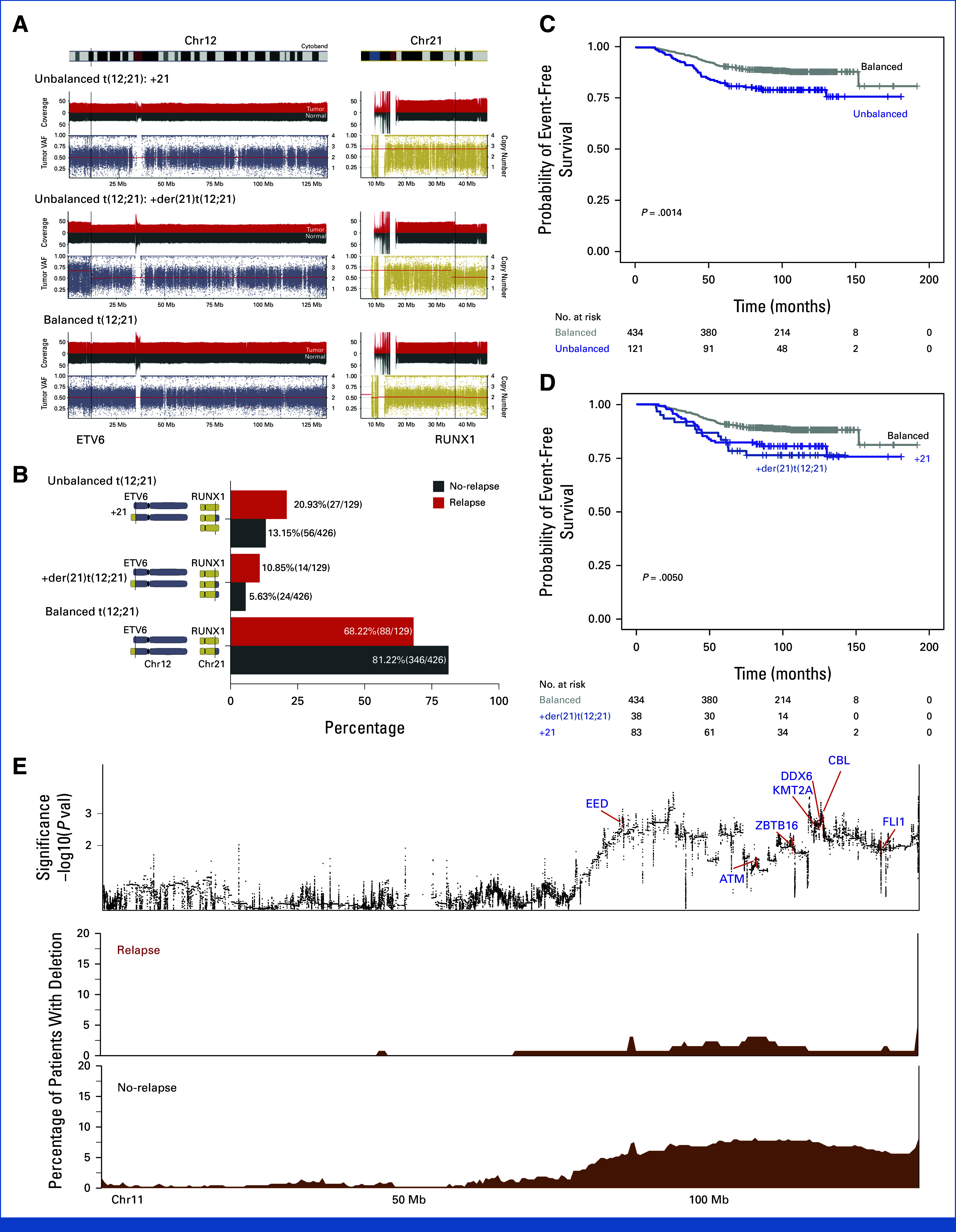
Associations of unbalanced translocations with poor outcome and 11q deletions with favorable outcome in ETV6::RUNX1 ALL. (A) Coverage profiles and variant allele frequency distribution on chr12 and chr21 for representative cases. For each case, WGS coverage for matched tumor/normal samples is shown in the top track and variant allele frequency is shown in the bottom. The red line represents the log2 ratio of the segments. (B) Comparison of percentage of patients with balanced and unbalanced ETV6::RUNX1 translocations. Unbalanced ETV6::RUNX1 translocation was more prevalent in relapse samples (P = .0027). (C) Weighted Kaplan-Meier (KM) curves of cases with unbalanced versus balanced ETV6::RUNX1 translocations. Cases with unbalanced translocations had inferior outcome compared with those with balanced translocation. (D) Weighted KM curves with unbalanced cases subclassified into +21 and +der(21)t(12;21) groups. (E) Top, significance of chr11q deletion enrichment in nonrelapsed patients on the basis of associations between CNV (log2 ratio) and the relapse status. Putative leukemia driver genes are highlighted in blue. Bottom, percentage of cases with deletion in relapse or no-relapse of ETV6::RUNX1. Window size is 500 Kbp. CNV, copy number variations; WGS, whole genome sequencing.
A striking finding was the high relapse rate of PAX5alt ALL (57 of 116 cases [49%], Figs 1 and 3). PAX5 encodes a transcription factor required for normal B-cell development that is mutated in B-ALL. Distinct PAX5 alterations define two B-ALL subtypes: PAX5 P80R14,17,18 and PAX5alt ALL that harbors diverse PAX5 rearrangements, intragenic amplification, and sequence mutations.14,19,20 The type of PAX5 alteration was associated with relapse risk in PAX5alt ALL (Fig 3). Drivers of PAX5alt ALL reported in studies enriched for HR B-ALL, PAX5::ETV6 and PAX5 R38H/R140H,14 were not observed, suggesting their association with HR features.
FIG 3.

PAX5alt genomic alterations and associations with relapse. (A) Oncoprint of PAX5alt lesions in the MP2PRT study group. (B) CNV segmentation plot and percentage of samples with PAX5 gains. (C) Weighted Kaplan-Meier curves for groups classified on the basis of granular combination types of SNV/indel, SV, and CNV. Significance values from weighted Cox regression test results are shown on the right. *P < .05. CNV, copy number variations; MP2PRT, Molecular Profiling to Predict Responses to Therapy; SNV, single nucleotide variations; SV, structural variations; WT, wild-type.
Conversely, PAX5alt cases in this study exhibited a high frequency of PAX5::NOL4L and PAX5::ZCCHC7 fusions, and focal internal tandem PAX5 amplifications14 that always involved PAX5 exon 5, encoding part of the DNA-binding paired domain (Fig 3B, Data Supplement, Fig S9 and Table S12). Compared with cases without PAX5 alterations, those cases with PAX5 amplification in combination with other structural PAX5 variants had the worst relapse-free survival (four of five cases relapsed, OR, 13.00 [95% CI, 1.25 to 255.49]; P = .03, weighted Cox regression test P = .02), followed by those with PAX5 amplification and PAX5 rearrangement (three of four cases relapsed, OR, 10.11 [95% CI, 0.90 to 204.62]; P = .06, weighted Cox regression test P = .04, Fig 3C, Data Supplement, Fig S10). Thus, biallelic alterations of PAX5 were associated with worst outcomes in cases with PAX5 amplification. In addition, PAX5 amplification was significantly enriched in PAX5alt MRD-positive patients. Specifically, PAX5 amplification was present in 34.9% of 43 MRD-positive patients versus 11.0% of 73 MRD-negative patients (OR, 4.29 [95% CI, 1.51 to 13.14]; P = .0032). Thus, genomic subtype and the type of driver alterations in PAX5alt ALL are important determinants of relapse in SR B-ALL.
Genome-Wide Analysis of Determinants of Relapse and MRD
Risk of relapse conferred by genomic alterations varies by B-ALL subtype, such as IKZF1 in BCR::ABL1 and BCR::ABL1-like ALL,4,21,22 and TP53 mutation in low-hypodiploid ALL.23 Accordingly, we identified somatic genomic alterations present in at least 3% of samples and further stratified these by subtype (Data Supplement, Fig S5 and Table S13).
Genome-wide analysis using all samples identified associations between any type of somatic alterations in 1,986 genes and relapse, with 452 remaining significant after adjusting for subtype (FDR <0.2, Data Supplement, Fig S11 and Table S14A). Thus, B-ALL subtypes/primary somatic alterations explain a large portion of the associations with relapse. Conversely, additional secondary alterations contributed to the risk of relapse. CDKN2A/CDKN2B deletions were frequent in PAX5alt B-ALL (73% of cases), and the association of homozygous deletions with relapse (OR, 1.87 [95% CI, 1.43 to 2.45]; P = 7.03 × 10⁻⁶ for CDKN2A, OR, 1.92 [95% CI, 1.45 to 2.54]; P = 8.06 × 10⁻⁷ for CDKN2B, using the full study group without adjustment for subtype) was moderated by adjustment for subtype (OR, 1.48 [95% CI, 1.08 to 2.01]; P = .015 for CDKN2A, OR, 1.50 [95% CI, 1.08 to 2.07]; P = .016 for CDKN2B). However, homozygous CDKN2A deletion was associated with relapse in non-PAX5alt cases (OR, 1.43 [95% CI, 1.02 to 2.00]; P = .036), and PAX5alt B-ALL was associated with relapse in cases lacking homozygous CDKN2A deletion (OR, 2.24 [95% CI, 1.04 to 4.67]; P = .043). Thus, PAX5alt is associated with relapse irrespective of CDKN2A status due to the presence of other types of alterations. Also, chromosome 9p23.1 alterations including homozygous deletion of CDKN2A/CDKN2B and the flanking genes IFNA7 and MTAP were associated with increased risk of relapse but a reduced risk of being MRD-positive at the end of induction (Data Supplement, Figs S12 and S13).
For common (No. > 10) subtypes, 881 genes were associated with relapse, many of which were attributable to large genomic alterations (Data Supplement, Table S14B). For example, 542 of 751 relapse-associated genes in ETV6::RUNX1 ALL reflected associations of deletion of chromosome 11 with CCR (OR, 0.06, [95% CI, 0.0004 to 0.41]; P = .0007; Fig 2E) and chromosome 15 deletions that were associated with relapse (OR, 3.38 [95% CI, 1.78 to 6.39]; P = .0002; Data Supplement, Table S15). The maximal region of chromosome 11q deletion was 47 Mb and encompassed seven leukemia driver genes, including KMT2A.
Genome-wide analysis of individual types of genomic alteration (Data Supplement, Table S14C) showed that homozygous deletions of PAX5 and CDKN2A/CDKN2B were significant for relapse (Data Supplement, Table S16). Logistic regression considering PAX5 and CDKN2A status in the model showed that each gene was associated with relapse (P = .0023 for CDKN2A homozygous deletion and P = .012 for PAX5 homozygous deletion). Similar analysis within each subtype identified additional associations with outcome (Data Supplement, Tables S14D).
Across this study group, no subtype-adjusted associations with MRD were observed for analyses combining different alteration types (Data Supplement, Table S14A). Within common subtypes, the majority of 810 gene-level associations with MRD (FDR < 0.2, Data Supplement, Table S14B) were observed in the PAX5alt group, most of which (702 of 797 genes) were due to deletions of chromosomes 9 (OR, 0.18 [95% CI, 0.05 to 0.52]; P = .001) and 20 (OR, 0.22 [95% CI, 0.06 to 0.65]; P = .006, Data Supplement, Table S15) that accompany the formation of structural variants of PAX5, such as unbalanced rearrangements.
We also performed analyses focusing on 381 putative leukemia driver genes.16 Sixteen were associated with relapse without adjustment for subtype and 10 with MRD. After subtype adjustment, seven were associated with relapse and none with MRD (Fig 4, Data Supplement, Table S17). Several of these associations were subtype-dependent. CREBBP alterations, most commonly sequence mutations, were associated with relapse (OR, 2.22 [95% CI, 1.45 to 3.40]; P = .0003) in hyperdiploid ALL and with elevated MRD in hyperdiploid ALL without DT (OR, 3.11 [95% CI, 1.53 to 6.49]; P = .0002, Data Supplement, Tables S16 and S17). Alterations of NRAS were associated with elevated MRD (OR, 2.32 [95% CI, 1.54 to 3.51]; P = 4.9 × 10⁻⁵, Data Supplement, Table S17), but were not associated with relapse (OR, 0.79 [95% CI, 0.52 to 1.21]; P = .28). Deletions and sequence mutations of INO80 were associated with relapse in ETV6::RUNX1 B-ALL (Fig 4); deletions occurred in 19 (14.7%) of 129 cases that relapsed compared with 31 (7.24%) of 428 controls (OR, 2.23 [95% CI, 1.20 to 4.04]; P = .01); 22 (17.05%) ETV6::RUNX1 cases that relapsed had INO80 sequence mutations compared with 43 (10.05%) of 428 controls (OR, 1.85 [95% CI, 1.05 to 3.19]; P = .03, Data Supplement, Fig S14).
FIG 4.

Association of secondary alterations with risk of relapse or MRD positivity for ALL driver genes. (A) Associations with relapse using the full group with adjustment for genomic subtypes. (B) Associations with relapse within each genomic subtype. (C) The association with EOI MRD status (MRD >0.01%) within each subtype. No significant associations with EOI MRD positivity were observed using the full study group adjusting for subtypes. FDR <0.2 and subtypes with sample size >50 were shown. EOI MRD, end of induction minimal residual disease; FDR, false discovery rate; MRD, minimal residual disease; OR, odds ratio.
IKZF1 Alterations and Outcome in Standard-Risk B-ALL
IKZF1 (IKAROS) alterations were associated with increased relapse risk after adjusting for subtypes (OR, 1.80 [95% CI, 1.34 to 2.40]; P = .00008) and were significant within multiple subtypes (PAX5alt, DUX4-r, and ETV6::RUNX1-like, Data Supplement, Table S18), particularly hyperdiploid ALL (OR, 3.23 [95% CI, 2.00 to 5.20]; P = 2.14 × 10⁻⁶). The most common IKZF1 alterations were deletions involving the whole gene (n = 69, 42.9%), followed by exon 4-7 (encoding the dominant-negative isoform IK6, n = 33, 20.5%) and exon 4-8 deletions that result in loss of function (n = 17, 10.6%; Figs 5A and 5B, Data Supplement, Table S19). Mutations in the C-terminal zinc fingers that mediate IKAROS dimerization were almost exclusively observed in diagnostic cases that experienced relapse (Fig 5C). Dominant-negative IKZF1 deletions were associated with relapse: 64.7% of cases with dominant-negative deletions relapsed compared with 26.3% of cases without IKZF1 deletions (OR, 5.11 [95% CI, 2.39 to 11.46]; P = 4.39 × 10⁻⁶; Fig 5D). Moreover, dominant-negative IKZF1 deletions or sequence mutations were associated with the worst relapse rates compared with patients with other IKZF1 deletions or no IKZF1 deletion (62% relapsed v 28.2% of cases lacking dominant-negative alterations, OR, 4.15 [95% CI, 2.24 to 7.86]; P = 1.56 × 10⁻⁶; Data Supplement, Fig S15).
FIG 5.

Specific structural somatic variants of IKZF1 are enriched in patients who relapsed. (A) Regions of somatic deletion of IKZF1 (blue lines) for each patient, ordered by relapse or no-relapse. Exons are shown on the top. (B) Percentage of samples with IKZF1 deletions (DEL). Exon 4-7 and 4-8 deletions were enriched in the relapse samples. (C) Somatic IKZF1 sequence variants in the MP2PRT group. (D) Weighted KM curves for groups classified on the basis of types of exon deletions in each sample. Samples with exon 4-5 or 4-7 deletions were classified as DEL_dominant_negative; samples with other deletions were classified as DEL_other. NoDel are samples without IKZF1 deletions. The weighted Cox regression test results are shown on the right. (E, F) Weighted KM curves for MLPA-equivalent IKZF1plus. **P < .01. MLPA, multiplex ligation probe amplification; MP2PRT, Molecular Profiling to Predict Responses to Therapy.
The composite IKZF1plus genotype (IKZF1 deletion/mutations with homozygous CDKN2A/CDKN2B deletion, and/or PAX5 deletion, and/or CRLF2 rearrangement in the absence of DUX4 rearrangment) has been reported to be associated with inferior outcome compared with IKZF1 alterations alone in B-ALL.24 However, IKZF1plus status is commonly identified using the multiplex ligation probe amplification (MLPA) assay, which does not detect all DUX4 and CRLF2 rearrangements. We analyzed MLPA-equivalent and genomically faithful definitions of IKZF1plus (Supplementary Methods; Data Supplement, Fig S16). Approximately 5% of the study group studied were IKZF1plus, and the results of MLPA-equivalent and genomically faithful approaches were similar (MLPA-equivalent: n = 73, relapse = 44 [60.3%], no-relapse = 29 [39.7%]; genomically faithful: n = 62, relapse = 39 [62.9%], no-relapse = 23 [38.1%]). ETV6::RUNX1-like and BCR::ABL1-like cases had the highest proportion of IKZF1plus cases among the B-ALL subtypes (Data Supplement, Table S20). Patients with IKZF1 deletion not fulfilling criteria for IKZF1plus had event-free survival (EFS) intermediate between IKZF1plus cases and those lacking IKZF1 deletion (Fig 5E, Data Supplement, S17A). IKZF1plus cases consistently had inferior outcome compared with non-IKZF1plus cases using both classifications (OR, 3.94 [95% CI, 2.38 to 6.64]; P = 1.97 × 10⁻⁸, Fig 5F, Data Supplement, Fig S17B).
Patterns of Aneuploidy Determine the Outcome of Hyperdiploid ALL
High hyperdiploidy, defined by gain of at least five chromosomes, is generally associated with favorable outcome.15,25 However, a subset of patients with hyperdiploid ALL experience relapse, underscoring the importance of identifying prognostic factors in this group. Within this study, the lack of DT was associated with higher rates of relapse in hyperdiploid ALL than cases with DT (OR, 2.45 [95% CI, 1.59 to 3.80]; P = 2.59 × 10⁻⁵), a finding replicated among patients enrolled on St Jude Total Therapy 15 and 16 studies (OR, 6.85 [95% CI, 1.69 to 39.55]; P = .002; Data Supplement, Fig S18B). The UK MRC ALL studies reported that trisomy of chromosomes 17 and 18, or one trisomy (17 or 18) without gains of chromosome 5 or 20 was associated with favorable 10-year EFS of 86% (95% CI, 82 to 89)26; this observation was replicated in MP2PRT (P < .0001) but not (P > .05) in the St Jude Total Therapy 15 and 16 studies27,28 (UK favorable-risk profile 10-year EFS: 96%, 95% CI, 93 to 99; UK poor-risk profile 10-year EFS: 90%, 95% CI, 82 to 99, Data Supplement, Fig S18A).
We thus sought to develop a predictor of outcome considering all possible patterns of aneuploidy. Using a classification and regression tree (CART) analysis considering each individual chromosome alone and in combination, we identified alterations of chromosomes 5, 6, 7, 10, and 17 as predictors of relapse in hyperdiploid ALL. This approach allowed us to classify the cases into distinct groups with varying outcome (Fig 6A). Trisomy of chromosome 10 (10+) with disomy of chromosome 7 (7N) predicted the highest likelihood of remaining in CCR in this study (CCR, 264/307, 86%; 10+,7N v non-10+,7N: OR, 0.27 [95% CI, 0.17 to 0.42]; P = 8.02 × 10⁻¹⁰) and the St Jude Total Therapy studies (CCR, 188/193, 97%; 10+,7N v non-10+,7N: OR, 0.22 [95% CI, 0.05 to 0.80]; P = .009; Figs 6B and 6C). By contrast, disomy of chromosomes 10 and 17 with trisomy of chromosome 6 was associated with increased risk of relapse (MP2PRT: 14 of 20 cases relapsed, OR, 7.16 [95% CI, 2.63 to 21.51]; P = 2.19 × 10⁻⁵; St Jude: 4 of 9 cases relapsed, OR, 21.32, [95% CI, 3.62 to 119.30]; P = .0004; Figs 6B and 6C).
FIG 6.

CART classification model using copy number changes to predict risk of relapse for hyperdiploid ALL. (A) CART classification model using copy number changes in hyperdiploid cases. The model was built on the basis of the sample relapse status. The percentage represents the fraction of hyperdiploid patients in each group. (B) Weighted KM curves for hyperdiploid samples in MP2PRT stratified by the classes determined in the CART model. Risk table is shown at the bottom. (C) Weighted KM curves for the hyperdiploid samples in the SJCRH Total 15/16 cohorts stratified by the classes determined by the CART model. Risk table is shown at the bottom. ALL, acute lymphoblastic leukemia; CART, classification and regression tree; MP2PRT, Molecular Profiling to Predict Responses to Therapy; SJCRH, St Jude Children's Research Hospital.
Associations of IKZF1 and CREBBP and relapse were evident in high-hyperdiploid ALL. Importantly, these associations remained significant even after stratifying cases according to aneuploidy patterns derived from the CART model (IKZF1: OR, 2.98 [95% CI, 1.71 to 5.20]; P = .00006; CREBBP: OR, 1.86 [95% CI, 1.12 to 3.08]; P = .012; Data Supplement, Table S21). Notably, these mutations were not significantly enriched in the highest risk strata (10+, 7+, 5+; or 10N, 17N, 6+), but were enriched in other clusters. IKZF1 alterations were enriched in patients with 10+, 7+, 5N (OR, 34.2 [95% CI, 1.34 to 870.55]; P = .01; Data Supplement, Table S22), 10N, 17+ (OR, 6.17 [95% CI, 1.45 to 31.43]; P = .005), and 10N, 17N, 6N (OR, 4.79 [95% CI, 1.21 to 21.37]; P = .01; Data Supplement, Table S22). Thus, integrated profiling of aneuploidy and sequence mutations refines the risk classification of high-hyperdiploid ALL.
DISCUSSION
Accurately predicting outcome in children diagnosed with SR B-ALL or HR cases with favorable genetics is critical for tailoring treatment intensity to maximize cure and minimize toxicity. However, because of the lack of large studies of uniformly treated ALL analyzed with comprehensive genomic approaches, recent studies refining the genetic taxonomy of B-ALL have not adequately addressed this question. To address this gap, we conducted integrated genomic analysis on a large group of patients using a design that specifically enriched for relapsed cases. Our approach identified multiple genomic alterations associated with treatment outcome, including adverse genetic features in patients otherwise considered to be at very low risk of relapse.
A striking finding was the association of the PAX5alt group with treatment failure, accompanied by variability in the type of PAX5 alterations and disease risk and outcome.14 This subtype was common, comprising 7.7% of the group studied or 27.3% of MP2PRT cases/controls lacking hyperdiploidy or ETV6::RUNX1, and was strongly associated with poor outcome, with 49% of PAX5alt cases experiencing relapse. The PAX5 driver alterations in this group differed from previous studies enriched for HR B-ALL, with PAX5::ETV6 and PAX5 R38/R140 mutations absent in this group.14 Moreover, we observed combinatorial effects of the type of PAX5 alterations and outcome, indicating that different PAX5alt driver alterations influence disease biology and outcome, and that genotyping for PAX5alt-defining alterations should be used to refine risk stratification. For example, a child diagnosed with SR B-ALL that has PAX5alt, especially those with PAX5 amplification or biallelic alterations, may require treatment with either high-risk or novel therapies to maximize the chances of cure.
Although generally considered a highly favorable prognostic genetic driver, patients with ETV6::RUNX1 B-ALL could be further categorized on the basis of translocation-associated alterations. Unbalanced translocations defined by gain of RUNX1 or an additional copy of ETV6::RUNX1 identified that a subset of patients were more likely to relapse after 40 months from diagnosis. We previously observed INO80 alterations in ETV6::RUNX1-positive ALL,16 but that study lacked power to assess associations with outcome in NCI SR patients. Here, we observed both deletions and sequence mutations of this gene predicted outcome. By contrast, patients with TCF3::PBX1 had a more favorable outcome with an unbalanced t(1;19) than patients with TCF3::PBX1 ALL and a balanced translocation. Although Down syndrome–associated ALL constituted a small proportion of cases, this group had a much higher incidence of relapse compared with the other common subtypes.
Additional associations of secondary genetic lesions with outcome were dependent on primary driver lesions. Indeed, the overall association of secondary lesions, when corrected for subtype, identified genotype-specific secondary events that may also contribute to improved risk stratification. Homozygous CDKN2A/CDKN2B deletion was associated with an increased risk of relapse but reduced risk of elevated EOI MRD, suggesting that patients with CDKN2A/CDKN2B deletion, who frequently harbor PAX5 alterations, could be candidates for therapy intensification or novel approaches, independent of early response.
Given the heterogeneity of genomic alterations targeting IKZF1, smaller studies with fewer comprehensive genomic analyses were unable to identify prognostic subsets of ALL according to the type of IKZF1 alteration.29 Here, we show that deletions, primarily the exon 4-7 deletion encoding the IK6 isoform, and sequence mutations resulting in dominant-negative IKAROS activity have inferior outcome to others, consistent with mechanistic data.30,31
As therapeutic strategies become increasingly tailored to specific genotypic groups, we need to identify certain patients who display the most favorable genetic risk factors to deintensify cytotoxic chemotherapy.32 Data from COG and other consortia from as early as the 1970s show that many patients may be cured with relatively low-dose systemic therapy.32 Refining current risk stratification approaches to identify patients currently considered SR that are curable with less intensive therapy or who require more intensive therapy for cure is a central goal of contemporary management of childhood ALL. Our results suggest several logical ways to achieve this goal: for example, patients with ETV6::RUNX1 B-ALL could be stratified according to secondary alterations of INO80D, chromosome 11q deletions, or unbalanced ETV6::RUNX1 alterations. Identification of the PAX5alt subtype is critical to accurately assign higher risk to this recently identified group of cases. Our results also indicate that identification of IKZF1plus status is important for SR ALL across multiple subtypes and that specific patterns of aneuploidy and secondary mutations modulate risk of relapse in hyperdiploid ALL.
Although many consider childhood ALL a cured disease, we report a large, comprehensively analyzed predominantly NCI SR group enriched for relapse and have identified additional mutational events or patterns of aneuploidy that refine current risk predictors. Validation of these findings in future studies is warranted. As discussions about deintensification of therapy are underway, it is essential to comprehensively genotype newly diagnosed patients with SR ALL to accurately tailor the intensity of therapy to minimize the toxicity without increasing the risk of relapse.
ACKNOWLEDGMENT
Biospecimen Processing was performed at Nationwide Children's Hospital Biopathology Center (Y. Moyer, K. Tegtmeier, J. Frick, A. Bryan). Whole genome sequencing and whole exome sequencing were performed by the Genomics Platform at the Broad Institute of MIT and Harvard. Total RNA sequencing was performed by the High Throughput Sequencing Facility at the University of North Carolina School of Medicine under the supervision of C. Jones and K. Hoadley.
Wenan Chen
Stock and Other Ownership Interests: Illumina, 10X Genomics
Abdelrahman Elsayed
Patents, Royalties, Other Intellectual Property: I have two patent applications: Patent 1: Title: “Pharmacogenomics score to make decisions on therapy augmentation in AML”; Status: Filed; Number: US Provisional Application No.: 63/233,673 Patent 2: Title: “Methods for Predicting AML Outcome”; Status: Published; Number: PCT/US2020/051961
Stanley B. Pounds
Patents, Royalties, Other Intellectual Property: I have pending patents for the six-gene pediatric leukemia stem cell score (https://pubmed.ncbi.nlm.nih.gov/31645648/) and other omics scores predictive of pediatric AML outcomes
Elizabeth A. Raetz
Research Funding: Pfizer (Inst)
Other Relationship: BMS
Meenakshi Devidas
This author is a member of the Journal of Clinical Oncology Editorial Board. Journal policy recused the author from having any role in the peer review of this manuscript.
Honoraria: Novartis, Merck
Cheng Cheng
This author is a member of the Journal of Clinical Oncology Editorial Board. Journal policy recused the author from having any role in the peer review of this manuscript.
Anne Angiolillo
Employment: Servier
Travel, Accommodations, Expenses: Servier
Michael J. Burke
Honoraria: Amgen
Speakers' Bureau: JAZZ Pharmaceuticals
Travel, Accommodations, Expenses: Amgen
William L. Carroll
Consulting or Advisory Role: Merck
Ilaria Iacobucci
Consulting or Advisory Role: Arima Genomics
Travel, Accommodations, Expenses: Mission Bio
Jeremy R. Wang
Employment: Moderna Therapeutics
Stock and Other Ownership Interests: Moderna Therapeutics
Leonard Mattano
Employment: Pfizer
Stock and Other Ownership Interests: Pfizer, Amgen, Monsanto
Consulting or Advisory Role: Novartis
Ching-Hon Pui
Leadership: Adaptive Biotechnologies
Honoraria: Novartis, Amgen
Consulting or Advisory Role: Adaptive Biotechnologies
Research Funding: National Cancer Institute
Travel, Accommodations, Expenses: Amgen
Cheryl Willman
Patents, Royalties, Other Intellectual Property: Patents related to genomic diagnostics for cancer
Brent Wood
Honoraria: Amgen, Beckman Coulter, Becton-Dickinson
Consulting or Advisory Role: Amgen
Research Funding: Amgen (Inst), Juno Therapeutics (Inst), Biosight (Inst), Novartis, Kite, a Gilead company (Inst), Macrogenics (Inst), Wugen, Inc (Inst), Beam Therapeutics Inc (Inst)
Travel, Accommodations, Expenses: Becton-Dickinson, Beckman Coulter
Charles G. Mullighan
Stock and Other Ownership Interests: Amgen
Honoraria: Illumina
Consulting or Advisory Role: Illumina, Beam Therapeutics
Speakers' Bureau: Amgen, Pfizer
Research Funding: Loxo, Pfizer
Patents, Royalties, Other Intellectual Property: Inventor on a pending patent application related to gene-expression signatures for detection of underlying Philadelphia chromosome-like events and therapeutic targeting in leukemia (PCT/US2012/069228), WO 2021/022076 A1 This Patent Highlight shows representative PROTAC compounds bound to JAK2, where ruxolitinib and baricitinib bind to the human JAK2 JH1. Furthermore, representative data illustrate protein degradation, cytotoxicity, and effect of the JAKSTAT signaling pathway of the PROTAC compounds in MHHCALL-4 cells, Marcus FISHER, Fatemeh KERAMATNIA, Kevin MCGOWAN, Jaeki MIN, Gisele A. NISHIGUCHI, Jeanine PRICE, Zoran RANKOVIC, Das SOURAV, Charles G. MULLIGHAN, Yunchao CHANG 2021 SUBSTITUTED N-(2-(2,6-DIOXOPIPERIDIN-3-YL)-1,3-DIOXOISOINDOLIN-5-YL)ARYLSULFONAMIDE ANALOGS AS MODULATORS OF CEREBLON PROTEIN, Application No: PCT/US2021/051648 Filed: September 23, 2021. Patent pending (Inst)
Travel, Accommodations, Expenses: Illumina
Stephen P. Hunger
Stock and Other Ownership Interests: Amgen, Merck (I)
Honoraria: Jazz Pharmaceuticals, Servier/Pfizer
No other potential conflicts of interest were reported.
SUPPORT
Supported by funding from the National Cancer Institute (NCI), National Institutes of Health under the Cancer Moonshot Initiative, under Contract No. HHSN261201500003I. The COG clinical trials were supported by NIH grants U10 CA98543 and U10 CA180886 (COG Chair's grants), U10 CA98413 and U10 CA180899 (COG Statistics and Data Center grants), U24 CA114766 and U24-CA196173 (COG Specimen Banking), and the St Baldrick's Foundation. C.G.M. was supported by NCI grant R35 CA197695. This work was also supported by NCI Cancer Center Support Grants CA021765 (C.G.M.) and CA015704 (M.L.L), and the American Lebanese Syrian Associated Charities of St Jude Children's Research Hospital (C.G.M). C.G.M. is the William E. Evans Endowed Chair at St Jude Children's Research Hospital. E.A.R. is a KiDS of NYU Foundation Professor at NYU Langone Health. S.P.H. is the Jeffrey E. Perelman Distinguished Chair in Pediatrics at the Children's Hospital of Philadelphia. M.L.L. is the Aldarra Foundation, June and Bill Boeing, Founders, Endowed Professor of Pediatric Cancer Research at Seattle Children's Hospital.
CLINICAL TRIAL INFORMATION
T.-C.C. and W.C. contributed equally to this work. C.G.M., and M.L.L. contributed equally to senior authorship.
DATA SHARING STATEMENT
A data sharing statement provided by the authors is available with this article at DOI https://doi.org/10.1200/JCO.23.02238.
AUTHOR CONTRIBUTIONS
Conception and design: Karen R. Rabin, Elizabeth A. Raetz, Meenakshi Devidas, Sima Jeha, Eric Larsen, Kelly Maloney, Wanda Salzer, Cheryl Willman, Stephen P. Hunger, Charles G. Mullighan, Mignon L. Loh
Financial support: Charles G. Mullighan
Administrative support: Charles G. Mullighan
Provision of study materials or patients: William L. Carroll, Sima Jeha, Kelly Maloney, Ching-Hon Pui, Nilsa C. Ramirez, Cheryl Willman
Collection and assembly of data: Karen R. Rabin, Meenakshi Devidas, Anne Angiolillo, Michael Borowitz, Andrew Carroll, I-Ming Chen, Nyla Heerema, Ilaria Iacobucci, Jeremy R. Wang, Leonard Mattano, Kelly Maloney, Ching-Hon Pui, Nilsa C. Ramirez, Wanda Salzer, Cheryl Willman, Brent Wood, Stephen P. Hunger, Charles G. Mullighan, Mignon L. Loh
Data analysis and interpretation: Ti-Cheng Chang, Wenan Chen, Chunxu Qu, Zhongshan Cheng, Dale Hedges, Abdelrahman Elsayed, Stanley B. Pounds, Mary Shago, Elizabeth A. Raetz, Meenakshi Devidas, Cheng Cheng, Pradyuamna Baviskar, Michael Borowitz, Michael J. Burke, William L. Carroll, Richard Harvey, Jeremy R. Wang, Sima Jeha, Leonard Mattano, Kelly Maloney, Ching-Hon Pui, Cheryl Willman, Naomi Winick, Brent Wood, Stephen P. Hunger, Gang Wu, Charles G. Mullighan, Mignon L. Loh
Manuscript writing: All authors
Final approval of manuscript: All authors
Accountable for all aspects of the work: All authors
AUTHORS' DISCLOSURES OF POTENTIAL CONFLICTS OF INTEREST
Genomic Determinants of Outcome in Acute Lymphoblastic Leukemia
The following represents disclosure information provided by authors of this manuscript. All relationships are considered compensated unless otherwise noted. Relationships are self-held unless noted. I = Immediate Family Member, Inst = My Institution. Relationships may not relate to the subject matter of this manuscript. For more information about ASCO's conflict of interest policy, please refer to www.asco.org/rwc or ascopubs.org/jco/authors/author-center.
Open Payments is a public database containing information reported by companies about payments made to US-licensed physicians (Open Payments).
Wenan Chen
Stock and Other Ownership Interests: Illumina, 10X Genomics
Abdelrahman Elsayed
Patents, Royalties, Other Intellectual Property: I have two patent applications: Patent 1: Title: “Pharmacogenomics score to make decisions on therapy augmentation in AML”; Status: Filed; Number: US Provisional Application No.: 63/233,673 Patent 2: Title: “Methods for Predicting AML Outcome”; Status: Published; Number: PCT/US2020/051961
Stanley B. Pounds
Patents, Royalties, Other Intellectual Property: I have pending patents for the six-gene pediatric leukemia stem cell score (https://pubmed.ncbi.nlm.nih.gov/31645648/) and other omics scores predictive of pediatric AML outcomes
Elizabeth A. Raetz
Research Funding: Pfizer (Inst)
Other Relationship: BMS
Meenakshi Devidas
This author is a member of the Journal of Clinical Oncology Editorial Board. Journal policy recused the author from having any role in the peer review of this manuscript.
Honoraria: Novartis, Merck
Cheng Cheng
This author is a member of the Journal of Clinical Oncology Editorial Board. Journal policy recused the author from having any role in the peer review of this manuscript.
Anne Angiolillo
Employment: Servier
Travel, Accommodations, Expenses: Servier
Michael J. Burke
Honoraria: Amgen
Speakers' Bureau: JAZZ Pharmaceuticals
Travel, Accommodations, Expenses: Amgen
William L. Carroll
Consulting or Advisory Role: Merck
Ilaria Iacobucci
Consulting or Advisory Role: Arima Genomics
Travel, Accommodations, Expenses: Mission Bio
Jeremy R. Wang
Employment: Moderna Therapeutics
Stock and Other Ownership Interests: Moderna Therapeutics
Leonard Mattano
Employment: Pfizer
Stock and Other Ownership Interests: Pfizer, Amgen, Monsanto
Consulting or Advisory Role: Novartis
Ching-Hon Pui
Leadership: Adaptive Biotechnologies
Honoraria: Novartis, Amgen
Consulting or Advisory Role: Adaptive Biotechnologies
Research Funding: National Cancer Institute
Travel, Accommodations, Expenses: Amgen
Cheryl Willman
Patents, Royalties, Other Intellectual Property: Patents related to genomic diagnostics for cancer
Brent Wood
Honoraria: Amgen, Beckman Coulter, Becton-Dickinson
Consulting or Advisory Role: Amgen
Research Funding: Amgen (Inst), Juno Therapeutics (Inst), Biosight (Inst), Novartis, Kite, a Gilead company (Inst), Macrogenics (Inst), Wugen, Inc (Inst), Beam Therapeutics Inc (Inst)
Travel, Accommodations, Expenses: Becton-Dickinson, Beckman Coulter
Charles G. Mullighan
Stock and Other Ownership Interests: Amgen
Honoraria: Illumina
Consulting or Advisory Role: Illumina, Beam Therapeutics
Speakers' Bureau: Amgen, Pfizer
Research Funding: Loxo, Pfizer
Patents, Royalties, Other Intellectual Property: Inventor on a pending patent application related to gene-expression signatures for detection of underlying Philadelphia chromosome-like events and therapeutic targeting in leukemia (PCT/US2012/069228), WO 2021/022076 A1 This Patent Highlight shows representative PROTAC compounds bound to JAK2, where ruxolitinib and baricitinib bind to the human JAK2 JH1. Furthermore, representative data illustrate protein degradation, cytotoxicity, and effect of the JAKSTAT signaling pathway of the PROTAC compounds in MHHCALL-4 cells, Marcus FISHER, Fatemeh KERAMATNIA, Kevin MCGOWAN, Jaeki MIN, Gisele A. NISHIGUCHI, Jeanine PRICE, Zoran RANKOVIC, Das SOURAV, Charles G. MULLIGHAN, Yunchao CHANG 2021 SUBSTITUTED N-(2-(2,6-DIOXOPIPERIDIN-3-YL)-1,3-DIOXOISOINDOLIN-5-YL)ARYLSULFONAMIDE ANALOGS AS MODULATORS OF CEREBLON PROTEIN, Application No: PCT/US2021/051648 Filed: September 23, 2021. Patent pending (Inst)
Travel, Accommodations, Expenses: Illumina
Stephen P. Hunger
Stock and Other Ownership Interests: Amgen, Merck (I)
Honoraria: Jazz Pharmaceuticals, Servier/Pfizer
No other potential conflicts of interest were reported.
REFERENCES
- 1.Hunger SP, Mullighan CG: Acute lymphoblastic leukemia in children. N Engl J Med 373:1541-1552, 2015 [DOI] [PubMed] [Google Scholar]
- 2.Iacobucci I, Kimura S, Mullighan CG: Biologic and therapeutic implications of genomic alterations in acute lymphoblastic leukemia. J Clin Med 10:3792, 2021 [DOI] [PMC free article] [PubMed] [Google Scholar]
- 3.Harvey RC, Mullighan CG, Wang X, et al. : Identification of novel cluster groups in pediatric high-risk B-precursor acute lymphoblastic leukemia with gene expression profiling: Correlation with genome-wide DNA copy number alterations, clinical characteristics, and outcome. Blood 116:4874-4884, 2010 [DOI] [PMC free article] [PubMed] [Google Scholar]
- 4.Roberts KG, Li Y, Payne-Turner D, et al. : Targetable kinase-activating lesions in Ph-like acute lymphoblastic leukemia. N Engl J Med 371:1005-1015, 2014 [DOI] [PMC free article] [PubMed] [Google Scholar]
- 5.Rheingold SR, Ji L, Xu X, et al. : Prognostic factors for survival after relapsed acute lymphoblastic leukemia (ALL): A Children’s Oncology group (COG) study. J Clin Oncol 37, 2019. (15_suppl; abstr 10008) [Google Scholar]
- 6.Sutcliffe MJ, Shuster JJ, Sather HN, et al. : High concordance from independent studies by the Children's Cancer Group (CCG) and Pediatric Oncology group (POG) associating favorable prognosis with combined trisomies 4, 10, and 17 in children with NCI standard-risk B-precursor acute lymphoblastic leukemia: A Children's Oncology Group (COG) initiative. Leukemia 19:734-740, 2005 [DOI] [PubMed] [Google Scholar]
- 7.Maloney KW, Devidas M, Wang C, et al. : Outcome in children with standard-risk B-cell acute lymphoblastic leukemia: Results of Children's Oncology Group trial AALL0331. J Clin Oncol 38:602-612, 2020 [DOI] [PMC free article] [PubMed] [Google Scholar]
- 8.Mattano LA Jr., Devidas M, Maloney KW, et al. : Favorable trisomies and ETV6-RUNX1 predict cure in low-risk B-cell acute lymphoblastic leukemia: Results from Children's Oncology Group trial AALL0331. J Clin Oncol 39:1540-1552, 2021 [DOI] [PMC free article] [PubMed] [Google Scholar]
- 9.Angiolillo AL, Schore RJ, Kairalla JA, et al. : Excellent outcomes with reduced frequency of vincristine and dexamethasone Pulses in standard-risk B-lymphoblastic leukemia: Results from Children's Oncology Group AALL0932. J Clin Oncol 39:1437-1447, 2021 [DOI] [PMC free article] [PubMed] [Google Scholar]
- 10.Schore RJ, Angiolillo AL, Kairalla JA, et al. : Outstanding outcomes with two low intensity regimens in children with low-risk B-ALL: A report from COG AALL0932. Leukemia 37:1375-1378, 2023 [DOI] [PMC free article] [PubMed] [Google Scholar]
- 11.Larsen EC, Devidas M, Chen S, et al. : Dexamethasone and high-dose methotrexate improve outcome for children and young adults with high-risk B-acute lymphoblastic leukemia: A report from Children's Oncology Group study AALL0232. J Clin Oncol 34:2380-2388, 2016 [DOI] [PMC free article] [PubMed] [Google Scholar]
- 12.Burke MJ, Devidas M, Chen Z, et al. : Outcomes in adolescent and young adult patients (16 to 30 years) compared to younger patients treated for high-risk B-lymphoblastic leukemia: Report from Children's Oncology Group study AALL0232. Leukemia 36:648-655, 2022 [DOI] [PMC free article] [PubMed] [Google Scholar]
- 13.Salzer WL, Burke MJ, Devidas M, et al. : Impact of intrathecal triple therapy versus intrathecal methotrexate on disease-free survival for high-risk B-lymphoblastic leukemia: Children's Oncology Group study AALL1131. J Clin Oncol 38:2628-2638, 2020 [DOI] [PMC free article] [PubMed] [Google Scholar]
- 14.Gu Z, Churchman ML, Roberts KG, et al. : PAX5-driven subtypes of B-progenitor acute lymphoblastic leukemia. Nat Genet 51:296-307, 2019 [DOI] [PMC free article] [PubMed] [Google Scholar]
- 15.Jeha S, Choi J, Roberts KG, et al. : Clinical significance of novel subtypes of acute lymphoblastic leukemia in the context of minimal residual disease-directed therapy. Blood Cancer Discov 2:326-337, 2021 [DOI] [PMC free article] [PubMed] [Google Scholar]
- 16.Brady SW, Roberts KG, Gu Z, et al. : The genomic landscape of pediatric acute lymphoblastic leukemia. Nat Genet 54:1376-1389, 2022 [DOI] [PMC free article] [PubMed] [Google Scholar]
- 17.Bastian L, Schroeder MP, Eckert C, et al. : PAX5 biallelic genomic alterations define a novel subgroup of B-cell precursor acute lymphoblastic leukemia. Leukemia 33:1895-1909, 2019 [DOI] [PubMed] [Google Scholar]
- 18.Passet M, Boissel N, Sigaux F, et al. : PAX5 P80R mutation identifies a novel subtype of B-cell precursor acute lymphoblastic leukemia with favorable outcome. Blood 133:280-284, 2019 [DOI] [PubMed] [Google Scholar]
- 19.Li JF, Dai YT, Lilljebjorn H, et al. : Transcriptional landscape of B cell precursor acute lymphoblastic leukemia based on an international study of 1,223 cases. Proc Natl Acad Sci USA 115:E11711-E11720, 2018 [DOI] [PMC free article] [PubMed] [Google Scholar]
- 20.Li Z, Lee SHR, Chin WHN, et al. : Distinct clinical characteristics of DUX4- and PAX5-altered childhood B-lymphoblastic leukemia. Blood Adv 5:5226-5238, 2021 [DOI] [PMC free article] [PubMed] [Google Scholar]
- 21.Mullighan CG, Su X, Zhang J, et al. : Deletion of IKZF1 and prognosis in acute lymphoblastic leukemia. N Engl J Med 360:470-480, 2009 [DOI] [PMC free article] [PubMed] [Google Scholar]
- 22.Slayton WB, Schultz KR, Kairalla JA, et al. : Dasatinib plus intensive chemotherapy in children, adolescents, and young adults with Philadelphia chromosome-positive acute lymphoblastic leukemia: Results of Children's Oncology Group trial AALL0622. J Clin Oncol 36:2306-2314, 2018 [DOI] [PMC free article] [PubMed] [Google Scholar]
- 23.Holmfeldt L, Wei L, Diaz-Flores E, et al. : The genomic landscape of hypodiploid acute lymphoblastic leukemia. Nat Genet 45:242-252, 2013 [DOI] [PMC free article] [PubMed] [Google Scholar]
- 24.Stanulla M, Dagdan E, Zaliova M, et al. : IKZF1(plus) defines a new minimal residual disease-dependent very-poor prognostic profile in pediatric B-cell precursor acute lymphoblastic leukemia. J Clin Oncol 36:1240-1249, 2018 [DOI] [PubMed] [Google Scholar]
- 25.Paulsson K, Johansson B: High hyperdiploid childhood acute lymphoblastic leukemia. Genes Chromosomes Cancer 48:637-660, 2009 [DOI] [PubMed] [Google Scholar]
- 26.Enshaei A, Vora A, Harrison CJ, et al. : Defining low-risk high hyperdiploidy in patients with paediatric acute lymphoblastic leukaemia: A retrospective analysis of data from the UKALL97/99 and UKALL2003 clinical trials. Lancet Haematol 8:e828-e839, 2021 [DOI] [PMC free article] [PubMed] [Google Scholar]
- 27.Jeha S, Pei D, Choi J, et al. : Improved CNS control of childhood acute lymphoblastic leukemia without cranial irradiation: St Jude total therapy study 16. J Clin Oncol 37:3377-3391, 2019 [DOI] [PMC free article] [PubMed] [Google Scholar]
- 28.Pui CH, Campana D, Pei D, et al. : Treating childhood acute lymphoblastic leukemia without cranial irradiation. N Engl J Med 360:2730-2741, 2009 [DOI] [PMC free article] [PubMed] [Google Scholar]
- 29.Boer JM, van der Veer A, Rizopoulos D, et al. : Prognostic value of rare IKZF1 deletion in childhood B-cell precursor acute lymphoblastic leukemia: An International Collaborative Study. Leukemia 30:32-38, 2016 [DOI] [PubMed] [Google Scholar]
- 30.Churchman ML, Low J, Qu C, et al. : Efficacy of retinoids in IKZF1-mutated BCR-ABL1 acute lymphoblastic leukemia. Cancer Cell 28:343-356, 2015 [DOI] [PMC free article] [PubMed] [Google Scholar]
- 31.Churchman ML, Qian M, Te Kronnie G, et al. : Germline genetic IKZF1 variation and predisposition to childhood acute lymphoblastic leukemia. Cancer Cell 33:937-948 e8, 2018 [DOI] [PMC free article] [PubMed] [Google Scholar]
- 32.Raetz EA, Bhojwani D, Devidas M, et al. : Children's Oncology Group blueprint for research: Acute lymphoblastic leukemia. Pediatr Blood Cancer 70:e30585, 2023. (suppl 6) [DOI] [PMC free article] [PubMed] [Google Scholar]
Associated Data
This section collects any data citations, data availability statements, or supplementary materials included in this article.
Data Availability Statement
A data sharing statement provided by the authors is available with this article at DOI https://doi.org/10.1200/JCO.23.02238.