



Abstract
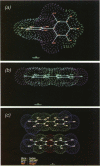
Treatment of cultured chick-embryo liver cells with polychlorinated biphenyls (PCB) results in decreased uroporphyrinogen decarboxylase activity and increased uroporphyrin accumulation. In the present study we examined the effect of the chloro- or bromo-substituent sites in biphenyls (BP) on uroporphyrin accumulation in cultured hepatocytes and the three-dimensional structure of these congeners determined by molecular orbital calculations using a MNDO ('modified neglect of diatomic overlap') method. Among 20 congeners examined, those which were effective in stimulating porphyrin accumulation contained at least two Cl or Br atoms at the lateral adjacent positions in each phenyl ring, e.g. 3,4,3',4'-tetrachloro-, 2,4,3',4'-tetrachloro-, 3,4,5,3',4',5'-hexachloro- and 3,4,5,3',4',5'-hexabromobiphenyl, whereas those which contained less than two halogen atoms or more than three halogen atoms in each phenyl ring or those which contained halogen atoms at 2,2'-positions were not effective. On the basis of the conformational energy (delta E, difference from the most stable conformational energy), which is calculated as a function of the dihedral angle (theta) between the two phenyl rings, biphenyl congeners can be classified into four groups with different conformations. The conformation of active PCB was relatively flexible, whereas inactive species had a rigidly angulated conformation. Furthermore, the calculated probability of the conformation distribution for each congener indicated that the probability of co-planarity was higher for active biphenyls than for inactive congeners. These structural characteristics suggest the significance of both the chloro-substituent sites and the conformational energy reflecting the phenyl-ring twist angles in determining the inhibitory effect of PCB on uroporphyrinogen decarboxylase activity.
Full text
PDF


Images in this article
Selected References
These references are in PubMed. This may not be the complete list of references from this article.
- Alvares A. P., Bickers D. R., Kappas A. Polychlorinated biphenyls: a new type of inducer of cytochrome P-448 in the liver. Proc Natl Acad Sci U S A. 1973 May;70(5):1321–1325. doi: 10.1073/pnas.70.5.1321. [DOI] [PMC free article] [PubMed] [Google Scholar]
- Alvares A. P., Kappas A. Heterogeneity of cytochrome P-450s induced by polychlorinated biphenyls. J Biol Chem. 1977 Sep 25;252(18):6373–6378. [PubMed] [Google Scholar]
- De Verneuil H., Sassa S., Kappas A. Effects of polychlorinated biphenyl compounds, 2,3,7,8-tetrachlorodibenzo-p-dioxin, phenobarbital and iron on hepatic uroporphyrinogen decarboxylase. Implications for the pathogenesis of porphyria. Biochem J. 1983 Jul 15;214(1):145–151. doi: 10.1042/bj2140145. [DOI] [PMC free article] [PubMed] [Google Scholar]
- Goldstein J. A., Hickman P., Bergman H., McKinney J. D., Walker M. P. Separation of pure polychlorinated biphenyl isomers into two types of inducers on the basis of induction of cytochrome P-450 or P-448. Chem Biol Interact. 1977 Apr;17(1):69–87. doi: 10.1016/0009-2797(77)90073-4. [DOI] [PubMed] [Google Scholar]
- Grandchamp B., Deybach J. C., Grelier M., de Verneuil H., Nordmann Y. Studies of porphyrin synthesis in fibroblasts of patients with congenital erythropoietic porphyria and one patient with homozygous coproporphyria. Biochim Biophys Acta. 1980 May 22;629(3):577–586. doi: 10.1016/0304-4165(80)90163-4. [DOI] [PubMed] [Google Scholar]
- Kaminsky L. S., Kennedy M. W., Adams S. M., Guengerich F. P. Metabolism of dichlorobiphenyls by highly purified isozymes of rat liver cytochrome P-450. Biochemistry. 1981 Dec 22;20(26):7379–7384. doi: 10.1021/bi00529a009. [DOI] [PubMed] [Google Scholar]
- Kawanishi S., Mizutani T., Sano S. Induction of porphyrin synthesis in chick embryo liver cell culture by synthetic polychlorobiphenyl isomers. Biochim Biophys Acta. 1978 Apr 19;540(1):83–92. doi: 10.1016/0304-4165(78)90437-3. [DOI] [PubMed] [Google Scholar]
- Knutson J. C., Poland A. 2,3,7,8-Tetrachlorodibenzo-p-dioxin: failure to demonstrate toxicity in twenty-three cultured cell types. Toxicol Appl Pharmacol. 1980 Jul;54(3):377–383. doi: 10.1016/0041-008x(80)90163-5. [DOI] [PubMed] [Google Scholar]
- Kuratsune M., Yoshimura T., Matsuzaka J., Yamaguchi A. Epidemiologic study on Yusho, a Poisoning Caused by Ingestion of Rice Oil Contaminated with a Commercial Brand of Polychlorinated Biphenyls. Environ Health Perspect. 1972 Apr;1:119–128. doi: 10.1289/ehp.7201119. [DOI] [PMC free article] [PubMed] [Google Scholar]
- LOWRY O. H., ROSEBROUGH N. J., FARR A. L., RANDALL R. J. Protein measurement with the Folin phenol reagent. J Biol Chem. 1951 Nov;193(1):265–275. [PubMed] [Google Scholar]
- McConnell E. E., Moore J. A. Toxicopathology characteristics of the halogenated aromatics. Ann N Y Acad Sci. 1979 May 31;320:138–150. [PubMed] [Google Scholar]
- Parkinson A., Cockerline R., Safe S. Polychlorinated biphenyl isomers and congeners as inducers of both 3-methylcholanthrene- and phenobarbitone-type microsomal enzyme activity. Chem Biol Interact. 1980 Mar;29(3):277–289. doi: 10.1016/0009-2797(80)90147-7. [DOI] [PubMed] [Google Scholar]
- Parkinson A., Robertson L. W., Safe S. Hepatic microsomal enzyme induction by 2,2', 3,3', 4,4'- and 2,2', 3', 4,4', 5-hexachlorobiphenyl. Life Sci. 1980 Dec 15;27(24):2333–2337. doi: 10.1016/0024-3205(80)90502-0. [DOI] [PubMed] [Google Scholar]
- Parkinson A., Robertson L., Safe L., Safe S. Polychlorinated biphenyls as inducers of hepatic microsomal enzymes: structure-activity rules. Chem Biol Interact. 1980 Jun;30(3):271–285. doi: 10.1016/0009-2797(80)90050-2. [DOI] [PubMed] [Google Scholar]
- Poland A., Glover E. Chlorinated dibenzo-p-dioxins: potent inducers of delta-aminolevulinic acid synthetase and aryl hydrocarbon hydroxylase. II. A study of the structure-activity relationship. Mol Pharmacol. 1973 Nov;9(6):736–747. [PubMed] [Google Scholar]
- Poland A., Greenlee W. F., Kende A. S. Studies on the mechanism of action of the chlorinated dibenzo-p-dioxins and related compounds. Ann N Y Acad Sci. 1979 May 31;320:214–230. doi: 10.1111/j.1749-6632.1979.tb56603.x. [DOI] [PubMed] [Google Scholar]
- Poland A., Knutson J. C. 2,3,7,8-tetrachlorodibenzo-p-dioxin and related halogenated aromatic hydrocarbons: examination of the mechanism of toxicity. Annu Rev Pharmacol Toxicol. 1982;22:517–554. doi: 10.1146/annurev.pa.22.040182.002505. [DOI] [PubMed] [Google Scholar]
- Sassa S., Kappas A. Induction of aminolevulinate synthase and porphyrins in cultured liver cells maintained in chemically defined medium. Permissive effects of hormones on induction process. J Biol Chem. 1977 Apr 10;252(7):2428–2436. [PubMed] [Google Scholar]