



Abstract
A multidisciplinary approach in the investigation of unidentified decedents employs the use of a variety of scientific approaches. This approach is applied in casework in North Carolina, USA and has led to successful identifications using anthropological analysis and population affinity estimation using 3D-ID, investigative genetic geneaology (IGG), and isotopic analyses. Results from one scientific approach can help to inform the others, providing more information about the decedent, and thus enhancing the investigation. This case report outlines three cases from North Carolina that combine each of these scientific approaches and serve as examples of collaboration in a multidisciplinary approach.
Key points
Anthropological analyses including population affinity using 3D-ID can be used in conjunction with isotopic analyses in estimating geographic origin.
Results from anthropological and isotopic analyses can help to narrow down or direct IGG.
Multidisciplinary collaboration in the investigation of unidentified decedents enhances the investigation.
Keywords: forensic sciences, isotope analysis, forensic anthropology, investigative genetic genealogy, cold case analysis
Introduction
As of 26 February 2024, there are 158 unidentified persons cases listed in the National Missing and Unidentified Persons System (NamUs) in the state of North Carolina (Figure 1). A multidisciplinary approach has been adopted at the North Carolina State University Human Identification and Forensic Analysis Laboratory (NCSUHIFAL) [1]. Modern methods of skeletal analyses are employed including developing a biological profile (e.g. biological sex, age at death, stature, and population affinity) for unidentified decedents, radiographic comparisons for identification, and trauma analysis, to assist Medical Examiner offices. Additional techniques are employed to develop standard operating procedures for North Carolina casework. An interinstitutional grant awarded in 2019 to North Carolina State University (NCSU) and Western Carolina University (WCU) funded a pilot project to implement a holistic approach to identification involving standard forensic anthropological analysis, investigative genetic geneaology (IGG), and isotopic signatures [1]. Furthermore, NCSHIFAL partnered with the NC State Bureau of Investigation on a grant funded by a Bureau of Justice Assistance under their Missing and Unidentified Human Remains (MUHR) programme to advance the multidisciplinary approach to reduce the backlog of unidentified cases in North Carolina. A more comprehensive overview of the multidisciplinary endeavour to cold case work within the state of North Carolina has been outlined by Ross and Passalacqua [1]. Recently, bone and tooth samples from nine decedents were sent to Washington State University (WSU) for isotopic analyses. Here, we present the results of isotopic investigations from three of those cases using geolocation and dietary isotopes, anthropological analyses including population affinity estimation using 3D-ID [2], and IGG. The purpose of this paper is to highlight the multidisciplinary approach and show the added value of using advanced testing in forensic anthropology casework in North Carolina.
Figure 1.

Map displaying recovery location of unidentified skeletonized human remains in North Carolina, USA by county. UID: unidentified.
Isotope analysis—background
Tissues analyzed
Collagen is the main organic component and apatite is the mineralized component in bone structure and physiology [3]. Different skeletal elements remodel throughout life at varying rates, and therefore, isotopic signatures measured in bone are reflective of isotopic sources from the most recent decades of one’s life [4–6]. Tooth enamel is a highly mineralized tissue that forms during childhood and does not remodel once formed [7]. Isotopic values in tooth enamel thus reflect childhood diet and place of residence. Due to the compact mineralized structure, tooth enamel is also resistant to the effects of diagenesis or taphonomic alteration [8].
87/86Sr analysis—tooth enamel and bone: geolocation
Analysis of 87/86Sr in human skeletal tissues is commonly used to reconstruct human mobility in archaeological and forensic contexts [9, 10]. 87/86Sr varies across the landscape based on the age, chemical composition, and weathering rates of the underlying geology [9]. As humans feed and drink, the 87/86Sr of consumed food and water is incorporated into their skeletal tissues [10]. Strontium isotopes are not significantly fractionated as they are passed up the food chain, so skeletal 87/86Sr reflects the local biologically available 87/86Sr in soil, plants, and water. 87/86Sr measured in tooth enamel corresponds to the location of origin during childhood, while bone represents an average of the past 5–25 years of location due to remodeling [11].
δ18O analysis—tooth enamel: geolocation
Stable oxygen isotope ratios (18O:16O) are similarly used as a proxy for human mobility. Oxygen isotope values are expressed using δ18O notation in ‰ difference of the ratio of 18O to 16O compared with an international standard [12–14]. δ18O varies due to the fractionation of oxygen isotopes within the water cycle. Factors such as evaporation, condensation, precipitation, temperature, latitude, elevation, and distance from large bodies of water affect δ18O [15–17]. Oxygen isotopes are incorporated into phosphate (PO43−) and carbonate (CO32−) groups in bones and teeth, which can be directly compared with measured values from individuals of known origin, or converted to drinking water values, which have been modeled using isoscapes [18, 19]. Direct comparison between measured tooth enamel from known populations is a simplified approach to utilizing δ18O isotope as a geolocation tool and is useful when drinking water models are not yet available [20].
δ13C analysis—tooth enamel and bone collagen
Carbon isotope ratios (13C/12C) are also expressed in ‰ using δ-notation [21]. Carbon isotopes in plants vary according to their photosynthetic pathway (C3, C4, and crassulacean acid metabolism CAM), which affects how they fractionate atmospheric carbon. C3 plants discriminate more against the heavier 13C resulting in lower δ13C in comparison to C4 plants. CAM plants have intermediate δ13C, which can be influenced by local environmental conditions [22–24]. C3 plants comprise a majority of plants on the planet including fruits, vegetables, nuts, and grains such as wheat and rice. C4 plants consumed by humans include corn, sugarcane, amaranth, millet, and sorghum. CAM plants are not typically major components of the human diet and include succulents and cacti [25, 26]. Marine plants follow the same photosynthetic pathways as terrestrial plants, but plants in ocean water derive carbon from ocean bicarbonate, which is more enriched in 13C than atmospheric carbon [27]. Bone and tooth enamel carbonate δ13C reflects total dietary carbon including protein, lipids, and carbohydrates, while isotope values measured in bone or dentine collagen preferentially reflect carbon isotope ratios from dietary protein [28].
δ15N analysis—bone collagen
Nitrogen isotope ratios (15N/14N) are similarly expressed using δ-notation (δ15N) with atmospheric air (0‰) as the standard [29]. In bone collagen, δ15N reflects dietary sources of animal protein. Metabolic fractionation of nitrogen corresponds to the trophic level of an organism: the higher the trophic level, the higher δ15N [30]. Additionally, marine resources have higher δ15N in comparison to terrestrial food resources since the source of nitrogen in marine systems is dissolved nitrogen, which is ~4‰ higher vs. atmospheric air (0‰) [31]. Anthropogenic sources (e.g. fertilizer, sewage, and animal waste) can increase δ15N in consumed foods [32]. A multi-isotope approach can help to minimize the impact of these inputs when interpreting values. Detailed isotopic laboratory methods are discussed in the Supplementary material.
Identified Mecklenburg John Doe 2021
Case background
Human remains in a state of advanced decomposition were discovered in a wooded area in Mecklenburg County, North Carolina in June of 2021. Based on anthropological analysis conducted at NCSU in June of 2022, the decedent was estimated to be a 30- to 50-year-old European-American male, with a mean stature of 5 feet 5 inches (1.651 m) [2, 33–35]. The hair-on-end appearance or the perpendicular trabecular proliferation resulting from severe anemias was visible on the postmortem radiographic images (Figure 2) [36]. No perimortem trauma was observed on the remains available for analysis. Bone samples were selected for DNA extraction and sequencing, and isotopic analyses (87/86Sr, δ13C, δ15N) in 2022.
Figure 2.

Lateral radiograph of the cranium of Identified Mecklenburg John Doe 2021 showing hair-on-end appearance (arrows) indicative of anemia.
Bone apatite (87/86Sr) for recent geographic movement
Bone apatite cannot confirm natal origin but reflects recent movements. The strontium (87/86Sr) isotope value of the bone sample (0.708307) is consistent with modern Americans (Table 1) [37–39]. Bioavailable strontium isoscapes indicate that the strontium values are consistent with the Southeast region of the USA [40, 41]. Additionally, strontium isotopes have been shown to vary across the continental USA and used alone may not be useful in establishing recent movements [39].
Table 1.
Isotope ratios from measured osteological samples.
| Cases | Material | 87/86 Sr | δ 18 Ovpdb (‰) | δ 13 Cvpdb(‰) | δ 13 C coll (‰) | δ 15 N (‰) |
|---|---|---|---|---|---|---|
| Identified Mecklenburg John Doe 2021 | Bone | 0.708307 | - | - | −15.98 | 10.05 |
| Unidentified Mecklenburg Jane Doe 2011 | Tooth enamel | 0.706827 | −2.01 | −7.10 | - | - |
| Bone | 0.708043 | - | - | −13.41 | 10.97 | |
| Identified Mecklenburg John Doe 1987 | Tooth enamel | 0.708905 | −4.22 | −8.93 | - | - |
Bone collagen δ13C, δ15N for diet markers
Carbon (δ13C) and nitrogen (δ15N) values reflect locally available dietary sources [28, 29]. The δ13C from the bone collagen is consistent with a C4-based diet observed in US populations (−15.98‰) [42].
Investigative Genetic Geneaology
A relative reported that a first cousin was missing in January of 2023, whose profile matched the Mecklenburg County John Doe. Using DNA kits from private genealogy databases, familial matches from the first cousin who submitted the missing person’s report, and subsequently a biological son of the potential decedent, were used to positively identify the Mecklenburg County John Doe.
Summary
The decedent was positively identified via IGG in March of 2023. He was originally from South Carolina and was known to live on the streets of Charlotte. Anthropological analyses along with isotopic analyses are consistent with the demographic information provided in the missing person’s report, and these analyses were used as a road map for IGG.
Unidentified Mecklenburg Jane Doe 2011
Case background
An incomplete set of skeletal remains was discovered by the Department of Transportation workers in a wooded area of Mecklenburg County, North Carolina in March 2011. Forensic anthropological analyses were conducted as part of the cold case initiative at NCSU in March of 2024. The decedent was estimated to be a 23- to 49-year-old Mesoamerican female using the software 3D-ID and web-based system rASUDAS [2, 43–45]. Extensive carnivore scavenging was present throughout the postcranial elements. There are dark gray dental amalgam fillings on the left and right mandibular first molars. A mandibular incisor and a rib were selected for isotopic analyses (87/86Sr, δ18O, δ13C, δ15N) in 2022.
Enamel and bone apatite dual isotopic (87/86Sr, δ18O, δ13C) signatures for geographic origin
The strontium (87/86Sr) and oxygen (δ18O) data are consistent with geographic origin outside of the USA (Table 1) [37–39, 46–48]. Using data from Keller et al. [39], Laffoon et al. [46], Juarez [47], and Wright [48] of US Cadets, Circum-Caribbean born, modern Mexican-born, and Guatemalan-born individuals, respectively, the measured values from the tooth enamel cluster on a bivariate graph with the Mesoamerican and Caribbean born group for strontium (0.7068), oxygen (−2.01‰), and the Caribbean group for oxygen and carbon (−7.10‰) (Figures 3 and 4). Measured strontium values between enamel (0.706827) and bone apatite (0.708043) vary, with the observed bone apatite value trending closer to the normal range of modern Americans [37]. Based on remodeling rates of ribs, these results suggest the decedent relocated to the USA within the last 5–10 years of their life [49].
Figure 3.

δ18Ovpdb values vs.87/86Sr of Unidentified (UID) Mecklenburg Jane Doe plotted against known samples from regions within the USA and known samples from Mesoamerica and the Circum-Caribbean [39, 46–48].
Figure 4.

δ18Ovpdb values vs. δ13Cvpdb of Unidentified (UID) Mecklenburg Jane Doe plotted against known samples from regions within the USA and known samples from Mesoamerica and the Circum-Caribbean [39, 46–48].
Enamel and bone collagen isotopic signatures for diet and identity (δ13C, δ15N)
Measured δ13C from both bone collagen (−13.41‰) and tooth enamel (−7.10‰) are more enriched than a typical US diet, consistent with a higher proportion of C4 plants (namely corn and corn products) in the diet during childhood and in recent decades [50]. Marine diets and oceanic environments also affect dietary isotopic values of carbon and nitrogen [51]. When plotted on a bivariate graph, the bone sample clusters with Circum-Caribbean samples with oceanic or marine contributions to diet (Figure 5).
Figure 5.
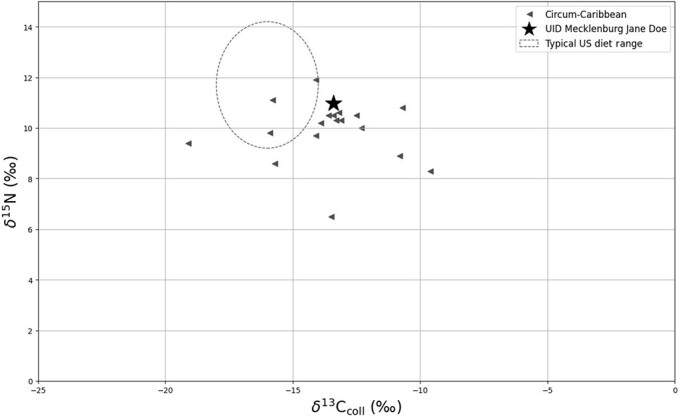
δ13Ccoll values vs. δ15N from bone collagen of Unidentified (UID) Mecklenburg Jane Doe plotted against observed range of the US American diet and known samples within the Mesoamerica and the Circum-Caribbean [51, 52].
Summary
The decedent remains unidentified. The enamel isotopic results suggest the decedent was born in the Circum-Caribbean or Mesoamerican regions and bone apatite signatures suggest that they had recently relocated to North Carolina within the last 5–10 years. The assessment of population affinity using modern techniques (e.g. 3D-ID and rASUDAS) was consistent with isotopic results. This individual is most likely undocumented and will be triaged for IGG.
Identified Mecklenburg John Doe 1987
Case background
A cranium was recovered in Mecklenburg County, North Carolina from a creek bed. Forensic anthropological analysis was conducted at NCSU in January of 2024. Population affinity was estimated to be a male of West African/Nigerian origin using 3D-ID software, with a posterior probability of 0.8364 and a typicality of 0.0422 [2]. The typicality probability is low, meaning that the decedent is not well represented within the reference samples of the software. Bomb pulse dating was applied to confirm the antiquity of the remains and rule out historical origin. The second maxillary premolar was used to estimate the year of birth, which was estimated to be around 1955 and to estimate an age-at-death range of 30–40 years old [52]. No trauma or pathologies were noted on the cranium. A right first maxillary premolar was selected for isotopic analyses (87/86Sr, δ18O, δ13C) in 2022. A maxillary premolar was selected for bomb pulse dating in 2023.
Enamel dual isotopic (87/86Sr, δ18O) signatures for geographic origin
The strontium (87/86Sr) and oxygen (δ18O) data are consistent with geographic origin within North America (Table 1) [37–39]. Using data from Keller et al. [39] of US Cadets, the measured oxygen and strontium values from the enamel cluster on the bivariate graph on the edge of the Southeast region of the USA (Figure 6). These values are consistent with the area where the remains were recovered. When considering population affinity estimation, data from Keller et al. [39] of US cadets, Schroeder et al. [46] for Barbadian-born and African-born individuals, and Laffoon et al. [53] for Circum-Caribbean born individuals, the decedent clusters between the USA and the Caribbean-born group for strontium (0.708905), oxygen (−4.22‰), and carbon (−8.93‰) (Figures 7 and 8). However, other regions of origin within North America cannot be ruled out.
Figure 6.

δ18Ovpdb values vs.87/86Sr of Identified (ID) Mecklenburg John Doe plotted against known samples from regions within the USA [39].
Figure 7.

δ18Ovpdb values vs.87/86Sr of Identified (ID) Mecklenburg John Doe plotted against known samples from regions within the USA, known samples from the Circum-Caribbean and, possibly Barbadian-born and African-born individuals [39, 46, 54].
Figure 8.

δ18Ovpdb values vs. δ13Cvpdb of Identified (ID) Mecklenburg John Doe plotted against known samples from regions within the USA, known samples from the Circum-Caribbean and, possibly Barbadian-born and African-born individuals [39, 46, 54].
Investigative Genetic Geneaology
This individual was identified in May 2024 via IGG. Estimates of year-of-birth and West African origin aided in the direction of the IGG investigation.
Summary
The decedent was positively identified via IGG. The family confirmed the age-at-death when he went missing in 1987, the family’s West African origin, and that he was born in the Charlotte, NC area. Anthropological analyses and isotope results are consistent with the information provided by the family. However, the isotope results were broadly consistent with this finding and could not be used to narrow down a region of origin more specific than North America.
Discussion
The human right to personal identity is internationally recognized through various declarations and conventions (e.g. United Nations Convention on the Rights of the Child, Article 8). According to the FBI’s National Crime Information Center statistics, there were 8 415 records of unidentified persons in 2021. NamUs states that our missing and unidentified are the nation’s silent mass disaster. NamUs lists 158 unidentified persons in the state of North Carolina with over 100 being skeletonized with national estimates of 4 400 unidentified bodies recovered each year [54]. However, this is likely an underestimate as the data in this reference are almost 20 years old [1]. Further complicating identifications, foreign-born and undocumented migrants pose unique challenges as conventional identification tools such as familial DNA reference databases target US citizens [55]. While the ability to solve these cases is multifactorial, information regarding the region of origin using modern tools such as 3D-ID [2] and isotopic analyses [56, 57] is critical to estimating the place of origin. Anthropological analyses draw on modern population affinity techniques such as rASUDAS and 3D-ID. Historical events, gene flow, and migration have shaped similarities and differences observed in modern populations, and population affinity is a statistical approach to examining skeletal variation without the use of racial and typological axioms [58]. When combined with isotopic analyses, such as presented in this multidisciplinary approach, an individual’s place of origin can be more confidently estimated. However, both population affinity and isotopic analyses rely on reference populations and reference data with which to compare individual measurements or values. Continued collection and publication of these data is essential to obtain global coverage.
Applying these methods requires a systematic process to determine which method(s) to apply to each case (Figure 9). Initially, skeletonized remains undergo anthropological analyses, utilizing current methods of estimating the biological profile, trauma, and/or pathologies (i.e. [2, 33–35, 43–45]). In cases where taphonomic or postmortem alteration is minimal, there is a higher likelihood that further analyses (i.e. DNA or isotope analyses) will yield viable results. Bone and tooth samples are selected and sent to State and private laboratories for DNA and isotope analyses. When the circumstances of discovery are not straightforward, radiocarbon bomb-pulse dating can be used to establish antiquity and forensic significance. Ultimately, the application of these methods still may not provide an identification. The last method applied is IGG, which draws on all previous analyses in genealogical research. IGG is very costly, relying on grant and law enforcement funding, and is used as a last resort with cases being prioritized based on the preservation of remains, circumstances of death, and investigative information.
Figure 9.

Decision tree demonstrating the process of applying various methods to current cases of unidentified remains and to cold case re-examination. These analyses are completed under grant and law enforcement funding at the North Carolina State University Human Identification and Forensic Analysis Laboratory.
Conclusion
The cases outlined in this report utilize a collaborative approach to casework, leading to the successful identification of several decedents, including the two outlined above. Where investigations are ongoing, input from anthropological and isotopic analyses can now be considered in further evaluations and methods, such as IGG. This multidisciplinary approach to forensic casework in North Carolina continues to inform investigators in cold case reanalysis and is the first step in addressing the cold caseload within the state.
Supplementary Material
Acknowledgements
We thank Devin Williams (NCSU) for her assistance with anthropological casework. We thank Dr. Jeff Vervoort (WSU-RIGL) and Dr. Dave Evans and Mike Lott (WSU Stable Isotope Core Laboratory) for their assistance with mass spectrometry. We thank Leslie Kaufman for her assistance with genetic genealogical research. We thank North Carolina Medical Examiner Offices and law enforcement for their assistance and continued collaboration.
Contributor Information
Nicole Long, Department of Biological Sciences, North Carolina State University, Raleigh, NC, USA.
Kimberly Sheets, Department of Anthropology, Washington State University, Pullman, WA, USA.
Erin Kennedy Thornton, Department of Anthropology, Washington State University, Pullman, WA, USA.
Ann H Ross, Department of Biological Sciences, North Carolina State University, Raleigh, NC, USA.
Authors' contributions
Nicole Long helped conceive the project, led the design and coordination of the report, assisted with anthropological analyses, and drafted the manuscript; Kimberly Sheets conducted the isotopic lab work and helped draft the isotopic methods section; Erin Kennedy Thornton supervised and assisted with the isotopic analyses and helped to draft the manuscript; Ann H. Ross helped conceive the project, reviewed anthropological casework, participated in the design and coordination of the report, and helped to draft the manuscript. All authors contributed to the final text and approved it.
Compliance with ethical standards
This article does not contain any studies with human participants or animals performed by any of the authors.
Conflict of interest
Ann H. Ross initial holds the position of Editorial Board Member for the Forensic Sciences Research and is blinded from reviewing or making decisions for the manuscript.
Funding
Funding for these cases was provided by the Charlotte-Mecklenburg Police Department and a Bureau of Justice Assistance grant [15PBJA-23-GG-00830-SLFO].
References
- 1. Ross AH, Passalacqua NV. Chapter 8—unidentified decedent investigation protocols. In: Ross AH, Byrd JH, editors. Methodological and technological advances in death investigations. Cambridge (MA): Academic Press; 2024. p. 247–258. [Google Scholar]
- 2. Slice D, Ross A. 3D-ID: geometric morphometric classification of crania for forensic scientists. 2024. Raleigh (NC): Revware; 2024. Available from: https://www.3d-id.org/
- 3. Weiner S, Wagner HD. The material bone: structure-mechanical function relations. Annu Rev Mater Sci. 1998;28:271–298. [Google Scholar]
- 4. Hedges REM, Clement JG, Thomas CD, et al. Collagen turnover in the adult femoral mid-shaft: modeled from anthropogenic radiocarbon tracer measurements. Am J Phys Anthropol. 2007;133:808–816. [DOI] [PubMed] [Google Scholar]
- 5. Hill PA. Bone remodelling. Br J Orthod. 1998;25:101–107. [DOI] [PubMed] [Google Scholar]
- 6. Sealy J, Armstrong R, Schrire C. Beyond lifetime averages: tracing life histories through isotopic analysis of different calcified tissues from archaeological human skeletons. Antiquity. 1995;69:290–300. [Google Scholar]
- 7. Hillson S. Dental anthropology. Cambridge (UK): Cambridge University Press; 2012. [Google Scholar]
- 8. Turner-Walker G. The chemical and microbial degradation of bones and teeth. In: Advances in human palaeopathology. West Sussex England (UK): John Wiley & Sons Ltd; 2007. p.3–29.
- 9. Bentley AR. Strontium isotopes from the earth to the archaeological skeleton: a review. J Archaeol Method Theory. 2006;13:135–187. [Google Scholar]
- 10. Bartelink EJ, Chesson LA. Recent applications of isotope analysis to forensic anthropology. Forensic Sci Res. 2019;4:29–44. [DOI] [PMC free article] [PubMed] [Google Scholar]
- 11. Aggarwal J, Habicht-Mauche J, Juarez C. Application of heavy stable isotopes in forensic isotope geochemistry: a review. Appl Geochem. 2008;23:2658–2666. [Google Scholar]
- 12. Meier-Augenstein W. How it works. In: Stable Isotope Forensics: methods and forensic applications of stable isotope analysts. Chichester (UK: ): Wiley-Blackwell; 2017. p. 1–80. [Google Scholar]
- 13. Sharp Z. Principles of stable isotope geochemistry. Upper Saddle River (NJ): Pearson/Prentice Hall; 2007. [Google Scholar]
- 14. Coplen TB. Guidelines and recommended terms for expression of stable-isotope-ratio and gas-ratio measurement results. Rapid Commun Mass Spectrom. 2011;25:2538–2560. [DOI] [PubMed] [Google Scholar]
- 15. Dansgaard W. The O18-abundance in fresh water. Geochim Cosmochim Acta. 1954;6:241–260. [Google Scholar]
- 16. Dansgaard W. Stable isotopes in precipitation. Tellus. 1964;16:436–468. [Google Scholar]
- 17. Craig H. Isotopic variations in meteoric waters. Science. 1961;133:1702–1703. [DOI] [PubMed] [Google Scholar]
- 18. Chenery CA, Pashley V, Lamb AL, et al. The oxygen isotope relationship between the phosphate and structural carbonate fractions of human bioapatite. Rapid Commun Mass Spectrom. 2012;26:309–319. [DOI] [PubMed] [Google Scholar]
- 19. Iacumin P, Rossi M, Selmo E, et al. Oxygen isotopes in carbonate and phosphate of modern mammal bioapatite: new data and critical revision after about 25 years from the first recognitions. Minerals. 2022;12:1–17. [Google Scholar]
- 20. Pollard AM, Pellegrini M, Lee-Thorp J. Technical note: some observations on the conversion of dental enamel δ18Op values to δ18Ow to determine human mobility. Am J Phys Anthropol. 2011;145:499–504. [DOI] [PubMed] [Google Scholar]
- 21. Craig H. The geochemistry of the stable carbon isotopes. Geochim Cosmochim Acta. 1953;3:53–92. [Google Scholar]
- 22. Cerling TE, Harris JM, MacFadden BJ, et al. Global vegetation change through the Miocene/Pliocene boundary. Nature. 1997;389:153–158. [Google Scholar]
- 23. Merwe NJ. Carbon isotopes, photosynthesis, and archaeology: different pathways of photosynthesis cause characteristic changes in carbon isotope ratios that make possible the study of prehistoric human diets. Am Sci. 1982;70:596–606. [Google Scholar]
- 24. Schwarcz HP, Schoeninger MJ. Stable isotope analyses in human nutritional ecology. Am J Phys Anthropol. 1991;34:283–321. [Google Scholar]
- 25. Schoeninger MJ, Moore K. Bone stable isotope studies in archaeology. J World Prehist. 1992;6:247–296. [Google Scholar]
- 26. Tykot R. Isotope analysis and the histories of maize. In: Staller J, Tykot R, Benz B, editors. Histories of maize in Mesoamerica: multidisciplinary approaches, 1st ed.New York (NY): Routledge; 2016. p. 130–142. [Google Scholar]
- 27. Schoeninger MJ, DeNiro MJ, Tauber H. Stable nitrogen isotope ratios of bone collagen reflect marine and terrestrial components of prehistoric human diet. Science. 1983;220:1381–1383. [DOI] [PubMed] [Google Scholar]
- 28. Ambrose SH, Norr L. Experimental evidence for the relationship of the carbon isotope ratios of whole diet and dietary protein to those of bone collagen and carbonate. In: Lambert JB, Grupe G, editors. Prehistoric human bone: archaeology at the molecular level. Heidelberg (Germany): Springer Berlin, Heidelberg; 1993. [Google Scholar]
- 29. Deniro MJ, Epstein S. Influence of diet on the distribution of nitrogen isotopes in animals. Geochim Cosmochim Acta. 1981;45:341–351. [Google Scholar]
- 30. Post DM. Using stable isotopes to estimate trophic position: models, methods, and assumptions. Ecology. 2002;83:703–718. [Google Scholar]
- 31. Schoeninger MJ, DeNiro MJ. Nitrogen and carbon isotopic composition of bone collagen from marine and terrestrial animals. Geochim Cosmochim Acta. 1984;48:625–639. [Google Scholar]
- 32. Kendall C, Elliott EM, Wankel SD. Tracing anthropogenic inputs of nitrogen to ecosystems. In: Michener R, Lajtha K, editors. Stable isotopes in ecology and environmental science. Oxford (UK): Blackwell Publishing; 2007. p. 375–449. [Google Scholar]
- 33. Hartnett KM. Analysis of age-at-death estimation using data from a new, modern autopsy sample---part II: sternal end of the fourth rib. J Forensic Sci. 2010;55:1152–1156. [DOI] [PubMed] [Google Scholar]
- 34. Hartnett KM. Analysis of age-at-death estimation using data from a new, modern autopsy sample---part I: pubic bone. J Forensic Sci. 2010;55:1145–1151. [DOI] [PubMed] [Google Scholar]
- 35. Jantz RL, Ousley SD. FORDISC 3: computerized forensic discriminant functions, version 3.0. Knoxville (IN): The University of Tennessee; 2005. [Google Scholar]
- 36. Martin L, Rackard F. Images in clinical medicine. Hair-on-end sign. N Engl J Med. 2016;374:e23. [DOI] [PubMed] [Google Scholar]
- 37. Lustig A. Using strontium isotope analysis on modern populations to determine geolocation reliability in a forensic context [master's thesis]. Boston (MA): Boston University; 2013.
- 38. Regan L. Isotopic determination of region of origin in modern peoples: applications for identification of U.S. war-dead from the Vietnam Conflict [dissertation]. Gainesville (FL): University of Florida; 2006. [Google Scholar]
- 39. Keller AT, Regan LA, Lundstrom CC, et al. Evaluation of the efficacy of spatiotemporal Pb isoscapes for provenancing of human remains. Forensic Sci Int. 2016;261:83–92. [DOI] [PubMed] [Google Scholar]
- 40. Bataille CP, Crowley BE, Wooller MJ, et al. Advances in global bioavailable strontium isoscapes. Palaeogeogr, Palaeoclimatol, Palaeoecol. 2020;555:109849. [Google Scholar]
- 41. Chesson LA, Tipple BJ, Mackey GN, et al. Strontium isotopes in tap water from the coterminous USA. Ecosphere. 2012;3:1–17. [Google Scholar]
- 42. Bartelink E, Berg G, Beasley M, et al. Application of stable isotope forensics for predicting region of origin of human remains from past wars and conflicts. Ann Anthrop Pract. 2014;38:124–136. [Google Scholar]
- 43. Scott GR, Pilloud MA, Navega D, et al. rASUDAS: a new web-based application for estimating ancestry from tooth. Morphology. 2018;1:18–31. [Google Scholar]
- 44. González-Colmenares G, Botella-López MC, Moreno-Rueda G, et al. Age estimation by a dental method: a comparison of Lamendin's and Prince & Ubelaker's technique. J Forensic Sci. 2007;52:1156–1160. [DOI] [PubMed] [Google Scholar]
- 45. Lamendin H, Baccino E, Humbert JF, et al. A simple technique for age estimation in adult corpses: the two criteria dental method. J Forensic Sci. 1992;37:1373–1379. [PubMed] [Google Scholar]
- 46. Laffoon JE, Valcarcel Rojas R, Hofman CL. Oxygen and carbon isotope analysis of human dental enamel from the Caribbean: implications for investigating individual origins. Archaeometry. 2013;55:742–765. [Google Scholar]
- 47. Juarez C. Geolocation: a pathway to identification for deceased undocumented border crossers. Santa Cruz (CA): University of California; Santa Cruz. p. 2011. [Google Scholar]
- 48. Wright LE. Identifying immigrants to Tikal, Guatemala: defining local variability in strontium isotope ratios of human tooth enamel. J Archoarol Sci 2005;32:555–566. [Google Scholar]
- 49. Cox G, Sealy J. Investigating identity and life histories: isotopic analysis and historical documentation of slave skeletons found on the Cape Town Foreshore, South Africa. Int J Hist Archaeol 1997;1:207–224. [Google Scholar]
- 50. Bartelink EJ, Berg GE, Chesson LA, et al. Chapter 15—applications of stable isotope forensics for geolocating unidentified human remains from past conflict situations and large-scale humanitarian efforts. In: Latham KE, Bartelink EJ, Finnegan M, editors. New perspectives in forensic human skeletal identification. Cambridge (MA): Academic Press; 2018. p. 175–184. [Google Scholar]
- 51. Keegan WF, DeNiro MJ. Stable carbon- and nitrogen-isotope ratios of bone collagen used to study coral-reef and terrestrial components of prehistoric Bahamian diet. Am Antiguity. 1988;53:320–336. [Google Scholar]
- 52. Johnstone-Belford EC, Blau S. A review of bomb pulse dating and its use in the investigation of unidentified human remains. J Forensic Sci. 2020;65:676–685. [DOI] [PubMed] [Google Scholar]
- 53. Schroeder H, O'Connell TC, Evans JA, et al. Trans-Atlantic slavery: isotopic evidence for forced migration to Barbados. Am J Phys Anthropol. 2009;139:547–557. [DOI] [PubMed] [Google Scholar]
- 54. Hickman MJ, Hughes KA, Strom KJ, et al. Medical Examiners and Coroners' Offices, 2004. Washington, DC: US Department of Justice; 2007. Report No.:NCJ 216756.
- 55. Ross AH, Juarez CA, Urbanová P. Chapter 14—complexity of assessing migrant death place of origin. In: Pilloud MA, Hefner JT, editors. Biological distance analysis. San Diego (CA): Academic Press; 2016. p. 265–283. [Google Scholar]
- 56. Kramer RT, Bartelink EJ, Herrmann NP, et al. Application of stable isotopes and geostatistics to infer region of geographical origin for deceased undocumented Latin American migrants. In: Parra RC, Zapico SC, Ubelaker DH, editors. Forensic science and humanitarian action. Hoboken (NJ): John Wiley & Sons Ltd.; 2020. p. 425–440.
- 57. Kimmerle EH, Falsetti A, Ross AH. Immigrants, undocumented workers, runaways, transients and the homeless: towards contextual identification among unidentified decedents. Forensic Science Policy & Management: An International Journal. 2010;1:178–186. [Google Scholar]
- 58. Ross AH, Pilloud M. The need to incorporate human variation and evolutionary theory in forensic anthropology: a call for reform. Am J Phys Anthropol. 2021;176:672–683. [DOI] [PubMed] [Google Scholar]
Associated Data
This section collects any data citations, data availability statements, or supplementary materials included in this article.