



Abstract
Background
Medical texts present significant domain-specific challenges, and manually curating these texts is a time-consuming and labor-intensive process. To address this, natural language processing (NLP) algorithms have been developed to automate text processing. In the biomedical field, various toolkits for text processing exist, which have greatly improved the efficiency of handling unstructured text. However, these existing toolkits tend to emphasize different perspectives, and none of them offer generation capabilities, leaving a significant gap in the current offerings.
Objective
This study aims to describe the development and preliminary evaluation of Ascle. Ascle is tailored for biomedical researchers and clinical staff with an easy-to-use, all-in-one solution that requires minimal programming expertise. For the first time, Ascle provides 4 advanced and challenging generative functions: question-answering, text summarization, text simplification, and machine translation. In addition, Ascle integrates 12 essential NLP functions, along with query and search capabilities for clinical databases.
Methods
We fine-tuned 32 domain-specific language models and evaluated them thoroughly on 27 established benchmarks. In addition, for the question-answering task, we developed a retrieval-augmented generation (RAG) framework for large language models that incorporated a medical knowledge graph with ranking techniques to enhance the reliability of generated answers. Additionally, we conducted a physician validation to assess the quality of generated content beyond automated metrics.
Results
The fine-tuned models and RAG framework consistently enhanced text generation tasks. For example, the fine-tuned models improved the machine translation task by 20.27 in terms of BLEU score. In the question-answering task, the RAG framework raised the ROUGE-L score by 18% over the vanilla models. Physician validation of generated answers showed high scores for readability (4.95/5) and relevancy (4.43/5), with a lower score for accuracy (3.90/5) and completeness (3.31/5).
Conclusions
This study introduces the development and evaluation of Ascle, a user-friendly NLP toolkit designed for medical text generation. All code is publicly available through the Ascle GitHub repository. All fine-tuned language models can be accessed through Hugging Face.
Keywords: natural language processing, machine learning, deep learning, generative artificial intelligence, large language models, retrieval-augmented generation, healthcare
Introduction
Medical texts pose considerable challenges due to their domain-specific nature, including issues such as ambiguities, frequent abbreviations, and specialized terminology [1,2]. The manual curation of these texts is both time-consuming and labor-intensive [2]. Therefore, natural language processing (NLP) algorithms have been developed to automate text processing [2-4]. Recent years have seen a notable shift toward the use of domain-specific pretrained language models, transitioning from shallow embeddings such as BioWordVec [5] and BioSentVec [6] to advanced architectures like Bidirectional Encoder Representations from Transformers (BERT) [7], such as BioBERT [8], ClinicalBERT [9], and PubMedBERT [10]. Furthermore, large language models (LLMs), such as Med-PaLM [11] and Med-Gemini [12], have demonstrated powerful generative capabilities, possessing exceptional zero- and few-shot performance. These domain-specific language models have substantially enhanced the effectiveness of NLP tasks in the biomedical and clinical domains [13-15].
Despite the success of these advanced methods, their complexity remains a significant barrier to practical application for health care professionals lacking basic programming skills. Consequently, there is an increasing demand for user-friendly and accessible toolkits designed to simplify medical text processing. Multiple toolkits for text processing are available in the biomedical domain. Table 1 summarizes representative tools. While there are many other useful tools, here we mainly limit our comparison with Python-based open-source toolkits.
Table 1.
A comparison of Ascle with existing Python-based toolkits.
| Toolkits | Question- Answeringa |
Text Summarization |
Text Simplification |
Machine Translation |
Basic NLPb Functions | Query Search |
| MIMIC-Extract [16] | —c | — | — | — | — | ✓ |
| ScispaCy [17] | — | — | — | — | ✓ | — |
| MedspaCy [18] | — | — | — | — | ✓ | — |
| Transformers-sklearn [19] | — | — | — | — | ✓ | — |
| Stanza Biomed [20] | — | — | — | — | ✓ | — |
| Ascle (this study) | ✓ | ✓ | ✓ | ✓ | ✓ | ✓ |
aFor the question-answering task, we specifically propose a retrieval-augmented generation framework for large language models that incorporates a medical knowledge graph with ranking techniques.
bNLP: natural language processing. Basic natural language processing functions include abbreviation extraction, sentence tokenization, word tokenization, negation detection, hyponym detection, Unified Medical Language System concept extraction, named entity recognition, document clustering, part-of-speech tagging, entity linking, text summarization (extractive methods), and multiple-choice question-answering. It is worth noting that not every toolkit includes these 12 basic natural language processing functions, but Ascle includes them all.
cNot applicable.
These existing toolkits tend to emphasize different perspectives, and none of them offer generation capabilities, leaving a significant gap in the current offerings. In response, we present Ascle, a pioneering NLP toolkit for medical text generation, which, for the first time, includes 4 advanced generative functions. We fine-tuned 32 domain-specific language models and evaluated them thoroughly on 27 established benchmarks. In addition, for the question-answering task, we developed a retrieval-augmented generation (RAG) framework [21] that combines a medical knowledge graph (The Unified Medical Language System [UMLS]) [22] with ranking techniques, aimed at improving the reliability of long-form answers [15]. We uploaded all fine-tuned language models to Hugging Face and listed 32 fine-tuned language models along with 27 benchmarks in Multimedia Appendix 1 for a clearer explanation.
In conclusion, Ascle empowers a diverse spectrum of users, from novices to experienced professionals, enabling them to effortlessly address their NLP tasks, even with limited technical expertise in handling textual data. We believe that Ascle not only democratizes access to cutting-edge methods but also expedites their integration into health care.
Methods
The Overall Architecture of Ascle
Ascle consists of 3 modules, with the core module being the “generative functions,” including 4 challenging generation tasks: question-answering, text summarization, text simplification, and machine translation, covering a variety of application scenarios in health care. In addition, Ascle integrates 12 basic NLP functions, as well as query and search capabilities for clinical databases. The overall architecture of Ascle is shown in Figure 1. This section will focus on introducing the core module of Ascle—Generative Functions. For more information on basic NLP functions and query and search functions within Ascle, please refer to Multimedia Appendix 2 and Multimedia Appendix 3, respectively.
Figure 1.

The overall architecture of Ascle.  indicates that we have our fine-tuned language models for this task.
  indicates that we conducted evaluations for this task. POS: Parts-Of-Speech; QA: Question-Answering; UMLS: Unified Medical Language System.
Generative Functions
Ascle offers a range of generative functions through pretrained and fine-tuned language models, all of which are publicly available for user access. In the following sections, we will introduce these powerful generative functions separately.
Question-Answering
Question-answering is particularly crucial in health care [13]. When integrated into health care systems, it assumes roles, such as preconsultation and remote consultation, effectively coping with the exponential increase in patient load. Furthermore, specialized question-answering systems hold the potential to contribute to medical education [13,21].
In Ascle, we first provide an interface for medical LLMs, such as Baize-healthcare [23], allowing users to use them directly. In addition, we develop a RAG framework that uses UMLS with ranking techniques to enhance LLMs in generating long-form answers [21]. Specifically, when receiving a query, the RAG framework first extracts medical entities within the query automatically and then retrieves related triplets from UMLS for each extracted entity. A triplet consists of 2 medical concepts and the relation between them, that is, (Myopia, clinically_associated_with, HYPERGLYCEMIA). Subsequently, the RAG framework uses ranking and reranking techniques to refine the ordering of these triples. Finally, the query and the retrieved triplets would be prompted to LLM for inference. For more details about the RAG framework, please refer to Multimedia Appendix 4. We apply this framework to the GPT (OpenAI) [24] and LLaMA (Meta) [25] series of LLMs.
We conducted evaluations on 4 medical QA data sets, including LiveQA [26], ExpertQA (Med & Bio) [27], and MedicationQA [28]. LiveQA consists of health questions submitted by consumers to the National Library of Medicine. It includes a training set with 634 QA pairs and a test set comprising 104 QA pairs, and the test set was used for evaluation. ExpertQA is a high-quality long-form QA data set covering multiple fields, along with answers verified by domain experts. Among them, we used 504 medical questions (Med) and 96 biology (Bio) questions for evaluation. MedicationQA includes 690 drug-related consumer questions along with information retrieved from reliable websites and scientific papers.
Additionally, considering that automated metrics cannot effectively assess the quality of generated content, especially in terms of factuality, we performed a physician validation. A total of 50 question-answer pairs from LiveQA were randomly selected, with answers generated by Baize-healthcare. Subsequently, 2 health care professionals (1 resident and 1 attending specialist) rated these generated answers on the criteria of readability, relevancy, accuracy, and completeness, using a 5-point Likert scale.
Text Summarization
In health care, clinicians and researchers are confronted with an increasing amount of information, including literature, clinical notes, and more [29,30]. Text summarization is an important generation task, aiming to distill essential information from the overwhelming complexity of texts and compress it into a more concise format [31]. Through automatic text summarization, clinicians and researchers can efficiently acquire information, thereby avoiding information overload.
We provide an abstractive text summarization function and compare general pretrained summarization models, including Pegasus [32], BigBird [33], Bidirectional and Auto-Regressive Transformer (BART) [34], PRIMERA [35], as well as domain-specific models, such as SciFive [36] and BioBART [37], which make use of biomedical corpora. Furthermore, we chose PubMed [38], MIMIC Chest X-Ray (MIMIC-CXR [39]), and MEDIQA-AnS [40] data sets for evaluation. The PubMed data set consists of biomedical scientific publications from the PubMed database, where each input document is a scientific article with its abstract serving as the ground truth. We reported the evaluation results for the test set, which contains 1660 examples. MIMIC-CXR is a deidentified data set of chest radiographs with free-text radiology reports, and we used a subset of MIMIC-CXR that includes 2000 instances for evaluation. MEDIQA-AnS is a collection of 156 consumer health questions along with passages that contain relevant information. It supports both single-document and multiple-document summarization evaluation.
Text Simplification
Biomedical texts are typically laden with intricate terminologies, which can hinder the understanding of individuals without a clinical background [41]. In Ascle, the function of text simplification is to translate complex and technical biomedical texts into understandable content. This will enhance the comprehension and involvement of nonclinical individuals, including patients, enabling them to better engage with the information and participate in clinical decisions more effectively.
We finetuned and evaluated widely used pretrained language models on 3 data sets: eLife, PLOS [42], and MedLane [43]. This included 2 general models, BigBirdPegasus [32] and BART, as well as a biomedical-specific model, BioBART. The eLife and PLOS are shared task data released from the BioLaySumm 2023 Task 1, which contains biomedical journal articles with expert-written lay summaries. We evaluated the validation sets for eLife and PLOS, which contain 241 and 1376 examples, respectively. MedLane is a large-scale human-annotated data set containing professional-to-customer sentences selected from Medical Information Mart for Intensive Care III (MIMIC-III). For MedLane, we used the test set for evaluation, which includes 1016 instances.
Machine Translation
Language barriers pose difficulties for patients to access timely information and communicate effectively with health care providers, resulting in low-quality health care services [44]. Our machine translation function aims to translate the text from a source language into a target language in a clinical scenario. By fine-tuning pretrained language models on the medical corpus, Ascle supports machine translation from English (en) to 8 target languages: Spanish (es), French (fr), Romanian (ro), Czech (cs), German (de), Hungarian (hu), Polish (pl), and Swedish (sv). Here, we only emphasize the 8 languages fine-tuned on medical data, while other languages, such as English to Chinese, are supported by the pretrained language models.
We fine-tuned the existing MarianMT [45] and multilingual T5 [46] using UFAL Medical Corpus [47] which includes various medical text sources, such as titles of medical Wikipedia articles, medical term pairs, patents, and documents from the European Medicines Agency. During the preprocessing phase, we excluded general domain data from UFAL, such as parliamentary proceedings, and randomly shuffled the medical domain corpora, splitting them into 2 parts at a ratio of 85% and 15% for training and testing, respectively. We reported the results on the test set, the size of which varies from 111,779 to 407,388 depending on the different language pairs. Furthermore, for each language pair, we used all available parallel data to maximize the breadth and accuracy of our machine translation function.
Ethical Considerations
This study used publicly available data sets and a restricted, deidentified data set. Access to the restricted data set was granted after the required training and certification, ensuring compliance with the data use agreement. No additional ethical review or informed consent was necessary, as human subjects or identifiable data were not directly involved. Two health care professionals voluntarily participated in the physician validation process without compensation. Data privacy and confidentiality were strictly maintained throughout the research, ensuring the protection of individual privacy while contributing to the advancement of the NLP toolkit for medical text generation.
Results
Overall Performance of Generation Tasks
In the question-answering task, we used ROUGE-L [48], BERTScore [49], MoverScore [50], and BLEURT [51] for a comprehensive evaluation, and used GPT-4 and LLaMA2-13b as the vanilla LLMs. As shown in Table 2, our RAG framework surpasses the zero-shot setting on all evaluation metrics for the LiveQA, ExpertQA-Bio, ExpertQA-Med, and MedicationQA data sets. Among them, the ROUGE-L score has increased by more than 18% on the ExpertQA-Bio data set.
Table 2.
For the evaluation of the question-answering task, we compared ROUGE-L, BERTScore, MoverScore, and BLEURT on the zero-shot and retrieval-augmented generation framework.
|
|
LLaMa2-13b | GPT-4 | |||||||||
|
|
ROUGE-L | BERTScore | MoverScore | BLEURT | ROUGE -L | BERTScore | MoverScore | BLEURT | |||
| LiveQAa | |||||||||||
|
|
Z.Sb | 17.73 | 81.93 | 53.37 | 40.45 | 18.89 | 82.50 | 54.02 | 39.84 | ||
|
|
RAGc | 18.83d | 82.79d | 53.79d | 40.59d | 19.44d | 83.01d | 54.11d | 40.55d | ||
| ExpertQAa-Bio | |||||||||||
|
|
Z.S | 23.26 | 84.38 | 55.58 | 44.65 | 23.00 | 84.50 | 56.15 | 44.53 | ||
|
|
RAG | 25.79d | 85.18d | 56.17d | 45.20d | 27.20d | 85.83d | 57.11d | 45.91d | ||
| ExpertQAa-Med | |||||||||||
|
|
Z.S | 24.86 | 84.89 | 55.74 | 46.32 | 25.45 | 85.11 | 56.50 | 45.98 | ||
|
|
RAG | 27.49d | 85.80d | 56.58d | 46.47d | 28.08d | 86.30d | 57.32d | 47.00d | ||
| MedicationQAa | |||||||||||
|
|
Z.S | 13.30 | 81.81 | 51.96 | 38.30 | 14.41 | 82.55 | 52.62 | 37.41 | ||
|
|
RAG | 14.71d | 82.79d | 52.59d | 38.42d | 16.19d | 83.59d | 53.30d | 37.91d | ||
aQA: question-answering.
bZ.S: zero-shot.
cRAG: retrieval-augmented generation framework.
dThe superior score within the same data set.
For the text summarization task, we evaluated 5 pretrained language models on single-document summarization, as shown in Table 3. To ensure a fair comparison, we excluded the results of BioBART and SciFive on PubMed, as they were fine-tuned on this data set. It is worth noting that BART consistently demonstrated strong performance across 3 benchmarks, while BioBART only outperformed BART in 1 of the benchmarks. In addition, we evaluated the multidocument summarization task and discussed the differences between abstractive and extractive methods, as well as the limitations of evaluation metrics, which can be found in the Discussion section.
Table 3.
For the evaluation of the single-document summarization task, we compared ROUGE-1, ROUGE-2, ROUGE-L, and some results are derived from other papers [52].
|
|
PubMed | MIMIC-CXRa | MEDIQA-AnS (p) | MEDIQA-AnS (s) | |||||||||||
|
|
R-1 | R-2 | R-L | R-1 | R-2 | R-L | R-1 | R-2 | R-L | R-1 | R-2 | R-L | |||
| Pegasus | 45.97 | 20.15 | 28.25 | 22.49 | 11.57 | 20.35 | 18.29 | 4.82 | 13.87 | 22.21 | 8.23 | 16.76 | |||
| BigBird | 46.32 | 20.65 | 42.33b | 38.99 | 29.52 | 38.59 | 13.18 | 2.14 | 10.04 | 14.89 | 3.13 | 11.15 | |||
| BART | 48.35b | 21.43b | 36.90 | 41.70b | 32.93b | 41.16b | 24.02b | 7.20 | 17.09b | 38.19 | 22.20 | 30.58 | |||
| SciFive | —c | — | — | 35.41 | 26.48 | 35.07 | 13.08 | 2.15 | 10.10 | 16.88 | 6.47 | 14.42 | |||
| BioBART | — | — | — | 41.61 | 32.90 | 41.00 | 22.58 | 7.49b | 16.69 | 39.40b | 24.64b | 32.07b | |||
aMIMIC-CXR: MIMIC Chest X-Ray database.
bThe superior score within the same data set.
cNot applicable.
Regarding the text simplification task, we compared the performance of fine-tuned models and conducted an analysis of readability using the Flesch-Kincaid Grade Level (FKGL) score [53], as indicated in Table 4. For the eLife and PLOS data sets, the ground truth exhibits FKGL scores of 12 and 15, respectively. Interestingly, the BioBART model performs competitively in terms of ROUGE metrics, but fails to significantly reduce the difficulty of understanding, as evidenced by its FKGL score of 17 in both data sets. On the other hand, the BART model manages to slightly lower the FKGL score to 14 and 16 for eLife and PLOS, respectively. However, in the case of the MedLane data set, all methods appear to reach a similar level of complexity as the ground truth. This can be attributed to the data set’s shorter examples and potentially smaller vocabulary size, which limits the observed differences.
Table 4.
For evaluation of the text simplification task, we compared ROUGE-1, ROUGE-2, ROUGE-L, and Flesch-Kincaid Grade Level score.
|
|
eLife | PLOS | MedLane | |||||||||||
|
|
R-1a | R-2b | R-Lc | FKGLd | R-1 | R-2 | R-L | FKGL | R-1 | R-2 | R-L | FKGL | ||
| Ground Truth | —e | — | — | 12 | — | — | — | 15 | — | — | — | 13 | ||
| BigBirdPegasus | 14.00 | 3.42 | 9.16 | 13f | 18.92 | 4.79 | 12.54 | 17 | 74.96 | 65.37 | 74.56 | 13f | ||
| BART | 16.16f | 4.31f | 10.19f | 14 | 21.09 | 7.20 | 14.17 | 16f | 83.25f | 74.50f | 82.99f | 13f | ||
| BioBART | 14.31 | 3.70 | 9.36 | 17 | 23.80f | 7.83f | 15.65f | 17 | 82.89 | 74.26 | 82.65 | 13f | ||
aR-1: ROUGE-1.
bR-2: ROUGE-2.
cR-L: ROUGE-L.
dFKGL: Flesch-Kincaid Grade Level.
eNot applicable.
fThe superior score within the same data set.
In the machine translation task, we fine-tuned the models across 8 languages, as illustrated in Table 5. After fine-tuning, the BLEU scores significantly improved, with the most substantial improvement observed in the “en-fr” language pair, increasing by over 61%. This enhancement can be attributed to the larger amount of training data available for “en-fr” (2,812,305 samples).
Table 5.
For the evaluation of the machine translation task, we evaluated the BLEU score on 8 language pairs.
|
|
BLEU score | |||||||
|
|
en-esa | en-frb | en-roc | en-csd | en-dee | en-huf | en-plg | en-svh |
| MarianMT | 38.02 | 33.02 | 40.45 | —i | — | — | — | — |
| F.T-MarianMT | 41.64 | 43.72 | 43.88 | — | — | — | — | — |
| F.T-mT5 | 45.88j | 53.29j | 47.28j | 43.30 | 50.73 | 32.25 | 40.24 | 44.17 |
aen-es: English-Spanish.
ben-fr: English-French.
cen-ro: English-Romanian.
den-cs: English-Czech.
een-de: English-German.
fen-hu: English-Hungarian.
gen-pl: English-Polish.
hen-sv: English-Swedish.
iNot applicable.
jThe superior score within the same data set.
Physician Validation
The results verified by the physicians are shown in Figure 2A. Detailed evaluation criteria can be found in Multimedia Appendix 5. The generated answers have good readability and relatively good relevancy, with scores of 4.95 and 4.43, respectively. In contrast, the completeness score is relatively lower (3.31). Figure 2B shows 2 cases. In the first case, compared with the ground truth, the generated answer does not point out that Zolmitriptan is used for treating acute migraines, nor does it indicate that it cannot be used to prevent migraine attacks or to reduce the frequency of headaches. In the second case, the generated answer does not mention that a gluten-free diet is the main treatment for celiac disease. We provide 2 additional cases in Multimedia Appendix 6.
Figure 2.
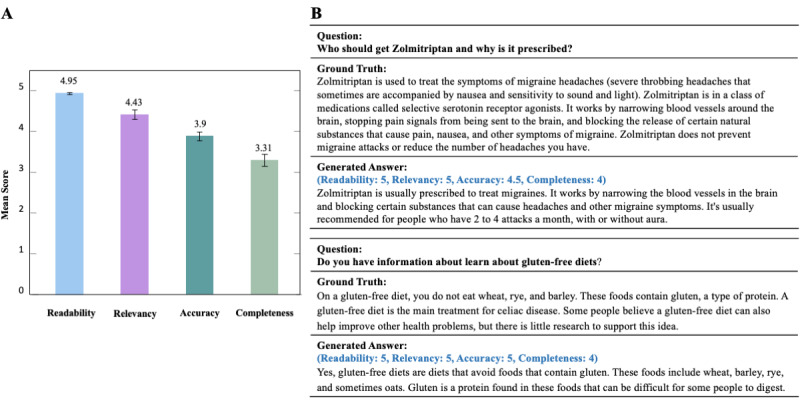
(A) Physician validation (readability, relevancy, accuracy, and completeness) for 50 question-answer pairs. (B) Two examples of generated answers with ground truth.
In addition, we calculated the interevaluator agreement using percentage agreement for each criterion. A total of 2 health care professionals demonstrated a high level of consistency across all criteria, with the percentage agreement consistently exceeding 0.65.
Discussion
In-Depth Analysis of the Text Summarization Task
In the multidocument summarization task, we included models based on traditional methods, such as TextRank [54], as well as pretrained language models, such as BART, Pegasus, PRIMERA, and BioBART. We evaluated their performance using ROUGE scores on the MEDIQA-AnS data set, which consists of 156 examples, and the results are shown in Table 6. However, it is noteworthy that although TextRank outperforms almost all generative models in ROUGE scores, this does not necessarily indicate superior performance. As ROUGE scores are calculated based on the overlap between the generated content and reference summaries, and TextRank is an extractive summarization model, it tends to score higher by this measure.
Table 6.
Evaluation for the multidocument summarization task.
|
|
MEDIQA-AnS (p) | MEDIQA-AnS (s) | |||||
|
|
ROUGE-1 | ROUGE-2 | ROUGE-L | ROUGE-1 | ROUGE-2 | ROUGE-L | |
| TextRanka | 29.88 | 10.23 | 17.01 | 43.77 | 26.80 | 30.52 | |
| BART | 24.56b | 7.56b | 17.18b | 32.32b | 15.42 | 24.03b | |
| Pegasus | 17.44 | 5.36 | 13.44 | 19.54 | 7.46 | 14.93 | |
| PRIMERA | 16.66 | 4.89 | 12.68 | 21.78 | 9.77 | 16.85 | |
| BioBART | 23.16 | 7.47 | 16.47 | 30.87 | 15.91b | 23.66 | |
aTextRank is only used as a reference for extractive summarization, so its scores are not compared with those of generative models.
bThe superior score within the same data set.
While generative models possess semantic comprehension abilities, enabling them to distill complex information into an easy-to-understand format. As shown in Textbox 1, the summarizations generated by BART display well-structured patient information, with a brief description of events and corresponding conditions of the current patient (highlighted in blue), exhibiting high readability. In contrast, the summarizations produced by TextRank are less readable and include noise (highlighted in orange); the generated content is often a literal collage of text fragments. Despite TextRank achieving higher ROUGE scores, it lacks the ability to discern information and integrate it into coherent and readable content, showing significant limitations for practical use.
Two MIMIC-III (parts) examples of the text summarization task, generated by BART and TextRank, respectively (we eliminated sensitive information).
BART
The patient is an XXX-year-old man with a history of a question of coronary artery disease, borderline diabetes mellitus. He was in his usual state of health until 11 p.m. last night when he experienced chest pain with radiation to his back, positive shortness of breath, positive diaphoresis, no vomiting, no lightheadedness. The patient had had a similar episode of chest pain and was taken to an XXX. He had successful angioplasty and stent of LAD and CX. He is a middle aged XXX man in no acute hypertensive distress. He has had anginal chest pain, which is similar to his presenting complaint, but without radiations to his Back. His blood pressure was 105/73, pulse 84, respiratory 21, O2 saturation 92% on 2 liters. His CPK was 594, The index was 7.7, and he was admitted to the hospital with a high blood pressure. His condition was described as “stable” and “normal” by the doctor. The doctor referred the patient to a cardiologist for further treatment. The cardiologist said the patient was in good condition and should be discharged in a few days.
-
Patient has CABG complicated by postop bleed and pleural effusion with discharge to [**Hospital1 **] Rehabilitation presents with abdominal pain. Zosyn was given in the ED. Patient was otherwise doing well and was to go back to rehab to finish his course of Cipro and Flagyl on [**5-17**]. Patient was last seen normal sometime last evening. He woke up and noticed that the left side of his body felt “numb”. He was not aware of any other
neurological weakness, and mostly complained of being very tired. He denied any new vision problems, did not have a headache. He sounded somewhat slurred but did not feel as if his speech was changed significantly. He felt sleepy but able to sustain attention, currently apparently in no distress. He was on standing. Plavix and [**State **] which had been held for the last few days (at least since the 14), since he had the percutaneous drainage. He did not. feel that the weakness had progress and reported that he felt the sense of numbness was starting to improve and had some difficulty squeezing an examiners hand. He is a retired postal worker. He lives with wife and son who is a chiropractor.
TextRank
Admission Date: XXX Discharge Date: XXX Date of Birth: Sex: M Service: CCU-6HISTORY OF PRESENT ILLNESS: The patient is a XXX-year-old man with a history of a question of coronary artery disease, status post myocardial infarction in [**December 2175**], hypertension, borderline diabetes mellitus who was in his usual state of health until 11 p.m. last night when, while [**4-12**] midsternal pressure like chest pain with radiation to back, positive shortness of breath, positive diaphoresis, positive nausea, no vomiting, no lightheadedness. Mucous membranes moist. Oropharynx clear. NECK: No jugular venous distention, no carotid bruits. CARDIOVASCULAR: Regular rate, S1, S2, artificial S1 gallop and balloon pump, no murmurs or rubs. LUNGS: Bibasilar rales, left greater than right. ABDOMEN: Normoactive bowel sounds, nontender, nondistended. EXTREMITIES: No cyanosis, clubbing or edema. NEUROLOGIC: Alert and oriented x3.LABS AT OUTSIDE HOSPITAL: CPK was 304, troponin 1.75.Electrocardiogram at 1:23 a.m. was normal sinus rhythm at101, normal axis deviation, 2 to [**Street Address(2) 1755**] elevation V1 to V5,Q V3, AVF.LABS AT [**Hospital6 **] AT 8 A.M.: CBC- white blood cells 11.2, hemoglobin 13.0, hematocrit 36.7,platelets 232. CARDIOVASCULAR: Coronary artery disease: Three vessel disease with successful intervention on LAD and left circumflex, but RCA not done secondary to good collateral. The patient was continued on aspirin 325 qd.
Of note he was on standing Plavix and [**State **] which had been held for the last few days (atleast since the 14), since he had the percutaneous drainage. The patient was otherwise doing well and was to go back to rehab to finish his course of Cipro and Flagyl on [**5-17**].Past Medical History: coronary artery disease s/p right coronary artery stent x2([**10-3**], [**3-4**]), hypertension, hyperlipidemia, chronic obstructive pulmonary disease, asbestos exposure, chronic back pain, insomnia and obstructive sleep apnea (untreated)PSH:[**2144-4-21**]Endoscopic, minimally invasive, off pump coronary artery bypass graft x1 with left internal mammary artery to left anterior descending artery.[**2144-4-21**]Re-exploration for bleeding, post coronary artery bypass grafting. Social History: Lives with wife. Exposure to asbestos. Defers all medical decisions to son who is a chiropractor. Occupation: retired postal worker. Tobacco: 3 PPD x 30 years, quit 45 years ago ETOH: None Family History: Non-contributory to cholecystitis. Physical Exam: Physical Exam: Vitals: T: 97.9 P:75 R: 16 BP:128/73 SaO2:96 General: Awake, felt sleepy but able to sustain attention, poor historian currently.
System Usage
Ascle provides an easy-to-use approach for biomedical researchers and clinical staff. Users can efficiently use it by merely inputting text and calling the required functions. Figure 3 illustrates 2 use cases.
Figure 3.

Demonstration of system usage. We show two use cases: Text Simplification and Machine Translation.
Estimated Inference Time and Computational Resources
As shown in Table 7, we list the estimated inference time and computational resources required for the 4 generative tasks in Ascle. It is worth noting that the inference time is specific to our experimental settings, and the actual inference time for users may vary depending on the length of the input text and the computational resources used. For the question-answering task, GPT’s response time is faster compared with LLaMA2-13b. However, it is important to mention that LLaMA2-13b was not deployed with quantization, and with quantization, the required inference time and computational resource requirements would be reduced.
Table 7.
Estimated inference time and computational resources required for the generative tasks in Ascle.
| Tasks | Estimated inference time | Computational resource |
| Question Answering |
|
|
| Text Summarization | <2 s/item | 1 * NVIDIA V100 GPU |
| Text Simplification | <2 s/item | 1 * NVIDIA V100 GPU |
| Machine translation | <2 s/item | 1 * NVIDIA V100 GPU |
as/item: seconds per item.
bAPI: application programming interface.
Clinicians’ Use of Ascle
To evaluate the ease of usability of Ascle for clinicians, we report the time required for 2 clinicians with different backgrounds to use the package after receiving guidance. The backgrounds of the clinicians are as follows: (1) physician 1: Singapore General Hospital, senior resident, 7 years of working experience, has a basic level of programming knowledge, and is able to perform basic statistical analyses; and (2) physician 2: SengKang General Hospital, senior consultant, 15 years of working experience, and has no programming knowledge.
Both clinicians received guidance on using Ascle, including setting up a virtual environment and accessing models from Hugging Face. The entire guidance process took about 10 minutes, after which both clinicians could independently and easily use Ascle and experiment with various generative functions without any issues. The main difficulty for the clinicians was setting up the virtual environment, as they lacked AI-specific knowledge. In response, Ascle provided a very simple virtual environment setup guideline. The clinicians’ experience further confirms the user-friendliness of Ascle.
Limitations
In the case of generation tasks, we primarily chose automatic metrics for evaluation, such as ROUGE and BLEU scores. However, these metrics cannot effectively assess factual correctness [55] and may not align with human preference [56]. While human evaluation serves as an invaluable aspect in assessing the performance of the model, its incorporation may pose certain challenges due to various factors, including budget constraints.
Future Work
Recent LLMs have shown great potential in generative applications especially its superior zero- and few-shot performance [13,57,58]. Despite this, the generated content can be unfaithful, inconsistent, and biased [21,55,59,60]. We plan to thoroughly evaluate LLMs and extend to Ascle in the future. Meanwhile, we will strengthen the ethical review of these generative AI techniques to ensure their application truly and responsibly benefits biomedical researchers and health care professionals [61,62].
Conclusions
We introduce Ascle, a comprehensive NLP toolkit designed specifically for medical text generation. For the first time, it integrates 4 challenging generative functions, including question-answering, text summarization, text simplification, and machine translation. Our research fills the gap of existing toolkits for generative tasks, which holds significant implications for the entire medical domain. Ascle boasts remarkable flexibility, allowing users to access a variety of cutting-edge pretrained language models. Meanwhile, it stands as a user-friendly toolkit, ensuring ease of use even for clinical staff without a technical background. We will continue to maintain and extend Ascle.
Acknowledgments
TK and EC were supported by the National Institutes of Health (NIH) Intramural Research Program (IRP), National Eye Institute. ZL and QC were supported by the NIH IRP, National Library of Medicine. QC was also supported by the National Library of Medicine of the NIH (award 1K99LM014024). IL was supported by the Japan Society for the Promotion of Science (JSPS) KAKENHI (grant 24K20832). RY and IL received support from GCP Credit Award by Google.
Abbreviations
- BART
Bidirectional and Auto-Regressive Transformer
- BERT
Bidirectional Encoder Representations from Transformers
- FKGL
Flesch-Kincaid Grade Level
- LLM
large language model
- NLP
natural language processing
- RAG
Retrieval-Augmented Generation
- UMLS
Unified Medical Language System
32 Fine-tuned language models and 27 benchmarks in Ascle.
Basic natural language processing functions in Ascle.
Query and search module in Ascle.
The Retrieval-Augmented Generation framework in Ascle – KG-Rank.
Evaluation criteria for physician validation.
Case study.
Footnotes
Authors' Contributions: RY, QZ, KY, YQ, LH, CCH, BR, JG, YHK, and IL performed the data collection, data processing, and experiments. AD, TK conducted manual reviews. RY, QC, and IL created the figures and tables and drafted the manuscript. CH, NL, EC, DR, ZL, HX, QC, and IL were responsible for project administration. All authors conceived the idea for the article.
Conflicts of Interest: None declared.
References
- 1.Li I, Yasunaga M, Nuzumlalı MY, Caraballo C, Mahajan S, Krumholz H, Radev D. A neural topic-attention model for medical term abbreviation disambiguation. ArXiv. Preprint posted online on October 30, 2019. 2019 doi: 10.5260/chara.21.2.8. https://arxiv.org/abs/1910.14076 . [DOI] [Google Scholar]
- 2.Li I, Pan J, Goldwasser J, Verma N, Wong WP, Nuzumlalı MY, Rosand B, Li Y, Zhang M, Chang D, Taylor RA, Krumholz HM, Radev D. Neural natural language processing for unstructured data in electronic health records: a review. Computer Science Review. 2022;46:100511. doi: 10.1016/j.cosrev.2022.100511. [DOI] [Google Scholar]
- 3.Shickel B, Tighe PJ, Bihorac A, Rashidi P. Deep EHR: a survey of recent advances in deep learning techniques for electronic health record (EHR) analysis. IEEE J Biomed Health Inform. 2018;22(5):1589–1604. doi: 10.1109/JBHI.2017.2767063. https://europepmc.org/abstract/MED/29989977 . [DOI] [PMC free article] [PubMed] [Google Scholar]
- 4.al-Aiad A, Duwairi R, Fraihat M. Survey: deep learning concepts and techniques for electronic health record. IEEE/ACS 15th International Conference on Computer Systems and Applications (AICCSA); 2018 October 28 - 2018 November 01; Aqaba, Jordan. IEEE; 2018. pp. 1–5. [DOI] [Google Scholar]
- 5.Zhang Y, Chen Q, Yang Z, Lin H, Lu Z. BioWordVec, improving biomedical word embeddings with subword information and MeSH. Sci Data. 2019;6(1):52. doi: 10.1038/s41597-019-0055-0. http://europepmc.org/abstract/MED/31076572 .10.1038/s41597-019-0055-0 [DOI] [PMC free article] [PubMed] [Google Scholar]
- 6.Chen Q, Peng Y, Lu Z. BioSentVec: creating sentence embeddings for biomedical texts. IEEE International Conference on Healthcare Informatics (ICHI); June 10-13, 2019; Xi'an, China. IEEE; 2019. pp. 1–5. [DOI] [Google Scholar]
- 7.Devlin J, Chang MW, Lee K, Toutanova K. BERT: pre-training of deep bidirectional transformers for language understanding. ArXiv. Preprint posted online on May 24, 2019. 2019:1–16. doi: 10.5260/chara.21.2.8. https://arxiv.org/abs/1810.04805 . [DOI] [Google Scholar]
- 8.Lee J, Yoon W, Kim S, Kim D, Kim S, So CH, Kang J. BioBERT: a pre-trained biomedical language representation model for biomedical text mining. Bioinformatics. 2020;36(4):1234–1240. doi: 10.1093/bioinformatics/btz682.5566506 [DOI] [PMC free article] [PubMed] [Google Scholar]
- 9.Alsentzer E, Murphy JR, Boag W, Weng WH, Jin D, Naumann T, McDermott MBA. Publicly available clinical BERT embeddings. Association for Computational Linguistics; the 2nd Clinical Natural Language Processing Workshop; June 2019; Minneapolis, Minnesota, USA. 2019. pp. 72–78. [DOI] [Google Scholar]
- 10.Gu Y, Tinn R, Cheng H, Lucas M, Usuyama N, Liu X, Naumann T, Gao J, Poon H. Domain-specific language model pretraining for biomedical natural language processing. ACM Trans. Comput. Healthcare. 2021;3(1):1–23. doi: 10.1145/3458754. [DOI] [Google Scholar]
- 11.Singhal K, Tu T, Gottweis J, Sayres R, Wulczyn E, Hou L, Clark K, Pfohl S, Cole-Lewis H, Neal D, Schaekermann M, Wang A, Amin M, Lachgar S, Mansfield P, Prakash S, Green B, Dominowska E, Arcas BA, Tomasev N, Liu Y, Wong R, Semturs C, Mahdavi SS, Barral J, Webster D, Corrado GS, Matias Y, Azizi S, Karthikesalingam A, Natarajan V. Towards expert-level medical question answering with large language models. ArXiv. Preprint posted online on May 16, 2023. 2023 doi: 10.48550/arXiv.2305.09617. [DOI] [Google Scholar]
- 12.Saab K, Tu T, Weng WH, Tanno R, Stutz D, Wulczyn E, Zhang F, Strother T, Park C, Vedadi E, Chaves JZ, Hu SY, Schaekermann M, Kamath A, Cheng Y, Barrett DGT, Cheung C, Mustafa B, Palepu A, McDuff D, Hou L, Golany T, Liu L, Alayrac JB, Houlsby N, Tomasev N, Freyberg J, Kemp J, Lai J, Azizi S, Kanada K, Man S, Kulkarni K, Sun R, Shakeri S, He L, Caine B, Webson A, Latysheva N, Johnson M, Mansfield P, Lu J, Rivlin E, Anderson J, Green B, Wong R, Krause J, Shlens J, Dominowska E, Eslami EMA, Chou K, Cui C, Vinyals O, Kavukcuoglu K, Manyika J, Dean J, Hassabis D, Matias Y, Webster D, Barral J, Corrado G, Semturs C, Mahdavi SS, Gottweis J, Karthikesalingam A, Natarajan V. Capabilities of gemini models in medicine. ArXiv. Preprint posted online on May 1, 2024. 2024 doi: 10.48550/arXiv.2404.18416. [DOI] [Google Scholar]
- 13.Yang R, Tan TF, Lu W, Thirunavukarasu AJ, Ting DSW, Liu N. Large language models in health care: development, applications, and challenges. Health Care Sci. 2023;2(4):255–263. doi: 10.1002/hcs2.61. https://europepmc.org/abstract/MED/38939520 .HCS261 [DOI] [PMC free article] [PubMed] [Google Scholar]
- 14.Li C, Mowery DL, Ma X, Yang R, Vurgun U, Hwang S, Donnelly HK, Bandhey H, Akhtar Z, Senathirajah Y, Sadhu EM, Getzen E, Freda PJ, Long Q, Becich MJ. Realizing the potential of social determinants data: a scoping review of approaches for screening, linkage, extraction, analysis and interventions. medRxiv. Preprint posted online on February 6, 2024. 2024 doi: 10.1101/2024.02.04.24302242. https://europepmc.org/abstract/MED/38370703 .2024.02.04.24302242 [DOI] [Google Scholar]
- 15.Yang R, Ning Y, Keppo E, Liu M, Hong C, Bitterman D, Ong J, Ting D, Liu N. Retrieval-augmented generation for generative artificial intelligence in medicine. ArXiv. Preprint posted online on June 18, 2024. 2024 doi: 10.48550/ARXIV.2406.12449. [DOI] [Google Scholar]
- 16.Wang S, McDermott MBA, Chauhan G, Ghassemi M, Hughes MC, Naumann T. MIMIC-Extract. CHIL '20: Proceedings of the ACM Conference on Health, Inference, and Learning; April 2-4, 2020; New York, USA. USA: ACM; 2020. pp. 222–235. [DOI] [Google Scholar]
- 17.Neumann M, King D, Beltagy I, Ammar W. ScispaCy: Fast and robust models for biomedical natural language processing. Proceedings of the 18th BioNLP Workshop and Shared Task Stroudsburg; August 1, 2019; Florence, Italy. USA: Association for Computational Linguistics; 2019. pp. 319–327. [DOI] [Google Scholar]
- 18.Eyre H, Chapman AB, Peterson KS, Shi J, Alba PR, Jones MM, Box TL, DuVall SL, Patterson OV. Launching into clinical space with medspaCy: a new clinical text processing toolkit in Python. AMIA Annu Symp Proc. 2022;2021:438–447. https://europepmc.org/abstract/MED/35308962 .3576697 [PMC free article] [PubMed] [Google Scholar]
- 19.Yang F, Wang X, Ma H, Li J. Transformers-sklearn: a toolkit for medical language understanding with transformer-based models. BMC Med Inform Decis Mak. 2021;21(Suppl 2):90. doi: 10.1186/s12911-021-01459-0. https://bmcmedinformdecismak.biomedcentral.com/articles/10.1186/s12911-021-01459-0 .10.1186/s12911-021-01459-0 [DOI] [PMC free article] [PubMed] [Google Scholar]
- 20.Zhang Y, Zhang Y, Qi P, Manning CD, Langlotz CP. Biomedical and clinical English model packages for the stanza python NLP library. J Am Med Inform Assoc. 2021;28(9):1892–1899. doi: 10.1093/jamia/ocab090. http://europepmc.org/abstract/MED/34157094 .6307885 [DOI] [PMC free article] [PubMed] [Google Scholar]
- 21.Yang R, Liu H, Marrese-Taylor E, Zeng Q, Ke YH, Li W, Cheng L, Chen Q, Caverlee J, Matsuo Y, Li I. KG-Rank: Enhancing large language models for medical QA with knowledge graphs and ranking techniques. ArXiv. Preprint posted online on July 04, 2024. 2024 doi: 10.48550/ARXIV.2403.05881. [DOI] [Google Scholar]
- 22.Bodenreider O. The unified medical language system (UMLS): integrating biomedical terminology. Nucleic Acids Res. 2004;32(Database issue):D267–D270. doi: 10.1093/nar/gkh061. http://nar.oxfordjournals.org/cgi/pmidlookup?view=long&pmid=14681409 .32/suppl_1/D267 [DOI] [PMC free article] [PubMed] [Google Scholar]
- 23.Xu C, Guo D, Duan N, McAuley J. Baize: an open-source chat model with parameter-efficient tuning on self-chat data. Proceedings of the 2023 Conference on Empirical Methods in Natural Language Processing; December 2023; Singapore. Association for Computational Linguistics; 2023. pp. 6268–6278. [DOI] [Google Scholar]
- 24.OpenAI. Achiam J, Adler S, Agarwal S, Ahmad L, Akkaya I, Aleman FL, Almeida D, Altenschmidt J, Altman S, Anadkat S, Avila R, Babuschkin I, Balaji S, Balcom V et al. GPT-4 Technical Report. ArXiv. Preprint posted online on March 04, 2024. 2024 doi: 10.48550/ARXIV.2303.08774. [DOI] [Google Scholar]
- 25.Touvron H, Martin L, Stone K, Albert P, Almahairi A, Babaei Y, Bashlykov N, Batra S, Bhargava P, Bhosale S, Bikel D, Blecher L, Ferrer C, Chen M, Cucurull G, Esiobu D, Fernandes J, Fu J, Fu W, Fuller B, Gao C, Goswami V, Goyal N, Hartshorn A, Hosseini S, Hou R, Inan H, Kardas M, Kerkez V, Khabsa M, Kloumann I, Korenev A, Koura P, Lachaux M, Lavril T, Lee J, Liskovich D, Lu Y, Mao Y, Martinet X, Mihaylov T, Mishra P, Molybog I, Nie Y, Poulton A, Reizenstein J, Rungta R, Saladi K, Schelten A, Silva R, Smith E, Subramanian R, Tan X, Tang B, Taylor R, Williams A, Kuan J, Xu P, Yan Z, Zarov I, Zhang Y, Fan A, Kambadur M, Narang S, Rodriguez A, Stojnic R, Edunov S, Scialom T. Llama 2: open foundation and fine-tuned chat models. ArXiv. Preprint posted online on July 19, 2023. 2024 doi: 10.48550/ARXIV.2307.09288. [DOI] [Google Scholar]
- 26.Abacha AB, Agichtein E, Pinter Y, Demner-Fushman D. Overview of the medical question answering task at TREC 2017 LiveQA. Text REtrieval Conference (TREC); May 2017; Gaithersburg, MD, USA. 2018. https://trec.nist.gov/pubs/trec26/papers/Overview-QA.pdf?ref=https://githubhelp.com . [Google Scholar]
- 27.Malaviya C, Lee S, Chen S, Sieber E, Yatskar M, Roth D. ExpertQA: expert-curated questions and attributed answers. ArXiv. Preprint posted online on April 02, 2024. 2024 doi: 10.48550/arXiv.2309.07852. https://arxiv.org/pdf/2309.07852 . [DOI] [Google Scholar]
- 28.Abacha AB, Mrabet Y, Sharp M, Goodwin TR, Shooshan SE, Demner-Fushman D. Bridging the gap between consumers' medication questions and trusted answers. Stud Health Technol Inform. 2019;264:25–29. doi: 10.3233/SHTI190176.SHTI190176 [DOI] [PubMed] [Google Scholar]
- 29.Mishra R, Bian J, Fiszman M, Weir CR, Jonnalagadda S, Mostafa J, Del Fiol G. Text summarization in the biomedical domain: a systematic review of recent research. J Biomed Inform. 2014;52:457–467. doi: 10.1016/j.jbi.2014.06.009. https://linkinghub.elsevier.com/retrieve/pii/S1532-0464(14)00147-6 .S1532-0464(14)00147-6 [DOI] [PMC free article] [PubMed] [Google Scholar]
- 30.Ke Y, Yang R, Liu N. Comparing open-access database and traditional intensive care studies using machine learning: bibliometric analysis study. J Med Internet Res. 2024;26:e48330. doi: 10.2196/48330. https://www.jmir.org/2024//e48330/ v26i1e48330 [DOI] [PMC free article] [PubMed] [Google Scholar]
- 31.Xie Q, Luo Z, Wang B, Ananiadou S. A survey for biomedical text summarization: from pre-trained to large language models. ArXiv. Preprint posted online on July 13, 2023. 2024 doi: 10.48550/ARXIV.2304.08763. [DOI] [Google Scholar]
- 32.Zhang J, Zhao Y, Saleh M, Liu PJ. PEGASUS: pre-training with extracted gap-sentences for abstractive summarization. ArXiv. Preprint posted online on July 10, 2020. 2020 doi: 10.48550/ARXIV.1912.08777. [DOI] [Google Scholar]
- 33.Zaheer M, Guruganesh G, Dubey A, Ainslie J, Alberti C, Ontanon S, Pham P, Ravula A, Wang Q, Yang L, Ahmed A. Big bird: transformers for longer sequences. ArXiv. Preprint posted online on January 08, 2021. 2021 doi: 10.48550/ARXIV.2007.14062. [DOI] [Google Scholar]
- 34.Lewis M, Liu Y, Goyal N, Ghazvininejad M, Mohamed A, Levy O, Stoyanov V, Zettlemoyer L. BART: denoising sequence-to-sequence pre-training for natural language generation, translation, and comprehension. Proceedings of the 58th Annual Meeting of the Association for Computational Linguistics; July 2020; Online. Association for Computational Linguistics; 2020. pp. 7871–7880. [DOI] [Google Scholar]
- 35.Xiao W, Beltagy I, Carenini G, Cohan A. PRIMERA: pyramid-based masked sentence pre-training for multi-document summarization. Proceedings of the 60th Annual Meeting of the Association for Computational Linguistics; May 2022; Dublin, Ireland. Association for Computational Linguistics; 2022. [DOI] [Google Scholar]
- 36.Phan LN, Anibal JT, Tran H, Chanana S, Bahadroglu E, Peltekian A, Altan-Bonnet G. SciFive: a text-to-text transformer model for biomedical literature. ArXiv. Preprint posted online on May 28, 2021. 2021 doi: 10.48550/ARXIV.2106.03598. [DOI] [Google Scholar]
- 37.Yuan H, Yuan Z, Gan R, Zhang J, Xie Y, Yu S. BioBART: pretraining and evaluation of a biomedical generative language model. Proceedings of the 21st Workshop on Biomedical Language Processing; May 2022; Dublin, Ireland. BioBART: Pretraining and evaluation of A biomedical generative language model. arXiv; 2022. pp. 97–109. [DOI] [Google Scholar]
- 38.Cohan A, Dernoncourt F, Kim D, Bui T, Kim S, Chang W, Goharian N. A discourse-aware attention model for abstractive summarization of long documents. Proceedings of the 2018 Conference of the North American Chapter of the Association for Computational Linguistics: Human Language Technologies; June 2018; New Orleans, Louisiana. 2018. pp. 615–621. [DOI] [Google Scholar]
- 39.Johnson AEW, Pollard TJ, Berkowitz SJ, Greenbaum NR, Lungren MP, Deng CY, Mark RG, Horng S. MIMIC-CXR, a de-identified publicly available database of chest radiographs with free-text reports. Sci Data. 2019;6(1):317. doi: 10.1038/s41597-019-0322-0. doi: 10.1038/s41597-019-0322-0.10.1038/s41597-019-0322-0 [DOI] [PMC free article] [PubMed] [Google Scholar]
- 40.Savery M, Abacha AB, Gayen S, Demner-Fushman D. Question-driven summarization of answers to consumer health questions. Sci Data. 2020;7(1):322. doi: 10.1038/s41597-020-00667-z. doi: 10.1038/s41597-020-00667-z.10.1038/s41597-020-00667-z [DOI] [PMC free article] [PubMed] [Google Scholar]
- 41.Devaraj A, Wallace BC, Marshall IJ, Li JJ. Paragraph-level Simplification of medical texts. Proc Conf. 2021;2021:4972–4984. doi: 10.18653/v1/2021.naacl-main.395. https://europepmc.org/abstract/MED/35663507 . [DOI] [PMC free article] [PubMed] [Google Scholar]
- 42.Goldsack T, Zhang Z, Lin C, Scarton C. Making science simple: corpora for the lay summarisation of scientific literature. Proceedings of the 2022 Conference on Empirical Methods in Natural Language Processing; December 2022; Abu Dhabi, United Arab Emirates. Association for Computational Linguistics; 2022. pp. 10589–10604. [DOI] [Google Scholar]
- 43.Luo J, Zheng Z, Ye H, Ye M, Wang Y, You Q, Xiao C, Ma F. Benchmarking automated clinical language simplification: dataset, algorithm, and evaluation. ArXiv. Preprint posted online on September 21, 2023. 2024 doi: 10.48550/ARXIV.2012.02420. [DOI] [Google Scholar]
- 44.Khoong EC, Rodriguez JA. A research agenda for using machine translation in clinical medicine. J Gen Intern Med. 2022;37(5):1275–1277. doi: 10.1007/s11606-021-07164-y. https://europepmc.org/abstract/MED/35132559 .10.1007/s11606-021-07164-y [DOI] [PMC free article] [PubMed] [Google Scholar]
- 45.Junczys-Dowmunt M, Grundkiewicz R, Dwojak T, Hoang H, Heafield K, Neckermann T, Seide F, Germann U, Aji A, Bogoychev N, Martins A, Birch A. Marian: fast neural machine translation in C++. Proceedings of ACL 2018, System Demonstrations; July 2018; Melbourne, Australia. Association for Computational Linguistics: 2018. pp. 116–121. [DOI] [Google Scholar]
- 46.Xue L, Constant N, Roberts A, Kale M, Al-Rfou R, Siddhant A, Barua A, Raffel C. mT5: A massively multilingual pre-trained text-to-text transformer. Proceedings of the 2021 Conference of the North American Chapter of the Association for Computational Linguistics: Human Language Technologies; June 2021; Online. Association for Computational Linguistics; 2021. pp. 483–498. [DOI] [Google Scholar]
- 47.UFAL Medical Corpus v. 1.0. UFAL MediCorp; [2024-08-06]. https://ufal.mff.cuni.cz/ufal_medical_corpus . [Google Scholar]
- 48.Lin CY. ROUGE: a package for automatic evaluation of summaries. Text Summarization Branches Out; July 2004; Barcelona, Spain. Association for Computational Linguistics; 2004. pp. 74–81. https://aclanthology.org/W04-1013.pdf . [Google Scholar]
- 49.Zhang T, Kishore V, Wu F, Weinberger KQ, Artzi Y. BERTScore: evaluating text generation with BERT. ArXiv. Preprint posted online on February 24, 2020. 2020 doi: 10.5260/chara.21.2.8. [DOI] [Google Scholar]
- 50.Zhao W, Peyrard M, Liu F, Gao Y, Meyer C, Eger S. MoverScore: text generation evaluating with contextualized embeddings and earth mover distance. Proceedings of the 2019 Conference on Empirical Methods in Natural Language Processing and the 9th International Joint Conference on Natural Language Processing (EMNLP-IJCNLP); November 2019; Hong Kong, China. Association for Computational Linguistics; 2019. pp. 563–578. [DOI] [Google Scholar]
- 51.Sellam T, Das D, Parikh AP. BLEURT: learning robust metrics for text generation. ArXiv. Preprint posted online on May 21, 2020. 2020 doi: 10.48550/ARXIV.2004.04696. [DOI] [Google Scholar]
- 52.Rohde T, Wu X, Liu Y. Hierarchical learning for generation with long source sequences. ArXiv. Preprint posted online on September 16, 2021. 2021 doi: 10.5260/chara.21.2.8. [DOI] [Google Scholar]
- 53.Kincaid JP, Fishburne RP, Rogers RL, Chissom BS. Derivation Of new readability formulas (Automated Readability Index, Fog Count And Flesch Reading Ease Formula) for navy enlisted personnel. Institute for Simulation and Training. 1975;56 doi: 10.21236/ada006655. https://stars.library.ucf.edu/istlibrary/56 . [DOI] [Google Scholar]
- 54.Mihalcea R, Tarau P. TextRank: Bringing Order into Text. Proceedings of the Conference on Empirical Methods in Natural Language Processing; August 01, 2004; Barcelona, Spain. Association for Computational Linguistics; 2004. pp. 404–411. https://aclanthology.org/W04-3252.pdf . [Google Scholar]
- 55.Xie Q, Schenck EJ, Yang HS, Chen Y, Peng Y, Wang F. Faithful AI in medicine: a systematic review with large language models and beyond. medRxiv. Preprint posted online on July 01, 2023. 2023 doi: 10.1101/2023.04.18.23288752. https://europepmc.org/abstract/MED/37398329 .2023.04.18.23288752 [DOI] [Google Scholar]
- 56.Fleming SL, Lozano A, Haberkorn WJ, Jindal J, Reis E, Thapa R, Blankemeier L, Genkins JZ, Steinberg E, Nayak A, Patel BS, Chiang CC, Callahan A, Huo Z, Gatidis S, Adams SJ, Fayanju O, Shah S, Savage T, Goh E, Chaudhari AS, Aghaeepour N, Sharp C, Pfeffer MA, Liang P, Chen J, Morse K, Brunskill E, Fries J, Shah N. MedAlign: a clinician-generated dataset for instruction following with electronic medical records. Proceedings of the 38th AAAI Conference on Artificial Intelligence; February 20-27, 2024; Vancouver, Canada. 2024. pp. 22021–22030. [DOI] [Google Scholar]
- 57.Gao F, Jiang H, Yang R, Zeng Q, Lu J, Blum M, Liu D, She T, Jiang Y, Li I. Large Language models on wikipedia-style survey generation: an evaluation in NLP concepts. ArXiv. Preprint posted online on May 23, 2024. 2024 doi: 10.48550/ARXIV.2308.10410. [DOI] [Google Scholar]
- 58.Yang R, Yang B, Ouyang S, She T, Feng A, Jiang Y, Lecue F, Lu J, Li I. Leveraging large language models for concept graph recovery and question answering in NLP education. ArXiv. Preprint posted online on February 22, 2024. 2024 doi: 10.48550/ARXIV.2402.14293. [DOI] [Google Scholar]
- 59.Ke YH, Yang R, Lie SA, Lim TXY, Abdullah HR, Ting DSW, Liu N. Enhancing diagnostic accuracy through multi-agent conversations: using large language models to mitigate cognitive bias. ArXiv. Preprint posted online on May 12, 2024. 2024 doi: 10.48550/ARXIV.2401.14589. [DOI] [Google Scholar]
- 60.Tian S, Jin Q, Yeganova L, Lai PT, Zhu Q, Chen X, Yang Y, Chen Q, Kim W, Comeau DC, Islamaj R, Kapoor A, Gao X, Lu Z. Opportunities and challenges for ChatGPT and large language models in biomedicine and health. Brief Bioinform. 2023;25(1):bbad493. doi: 10.1093/bib/bbad493. https://europepmc.org/abstract/MED/38168838 .7505071 [DOI] [PMC free article] [PubMed] [Google Scholar]
- 61.Ning Y, Teixayavong S, Shang Y, Savulescu J, Nagaraj V, Miao D, Mertens M, Ting DSW, Ong JCL, Liu M, Cao J, Dunn M, Vaughan R, Ong MEH, Sung JJY, Topol E, Liu N. Generative artificial intelligence in healthcare: ethical considerations and assessment checklist. ArXiv. Preprint posted online on February 23, 2024. 2024 doi: 10.48550/ARXIV.2311.02107. [DOI] [Google Scholar]
- 62.Yang R, Nair SV, Ke Y, D’Agostino D, Liu M, Ning Y, Liu N. Disparities in clinical studies of AI-enabled applications from a global perspective. NPJ Digit Med. 2024;7:209. doi: 10.1038/s41746-024-01212-7. [DOI] [PMC free article] [PubMed] [Google Scholar]
Associated Data
This section collects any data citations, data availability statements, or supplementary materials included in this article.
Supplementary Materials
32 Fine-tuned language models and 27 benchmarks in Ascle.
Basic natural language processing functions in Ascle.
Query and search module in Ascle.
The Retrieval-Augmented Generation framework in Ascle – KG-Rank.
Evaluation criteria for physician validation.
Case study.