



Abstract

In the Arctic, environment and health are linked in myriad ways. A key emphasis has been on numerous long-lived contaminants in traditional foods, particularly marine mammals, and their well-documented impacts on human, animal and environmental health (“One health approach”). More recent concerns for Indigenous communities focus on the (side) effects of the switch to a modern, processed diet, which is accompanied by a loss of tradition and emerging health impacts. Furthermore, the availability of traditional foods is increasingly threatened by the impacts of climate change, which also causes the emergence and spread of new and old diseases, such as anthrax. Climate change, including thawing permafrost and new forest fire regimes, threatens the built environment and infrastructure. In particular, well-built, planned, and healthy housing is urgently needed, given that much time is spent indoors. Health care, particularly for remote and Indigenous communities, is sparse, and often ignores traditional knowledge and local languages. Indigenous communities in the Arctic continue to suffer from marginalization, resource colonization/extraction, and the impacts of racism. Recent examples of the green energy transition, such as in Norway, continue a pattern of ignoring Indigenous rights and lifestyles. Overall, the connection between environment and health in the Arctic is multifaceted and complex, and investigations and solutions ought to embrace an interdisciplinary and holistic approach toward improving Environmental and Human Health in the region.
Keywords: Climate change, Indigenous, Infrastructure, Permafrost, Housing, Health care, Well-being, Green transition
Introduction
For readers of ACS journals, environment is typically considered the external surroundings and landscape, and its effect on health is often focused on pollution (primarily contaminants, toxins) impacting the environment, animal and human health.1 In the case of the Arctic region, it is home to just over 4 Mio people, about 10% of which are Indigenous Peoples with many different cultures and languages. Here, we argue that to understand and assess health in (Arctic) communities properly, a broader understanding of health, environment, and well-being is needed (Figure 1). Such a holistic approach was already formulated in the “One Health” concept which is based on the idea that the health of people and animals are linked not only to each other, but also to the environment, where the changes that take place significantly impact health. Health-related problems require global solutions (“one world, one medicine, one health”). The One Health concept was initially introduced as an operating model in the United States in the early 2000s to enhance research and fight against new, globally threatening infectious diseases.2−4 The goal of the movement is to promote the well-being of all species and the environment by combining expertise in medicine, veterinary medicine and environmental sciences, i.e. research, education, and administration, and by transferring knowledge to political decision-making and citizens.5
Figure 1.

Multiple facets of health, environment, and well-being in the Arctic.
Environmental Impacts in the Arctic
The Arctic is the region most strongly impacted by climate change.6−8 Several of the so-called “tipping points” in Earth’s climate are located in the Arctic, including the cascading effects from the loss of the Arctic summer ice, the loss of the Greenland ice sheet and its impacts on the Gulf Stream and global overturning circulation, and associated effects on permafrost and the stability of boreal forests.9
These environmental changes also affect the environment and health of Indigenous communities and other residents of the Arctic regions in myriad ways.10 Yet beyond the visible signs of a changing Arctic, Indigenous peoples, residents, and newcomers to the Arctic also have to deal with invisible factors impacting health and well-being. The Arctic environment and food are known to be contaminated by a wide range of synthetic organic contaminants, typically via long-range transport from the industrial and urban regions in the temperate regions (North America, Europe and Russia/Asia),11 including polychlorinated biphenyls (PCBs),12 per- and polyfluorinated alkyl substances (PFAS),13 mercury (Hg),14 lead and emerging contaminants.15 Several Arctic communities are known to have elevated levels of these contaminants, with known or suspected adverse health impacts.16 Ongoing resource extraction of hydrocarbons and minerals also contributes to air, soil, and water pollution.17−19
The Arctic Dilemma
Many traditional subsistence foods, in particular marine mammals, hugely important for spiritual, nutritional and cultural reasons, are heavily contaminated by persistent organic pollutants (POPs), other organic contaminants, and Hg. This creates a choice between two evils, of either foregoing traditions of hunting and eating, or knowingly consuming contaminated foods that endanger human health for Indigenous Arctic peoples.16
Switching to a modern, processed diet has probably contributed to a decrease in body burdens of various organic pollutants and Hg, but at the same time has resulted in an increase in associated adverse effects, such as obesity, cardio-vascular diseases and a lack of vitamin D.20
Food Security
A more recent development is that the actual migration patterns of Arctic biota have been severely altered, endangering the reliance on traditional foods. For example, ringed seals rely on sea ice for reproduction and resting. In the Barents Sea, the marginal ice zone has been contracting northwards.21 Similarly, changes in sea ice in the Pacific Arctic Ocean also affect the migratory pattern of Pacific Arctic beluga whales.22 The warming Arctic Ocean also affects the ability to use the ice as a solid basis for fishing and hunting.
Similar perturbations are also experienced by Arctic terrestrial animals. Evidence from several decades of tracking Arctic animal movements has shown changes in migration, parturition and foraging.23 These changes will not only affect the animal populations directly, but also the food availability for their human and natural predators. In addition, food and water security will also depend on preventing and minimizing food- and water-borne diseases and contaminants.24
The high cost of living, in particular the high food prices, represents a major challenge for old and new residents. Generally, purchasing fresh food and other dry goods in the Arctic is more costly than in less remote and northern regions.25−28 In Canada’s Arctic northern and Indigenous communities, food insecurity affected between one and two-thirds of surveyed households.29 For recent migrants and refugees, these costs may also affect family or individual economics in disproportionate ways, leading to reduced food security. Initiatives of local, affordable food production should be supported to provide for nutritious, affordable food.
Environmental and Human Health Impacts of a Changing Climate
Extreme climatic and weather events—heat and cold waves, floods, droughts, etc.—are associated with anthropogenic climate change and reflect growing climatic variability.30−33 Significant and increasing direct and indirect effects of extreme temperatures on human health–excessive morbidity and mortality, negative consequences for mental health, human and community well-being and health systems, are becoming an increasingly urgent global problem.
An increase in the number of days with maximum temperatures exceeding the threshold values is predicted by the middle of the 21st century for some regions of Russia, including Sakha (Yakutia) and the northern parts of Chukotkskyi Autonomous Okrug.30,34 As an example, a long heat wave in 2020 in Siberia was recorded in Verkhoyansk, the world’s “cold pole”, part of a major Arctic event, causing thawing permafrost and wildfires over the vast area.31 The extreme heat of the 2021 summer has broken almost all temperature records since the beginning of the 21st century over the whole of Russia; temperatures in the Russian Arctic for several days at the end of June were above 30 °C, and 15 °C higher than normal (base period 1961–1990) in some parts of Siberia. Wildfires in taiga forests covered Siberia and the Far Eastern regions with smoke reaching the North Pole.30,35
With the reduction of the permafrost, the taiga will come to replace the tundra. From an epidemiological point of view, this means the possibility of expanding the habitats of a number of rodents and insects that are carriers of infections. A longer period of high air temperature, early warm spring and long autumn are the causes of the spread of certain types of rodent vectors, which in turn creates prerequisites for the existence of foci of tularemia, leptospirosis, hemorrhagic fever with renal syndrome, and pseudotuberculosis.36
Climate change also leads to the degradation of permafrost zones. The issues of changing these zones are directly related to the risks of natural focal infections, in particular, those associated with spore-forming bacteria. There may be a potential reappearance of anthrax associated with the melting of permafrost in cattle burial sites, which poses a serious danger in the northern regions. When the temperature anomaly in the summer of 2016 reached 29–34 °C, it led to an increase in the depth of seasonal permafrost thawing, and likely mobilized the anthrax microbe with interpermafrost waters to the soil surface. This led to the emergence of the largest epizootic event among reindeer.37 Beyond anthrax, tularemia, tick-borne encephalitis and others, depending on climatic conditions, are activated with climate warming, so detailed specific preventive measures should be developed for the Arctic region. These include strengthening the system of early meteorological warnings about the onset of heat and high levels of atmospheric air pollution, floods, determining the most vulnerable groups of the population in certain areas, including those aged 65 years or older, and establishing surveillance of emerging diseases in wildlife and people.
Environmental and Health Impacts from a Changing Arctic Infrastructure
The special characteristics of the Arctic region–coldness, long-lasting snow cover, humidity, darkness, long distances and, in some places, permafrost–affect the way of housing and construction. The built environment is in a state of change. Global warming causes, e.g. an increase in rainfall, an increase in storm winds, and a decrease in snow cover and frost, which affect construction solutions and the long-term durability of buildings. As a result of climate change, the permafrost thaws deeper and deeper, and can cause instability in the foundations of houses in permafrost areas. When humidity and windiness increase, moisture damage to structures also increases.
While urban settlements are no larger than about 5500 people in the North American Arctic, people live in cities in the European and Russian arctics. Within Europe, concerns about infrastructure exist, but the governments of Norway, Sweden, and Finland are actively working to address the future of one- to three-story buildings, roadways, and underground infrastructure (e.g., utilities). The impacts of climate change are very pronounced in the Arctic, and have so far resulted in infrastructure deformations across the Alaskan, Canadian, and Russian permafrost regions, in particular due to the large presence of permafrost, or perennially frozen ground.38 More than 80% of Alaska, 50% of Canada, and 65% of Russia are underlain by permafrost. A combination of climatic and anthropogenic factors have already resulted in significant damage to permafrost infrastructure, including deformations of buildings and linear infrastructure, and an overall reduction in the usable lifespan of important infrastructure across the circumpolar Arctic.38,39 A study in Western Greenland identified about 40% of roads as being established on hazardous terrain, and that 12% of paved roads were highly susceptible to permafrost thaw-caused damage.40 Infrastructure damage is projected to continue: up to 50% of roads and railroads, and 10–20% of buildings will be affected by permafrost degradation by 2050, according to different scenarios of global warming.39,41
In many Arctic settlements, especially smaller and more remote ones, there is a lack of infrastructure to support the needs and desires of an aging population. For example, as working-age individuals migrate to find work in other locales, elders are left behind in existing, often decaying, housing. In these settlements, there is little social infrastructure to support pensioners and, often, the very young children are left with elders for child care purposes. In many Arctic settlements, sidewalks and outside stairs are often lacking or in disrepair. In some places, the lack of infrastructure for living healthily extends to reduced numbers of healthcare professionals, scaled-down health facilities and reduced selections of items available in drugstores. Across the Russian Arctic facilities where pensioners can meet to talk or exercise are lacking, as are childcare facilities. Programs like the One Arctic One Health Program attempt to address these concerns, alongside those more traditionally considered as environmental, such as access to traditional and local food for food security.42
The plan of adaptation of the Arctic Region to climate risks should provide a special section on the health risks caused by the long-term permafrost degradation (assessment until 2050).
Built and Indoor Environment
While Arctic wildfires have recently captured global attention and shown the world the spectacular environmental changes transpiring in this region, indoor health quality concerns in local Arctic places are composed of a wide range of factors.43 Humans in the Arctic spend lots of their time indoors, and buildings need to meet the complex requirements of comfort, satisfaction, health, while also responding to energy performance.44,45 One contributing factor to high rates of hospitalization for respiratory diseases in many parts of the Arctic is poor indoor air quality in home environments; smoke, road dust, and mold and moisture intrusion which all have a negative impact on respiratory health, and put especially children at a high risk of chronic illness.46−48
Slowing down global warming in construction involves not only the transition to renewable energy, but also energy-efficient construction. Increasing the efficiency of thermal insulation and increasing the air tightness of buildings might cause even more severe indoor air problems.49 In addition to solving indoor air problems social and cultural aspects must also be kept alongside technical solutions.
When standardizing housing construction to pursue good quality, standardizing cultures by ignoring local values and variations in living is not desirable.50 The housing challenges in many countries are still being addressed at the planning table, to which locals have yet to be invited. Participation and inclusion also indicate environmental well-being: this does not mean superficial and minimum consultation. Healthy housing thus ought to integrate Indigenous knowledge of adaptive living in the Arctic region, and incorporate tools for improving indoor air quality and minimizing indoor air pollutants.51
Resource Extraction and the Green Transition in the Arctic
Given the particular strong impacts of climate change in the Arctic region, a transition to green energy seems an imperative to minimize a further degradation of the environment. Sadly, the current impacts of the green transitions seem to continue the disrespect for Indigenous communities, and their historical use of the region for caribou/reindeer herding and protecting the environment (Figure 2).
Figure 2.
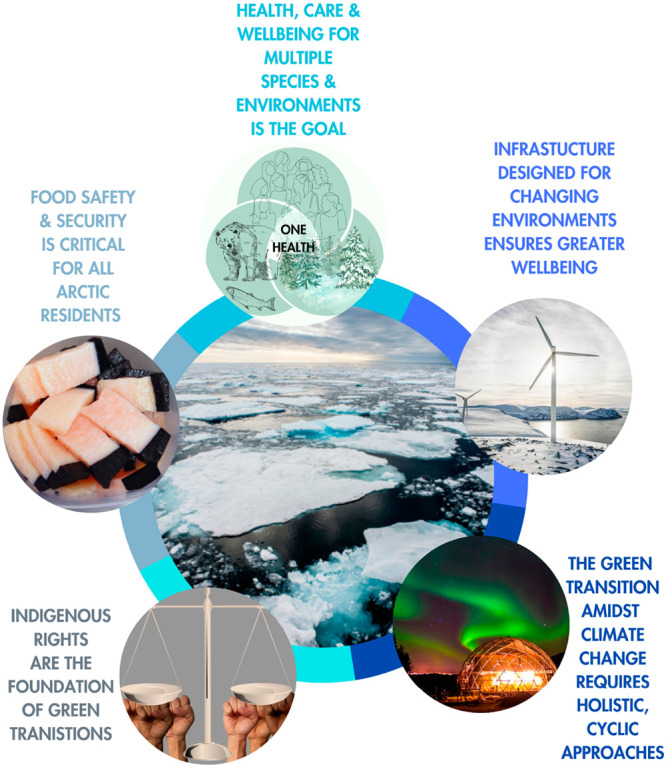
A successful green transition in the Arctic depends on a strong foundation of attention to indigenous rights, food sovereignty, health and well-being of all arctic human and nonhuman residents, and careful attention to new infrastructure and development amidst ongoing and utterly transformative climatic changes.
For example, the Fosen wind turbine park in Central-Norway violated laws and impeded Sámi reindeer herding practices.52 The wind park consists of six wind farms that are part of the largest onshore wind power project in Europe, and are located on the pastures of south Sámi reindeer herders. The wind farms faced resistance from the local south-Sámi reindeer herders’ communities from the beginning of planning the wind farms in 2005, however their voices about losing their winter pastures and the threat this had to the Indigenous Sámi culture, identity and language were not listened to. The Sámi reindeer herders then claimed that the wind farms interfered with their right to enjoy their own culture according to UN Article 27. Article 27 of the UN treaty states that minority ethnic people “shall not be denied the right, in community with the other members of their group, to enjoy their own culture, to profess and practice their own religion, or to use their own language”.53
On October 11, 2021, the Norwegian Supreme Court ruled that the licensing decisions for the Fosen wind farms were invalid because they violated the right of the Sámi reindeer herders to enjoy their own culture. Almost two years after the Supreme Court decision the wind turbines are still running.54 This serves as a reminder that to this day, Arctic, and in particular Indigenous communities, have little say in matters concerning the planning and development of their local resources. Unfortunately, this is no isolated incident. At the 22nd Session of the United Nations Permanent Forum on Indigenous Issues (UNPFII) held in New York in April, 2023, the Cultural Survival advocacy group, called attention to how the extraction of rare Earth elements is causing conflicts in tribal communities in the US and around the world.55
In the Russian Arctic, the green transition exists on paper as attempts by Russian companies and regional governments to reduce localized pollution, especially in cities where existing factories and extractive industries exist (such as near hydrocarbon extraction locations in the Yamal Peninsula) and in/near fly in-fly out (FIFO) mining camps. However, localized pollution–largely related to industrial and construction chemicals–remains problematic for FIFO workers.56 Few attempts are made to address these concerns via environmental impact assessments and, as new industrial complexes in the Russian North continue to operate without international partners, and as Russia closes its borders to scholars and journalists from the West, less will become known about the overall environmental conditions and the green transition. If prior observations from the takeover of multinational-operated hydrocarbon development by state-owned Rosneft and Gazprom in the sub-Arctic are any indication, it may be likely that the future holds an overall brown, rather than green, transition.57
Many remote communities in the northern regions of the US state of Alaska lack connection to national electricity grids, resulting in their heavy reliance on costly imported fuels for power generation. Yet several specific locations within Alaska have taken a pioneering role in the development of community renewable energy supplies.58 Energy systems encompass not just technology and infrastructure, but also the communities involved in generating, using, and benefiting from energy. Significant capacity development is required, including the need for support for local energy champions and the establishment of networks that enable intercommunity energy cooperation. A case study focusing on four Gwich’in communities located in the Northwest Territories, Canada, shows that the transition to renewable energy is closely interlinked with socio-technical capacity required for it.59
Health and Well-Being of Indigenous Communities
It’s important to encompass a holistic view of health and well-being that recognizes traditional knowledge: The health of Indigenous communities can only be understood within the context of colonization, which combined genocide, forced dislocation, forced separation of families (children sent to boarding schools), denigration of traditional values, cultures, and practices. These traumas continue to exert a toll on Indigenous communities, e.g., which continue to have high rates of mental illness and suicide among Arctic youth, and the lack of available resources to combat this problem. While recognition of past evils has begun, the identities of Indigenous people in Arctic societies remain at peril, as every generation faces the choice of assimilation versus expression of their traditional values, and a combination of both. While the strength and resilience of northern communities is remarkable, additional environmental or societal stressors place an extra burden on them.
The historical and ongoing oppression (racism) impacts of colonialism on Arctic Indigenous peoples forms the backdrop for many of the documented health disparities among Arctic communities.60 The colonization of Indigenous peoples and territories by Arctic states accelerated in most regions of the Arctic during the early 20th century,61 creating vulnerability to many of the intergenerational health challenges that too many Indigenous peoples struggle with today. Indigenous health can thus not be reduced to biomedical conditions, but needs to consider the ongoing impact of long-standing marginalization and oppression faced by Indigenous people and communities in the Arctic. Thus, marginalization, racism, and oppression have been recognized as social determinants of health that generate and maintain health inequities.62
Arctic community health care systems must consider the influence of Indigenous peoples’ view of traditional health and well-being and to rectify racism, develop specific interventions to increase access and utilization among Indigenous populations.63 The systematic neglect of culture in health was attributed to be the single biggest barrier to advancement of the highest attainable standard of health worldwide.64 This requires incorporating traditional medical knowledge and health practices in the healthcare sector and to understand how socioeconomic, culture, social, political, and spiritual determinants effect health and well-being for Indigenous individuals and Arctic rural- and urban communities. Social and built environments need to be transformed to create equity-driven and barrier-free access to traditional medicine.63
Health Care of Arctic Communities
While health care varies from Arctic country to country, isolated remote Arctic communities typically have less access to good health care compared to other communities. In parts, this simply reflects the difficulty in transport and the harsh living conditions, but possibly also a lack of investment. COVID hit many Indigenous tribes and remote communities particularly hard according to several factors.65 These included barriers to health services, poor housing conditions, higher rates of pre-existing health conditions, like for instance, respiratory infections, cardiovascular illnesses, diabetes, and obesity.66 Native Americans and Alaska Natives had a 1.8 higher risk of dying than their white counterparts.67 Also, mortality rates for COVID have been a big risk for losing the elders in the local Arctic communities, effecting traditional knowledge transition between generations.65
Delivering culturally appropriate public health care and the availability of quality medical care for the Indigenous Peoples in the Arctic areas poses significant challenges.68 Indigenous peoples in the Arctic are culturally and linguistically diverse, and settlements are typically numerically small and remote. Often, they must travel long distance to get health care or go to hospital.68 Arctic Indigenous people also experience prejudices and discrimination from non-Indigenous health care providers when accessing health care services.69 To address Indigenous health inequities there is an urgent need to incorporate traditional medical knowledge and health practices in the healthcare sectors, which take care of language barriers, cross-cultural misunderstanding and make sure that health care is as good as they are for the majority peers.63
Outlook
As argued above, human, animal, and environmental health are tightly intertwined in the Arctic (“One Health” approach). A traditional focus in environmental chemistry has been on the contamination of the Arctic environment, endangering the safe consumption of local foods and traditional diets. This created the original Arctic dilemma for Indigenous peoples: whether and how to respect both traditional ways of living while avoiding the adverse impacts of pollution.
The interconnected challenges for environment and health in the Arctic are profound and evolving. Climate adaptation plans in the Arctic Region should include a focus on the health risks caused by the long-term permafrost degradation. Healthy housing thus ought to integrate and include local and Indigenous knowledge of adaptive living in the Arctic region, and incorporate tools for improving indoor air quality and minimizing indoor air pollutants. Improving participation and fostering inclusion of local and traditional knowledge will not only lead to better decision-making, but also empower Arctic communities, and contribute to health and environmental well-being. Respecting indigenous rights and traditions with meaningful consultations will ideally prevent further violations of land and cultural sovereignty in the Arctic region. To improve food security, initiatives of local, affordable food production should be supported to provide for nutritious, affordable food. Given the rapidly changing climate and environment, preventive measures should be developed for the Arctic region, to strengthen systems of early meteorological warnings about the onset of heat and high levels of atmospheric air pollution and floods. The surveillance of emerging diseases in wildlife and people needs to be established given the recent disease outbreaks among animals and humans. An improved health care system that incorporates local and traditional knowledge, including health care workers trained in the local languages is warranted. Initiatives and solutions to improve environment and health must be understood holistically, recognizing the multiple challenges of the region and its inhabitants. While the rapidly changing “new” Arctic might not resemble the past, its inhabitants will continue to adapt to their new environment, as they have done for millennia.
Acknowledgments
The authors acknowledge funding from the Fulbright Arctic Initiative III.
Biography

Rainer Lohmann is Professor of Oceanography at the University of Rhode Island’s Graduate School of Oceanography (US). His training combines a degree in chemical engineering (EHICS, Strasbourg, France) and a PhD in Environmental Science (Lancaster, UK). Lohmann is Director of the Superfund Research Center at the University of Rhode Island (Sources, Transport, Exposure and Effects of PFAS – STEEP), that encompasses cutting edge multidisciplinary research with training, community engagement and research translation activities. His research focuses on the detection, transport and fate of man-made persistent, bioaccumulative and toxic chemicals. His scientific collaborations in the Arctic region include scientists from Environment Canada and local communities, the German Alfred Wegener Institute, and numerous US and European scientists. Lohmann serves as a Scientific Counsellor on the U.S. EPA’s Board of Scientific Counselors. As a member of the Global PFAS Science Panel, Lohmann works towards the phase-out of the most harmful chemicals currently being produced in large volumes, while he co-leads an initiative of a global monitoring program for organic pollutants (AQUA-GAPS/MONET) in the waters of the world. He serves as Editor for Environmental Toxicology and Chemistry, and is on the Editorial Boards for Environmental Science and Technology, Environmental Science and Technology Letters, Eco-Environment& Health, and Environment & Health, among others.
Author Contributions
R.L. drafted the original manuscript. A.S. created Figure 1; J.G. created Figure 2. All authors revised the manuscript, approved the final manuscript, and agreed to take responsibility for all aspects of the work.
The authors declare no competing financial interest.
References
- Hung H.; Kallenborn R.; Breivik K.; Su Y.; Brorström-Lundén E.; Olafsdottir K.; Thorlacius J. M.; Leppänen S.; Bossi R.; Skov H.; Manø S.; Patton G. W.; Stern G.; Sverko E.; Fellin P. Atmospheric Monitoring of Organic Pollutants in the Arctic under the Arctic Monitoring and Assessment Programme (AMAP): 1993–2006. Sci. Total Environ. 2010, 408 (15), 2854–2873. 10.1016/j.scitotenv.2009.10.044. [DOI] [PubMed] [Google Scholar]
- Atlas R. M.One Health: Its Origins and Future. In One Health: The Human-Animal-Environment Interfaces in Emerging Infectious Diseases: The Concept and Examples of a One Health Approach; Mackenzie J. S., Jeggo M., Daszak P., Richt J. A., Eds.; Current Topics in Microbiology and Immunology; Springer: Berlin, Heidelberg, 2013; pp 1–13. 10.1007/82_2012_223 [DOI] [PubMed] [Google Scholar]
- Destoumieux-Garzón D.; Mavingui P.; Boetsch G.; Boissier J.; Darriet F.; Duboz P.; Fritsch C.; Giraudoux P.; Le Roux F.; Morand S.; Paillard C.; Pontier D.; Sueur C.; Voituron Y. The One Health Concept: 10 Years Old and a Long Road Ahead. Front. Vet. Sci. 2018, 5, 14. 10.3389/fvets.2018.00014. [DOI] [PMC free article] [PubMed] [Google Scholar]
- Gibbs E. P. J. The Evolution of One Health: A Decade of Progress and Challenges for the Future. Vet. Rec. 2014, 174 (4), 85–91. 10.1136/vr.g143. [DOI] [PubMed] [Google Scholar]
- Zinsstag J.; Schelling E.; Waltner-Toews D.; Tanner M. From “One Medicine” to “One Health” and Systemic Approaches to Health and Well-Being. Prev. Vet. Med. 2011, 101 (3), 148–156. 10.1016/j.prevetmed.2010.07.003. [DOI] [PMC free article] [PubMed] [Google Scholar]
- Nielsen-Englyst P.; Høyer J. L.; Kolbe W. M.; Dybkjær G.; Lavergne T.; Tonboe R. T.; Skarpalezos S.; Karagali I. A Combined Sea and Sea-Ice Surface Temperature Climate Dataset of the Arctic, 1982–2021. Remote Sens. Environ. 2023, 284, 113331. 10.1016/j.rse.2022.113331. [DOI] [Google Scholar]
- Rantanen M.; Karpechko A. Y.; Lipponen A.; Nordling K.; Hyvärinen O.; Ruosteenoja K.; Vihma T.; Laaksonen A. The Arctic Has Warmed Nearly Four Times Faster than the Globe since 1979. Commun. Earth Environ. 2022, 3 (1), 1–10. 10.1038/s43247-022-00498-3. [DOI] [Google Scholar]
- Esau I.; Pettersen L. H.; Lauzent M.; Chapron B.; Chernokulsky A.; Donlon C.; Sizov O.; Soromotin A.; Johannesen J. A.. The Arctic Amplification and Its Impact: A Synthesis through Satellite Observations. https://www.mdpi.com/2072-4292/15/5/1354 (accessed 2023-10-23).
- Steffen W.; Rockström J.; Richardson K.; Lenton T. M.; Folke C.; Liverman D.; Summerhayes C. P.; Barnosky A. D.; Cornell S. E.; Crucifix M.; Donges J. F.; Fetzer I.; Lade S. J.; Scheffer M.; Winkelmann R.; Schellnhuber H. J. Trajectories of the Earth System in the Anthropocene. Proc. Natl. Acad. Sci. U. S. A. 2018, 115 (33), 8252–8259. 10.1073/pnas.1810141115. [DOI] [PMC free article] [PubMed] [Google Scholar]
- Timlin U.; Ramage J.; Gartler S.; Nordström T.; Rautio A. Self-Rated Health, Life Balance and Feeling of Empowerment When Facing Impacts of Permafrost Thaw—A Case Study from Northern Canada. Atmosphere 2022, 13 (5), 789. 10.3390/atmos13050789. [DOI] [Google Scholar]
- Wania F.; Mackay D. Tracking the Distribution of Persistent Organic Pollutants. Environ. Sci. Technol. 1996, 30 (9), 390A–396A. 10.1021/es962399q. [DOI] [PubMed] [Google Scholar]
- Lohmann R.; Vrana B.; Muir D.; Smedes F.; Sobotka J.; Zeng E. Y.; Bao L.-J.; Allan I. J.; Astrahan P.; Barra R. O.; Bidleman T.; Dykyi E.; Estoppey N.; Fillmann G.; Greenwood N.; Helm P. A.; Jantunen L.; Kaserzon S.; Macías J. V.; Maruya K. A.; Molina F.; Newman B.; Prats R. M.; Tsapakis M.; Tysklind M.; van Drooge B. L.; Veal C. J.; Wong C. S. Passive-Sampler-Derived PCB and OCP Concentrations in the Waters of the World—First Results from the AQUA-GAPS/MONET Network. Environ. Sci. Technol. 2023, 57 (25), 9342–9352. 10.1021/acs.est.3c01866. [DOI] [PubMed] [Google Scholar]
- Yeung L. W. Y.; Dassuncao C.; Mabury S.; Sunderland E. M.; Zhang X.; Lohmann R. Vertical Profiles, Sources, and Transport of PFASs in the Arctic Ocean. Environ. Sci. Technol. 2017, 51 (12), 6735. 10.1021/acs.est.7b00788. [DOI] [PubMed] [Google Scholar]
- Dastoor A.; Angot H.; Bieser J.; Christensen J. H.; Douglas T. A.; Heimbürger-Boavida L.-E.; Jiskra M.; Mason R. P.; McLagan D. S.; Obrist D.; Outridge P. M.; Petrova M. V.; Ryjkov A.; St. Pierre K. A.; Schartup A. T.; Soerensen A. L.; Toyota K.; Travnikov O.; Wilson S. J.; Zdanowicz C. Arctic Mercury Cycling. Nat. Rev. Earth Environ. 2022, 3 (4), 270–286. 10.1038/s43017-022-00269-w. [DOI] [Google Scholar]
- McConnell J. R.; Chellman N. J.; Wilson A. I.; Stohl A.; Arienzo M. M.; Eckhardt S.; Fritzsche D.; Kipfstuhl S.; Opel T.; Place P. F.; Steffensen J. P. Pervasive Arctic Lead Pollution Suggests Substantial Growth in Medieval Silver Production Modulated by Plague, Climate, and Conflict. Proc. Natl. Acad. Sci. U. S. A. 2019, 116 (30), 14910–14915. 10.1073/pnas.1904515116. [DOI] [PMC free article] [PubMed] [Google Scholar]
- AMAP . AMAP Assessment 2021: Human Health in the Arctic. https://www.amap.no/documents/doc/amap-assessment-2021-human-health-in-the-arctic/3593 (accessed 2023-08-10).
- Law K. S.; Roiger A.; Thomas J. L.; Marelle L.; Raut J.-C.; Dalsøren S.; Fuglestvedt J.; Tuccella P.; Weinzierl B.; Schlager H. Local Arctic Air Pollution: Sources and Impacts. Ambio 2017, 46 (3), 453–463. 10.1007/s13280-017-0962-2. [DOI] [PMC free article] [PubMed] [Google Scholar]
- Matveeva V. A.; Alekseenko A. V.; Karthe D.; Puzanov A. V. Manganese Pollution in Mining-Influenced Rivers and Lakes: Current State and Forecast under Climate Change in the Russian Arctic. Water 2022, 14 (7), 1091. 10.3390/w14071091. [DOI] [Google Scholar]
- Marquès M.; Sierra J.; Drotikova T.; Mari M.; Nadal M.; Domingo J. L. Concentrations of Polycyclic Aromatic Hydrocarbons and Trace Elements in Arctic Soils: A Case-Study in Svalbard. Environ. Res. 2017, 159, 202–211. 10.1016/j.envres.2017.08.003. [DOI] [PubMed] [Google Scholar]
- Van Oostdam J.; Donaldson S. G.; Feeley M.; Arnold D.; Ayotte P.; Bondy G.; Chan L.; Dewaily C.; Furgal C. M.; Kuhnlein H.; Loring E.; Muckle G.; Myles E.; Receveur O.; Tracy B.; Gill U.; Kalhok S. Human Health Implications of Environmental Contaminants in Arctic Canada: A Review. Sci. Total Environ. 2005, 351–352, 165–246. 10.1016/j.scitotenv.2005.03.034. [DOI] [PubMed] [Google Scholar]
- Lone K.; Hamilton C. D.; Aars J.; Lydersen C.; Kovacs K. M. Summer Habitat Selection by Ringed Seals (Pusa Hispida) in the Drifting Sea Ice of the Northern Barents Sea. Polar Research 2019, 10.33265/polar.v38.3483. [DOI] [Google Scholar]
- Hauser D. D. W.; Laidre K. L.; Stafford K. M.; Stern H. L.; Suydam R. S.; Richard P. R. Decadal Shifts in Autumn Migration Timing by Pacific Arctic Beluga Whales Are Related to Delayed Annual Sea Ice Formation. Global Change Biology 2017, 23, 2206–2217. 10.1111/gcb.13564. [DOI] [PubMed] [Google Scholar]
- Davidson S. C.; Bohrer G.; Gurarie E.; LaPoint S.; Mahoney P. J.; Boelman N. T.; Eitel J. U. H.; Prugh L. R.; Vierling L. A.; Jennewein J.; Grier E.; Couriot O.; Kelly A. P.; Meddens A. J. H.; Oliver R. Y.; Kays R.; Wikelski M.; Aarvak T.; Ackerman J. T.; Alves J. A.; Bayne E.; Bedrosian B.; Belant J. L.; Berdahl A. M.; Berlin A. M.; Berteaux D.; Bêty J.; Boiko D.; Booms T. L.; Borg B. L.; Boutin S.; Sean Boyd W.; Brides K.; Brown S.; Bulyuk V. N.; Burnham K. K.; Cabot D.; Casazza M.; Christie K.; Craig E. H.; Davis S. E.; Davison T.; Demma D.; DeSorbo C. R.; Dixon A.; Domenech R.; Eichhorn G.; Elliott K.; Evenson J. R.; Exo K.-M.; Ferguson S. H.; Fiedler W.; Fisk A.; Fort J.; Franke A.; Fuller M. R.; Garthe S.; Gauthier G.; Gilchrist G.; Glazov P.; Gray C. E.; Grémillet D.; Griffin L.; Hallworth M. T.; Harrison A.-L.; Hennin H. L.; Mark Hipfner J.; Hodson J.; Johnson J. A.; Joly K.; Jones K.; Katzner T. E.; Kidd J. W.; Knight E. C.; Kochert M. N.; Kölzsch A.; Kruckenberg H.; Lagassé B. J.; Lai S.; Lamarre J.-F.; Lanctot R. B.; Larter N. C.; Latham D. A. M.; Latty C. J.; Lawler J. P.; Léandri-Breton D.-J.; Lee H.; Lewis S. B.; Love O. P.; Madsen J.; Maftei M.; Mallory M. L.; Mangipane B.; Markovets M. Y.; Marra P. P.; McGuire R.; McIntyre C. L.; McKinnon E. A.; Miller T. A.; Moonen S.; Mu T.; Müskens G. J. D. M.; Ng J.; Nicholson K. L.; Øien I. J.; Overton C.; Owen P. A.; Patterson A.; Petersen A.; Pokrovsky I.; Powell L. L.; Prieto R.; Quillfeldt P.; Rausch J.; Russell K.; Saalfeld S. T.; Schekkerman H.; Schmutz J. A.; Schwemmer P.; Seip D. R.; Shreading A.; Silva M. A.; Smith B. W.; Smith F.; Smith J. P.; Snell K. R. S.; Sokolov A.; Sokolov V.; Solovyeva D. V.; Sorum M. S.; Tertitski G.; Therrien J. F.; Thorup K.; Lee Tibbitts T.; Tulp I.; Uher-Koch B. D.; van Bemmelen R. S. A.; van Wilgenburg S.; von Duyke A. L.; Watson J. L.; Watts B. D.; Williams J. A.; Wilson M. T.; Wright J. R.; Yates M. A.; Yurkowski D. J.; Žydelis R.; Hebblewhite M. Ecological Insights from Three Decades of Animal Movement Tracking across a Changing Arctic. Science 2020, 370, 712–715. 10.1126/science.abb7080. [DOI] [PubMed] [Google Scholar]
- Nilsson L. M.; Berner J.; Dudarev A. A.; Mulvad G.; Øyvind Odland J.; Parkinson A.; Rautio A.; Tikhonov C.; Evengård B. Indicators of Food and Water Security in an Arctic Health Context - Results from an International Workshop Discussion. Int. J. Circumpolar Health 2013, 72 (1), 21530. 10.3402/ijch.v72i0.21530. [DOI] [PMC free article] [PubMed] [Google Scholar]
- Why Food Is So Expensive on First Nations Reserves in Canada. Global Citizen. https://www.globalcitizen.org/en/content/why-food-is-so-expensive-on-first-nations-reserves/ (accessed 2023-08-10).
- Cost of Living in Alaska (2023). SoFi. https://www.sofi.com/cost-of-living-in-alaska/ (accessed 2023-08-10).
- Fawcett-Atkinson M.Food prices in the North are astronomical, despite subsidies. Who benefits from Ottawa’s plan to tackle food insecurity? Canada’s National Observer. https://www.nationalobserver.com/2023/03/23/news/food-prices-north-are-astronomical-despite-subsidies (accessed 2023-08-10).
- https://www.inuitcircumpolar.com/project/food-security-across-the-arctic/.
- Council of Canadian Academies. Aboriginal Food Security in Northern Canada: An Assessment of the State of Knowledge; The Expert Panel on the State of Knowledge of Food Security in Northern Canada, Council of Canadian Academies: Ottawa, ON (Canada), 2014. [Google Scholar]
- Grigorieva E. A.; Revich B. A. Health Risks to the Russian Population from Temperature Extremes at the Beginning of the XXI Century. Atmosphere 2021, 12 (10), 1331. 10.3390/atmos12101331. [DOI] [Google Scholar]
- Ciavarella A.; Cotterill D.; Stott P.; Kew S.; Philip S.; van Oldenborgh G. J.; Skålevåg A.; Lorenz P.; Robin Y.; Otto F.; Hauser M.; Seneviratne S. I.; Lehner F.; Zolina O. Prolonged Siberian Heat of 2020 Almost Impossible without Human Influence. Clim. Change 2021, 166 (1), 9. 10.1007/s10584-021-03052-w. [DOI] [PMC free article] [PubMed] [Google Scholar]
- Ebi K. L.; Vanos J.; Baldwin J. W.; Bell J. E.; Hondula D. M.; Errett N. A.; Hayes K.; Reid C. E.; Saha S.; Spector J.; Berry P. Extreme Weather and Climate Change: Population Health and Health System Implications. Annu. Rev. Public Health 2021, 42, 293–315. 10.1146/annurev-publhealth-012420-105026. [DOI] [PMC free article] [PubMed] [Google Scholar]
- Revich B. A. Risks to Public Health in the Climate Change of the Arctic Macroregion. Sci. Pap. Inst. Natl. Econ. Forecast. Russ. Acad. Sci. 2020, 18, 395–408. (In Russ.) 10.47711/2076-318-2020-395-408. [DOI] [Google Scholar]
- Vinogradova V. V. Thermal Impact on the Territory of Russia in the Middle of the XXI Century According to Model Data. Izv Ross Akad Nauk Ser. Geogr 2020, 3, 404–413. (In Russ.) 10.31857/S2587556620030115. [DOI] [Google Scholar]
- Kharuk V. I.; Ponomarev E. I.; Ivanova G. A.; Dvinskaya M. L.; Coogan S. C. P.; Flannigan M. D. Wildfires in the Siberian Taiga. Ambio 2021, 50 (11), 1953–1974. 10.1007/s13280-020-01490-x. [DOI] [PMC free article] [PubMed] [Google Scholar]
- McCoy K. D.; Toty C.; Dupraz M.; Tornos J.; Gamble A.; Garnier R.; Descamps S.; Boulinier T. Climate Change in the Arctic: Testing the Poleward Expansion of Ticks and Tick-Borne Diseases. Glob. Change Biol. 2023, 29 (7), 1729–1740. 10.1111/gcb.16617. [DOI] [PubMed] [Google Scholar]
- Ezhova E.; Orlov D.; Suhonen E.; Kaverin D.; Mahura A.; Gennadinik V.; Kukkonen I.; Drozdov D.; Lappalainen H. K.; Melnikov V.; Petäjä T.; Kerminen V.-M.; Zilitinkevich S.; Malkhazova S. M.; Christensen T. R.; Kulmala M. Climatic Factors Influencing the Anthrax Outbreak of 2016 in Siberia, Russia. EcoHealth 2021, 18 (2), 217–228. 10.1007/s10393-021-01549-5. [DOI] [PMC free article] [PubMed] [Google Scholar]
- Landers K.; Streletskiy D. (Un)Frozen Foundations: A Study of Permafrost Construction Practices in Russia, Alaska, and Canada. Ambio 2023, 52, 1170–1183. 10.1007/s13280-023-01866-9. [DOI] [PMC free article] [PubMed] [Google Scholar]
- Hjort J.; Streletskiy D.; Dore G.; Wu Q.; Bjella K.; Luoto M. Impacts of Permafrost Degradation on Infrastructure. Nat. Rev. Earth Environ. 2022, 3, 24–38. 10.1038/s43017-021-00247-8. [DOI] [Google Scholar]
- Scheer J.; Tomaškovičová S.; Ingeman-Nielsen T.. Thaw Settlement Susceptibility Mapping for Roads on Permafrost - Towards Climate-Resilient and Cost-Efficient Infrastructure in the Arctic, Rochester, New York,September 1, 2023. 10.2139/ssrn.4558538 [DOI]
- Streletskiy D.; Clemens S.; Lanckman J.-P.; Shiklomanov N. The Costs of Arctic Infrastructure Damages Due to Permafrost Degradation - IOPscience. Environ. Res. Lett. 2023, 18, 015006. 10.1088/1748-9326/acab18. [DOI] [Google Scholar]
- https://arctic-council.org/news/one-arctic-one-health/, 2019.
- Schmale J.; Arnold S. R.; Law K. S.; Thorp T.; Anenberg S.; Simpson W. R.; Mao J.; Pratt K. A. Local Arctic Air Pollution: A Neglected but Serious Problem. Earths Future 2018, 6 (10), 1385–1412. 10.1029/2018EF000952. [DOI] [Google Scholar]
- Katsoyiannis A.; Anda E. E.; Cincinelli A.; Martellini T.; Leva P.; Goetsch A.; Sandanger T. M.; Huber S. Indoor Air Characterization of Various Microenvironments in the Arctic. The Case of TromsØ, Norway. Environ. Res. 2014, 134, 1–7. 10.1016/j.envres.2014.06.011. [DOI] [PubMed] [Google Scholar]
- Kotol M.Survey of Occupant Behaviour, Energy Use and Indoor Air Quality in Greenlandic Dwellings. In Paper presented at 5th International Building Physics Conference (IBPC), Kyoto, Japan, 2012.
- Singleton R.; Salkoski A. J.; Bulkow L.; Fish C.; Dobson J.; Albertson L.; Skarada J.; Kovesi T.; McDonald C.; Hennessy T. W.; Ritter T. Housing Characteristics and Indoor Air Quality in Households of Alaska Native Children with Chronic Lung Conditions. Indoor Air 2017, 27 (2), 478–486. 10.1111/ina.12315. [DOI] [PubMed] [Google Scholar]
- Aubin D.; Ouazia B.; Poulin P.; Levesque B.; Tremblay F.; Boulet L.-P.; Duchaine C.; Degois J.; Maltais F.; Brisson M.; Savignac M. Intervention Field Study in the Canadian Arctic: Improving Ventilation, Indoor Air Quality, and the Respiratory Health in Nunavik Dwellings and Children. IOP Conf. Ser. Mater. Sci. Eng. 2019, 609 (4), 042055. 10.1088/1757-899X/609/4/042055. [DOI] [Google Scholar]
- Kovesi T.; Creery D.; Gilbert N. L.; Dales R.; Fugler D.; Thompson B.; Randhawa N.; Miller J. D. Indoor Air Quality Risk Factors for Severe Lower Respiratory Tract Infections in Inuit Infants in Baffin Region, Nunavut: A Pilot Study. Indoor Air 2006, 16 (4), 266–275. 10.1111/j.1600-0668.2006.00423.x. [DOI] [PubMed] [Google Scholar]
- Habre R.; Dorman D. C.; Abbatt J.; Bahnfleth W. P.; Carter E.; Farmer D.; Gawne-mittelstaedt G.; Goldstein A. H.; Grassian V. H.; Morrison G.; Peccia J.; Poppendieck D.; Prather K. A.; Shiraiwa M.; Stapleton H. M.; Williams M.; Harries M. E. Why Indoor Chemistry Matters: A National Academies Consensus Report. Environ. Sci. Technol. 2022, 56, 10560–10563. 10.1021/acs.est.2c04163. [DOI] [PMC free article] [PubMed] [Google Scholar]
- Soikkeli A. Human-Environmental Relationships in the Arctic: Mapping and Analyzing Shishmaref. J. Rural Community Dev. 2021, 16 (2), 43. [Google Scholar]
- Soikkeli A. The Sámi Cultural Landscape as the Scene of Collective Memory and Identity — Challenges in Preserving. Landsc. Hist. 2021, 42 (2), 125–138. 10.1080/01433768.2021.1999018. [DOI] [Google Scholar]
- Ravna Ø. Fosen Case and the Protection of Sámi Culture in Norway Pursuant to Article 27 ICCPR 2022, 30, 156. 10.1163/15718115-bja10085. [DOI] [Google Scholar]
- Declaration on the Rights of Persons Belonging to National or Ethnic, Religious and Linguistic Minorities. OHCHR. https://www.ohchr.org/en/instruments-mechanisms/instruments/declaration-rights-persons-belonging-national-or-ethnic (accessed 2023-08-10).
- A year after Supreme Court verdict, Fosen wind farm still stands amid soaring energy crisis. The Independent Barents Observer. https://thebarentsobserver.com/en/indigenous-peoples/2022/10/year-after-supreme-court-verdict-fosen-wind-farm-still-stands-amid (accessed 2023-08-11).
- Monet J.‘Green Colonialism’: Indigenous World Leaders Warn over West’s Climate Strategy. Guardian, April 23, 2023. https://www.theguardian.com/world/2023/apr/23/un-indigenous-peoples-forum-climate-strategy-warning.
- Korneeva Y. The Adverse Environmental Impact Factors Analysis on Fly-In-Fly-Out Personnel at Industrial Enterprises. Int. J. Environ. Res. Public. Health 2022, 19 (2), 997. 10.3390/ijerph19020997. [DOI] [PMC free article] [PubMed] [Google Scholar]
- Graybill J. K. Environmental Politics on Russia’s Pacific Edge: Reactions to Energy Development in the Russian Sea of Okhotsk. Pac. Geogr. 2016, 40, 11–16. [Google Scholar]
- Holdmann G.; Pride D.; Poelzer G.; Noble B.; Walker C. Critical Pathways to Renewable Energy Transitions in Remote Alaska Communities: A Comparative Analysis. Energy Res. Soc. Sci. 2022, 91, 102712. 10.1016/j.erss.2022.102712. [DOI] [Google Scholar]
- McMaster R.; Noble B.; Poelzer G.; Menghwani V. Local Capacity for Energy Transition in Northern and Indigenous Communities: Analysis of Gwich’in Communities in Northwest Territories, Canada. ARCTIC 2022, 76 (2), 143–159. 10.14430/arctic77183. [DOI] [Google Scholar]
- Hansen K. L. Ethnic Discrimination and Health: The Relationship between Experienced Ethnic Discrimination and Multiple Health Domains in Norway’s Rural Sami Population. Int. J. Circumpolar Health 2015, 74 (1), 25125. 10.3402/ijch.v74.25125. [DOI] [PMC free article] [PubMed] [Google Scholar]
- Hansen K. L.The History and Current Situation of Discrimination against the Sámi. In The Sámi World; Valkonen S., Alakorva S., Magga S.-M., Eds.; Routledge, 2022. [Google Scholar]
- Schultz A.; Nguyen T.; Sinclaire M.; Fransoo R.; McGibbon E. Historical and Continued Colonial Impacts on Heart Health of Indigenous Peoples in Canada: What’s Reconciliation Got to Do With It?. CJC Open 2021, 3 (12), S149–S164. 10.1016/j.cjco.2021.09.010. [DOI] [PMC free article] [PubMed] [Google Scholar]
- Poelzer G., Rink E. L., Eds. Fulbright Arctic Initiative Policy Brief, 2023.
- Napier A. D.; Ancarno C.; Butler B.; Calabrese J.; Chater A.; Chatterjee H.; Guesnet F.; Horne R.; Jacyna S.; Jadhav S.; Macdonald A.; Neuendorf U.; Parkhurst A.; Reynolds R.; Scambler G.; Shamdasani S.; Smith S. Z.; Stougaard-Nielsen J.; Thomson L.; Tyler N.; Volkmann A.-M.; Walker T.; Watson J.; Williams A. C. de C.; Willott C.; Wilson J.; Woolf K. Culture and Health. Lancet London Engl. 2014, 384 (9954), 1607–1639. 10.1016/S0140-6736(14)61603-2. [DOI] [PubMed] [Google Scholar]
- Spence J.; Exner-Pirot H.; Petrov A.. Arctic Pandemics: COVID-19 and Other Pandemic Experiences and Lessons Learned; Arctic Portal: Akureyri, Iceland, 2023. [Google Scholar]
- Hathaway E. D. American Indian and Alaska Native People: Social Vulnerability and COVID-19. J. Rural Health Off. J. Am. Rural Health Assoc. Natl. Rural Health Care Assoc. 2021, 37 (1), 256–259. 10.1111/jrh.12505. [DOI] [PMC free article] [PubMed] [Google Scholar]
- Arrazola J.; Masiello M. M.; Joshi S. COVID-19 Mortality Among American Indian and Alaska Native Persons — 14 States, January-June 2020. MMWR 2020, 69, 1853.https://www.cdc.gov/mmwr/volumes/69/wr/mm6949a3.htm 10.15585/mmwr.mm6949a3. [DOI] [PMC free article] [PubMed] [Google Scholar]
- Oosterveer T. M.; Kue Young T. Primary Health Care Accessibility Challenges in Remote Indigenous Communities in Canada’s North. Int. J. Circumpolar Health 2015, 74, 29576. 10.3402/ijch.v74.29576. [DOI] [PMC free article] [PubMed] [Google Scholar]
- Harding J.; MacKinnon K.; Sangster-Gormley E.; Gordon C. Indigenous Peoples’ Positive Experiences of Culturally Safe Health Care: A Qualitative Systematic Review Protocol. JBI Evid. Synth. 2021, 19 (9), 2434. 10.11124/JBIES-20-00181. [DOI] [PubMed] [Google Scholar]