



Abstract
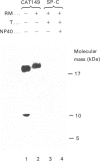
Human pulmonary-surfactant-associated protein C (SP-C) is an extremely hydrophobic peptide comprising 34-35 amino acids. It is involved in the reduction of surface tension at the air/liquid in the lung. In order to understand the mechanism by which this molecule is generated from its 197-amino-acid-residues-long precursor and secreted into the alveolar space, we analysed the biosynthesis and processing of this precursor in an 'in vitro' system. Our results show that the SP-C precursor is a 21 kDa integral membrane protein. It is anchored in the membrane by a hydrophobic domain that comprises the 20-amino-acid-residues-long hydrophobic core of the mature SP-C peptide. The N-terminus remains in the cytoplasm, which leads to a type II transmembrane orientation of the precursor. Membrane integration occurs in a signal-peptidase-independent manner. The hydrophobic domain acts as both signal sequence and membrane-anchoring domain. We suggest that correct membrane insertion of the SP-C precursor, which is strictly dependent on the hydrophobic-amino-acid sequence represented by the hydrophobic core of the mature SP-C, is itself a prerequisite for further processing and intracellular transport of the mature SP-C.
Full text
PDF


Images in this article
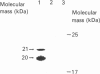

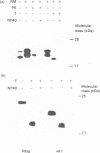
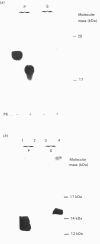
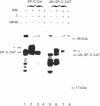
Selected References
These references are in PubMed. This may not be the complete list of references from this article.
- Curstedt T., Johansson J., Persson P., Eklund A., Robertson B., Löwenadler B., Jörnvall H. Hydrophobic surfactant-associated polypeptides: SP-C is a lipopeptide with two palmitoylated cysteine residues, whereas SP-B lacks covalently linked fatty acyl groups. Proc Natl Acad Sci U S A. 1990 Apr;87(8):2985–2989. doi: 10.1073/pnas.87.8.2985. [DOI] [PMC free article] [PubMed] [Google Scholar]
- Dobbs L. G., Wright J. R., Hawgood S., Gonzalez R., Venstrom K., Nellenbogen J. Pulmonary surfactant and its components inhibit secretion of phosphatidylcholine from cultured rat alveolar type II cells. Proc Natl Acad Sci U S A. 1987 Feb;84(4):1010–1014. doi: 10.1073/pnas.84.4.1010. [DOI] [PMC free article] [PubMed] [Google Scholar]
- Eilers M., Schatz G. Protein unfolding and the energetics of protein translocation across biological membranes. Cell. 1988 Feb 26;52(4):481–483. doi: 10.1016/0092-8674(88)90458-8. [DOI] [PubMed] [Google Scholar]
- Fujiki Y., Hubbard A. L., Fowler S., Lazarow P. B. Isolation of intracellular membranes by means of sodium carbonate treatment: application to endoplasmic reticulum. J Cell Biol. 1982 Apr;93(1):97–102. doi: 10.1083/jcb.93.1.97. [DOI] [PMC free article] [PubMed] [Google Scholar]
- Glasser S. W., Korfhagen T. R., Weaver T. E., Clark J. C., Pilot-Matias T., Meuth J., Fox J. L., Whitsett J. A. cDNA, deduced polypeptide structure and chromosomal assignment of human pulmonary surfactant proteolipid, SPL(pVal). J Biol Chem. 1988 Jan 5;263(1):9–12. [PubMed] [Google Scholar]
- Glasser S. W., Korfhagen T. R., Weaver T., Pilot-Matias T., Fox J. L., Whitsett J. A. cDNA and deduced amino acid sequence of human pulmonary surfactant-associated proteolipid SPL(Phe). Proc Natl Acad Sci U S A. 1987 Jun;84(12):4007–4011. doi: 10.1073/pnas.84.12.4007. [DOI] [PMC free article] [PubMed] [Google Scholar]
- Gottschalk S., Waheed A., Schmidt B., Laidler P., von Figura K. Sequential processing of lysosomal acid phosphatase by a cytoplasmic thiol proteinase and a lysosomal aspartyl proteinase. EMBO J. 1989 Nov;8(11):3215–3219. doi: 10.1002/j.1460-2075.1989.tb08480.x. [DOI] [PMC free article] [PubMed] [Google Scholar]
- Haagsman H. P., Hawgood S., Sargeant T., Buckley D., White R. T., Drickamer K., Benson B. J. The major lung surfactant protein, SP 28-36, is a calcium-dependent, carbohydrate-binding protein. J Biol Chem. 1987 Oct 15;262(29):13877–13880. [PubMed] [Google Scholar]
- Haeuptle M. T., Flint N., Gough N. M., Dobberstein B. A tripartite structure of the signals that determine protein insertion into the endoplasmic reticulum membrane. J Cell Biol. 1989 Apr;108(4):1227–1236. doi: 10.1083/jcb.108.4.1227. [DOI] [PMC free article] [PubMed] [Google Scholar]
- Hartmann E., Rapoport T. A., Lodish H. F. Predicting the orientation of eukaryotic membrane-spanning proteins. Proc Natl Acad Sci U S A. 1989 Aug;86(15):5786–5790. doi: 10.1073/pnas.86.15.5786. [DOI] [PMC free article] [PubMed] [Google Scholar]
- Hawgood S., Benson B. J., Schilling J., Damm D., Clements J. A., White R. T. Nucleotide and amino acid sequences of pulmonary surfactant protein SP 18 and evidence for cooperation between SP 18 and SP 28-36 in surfactant lipid adsorption. Proc Natl Acad Sci U S A. 1987 Jan;84(1):66–70. doi: 10.1073/pnas.84.1.66. [DOI] [PMC free article] [PubMed] [Google Scholar]
- Ikegami M., Jacobs H., Jobe A. Surfactant function in respiratory distress syndrome. J Pediatr. 1983 Mar;102(3):443–447. doi: 10.1016/s0022-3476(83)80673-8. [DOI] [PubMed] [Google Scholar]
- King R. J., Martin H. Intracellular metabolism of the apoproteins of pulmonary surfactant in rat lung. J Appl Physiol Respir Environ Exerc Physiol. 1980 May;48(5):812–820. doi: 10.1152/jappl.1980.48.5.812. [DOI] [PubMed] [Google Scholar]
- King R. J. Pulmonary surfactant. J Appl Physiol Respir Environ Exerc Physiol. 1982 Jul;53(1):1–8. doi: 10.1152/jappl.1982.53.1.1. [DOI] [PubMed] [Google Scholar]
- Lipp J., Dobberstein B. Signal and membrane anchor functions overlap in the type II membrane protein I gamma CAT. J Cell Biol. 1988 Jun;106(6):1813–1820. doi: 10.1083/jcb.106.6.1813. [DOI] [PMC free article] [PubMed] [Google Scholar]
- Lipp J., Dobberstein B. The membrane-spanning segment of invariant chain (I gamma) contains a potentially cleavable signal sequence. Cell. 1986 Sep 26;46(7):1103–1112. doi: 10.1016/0092-8674(86)90710-5. [DOI] [PMC free article] [PubMed] [Google Scholar]
- Munro S., Pelham H. R. A C-terminal signal prevents secretion of luminal ER proteins. Cell. 1987 Mar 13;48(5):899–907. doi: 10.1016/0092-8674(87)90086-9. [DOI] [PubMed] [Google Scholar]
- Notter R. H., Shapiro D. L., Ohning B., Whitsett J. A. Biophysical activity of synthetic phospholipids combined with purified lung surfactant 6000 dalton apoprotein. Chem Phys Lipids. 1987 Jun;44(1):1–17. doi: 10.1016/0009-3084(87)90002-8. [DOI] [PubMed] [Google Scholar]
- Phizackerley P. J., Town M. H., Newman G. E. Hydrophobic proteins of lamellated osmiophilic bodies isolated from pig lung. Biochem J. 1979 Dec 1;183(3):731–736. doi: 10.1042/bj1830731. [DOI] [PMC free article] [PubMed] [Google Scholar]
- Possmayer F. A proposed nomenclature for pulmonary surfactant-associated proteins. Am Rev Respir Dis. 1988 Oct;138(4):990–998. doi: 10.1164/ajrccm/138.4.990. [DOI] [PubMed] [Google Scholar]
- Sanger F., Nicklen S., Coulson A. R. DNA sequencing with chain-terminating inhibitors. Proc Natl Acad Sci U S A. 1977 Dec;74(12):5463–5467. doi: 10.1073/pnas.74.12.5463. [DOI] [PMC free article] [PubMed] [Google Scholar]
- Schägger H., von Jagow G. Tricine-sodium dodecyl sulfate-polyacrylamide gel electrophoresis for the separation of proteins in the range from 1 to 100 kDa. Anal Biochem. 1987 Nov 1;166(2):368–379. doi: 10.1016/0003-2697(87)90587-2. [DOI] [PubMed] [Google Scholar]
- Suzuki Y., Curstedt T., Grossmann G., Kobayashi T., Nilsson R., Nohara K., Robertson B. The role of the low-molecular weight (less than or equal to 15,000 daltons) apoproteins of pulmonary surfactant. Eur J Respir Dis. 1986 Nov;69(5):336–345. [PubMed] [Google Scholar]
- Voss T., Eistetter H., Schäfer K. P., Engel J. Macromolecular organization of natural and recombinant lung surfactant protein SP 28-36. Structural homology with the complement factor C1q. J Mol Biol. 1988 May 5;201(1):219–227. doi: 10.1016/0022-2836(88)90448-2. [DOI] [PubMed] [Google Scholar]
- Warr R. G., Hawgood S., Buckley D. I., Crisp T. M., Schilling J., Benson B. J., Ballard P. L., Clements J. A., White R. T. Low molecular weight human pulmonary surfactant protein (SP5): isolation, characterization, and cDNA and amino acid sequences. Proc Natl Acad Sci U S A. 1987 Nov;84(22):7915–7919. doi: 10.1073/pnas.84.22.7915. [DOI] [PMC free article] [PubMed] [Google Scholar]
- Weaver T. E., Sarin V. K., Sawtell N., Hull W. M., Whitsett J. A. Identification of surfactant proteolipid SP-B in human surfactant and fetal lung. J Appl Physiol (1985) 1988 Aug;65(2):982–987. doi: 10.1152/jappl.1988.65.2.982. [DOI] [PubMed] [Google Scholar]
- White R. T., Damm D., Miller J., Spratt K., Schilling J., Hawgood S., Benson B., Cordell B. Isolation and characterization of the human pulmonary surfactant apoprotein gene. 1985 Sep 26-Oct 2Nature. 317(6035):361–363. doi: 10.1038/317361a0. [DOI] [PubMed] [Google Scholar]
- Williams M. C., Hawgood S., Schenk D. B., Lewicki J., Phelps M. N., Benson B. Monoclonal antibodies to surfactant proteins SP28-36 label canine type II and nonciliated bronchiolar cells by immunofluorescence. Am Rev Respir Dis. 1988 Feb;137(2):399–405. doi: 10.1164/ajrccm/137.2.399. [DOI] [PubMed] [Google Scholar]