



Abstract
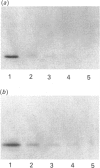
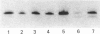
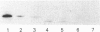
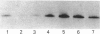
Monospecific polyclonal rabbit antibodies to a purified form of haem oxygenase of chick liver, showing sequence similarity to mammalian haem oxygenase-1, were raised and used to study characteristics of the oxygenase. The antibodies inhibited activity of the purified oxygenase, but not other enzyme components (NADPH:cytochrome reductase and biliverdin reductase) of the standard assay mixture of haem oxygenase. In addition, the antibodies inhibited activity of haem oxygenase in microsomes (microsomal fractions) from Cd(2+)-treated chick liver, spleen, testis and brain. Western (immuno-) blots of microsomal proteins of selected organs from chick, rat and man, and homogenates of chick-embryo liver-cell cultures, probed with the antibodies, showed a major protein with a molecular mass of 33-34 kDa and a lower-molecular-mass protein (28-29 kDa) of variable intensity. Studies with trypsin and selected proteinase inhibitors established that the smaller peptide was a proteolytic product of the larger. Treatment of chick-embryo liver-cell cultures with CdCl2, a potent inducer of haem oxygenase, increased the degree of proteinase-mediated cleavage of the 33 kDa protein to the lower-molecular-mass form. These results indicate that, under at least some conditions, such cultures should be homogenized in the presence of trypsin inhibitor to prevent proteolytic degradation of the enzyme and allow maximal expression of haem oxygenase activity. The antibodies also reacted with haem oxygenase from spleen, testis and brain of both chicks and rats, and the spleen of humans. A method for quantifying the amount of haem oxygenase protein was developed with use of slot-blots and laser densitometry; linearity was observed from 0 to 5 ng of haem oxygenase protein per slot, and the method was applied to sonicated cultured chick-embryo liver cells treated with Cd2+ (0.3 mM) or iron plus glutethimide. In both cases, increases in enzyme activity were of similar magnitude to increases in amounts of enzyme protein. Approximate amounts of haem oxygenase protein in microsomes of several organs from intact animals could also be estimated by the use of slot-blot-laser densitometry, and the amounts measured were increased by the addition of purified haem oxygenase to the microsomal preparations. Results of these studies indicated that haem oxygenase-1 could be detected in microsomes from all chick or rat organs studied, including testis and brain.(ABSTRACT TRUNCATED AT 400 WORDS)
Full text
PDF


Images in this article
Selected References
These references are in PubMed. This may not be the complete list of references from this article.
- Abraham N. G., Lin J. H., Schwartzman M. L., Levere R. D., Shibahara S. The physiological significance of heme oxygenase. Int J Biochem. 1988;20(6):543–558. doi: 10.1016/0020-711x(88)90093-6. [DOI] [PubMed] [Google Scholar]
- Alam J., Shibahara S., Smith A. Transcriptional activation of the heme oxygenase gene by heme and cadmium in mouse hepatoma cells. J Biol Chem. 1989 Apr 15;264(11):6371–6375. [PubMed] [Google Scholar]
- Bissell D. M., Guzelian P. S. Degradation of endogenous hepatic heme by pathways not yielding carbon monoxide. Studies in normal rat liver and in primary hepatocyte culture. J Clin Invest. 1980 May;65(5):1135–1140. doi: 10.1172/JCI109767. [DOI] [PMC free article] [PubMed] [Google Scholar]
- Bissell D. M., Hammaker L., Schmid R. Hemoglobin and erythrocyte catabolism in rat liver: the separate roles of parenchymal and sinusoidal cells. Blood. 1972 Dec;40(6):812–822. [PubMed] [Google Scholar]
- Bonkovsky H. L., Healey J. F., Pohl J. Purification and characterization of heme oxygenase from chick liver. Comparison of the avian and mammalian enzymes. Eur J Biochem. 1990 Apr 20;189(1):155–166. doi: 10.1111/j.1432-1033.1990.tb15472.x. [DOI] [PubMed] [Google Scholar]
- Cable E., Greene Y., Healey J., Evans C. O., Bonkovsky H. Mechanism of synergistic induction of hepatic heme oxygenase by glutethimide and iron: studies in cultured chick embryo liver cells. Biochem Biophys Res Commun. 1990 Apr 16;168(1):176–181. doi: 10.1016/0006-291x(90)91690-t. [DOI] [PubMed] [Google Scholar]
- Cruse I., Maines M. D. Evidence suggesting that the two forms of heme oxygenase are products of different genes. J Biol Chem. 1988 Mar 5;263(7):3348–3353. [PubMed] [Google Scholar]
- Drummond G. S., Galbraith R. A., Sardana M. K., Kappas A. Reduction of the C2 and C4 vinyl groups of Sn-protoporphyrin to form Sn-mesoporphyrin markedly enhances the ability of the metalloporphyrin to inhibit in vivo heme catabolism. Arch Biochem Biophys. 1987 May 15;255(1):64–74. doi: 10.1016/0003-9861(87)90294-3. [DOI] [PubMed] [Google Scholar]
- Drummond G. S., Kappas A. Prevention of neonatal hyperbilirubinemia by tin protoporphyrin IX, a potent competitive inhibitor of heme oxidation. Proc Natl Acad Sci U S A. 1981 Oct;78(10):6466–6470. doi: 10.1073/pnas.78.10.6466. [DOI] [PMC free article] [PubMed] [Google Scholar]
- Evans C. O., Healey J. F., Greene Y., Bonkovsky H. L. Cloning, sequencing and expression of cDNA for chick liver haem oxygenase. Comparison of avian and mammalian cDNAs and deduced proteins. Biochem J. 1991 Feb 1;273(Pt 3):659–666. doi: 10.1042/bj2730659. [DOI] [PMC free article] [PubMed] [Google Scholar]
- Girard P. R., Mazzei G. J., Kuo J. F. Immunological quantitation of phospholipid/Ca2+-dependent protein kinase and its fragments. Tissue levels, subcellular distribution, and ontogenetic changes in brain and heart. J Biol Chem. 1986 Jan 5;261(1):370–375. [PubMed] [Google Scholar]
- Grandchamp B., Bissell D. M., Licko V., Schmid R. Formation and disposition of newly synthesized heme in adult rat hepatocytes in primary culture. J Biol Chem. 1981 Nov 25;256(22):11677–11683. [PubMed] [Google Scholar]
- Ishizawa S., Yoshida T., Kikuchi G. Induction of heme oxygenase in rat liver. Increase of the specific mRNA by treatment with various chemicals and immunological identity of the enzymes in various tissues as well as the induced enzymes. J Biol Chem. 1983 Apr 10;258(7):4220–4225. [PubMed] [Google Scholar]
- Kaminsky L. S., Fasco M. J., Guengerich F. P. Production and application of antibodies to rat liver cytochrome P-450. Methods Enzymol. 1981;74(Pt 100):262–272. doi: 10.1016/0076-6879(81)74018-7. [DOI] [PubMed] [Google Scholar]
- Kikuchi G., Yoshida T. Function and induction of the microsomal heme oxygenase. Mol Cell Biochem. 1983;53-54(1-2):163–183. doi: 10.1007/BF00225252. [DOI] [PubMed] [Google Scholar]
- LOWRY O. H., ROSEBROUGH N. J., FARR A. L., RANDALL R. J. Protein measurement with the Folin phenol reagent. J Biol Chem. 1951 Nov;193(1):265–275. [PubMed] [Google Scholar]
- Lincoln B. C., Aw T. Y., Bonkovsky H. L. Heme catabolism in cultured hepatocytes: evidence that heme oxygenase is the predominant pathway and that a proportion of synthesized heme is converted rapidly to biliverdin. Biochim Biophys Acta. 1989 Jul 21;992(1):49–58. doi: 10.1016/0304-4165(89)90049-4. [DOI] [PubMed] [Google Scholar]
- Lincoln B. C., Healey J. F., Bonkovsky H. L. Regulation of hepatic haem metabolism. Disparate mechanisms of induction of haem oxygenase by drugs and metals. Biochem J. 1988 Feb 15;250(1):189–196. doi: 10.1042/bj2500189. [DOI] [PMC free article] [PubMed] [Google Scholar]
- Maines M. D. Heme oxygenase: function, multiplicity, regulatory mechanisms, and clinical applications. FASEB J. 1988 Jul;2(10):2557–2568. [PubMed] [Google Scholar]
- Maines M. D., Trakshel G. M., Kutty R. K. Characterization of two constitutive forms of rat liver microsomal heme oxygenase. Only one molecular species of the enzyme is inducible. J Biol Chem. 1986 Jan 5;261(1):411–419. [PubMed] [Google Scholar]
- Maines M. D. Zinc . protoporphyrin is a selective inhibitor of heme oxygenase activity in the neonatal rat. Biochim Biophys Acta. 1981 Mar 18;673(3):339–350. doi: 10.1016/0304-4165(81)90465-7. [DOI] [PubMed] [Google Scholar]
- Martasek P., Solangi K., Goodman A. I., Levere R. D., Chernick R. J., Abraham N. G. Properties of human kidney heme oxygenase: inhibition by synthetic heme analogues and metalloporphyrins. Biochem Biophys Res Commun. 1988 Dec 15;157(2):480–487. doi: 10.1016/s0006-291x(88)80274-2. [DOI] [PubMed] [Google Scholar]
- McKinney M. M., Parkinson A. A simple, non-chromatographic procedure to purify immunoglobulins from serum and ascites fluid. J Immunol Methods. 1987 Feb 11;96(2):271–278. doi: 10.1016/0022-1759(87)90324-3. [DOI] [PubMed] [Google Scholar]
- Pimstone N. R., Tenhunen R., Seitz P. T., Marver H. S., Schmid R. The enzymatic degradation of hemoglobin to bile pigments by macrophages. J Exp Med. 1971 Jun 1;133(6):1264–1281. doi: 10.1084/jem.133.6.1264. [DOI] [PMC free article] [PubMed] [Google Scholar]
- Rotenberg M. O., Maines M. D. Isolation, characterization, and expression in Escherichia coli of a cDNA encoding rat heme oxygenase-2. J Biol Chem. 1990 May 5;265(13):7501–7506. [PubMed] [Google Scholar]
- Shibahara S., Müller R. M., Taguchi H. Transcriptional control of rat heme oxygenase by heat shock. J Biol Chem. 1987 Sep 25;262(27):12889–12892. [PubMed] [Google Scholar]
- Shibahara S., Müller R., Taguchi H., Yoshida T. Cloning and expression of cDNA for rat heme oxygenase. Proc Natl Acad Sci U S A. 1985 Dec;82(23):7865–7869. doi: 10.1073/pnas.82.23.7865. [DOI] [PMC free article] [PubMed] [Google Scholar]
- Shibahara S. Regulation of heme oxygenase gene expression. Semin Hematol. 1988 Oct;25(4):370–376. [PubMed] [Google Scholar]
- Sun Y., Rotenberg M. O., Maines M. D. Developmental expression of heme oxygenase isozymes in rat brain. Two HO-2 mRNAs are detected. J Biol Chem. 1990 May 15;265(14):8212–8217. [PubMed] [Google Scholar]
- Tenhunen R., Marver H. S., Schmid R. The enzymatic conversion of heme to bilirubin by microsomal heme oxygenase. Proc Natl Acad Sci U S A. 1968 Oct;61(2):748–755. doi: 10.1073/pnas.61.2.748. [DOI] [PMC free article] [PubMed] [Google Scholar]
- Thomas P. E., Lu A. Y., Ryan D., West S. B., Kawalek J., Levin W. Multiple forms of rat liver cytochrome P-450. Immunochemical evidence with antibody against cytochrome P-448. J Biol Chem. 1976 Mar 10;251(5):1385–1391. [PubMed] [Google Scholar]
- Trakshel G. M., Kutty R. K., Maines M. D. Cadmium-mediated inhibition of testicular heme oxygenase activity: the role of NADPH-cytochrome c (P-450) reductase. Arch Biochem Biophys. 1986 Nov 15;251(1):175–187. doi: 10.1016/0003-9861(86)90064-0. [DOI] [PubMed] [Google Scholar]
- Trakshel G. M., Kutty R. K., Maines M. D. Purification and characterization of the major constitutive form of testicular heme oxygenase. The noninducible isoform. J Biol Chem. 1986 Aug 25;261(24):11131–11137. [PubMed] [Google Scholar]
- Yoshida T., Biro P., Cohen T., Müller R. M., Shibahara S. Human heme oxygenase cDNA and induction of its mRNA by hemin. Eur J Biochem. 1988 Feb 1;171(3):457–461. doi: 10.1111/j.1432-1033.1988.tb13811.x. [DOI] [PubMed] [Google Scholar]
- Yoshida T., Sato M. Posttranslational and direct integration of heme oxygenase into microsomes. Biochem Biophys Res Commun. 1989 Sep 15;163(2):1086–1092. doi: 10.1016/0006-291x(89)92332-2. [DOI] [PubMed] [Google Scholar]