



Abstract
Objectives:
To describe trends in vision screening and type based on insurance claims for young children in the United States over the last decade.
Methods:
This cross-sectional study used administrative claims data from the 2010–2019 IBM MarketScan Commercial Claims and Encounters Database. We included children aged 1 to <5 years at the beginning of each calendar year. The primary outcome was a vision screening claim within 12 months for chart-based or instrument-based screening. Linear regression was used evaluate trends over time in vision screening claims and practitioner payment.
Results:
This study included a median 810,048 (IQR, 631,523–1,029,481) children between 2010 and 2019 (mean [SD] age, 2.5 [1.1] years; 48.7% female). The percentage of children with vision screening claims increased from 16.7% in 2010 to 44.3% in 2019 (difference, 27.5%; 95% CI, 27.4%−27.7%). Instrument-based screening claims, which were identified among less than 0.2% of children in 2010, increased to 23.4% of children 1 to <3 years old and 14.4% of children 3 to <5 years old by 2019. From 2013–2018, the mean practitioner payment for instrument-based screening was $23.70, decreasing $2.10 per year during this time (95% CI, $0.85 to $3.34; p=0.009).
Conclusions:
Vision screening claims among young children nearly tripled over the last decade and this change was driven by increased instrument-based screening for children aged <3 years. Further investigation is needed to determine if the decreasing trends in physician payment for screening devices will reduce the adoption of vision screening technology in clinical practice.
Article Summary:
Instrument-based vision screening for children <3 years old has greatly increased the number of children receiving vision screening over the last decade.
Vision screening is an important component of preventive care delivered to young children in the primary care setting.1 Both chart-based and instrument-based approaches to vision screening are supported by the American Academy of Pediatrics (AAP) and American Academy of Ophthalmology (AAO) for children <5 years old.2 However, screening preschool-aged children using chart-based techniques is often challenging and may be inconsistently successful.3 Instrument-based screening can provide quicker and simpler identification of risk factors for vision loss, particularly among younger children for whom eye chart evaluations can be tedious or unfeasible.4 Implementation of vision screening devices in the primary care setting has been found to improve the rates of completed vision screening at well child visits.5
The implementation of instrument-based screening and the impact of these devices on the landscape of preventive vision care delivery has not been well characterized. Among children aged 1 to <3 years, there is evidence of geographic variation in the use of instrument-based screening, and rates of screening vary based on practitioner payment and patient out-of-pocket expenses.6 However, the trends over time in payments received by practitioners for chart-based and instrument-based screening as well as the proportion of young children receiving each type of vision screening have not been described using a nationwide database. This study reports the trends in vision screening approach and practitioner payment in the US over the last decade based on insurance claims data.
Methods
Study design and data source
This cross-sectional study was performed using administrative claims data from a large database of privately insured patients in the US (2010–2019 IBM MarketScan Commercial Claims and Encounters Database). The MarketScan database includes several million individuals annually, encompassing employees, their spouses and dependents who are covered by employer-sponsored private health insurance plans in the US.7 The study protocol involving the analysis of de-identified insurance claims was exempt by the Harvard Pilgrim Health Care Institutional Review Board and adhered to the tenets of the Declaration of Helsinki. We followed the Strengthening the Reporting of Observational Studies in Epidemiology (STROBE) reporting guidelines.8
Study population
We included children 1 to <5 years of age at the beginning of each calendar year with at least one preventive care encounter during the year, identified using Current Procedural Terminology (CPT) codes (CPT 99381–99383 and 99391–99393). We excluded children enrolled in capitated insurance plans (where a fixed payment per member per unit of time is paid in advance to the physician for health care service delivery) and with less than one year of continuous enrollment (with a 45-day grace period). Demographic data collected included age, sex, and geographic region of residence.
Outcomes
Vision screening-related claims were categorized into chart-based screening (CPT 99173), instrument-based screening involving a device with off-site interpretation (CPT 99174) or on-site interpretation (CPT 99177). Off-site interpretation refers to devices relying on a remote analytic center to interpret screening data, whereas on-site interpretation refers to devices providing an instantaneous report of referral recommendations. The primary outcome was the percentage of children with a vision screening claim during each calendar year (January 1st to December 31st). We stratified the children by age (1 to <3 and 3 to <5 years) at the beginning of each calendar year. The secondary outcomes included the percentage of vision screening claims without separate, unbundled physician payment and the physician payment among vision screening claims with payment.
Statistical Analysis
We reported medians and interquartile ranges (IQR) for continuous variables and frequency and proportions for categorical variables. We used linear regression to evaluate trends over time in vision screening and practitioner payment. All costs were adjusted to 2018 US dollars using the Consumer Price Index.9 Analyses were performed using R, version 4.2.0 (R Core Team, 2022), with the significance level of 0.05 for a two-tailed test.
Results
We analyzed the insurance claims of a median 810,048 children (IQR, 631,523–1,029,481) each year. The mean age was 2.5 years (SD, 1.1 years) and 48.7% were female. 37.9% of children resided in the South, 24.3% in the Midwest, 19.0% in the Northeast, and 17.1% in the West census regions. The percentage of children with vision screening claims increased from 16.7% in 2010 to 44.3% in 2019 (difference, 27.5%; 95% CI, 27.4%−27.7%).
Approximately 5% of children 1 to <3 years old and 30% of children 3 to <5 years old had chart-based screening claims each year over the study period. Instrument-based screening claims, which were identified in less than 0.2% of all children in 2010, increased to 23.4% of children 1 to <3 years old and 14.4% of children 3 to <5 years old by 2019 (Figure 1).
Figure 1:
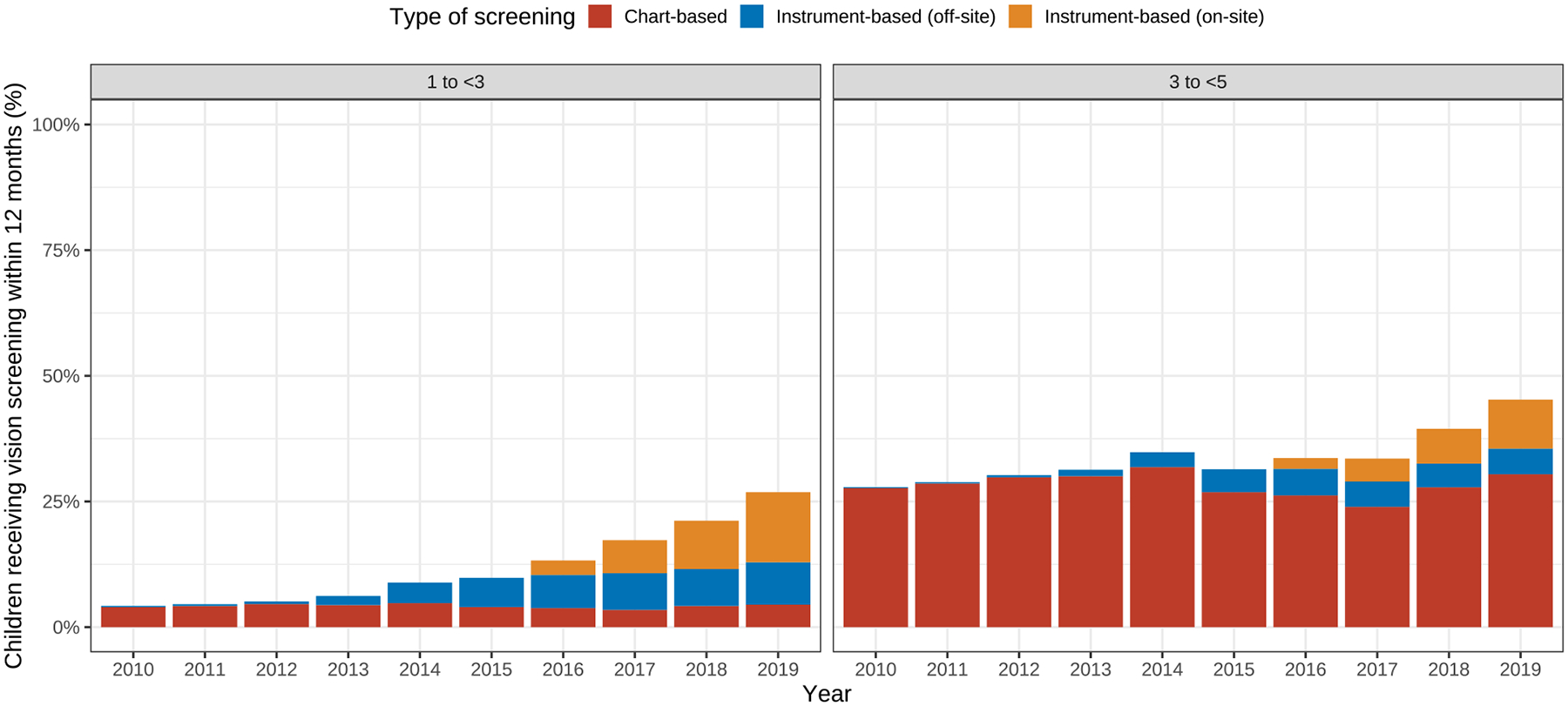
Instrument-based vision screening claims of commercially insured children (aged 1 to 5 years) between 2010 and 2019 in the US.
The percentage of vision screening claims without practitioner payment for chart-based screening did not significantly change over time from 2010 to 2018 (0.1% per year; 95% CI, −0.6% to 2.6%; p=.18) and decreased for instrument-based screening (−2.8% per year; 95% CI, −4.9% to −0.7%; p=.017) (Figure 2A). The mean practitioner payment for chart-based screening was $3.72 and did not change over time ($0.03 increase per year; 95% CI, $−0.02 to $0.09; p=0.18). From 2013–2018, the mean payment for instrument-based screening was $23.70, decreasing $2.10 per year during this time (95% CI, $0.85 to $3.34; p=0.009) (Figure 2B).
Figure 2:

A) The percentage of vision screening claims without seperate, unbundled practitioner payment and B) The median practitioner payment per vision screening claim in 2018 US dollars. Payment data were not available for the 2019 calendar year.
Discussion
The percentage of children less than five years of age with vision screening claims in the primary care setting increased by approximately three-fold over the last ten years. This change has been driven by an increase in use of instrument-based vision screening devices among children less than 3 years old. During this decade, payment for chart-based screening did not change (less than $5 per claim). However, there was a decline in payment for instrument-based screening despite advances in vision screening technology and a growing landscape of available devices demonstrating improved performance.
Billing codes for instrument-based vision screening were first introduced in 2008 and expanded in 2013 to specify devices using off-site interpretation (CPT 99174) and on-site interpretation (CPT 99177).7 Most newer screening devices use on-site interpretation and provide instantaneous results; however, practitioner payment is lower for claims using these devices compared to those involving off-site interpretation. The lower payment for devices providing instantaneous results may contribute to the decrease in overall payment for instrument-based screening and discourage further innovation in vision screening technology. Practitioner payment has been shown to vary geographically, and lower payment may discourage screening with these devices.6 Fluctuations in coding practices over time may reflect delayed adoption of new codes by practitioners and response to insurer coverage.10
Many insurance programs argue that vision screening is a mandatory component of a well-child visit and do not pay for additional testing. Approximately 1 in 5 claims in the most recent calendar year did not include a separate, unbundled physician payment. Trends in insurance coverage and payment may influence the adoption of vision screening devices among practitioners.11 The 2016 AAP and AAO joint policy statement supports the use of instrument-based vision screening starting at 12 months of age,2 with annual evaluations recommended until the children reach a developmental stage where they can participate reliably in chart-based visual acuity assessment.4 In 2017, the US Preventive Services Task Force (USPSTF) released an updated statement on visual screening,12 which included a Grade B recommendation for children aged 3–5 years, indicating a moderate to a substantial net benefit. For children aged 1–3 years, the USPSTF provided an “I” statement, issued when there is not enough evidence or when the available evidence is of poor quality or conflicting. As a result, the USPSTF is unable to assess the balance of benefits and harms and cannot make a recommendation for or against providing the preventive service.13 Chart-based screening of preschool children, especially those under age 4, is unreliable,14,15 while instrument-based screening has been shown to be more reliable than visual acuity screening.15 Despite the USPSTF statement, the percentage of children with vision screening claims has increased more in the <3-year-old population than the 3 to <5-year-old population, which may reflect the role of instrument-based screening devices in children who are otherwise unable to participate in chart-based evaluations. The potential implications of this paradigm shift in vision screening on the diagnosis of vision-threatening conditions and the practice patterns of pediatricians and eye specialists deserves further investigation.
There are several limitations of the data source and analytic approach to consider. First, the MarketScan database is national but not nationally representative, and represents a privately insured population that excludes uninsured children and those enrolled in public insurance plans. As a result, the study cohort may underrepresent socioeconomically disadvantaged children who may be less likely to receive preventive care. Conversely, underutilization of screening codes by practitioners due to lack of payment by some insurance for submitted codes may contribute to a lower estimated screening rate from this claims-based analysis compared to self-reported practices.11 Given lags in adoption of new screening codes, the billing codes reported in this dataset may not always reflect the actual device used for screening.10 How individual insurance plans handle vision screening within global payments for preventive care is unclear and cannot be determined in our dataset. Low payment or payment bundled with the preventive visit may disincentivize practitioners from using vision screening billing codes, even when the service may have been provided. In this analysis, we excluded children enrolled in capitated insurance plans where services such as vision screening may be part of per-member-per-month global payments; however, there may be other non-capitated insurance plans in our study where payment for the vision screening claim may be part of per-member-per-month global payments and may not be separately captured in the database, leading to an underestimation of physician payment for vision screening. In addition, the insurance claims dataset does not include screening results to be able to measure subsequent referrals to eye specialty care. Finally, this study focuses on vision screening trends prior to the 2019 Coronavirus pandemic, which disrupted the delivery of preventive care.16 The degree to which vision screening in the primary care setting was impacted by the pandemic is not captured in this analysis and warrants further investigation.
In conclusion, vision screening claims among young children have increased significantly over the last decade, and this change has been driven by instrument-based screening device use for children less than three years old. Further investigation is needed to determine whether the decreasing trends in physician payment for screening devices will impact further innovation in vision screening technology or the more widespread adoption of vision screening devices in clinical practice.
What’s Known on this Subject:
Vision screening is an important component of pediatric preventive care and instrument-based devices may enable vision screening among children unable to perform chart-based evaluations.
What This Study Adds:
Instrument-based vision screening claims have increased over the last decade in the US, particularly among children under the age of three. However, practitioner payment for vision screening has decreased during this time interval.
Acknowledgements:
We would like to thank Amy Han, MPH for assistance with project management.
Funding/Support:
Isdin Oke received grant funding from the Agency for Healthcare Research and Quality (T32HS000063).
Abbreviations:
- CPT
Current Procedural Terminology
- STROBE
Strengthening the Reporting of Observational Studies in Epidemiology
- IQR
Interquartile range
- AAP
American Academy of Pediatrics
- AAO
American Academy of Ophthalmology
- USPSTF
United States Preventive Services Task Force
Footnotes
Conflicts of Interest Disclosures: David G. Hunter reports involvement with Rebion, Inc (founder, equity) and Luminopia, Inc (advisor, equity). The remaining authors have indicated they have no conflicts of interest relevant to this article to disclose.
References:
- 1.Donahue SP, Baker CN, Committee on Practice and Ambulatory Medicine, American Academy of Pediatrics, et al. Procedures for the Evaluation of the Visual System by Pediatricians. Pediatrics. 2016;137(1). doi: 10.1542/peds.2015-3597 [DOI] [PubMed] [Google Scholar]
- 2.Donahue S, Nixon C, Section on Opthamology, American Academy of Pediatrics, et al. Visual System Assessment in Infants, Children, and Young Adults by Pediatricians. Pediatrics. 2016;137(1):28–30. doi: 10.1542/peds.2015-3596 [DOI] [PubMed] [Google Scholar]
- 3.Modest JR, Johnston SC, Majzoub KM, et al. Results of a primary care-based quality improvement project to optimize chart-based vision screening for preschool age children. J AAPOS. 2016;20(4):305–309. doi: 10.1016/j.jaapos.2016.04.005 [DOI] [PubMed] [Google Scholar]
- 4.Silverstein E, Donahue SP. Preschool Vision Screening: Where We Have Been and Where We Are Going. Am J Ophthalmol. 2018;194:xviii–xxiii. doi: 10.1016/j.ajo.2018.07.022 [DOI] [PubMed] [Google Scholar]
- 5.Modest JR, Majzoub KM, Moore B, Bhambhani V, McLaughlin SR, Vernacchio L. Implementation of Instrument-Based Vision Screening for Preschool-Age Children in Primary Care. Pediatrics. 2017;140(1):e20163745. doi: 10.1542/peds.2016-3745 [DOI] [PubMed] [Google Scholar]
- 6.Oke I, Lutz SM, Hunter DG, Galbraith AA. Use and Costs of Instrument-Based Vision Screening for US Children Aged 12 to 36 Months. JAMA Pediatr. Published online May 22, 2023. doi: 10.1001/jamapediatrics.2023.0808 [DOI] [PMC free article] [PubMed] [Google Scholar]
- 7.Butler AM, Nickel KB, Overman RA, Brookhart MA. IBM MarketScan Research Databases. In: Sturkenboom M, Schink T, eds. Databases for Pharmacoepidemiological Research. Springer Series on Epidemiology and Public Health. Springer International Publishing; 2021:243–251. doi: 10.1007/978-3-030-51455-6_20 [DOI] [Google Scholar]
- 8.von Elm E, Altman DG, Egger M, et al. The Strengthening the Reporting of Observational Studies in Epidemiology (STROBE) statement: guidelines for reporting observational studies. Ann Intern Med. 2007;147(8):573–577. doi: 10.7326/0003-4819-147-8-200710160-00010 [DOI] [PubMed] [Google Scholar]
- 9.Consumer Price Index (CPI) Databases : U.S. Bureau of Labor Statistics. Accessed April 21, 2023. https://www.bls.gov/cpi/data.htm [Google Scholar]
- 10.CPT 99174 & CPT 99177 Reimbursement for Ocular Screening FAQs. iScreen Vision. Accessed April 18, 2023. https://www.iscreenvision.com/faqs/cpt-99174-cpt-99177-reimbursement/ [Google Scholar]
- 11.Kemper AR, Clark SJ. Preschool Vision Screening in Pediatric Practices. Clin Pediatr (Phila). 2006;45(3):263–266. doi: 10.1177/000992280604500309 [DOI] [PMC free article] [PubMed] [Google Scholar]
- 12.Jonas DE, Amick HR, Wallace IF, et al. Vision Screening in Children Aged 6 Months to 5 Years: Evidence Report and Systematic Review for the US Preventive Services Task Force. JAMA. 2017;318(9):845. doi: 10.1001/jama.2017.9900 [DOI] [PubMed] [Google Scholar]
- 13.Definitions Grade. US Preventive Services Taskforce. October 2018. Accessed May 17, 2023. https://www.uspreventiveservicestaskforce.org/uspstf/about-uspstf/methods-and-processes/grade-definitions
- 14.Varma R, Deneen J, Cotter S, et al. The multi-ethnic pediatric eye disease study: design and methods. Ophthalmic Epidemiol. 2006;13(4):253–262. doi: 10.1080/09286580600719055 [DOI] [PubMed] [Google Scholar]
- 15.Salcido AA, Bradley J, Donahue SP. Predictive value of photoscreening and traditional screening of preschool children. J AAPOS. 2005;9(2):114–120. doi: 10.1016/j.jaapos.2003.10.011 [DOI] [PubMed] [Google Scholar]
- 16.Laing S, Johnston S. Estimated impact of COVID-19 on preventive care service delivery: an observational cohort study. BMC Health Services Research. 2021;21(1):1107. doi: 10.1186/s12913-021-07131-7 [DOI] [PMC free article] [PubMed] [Google Scholar]