



Abstract
Bacground and purpose: Today, the unwanted contamination of the composite surface with latex gloves during tooth restoration is one of the common problems in restorative dentistry. The present study was conducted with the aim of investigating the effect of resin composite contamination with latex gloves containing corn powder on the strength of the shear bond to bovine dentin during the fifth and seventh generations of the bonding system.
Materials and methods: This case-control study was conducted on 90 cow teeth without caries or lesions. To connect the composite restorative material to the samples, 90 plastic molds with a diameter of 3 mm and a height of 2 mm were made. Then, the samples were placed in one of the following six groups of 15 samples each: two control groups (uncontaminated gloves), two groups of gloves contaminated with corn powder and two groups of gloves contaminated with talc powder. Each of the aforementioned groups was assigned to one of the two bonding systems, generation 5 (FGM Amber) or generation 7 (FGM Amber universal self etch). For all samples, the shear strength test was done using a universal testing machine. The shearing force was applied to the bonding area of the composite and the tooth with the force arm with the cross section of a knife with an area of 0.5 cm2. Finally, the findings were compared between the studied groups.
Results: The results of the present study showed that the bond shear strength during the fifth generation bonding system in the control, corn powder and talc powder groups was 191.6, 171.3 and 164.3 newtons, respectively. This amount was equal to 190.3, 165.7 and 161.3 newtons during the seventh generation bonding system in the control, corn powder and talc powder groups, respectively. In both generations of the bonding system, the shear strength of the bond in the control group was significantly higher than the corn powder group. Finally, the comparison of the two types of bonding system groups did not show any significant differences between the study groups.
Conclusion: Based on the findings of the present study, it can be concluded that in both types of fifth and seventh generation bonding systems, latex gloves with corn powder reduce the strength of the shear bond to tooth dentin compared to latex gloves without powder.
Keywords: shear bond strength, latex with corn powder, bonding systems, dental dentin.
Introduction
Today's composites have bis methacrylate (1). The most important factors of the failure of resin treatments include incomplete curing due to the high thickness of the composite, incorrect isolation and contamination with saliva, blood, gingival sulcus fluid, as well as contamination of the pens that are used. Also, if the desired surfaces are contaminated, the shear strength of the bond decreases (2). Along with the development of adhesive restorative dentistry, the use of latex gloves became widespread (3, 4). Today, talcum powder is also added to some latex gloves to prevent contamination of the composite surface and bandage (5). Exposure to talc causes a series of local or systemic pathological reactions in the body, which depends on how talc enters the body. In histological levels, the reaction to talc was in the form of granuloma or fibrosis in reaction to a foreign body. Gloves containing talc powder is one of the possible sources of contamination with talc (6, 7). Previous studies have shown that talc powder could reduce the shear strength of composites (8). Various substances have been introduced in order to solve these side effects of talc and to find suitable substitutes. Corn starch powder is one of these newly introduced materials (9, 10).
At the same time, as the use of powdered latex gloves became popular, Browning et al (1994) (11), Neissen et al (1986) (12), Reitz et al (1988) (13), Rosen et al (1989) (14) and Hubar et al (1991) (15) mentioned the negative effects of powders in latex gloves. The results of the aforementioned studies showed that particles of these powders could be transported by air and cause contamination of dental equipment and dental restorations. The study of Roberts and Bartoloni (2002) (16) reported that the use of powdered latex gloves compared to non-powdered gloves did not have a significant effect on bond strength, but Oskoee et al (2012) (17) showed that padded latex gloves could cause contamination in the bonding area and reduce the shear bond strength of an ivory. Given that the effect of corn starch powder contamination on the shear bond strength to tooth dentin has not been investigated in prior research, we aimed at evaluating the composite contamination with corn starch powder versus talc powder and uncontaminated sample on the shear strength of the composite through an in vitro study.
MATERIALS AND METHODS
Sampling: We designed the present in vitro study with the aim of investigating the contamination of composite with corn starch powder in comparison with talc powder and uncontaminated sample on the shear strength of composite to bovine dentin using two types of bonding systems. Ninety samples of cow teeth without caries and lesions were selected and randomly assigned to six experimental groups comprising 15 samples each. Our study was conducted in the Faculty of Dentistry, Tabriz University of Medical Sciences, Iran, and had a duration of 12 months, from 12 November 2018 to 21 December 2019.
Among the exclusion criteria were the presence of softness, scratches, cracks or any defect in the cow teeth after examination with probe and stereomicroscope.
Study implementation method: To connect the composite restorative material to the samples, 90 plastic molds with diameter of 3 mm and height of 2 mm were made. Then, the samples were prepared in one of the six study groups, including three groups related to the fifth generation bonding system and three groups related to the seventh generation bonding system, as described below.
The three groups related to the fifth generation bonding system (FGM Amber bonding system) included:
- group A-1 (control, without contamination), in which the bonding system was used as follows: samples with phosphoric acid 35% (Scotch Bond Etchant; 3M, ESPE, MN, USA) were etched for 15 seconds; the surface of samples was washed with water spray for 15 seconds and dried for 1 to 2 seconds with a gentle flow of air to maintain its moisture; FGM Amber was used according to the manufacturer's instructions so that all the cut surfaces were coated with the bond and two layers of bonding material were applied on the etched surfaces and finally dried for 2-5 seconds; the adhesive was cured with a light cure device (Astralis; Ivocar Vivadent; Austria) for 10 seconds with an intensity of 400 mw/cm² and with a distance of 1 mm; the intensity of the light cure device was measured by (Colten/ Whaledent Inc, NJ, USA) at the beginning of the work; the prepared plastic mold was placed on the slope surface and filled with composite resin (filtek Z 250, 3M ESPE) and then placed on the band surface; additions of restorative material were removed with a catheter; the generator was cured for 40 seconds with a light curing device at 400 mw/cm²; and the plastic mold was gently cut by bisturi number ?11.
- group A-2 (contamination by gloves containing corn powder) – all steps were similar to those described for group A-1, with the difference that in this group, the resin composite was packed on the surface of the glass slab inside the plastic mold and then bonded to the tooth; first, before bonding, the composite was contaminated for two minutes with the outer layer of a latex glove containing corn powder (GTEX Azar Tjhiz Teb Aras company Manufacturing Iran) in a dark room to prevent the resin from setting; a new glove was used for each sample.
- group A-3 (contamination by gloves containing talc) – similar to group A-2, with the difference that the resin composite was contaminated by the outer surface of the glove (GTEX Azar Tjhiz Teb Aras company Manufacturing Iran) in the dark room.
The three groups related to the seventh generation bonding system (FGM Amber universal self etch bonding system) included:
- group B -1 (control, without contamination), in which the bonding system was used as follows: the dentine surface of the samples was etched and primed with primer (Kurary, Okayama, Japan Clearfil SE Bond) for 20 seconds; FGM Amber universal self etch bonding material was applied to the samples according to the factory instructions; they were cured for 10 seconds with an Astralis7 light cure device with an intensity of 400 mw/cm² with a distance of 1 mm; the remaining steps were similar to those followed for group A-1.
- group B -2 (contamination by gloves containing corn powder), with all the steps being similar to those used for group B -1, with the difference that in this group, resin composite was packed on the surface of the glass slab inside the plastic mold, and then its surface was covered for two minutes with the outer layer of latex gloves containing corn powder (GTEX Azar Tjhiz Teb Aras company Manufacturing Iran) in a dark room to avoid resin contamination; and a new glove was used for each sample.
- group B -3 (contamination by gloves containing talc), with all steps being similar to those used for group B -2, with the difference that the composite was contaminated for two minutes by gloves (GTEX Azar Tjhiz Teb Aras Manufacturing company Iran).
All samples in the six studied groups were subjected to thermocycling before preparation. Afterwards, shear strength tests were done with a universal testing machine (Hounsfield test equipment). Shearing force was applied to the bonding area of the composite and the tooth with a force arm with a knife cross-section area of 0.5 cm². The maximum force that led to failure was recorded in newtons and was converted to megapascals by dividing it by the bond surface.
Also, the fracture of samples was examined under a stereo microscope and the fracture pattern was divided into three groups: cohesive, adhesive, and mixed.
Evaluated parameters: The present study included two control groups with no contamination, in which samples were not exposed to any contamination; two groups with corn starch powder contamination, in which samples were contaminated using latex gloves coated with corn starch powder; and two groups with talc powder contamination, in which samples were contaminated using latex gloves coated with talc powder.
Measurement: The shear bond strength of composite resin to bovine dentin was measured in all groups using a universal testing machine at a crosshead speed of 0.5 mm/min.
Statistical analysis: The data obtained in this study were analyzed using SPSS version 22 statistical software. In all studied cases, the results were considered statistically significant if P < 0.05.
Results
The evaluation of the shear strength of the bond to bovine dentin using the fifth generation bonding material in samples of the control group (without composite contamination) showed an average shear strength of the bond of 191.6 (125.1 Π224.8). Also, the shear strength of the bond to the dentin of the cow tooth using the fifth generation bonding material in samples of the corn powder group was 171.3 (101.6 Π197.8).
When comparing the bond shear strength between the control and corn powder groups in the fifth generation bonding system by the Mann-Whitney test, we observed that the bond shear strength in the control group was significantly higher than the corn powder group (P=0.029). So, the shear strength of the band in the control group was on average 20 newton units higher than the corn powder group (Figure 1).
The evaluation of the shear strength of the bond to bovine dentin using the seventh generation bonding material in samples of the control group (without composite contamination) showed an average shear strength of the bond of 190.3 (146.3 Π220.7). Also, the shear strength of the bond to the dentin of the cow tooth using the seventh generation bonding material in the samples of the corn powder group was 165.7 (196.3 Π109.6). Comparing the bond shear strength between the control and corn powder groups in the seventh generation bonding system, the Mann-Whitney test showed that the bond shear strength in the control group was significantly higher than the corn powder group (p=0.015). So, the shear strength of the band in the control group was on average 25 newton units higher than the corn powder group (Figure 2).
The evaluation of the shear strength of the bond to the dentin of the cow tooth using the fifth generation bonding material in samples of the talc group showed an average shear strength of the bond of 164.3 (192.8 Π101.6). Although the average bond shear strength in the fifth generation talc group was lower than the fifth generation corn powder group, the comparison of the bond shear strength between the corn powder and talc powder groups in the fifth generation bonding system using Mann-Whitney test showed that there was no significant difference in the bond shear strength between corn powder and talc powder groups (P=0.675).
The evaluation of the shear strength of the bond to bovine dentin using the seventh generation bonding material in samples of the talc group showed that the average shear strength of the bond in this group was 161.3 (196.8 Π128.2). In the present study, although the average shear strength of the bond in the seventh generation talc group was lower than the seventh generation corn powder group, the comparison of the bond shear strength between the corn powder and talc powder groups in the seventh generation bonding system using Mann-Whitney test showed that there was no significant difference in bond shear strength between corn powder and talc powder groups (P=0.927).
According to our findings, although the average bond shear strength in the seventh generation control group was lower than the fifth generation control group, the comparison of the bond shear strength of the control groups between the fifth and seventh generation bonding systems using Mann-Whitney test showed that there was a significant difference. There was no bond shear strength between the control groups of generations fifth and seventh (P=0.631). Although the average bond shear strength in the seventh generation corn powder group was lower than the fifth generation corn powder group, the comparison of the bond shear strength of the corn powder groups between the fifth and seventh generation bonding systems by Mann-Whitney test showed that there was no significant difference in strength bond gap between the corn powder groups of the fifth and seventh generations (P=0.567).
Also, although the average bond shear strength in the seventh generation talc powder group was lower than the fifth generation talc group, the comparison of the bond shear strength of the talc powder groups between the fifth and seventh generation bonding systems using Mann-Whitney test showed that there was no significant difference in bond shear strength between fifth and seventh generation talc powder groups (P=0.838).
Based on the results of the present study, the most common failure pattern in the fifth generation bonding system in all control groups was corn powder and talc powder related to adhesive (Table 1). Also, the most common failure pattern in the seventh generation bonding system in the control group was related to mixed, while in the corn powder and talc powder groups it was related to adhesive (Table 2).
Discussion
Latex gloves are commonly used in dental procedures. There are two types of disposable gloves, including powdered and non-powdered. Powders like talc or corn starch are often added to latex gloves to make them easier to put on and remove, but these powders can inadvertently cause contamination during dental procedures, potentially affecting the performance of bonding materials. While previous studies have investigated the effect of talc on the bonding process, the impact of corn starch powder has not been as extensively studied. Therefore, our study aimed to assess how contamination with latex gloves containing either corn starch or talc powder affects the shear bond strength of composite resin to bovine dentin when using fifth and seventh generation bonding systems. Our findings showed that, regardless of whether a fifth or seventh generation bonding system was used, contamination by latex gloves with either corn starch or talc powder significantly reduced the bond strength compared to uncontaminated samples.
For example, in the fifth generation system, the control group (no contamination) had an average bond strength of 191.6 newtons, while the corn powder and talc powder groups had reduced bond strengths of 171.3 and 164.3 newtons, respectively. A similar pattern was observed in the seventh generation bonding system, where the control group exhibited a bond strength of 190.3 newtons, compared to 165.7 and 161.3 newtons in the corn powder and talc powder groups, respectively. The results also indicated that while both types of powder (corn and talc) reduced bond strength, there was no statistically significant difference between the two. This suggests that both powders negatively affect the bond strength to a similar extent, but neither powder is worse than the other in terms of reducing bond strength.
When comparing the fifth and seventh generation bonding systems, there was no significant difference in bond strength between the two systems, regardless of whether the samples were contaminated or not. This suggests that both bonding systems are similarly affected by contamination, with no advantage offered by one system over the other in resisting the impact of powder contamination. Our findings align with previous research that has demonstrated the negative effects of powdered gloves on dental materials. For instance, Browning et al. (1994), Neissen et al. (1986) and Hubar et al. (1991) have all shown that powdered gloves could lead to contamination that weakens bonding. Additionally, Oskoee et al. (2012) reported that contamination from powdered gloves reduces shear bond strength, which was consistent with our findings.
However, there are some conflicting studies, such as those conducted by Roberts and Bartoloni (2002) and Sanders et al. (2004), which suggested that powdered gloves did not significantly affect bond strength. The variation in findings across studies may be due to differences in the chemical formulations of bonding systems as well as the specific testing methods used in each study. One important aspect to consider is the location and type of bond failure. In our study, the most common type of bond failure observed was adhesive failure, where the bond between the resin composite and dentin failed. This was particularly prevalent in the contaminated groups. In contrast, the control groups, especially in the seventh generation bonding system, had a higher proportion of mixed failures, indicating stronger bonding.
Overall, the results of the present study suggest that contamination with latex gloves containing either corn starch or talc powder reduces the strength of the composite bond to dentin, and this effect is consistent across different generations of bonding systems. Therefore, it is advisable to use non-powdered gloves during dental restorative procedures to avoid compromising the bond strength.
In conclusion, dentists should be aware of the potential for contamination when using powdered latex gloves, as this can negatively affect the bond strength of restorative materials, leading to possible long-term failures in dental restorations. Further research could explore whether different bonding techniques or materials might be less affected by contamination or whether other glove materials could mitigate these effects.
Conclusion
According to the findings of the present study, it can be concluded that in both types of fifth and seventh generation bonding systems, latex gloves with corn powder reduce the strength of the shear bond to tooth dentin compared to latex gloves without powder. Also, in both types of fifth and seventh generation bonding systems, the strength of the shear bond to dentin during the use of latex gloves with corn powder was not significantly different from latex gloves with talc powder.
Informe d consent: was obtained from all individual participants included in the present study.
Conflicts of interest: none declared.
Financial support: none declared.
FIGURE 1.
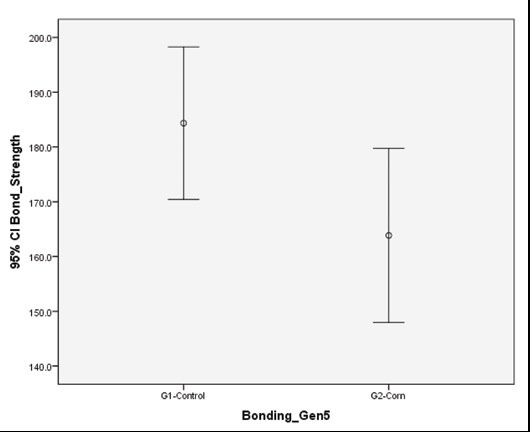
Error bar graph according to band shear strength in the control and corn powder groups for the fifth generation bonding material
FIGURE 2.
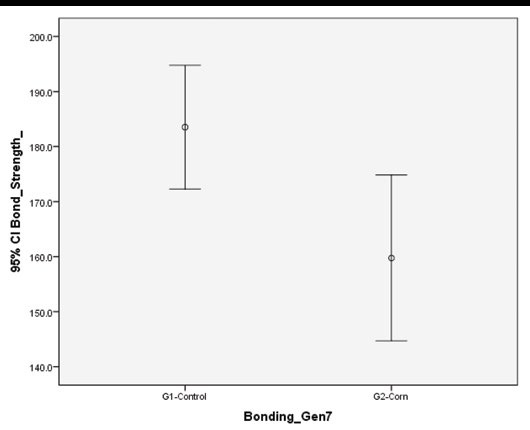
Error bar graph according to band shear strength in the control and corn powder groups for the seventh generation bonding material
TABLE 1.
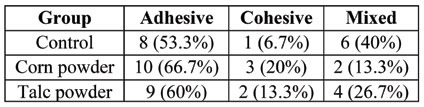
The frequency of different failure patterns in the fifth generation bonding system
TABLE 2.
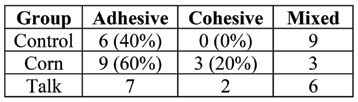
The frequency of different failure patterns in the seventh generation bonding system
Contributor Information
Mehdi DANESHPOOY, Department of Operative Dentistry, Faculty of Dentistry, Tabriz University of Medical Sciences, Tabriz, Iran.
Elmira JAFARI-NAVIMIPOUR, Department of Operative Dentistry, Faculty of Dentistry, Tabriz University of Medical Sciences, Tabriz, Iran.
Mohammad MOTAGHIZADEE-GARGARI, Department of Operative Dentistry, Faculty of Dentistry, Tabriz University of Medical Sciences, Tabriz, Iran.
Reza SAFARALIZADEH, Department of Operative Dentistry, Faculty of Dentistry, Tabriz University of Medical Sciences, Tabriz, Iran.
Yashar REZAI, Department of Dental Biomaterials, Faculty of Dentistry, Tabriz University of Medical Sciences, Tabriz, Iran.
References
- 1.Haralur SB, Alharthi SM, Abohasel SA. Effect of Decontamination Treatments on Micro-Shear Bond Strength between Blood–Saliva-Contaminated Post-Etched Dentin Substrate and Composite Resin. Healthcare (Basel) 2019. [DOI] [PMC free article] [PubMed]
- 2.Güers P, Wille S, Strunskus T, et al. Durability of resin bonding to zirconia ceramic after contamination and the use of various cleaning methods. Dental Materials. 2019;35:1388–1396. doi: 10.1016/j.dental.2019.07.027. [DOI] [PubMed] [Google Scholar]
- 3.Holtan JR, Lua MJ, Belvedere PC, Lambert DL. Evaluating the effect of glove coating on the shear bond strength of porcelain laminate veneers. J Am Dent Assoc. 1995;126:611–616. doi: 10.14219/jada.archive.1995.0240. [DOI] [PubMed] [Google Scholar]
- 4.Sanders B, Pollock A, Weddell J, Moore K. The effect of glove contamination on the bond strength of resin to enamel. J Clin Pediatr Dent. 2004;28:339–341. doi: 10.17796/jcpd.28.4.4627726k1k3t5r10. [DOI] [PubMed] [Google Scholar]
- 5.Lazaro C, Reichelt C, Lazaro J, et al. Foreign body post‐varicella granulomas due to talc. J Eur Acad Dermatol Venereol. 2006;20:75–78. doi: 10.1111/j.1468-3083.2005.01347.x. [DOI] [PubMed] [Google Scholar]
- 6.Verlynde G, Agneessens E, Dargent J-L. Pulmonary Talcosis Due to Daily Inhalation of Talc Powder. J Belg Soc Radiol. 2018;102:12. doi: 10.5334/jbsr.1384. [DOI] [PMC free article] [PubMed] [Google Scholar]
- 7.Roberts HW, Bartoloni J. Effect of latex glove contamination on bond strength. J Adhes Dent. 2002;4:205–210. [PubMed] [Google Scholar]
- 8.Powers JM, Sakaguchi RL, Craig RG. In:Craigs Restorative Dental Materials. Ronald L. Edited by Sakaguchi R, Powers JM. Philadelphia, PA: Elsevier/Mosby. 2012.
- 9.Merriam-Webster (Producer). Definition of Cornstarch. Retrieved from Merriam-webster.com. 2016.
- 10.Whistler RL, BeMiller JN, Paschall EF. In:Starch: chemistry and technology. Academic Press. 2012.
- 11.Browning GC, Broome JC, Murchison DF. Removal of latex glove contaminants prior to taking poly (vinylsiloxane) impressions. Quintessence Int. 1994;25:787–790. [PubMed] [Google Scholar]
- 12.Neissen LC, Strassler H, Levinson PD, et al. Effect of latex gloves on setting time of polyvinylsiloxane putty impression material. J Prosthet Dent. 1986;55:128–129. doi: 10.1016/0022-3913(86)90088-0. [DOI] [PubMed] [Google Scholar]
- 13.Reitz CD, Clark NP. The setting of vinyl polysiloxane and condensation silicone putties when mixed with gloved hands. J Am Dent Assoc. 1988;116:371–375. doi: 10.14219/jada.archive.1988.0236. [DOI] [PubMed] [Google Scholar]
- 14.Rosen M, Touyz L, Becker P. The effect of latex gloves on setting time of vinyl polysiloxane putty impression material. Br Dent J. 1989;166:374–375. doi: 10.1038/sj.bdj.4806847. [DOI] [PubMed] [Google Scholar]
- 15.Hubar J, Etzel K, Dietrich C. Effects of glove powder on radiographic quality. J Canad Dent Assoc. 1991;57:790–792. [PubMed] [Google Scholar]
- 16.Roberts HW, Bartoloni J. Effect of latex glove contamination on bond strength. J Adhes Dent. 2002;4:205–210. [PubMed] [Google Scholar]
- 17.Oskoee S, Navimipour E, Bahari M, et al. Effect of composite resin contamination with powdered and unpowdered latex gloves on its shear bond strength to bovine dentin. Oper Dent. 2012;37:492–500. doi: 10.2341/11-088-L. [DOI] [PubMed] [Google Scholar]
- 18.Critchley E, Pemberton MN. Latex and synthetic rubber glove usage in UK general dental practice: changing trends. Heliyon. 2020;6:e03889. doi: 10.1016/j.heliyon.2020.e03889. [DOI] [PMC free article] [PubMed] [Google Scholar]
- 19.Critchley E, Pemberton MN. The use of latex and non-latex gloves and dental equipment in UK and Irish dental hospitals. Br Dent J. 2021. [DOI] [PubMed]
- 20.Ghasemi M, Yoosefi A, Najdalizadeh M, Sheikhi M. Evaluation of the effect of nitrile and powderless latex gloves contamination on the shear bond strength of orthodontic brackets bonded with composite on dental enamel. Caspian J Dent Res. 2023;12:35–41. [Google Scholar]
- 21.Dodamani AS, Jadhav HC, Khairnar MR, Naik RG. Dental professionals’ knowledge and behavior towards utilization of gloves: a cross-sectional survey. J Prev Med Hyg. 2020;61:E636–E641. doi: 10.15167/2421-4248/jpmh2020.61.4.1291. [DOI] [PMC free article] [PubMed] [Google Scholar]
- 22.Trzcionka A, Narbutaite R, Pranckeviciene A, et al. In vitro analysis of quality of dental adhesive bond systems applied in various conditions. Coatings 2020.
- 23.Weerakoon AT, Cooper C, Sokolowski KA, et al. Effect of dentine site on resin and cement adaptation tested using X‐ray and electron microscopy to evaluate bond durability and adhesive interfaces. Eur J Oral Sci. 2022;130:e12890. doi: 10.1111/eos.12890. [DOI] [PMC free article] [PubMed] [Google Scholar]
- 24.Condò R, Mampieri G, Cioffi A, et al. Physical and chemical mechanisms involved in adhesion of orthodontic bonding composites:in vitro evaluations. BMC Oral Health 2021. [DOI] [PMC free article] [PubMed]