



Abstract
Rare de novo heterozygous loss-of-function SETBP1 variants lead to a neurodevelopmental disorder characterized by speech deficits, indicating a potential involvement of SETBP1 in human speech. However, the expression pattern of SETBP1 in brain regions associated with vocal learning remains poorly understood, along with the underlying molecular mechanisms linking it to vocal production. In this study, we examined SETBP1 expression in the brain of male zebra finches, a well-established model for studying vocal production learning. We demonstrated that zebra finch SETBP1 exhibits a greater number of exons and isoforms compared to its human counterpart. We characterized a SETBP1 antibody and showed that SETBP1 colocalized with FoxP1, FoxP2, and Parvalbumin in key song nuclei. Moreover, SETBP1 expression in neurons in Area X is significantly higher in zebra finches singing alone, than those singing courtship song to a female, or non-singers. Importantly, we found a distinctive neuronal protein expression of SETBP1 and FoxP2 in Area X only in zebra finches singing alone, but not in the other conditions. We demonstrated SETBP1´s regulatory role on FoxP2 promoter activity in vitro. Taken together, these findings provide compelling evidence for SETBP1 expression in brain regions to be crucial for vocal learning and its modulation by singing behavior.
Supplementary Information
The online version contains supplementary material available at 10.1038/s41598-024-75353-w.
Subject terms: Molecular biology, Neuroscience
Introduction
SETBP1 (SET Binding Protein 1) was first discovered in 2001 as a protein that binds to the SET protein and is involved in tumorigenesis and leukemogenesis when disrupted by somatic missense variants1–4. Interestingly, different types of germline genetic disruption in the SETBP1 gene cause clinically distinct neurodevelopmental disorders with a broad and variable clinical spectrum. Rare de novo heterozygous missense variants clustering in a specific degron region in SETBP1 that is important for its degradation cause Schinzel-Giedion syndrome (SGS, MIM #269150, OMIM 269150), a severe multi-system developmental disorder where most affected individuals do not survive infancy5,6. In contrast, heterozygous de novo germline loss-of-function (LoF) variants (truncating and SETBP1-specific microdeletions) lead to SETBP1-haploinsufficiency disorder (MIM #616078, OMIM 606078) which is a milder neurodevelopmental disorder showing a broad range of symptoms with variable severity7. The most commonly observed clinical features were developmental delay, speech impairment, intellectual disability, hypotonia, vision impairment, attention/concentration deficits, and hyperactivity8. The speech and language phenotypes of individuals with SETBP1-haploinsufficiency were systematically characterized in another partially overlapping cohort. The core characteristics include articulatory, spoken, and written language deficits, with childhood apraxia of speech (CAS) as the most common diagnosis9. Interestingly, heterozygous pathogenic LoF variants in SETBP1 have been independently identified by exome/genome sequencing in different cohorts of individuals with CAS, suggesting SETBP1 involvement in human speech and language10–12. Moreover, a recent study systematically characterized the clinical and functional spectrum of missense variants within and outside the degron region. The research found that while variants within the degron region primarily caused SGS, variants outside this region cause milder phenotypes (including prominent speech and language deficits) more similar to haploinsufficiency disorder13, further indicating a potential role of SETBP1 in speech and language.
Zebra finches are thus far the most well-established animal model for studying vocal learning14,15. There are notable similarities between human speech and zebra finch song learning, ranging from behavioral aspects15 to genetic factors that have been found to correlate with similar deficits16,17. Zebra finches could therefore serve as a suitable model for studying the function of SETBP1 in vocal production learning. Despite SETBP1 being known since 2001 and its association with clinically distinct syndromes more than a decade ago, there are only a handful of studies examining SETBP1 expression18,19 or function in the brain20–22. In mice, a few articles have been published examining the effects of SGS SETBP1 variants on various tissues18,23, but none have specifically focused on the LoF variants. Cross-species analysis is necessary to determine if the evolution of SETBP1 could be related to language evolution. In this study, we therefore systematically examined the expression pattern of SETBP1 in the brains of male zebra finches, a well-established vocal learning model, and investigated the influence of different singing contexts on its expression.
Results
The zebra finch SETBP1 gene
We first cloned the complete SETBP1 cDNA from male zebra finch brain tissue, and revealed that SETBP1 consists of six exons and results in four isoforms (Fig. 1, NCBI accession numbers OR257526-OR257529). In contrast to humans and mice, whose SETBP1 is located in autosomes, zebra finch SETBP1 is located on the Zq arm of the sex chromosome Z, which means that males have two copies of SETBP1 (males have sex chromosomes ZZ) while females have one copy (ZW). In addition, zebra finch SETBP1 has one more coding exon which results in two more isoforms, compared to humans and mice. The nucleotide sequence of the longest isoform (IsoA) contains 4,845 bp and codes for 1,614 amino acids. The amino acid sequence of SETBP1-IsoA is about 75% similar to the human or mouse sequence. The conservation of the protein domains varies from 50% (second PEST domain) to 100% (first two AT-hook domains) compared to humans (supplementary Table 1). Most of the protein domains that are present in human SETBP1 are also present in zebra finch SETBP1 with the exception that zebra finch SETBP1 lacks the last two PPLPPP domains (supplementary Table 1).
Fig. 1.

SETBP1 genomic organization. The SETBP1 zebra finch gene is found in the Z chromosome in the Zq arm. The exact position is shown in black. The first non-coding exon is shown in pink and all coding exons are shown in green. Schematic representations of all isoforms in zebra finches (Tg) and Humans and mice (Hs/Mm) are shown. The sequence of the epitope of the antibody used in this study is depicted with a blue line. Lastly, a schematic representation of the longest human isoform of the SETBP1 protein is shown, with all the known protein domains displayed. Scale bar in the genomic part = 1,000 bp and the coding sequence = 100 bp.
A SETBP1 antibody detects both SETBP1 isoforms in vitro and in the zebra finch brain
Next, we went on to assess where SETBP1 is expressed in the brain of male zebra finches. Using the protein sequence of zebra finch SETBP1, we identified a SETBP1 antibody with an epitope at the beginning of the protein that was 64.71% similar to the zebra finch SETBP1 protein, 85.19% similar in the sequence of the first coding exon. We then characterized the specificity of this SETBP1 antibody for zebra finch SETBP1, in vitro and in vivo. We first tested in vitro if the SETBP1 antibody would detect the longest and shortest zebra finch SETBP1 isoforms exogenously expressed in HEK cells using immunoblotting (Fig. 2). Both isoforms of the zebra finch SETBP1 were detected by the SETBP1 antibody, revealing a band of approximately 185 kDa, matching the expected size of SETBP1 isoforms (Fig. 2a). This specific band was not observed in protein lysates of cells expressing only the pMAX vector (GFP transfection control) or the empty vector (EV). Furthermore, immunohistochemical detection in HEK cells expressing the same zebra finch SETBP1 isoforms produced a signal only where SETBP1 was expressed. No signal was observed in cells transfected with an empty vector or in no-primary antibody controls (NPC) (Fig. 2b). These results suggested that this SETBP1 antibody could detect zebra finch SETBP1 isoforms in vitro.
Fig. 2.

In vitro characterization of the SETBP1 antibody PA5-96609 for zebra finches. (a) A cropped western blot analysis of protein lysates of HEK cells transfected, from left to right, with pMAX, empty vector, zebra finch SETBP1-isoA and zebra finch SETBP1-isoB and detected with the SETBP1 antibody. A specific band with the expected size was only seen in the lysates that expressed zebra finch SETBP1. Original western blot is presented in Supplementary Fig. 1. (b) Immunodetection of SETBP1 in HEK cells transfected with zebra finch SETBP1-isoA (i-ii) and SETBP1-isoB (iii-iv) or with an empty vector (v-vi) and no primary antibody controls (NPC ii, iv and vi). Scale bar = 20 μm.
To further characterize the specificity of the SETBP1 antibody, we performed immunohistochemistry on brain slices of male zebra finches (Fig. 3a-e). The SETBP1 antibody showed specific detection of SETBP1 in neurons in the brain of zebra finches (Fig. 3a). In addition, this detection was diminished or abolished when we pre-incubated the antibody with protein lysates of either zebra finch SETBP1-IsoA or -IsoB before proceeding with immunohistochemistry (Fig. 3b-c), or when we omitted the SETBP1 antibody (no primary control, Fig. 3e). In contrast, pre-incubation with lysates expressing the empty vector did not affect the detection of SETBP1 (Fig. 3d). The antibody also detected the shortest isoform B, which lacks exons 3.1 and 3.2 (Fig. 1). Notably, this region exhibits a high degree of conservation in the amino acid sequence. These findings suggest that the main epitope recognized by the SETBP1 antibody is located in the region of exon 2 (the first coding exon) of zebra finch SETBP1, which is conserved to humans as aforementioned. Taken together, our results demonstrate that the tested SETBP1 antibody detects both isoforms of zebra finch SETBP1 (IsoA and IsoB) using western blot and immunohistochemistry, both in vitro and in vivo. These findings contribute to the validation of antibody specificity for future studies involving SETBP1 expression and function in zebra finches and potentially other avian species.
Fig. 3.

In vivo characterization of the SETBP1 antibody for zebra finches. The strong staining (a) was abolished or strongly reduced on brain slices when the SETBP1 antibody was pre-incubated with HEK protein lysates overexpressing SETBP1-Iso A (b) or SETBP1-Iso B (c). This was not the case when lysate of cells transfected with an empty vector was used for pre-incubation (d). No staining was observed in no primary antibody control (e). All photos were taken in mesopallium, a region with a high expression of zebra finch SETBP1 (supplementary Fig. 2). Scale bar = 20 μm.
The SETBP1 protein is prominently expressed in nuclei of the song system in the zebra finch brain
To identify the regions where SETBP1 is expressed, we conducted DAB immunostainings in the brains of non-singing adult males, which serve as a control condition to avoid detecting singing-related expression changes. The DAB staining revealed a homogenous expression of SETBP1 throughout the zebra finch brain (supplementary Fig. 2). Furthermore, we observed that SETBP1 was prominently expressed in key nuclei of the song system, including HVC (Fig. 4a, f, k and p), the robust nucleus of the arcopallium (RA; Fig. 4b, g, l and q) and Area X (AX; Fig. 4c, h, m and r), contrary to the lateral magnocellular nucleus of the anterior neostriatum (LMAN; Fig. 4d, i, n and s) which showed a weaker expression than the surrounding area. In the majority of the brain regions investigated, SETBP1 exhibited a nuclear expression (Fig. 4k-n). However, interestingly, we also observed cytoplasmic expression of SETBP1 in cells in the nucleus rotundus (RT), in addition to expression in the nucleus (Fig. 4e, j, o and t, supplementary Fig. 3). Intriguingly, in Area X, neurons displayed variable SETBP1 expression, where some neurons showed weak staining while others exhibited strong staining (Fig. 4m). This pattern may suggest a bimodal distribution of staining intensities, similar to what has been previously described for the FoxP2 protein in zebra finches, where neurons in Area X segregate into low- and high-expressing medium spiny neurons (MSNs)24,25. Alternatively, the intensities could follow a normal distribution, ranging from low to high expression, with a peak at the midpoint between the two extremes. Using the SETBP1 antibody, we were able to systematically map the expression of SETBP1 in the brains of male non-singing zebra finches.
Fig. 4.

SETBP1 expression in the zebra finch brain. First column shows schematic representations of the different brain regions shown in a-e. DAB immunohistochemistry of SETBP1 on a sagittal slice of a non-singing bird brain showing the regions of HVC (a, f, k and p); the robust nucleus of the arcopallium (RA) (b, g, l and q); Area X (AX) (c, h, m and r); the lateral magnocellular nucleus of the anterior neostriatum (LMAN) (d, i, n and s) and nucleus rotundus (RT) (e, j, o and t) in two different magnifications (5x a-j and 63x k-t) and respective no primary controls (NPC columns f-j and p-t). Scale bar in “a” 5x = 50 μm and “k” 63x = 20 μm. Refer to supplementary Fig. 2 for regions where images (k-t, 63x) were taken.
The mean intensity of zebra finch SETBP1 in Area X neurons is higher in undirected singers
Previous studies have shown that singing activity and the age of zebra finches can influence the proportion of neurons showing high- or low- FoxP2 intensity in Area X24. We therefore further investigated whether SETBP1 expression in Area X was affected by these factors and whether the intensities of SETBP1 followed a bimodal pattern, as observed for FoxP2, or a normal distribution. We performed fluorescence immunostainings and confocal imaging, followed by intensity analysis to quantify the intensity levels of SETBP1 (Fig. 5a). We analyzed the intensities of SETBP1 neurons in male zebra finches under different conditions: undirected singing or singing alone (US, N = 7), singing directed to a female (directed singing, DS, N = 6), non-singing adults (NS, N = 5), and non-singing juveniles (Juvenile, 50 days post-hatching, N = 5). Undirected singing is a ‘putative practice state´ of singing while directed singing is a ‘performance state’ in the context of courtship26. Interestingly, we did not observe a bimodal pattern of SETBP1 intensities but a normal distribution of intensities ranging from low- to high-SETBP1 expression, in Area X in all of the singing conditions (Fig. 5b and c), unlike the bimodal pattern described for FoxP2 in zebra finches24. The overall mean intensity of SETBP1 in neurons was significantly higher in US birds (94.57 ± 6.322, SEM) compared to NS (63.13 ± 5.537, SEM), DS (62.33 ± 6.085, SEM) and juveniles (58.53 ± 6.987, SEM) (Fig. 5c; *p < 0.05 and **p < 0.005, Tukey’s post-hoc test). This suggests that SETBP1 is specifically regulated when birds practice their song (US). Interestingly, we did not find any correlation between singing activity and intensities of SETBP1 in Area X neurons in any of the singing conditions. These results suggest that SETBP1 expression in Area X neurons might vary under different social contexts implying a role of SETBP1 in the neural processes associated with vocal learning and/or production in zebra finches.
Fig. 5.
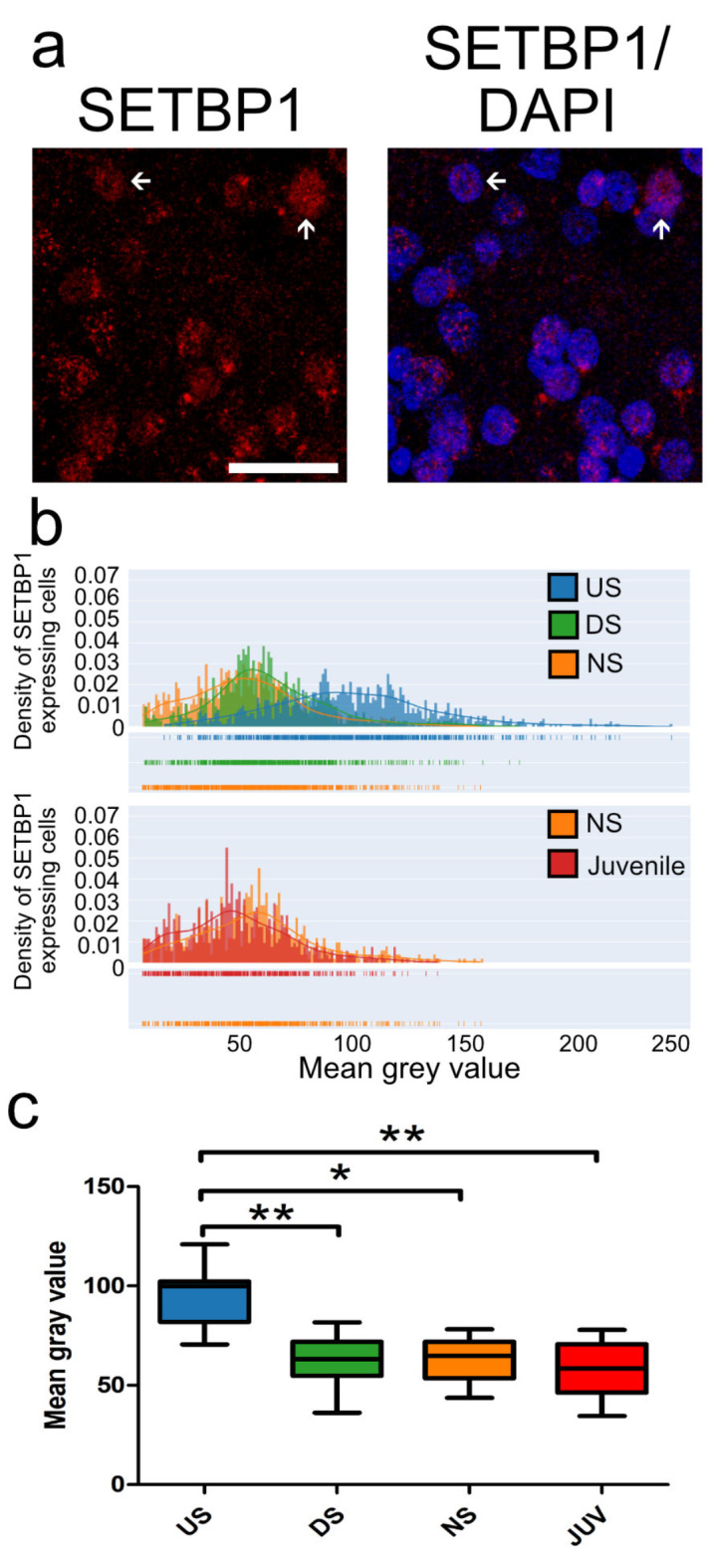
The mean intensity of zebra finch SETBP1 expression in neurons in Area X is higher in undirected singers. (a) Example of zebra finch SETBP1 immunostaining in Area X showing weak (arrowhead) and high (arrow) intensities (see also Fig. 4m). (b) Density plots of zebra finch SETBP1 pixel intensities of individual neurons in Area X of undirected singers (blue), directed singers (green), adult non-singers (orange) and juvenile non-singers (50PHDs, red). N = 3200 neurons of 23 zebra finches (c) Box plots showing the mean of all zebra finch SETBP1 neuron intensities plotted as a mean for each individual for the different conditions. Sample size: mean of US = 7, DS = 6, NS = 5 and Juveniles = 5. *p < 0.05; **p < 0.005, one-way ANOVA, Tukey’s Multiple Comparison Test. Scale bar: 50 μm.
SETBP1 co-localizes with FoxP1, FoxP2, and Parvalbumin in key nuclei of zebra finch song system
To further characterize the SETBP1-expressing neurons in HVC, RA, and Area X, we performed double immunohistochemistry alongside other key proteins involved in vocal learning, namely FoxP1 (expressed in HVC, RA and Area X) and FoxP2. For FoxP2, we focused on Area X because changes in its protein abundance have been shown during development and in response to singing. In contrast, only mRNA expression27, but not changes in protein expression during development or singing, has been previously observed in RA and HVC. Both FoxP1 and FoxP2 are recognized markers for medium spiny neurons (MSNs). We also included parvalbumin (PV; expressed in HVC, RA, and Area X), a marker for interneurons, which is also expressed in a subpopulation of projecting neurons in HVC and RA28. In HVC, we observed that SETBP1 co-localized (defined as the presence of two fluorochromes on the same physical structure in a neuron) with FoxP1 (Fig. 6a), indicating its expression in projection neurons of HVC29. Additionally, SETBP1 also co-localized with PV (Fig. 6b), indicating that SETBP1 is also expressed in at least PV-positive interneurons as well as glutamatergic projecting neurons in HVC. Similarly, co-localization of SETBP1 with FoxP1 (Fig. 6a) or PV (Fig. 6b) was also observed in RA. In Area X, SETBP1 co-localized with FoxP1 (Fig. 6a), PV (Fig. 6b), or FoxP2 (Fig. 7a). We quantified the percentage of neurons showing co-localization of SETBP1 with FoxP1, FoxP2, or PV in four singing conditions: NS, US, DS, and juvenile male zebra finches. The mean co-localization of SETBP1 and FoxP1 in Area X for NS birds was 53.50% ±6.444 (SEM), while it was 36.64% ± 3.245 (SEM) for DS birds, 36.43% ± 5.360 (SEM) for US birds, and 38.51% ± 8.456 (SEM) for juvenile birds (Fig. 6c, supplementary Table 2). The mean co-localization of zebra finch SETBP1 and FoxP2 in Area X for NS birds was 21.38% ± 4.506 (SEM), 27.13% ±2.917 (SEM) for DS birds, 25.92% ± 2.361 (SEM) for US birds and 20.79% ± 4.814 (SEM) for juvenile birds (Fig. 7b, supplementary Table 2). The mean co-localization of SETBP1 and PV in Area X for NS birds was 7.537% ± 1.324 (SEM), 5.39% ±1.236 (SEM) for DS birds, 5.626% ± 1.687 (SEM) for US birds, and 10.85% ± 4.043 (SEM) for juvenile birds (Fig. 6d, supplementary Table 2). The different singing conditions showed similar extent of SETBP1 co-localization with FoxP1, FoxP2 or PV in Area X (Fig. 6c-d and Fig. 7b). These results suggest that SETBP1 is expressed in interneurons and MSNs or projecting neurons in the brain regions we examined, and that the extent of co-localization with FoxP1, FoxP2, or PV remains stable during singing and zebra finch brain development.
Fig. 6.

SETBP1 co-localizes with FoxP1 and PV in Area X, HVC and RA. (a) SETBP1 (color-coded in red) and FoxP1 (pseudo color-coded in yellow) immunostainings showed colocalization in HVC, RA and Area X. SETBP1 is expressed in projection neurons in HVC and medium spiny neurons in Area X. (b) SETBP1 (color-coded in red) and Parvalbumin (pseudo color-coded in yellow) immunostainings showing colocalization in HVC, RA and Area X. SETBP1 is also expressed in interneurons in HVC and Area X. In all areas we show DAPI (color-coded in blue) and merge of all channels. Orthogonal views of the co-localizing cells are show in each panel. Arrows indicate examples of a neuron co-expressing SETBP1 with either FoxP1 or PV. Scale bar = 20 μm. (c) Box plots showing the mean percentage of zebra finch SETBP1 and FoxP1 co-localizing neurons in Area X under different conditions (US, DS, NS and juvenile). (d) Box plots showing the mean percentage of zebra finch SETBP1 and PV co-localizing neurons in Area X in different conditions (US, DS, NS and juvenile). Sample size (number of birds): mean of US = 7, DS = 6, NS = 5 and Juveniles = 5. No statistically significant differences between the experimental conditions were detected, one-way ANOVA, Tukey’s Multiple Comparison Test (values in supplementary Table 2).
Fig. 7.

SETBP1 and FoxP2 co-expressing neurons´ intensities correlate with undirected singing. (a) DAPI (color coded in blue), SETBP1 (color coded in red) and FoxP2 (pseudo color coded in yellow) immunostaining in Area X and merge of all channels, arrow pointing to the left highlights to a SETBP1+/FoxP2 + example, arrow pointing down a SETBP1+/FoxP2- neuron. Orthogonal views of the co-localizing cell are shown for each channel. (b) Box plots showing the mean percentage of zebra finch SETBP1 and FoxP2 co-localizing neurons in Area X in different conditions (US, DS, NS and juvenile). Sample size (number of birds): mean of US = 7, DS = 6, NS = 5 and Juveniles = 5. No statistically significant differences between the experimental conditions were detected, one-way ANOVA, Tukey’s Multiple Comparison Test (supplementary Table 2). (c) Density plots of pixel intensities of individual SETBP1 (orange) and FoxP2 (blue) co-localizing neurons in Area X of undirected singers (US), direct singers (DS), non- singers (NS) and 50 PHDs juvenile non-singers (Juvenile). On the right of the density plots we show correlation plots of intensities of SETBP1 and FoxP2 co-localizing neurons in Area X, undirected singers have a significant correlation (Spearman correlation, spearman r = 0.3149, p = 0.0044), all others did not (DS, spearman r = 0.1833, p = 0.1035; NS, spearman r = 0.2264, p = 0.0820; Juveniles, spearman r=-0.09064, p = 0.4910). We analyzed 60 neurons for NS (n = 3 birds), 80 neurons for US (n = 4 birds), 80 neurons for DS (n = 4 birds), and 60 neurons for juveniles (n = 3 birds). Scale bar = 20 μm.
Expression of SETBP1 and FoxP2 co-localizing medium spiny neurons of Area X changes during development and is induced by undirected singing
We next examined whether there is a correlation between SETBP1 and FoxP2 expression intensities in MSNs expressing both proteins in Area X under different singing conditions (Fig. 7). Our analyses showed that the fluorescence intensity distributions of SETBP1 and FoxP2 in Area X MSNs displayed different patterns in all singing conditions (Fig. 7c). US birds showed overall higher mean gray values (MGV), i.e. higher SETBP1 fluorescence intensities while having low-FoxP2 intensities (Fig. 7c). We only found a statistically significant positive correlation between the two proteins in MSNs in US birds (Spearman correlation, spearman r = 0.3149, p = 0.0044) but not in the other singing types (DS spearman r = 0.1833, p = 0.1035; NS spearman r = 0.2264, p = 0.0820) or in juvenile zebra finches (spearman r=-0.09064, p = 0.4910). Interestingly, although not statistically significant, juvenile birds exhibited higher FoxP2 intensities in neurons co-localizing with SETBP1 compared to all adult conditions (NS, US, and DS) (Fig. 7c). In DS and NS birds the majority of neurons in which SETBP1 and FoxP2 co-localized showed weak expression of both proteins. Altogether this suggests that SETBP1 and FoxP2 expression correlate in MSNs during US, a period of vocal practice.
Zebra finch SETBP1 regulates a zebra finch FoxP2 promoter in vitro
SETBP1 has been shown to directly regulate two promoters of FOXP2 in vitro in human cells13. We thus searched for these two promoter regions of FoxP2 in the zebra finch genome. We found two putative regions at similar distances from exon 1 of FoxP2 as described for humans (Fig. 8a)30. The promoter region we identified upstream of TSS1 is 2181 bp long and is 53.16% similar to the human promoter sequence. This promoter sequence is located about 329 kb upstream of the coding exon 1 of FoxP2. We identified the zebra finch FoxP2 promoter upstream of TSS2 at about 11 kb upstream of the first FoxP2 exon. The promoter region we identified upstream of TSS2 is 2501 bp long and 81.3% similar to the human sequence. In addition, two zebra finch 5´UTRs are known in the region of TSS2 (ENSTGUG00000005315:ENSTGUT00000043419.1 and ENSTGUG00000005315:ENSTGUT00000040986.1) (Fig. 8a). We used the promoter regions upstream of TSS1 and TSS2 of zebra finch FoxP2 to drive the expression of Luciferase protein (Photinus pyralis synthetic protein) and tested the regulatory effects of all zebra finch SETBP1 isoforms in HEK cells using a luciferase reporter assay. Human SETBP1 was shown to upregulate Luciferase expression via TSS1 and TSS2 of FOXP2 in vitro13. In contrast to human SETBP1, zebra finch SETBP1 could not regulate FoxP2 TSS1 (Fig. 8b). Luciferase expression via FoxP2 TSS2 was upregulated by all zebra finch SETBP1 isoforms significantly compared to the empty vector control (one-way ANOVA, followed by Tukey’s multiple comparison test, ∗∗∗p < 0.001; F = 50.76). Among zebra finch SETBP1 isoforms, we found that SETBP1-IsoC was the strongest activator of TSS2 (mean of 10.55 ± 0.3632, SEM) while SETBP1-IsoA was the weakest activator (7.924 ± 0.9074, SEM) (One-way ANOVA, Tukey’s Multiple Comparison Test, ∗p < 0.05, q = 5.549). Both SETBP1-IsoB (8.732 ± 0.1197, SEM) and -IsoD (9.281 ± 0.1552, SEM) led to moderate activation of FoxP2 TSS2.
Fig. 8.

Zebra finch SETBP1 regulates at least one promoter of zebra finch FoxP2 in vitro. (a) The genomic region of FoxP2 includes two transcription start sites (TSS, shown in red) and known untranslated regions (UTRs, depicted as white boxes) preceding the first coding exon of FoxP2 (green). These regions were used in luciferase assays with the overexpression of all zebra finch SETBP1 isoforms. b-c) Dot plot, each dot represents the mean of the luminescence measured from each experiment performed in triplicate, the red line is the mean of means, presented as normalized luciferase activity relative to empty vector control, corrected for transfection by pGL4.75 Renilla luciferase activity. (b) Luciferase assays with TSS1 and all SETBP1 isoforms, all were non-significant. (c) Significance levels from all SETBP1 isoforms to the empty vector control are represented by stars, ∗0.01 < p < 0.05; ∗∗∗p < 0.001. One-way ANOVA; F = 50.76; R squared = 0.9442, DF = 19; n = 5; followed by Tukey’s multiple comparison test; Luciferase assays with TSS2 and all zebra finch SETBP1 isoforms, all activated FoxP2 expression with isoform-C being the strongest activator.
Altogether, our data show that SETBP1 is expressed in regions important for vocal learning in the zebra finch brain, co-localized with proteins whose rare genetic disruptions are correlated with speech and song/vocal learning deficits, and that it can directly regulate FoxP2 expression.
Discussion
In the present study we systematically examined the SETBP1 expression in regions that are important for vocal learning in the male zebra finch brain. We showed that zebra finch SETBP1 has four isoforms, unlike in humans and mice. We characterized a commercial antibody for its use to detect the SETBP1 protein in the zebra finch brain. We showed that SETBP1 subcellular localization can be either nuclear or cytoplasmic. Furthermore, SETBP1 is expressed in important vocal nuclei in the brain of zebra finches and co-localizes with FoxP1 and FoxP2, whose rare genetic variants are correlated with human speech deficits. Undirected singing activity had the strongest effect on the expression of the SETBP1 protein in Area X, and this was positively correlated with FoxP2 expression and singing dynamics. Finally, we demonstrated the direct regulation of the FoxP2 transcript from TSS2 by all zebra finch SETBP1-isoforms in vitro. Overall, our data suggest that SETBP1 and FoxP2 co-localize in MSNs in a key vocal nucleus Area X and that SETBP1 might regulate FoxP2 expression in zebra finches. However, we would like to point out that while we used FoxP1 and FoxP2 proteins as markers for MSNs in Area X, mRNA sequencing data indicate that both proteins are not exclusive to MSNs and may also be expressed in other cell types31. Co-localization studies are needed to confirm the presence of these proteins in other cell types and whether SETBP1 is exclusively expressed in MSNs in Area X.
Similar to human SETBP1, the zebra finch SETBP1 protein has three nuclear localizing sequences and is predicted to show nuclear expression. However, it was shown that it can also show cytoplasmic expression1. In the brain of male zebra finches SETBP1 protein is mostly expressed in the nucleus, but cytoplasmic expression of SETBP1 was also consistently detected in nucleus rotundus. This could suggest a different functional role or regulation of SETBP1 as compared to all other brain regions analyzed where SETBP1 is only found in the nucleus. Human SETBP1 has been shown to function as a transcription factor and directly bind to DNA through the AT hooks and interaction with other proteins23. Thus far, only a few SETBP1 interactors have been identified and it remains unclear whether the interaction exists in the brain, let alone regions important for speech development and vocal learning. SETBP1 was first identified as it bound to the SET protein, an oncogene well-studied in non-neural tissues32. SETBP1 variants and functional dosage of SETBP1 protein may affect functions of SET such as (a) acetylation state of histones which are targets of the INHAT complex; (b) phosphorylation state of targets of PP2A protein; (c) DNA nuclease activity that may be important in DNA repair; and (d) cell cycle through CDKN1A and p5333. All these pathways may affect brain development. SET variants were linked to moderate intellectual disability and in most cases speech delays were reported34,35. Investigating the expression of SET protein in the brain would help to know where SETBP1 and SET may interact or not. Another known binding partner of SETBP1 is HCF123. HCF1 variants are linked to intellectual disability and in some cases speech deficiency36. However, HCF1 is highly expressed in embryonic brain tissue but not in the adult brain37, which might suggest that SETBP1 and HFC1 complex could be important during embryonic development but less during a learning context. HFC1 was shown to be expressed in interneurons38. Future studies mapping SETBP1 interaction partners will be helpful to understand how SETBP1 and its interactors contribute to vocal learning and speech development.
To date, there are limited studies that analyzed the expression of SETBP1 in the brain. There are thus far two studies showing SETBP1 expression in mouse cortical cells using single nucleus RNA-seq18 but this approach does not inform us of spatial localization or abundance of the SETBP1 protein. An individual with SGS was studied with serial MRI showing progressive atrophy in the white matter and especially in the basal ganglia5,39. Other regions shown to be affected were thalamus, brainstem and cerebellum. However, the expression of SETBP1 in these brain regions have not been investigated. Notably, we found high expression of SETBP1 in all these equivalent regions in the brain of male zebra finches (Fig. 4 and supplementary Fig. 2). Especially in basal ganglia, we demonstrated SETBP1 expression in MSNs and interneurons in Area X. Of note, SETBP1 expression is higher in undirected singers in MSNs of Area X compared to other singing conditions, implicating its potential role in vocal plasticity. In Area X, both low- and high-FoxP2-expressing MSNs have been found24. FoxP2 expression levels are crucial for vocal learning shown by the fact that downregulation17,40 or overexpression41 during song learning leads to song deficits. Both conditions inhibit dynamic behavioral regulation. Interestingly, we demonstrated that while the number of low-FoxP2-expressing neurons decreased upon singing, the same neurons also showed high SETBP1 level (Fig. 7b). Using an in vitro assay, we showed that SETBP1 can regulate a FoxP2 promoter and its expression. Together, this tight regulation of SETBP1 expression in Area X suggests that the expression levels of SETBP1 might be crucial for song plasticity in male zebra finches. Further investigation and functional studies will be informative to elucidate the specific role of zebra finch SETBP1 and the genes it regulates and interacts with in the regulation of vocal learning and/or song maintenance in zebra finches.
It is interesting that while both juveniles (vocal learning) and US (vocal practice) are highly plastic conditions, SETBP1 levels are low in Area X in juveniles (Figs. 5 and 7) relative to US, yet similar to DS and NS (low plasticity/low learning conditions). One possible explanation is that while the overall expression of SETBP1 is important, the expression of different SETBP1 isoforms might contribute differently to its functions. The fully characterized antibody used in this study detects more than one SETBP1 isoform, similar to other uncharacterized commercially available antibodies. While we showed that two SETBP1 isoforms are expressed in mesopallium, the isoform expression in different song nuclei and their functions in juveniles and adults remain unclear. Moreover, the upstream regulators of SETBP1 remains to be elucidated, which might influence SETBP1 (isoform) expression during development and different singing conditions. Alternatively, SETBP1 (and its isoforms) might interact with different interactors even though its overall expression might appear similar. Furthermore, different genes might be regulated by SETBP1 as a transcription factor and chromatin remodeler during development and in different singing conditions contributing to functional differences independent of expression levels. Future detailed investigation will help clarifying these important questions.
FoxP2 is differentially expressed in juvenile birds compared to adults in Area X42. This difference is evident when we analyze the intensities of FoxP2 in neurons co-localizing with SETBP1 (Fig. 7c). While both juveniles and adults that did not sing exhibited low SETBP1 intensity, the FoxP2 intensity in these neurons was higher in juveniles than in adults (Fig. 7c). It is unclear whether FoxP2 regulates SETBP1, but the variation in FoxP2 expression suggests that SETBP1 is not the sole regulator of FoxP2. In murine neocortical development, Foxp1 knockout led to a downregulation of SETBP143, suggesting that, at least in this context and in mice, Foxp1 could regulate SETBP1 expression.
SETBP1 regulates FoxP2 in both humans13 and zebra finches (Fig. 8c), as evidenced by the fact that conserved promoter regions in both species are regulated by SETBP113. Our in vitro data from HEK cells suggest that SETBP1 activates FoxP2 expression (Fig. 8c), but our findings indicate the opposite at the protein level (Fig. 7c), with high SETBP1 and low FoxP2 intensities in co-localizing neurons. Whether FoxP2 is upregulated in vivo as seen in vitro needs further confirmation. It is known that the same promoter can be regulated differently in different cells, as was the case with CNTNAP2 regulation by FoxP2 in G266 zebra finch cells and HEK cells44,45.
If SETBP1 regulates FoxP2, this could explain the vocal phenotype associated with SETBP1 loss-of-function (LoF) variants in humans9. However, the vocal deficits could also be independent of FoxP2. By regulating FoxP2, SETBP1 also influences FoxP2’s direct binding partners, namely FoxP1 and FoxP445,46. The FoxP subfamily of transcription factors is known to form homo- and heterodimers45, all of which are involved in varying degrees of speech deficits47–50. A lack of FoxP2 due to its regulation by SETBP1 would disrupt the balance of dimers expressed in a cell, thereby affecting FoxP-mediated regulation.
Overall, this is, to our knowledge, the first systematic characterization of SETBP1 expression in the brains of male zebra finches, a well-established vocal learning model. We showed that SETBP1 is dynamically expressed in song nucleus Area X in male zebra finches and significantly positively correlated with expression of FoxP2, an important regulator of song learning that can itself be regulated by SETBP1. This suggests a potential role for zebra finch SETBP1 in the regulation of vocal learning and/or song maintenance. Our study provides important insights into the zebra finch SETBP1 gene, its expression, and its singing-induced and developmental regulation.
Materials and methods
Animals and brain sectioning
All male zebra finches used in this study were obtained from a breeding colony at the Free Universität, Berlin. The animal husbandry, breeding, and experimental procedures were conducted in strict compliance with the regulations and permits granted by the local Berlin authorities governing research involving animals (TierSchG). For this study, a total of five juvenile zebra finches, aged 50 ± 2 post-hatching days (PHD), and five adult male birds (> 100 PHDs) were used. Both of these conditions were non-singing (NS) birds, for which they were recorded for two hours after lights-on, and individuals that sang less than 10 motifs in the last 30 min were selected. In addition, we had adult male zebra finches that were chosen if they would sing more than 100 motifs in the last 30 min. This was the undirected singer (US) group. Lastly, we had adult zebra finches that were presented with adult females to encourage directed-singing (DS) or courtship song. To ensure that male zebra finches were singing directly to the females, we video-recorded these experiments and exchanged the females every 5 min. Again, only birds that sang more than 100 motifs in the last 30 min were chosen. Birds that met these criteria were quickly euthanized with an overdose of isoflurane and, after death was confirmed, were transcardially perfused with PBS followed by 4% paraformaldehyde (PFA) in phosphate buffer. Brains were dissected carefully and were kept in 4% PFA overnight for postfixation, then transferred to PBS until they were cut into 70 μm thick sagittal sections in the Vibratome (LEICA VT1000S) and stored in wells with PBS until further processing for immunohistochemistry. We confirm that our study is reported in accordance with ARRIVE guidelines. All experiments were approved by the Animal Behaviour Institute of the Free University in Berlin and were performed in accordance with relevant guidelines and regulations. A total of five NS, seven US, six DS, and five juvenile birds were used in this study. The number of birds used for each method and analysis is specified for each method and in the figure legends.
Cloning of SETBP1 cDNAs from zebra finch brain
cDNA from the brains of zebra finches, prepared in our laboratory51, was used to clone SETBP1. The coding sequence (CDS) of SETBP1 was downloaded from Ensembl (https://www.ensembl.org/index.html) after searching the zebra finch genome for SETBP1 (ENSTGUG00000001615.2). Primers were designed to amplify the entire coding region of zebra finch SETBP1, spanning 4845 base pairs (bp) (first set of primers: 5´-gatGGTACCATGGAGCCCAGAGAGACTTTGAG-3´ forward and 5´-atcGAATTCTTAGGGAAGGCCTTCACTTTCGC-3´ reverse). The forward primer has a KpnI and the reverse an EcoRI restriction site. The resulting polymerase chain reaction (PCR) product using Phusion High-Fidelity DNA Polymerase (Thermo Scientific F-5345) was examined on an agarose gel, cleaned from nucleotides with the Qiaquick PCR purification kit (Qiagen, Chatsworth, CA), and cloned into the pcDNA3.1 vector using the mentioned restriction sites. Initially, we obtained clones with SETBP1-IsoA and -IsoB. To specifically discern between the other isoforms, a series of PCRs with a different set of primers (second set of primers: 5´-ACCACCAAGAGAGCGAAGAA-3´ forward and 5´-CACAGGGAACCCACACTC-3´ reverse; 5´-CCTTGGTGGCACTAATTGCT-3´ forward and 5´-GTGGTTGCAGAAAAGGGAAA-3´ reverse, in both cases resulting in two bands indicating the presence of isoC and isoD in tissue) was done to see if they would express SETBP1 from cDNA. A first amplification round was done with the first set of primers, and clones were picked and genotyped using the second set of primers to select for the remaining isoforms. At least four clones were sequenced for each isoform. The sequences of the four SETBP1 isoforms were deposited to NCBI (NCBI accession numbers: OR257526-OR257529).
Antibody characterization
The protein sequence of SETBP1 from zebra finches was utilized to search for antibodies that would be compatible. The antibody with the most conserved sequence found in our epitope comparisons was the rabbit polyclonal anti-SETBP1 (Invitrogen, rabbit polyclonal, PA5-96609 batch XC358766A, concentration 1.82 mg/ml, RRID: AB_2808411) with an epitope between amino acids 1-242 of human SETBP1. To characterize this SETBP1 antibody, the zebra finch SETBP1-IsoA (longest) and -isoB (shortest) proteins were expressed in HEK293 cells followed by western blotting, showing a band corresponding to approximately 185 kDa molecular weight in each case. Furthermore, to characterize the antibodies for immunohistochemistry, the two SETBP1 isoforms were overexpressed again in HEK cells and detected with the SETBP1 antibody. Negative controls were prepared by omitting the primary antibodies (NPC) or using empty vectors. In both SETBP1-overexpressing conditions, but not with NPC or empty vector, a signal was detected by immunohistochemistry. Additionally, to block the antibody before incubation on the slides, we preincubated 1 µl of the SETBP1 antibody with 25 µl of zebra finch SETBP1-isoA or -isoB overexpressing protein lysate in PBS/0.3% Triton-X100 in an ending volume of 500 µl, using NPC or 25 µl of empty vector lysate as a control. The antibody alone or the antibody with protein lysates were incubated for 120 min at 4 °C before proceeding with the immunohistochemistry protocol. Only in slices that had no pre-incubation with SETBP1 protein lysate or empty vector lysate did we find a signal, but detection was abolished or diminished in the slices that were pre-incubated with SETBP1 overexpression lysates. The specificity of the FoxP1 antibody (Abcam, mouse monoclonal, ab32010, RRID: AB_1141518) had previously been determined using transient overexpression of human or zebra finch FoxP1 in HEK293 cells and peptide blocking29,45. The specificity of the FoxP2 antibody (Abcam, goat polyclonal, ab1307, RRID: AB_1268914) was characterized for zebra finches by western blot and peptide blocking24. The specificity of the parvalbumin (PV) antibody (Swant, mouse monoclonal, PV 235, RRID: AB_10000343) was characterized for zebra finches52.
Western blotting
Western blot was conducted following the protocol described previously45, with the following modifications. Protein concentration was quantified using BCA1 from Sigma. Thirty micrograms of protein lysate were separated by 6% Bis-Tris Gel, then transferred to a polyvinylidene fluoride membrane (Roche, Indianapolis, IN, USA), and blocked with Roti-Immunoblock for 2 h. The membranes were then incubated with the SETBP1 antibody (dilution 1/10000) overnight at 4 °C. Subsequently, the membranes were washed three times with PBS/0.1% Tween 20, followed by incubation with a donkey anti-rabbit IgG POD F(ab’)2 (dilution 1/200,000, Amersham NA9340, RRID: AB_772191) for another 30 min. Binding was detected on X-ray films using a Western Lightning Plus Chemiluminescent Substrate detection system for HRP (Perkin-Elmer, Boston, MA, USA, NEL103E001EA).
DAB-Immunohistochemistry
DAB-immunostaining was performed following the previously described protocol24, with the following modifications. After washing the slices with PBS containing 3% Triton for 15 min, repeated six times, the slices were blocked for 1 h in ROTI®Immuno Block. Subsequently, the sections were incubated overnight with a primary antibody against SETBP1 (dilution 1:500) in 0.1% Triton/0.1 M PBS, applied to the slices at 4 °C overnight. For the secondary antibody, a goat anti-rabbit (Vector Laboratories, Biotinylated, BA-1000, RRID: AB_2313606) was used at a dilution of 1:200. All sections were processed in one batch. Images were captured using the 5x and 63x objectives with an inverted Zeiss microscope under the same settings for all slices.
Double fluorescent-Immunohistochemistry
Double-immunostainings were performed following the previously described protocol29, with the following modifications. We utilized 70 μm thick vibratome slices for the experiment, and all conditions were conducted in the same batch. Sections were blocked with 1x ROTI®Immuno Block for 1 h at room temperature (RT). The antibody dilutions used were as follows: anti-FoxP1, anti-FoxP2, and anti-PV at a dilution of 1:1000, and anti-SETBP1 at a dilution of 1:500. For the secondary antibodies, we used donkey anti-goat (Invitrogen, Alexa 488, A11055, RRID: AB_2534102), donkey anti-mouse (Invitrogen, Alexa 488, A21202, RRID: AB_141607), and donkey anti-rabbit (Invitrogen, Alexa 568, A10042, RRID: AB_2534017), all at a dilution of 1:200. To visualize nuclei, all sections were counterstained with 4′,6-Diamidin-2-phenylindol (DAPI, Serva). Co-localization data were analyzed by manually counting co-localization in 200 × 200 μm confocal images using the cell counter tool of the Fiji software package53. The co-localization of zebra finch SETBP1 with either FoxP1, FoxP2, or PV was analyzed in a total of NS (n = 5), US (n = 7), DS (n = 6), and juvenile (n = 5) samples.
Confocal imaging and quantification of intensities from fluorescent-Immunohistochemistry
Z-stacks of zebra finch SETBP1 and co-localization experiments in Area X were acquired with a SP8-1 confocal microscope (Leica). All microscope settings were kept constant for all conditions and slices. Scans of all conditions were performed using a 40x lens with an image size of 1024 × 1024 pixels and a z-stack size of 1 μm. The acquired images were processed using the Fiji software package53. For each condition, we quantified an area of 200 × 200 μm randomly placed in the acquired image. The Rolling Ball Background Subtraction plugin was utilized to subtract background, and only nuclei with a mean gray value (MGV) > 25 were quantified. We measured the mean gray values of nuclear SETBP1, or nuclear SETBP1 and nuclear FoxP2 in SETBP1+/FoxP2 + confirmed nuclei, by positioning a circle of 6 μm in diameter in the center of the positive nucleus. The intensity of the SETBP1-dependent fluorescence was analyzed in a total of 637 neurons for NS (n = 5 birds), 994 neurons for US (n = 7 birds), 909 neurons for DS (n = 6 birds), and 660 neurons for juveniles (n = 5 birds). For SETBP1+/FoxP2 + co-localization, the fluorescence intensity of zebra finch SETBP1 and FOXP2 was analyzed in each neuron. We analyzed 60 neurons for NS (n = 3 birds), 80 neurons for US (n = 4 birds), 80 neurons for DS (n = 4 birds), and 60 neurons for juveniles (n = 3 birds).
Cloning of FoxP2 Promoters
Genomic DNA from the blood of an adult male zebra finch was used as the template to amplify the promoter regions upstream of FoxP2 TSS1 and TSS2. We downloaded 380 kB of the PacBio54 sequence upstream of the first coding exon of FoxP2 and aligned the sequences upstream of TSS1 and TSS2 from humans to it30. Primers were designed to amplify the entire genomic region upstream of TSS1 of the zebra finch, spanning 2,181 bp (5´-gatGCTAGCGGCATTTCACTCAGCCTCAT-3´ forward and 5´-atcAGGCCTCCCGGGTACTTTTTCCAGA-3´ reverse), and TSS2, spanning 2,501 bp (5´-gatGCTAGCTGGGTAAAATGAGAATGTAGGC-3´ forward and 5´-atcAGGCCTTCCCAGACTGATGGCATTTT-3´ reverse). Both forward primers have an NheI restriction site, and the reverse primers have a StuI restriction site. Platinum SuperFi II DNA polymerase (Invitrogen 12361010) was used to amplify the fragments. The resulting polymerase chain reaction (PCR) product was examined on an agarose gel, cleaned from nucleotides with the Qiaquick PCR purification kit (Qiagen, Chatsworth, CA), and cloned into the pGL4.13 vector using the mentioned restriction sites. We sequenced at least four clones for each of the TSS. A consensus sequence was deposited in NCBI, and the accession numbers of both TSS are OR270935 and OR270936.
Luciferase promoter reporter assays for FoxP2 promoters
Luciferase assays were conducted in HEK293 cells following the previously described protocol45,55. Five luciferase assays for each TSS were performed, with each assay conducted after an independent transfection. Within each assay, triplicates were run, meaning three wells contained the same transfection reagents and quantity of cells. The mean of the triplicates was utilized for statistical analysis. Each plate was measured once in the ELISA reader. Luminescence was measured using the Dual Glo Luciferase Kit (Promega) following the manufacturer’s protocol in an ELISA plate reader (Tecan, GENios; Switzerland). The mean background from untransfected wells was subtracted from all other wells. Luciferase results are presented as the mean normalized Luciferase activity relative to the control from five independent assays.
Statistics
GraphPad and Python were utilized to generate all graphs and analyze data. A significance level of p < 0.05 was set for all tests. For the analysis of co-localization, GraphPad was used, and statistical significance was assessed using ANOVA followed by Tukey’s multiple comparison test. For the analysis of SETBP1 intensities, the mean intensity of each bird was analyzed using ANOVA followed by Tukey’s multiple comparison test. Density plots were generated using the kernel density estimation method in Python. For the analysis of correlation between singing and SETBP1 intensities, as well as the correlation between zebra finch SETBP1 and FoxP2 intensities, Spearman correlation analysis was employed. For the Luciferase assays, a one-way ANOVA followed by Tukey’s multiple comparison test was conducted.
Electronic supplementary material
Below is the link to the electronic supplementary material.
Acknowledgements
Ezequiel Mendoza was supported FU Starting Grant, Nr. 43 mit FK-Beschluss vom 06.02.2023. Maggie MK Wong is supported by Max Planck Society. We sincerely thank Ursula Kobalz and Nshdejan Arpik for their invaluable technical assistance. We would like to express our gratitude to Prof. Constance Scharff, Prof. Katja Nowick, and Sophie Holtz for their invaluable assistance in proofreading and providing critical feedback on the manuscript. Additionally, we would like to acknowledge the support of the Core Facility BioSupraMol, which is funded by the DFG.
Author contributions
EM and MMKW conceived general idea and together with DG, SLPdeC and ND designed all experiments. EM was involved in SETBP1 cloning. EM and SLPdeC searched for antibodies. DG, SLPdeC and EM generated all zebra finch conditions and co-localization and intensity data. EM scanned all confocal images. ND generated all DAB staining and took all DAB images. EM and MMKW were involved in cloning of TSSs of FoxP2 and luciferase assays. EM, DG and MMKW generated all figures. EM, PN and DG analyze the data and conducted statistical analysis. EM took lead in writing the manuscript. All authors provided critical feedback and helped shape the manuscript.
Funding
Open Access funding enabled and organized by Projekt DEAL.
Data availability
The sequences of the four zebra finch SETBP1 isoforms were deposited to NCBI (NCBI accession numbers: OR257526-OR257529). Additionally, the consensus sequences of both TSS used for luciferase assays were deposited in NCBI with the accession numbers OR270935 and OR270936.
Declarations
Competing interests
The authors declare no competing interests.
Footnotes
The original online version of this Article was revised: In the original version of this Article Maggie Mei-Ki Wong and Ezequiel Mendoza were omitted as equally contributing authors.
Publisher’s note
Springer Nature remains neutral with regard to jurisdictional claims in published maps and institutional affiliations.
These authors contributed equally: Maggie Mei-Ki Wong and Ezequiel Mendoza.
Change history
2/12/2025
A Correction to this paper has been published: 10.1038/s41598-025-89141-7
References
- 1.Minakuchi, M. et al. Identification and characterization of SEB, a novel protein that binds to the acute undifferentiated leukemia-associated protein SET. Eur. J. Biochem. 268 (5), 1340–1351 (2001). [DOI] [PubMed] [Google Scholar]
- 2.Ott, M. G. et al. Correction of X-linked chronic granulomatous disease by gene therapy, augmented by insertional activation of MDS1-EVI1, PRDM16 or SETBP1. Nat. Med. 12 (4), 401–409 (2006). [DOI] [PubMed] [Google Scholar]
- 3.Panagopoulos, I. et al. Fusion of NUP98 and the SET binding protein 1 (SETBP1) gene in a paediatric acute T cell lymphoblastic leukaemia with t(11;18)(p15;q12). Br. J. Haematol. 136 (2), 294–296 (2007). [DOI] [PubMed] [Google Scholar]
- 4.Piazza, R. et al. Recurrent SETBP1 mutations in atypical chronic myeloid leukemia. Nat. Genet. 45 (1), 18–24 (2013). [DOI] [PMC free article] [PubMed] [Google Scholar]
- 5.Hoischen, A. et al. De novo mutations of SETBP1 cause Schinzel-Giedion syndrome. Nat. Genet. 42 (6), 483–485 (2010). [DOI] [PubMed] [Google Scholar]
- 6.Acuna-Hidalgo, R. et al. Overlapping SETBP1 gain-of-function mutations in Schinzel-Giedion syndrome and hematologic malignancies. PLoS Genet. 13 (3), e1006683 (2017). [DOI] [PMC free article] [PubMed] [Google Scholar]
- 7.Coe, B. P. et al. Refining analyses of copy number variation identifies specific genes associated with developmental delay. Nat. Genet. 46 (10), 1063–1071 (2014). [DOI] [PMC free article] [PubMed] [Google Scholar]
- 8.Jansen, N. A. et al. Clinical delineation of SETBP1 haploinsufficiency disorder. Eur. J. Hum. Genet. 29 (8), 1198–1205 (2021). [DOI] [PMC free article] [PubMed] [Google Scholar]
- 9.Morgan, A. et al. Speech and language deficits are central to SETBP1 haploinsufficiency disorder. Eur. J. Hum. Genet. 29 (8), 1216–1225 (2021). [DOI] [PMC free article] [PubMed] [Google Scholar]
- 10.Kaspi, A. et al. Genetic aetiologies for childhood speech disorder: novel pathways co-expressed during brain development. Mol. Psychiatry. 28 (4), 1647–1663 (2023). [DOI] [PMC free article] [PubMed] [Google Scholar]
- 11.Eising, E. et al. A set of regulatory genes co-expressed in embryonic human brain is implicated in disrupted speech development. Mol. Psychiatry. 24 (7), 1065–1078 (2019). [DOI] [PMC free article] [PubMed] [Google Scholar]
- 12.Hildebrand, M. S. et al. Severe childhood speech disorder. Neurology. 94 (20), e2148–e2167 (2020). [DOI] [PubMed] [Google Scholar]
- 13.Wong, M. M. K. et al. SETBP1 variants outside the degron disrupt DNA-binding and transcription independent of protein abundance to cause a heterogeneous neurodevelopmental disorder. medRxiv, : p. 2022.03.04.22271462. (2022).
- 14.Bolhuis, J. J., Okanoya, K. & Scharff, C. Twitter evolution: converging mechanisms in birdsong and human speech. Nat. Rev. Neurosci. 11 (11), 747–759 (2010). [DOI] [PubMed] [Google Scholar]
- 15.Doupe, A. J. & Kuhl, P. K. Birdsong and human speech: common themes and mechanisms. Annu. Rev. Neurosci. 22, 567–631 (1999). [DOI] [PubMed] [Google Scholar]
- 16.Lai, C. S. et al. A forkhead-domain gene is mutated in a severe speech and language disorder. Nature. 413 (6855), 519–523 (2001). [DOI] [PubMed] [Google Scholar]
- 17.Norton, P. et al. Differential Song deficits after lentivirus-mediated knockdown of FoxP1, FoxP2, or FoxP4 in Area X of Juvenile Zebra finches. J. Neurosci. 39 (49), 9782–9796 (2019). [DOI] [PMC free article] [PubMed] [Google Scholar]
- 18.Whitlock, J. H. et al. Cell-type-specific gene expression and regulation in the cerebral cortex and kidney of atypical Setbp1S858R Schinzel Giedion syndrome mice. J. Cell. Mol. Med. 27 (22), 3565–3577 (2023). [DOI] [PMC free article] [PubMed] [Google Scholar]
- 19.Whitlock, J. H. et al. The landscape of < em > SETBP1 gene expression and transcription factor activity across human tissues. bioRxiv, : p. 2023.08.08.551337. (2023). [DOI] [PMC free article] [PubMed]
- 20.Banfi, F. et al. SETBP1 accumulation induces P53 inhibition and genotoxic stress in neural progenitors underlying neurodegeneration in Schinzel-Giedion syndrome. Nat. Commun. 12 (1), 4050 (2021). [DOI] [PMC free article] [PubMed] [Google Scholar]
- 21.Zaghi, M. et al. Balanced SET levels favor the correct enhancer repertoire during cell fate acquisition. Nat. Commun. 14 (1), 3212 (2023). [DOI] [PMC free article] [PubMed] [Google Scholar]
- 22.Cardo, L. F., de la Fuente, D. C. & Li, M. Impaired neurogenesis and neural progenitor fate choice in a human stem cell model of SETBP1 disorder. Mol. Autism. 14 (1), 8 (2023). [DOI] [PMC free article] [PubMed] [Google Scholar]
- 23.Piazza, R. et al. SETBP1 induces transcription of a network of development genes by acting as an epigenetic hub. Nat. Commun. 9 (1), 2192 (2018). [DOI] [PMC free article] [PubMed] [Google Scholar]
- 24.Thompson, C. K. et al. Young and intense: FoxP2 immunoreactivity in Area X varies with age, song stereotypy, and singing in male zebra finches. Front. Neural Circuits. 7, 24 (2013). [DOI] [PMC free article] [PubMed] [Google Scholar]
- 25.Kosubek-Langer, J. & Scharff, C. Dynamic FoxP2 levels in male zebra finches are linked to morphology of adult-born Area X medium spiny neurons. Sci. Rep. 10 (1), 4787 (2020). [DOI] [PMC free article] [PubMed] [Google Scholar]
- 26.Palmer, S. E. et al. Temporal sequences of spikes during practice code for time in a complex motor sequence.
- 27.Colquitt, B. M. et al. Cellular transcriptomics reveals evolutionary identities of songbird vocal circuits. Science, 371(6530), pp. 1-12 (2021). [DOI] [PMC free article] [PubMed]
- 28.Wild, J. M., Williams, M. N. & Suthers, R. A. Parvalbumin-positive projection neurons characterise the vocal premotor pathway in male, but not female, zebra finches. Brain Res. 917 (2), 235–252 (2001). [DOI] [PubMed] [Google Scholar]
- 29.Mendoza, E. et al. Differential coexpression of FoxP1, FoxP2, and FoxP4 in the Zebra Finch (Taeniopygia guttata) song system. J. Comp. Neurol. 523 (9), 1318–1340 (2015). [DOI] [PubMed] [Google Scholar]
- 30.Becker, M. et al. Mapping of human FOXP2 enhancers reveals Complex Regulation. Front. Mol. Neurosci. 11, 47 (2018). [DOI] [PMC free article] [PubMed] [Google Scholar]
- 31.Xiao, L. et al. Functional Identification of Specialized Basal Ganglia Circuits that Regulate Vocal Motor Sequences. bioRxiv, : p. 2020.03.14.991042. (2020).
- 32.von Lindern, M. et al. Can, a putative oncogene associated with myeloid leukemogenesis, may be activated by fusion of its 3’ half to different genes: characterization of the set gene. Mol. Cell. Biol. 12 (8), 3346–3355 (1992). [DOI] [PMC free article] [PubMed] [Google Scholar]
- 33.Antonyan, L. & Ernst, C. Putative roles of SETBP1 dosage on the SET Oncogene to affect Brain Development. Front. Neurosci. 16, 813430 (2022). [DOI] [PMC free article] [PubMed] [Google Scholar]
- 34.Stevens, S. J. C. et al. De novo mutations in the SET nuclear proto-oncogene, encoding a component of the inhibitor of histone acetyltransferases (INHAT) complex in patients with nonsyndromic intellectual disability. Hum. Mutat. 39 (7), 1014–1023 (2018). [DOI] [PubMed] [Google Scholar]
- 35.Pan, X. et al. Whole exome sequencing and transcriptome analysis in two unrelated patients with novel SET mutations. J. Hum. Genet. 68 (12), pp 867-74 (2023). [DOI] [PubMed]
- 36.Castro, V. L. & Quintana, A. M. The role of HCFC1 in syndromic and non-syndromic intellectual disability. Med. Res. Archives, 8(6). (2020). [DOI] [PMC free article] [PubMed]
- 37.Wilson, A. C. et al. The gene encoding the VP16-accessory protein HCF (HCFC1) resides in human Xq28 and is highly expressed in fetal tissues and the adult kidney. Genomics. 25 (2), 462–468 (1995). [DOI] [PubMed] [Google Scholar]
- 38.Minocha, S. & Herr, W. Cortical and commissural defects upon HCF-1 loss in Nkx2.1-Derived embryonic neurons and Glia. Dev. Neurobiol. 79 (6), 578–595 (2019). [DOI] [PMC free article] [PubMed] [Google Scholar]
- 39.Takeuchi, A. et al. Progressive brain atrophy in Schinzel-Giedion syndrome with a SETBP1 mutation. Eur. J. Med. Genet. 58 (8), 369–371 (2015). [DOI] [PubMed] [Google Scholar]
- 40.Haesler, S. et al. Incomplete and inaccurate vocal imitation after knockdown of FoxP2 in songbird basal ganglia nucleus area X. PLoS Biol. 5 (12), e321 (2007). [DOI] [PMC free article] [PubMed] [Google Scholar]
- 41.Heston, J. B. & White, S. A. Behavior-linked FoxP2 regulation enables zebra finch vocal learning. J. Neurosci. 35 (7), 2885–2894 (2015). [DOI] [PMC free article] [PubMed] [Google Scholar]
- 42.Haesler, S. et al. FoxP2 expression in avian vocal learners and non-learners. J. Neurosci. 24 (13), 3164–3175 (2004). [DOI] [PMC free article] [PubMed] [Google Scholar]
- 43.Ortiz, A. et al. Cell type specific roles of FOXP1 during early neocortical murine development. bioRxiv, : p. 2024.06.08.598089. (2024).
- 44.Adam, I. et al. CNTNAP2 is a direct FoxP2 target in vitro and in vivo in zebra finches: complex regulation by age and activity. Genes Brain Behav. 16 (6), 635–642 (2017). [DOI] [PubMed] [Google Scholar]
- 45.Mendoza, E. & Scharff, C. Protein-protein Interaction among the FoxP family members and their regulation of two target genes, VLDLR and CNTNAP2 in the Zebra Finch Song System. Front. Mol. Neurosci. 10, 112 (2017). [DOI] [PMC free article] [PubMed] [Google Scholar]
- 46.Li, S. R., Weidenfeld, J. & Morrisey, E. E. Transcriptional and DNA binding activity of the Foxp1/2/4 family is modulated by heterotypic and homotypic protein interactions. Mol. Cell. Biol. 24 (2), 809–822 (2004). [DOI] [PMC free article] [PubMed] [Google Scholar]
- 47.Sollis, E. et al. Identification and functional characterization of de novo FOXP1 variants provides novel insights into the etiology of neurodevelopmental disorder. Hum. Mol. Genet. 25 (3), 546–557 (2016). [DOI] [PubMed] [Google Scholar]
- 48.Sollis, E. et al. Equivalent missense variant in the FOXP2 and FOXP1 transcription factors causes distinct neurodevelopmental disorders. Hum. Mutat. 38 (11), 1542–1554 (2017). [DOI] [PubMed] [Google Scholar]
- 49.Myers, A. et al. FOXP1 haploinsufficiency: phenotypes beyond behavior and intellectual disability? Am. J. Med. Genet. A. 173 (12), 3172–3181 (2017). [DOI] [PubMed] [Google Scholar]
- 50.Charng, W. L. et al. Exome sequencing in mostly consanguineous arab families with neurologic disease provides a high potential molecular diagnosis rate. BMC Med. Genomics. 9 (1), 42 (2016). [DOI] [PMC free article] [PubMed] [Google Scholar]
- 51.Olias, P. et al. Reference genes for quantitative gene expression studies in multiple avian species. PLoS One. 9 (6), e99678 (2014). [DOI] [PMC free article] [PubMed] [Google Scholar]
- 52.Scotto-Lomassese, S. et al. HVC interneurons are not renewed in adult male zebra finches. Eur. J. Neurosci. 25 (6), 1663–1668 (2007). [DOI] [PubMed] [Google Scholar]
- 53.Schindelin, J. et al. Fiji: an open-source platform for biological-image analysis. Nat. Methods. 9 (7), 676–682 (2012). [DOI] [PMC free article] [PubMed] [Google Scholar]
- 54.Korlach, J. et al. De novo PacBio long-read and phased avian genome assemblies correct and add to reference genes generated with intermediate and short reads. Gigascience. 6 (10), 1–16 (2017). [DOI] [PMC free article] [PubMed] [Google Scholar]
- 55.Adam, I. et al. FoxP2 directly regulates the reelin receptor VLDLR developmentally and by singing. Mol. Cell. Neurosci. 74, 96–105 (2016). [DOI] [PubMed] [Google Scholar]
Associated Data
This section collects any data citations, data availability statements, or supplementary materials included in this article.
Supplementary Materials
Data Availability Statement
The sequences of the four zebra finch SETBP1 isoforms were deposited to NCBI (NCBI accession numbers: OR257526-OR257529). Additionally, the consensus sequences of both TSS used for luciferase assays were deposited in NCBI with the accession numbers OR270935 and OR270936.