



Abstract
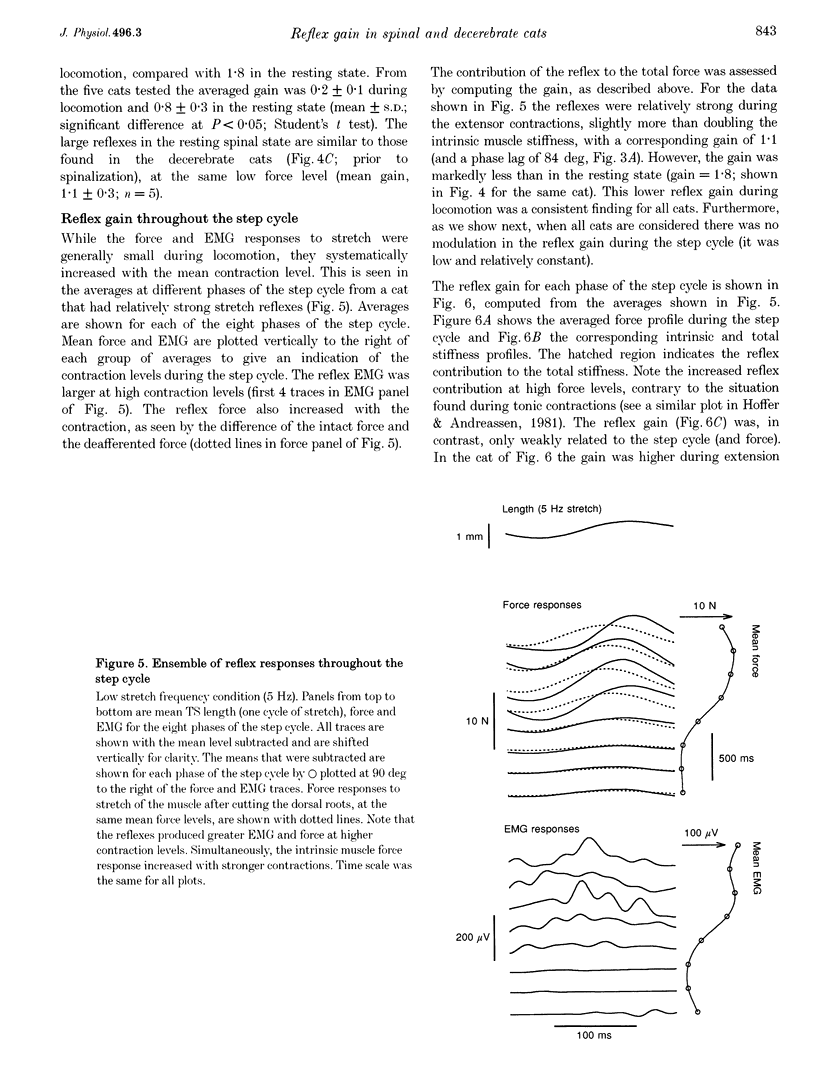
1. The triceps surae (TS) stretch reflex was measured in decerebrate cats during crossed extensor stimulation and after spinalization during rhythmic locomotor activity induced by clonidine and manual perineal stimulation. The TS force in response to sinusoidal stretch was measured at a given contraction level before and after deafferentation, and the 'reflex force' was computed by subtracting these two responses. Reflex 'gain' was computed as the ratio of the reflex and deafferented force responses (a unitless estimate of the open loop feedback gain). 2. Prior to locomotion the spontaneous muscle activity was low (less than 15% of maximum), but the reflex gain was relatively high (close to 1.0 with a 5 Hz stretch). When locomotion commenced the reflex gain was markedly lowered when measured at the same contraction level as before locomotion (25% of the gain prior to locomotion). At higher contraction levels the reflex gain was not significantly increased. The reflex force and EMG responses to stretch increased with the contraction level, but their effect on the total reflex gain was cancelled by an associated increase in the intrinsic muscle stiffness. 3. In the decerebrate cat, during weak tonic contractions (spontaneous), the reflex gain was high and comparable with the gain in the resting spinal cat. However, with increased tonic contractions produced by crossed extensor stimulation the reflex gain dropped. At higher contraction levels the gain was not significantly different from the gain during spinal locomotion. 4. When the frequency of stretch was increased from 3 to 20 Hz, EMG responses to stretch increased, but the reflex force decreased, since a more fused contraction developed with the more frequent reflex activations. Overall, the reflex gain decreased with frequency in both spinal and decerebrate cats. The phase lag of the reflex force, relative to the intrinsic muscle force, increased with increasing frequency, due to reflex delays, with a 180 deg lag occurring between 12 and 18 Hz (tremor frequencies). The mean gain was significantly lower and the phase lag was significantly greater during locomotion than during tonic crossed extensor contractions, suggesting different reflex mechanisms. 5. In conclusion, during locomotion in spinal cats afferent feedback from low frequency ankle movements, similar to those occurring during the normal step cycle, reflexly produces a small but significant fraction of the extensor force (about a quarter of the stretch-related force modulation). This fraction is remarkably constant at the different contraction levels of the step cycle. Afferent feedback during higher frequency movement is less effective, minimizing the chance of instability and tremor. In contrast during tonic contractions afferent feedback produces half of the total muscle force during perturbations, clearly contributing to the maintenance of posture.
Full text
PDF





Selected References
These references are in PubMed. This may not be the complete list of references from this article.
- Akazawa K., Aldridge J. W., Steeves J. D., Stein R. B. Modulation of stretch reflexes during locomotion in the mesencephalic cat. J Physiol. 1982 Aug;329:553–567. doi: 10.1113/jphysiol.1982.sp014319. [DOI] [PMC free article] [PubMed] [Google Scholar]
- Allum J. H., Mauritz K. H., Vögele H. The mechanical effectiveness of short latency reflexes in human triceps surae muscles revealed by ischaemia and vibration. Exp Brain Res. 1982;48(1):153–156. doi: 10.1007/BF00239584. [DOI] [PubMed] [Google Scholar]
- Andén N. E., Jukes M. G., Lundberg A., Vyklický L. The effect of DOPA on the spinal cord. 1. Influence on transmission from primary afferents. Acta Physiol Scand. 1966 Jul-Aug;67(3):373–386. doi: 10.1111/j.1748-1716.1966.tb03324.x. [DOI] [PubMed] [Google Scholar]
- Bawa P., Mannard A., Stein R. B. Effects of elastic loads on the contractions of cat muscles. Biol Cybern. 1976;22(3):129–137. doi: 10.1007/BF00365523. [DOI] [PubMed] [Google Scholar]
- Bayev K. V., Kostyuk P. G. Polarization of primary afferent terminals of lumbosacral cord elicited by the activity of spinal locomotor generator. Neuroscience. 1982 Jun;7(6):1401–1409. doi: 10.1016/0306-4522(82)90253-6. [DOI] [PubMed] [Google Scholar]
- Bennett D. J., De Serres S. J., Stein R. B. Regulation of soleus muscle spindle sensitivity in decerebrate and spinal cats during postural and locomotor activities. J Physiol. 1996 Sep 15;495(Pt 3):835–850. doi: 10.1113/jphysiol.1996.sp021636. [DOI] [PMC free article] [PubMed] [Google Scholar]
- Bennett D. J., Gorassini M., Prochazka A. Catching a ball: contributions of intrinsic muscle stiffness, reflexes, and higher order responses. Can J Physiol Pharmacol. 1994 May;72(5):525–534. doi: 10.1139/y94-076. [DOI] [PubMed] [Google Scholar]
- Bennett D. J. Stretch reflex responses in the human elbow joint during a voluntary movement. J Physiol. 1994 Jan 15;474(2):339–351. doi: 10.1113/jphysiol.1994.sp020026. [DOI] [PMC free article] [PubMed] [Google Scholar]
- Bergmans J., Grillner S. Changes in dynamic sensitivity of primary endings of muscle spindle afferents induced by DOPA. Acta Physiol Scand. 1968 Dec;74(4):629–636. doi: 10.1111/j.1748-1716.1968.tb04273.x. [DOI] [PubMed] [Google Scholar]
- Capaday C., Stein R. B. Amplitude modulation of the soleus H-reflex in the human during walking and standing. J Neurosci. 1986 May;6(5):1308–1313. doi: 10.1523/JNEUROSCI.06-05-01308.1986. [DOI] [PMC free article] [PubMed] [Google Scholar]
- Carter R. R., Crago P. E., Keith M. W. Stiffness regulation by reflex action in the normal human hand. J Neurophysiol. 1990 Jul;64(1):105–118. doi: 10.1152/jn.1990.64.1.105. [DOI] [PubMed] [Google Scholar]
- Chen W. J., Poppele R. E. Small-signal analysis of response of mammalian muscle spindles with fusimotor stimulation and a comparison with large-signal responses. J Neurophysiol. 1978 Jan;41(1):15–27. doi: 10.1152/jn.1978.41.1.15. [DOI] [PubMed] [Google Scholar]
- Conway B. A., Hultborn H., Kiehn O., Mintz I. Plateau potentials in alpha-motoneurones induced by intravenous injection of L-dopa and clonidine in the spinal cat. J Physiol. 1988 Nov;405:369–384. doi: 10.1113/jphysiol.1988.sp017337. [DOI] [PMC free article] [PubMed] [Google Scholar]
- ECCLES J. C., SCHMIDT R. F., WILLIS W. D. Presynaptic inhibition of the spinal monosynaptic reflex pathway. J Physiol. 1962 May;161:282–297. doi: 10.1113/jphysiol.1962.sp006886. [DOI] [PMC free article] [PubMed] [Google Scholar]
- Eccles J. C., Magni F., Willis W. D. Depolarization of central terminals of Group I afferent fibres from muscle. J Physiol. 1962 Jan;160(1):62–93. doi: 10.1113/jphysiol.1962.sp006835. [DOI] [PMC free article] [PubMed] [Google Scholar]
- Goodwin G. M., Hoffman D., Luschei E. S. The strength of the reflex response to sinusoidal stretch of monkey jaw closing muscles during voluntary contraction. J Physiol. 1978 Jun;279:81–111. doi: 10.1113/jphysiol.1978.sp012332. [DOI] [PMC free article] [PubMed] [Google Scholar]
- Gossard J. P., Cabelguen J. M., Rossignol S. An intracellular study of muscle primary afferents during fictive locomotion in the cat. J Neurophysiol. 1991 Apr;65(4):914–926. doi: 10.1152/jn.1991.65.4.914. [DOI] [PubMed] [Google Scholar]
- Grillner S. The role of muscle stiffness in meeting the changing postural and locomotor requirements for force development by the ankle extensors. Acta Physiol Scand. 1972 Sep;86(1):92–108. doi: 10.1111/j.1748-1716.1972.tb00227.x. [DOI] [PubMed] [Google Scholar]
- Hoffer J. A., Andreassen S. Regulation of soleus muscle stiffness in premammillary cats: intrinsic and reflex components. J Neurophysiol. 1981 Feb;45(2):267–285. doi: 10.1152/jn.1981.45.2.267. [DOI] [PubMed] [Google Scholar]
- Houk J. C., Singer J. J., Goldman M. R. An evaluation of length and force feedback to soleus muscles of decerebrate cats. J Neurophysiol. 1970 Nov;33(6):784–811. doi: 10.1152/jn.1970.33.6.784. [DOI] [PubMed] [Google Scholar]
- Houk J., Simon W. Responses of Golgi tendon organs to forces applied to muscle tendon. J Neurophysiol. 1967 Nov;30(6):1466–1481. doi: 10.1152/jn.1967.30.6.1466. [DOI] [PubMed] [Google Scholar]
- Matthews P. B. Observations on the automatic compensation of reflex gain on varying the pre-existing level of motor discharge in man. J Physiol. 1986 May;374:73–90. doi: 10.1113/jphysiol.1986.sp016066. [DOI] [PMC free article] [PubMed] [Google Scholar]
- Nichols T. R., Steeves J. D. Resetting of resultant stiffness in ankle flexor and extensor muscles in the decerebrate cat. Exp Brain Res. 1986;62(2):401–410. doi: 10.1007/BF00238859. [DOI] [PubMed] [Google Scholar]
- Nichols T. R., Stein R. B., Bawa P. Spinal reflexes as a basis for tremor in the premammillary cat. Can J Physiol Pharmacol. 1978 Jun;56(3):375–383. doi: 10.1139/y78-056. [DOI] [PubMed] [Google Scholar]
- Pearson K. G., Ramirez J. M., Jiang W. Entrainment of the locomotor rhythm by group Ib afferents from ankle extensor muscles in spinal cats. Exp Brain Res. 1992;90(3):557–566. doi: 10.1007/BF00230939. [DOI] [PubMed] [Google Scholar]
- Perreault M. C., Angel M. J., Guertin P., McCrea D. A. Effects of stimulation of hindlimb flexor group II afferents during fictive locomotion in the cat. J Physiol. 1995 Aug 15;487(1):211–220. doi: 10.1113/jphysiol.1995.sp020872. [DOI] [PMC free article] [PubMed] [Google Scholar]
- Prochazka A. Sensorimotor gain control: a basic strategy of motor systems? Prog Neurobiol. 1989;33(4):281–307. doi: 10.1016/0301-0082(89)90004-x. [DOI] [PubMed] [Google Scholar]
- Rack P. M., Westbury D. R. The effects of length and stimulus rate on tension in the isometric cat soleus muscle. J Physiol. 1969 Oct;204(2):443–460. doi: 10.1113/jphysiol.1969.sp008923. [DOI] [PMC free article] [PubMed] [Google Scholar]
- Rosenthal N. P., McKean T. A., Roberts W. J., Terzuolo C. A. Frequency analysis of stretch reflex and its main subsystems in triceps surae muscles of the cat. J Neurophysiol. 1970 Nov;33(6):713–749. doi: 10.1152/jn.1970.33.6.713. [DOI] [PubMed] [Google Scholar]
- Shefchyk S. J., Stein R. B., Jordan L. M. Synaptic transmission from muscle afferents during fictive locomotion in the mesencephalic cat. J Neurophysiol. 1984 May;51(5):986–997. doi: 10.1152/jn.1984.51.5.986. [DOI] [PubMed] [Google Scholar]
- Sinkjaer T., Hoffer J. A. Factors determining segmental reflex action in normal and decerebrate cats. J Neurophysiol. 1990 Nov;64(5):1625–1635. doi: 10.1152/jn.1990.64.5.1625. [DOI] [PubMed] [Google Scholar]
- Stein R. B., Kearney R. E. Nonlinear behavior of muscle reflexes at the human ankle joint. J Neurophysiol. 1995 Jan;73(1):65–72. doi: 10.1152/jn.1995.73.1.65. [DOI] [PubMed] [Google Scholar]
- Taylor J., Stein R. B., Murphy P. R. Impulse rates and sensitivity to stretch of soleus muscle spindle afferent fibers during locomotion in premammillary cats. J Neurophysiol. 1985 Feb;53(2):341–360. doi: 10.1152/jn.1985.53.2.341. [DOI] [PubMed] [Google Scholar]
- Yang J. F., Stein R. B., James K. B. Contribution of peripheral afferents to the activation of the soleus muscle during walking in humans. Exp Brain Res. 1991;87(3):679–687. doi: 10.1007/BF00227094. [DOI] [PubMed] [Google Scholar]
- Yang J. F., Whelan P. J. Neural mechanisms that contribute to cyclical modulation of the soleus H-reflex in walking in humans. Exp Brain Res. 1993;95(3):547–556. doi: 10.1007/BF00227148. [DOI] [PubMed] [Google Scholar]