



Abstract
The WHO recommends the use of human papillomavirus (HPV) testing for primary cervical cancer (CC) screening because of its high sensitivity. However, triage is desirable to correctly identify HPV+ women who have high‐grade lesions (CIN2+) and require treatment. The ANRS‐12375 study was conducted in Côte d'Ivoire, Burkina Faso and Cambodia to assess the performance, feasibility and benefits of different triage options for detecting CIN2+ lesions: partial (HPV16 and HPV16/18/45) and extended genotyping, visual inspection (VIA) alone and VIA combined with partial genotyping. VIA was performed by gynecologists. The sensitivity, specificity, and diagnostic likelihood ratio (DLR) of each triage option for detecting CIN2+ lesions with histology as a reference standard were calculated. Of the 2253 women living with HIV (WLHIV) included, 932 (41%) were HPV+. A CIN2+ lesion was identified in 105 (13%) of the 777 participants with histopathology results. The sensitivity of VIA as a triage test for CIN2+ patients was 89%, while that for extended genotyping was 89%, that for HPV16/18/45 partial genotyping was 51%, and that for HPV16 partial genotyping was 36%. The specificities for these tests were 45%, 29%, 72%., and 85%, respectively. Combining VIA and/or partial genotyping positivity slightly increased the sensitivity (94%) at the cost of lower specificity (28%). There was significant intersite heterogeneity (p = .04). Among the three triage tests with a sensitivity ≥85%, the VIA had the highest specificity and positive likelihood ratio (p < .001). VIA and extended genotyping, whether independent or combined, are good triage options with high sensitivity for identifying WLHIV needing treatment for CIN2+.
Keywords: cervical cancer, HIV, HPV, resource‐limited countries, screening
What's New?
Screening for human papillomavirus (HPV) infection is important for cervical cancer screening, but it is also necessary to identify HPV+ women who have high‐grade cervical lesions and require treatment. Here, the authors compared different triage methods: visual inspection with acetic acid (VIA), HPV genotyping and partial genotyping, and a combined approach. Extended genotyping and VIA both had high sensitivity (89%), but genotyping had lower specificity (29%) than VIA (45%). Partial genotyping had high specificity but low sensitivity, suggesting that VIA and extended genotyping, either alone or in combination, would be the best triage options.

1. INTRODUCTION
With approximately one‐third of a million global deaths each year, most of which occur in resource‐limited countries, cervical cancer (CC) is one of the most common female cancers in these settings. 1 , 2 This cancer is caused by persistent cervical infection with high‐risk oncogenic human papillomavirus (HPV). 3 Women infected with HIV have a higher rate of HPV infection and persistence 4 , 5 and are at an increased risk of cervical disease (both premalignant lesions and cancer). 6 , 7 Immunization against HPV and screening for premalignant lesions have been shown to be effective ways to reduce CC incidence in the general population and constitute one of the three pillars of the WHO strategy for CC elimination. 2 However, immunization coverage remains low in many countries, including those with high HIV prevalence, and vaccination will not have an immediate effect. 8 Therefore, regular screening of cervical lesions along with prompt treatment will remain important components of CC elimination strategies in the coming decades, particularly in settings with a high HIV prevalence. Because of its high sensitivity and negative predictive value, screening strategies using HPV testing have been favored over cytology or visual inspection with acetic acid (VIA)‐based strategies. 9 , 10 However, as most HPV infections spontaneously regress, additional triage is needed to avoid unnecessary additional investigation and/or treatment in HPV‐positive women with no cervical lesions. 10
VIA is considered a triage option for HPV‐positive women in resource‐limited settings because it is a safe, inexpensive, simple, and acceptable procedure. However, highly heterogeneous performance values have been reported, 11 , 12 , 13 , 14 , 15 , 16 most likely because of differences in operator experience. Recently, simplified criteria for the interpretation of VIA have been proposed, resulting in a triage algorithm with a sensitivity of approximately 85%. 17 These criteria have not yet been widely assessed in HIV‐infected women.
An alternative triage option is partial HPV genotyping, as the risk of CIN2+ and CC is known to vary widely by HPV type, with the risk being highest with HPV16 and HPV18 infection. 18 , 19 In high‐resource countries, clinical guidelines exist for referrals of HPV16‐18‐positive women for special management. 20 , 21 Adding HPV45‐positive women for special management may be particularly relevant to Africa, where HPV45 is the third most carcinogenic HPV type after HPV16 and HPV18. 19 , 22 , 23 , 24 , 25 , 26 An alternative risk stratification approach would be to group the high‐risk HPV types (HPV16, HPV18, and HPV45) with intermediate‐risk HPV types (HPV31, HPV33, HPV35, HPV52, and HPV58). 27 , 28 , 29
Finally, a combined strategy could be proposed with immediate management of HPV16, HPV18 or HPV45, with other types receiving additional triage by VIA. 30
The AIMA‐CC ANRS 12375 study aimed to assess the performance of these different triage options after primary HPV screening among women living with HIV in three resource‐limited countries.
2. METHODS
Women living with HIV were recruited from three HIV care services: the CEPREF in Abidjan, Côte d'Ivoire; the HIV day care center in Bobo‐Dioulasso, Burkina Faso; and the HIV care service of Calmette Hospital in Phnom Penh, Cambodia. Participants were eligible if they were infected with HIV‐1, had received antiretroviral therapy for ≥12 months, were aged 30–49 years and provided informed consent. Notably, the initial age criterion for inclusion was 30–59 years, which later changed to 30–49 years during the recruitment period because of the difficulty of interpreting VIA in older women. Women who were pregnant, had undergone a previous hysterectomy, or had been treated for cervical precancer or cancer in the previous 12 months were excluded.
After a general study information session from the research staff and after providing informed consent, the study participants were instructed on how to obtain a single, self‐collected, vaginal specimen using a flocked cotton swab. Self‐collected samples were immediately transported to the laboratory for HPV testing.
2.1. Laboratory procedure
Self‐collected samples were stored at room temperature before being analyzed on the same day with a GeneXpert assay operated by a trained laboratory technician in accordance with the manufacturer's instructions. The swabs were rinsed with a 0.9% saline solution and then mixed with a vortex. One milliliter of sample was added to the GeneXpert cartridge using a transfer pipette before placement on the Cepheid GeneXpert System.
The GeneXpert HPV assay is a multiplex real‐time PCR that allows for the simultaneous detection of 14 high risk HPV types (HPV16, 18, 31, 33, 35, 39, 45, 51, 52, 56, 58, 59, 66, and 68). The 14 targeted HPV types were detected in five fluorescent channels: (1) HPV16; (2) HPV18/45; (3) HPV31/33/35/52/58; (4) HPV51/59; and (5) HPV39/56/66/68.
2.2. Clinical assessment
For HPV‐positive participants, VIA was performed by trained local gynecologists who were aware of the HPV status of the participants. For VIA, 5% acetic acid solution was applied to the cervix, and the results were interpreted using the ABCD criteria 17 (Supplementary Methods S1).
2.3. Safety assessment and follow‐up
All study participants were invited to participate in an exit interview to assess their satisfaction, perceptions and knowledge regarding CC screening and treatment.
Participants who were treated were contacted by phone 1 week after treatment to control for the absence of adverse events and assess their satisfaction with the treatment. In addition, they underwent clinical assessment and HPV testing at 6 and 12 months after treatment completion.
2.4. Histology
Biopsies were performed in all HPV‐positive participants, primarily targeting visible lesions (one biopsy per lesion). Biopsies were not guided by colposcopy as it is not readily available in resource‐limited contexts such as those of this research. In the absence of a visible lesion, random biopsies were taken at the transformation zone (TZ) at 6 and 12 o'clock. 31 Biopsies were fixed with a neutral 10% formaldehyde solution, embedded in paraffin and cut into thin slices with a microtome. Slides were analyzed by two independent pathologists who were aware of the participants' HPV status. The first evaluation was performed locally (pathology laboratories at Calmette Hospital's for participants of Cambodia and at Felix Houphouet Boigny University for those of the African sites). The second evaluation was performed by pathologists of the Simone Veil Hospital, France. The results were reported using the CIN system. 32 Discrepancies between the pathologists were resolved through discussion and/or immunohistochemistry.
2.5. Clinical management
HPV‐positive women infected with HPV16, 18, or 45 and/or with abnormal VIA were treated with thermal ablation when eligible or were referred for another treatment (e.g., LEEP) when needed.
2.6. Statistical analysis
CIN2 or worse (CIN2+), either histologically confirmed or imputed among women with missing histology (see below), was the study endpoint. The sensitivity, specificity, diagnostic likelihood ratio (DLR) and predictive value of each triage option for detecting CIN2+ lesions with histology as the reference standard were calculated for the three sites, both combined and separately. Women who did not have a valid VIA were not included in the analyses. For women with both HPV and VIA results but undetermined histology, the presence or absence of CIN2+ was imputed using multiple imputation under the assumption that they were missing at random (Supplementary Table 1). 33 , 34 This allows complete use of the available data and minimizes any potential selection bias. Performance estimates were also computed with raw (nonimputed) data. Final estimates, along with their standard deviation, were computed using Rubin's rule. 34 The robust standard deviation with the robust sandwich method was used to account for the correlation between the three study sites.
Different triage options were directly compared (with VIA as the reference method) by means of the sensitivity and specificity values and the ratio of the positive to the negative DLR. 35 The DLR is a useful complement to sensitivity and specificity when comparing diagnostic tests because it reflects the ratio of (positive and negative) predictive values of these tests independently of disease prevalence. All data analyses were performed using R (version 4.3.1).
3. RESULTS
Between April 1, 2019 and December 31, 2021, a total of 2253 women were enrolled (Ivory Coast: 1497, Burkina Faso: 423, Cambodia: 333). Among these patients, 17 did not have an HPV test result, 1304 (58%) were HPV negative, and 932 (41%) were HPV positive (Figure 1). Among the HPV‐positive women, 46 (4.9%) did not have a visual assessment performed, and the visual assessment was inadequate for 50 participants (5.4%) because the TZ was not fully visible (TZ3), leaving a total of 836 eligible women in the analytical population.
FIGURE 1.
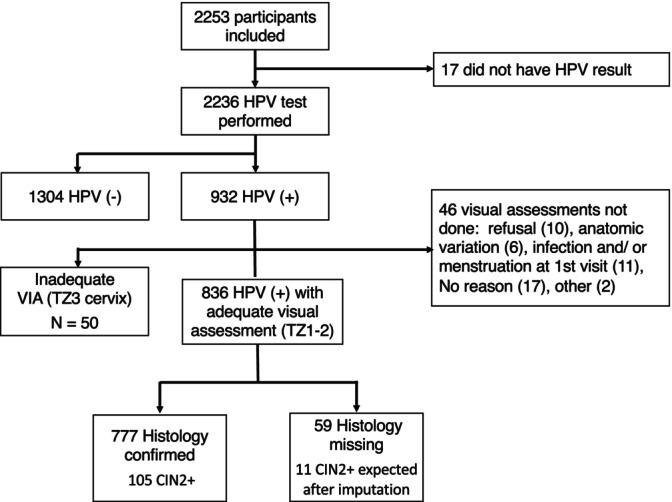
Study flow chart.
The median age of the study population was 42 years (IQR 39–47) (Table 1). Antiretroviral therapy was started at a median CD4+ cell count of 200 cells/mm 3 (IQR 102–334), and the patients were treated for a median duration of 10 years. The participants' characteristics are further displayed by study site in Supplementary Table 2. Women from Cambodia had a lower nadir CD4‐cell count (p < .0001) and were less likely to be infected with HPV (p < .0001) than were those from African countries. However, the proportions of HPV16‐, 18‐, or 45‐positive participants were similar across sites.
TABLE 1.
Participants characteristics.
| All participants | HPV negative | HPV positive | P a | |
|---|---|---|---|---|
| (n = 2253) | (n = 1304) | (n = 932) | ||
| Age | .5 | |||
| Median (IQR) | 42 (39–47) | 42 (39–47) | 43 (38–46) | |
| Education level | .003 | |||
| Never been to school | 595 (26) | 347 (27) | 248 (27) | |
| Primary | 736 (33) | 398 (31) | 334 (36) | |
| Secondary | 779 (35) | 487 (37) | 285 (31) | |
| Higher education | 129 (6) | 67 (5) | 62 (7) | |
| Missing | 14 (1) | 5 (<0.5) | 3 (<0.5) | |
| Work | <.0001 | |||
| Paid work | 383 (17) | 229 (18) | 150 (16) | |
| Informal work | 1251 (56) | 725 (56) | 521 (56) | |
| Home work | 284 (13) | 186 (14) | 97 (10) | |
| No work | 267 (12) | 127 (10) | 140 (15) | |
| Other | 51 (2) | 33 (3) | 18 (2) | |
| Missing | 15 (1) | 4 (<0.5) | 6 (1) | |
| Sparing ability | .9 | |||
| Yes | 882 (39) | 511 (39) | 368 (39) | |
| Missing | 23 (1) | 10 (1) | 7 (1) | |
| Marital status | <.0001 | |||
| Single | 714 (32) | 330 (25) | 379 (41) | |
| Married/in partnership | 1104 (49) | 703 (54) | 396 (42) | |
| Divorced/widowed | 421 (19) | 267 (21) | 154 (16) | |
| Missing | 12 (1) | 4 (<0.5) | 3 (<0.5) | |
| Any disability b | .7 | |||
| Mild/moderate | 1305 (58) | 755 (58) | 543 (58) | |
| Severe | 425 (19) | 254 (19) | 170 (18) | |
| Missing | — | — | — | |
| Parity | .6 | |||
| 0 | 319 (14) | 177 (14) | 139 (15) | |
| 1–3 | 1489 (66) | 873 (67) | 609 (66) | |
| ≥4 | 434 (19) | 253 (19) | 180 (19) | |
| Missing | — | — | — | |
| CD4 cell‐count | .3 | |||
| Median (IQR) | 208 (102–334) | 214 (102–338) | 198 (102–325) | |
| Missing | 223 (10) | 103 (8) | 117 (13) | |
| ART duration (years) | <.0001 | |||
| Median (IQR) | 10 (6–14) | 11 (7–14) | 9 (5–13) | |
| Missing | 18 (1) | 10 (1) | 6 (1) | |
| History of CC screening | .2 | |||
| N (%) | 848 (38) | 506 (39) | 334 (36) | |
| Missing | 1 (<0.5) | 1 (<0.5) | — |
P‐value of the test comparing the distribution of the variable between HPV positive and HPV negative participants (Kruskall and Wallis test for continuous variables; Chi‐2 test for categorical variables).
Based on the Washington Group Questionnaire.
Among the 836 HPV‐positive participants with a valid VIA, 510 (61%) had a positive VIA result. There was significant heterogeneity in the visual assessment positivity rate across sites, with a higher rate observed in the Ivory Coast and a lower rate in Cambodia (p < .0001, Supplementary Table 3).
Of the 777 HPV‐positive participants with histopathology results, 105 (13.5%) had CIN2+ lesions, and 75 (9.5%) had CIN3+ lesions. An additional 11 CIN2+ lesions were imputed among the 59 WLHIV with missing histology (Supplementary Methods S1).
A greater proportion of CIN2+ patients was found among Cambodian participants than among African participants (p < .0001, Supplementary Table 3). In the multivariate analysis adjusted for study site, the risk of high‐grade lesions increased among participants with a nadir CD4+ cell count less than 100 cells/mm3 (p = .03), and there was a borderline association with parity (p = .08, Supplementary Table 4).
The performance of the different triage tests for detecting CIN2+ lesions among HPV‐positive women is presented in Tables 2, 3, 4 (and Supplementary Tables 3–5 for raw data). VIA, extended genotyping and VIA combined with partial genotyping each had a sensitivity above 85%, but specificity was low. Compared to triage with VIA, triage with HPV16 partial genotyping had a significantly greater DLR+ (i.e., positive predictive value, p = .007) but a worse DLR‐ (i.e., negative predictive value, p = .0001). Triage with HPV16/18/45 partial genotyping had similar DLR+ (p = .4) but worse DLR‐ (p = .001), while triage with extended genotyping or with VIA combined with partial genotyping had lower DLR+ (p < .001 for both triage options) and similar DLR‐ (p = .2 and .7, respectively). The sensitivity and specificity of the VIA were both negatively associated with older age groups (Tables 3 and 4). The specificity of the VIA also decreased in women with higher parity and a history of previous screening but increased in those with longer ART durations.
TABLE 2.
Performance of the triage options (836 HPV+ participants with visual assessment).
| Sensitivity | Sensitivity ratio a | Specificity | Specificity ratio a | DLR+ | DLR+ ratio a | DLR– | DLR– ratio | |
|---|---|---|---|---|---|---|---|---|
| Visual inspection | ||||||||
| VIA | 89 (79–100) | Ref. | 45 (38–51) | Ref. | 1.6 (1.5–1.8) | Ref. | 0.2 (0.1–0.4) | Ref. |
| Partial and extended genotyping | ||||||||
| 16 |
36 (28–43) |
0.41 (0.36–0.86) |
85 (84–87) |
1.91 (1.68–2.16) |
2.4 (1.7–3.3) |
1.56 (1.13–2.15) |
0.8 (0.6–0.9) |
3.12 (1.79–5.43) |
| 16/18/45 |
51 (41–61) |
0.56 (0.51–0.62) |
72 (70–73) |
1.60 (1.41–1.81) |
1.8 (1.5–2.3) |
1.08 (0.84–1.37) |
0.7 (0.6–0.8) |
2.93 (1.64–5.24) |
| 16/18/31/33/35/45/52/58 |
89 (82–96) |
0.99 (0.93–1.05) |
29 (24–34) |
0.64 (0.52–0.79) |
1.3 (1.2–1.4) |
0.76 (0.67–0.86) |
0.4 (0.2–0.7) |
1.74 (0.81–3.7) |
| VIA and partial genotyping combined | ||||||||
| VIA and/or HPV16+ b |
90 (79–100) |
1.01 (1–1.03) |
39 (33–46) |
0.88 (0.86–0.90) |
1.5 (1.4–1.6) |
0.93 (0.89–0.96) |
0.3 (0.1–0.5) |
1.02 (0.85–1.24) |
| VIA and/or HPV16/18/45+ b |
94 (84–100) |
1.05 (1.03–1.08) |
28 (19–36) |
0.62 (0.52–0.73) |
1.3 (1.2–1.4) |
0.8 (0.75–0.86) |
0.2 (0.1–0.5) |
0.89 (0.51–1.53) |
Abbreviations: DLR+, positive diagnostic likelihood ratio; DLR–, negative diagnostic likelihood ratio.
Ratios computed with VIA as reference test.
Triage is positive if at least one of the test is positive.
TABLE 3.
Factor associated with the sensitivity of the triage options.
| VIA | HPV16 | HPV16/18/45 | Extended genotyping | VIA and/or HPV16/18/45+ | |
|---|---|---|---|---|---|
| Age | 0.86 (0.75–0.99) | 0.94 (0.87–1.02) | 1 (0.93–1.08) | 0.92 (0.81–1.03) | 0.91 (0.75–1.1) |
| Maximum education level | |||||
| Primary or less | Ref. | Ref. | Ref. | Ref. | |
| Secondary or higher | 2.99 (0.57–15.6) | 1.03 (0.43–2.47) | 0.69 (0.3–1.61) | 1.16 (0.31–4.28) | 3.58 (0.36–35.45) |
| Economic status | |||||
| Could spare money vs. no | 1.43 (0.35–5.86) | 0.81 (0.33–2) | 1.72 (0.72–4.11) | 0.61 (0.17–2.19) | 1.67 (0.25–11.14) |
| Parity | |||||
| 0 | Ref. | Ref. | Ref. | Ref. | Ref. |
| 1–3 | 0.47 (0.05–4.69) | 0.13 (0.02–0.73) | 0.31 (0.07–1.52) | 0.56 (0.06–5.44) | 0.68 (0.06–7.55) |
| >3 | 0.87 (0.04–19.03) | 0.11 (0.02–0.78) | 0.33 (0.06–1.98) | 0.59 (0.04–8.93) | NA |
| Nadir CD4 cell‐count | |||||
| >100 cells/mm3 | Ref. | Ref. | Ref. | Ref. | Ref. |
| ≤100 cells/mm3 | 2.12 (0.56–8.06) | 0.94 (0.37–2.39) | 0.81 (0.33–1.97) | 0.67 (0.15–2.91) | 1.3 (0.21–7.88) |
| ART duration (years) | |||||
| <5 years | Ref. | Ref. | Ref. | Ref. | |
| 5–10 years | 1.12 (0.13–9.4) | 0.94 (0.29–3.05) | 0.5 (0.15–1.62) | 0.16 (0.02–1.48) | 1.46 (0.07–30.52) |
| ≥10 years | 0.76 (0.13–4.31) | 0.57 (0.21–1.57) | 0.51 (0.19–1.39) | 0.37 (0.04–3.35) | 0.89 (0.08–10.35) |
| History of CC screening | |||||
| Any screening vs. no | 0.39 (0.08–1.88) | 0.57 (0.22–1.44) | 0.66 (0.27–1.6) | 0.65 (0.16–2.64) | 0.73 (0.06–9.09) |
TABLE 4.
Factor associated with the false positivity fraction (1‐specificity) of the triage options.
| VIA | HPV16 | HPV16/18/45 | Extended genotyping | VIA and/or HPV16/18/45+ | |
|---|---|---|---|---|---|
| Age | 0.97 (0.94–0.99) | 1 (0.96–1.03) | 0.99 (0.96–1.02) | 0.98 (0.95–1.01) | 0.99 (0.96–1.02) |
| Maximum education level | |||||
| Primary or less | Ref. | Ref. | Ref. | Ref. | Ref. |
| Secondary or higher | 0.92 (0.66–1.26) | 1.29 (0.83–2.02) | 1.27 (0.89–1.8) | 0.87 (0.61–1.24) | 1.03 (0.72–1.48) |
| Economic status | |||||
| Could spare money vs. no | 1.05 (0.75–1.45) | 0.98 (0.62–1.56) | 1.07 (0.74–1.53) | 0.94 (0.65–1.35) | 1.14 (0.78–1.65) |
| Parity | |||||
| 0 | Ref. | Ref. | Ref. | Ref. | Ref. |
| 1–3 | 1.64 (1.07–2.5) | 1.5 (0.8–2.84) | 1.26 (0.78–2.03) | 1.36 (0.86–2.15) | 2.35 (1.5–3.68) |
| >3 | 2.02 (1.2–3.42) | 0.93 (0.42–2.09) | 1.18 (0.66–2.1) | 1.17 (0.67–2.05) | 2.74 (1.54–4.87) |
| Nadir CD4 cell‐count | |||||
| >100 cells/mm3 | Ref. | Ref. | Ref. | Ref. | Ref. |
| ≤100 cells/mm3 | 0.95 (0.64–1.42) | 0.65 (0.38–1.1) | 0.56 (0.37–0.85) | 0.7 (0.44–1.12) | 0.65 (0.4–1.04) |
| ART duration (years) | |||||
| <5 years | Ref. | Ref. | Ref. | Ref. | Ref. |
| 5–10 years | 1.08 (0.72–1.63) | 0.78 (0.44–1.38) | 0.91 (0.59–1.41) | 1.15 (0.74–1.77) | 1.17 (0.72–1.89) |
| ≥10 years | 0.62 (0.43–0.9) | 0.96 (0.58–1.61) | 0.85 (0.57–1.28) | 1.31 (0.87–1.98) | 0.61 (0.4–0.92) |
| History of CC screening | |||||
| Any screening vs. no | 0.71 (0.51–0.99) | 0.64 (0.39–1.05) | 0.71 (0.49–1.03) | 0.85 (0.59–1.21) | 0.74 (0.51–1.07) |
As expected, triage with partial genotyping resulted in fewer visual inspection assessments (Table 5). Even the extended genotyping option almost halved the number of VIAs needed. Triage with visual inspection resulted in a ratio of roughly four treated women without CIN2+ to one treated woman with CIN2+, partial genotyping into a ratio of 3:1, while extended genotyping or combined triage resulted into a ratio of 5:1 (Table 5).
TABLE 5.
Clinical values and consequences for each triage option.
| PPV | NPV | % of participants requiring VIA | # without lesion treated/# with CIN2+ treated | |
|---|---|---|---|---|
| Visual inspection | ||||
| VIA | 20 (14–27) | 96 (92–100) | 42 | 4.2 |
| Partial and extended genotyping | ||||
| 16 | 28 (21–34) | 90 (85–94) | 6 | 2.6 |
| 16/18/45 | 22 (16–27) | 90 (85–96) | 10 | 3.7 |
| 16/18/31/33/35/45/52/58 | 16 (11–22) | 94 (89–99) | 24 | 5.4 |
| VIA and partial genotyping combined | ||||
| VIA and/or HPV16+ | 19 (13–25) | 96 (91–100) | 42 | 6.0 |
| VIA and/or HPV16/18/45+ | 17 (11–23) | 97 (91–100) | 42 | 4.9 |
Note: The proportion of participants requiring VIA is computed according to the option considered as follow: For VIA or VIA+ partial genotyping: all HPV+ women require VIA; For partial genotyping: only those with the specified HPV type require a VIA.
Immediate treatment with thermal ablation was recommended for 383 (17%) of the participants, 98% of whom actually received it. Five percent of the patients reported adverse events immediately after treatment (mostly pain), and no serious adverse events were observed. Overall, 98% of the participants treated stated that they would be treated again with thermal ablation if needed, and 89% would recommend this type of treatment to their peers when needed.
4. DISCUSSION
The introduction of HPV testing for CC screening has dramatically improved the identification of cervical disease. However, further triaging of HPV‐positive women is needed, especially among women living with HIV and in settings where limited financial and human resources should be efficiently used and directed toward women at higher risk. This study provides unique data on the performance of different triage options to identify women living with HIV with precancerous lesions in need of treatment after a primary HPV test. We found that triage with VIA using the simplified ABCD criteria 17 achieves high sensitivity and performs better than triage with extended genotyping or the combined method (VIA + partial genotyping). Triage with partial genotyping (HPV16 alone or HPV16/18/45) achieved higher specificity but had lower sensitivity than did VIA.
Identification of the best triage algorithm is a difficult task because it requires balancing clinical risk, cost, and potential harm related to screening and treatment as well as the constraints and preferences of patients and users. In contexts with limited resources, it is important to maximize the detection probability, as women may not present for regular screening. Therefore, lower negative DLR, indicating better performance to confirm the absence of disease, may be favored. On the other hand, overtreatment requires more human resources and could have adverse effects, although the preliminary data on the safety of thermal ablation, including our data, are reassuring. 36 This study reported good performance of VIA triage when simplified criteria were used for the evaluation, and our results are in line with those found in Cameroon with the same simplified VIA approach. 37 Importantly, VIA was performed with knowledge of the patient's HPV status, which may have contributed to the higher sensitivity than in previous estimations extrapolated from studies that evaluated both VIA and HPV as primary screening tests in parallel. 38 It should be noted that the use of the ABCD criteria could facilitate the task shifting of VIA to nurse or midwives. High heterogeneity in VIA performance across sites was observed, which could be due to some clinicians being more reluctant to adopt simplified criteria. Fortunately, the rapid development of automated methods for visual inspection will likely contribute to the improved performance of VIA for triage, especially in settings with limited experience. 39
There has been increased interest in the use of extended genotyping for risk stratification among HPV‐positive women. 29 , 40 , 41 , 42 , 43 , 44 , 45 As observed in this study and in line with those of other studies, 42 , 45 , 46 extended genotyping provides greater sensitivity than partial genotyping with HPV16 only or HPV16/18/45 to identify women with CIN2+ and, as an automated method, does not depend on clinician expertise. Furthermore, not all CIN2/3 cases progress to CC, and progression is known to be HPV type dependent, with HPV16 in particular but also HPV18 and 45 accounting for a larger proportion of CC cases than CIN2 and CIN3, 19 including among WLHIV. 22 Thus, the sensitivity of partial genotyping for preventing CC can be expected to be higher than that for detecting CIN2+.
DLR were used to report on the performance of the different triage options in addition to sensitivity and specificity as they provide direct information on the predictive abilities of the tests but do not depend on the condition prevalence. 47 Although there is no definitive threshold, the further away DLR of a test is from 1, the strongest is the added evidence provided by this test. In this study, the strongest evidence concerned the abilities to rule out a cervical lesion (negative DLR <1) although it should be noted that there was significant variations between the various options.
One challenge faced in this study was the difficulty of achieving satisfactory visual inspection among older women, which was responsible for one‐third of the missing visual inspection data. This could be related to the lower performance of VIA among older women. Recent studies revealed that up to half of women aged ≥45 years had a TZ that was not fully visible, 48 , 49 and the situation is even worse among women living with HIV, as menopause may occur earlier in this population. 50 In resource‐limited countries where CC screening efforts have just started, most women aged ≥45 years have never been screened but are more at risk of high‐grade lesions. Therefore, the screening approach needs to be adapted in this group to circumvent the difficulties associated with visual inspection, such as relying on extended genotyping and/or repeated HPV testing and systematic excisional treatment.
There are other limitations to this study that should be noted. Although multiple random biopsies were taken when the visual inspection was negative, small CIN2+ lesions may have been missed. A strong quality control process with double reading of every slide was implemented. However, the study advisory board found it unacceptable to biopsy women who were HPV negative, owing to their very low risk of CIN2+. Therefore, there is a small uncertainty about the performance of the HPV testing step of the complete screening algorithm, which was not the objective of this study. In addition, the study was powered for a comparison of the triage options on the pooled study population, and the sample size of the Cambodian site was too small for a subgroup analysis.
In conclusion, extended genotyping and VIA are promising triage options after primary HPV testing for identifying women living with HIV with precancerous lesions who need treatment in resource‐limited contexts.
AUTHOR CONTRIBUTIONS
Pierre Debeaudrap: Conceptualization; formal analysis; funding acquisition; methodology; project administration; writing – original draft. Firmin Nongodo Kabore: Conceptualization; project administration; supervision. Limsreng Setha: Investigation; project administration; supervision. Joseph Tegbe: Investigation; project administration; supervision. Brahima Doukoure: Investigation; supervision. Moeung Sotheara: Investigation; supervision. Olivier Segeral: Project administration; supervision. Korn Aun: Investigation; supervision. Eugène Messou: Investigation; supervision. Pauline Bitolog: Investigation; methodology; supervision. Kim Sothea: Investigation; supervision. Pierre Vassilakos: Investigation; supervision; validation. Armel Poda: Investigation; supervision. Evelyn Kasilé Poda: Investigation. Antoine Jaquet: Conceptualization; funding acquisition; methodology. Adolphe Some: Investigation. Patrick Petignat: Conceptualization; methodology; supervision. Gary Clifford: Conceptualization; formal analysis; methodology; supervision; writing – original draft. Apollinaire Horo: Conceptualization; funding acquisition; methodology; project administration; supervision.
FUNDING INFORMATION
This study was funded by the ANRS‐MIE (grant ANRS 12375). The funding organization had no influence on the analysis and interpretation of the data, manuscript preparation, or decision to submit for publication.
CONFLICT OF INTEREST STATEMENT
The authors declare no conflicts of interest.
ETHICS STATEMENT
The AIMA‐CC study was approved by the “Comité National d'Ethique des Sciences de la Vie et de la Santé” on the Ivory Coast, the “Comité d'Ethique du Centre Muraz” and the “Comité d'Ethique pour la Recherche en Santé” in Burkina Faso, the National Ethics Committee for Health Research in Cambodia and the “Comité Consultatif de Déontologie et d'Ethique” of the IRD. All participants gave written informed consent before inclusion. The study was registered on the ClinicalTrial.gov website (Identifier: NCT03789513).
Supporting information
Data S1. Supporting Information.
ACKNOWLEDGMENTS
The manuscript was edited by the American Journal of Experts. The authors would like to thank the study scientific advisory committee for its advice and support, the clinical staff of the study centers and the study participants; without their contributions, the research would not have been possible.
Debeaudrap P, Kabore FN, Setha L, et al. Performance of visual inspection, partial genotyping, and their combination for the triage of women living with HIV who are screen positive for human papillomavirus: Results from the AIMA‐CC ANRS 12375 multicentric screening study. Int J Cancer. 2025;156(3):598‐607. doi: 10.1002/ijc.35190
Where authors are identified as personnel of the International Agency for Research on Cancer/World Health Organization, the authors alone are responsible for the views expressed in this article and they do not necessarily represent the decisions, policy, or views of the International Agency for Research on Cancer/World Health Organization.
DATA AVAILABILITY STATEMENT
The data and code for data cleaning and analysis that support the findings of this study are available from the corresponding author upon request.
REFERENCES
- 1. Bray F, Ferlay J, Soerjomataram I, Siegel RL, Torre LA, Jemal A. Global cancer statistics 2018: GLOBOCAN estimates of incidence and mortality worldwide for 36 cancers in 185 countries. CA Cancer J Clin. 2018;68(6):394‐424. doi: 10.3322/caac.21492 [DOI] [PubMed] [Google Scholar]
- 2. WHO . Global Strategy to Accelerate the Elimination of Cervical Cancer as a Public Health Problem. WHO, 2020. https://www.who.int/publications/i/item/9789240014107 [Google Scholar]
- 3. Bosch FX, Broker TR, Forman D, et al. Comprehensive control of human papillomavirus infections and related diseases. Vaccine. 2013;31(7):H1‐H31. doi: 10.1016/j.vaccine.2013.10.003 [DOI] [PMC free article] [PubMed] [Google Scholar]
- 4. De Vuyst H, Clifford GM, Nascimento MC, Madeleine MM, Franceschi S. Prevalence and type distribution of human papillomavirus in carcinoma and intraepithelial neoplasia of the vulva, vagina and anus: a meta‐analysis. Int J Cancer. 2009;124(7):1626‐1636. doi: 10.1002/ijc.24116 [DOI] [PubMed] [Google Scholar]
- 5. Looker KJ, Ronn MM, Brock PM, et al. Evidence of synergistic relationships between HIV and human papillomavirus (HPV): systematic reviews and meta‐analyses of longitudinal studies of HPV acquisition and clearance by HIV status, and of HIV acquisition by HPV status. J Int AIDS Soc. 2018;21(6):e25110. doi: 10.1002/jia2.25110 [DOI] [PMC free article] [PubMed] [Google Scholar]
- 6. Palefsky JM, Minkoff H, Kalish LA, et al. Cervicovaginal human papillomavirus infection in human immunodeficiency virus‐1 (HIV)‐positive and high‐risk HIV‐negative women. J Nat Cancer Instit. 1999;91(3):226‐236. [DOI] [PubMed] [Google Scholar]
- 7. Stelzle D, Tanaka LF, Lee KK, et al. Estimates of the global burden of cervical cancer associated with HIV. Lancet Glob Health. 2021;9(2):e161‐e169. doi: 10.1016/s2214-109x(20)30459-9 [DOI] [PMC free article] [PubMed] [Google Scholar]
- 8. Canfell K, Kim JJ, Brisson M, et al. Mortality impact of achieving WHO cervical cancer elimination targets: a comparative modelling analysis in 78 low‐income and lower‐middle‐income countries. Lancet. 2020;395(10224):591‐603. doi: 10.1016/s0140-6736(20)30157-4 [DOI] [PMC free article] [PubMed] [Google Scholar]
- 9. Mustafa RA, Santesso N, Khatib R, et al. Systematic reviews and meta‐analyses of the accuracy of HPV tests, visual inspection with acetic acid, cytology, and colposcopy. Int J Gynaecol Obstet. 2016;132(3):259‐265. doi: 10.1016/j.ijgo.2015.07.024 [DOI] [PubMed] [Google Scholar]
- 10. World Health Organisation . WHO Guideline for Screening and Treatment of Cervical Pre‐Cancer Lesions for Cervical Cancer Prevention. 2nd ed. WHO; 2021. https://www.who.int/publications/i/item/9789240030824 [PubMed] [Google Scholar]
- 11. Baena A, Mesher D, Salgado Y, et al. Performance of visual inspection of the cervix with acetic acid (VIA) for triage of HPV screen‐positive women: results from the ESTAMPA study. Int J Cancer. 2023;152(8):1581‐1592. doi: 10.1002/ijc.34384 [DOI] [PMC free article] [PubMed] [Google Scholar]
- 12. Sebitloane HM, Forestier M, Ginindza TG, et al. Cervical cancer screening and treatment algorithms using human papillomavirus testing – lessons learnt from a south African pilot randomized controlled trial. Cancer Epidemiol Biomark Prev. 2023;33(6):779‐787. doi: 10.1158/1055-9965.Epi-23-0752 [DOI] [PMC free article] [PubMed] [Google Scholar]
- 13. Vassilakos P, Wisniak A, Catarino R, et al. A cross‐sectional study exploring triage of human papillomavirus (HPV)‐positive women by visual assessment, manual and computer‐interpreted cytology, and HPV‐16/18‐45 genotyping in Cameroon. Int J Gynecol Cancer. 2021;31(6):808‐816. doi: 10.1136/ijgc-2020-002302 [DOI] [PMC free article] [PubMed] [Google Scholar]
- 14. Kelly HA, Chikandiwa A, Sawadogo B, et al. Diagnostic accuracy of cervical cancer screening and screening‐triage strategies among women living with HIV‐1 in Burkina Faso and South Africa: a cohort study. PLoS Med. 2021;18(3):e1003528. doi: 10.1371/journal.pmed.1003528 [DOI] [PMC free article] [PubMed] [Google Scholar]
- 15. Luckett R, Mogowa N, Li HJ, et al. Performance of two‐stage cervical cancer screening with primary high‐risk human papillomavirus testing in women living with human immunodeficiency virus. Obstet Gynecol. 2019;134(4):840‐849. doi: 10.1097/aog.0000000000003496 [DOI] [PMC free article] [PubMed] [Google Scholar]
- 16. Duan R, Zhao X, Zhang H, et al. Performance of cervical cancer screening and triage strategies among women living with HIV in China. Cancer Med. 2021;10(17):6078‐6088. doi: 10.1002/cam4.4152 [DOI] [PMC free article] [PubMed] [Google Scholar]
- 17. Petignat P, Kenfack B, Wisniak A, et al. ABCD criteria to improve visual inspection with acetic acid (VIA) triage in HPV‐positive women: a prospective study of diagnostic accuracy. BMJ Open. 2022;12(4):e052504. doi: 10.1136/bmjopen-2021-052504 [DOI] [PMC free article] [PubMed] [Google Scholar]
- 18. Schiffman M, Glass AG, Wentzensen N, et al. A long‐term prospective study of type‐specific human papillomavirus infection and risk of cervical neoplasia among 20,000 women in the Portland Kaiser cohort study. Cancer Epidemiol Biomark Prev. 2011;20(7):1398‐1409. doi: 10.1158/1055-9965.epi-11-0206 [DOI] [PMC free article] [PubMed] [Google Scholar]
- 19. Guan P, Howell‐Jones R, Li N, et al. Human papillomavirus types in 115,789 HPV‐positive women: a meta‐analysis from cervical infection to cancer. Int J Cancer. 2012;131(10):2349‐2359. doi: 10.1002/ijc.27485 [DOI] [PubMed] [Google Scholar]
- 20. Saslow D, Solomon D, Lawson HW, et al. American Cancer Society, American Society for Colposcopy and Cervical Pathology, and American Society for Clinical Pathology screening guidelines for the prevention and early detection of cervical cancer. CA Cancer J Clin. 2012;62(3):147‐172. doi: 10.3322/caac.21139 [DOI] [PMC free article] [PubMed] [Google Scholar]
- 21. Huh WK, Ault KA, Chelmow D, et al. Use of primary high‐risk human papillomavirus testing for cervical cancer screening: interim clinical guidance. Gynecol Oncol. 2015;136(2):178‐182. doi: 10.1016/j.ygyno.2014.12.022 [DOI] [PubMed] [Google Scholar]
- 22. Clifford GM, Tully S, Franceschi S. Carcinogenicity of human papillomavirus types in HIV‐positive women: a meta‐analysis from HPV infection to cervical cancer. Clin Infect Dis. 2017;64(9):1228–1235. doi: 10.1093/cid/cix135 [DOI] [PMC free article] [PubMed] [Google Scholar]
- 23. Clifford GM, Smith JS, Aguado T, Franceschi S. Comparison of HPV type distribution in high‐grade cervical lesions and cervical cancer: a meta‐analysis. Br J Cancer. 2003;89(1):101‐105. doi: 10.1038/sj.bjc.6601024 [DOI] [PMC free article] [PubMed] [Google Scholar]
- 24. Castle PE, Cuzick J, Stoler MH, et al. Detection of human papillomavirus 16, 18, and 45 in women with ASC‐US cytology and the risk of cervical precancer: results from the CLEAR HPV study. Am J Clin Pathol. 2015;143(2):160‐167. doi: 10.1309/ajcplcd8ttomljtb [DOI] [PubMed] [Google Scholar]
- 25. Tjalma WA, Depuydt CE, Stoler MH, Wright TL. Don't forget HPV‐45 in cervical cancer screening. Am J Clin Pathol. 2012;137(1):161‐162. [DOI] [PubMed] [Google Scholar]
- 26. Boni SP, Tenet V, Horo A, et al. High‐risk human papillomavirus distribution according to human immunodeficiency virus status among women with cervical cancer in Abidjan, Côte D'ivoire, 2018 to 2020. Int J Cancer. 2023;154:962‐968. doi: 10.1002/ijc.34774 [DOI] [PMC free article] [PubMed] [Google Scholar]
- 27. Johnson LG, Saidu R, Mbulawa Z, et al. Selecting human papillomavirus genotypes to optimize the performance of screening tests among south African women. Cancer Med. 2020;9(18):6813‐6824. doi: 10.1002/cam4.3329 [DOI] [PMC free article] [PubMed] [Google Scholar]
- 28. Desai KT, Adepiti CA, Schiffman M, et al. Redesign of a rapid, low‐cost HPV typing assay to support risk‐based cervical screening and management. Int J Cancer. 2022;151(7):1142‐1149. doi: 10.1002/ijc.34151 [DOI] [PMC free article] [PubMed] [Google Scholar]
- 29. Cuzick J, Wheeler C. Need for expanded HPV genotyping for cervical screening. Papillomavirus Res. 2016;2:112‐115. doi: 10.1016/j.pvr.2016.05.004 [DOI] [PMC free article] [PubMed] [Google Scholar]
- 30. Luo H, Du H, Belinson JL, Wu R. Evaluation of alternately combining HPV viral load and 16/18 genotyping in secondary screening algorithms. PLoS One. 2019;14(7):e0220200. doi: 10.1371/journal.pone.0220200 [DOI] [PMC free article] [PubMed] [Google Scholar]
- 31. Huh WK, Sideri M, Stoler M, Zhang G, Feldman R, Behrens CM. Relevance of random biopsy at the transformation zone when colposcopy is negative. Obstet Gynecol. 2014;124(4):670‐678. doi: 10.1097/aog.0000000000000458 [DOI] [PubMed] [Google Scholar]
- 32. Clement PB, Young RH. Atlas of Gynecologic Surgical Pathology. Saunders/Elsevier; 2013. [Google Scholar]
- 33. Almonte M, Ferreccio C, Winkler JL, et al. Cervical screening by visual inspection, HPV testing, liquid‐based and conventional cytology in Amazonian Peru. Int J Cancer. 2007;121(4):796‐802. doi: 10.1002/ijc.22757 [DOI] [PubMed] [Google Scholar]
- 34. Rubin DB. Multiple Imputation for Nonresponse in Surveys. Wiley; 2009. [Google Scholar]
- 35. Gu W, Pepe MS. Estimating the capacity for improvement in risk prediction with a marker. Biostatistics. 2009;10(1):172‐186. doi: 10.1093/biostatistics/kxn025 [DOI] [PMC free article] [PubMed] [Google Scholar]
- 36. Zhang L, Sauvaget C, Mosquera I, Basu P. Efficacy, acceptability and safety of ablative versus excisional procedure in the treatment of histologically confirmed CIN2/3: a systematic review. Int J Gynaecol Obstet. 2023;130(2):153‐161. doi: 10.1111/1471-0528.17251 [DOI] [PubMed] [Google Scholar]
- 37. Frund C, Kenfack B, Sormani J, et al. Training, supervision, and competence assessment of Cameroonian health care providers using HPV self‐sampling, triage by visual inspection, and treatment by thermal ablation in a single visit. Front Public Health. 2022;10:875177. doi: 10.3389/fpubh.2022.875177 [DOI] [PMC free article] [PubMed] [Google Scholar]
- 38. Benoy IH, Vanden Broeck D, Ruymbeke MJ, et al. Prior knowledge of HPV status improves detection of CIN2+ by cytology screening. Am J Obstet Gynecol. 2011;205(6):569.e1‐569.e7. doi: 10.1016/j.ajog.2011.06.101 [DOI] [PubMed] [Google Scholar]
- 39. Desai KT, Befano B, Xue Z, et al. The development of “automated visual evaluation” for cervical cancer screening: the promise and challenges in adapting deep‐learning for clinical testing: interdisciplinary principles of automated visual evaluation in cervical screening. Int J Cancer. 2022;150(5):741‐752. doi: 10.1002/ijc.33879 [DOI] [PMC free article] [PubMed] [Google Scholar]
- 40. Schiffman M, Khan MJ, Solomon D, et al. A study of the impact of adding HPV types to cervical cancer screening and triage tests. J Nat Cancer Instit. 2005;97(2):147‐150. doi: 10.1093/jnci/dji014 [DOI] [PubMed] [Google Scholar]
- 41. Botha MH, Van Der Merwe FH, Snyman LC, Dreyer GJ, Visser C, Dreyer G. Utility of extended HPV genotyping as primary cervical screen in an unscreened population with high HIV Co‐infection rate. J Low Genit Tract Dis. 2023;27(3):212‐216. doi: 10.1097/lgt.0000000000000743 [DOI] [PubMed] [Google Scholar]
- 42. Broquet C, Vassilakos P, Ndam Nsangou FM, et al. Utility of extended HPV genotyping for the triage of self‐sampled HPV‐positive women in a screen‐and‐treat strategy for cervical cancer prevention in Cameroon: a prospective study of diagnostic accuracy. BMJ Open. 2022;12(12):e057234. doi: 10.1136/bmjopen-2021-057234 [DOI] [PMC free article] [PubMed] [Google Scholar]
- 43. Bai A, Xue P, Li Q, Jiang Y, Qiao Y. Diagnostic value of high‐risk HPV other than type 16/18 in high‐grade cervical neoplasia among cytology‐negative women: a multicenter retrospective study. Cancer Med. 2023;12(13):14794‐14805. doi: 10.1002/cam4.6109 [DOI] [PMC free article] [PubMed] [Google Scholar]
- 44. Schiffman M, Hyun N, Raine‐Bennett TR, et al. A cohort study of cervical screening using partial HPV typing and cytology triage. Int J Cancer. 2016;139(11):2606‐2615. doi: 10.1002/ijc.30375 [DOI] [PubMed] [Google Scholar]
- 45. Luckett R, Ramogola‐Masire D, Gompers A, et al. Triage of HPV positivity in a high HIV prevalence setting: a prospective cohort study comparing visual triage methods and HPV genotype restriction in Botswana. Int J Gynaecol Obstet. 2023;165(2):507‐518. doi: 10.1002/ijgo.15225 [DOI] [PMC free article] [PubMed] [Google Scholar]
- 46. Kahesa C, Thomsen LT, Linde DS, et al. Comparison of human papillomavirus‐based cervical cancer screening strategies in Tanzania among women with and without HIV. Int J Cancer. 2023;152(4):686‐696. doi: 10.1002/ijc.34283 [DOI] [PMC free article] [PubMed] [Google Scholar]
- 47. Pepe M. The Statistical Evaluation of Medical Tests for Classification and Prediction. Oxford University Press; 2003. [Google Scholar]
- 48. Lopez‐Ampuero C, Hansen N, Alvarez Larraondo M, et al. Squamocolumnar junction visibility among cervical cancer screening population in Peru might influence upper age for screening programs. Prev Med. 2023;174:107596. doi: 10.1016/j.ypmed.2023.107596 [DOI] [PubMed] [Google Scholar]
- 49. Desai KT, Ajenifuja KO, Banjo A, et al. Design and feasibility of a novel program of cervical screening in Nigeria: self‐sampled HPV testing paired with visual triage. Infect Agents Cancer. 2020;15:60. doi: 10.1186/s13027-020-00324-5 [DOI] [PMC free article] [PubMed] [Google Scholar]
- 50. Van Ommen CE, King EM, Murray MCM. Age at menopause in women living with HIV: a systematic review. Menopause. 2021;28(12):1428‐1436. doi: 10.1097/gme.0000000000001871 [DOI] [PubMed] [Google Scholar]
Associated Data
This section collects any data citations, data availability statements, or supplementary materials included in this article.
Supplementary Materials
Data S1. Supporting Information.
Data Availability Statement
The data and code for data cleaning and analysis that support the findings of this study are available from the corresponding author upon request.