



Abstract
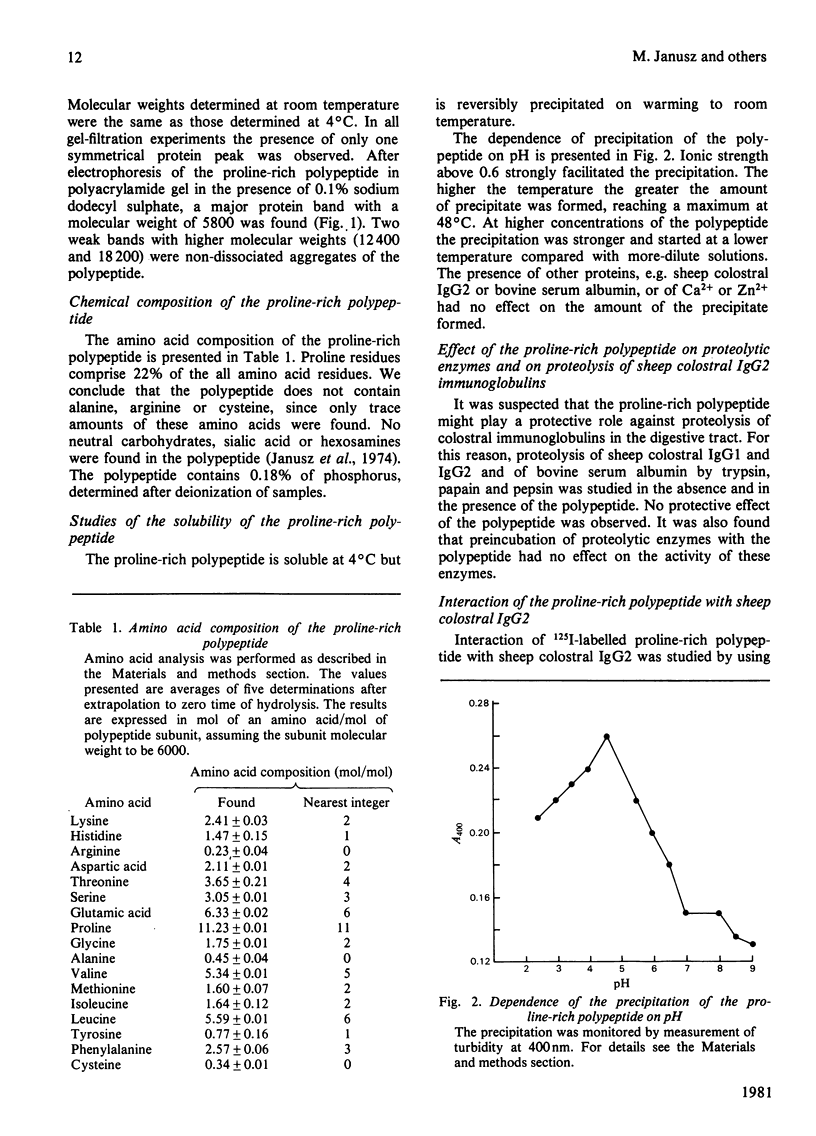
A proline-rich polypeptide isolated from sheep colostrum is described. The molecular weight of the polypeptide determined by gel filtration is 17 200. However, in the presence of guanidinium chloride the molecular weight found is about 6000. The polypeptide contains about 22% of proline, a high proportion of non-polar amino acids, a low percentage of glycine, and no alanine, arginine and cysteine residues. The only N-terminal amino acid found is leucine. C.d. spectra in water and in 50% (v/v) trifluoroethanol suggest the presence of block sequences of proline residues forming helices of polyproline II type. The proline-rich polypeptide is soluble at 4 degrees C but is reversibly precipitated on warming to room temperature. Maximal precipitation is observed at pH 4.6 and at ionic strength above 0.6. The precipitation depends on the concentration of the polypeptide. No effect of other proteins, Ca2+ and Zn2+ ions on the precipitation of the polypeptide was found. The proline-rich polypeptide is not an amphipathic protein. The lack of effect of the polypeptide on proteolytic enzymes ruled out the possibility that it is an inhibitor of proteinases.
Full text
PDF




Images in this article
Selected References
These references are in PubMed. This may not be the complete list of references from this article.
- Brown F. R., 3rd, Carver J. P., Blout E. R. Low temperature circular dichroism of poly (glycyl-L-prolyl-L-alanine). J Mol Biol. 1969 Jan;39(2):307–313. doi: 10.1016/0022-2836(69)90319-2. [DOI] [PubMed] [Google Scholar]
- Chen Y. H., Yang J. T., Chau K. H. Determination of the helix and beta form of proteins in aqueous solution by circular dichroism. Biochemistry. 1974 Jul 30;13(16):3350–3359. doi: 10.1021/bi00713a027. [DOI] [PubMed] [Google Scholar]
- Chou P. Y., Fasman G. D. Prediction of protein conformation. Biochemistry. 1974 Jan 15;13(2):222–245. doi: 10.1021/bi00699a002. [DOI] [PubMed] [Google Scholar]
- Deber C. M., Bovey F. A., Carver J. P., Blout E. R. Nuclear magnetic resonance evidence for cis-peptide bonds in proline oligomers. J Am Chem Soc. 1970 Oct 21;92(21):6191–6198. doi: 10.1021/ja00724a016. [DOI] [PubMed] [Google Scholar]
- Fairbanks G., Steck T. L., Wallach D. F. Electrophoretic analysis of the major polypeptides of the human erythrocyte membrane. Biochemistry. 1971 Jun 22;10(13):2606–2617. doi: 10.1021/bi00789a030. [DOI] [PubMed] [Google Scholar]
- Flengsrud R. Detection of amino-terminal tryptophan in peptides and proteins using dansyl chloride. Anal Biochem. 1976 Dec;76(2):547–550. doi: 10.1016/0003-2697(76)90347-x. [DOI] [PubMed] [Google Scholar]
- Greenfield N., Fasman G. D. Computed circular dichroism spectra for the evaluation of protein conformation. Biochemistry. 1969 Oct;8(10):4108–4116. doi: 10.1021/bi00838a031. [DOI] [PubMed] [Google Scholar]
- Hartley B. S. Strategy and tactics in protein chemistry. Biochem J. 1970 Oct;119(5):805–822. doi: 10.1042/bj1190805f. [DOI] [PMC free article] [PubMed] [Google Scholar]
- Helenius A., Simons K. Charge shift electrophoresis: simple method for distinguishing between amphiphilic and hydrophilic proteins in detergent solution. Proc Natl Acad Sci U S A. 1977 Feb;74(2):529–532. doi: 10.1073/pnas.74.2.529. [DOI] [PMC free article] [PubMed] [Google Scholar]
- Henkin R. I., Lippoldt R. E., Bilstad J., Wolf R. O., Lum C. K., Edelhoch H. Fractionation of human parotid saliva proteins. J Biol Chem. 1978 Oct 25;253(20):7556–7565. [PubMed] [Google Scholar]
- Isemura S., Saitoh E., Sanada K. Isolation and amino acid sequences of proline-rich peptides of human whole saliva. J Biochem. 1979 Jul;86(1):79–86. [PubMed] [Google Scholar]
- Janusz M., Godzińska H., Lisowski J. Immunoglobulins of colostrum. I. Preparation and identification of ovine colostral immunoglobulins. Arch Immunol Ther Exp (Warsz) 1973;21(3):435–444. [PubMed] [Google Scholar]
- Janusz M., Lisowski J., Franek F. Isolation and characterization of a proline-rich polypeptide from ovine colostrum. FEBS Lett. 1974 Dec 15;49(2):276–279. doi: 10.1016/0014-5793(74)80529-6. [DOI] [PubMed] [Google Scholar]
- Kousvelari E. E., Oppenheim F. G. Immunological comparison of proline-rich proteins from human and primate parotid secretion. Biochim Biophys Acta. 1979 May 23;578(1):76–86. doi: 10.1016/0005-2795(79)90115-6. [DOI] [PubMed] [Google Scholar]
- Krigbaum W. R., Knutton S. P. Prediction of the amount of secondary structure in a globular protein from its aminoacid composition. Proc Natl Acad Sci U S A. 1973 Oct;70(10):2809–2813. doi: 10.1073/pnas.70.10.2809. [DOI] [PMC free article] [PubMed] [Google Scholar]
- Laemmli U. K. Cleavage of structural proteins during the assembly of the head of bacteriophage T4. Nature. 1970 Aug 15;227(5259):680–685. doi: 10.1038/227680a0. [DOI] [PubMed] [Google Scholar]
- MOORE S., STEIN W. H. A modified ninhydrin reagent for the photometric determination of amino acids and related compounds. J Biol Chem. 1954 Dec;211(2):907–913. [PubMed] [Google Scholar]
- Muenzer J., Bildstein C., Gleason M., Carlson D. M. Properties of proline-rich proteins from parotid glands of isoproterenol-treated rats. J Biol Chem. 1979 Jul 10;254(13):5629–5634. [PubMed] [Google Scholar]
- Okabayashi H., Isemura T., Sakakibara S. Steric structure of L-proline oligopeptides. II. Far-ultraviolet absorption spectra and optical rotations of L-proline oligopeptides. Biopolymers. 1968;6(3):323–330. doi: 10.1002/bip.1968.360060307. [DOI] [PubMed] [Google Scholar]
- SCHEIDEGGER J. J. Une micro-méthode de l'immuno-electrophorèse. Int Arch Allergy Appl Immunol. 1955;7(2):103–110. [PubMed] [Google Scholar]
- Schade A. L., Reinhart R. W. Galactothermin, a reversibly heat-precipitable protein of human milk at neutral pH. Biochem J. 1970 Jun;118(1):181–186. doi: 10.1042/bj1180181. [DOI] [PMC free article] [PubMed] [Google Scholar]
- Seto A., Ito Y. Further characterization of milk pyroglobulin. Ann Immunol (Paris) 1976 Jan-Feb;127(1):71–81. [PubMed] [Google Scholar]
- Seto A., Okabe T., Ito Y. A new protein with a particular thermoprecipitability in bovine milk. Proc Soc Exp Biol Med. 1975 Nov;150(2):446–450. doi: 10.3181/00379727-150-39053. [DOI] [PubMed] [Google Scholar]
- Spencer R. L., Wold F. A new convenient method for estimation of total cystine-cysteine in proteins. Anal Biochem. 1969 Oct 15;32(1):185–190. doi: 10.1016/0003-2697(69)90123-7. [DOI] [PubMed] [Google Scholar]
- Swanson M. J., Sanders B. E. Isolation and characterization of a temperature sensitive protein from dog colostrum and milk. Prep Biochem. 1974;4(6):523–553. doi: 10.1080/00327487408061553. [DOI] [PubMed] [Google Scholar]
- Unkeless J. C., Eisen H. N. Binding of monomeric immunoglobulins to Fc receptors of mouse macrophages. J Exp Med. 1975 Dec 1;142(6):1520–1533. doi: 10.1084/jem.142.6.1520. [DOI] [PMC free article] [PubMed] [Google Scholar]
- Wieczorek Z., Zimecki M., Janusz M., Staroscik K., Lisowski J. Proline-rich polypeptide from ovine colostrum: its effect on skin permeability and on the immune response. Immunology. 1979 Apr;36(4):875–881. [PMC free article] [PubMed] [Google Scholar]
- Wong R. S., Hofmann T., Bennick A. The complete primary structure of a proline-rich phosphoprotein from human saliva. J Biol Chem. 1979 Jun 10;254(11):4800–4808. [PubMed] [Google Scholar]