



Abstract
Fungicide mixtures are an effective strategy in delaying the development of fungicide resistance. In this research, a fixed ratio ray design method was used to generate fifty binary mixtures of five fungicides with diverse modes of action. The interaction of these mixtures was then analyzed using CA and IA models. QSAR modeling was conducted to assess their fungicidal activity through multiple linear regression (MLR), support vector machine (SVM), and artificial neural network (ANN). Most mixtures exhibited additive interaction, with the CA model proving more accurate than the IA model in predicting fungicidal activity. The MLR model showed a good linear correlation between selected theoretical descriptors by the genetic algorithm and fungicidal activity. However, both ML-based models demonstrated better predictive performance than the MLR model. The ANN model showed slightly better predictability than the SVM model, with R2 and R2cv at 0.91 and 0.81, respectively. For external validation, the R2test value was 0.845. In contrast, the SVM model had values of 0.91, 0.78, and 0.77 for the same metrics. In conclusion, the proposed ML-based model can be a valuable tool for developing potent fungicidal mixtures to delay fungicidal resistance emergence.
Keywords: SVM, ANN, Synergism, Antagonist, Pesticide mixtures
Subject terms: Computational biology and bioinformatics, Drug discovery
Introduction
Using fungicide mixtures is a valuable strategy to delay the emergence of fungicide resistance1–3. Combining different modes of action can enhance control effectiveness by targeting various active sites, especially crucial when the pathogen shows resistance to specific fungicides1–4. It has been found that mixtures of low and high-risk fungicides can reduce the rate of fungal resistance development3. This can be achieved by reducing the dosage of the high-risk fungicide. Although it is always preferable to use mixtures containing fungicides with lower risk, evidence shows that mixtures comprising fungicides with high risk can also delay the development of resistance1,3,5. When different components are mixed together, they can interact in various ways depending on their concentration and ratios. If the combined activity of the mixture is stronger than the activity of each individual component, it is said to have a synergistic effect. On the other hand, if the mixture is less effective than the individual components, it is considered an antagonistic effect6–9. Therefore, it is essential to determine the optimal concentration and ratio of each component when developing effective fungicidal mixtures. This is crucial to delay resistance and reduce the use of fungicides7,9,10.
Toxicity prediction of pesticide mixtures is commonly done using the concentration additive (CA)11 and independent action (IA)12 models. CA is applied when the mixture components have the same mode of action (MOA), while IA is used when they have different MOAs. Despite the frequent use of these models in toxicity prediction across various chemical classes11–13, it is necessary to explore alternative and more precise methods for assessing the toxicity of fungicide mixtures, such as Quantitative Structure–Activity Relationship (QSAR). With QSAR, mathematical models are used to depict the relationship between the bioactivity of compounds and their physiochemical properties, known as molecular descriptors14. Simple QSAR methods such as multiple linear regression assume linearity in the relationship and have led to the development of many models with strong predictive capabilities. Nevertheless, in various instances, particularly when dealing with multidimensional datasets, exploring non-linear relationships is more suitable14,15. Recently, machine learning algorithms have been utilized in QSAR to study nonlinear structure–activity relationships15. Machine learning (ML) has transformed QSAR modeling with advanced tools like Artificial Neural Networks (ANNs) and Support Vector Machines (SVMs) for managing complex datasets, selecting features, and improving model accuracy15–17. One key benefit of using ML in QSAR modeling is its capacity to process vast amounts of data, enabling researchers to analyze complex relationships between chemical structures and biological activities15,18,19. Additionally, ML algorithms can automatically select the appropriate molecular descriptors that influence biological activity, reducing the risk of human error and saving time. Ultimately, this improves the overall performance and accuracy of the created models19. ML techniques have demonstrated remarkable accuracy in predicting the combined toxicity of nanoparticles20, pharmaceutical21, and pesticide mixtures22. Linear and non-linear SVM algorithms have been used to enhance the reliability of the QSAR model developed for predicting acute toxicity of binary pesticide mixtures in honey bees22. Back-propagation neural network (BPNN) revealed high accuracy in predicting the combined toxicity of multicomponent mixtures on Caenorhabditis elegans23.
In a recent investigation, the combined interaction of fungicides in binary mixtures was examined. Predictive models using Multiple Linear Regression (MLR) and Machine Learning-based Quantitative Structure–Activity Relationship (ML-QSAR) were developed to predict the fungicidal efficacy of these mixtures against the plant pathogenic fungus Fusarium oxysporum f.sp. lycopersici.
Materials and methods
Chemicals
Difenoconazole (DF) (purity 98%, CAS: 119446–68-3), and Tebuconazole (TB) (purity 99%, CAS: 107534–96-3), Thiophanate-methyl (TM) (purity 97%, CAS: 23564–05-8), Chlorothalonil (CT) (purity 98%, CAS: 1897–45-6), Iprodione (IP) (purity 96%, CAS: 36734–19-7) were purchased from Agricore Chemical Industry Co., Ltd. (A.C.I), China.
Fungal strain
The fungal strain of Fusarium oxysporum f.sp. lycopersici was isolated and characterized previously in the Department of Plant Pathology of Tarbiat Modares University, Tehran, Iran.
Signal anti-fungal activity
In order to evaluate the effectiveness of each fungicide against the mycelial growth of F. oxysporum, the poisoned food technique was utilized as described by Schmitz (1930)24. Carefully, increasing concentrations of the tested mixtures were mixed with 20–25 ml of melted warm PDA medium in a Petri dish. A 6 mm diameter agar disc of 5-day-old culture of the pathogen was aseptically transferred to the center of the Petri dish, which was then inoculated with PDA plates. Each treatment was replicated three times. A basal medium (PDA) serving as the control. The inoculated plates were incubated at a constant temperature of 25 °C, and the colony diameter was measured and recorded after 7 days. The percentage of mycelial growth inhibition was determined using the following equation:
| 1 |
where C is the diameter of the fungal colony (mean) in control, and T is the diameter of the fungal colony (mean) in the presence of the synthesized compound. The respective dose–response curves and effective concentration (EC50) values were calculated using GraphPad Prism25.
Binary mixture design
The five fungicides mentioned as (DF, TB, TM, CT, and IP) were used to form ten binary mixtures using Fixed Ratio Ray Design (FRRD) where the mixing ratio (proportions) (pi) of components was fixed across increasing mixture doses26,27. Five mixture rays (R1–R5) being uniformly distributed in the two-dimensional concentration space of two mixture components are designed for each binary mixture system10.
For a binary mixture, the p1, j and p2, j of components 1 and 2 in each mixture can be calculated by the following equation based on the 50% concentration effect (EC50, mg/L):
| 2 |
| 3 |
where j refers to the series number of a ray10. Overall, fifty binary mixtures were deigned and test for their fungicidal activity according to the procedures mentioned on signal anti-fungal assay.
Combined effects of mixtures (CA and IA models)
The expected EC50 of the mixtures was calculated using concentration addition model (CA)8 according to Eq. 4:
| 4 |
where ECxmix is the total concentration of the mixture provoking x% effect; ECxi is the concentration of component i provoking the x% effect, when applied singly; and pi denotes the fraction of component i in the mixture.
For independent action (IA) model7,8, the following equation (Eq. 5) was used:
| 5 |
To help explain the difference between observed toxicity and toxicity predicted by models, the model deviation ratio (MDR)9 was used as follows:
| 6 |
where Expected is the effective concentration of the mixture that would be predicted by the model, and Observed is the effective concentration for the mixture obtained from toxicity testing9. Based on the MDR value, the types of interactions between mixture components are divided into three groups: synergistic (MDR > 2), additive (0.5 ≤ MDR ≤ 2) and antagonistic (MDR < 0.5)9,28.
OSAR modeling
The relationship between the fungicidal activity of the studied mixtures (EC50) and their molecular descriptors was estimated via QSAR modeling to develop robust mathematical models for predicting the fungicidal activity of these mixtures. Multiple linear regression (MLR) models and machine learning ML-based QSAR models were carried out in our investigation.
Data set and calculation of mixture molecular descriptors
The structure of each individual compound was initially drawn and pre-optimized using molecular mechanics force fields (MM +) integrated within the HyperChem package29. Subsequently, the three-dimensional molecular geometries were refined using the AM1 semi-empirical quantum-chemical method with a root mean square gradient of 0.01 kcal mol–1. HyperChem software was employed to calculate a subset of molecular descriptors. To further optimize the geometric structure, density functional theory (DFT) was employed. Specifically, the B3LYP functional with the 6-31G** basis set was utilized to compute the quantum chemical descriptors using the Gaussian 09W software30,31. Additional descriptors were generated using E-Dragon 3.0 software32, specifically 1D-2D and 3-dimensional molecular descriptors. These descriptors were combined with the previously calculated descriptors from HyperChem and Gaussian software. The total number of molecular descriptors was reduced based on specific criteria. These criteria included: 1) Removing descriptors with a standard deviation less than 0.001, 2) Eliminating descriptors with at least one missing value, 3) Removing descriptors with constant values, and 4) Removing descriptors that were constant across all molecules or highly correlated (R ≥ 0.9)33–35. As a result, a total of 321 descriptors were obtained for the calculation of mixture descriptors according to Eq. (7).36
| 7 |
where Dmix,i represents the descriptor of a single mixture, i denotes the ith component in a mixture, and Xi stands for the descriptor of the ith component. The descriptors of the resulting mixtures from Eq. 7 are then refined based on the same criteria utilized for signal compounds29–31.
Genetic algorithm (GA)
The Genetic Algorithm (GA) is a search method inspired by Darwin's theory of natural selection and evolution. Due to its effectiveness and simplicity, the GA has been widely used as a promising approach for variable selection37. In QSAR modeling, the Genetic Algorithm can be employed to identify the most important molecular descriptors or features for predicting the bioactivity of compounds. In this particular study, the Genetic Algorithm was utilized to select the key molecular descriptors that would contribute to the development of QSAR models based on the calculated mixture descriptors mentioned earlier. The execution of the Genetic Algorithm was performed using the MATLAB software provided by MathWorks, Inc38.
K-means clustering of datasets
Following the selection of the most significant molecular descriptors using the Genetic Algorithm (GA) for QSAR modeling, the dataset was divided into a training set and a test set using the k-means classification technique. The training set consisted of 80% of the total dataset, while the remaining 20% formed the test set. To create the test set, 12 mixtures were randomly chosen from each cluster generated during the k-means process, while the remaining 38 mixtures were assigned to the training set39. The k-means procedure was carried out using the SPSS software.
Multiple linear regression (MLR) model
MLR is a technique employed for the modeling of linear relationships between dependent and independent variables40. In our study, the dependent variable corresponds to the compound bioactivity values, while the independent variable refers to the molecular descriptors. The regression coefficients are determined through the use of MLR, employing the least-squares curve fitting method. The regression equation can be represented as follows:
| 8 |
where Y is the dependent variable (fungicidal activity), Xi are the independent variables (molecular descriptors), n is the number of molecular descriptors, is the constant in the equation, and represent the coefficients of the descriptors. The effective concentrations (EC50) values of the fifty binary mixtures were converted to pEC50 level (pEC50 = –logEC50), and used as dependent variables, while the selected molecular descriptors by GA used as independent variables in the MLR.
Machine learning models
In the field of QSAR modeling, machine learning algorithms provide effective tools for capturing complex non-linear relationships when linear regression falls short in representing the relationship between bioactivity and the physicochemical parameters of the molecules under study41–43. Different algorithms can be employed in QSAR modeling depending on the nature of the dataset used to develop the model. For instance, in this study Support Vector Machine (SVM)44, and Artificial Neural Network (ANN)43 algorithms were utilized to develop ML-QSAR models.
Support vector machine (SVM) regression
Support vector machine (SVM) has gained recognition as a powerful and valuable machine learning tool in QSAR studies for classification and regression purposes. Its robustness in handling non-linear relationships and strong generalization performance have made it highly respected in the field.41,42 In this study, the support vector machine (SVM) with was utilized to develop a machine learning-quantitative structure–activity relationship (ML-QSAR) model using the same four molecular descriptors as the multiple linear regression (MLR) model. Bayesian optimization was performed on the hyperparameters: kernel function, box constraint level, and kernel scale. The accuracy of the predictions was evaluated using the coefficient of determination (R2) and the mean square of prediction (MSE). The calculations were performed using the MATLAB software provided by MathWorks, Inc38.
Multi-layer perceptron artificial neural network method (MLP-ANN)
The Multilayer perceptron artificial neural network (MLP-ANN) is a machine learning technique that offers a promising approach for addressing nonlinear problems47,48. The MLP network consists of one or more hidden layers, and the number of neurons in these hidden layers depends on the input and output datasets. In this particular study, the MLP-ANN was utilized to validate the accuracy of the selected molecular descriptors obtained from the MLR model. These descriptors were utilized as inputs for training the MLP-ANN network. The back-propagation (BP) algorithm was employed in the MLP-ANN for learning and updating the network's weights. Similar to Support Vector Machines (SVM), the prediction accuracy of the MLP-ANN was assessed. The analysis of the artificial neural network was conducted using the MATLAB software49.
Internal validation of the generated models
Leave many out cross validation (LMO-CV)
Our study aimed to assess the reliability of statistical models by employing cross-validation, a commonly used statistical technique for internal validation. Cross-validation involves repeatedly withholding different proportions of the training set as a validation set to evaluate the predictive power of the generated QSAR models. Among the cross-validation techniques commonly employed in QSAR studies, leave-one-out cross-validation (LOO-CV) and leave many out cross-validation (LMO-CV) are the most popular. In LOO-CV, one compound is designated as the validation set in each step, while the remaining compounds serve as the training set. This process is repeated for each compound, resulting in a total of n iterations, where n represents the number of compounds. The LMO-CV method is employed by selecting M compounds as the validation set while using the remaining compounds as the training set. To evaluate the predictive performance of the GA-MLR models, the internal validation technique of LMO-CV was utilized, where 20% of the training dataset was designated as the validation set. The training process was repeated 10+4 times. A model is considered internally robust in its predictions if it achieves a Cross-validated correlation coefficient (R2cv) greater than 0.550–52.
Y-randomization test (Y-scrambling test)
Y-randomization (Y-scrambling test) is a method used to assess the influence of chance in fitting data with generated models. Its purpose is to investigate and eliminate any random associations between descriptors and their corresponding biological activities within the model initially obtained through the MLR technique53. In this process, the dependent variable vector is randomly shuffled, while the independent variables remain unchanged. A new QSAR model is then developed using the shuffled data. The Y-randomization test considers the QSAR model valid and not a result of chance when the average random coefficient of determination (R2) and cross-validated R2 (R2cv) values of the randomly generated models are lower than the coefficient of determination (R2) of the original model54.
Applicability domain
According to The OECD principles, it is imperative that QSAR models incorporate a specified domain of applicability55. The assessment of the applicability domain assists in understanding if the constructed QSAR model can be applied to any given group of compounds. The applicability domain of the QSAR model is defined as a theoretical region within the chemical space of descriptors and the predicted activity56. This region encompasses the molecules for which their bioactivity is reliably estimated through the use of a quantitative structure–activity relationship (QSAR) model. However, the molecules for which their bioactivities are not accurately predicted are positioned outside of this domain, commonly referred to as outliers56,57.
The leverage approach is one of the most frequently used methods for defining the AD56,58. This can be achieved by utilizing the following formula:
| 9 |
where hi represents the leverage of a compound, xi represents the descriptor row vector of the studied compound, and x represents the whole matrix of the descriptor values of compounds in the training set. T is matrix or vector-transposed symbol.
External validation
The performance of the developed models was additionally evaluated on an external test set, which was created using the k-means clustering method mentioned earlier. This test set comprises 12 mixtures, accounting for 20% of the total mixtures, that were not used in the development and training of the models. The model's ability to predict the fungicidal activity of the external test set was assessed using two metrics: R2test and MSEtest. If the R2test value is greater than 0.5, the model is considered to be acceptable in terms of its predictive performance52.
Results and discussion
Fungicidal activity of tested fungicides and binary mixtures
The five fungicides mentioned were assessed for their fungicidal efficacy against the plant pathogenic fungi F. oxysporum. The EC50 values for each fungicide are presented in Table 1. It was noted that the azole fungicide TB demonstrated superior fungicidal effectiveness, followed by IP and TM. In contrast, the azole fungicide DF showed notably lower activity compared to the other compounds tested. The binary combinations of the tested fungicides showed a variety of interactions between the compounds. The effective concentrations (EC50) and component ratios (p1, j, and p2, j) for the fifty binary mixtures designed and tested using the Fixed Ratio Ray Design (FRRD) were detailed in Table 2. The dose–response curves of the fifty tested mixtures are illustrated in Fig. 1.
Table 1.
The observed effective concentrations (EC50) of the tested fungicides.
| Fungicide | EC50 (mg/L) | EC50, lower | EC50, upper |
|---|---|---|---|
| TM | 2.953 | 2.405 | 3.631 |
| CT | 4.182 | 2.598 | 6.615 |
| DF | 6.429 | 5.047 | 8.240 |
| TB | 0.58 | 0.485 | 0.698 |
| IP | 2.296 | 1.204 | 4.907 |
Table 2.
The observed effective concentrations (EC50) of the tested mixtures using FRRD.
| No | Mixture ray | p1, j | p2, j | EC50, obs. (mg/L) | pEC50 | EC50, lower | EC50, upper |
|---|---|---|---|---|---|---|---|
| 1 | TM-CT (R1) | 0.12 | 0.88 | 6.554 | − 0.8165 | 3.676 | 12.46 |
| 2 | TM-CT (R2) | 0.26 | 0.74 | 4.658 | − 0.6682 | 1.341 | 6.59 |
| 3 | TM-CT (R3) | 0.41 | 0.59 | 4.379 | − 0.6414 | 1.887 | 7.26 |
| 4 | TM-CT (R4) | 0.59 | 0.41 | 2.798 | − 0.4468 | 1.428 | 5.961 |
| 5 | TM-CT (R5) | 0.78 | 0.22 | 2.307 | − 0.3630 | 0.9416 | 3.113 |
| 6 | TM-IP (R1) | 0.2 | 0.8 | 9.65 | − 0.9845 | 8.643 | 11.02 |
| 7 | TM-IP (R2) | 0.39 | 0.61 | 7.5 | − 0.8751 | 5.689 | 9.035 |
| 8 | TM-IP (R3) | 0.56 | 0.44 | 7 | − 0.8451 | 5.148 | 8.53 |
| 9 | TM-IP (R4) | 0.72 | 0.28 | 4.681 | − 0.6703 | 3.002 | 7.413 |
| 10 | TM-IP (R5) | 0.87 | 0.13 | 4.482 | − 0.6515 | 3.835 | 5.374 |
| 11 | IP-CT (R1) | 0.1 | 0.9 | 2.97 | − 0.4728 | 1.23 | 7.44 |
| 12 | IP-CT (R2) | 0.22 | 0.78 | 1.748 | − 0.2425 | 0.2335 | 2.383 |
| 13 | IP-CT (R3) | 0.35 | 0.65 | 1.704 | − 0.2315 | 0.6882 | 3.877 |
| 14 | IP-CT (R4) | 0.52 | 0.48 | 1.449 | − 0.1611 | 0.5608 | 3.416 |
| 15 | IP-CT (R5) | 0.73 | 0.27 | 1.319 | − 0.1202 | 0.4972 | 3.191 |
| 16 | DF-TM (R1) | 0.92 | 0.08 | 3.428 | − 0.5350 | 2.155 | 5.548 |
| 17 | DF-TM (R2) | 0.81 | 0.19 | 5.427 | − 0.7346 | 2.898 | 8.523 |
| 18 | DF-TM (R3) | 0.69 | 0.31 | 6.812 | − 0.8333 | 2.979 | 11.76 |
| 19 | DF-TM (R4) | 0.52 | 0.48 | 7.197 | − 0.8572 | 3.009 | 12.351 |
| 20 | DF-TM (R5) | 0.3 | 0.7 | 7.442 | − 0.8717 | 5.98 | 9.328 |
| 21 | DF-CT (R1) | 0.24 | 0.76 | 2.996 | − 0.4765 | 1.618 | 5.65 |
| 22 | DF-CT (R2) | 0.43 | 0.57 | 4.137 | − 0.6167 | 2.607 | 6.719 |
| 23 | DF-CT (R3) | 0.61 | 0.39 | 4.672 | − 0.6695 | 2.721 | 8.168 |
| 24 | DF-CT (R4) | 0.75 | 0.25 | 5.143 | − 0.7112 | 3.432 | 7.836 |
| 25 | DF-CT (R5) | 0.88 | 0.12 | 7.783 | − 0.8911 | 4.212 | 14.9 |
| 26 | DF-IP (R1) | 0.36 | 0.64 | 5.554 | − 0.7446 | 3.809 | 8.237 |
| 27 | DF-IP (R2) | 0.58 | 0.42 | 4.902 | − 0.6904 | 2.535 | 9.428 |
| 28 | DF-IP (R3) | 0.74 | 0.26 | 2.308 | − 0.3632 | 1.707 | 3.104 |
| 29 | DF-IP (R4) | 0.85 | 0.15 | 2.178 | − 0.3381 | 1.512 | 3.117 |
| 30 | DF-IP (R5) | 0.93 | 0.07 | 2.076 | − 0.3172 | 1.277 | 3.336 |
| 31 | TB-CT (R1) | 0.03 | 0.97 | 3.323 | − 0.5215 | 1.354 | 8.29 |
| 32 | TB-CT (R2) | 0.07 | 0.93 | 2.593 | − 0.4138 | 1.846 | 5.94 |
| 33 | TB-CT (R3) | 0.11 | 0.88 | 2.123 | − 0.3269 | 1.356 | 3.33 |
| 34 | TB-CT (R4) | 0.15 | 0.78 | 1.752 | − 0.2435 | 0.6678 | 4.123 |
| 35 | TB-CT (R5) | 0.19 | 0.59 | 0.7 | 0.1549 | 0.3088 | 1.484 |
| 36 | TB-DF (R1) | 0.02 | 0.98 | 2.283 | − 0.3585 | 1.483 | 3.548 |
| 37 | TB-DF (R2) | 0.04 | 0.96 | 1.896 | − 0.2778 | 1.52 | 2.643 |
| 38 | TB-DF (R3) | 0.08 | 0.92 | 1.35 | − 0.1303 | 0.7783 | 2.353 |
| 39 | TB-DF (R4) | 0.15 | 0.85 | 0.6773 | 0.1692 | 0.4953 | 0.913 |
| 40 | TB-DF (R5) | 0.31 | 0.69 | 0.6345 | 0.1976 | 0.4355 | 0.9075 |
| 41 | TE-TM (R1) | 0.05 | 0.95 | 2.208 | − 0.3440 | 0.8377 | 6.026 |
| 42 | TE-TM (R2) | 0.11 | 0.89 | 1.909 | − 0.2808 | 1.142 | 3.259 |
| 43 | TE-TM (R3) | 0.2 | 0.8 | 1.867 | − 0.2711 | 1.184 | 2.919 |
| 44 | TE-TM (R4) | 0.34 | 0.66 | 0.8243 | 0.0839 | 0.3323 | 1.833 |
| 45 | TE-TM (R5) | 0.56 | 0.44 | 0.5012 | 0.3000 | 0.1825 | 1.238 |
| 46 | TE-IP (R1) | 0.05 | 0.95 | 1.782 | − 0.2509 | 1.157 | 2.721 |
| 47 | TE-IP (R2) | 0.11 | 0.89 | 1.132 | − 0.0538 | 0.7632 | 1.668 |
| 48 | TE-IP (R3) | 0.2 | 0.8 | 0.9769 | 0.0101 | 0.5453 | 1.753 |
| 49 | TE-IP (R4) | 0.34 | 0.66 | 0.7815 | 0.1071 | 0.6014 | 1.008 |
| 50 | TE-IP (R5) | 0.56 | 0.44 | 0.423 | 0.3737 | 0.2729 | 0.6317 |
Figure 1.

Dose response carvers of the studied mixtures. Black curve refers to the Ray1, Red to Ray 2, Green to Ray 3, Blue to Ray 4, and Purple to Ray 5 in each binary mixture.
The MDR values for the CA model ranged from 0.25 (Mix 6) to 3.78 (Mix 39), whereas for the IA model, the values varied between 0.001 (Mix 20) and 7.49 (Mix 39) as shown in Table S1. In the case of the CA model, 74% of the mixtures (37 in total) displayed additive interaction with MDR values from 0.5 to 2. Conversely, 8% (4 mixtures) and 18% (9 mixtures) exhibited antagonistic and synergistic interactions, respectively. In the IA model, 40% (20 mixtures) of the combinations exhibited additive interaction, with 36% (18 mixtures) showing antagonistic interactions, and 24% (12 mixtures) displaying synergistic interactions. In various mixtures (e.g. 35, 38, 39, and 50), MDR values for the IA model were notably higher than the CA model, suggesting that the IA model might tend to underestimate the fungicidal activity of the mixture compared to the CA model. Our findings support prior research results9,59,60. Compared to the IA model, the CA model exhibited a higher proportion of MDR values close to 1. Additionally, the CA model had a coefficient of determination (R2) and mean square error (MSE) of 0.17 and 4.45, respectively. In contrast, the IA model showed no correlation between the observed and estimated EC50 values, indicating that the CA model might offer more precise estimates of the fungicidal activity of the analyzed mixtures. Zhang and Liu (2015)60 showed that the CA model provides a good evaluation of the combined toxicity of organophosphorus pesticides, but the IA model tends to underestimate the joint toxicity of the compounds under study. Comparable results were shown when using CA and IA models to estimate the combined toxicity of medicines and chlorophenols to freshwater algae59.
QSAR modeling
Through QSAR modeling, the relationship between the fungicidal activity and physicochemical parameters of the investigated mixtures has been evaluated. The genetic algorithm (GA) was utilized to determine the key molecular descriptors that impact the fungicidal activity of the mixtures, calculated according to specified criteria in the materials and methods section. Four molecular descriptors ATS3m (Broto-Moreau autocorrelation of lag 3 weighted by mass from 2D autocorrelations descriptors), MLOGP (Moriguchi octanol–water partition coefficient from molecular descriptors)32, ELUMO (Least unoccupied molecular orbital from quantum chemical descriptors), and electronegativity (x) from quantum chemical descriptors were chosen to develop the QSAR models. For each of the fifty mixtures, the values of these descriptors were calculated (Table S2). The K-means classification was then used to split the entire dataset into train and test sets. Thus, to create the models, the following mixed rays: 3, 10, 14, 20, 23, 25, 27, 32, 36, 41, 46, and 50, were used as test set, while the remaining rays were utilized as train set. The pEC50 values of the mixtures and the four selected molecular descriptors by GA were used as input for QSAR model.
MLR model
To evaluate the linearity of the relationship between the mixtures pEC50 and the selected molecular descriptors using GA, the multiple linear regression method was used, leading to the following model (Eq. 10):
| 10 |
where n = 38, R2(train) = 0.625, R2(adj.) = 0.58, MSE (train) = 0.044, P < 0.001, R2(test) = 0.551, MSE (test) = 0.052, R2cv = 0.55.
Equation 10 revealed a good linear correlation between the four selected descriptors by GA and the fungicidal activity of the mixtures (pEC50). The statistical parameters R2(train) = 0.63, MSE (train) = 0.044, R2cv = 0.55, and a p-value below 0.05 demonstrates that the MLR model is statistically acceptable.
The cross-validation correlation coefficient R2cv = 0.55 > 0.5, indicates that the MLR model is accurate in predicting the fungicidal activity of data excluded from the train set. The distribution of the experimental and predicated pEC50 values through MLR model is shown in Fig. 2. A good correlation between experimental and predicated pEC50 values can be detected.
Figure 2.

Experimental vs predicted pEC50 values of (a) MLR, (b) SVM, and (c) ANN. The plot of residulas destribution of (d) MLR, (e) SVM, and (f) ANN.
Y-randomization (Y-scrambling) test for GA-MLR model
The dependent variable (pEC50) vector is randomly scrambled with the goal of ensuring the robustness of the MLR model. Four chemical descriptors, the independent variable, remain unchanged while 100 new models are created. The R2 and R2CV values of the generated models were lower than the original values obtained from the original MLR model (R, R2, R2CV) as shown in Fig. 3. The Y-randomization test indicates that the model obtained in Eq. (10) is robust and the pEC50 values predicted by the MLR model (Table 3) are not due to chance.
Figure 3.
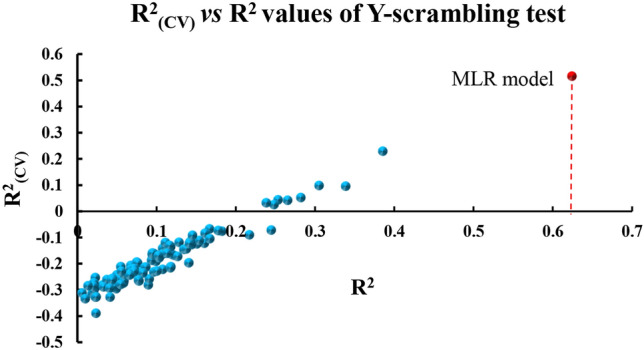
Y-Randomization (Y-scrambling) test results for the MLR model.
Table 3.
EC50 and residual values predicted by generated QSAR models.
| No | Mixture ray | pEC50, obs | MLR | SVM | ANN | |||
|---|---|---|---|---|---|---|---|---|
| pEC50 | Residual | pEC50 | Residual | pEC50 | Residual | |||
| Train set | ||||||||
| 1 | TM-CT (R1) | − 0.8165 | − 0.5572 | − 0.2593 | − 0.6507 | − 0.1658 | − 0.6194 | − 0.1971 |
| 2 | TM-CT (R2) | − 0.6682 | − 0.5804 | − 0.0878 | − 0.6897 | 0.0215 | − 0.6660 | − 0.0022 |
| 4 | TM-CT (R4) | − 0.4468 | − 0.6351 | 0.1882 | − 0.4878 | 0.0409 | − 0.3150 | − 0.1319 |
| 5 | TM-CT (R5) | − 0.3630 | − 0.6665 | 0.3035 | − 0.4030 | 0.0399 | − 0.3772 | 0.0141 |
| 6 | TM-IP (R1) | − 0.9845 | − 0.5541 | − 0.4304 | − 0.7631 | − 0.2214 | − 0.8837 | − 0.1008 |
| 7 | TM-IP (R2) | − 0.8751 | − 0.5895 | − 0.2856 | − 0.7875 | − 0.0875 | − 0.8951 | 0.0201 |
| 8 | TM-IP (R3) | − 0.8451 | − 0.6211 | − 0.2240 | − 0.7660 | − 0.0791 | − 0.7518 | 0.0815 |
| 9 | TM-IP (R4) | − 0.6703 | − 0.6509 | − 0.0194 | − 0.7101 | 0.0398 | − 0.8377 | − 0.0074 |
| 11 | IP-CT (R1) | − 0.4728 | − 0.5352 | 0.0625 | − 0.4326 | − 0.0402 | − 0.4800 | 0.0072 |
| 12 | IP-CT (R2) | − 0.2425 | − 0.5328 | 0.2903 | − 0.3112 | 0.0687 | − 0.4272 | 0.1847 |
| 13 | IP-CT (R3) | − 0.2315 | − 0.5302 | 0.2987 | − 0.1913 | − 0.0401 | − 0.2280 | − 0.0035 |
| 15 | IP-CT (R5) | − 0.1202 | − 0.5224 | 0.4022 | − 0.1611 | 0.0409 | − 0.3251 | 0.2048 |
| 16 | DF-TM (R1) | − 0.5350 | − 0.4793 | − 0.0558 | − 0.4671 | − 0.0680 | − 0.4832 | − 0.0518 |
| 17 | DF-TM (R2) | − 0.7346 | − 0.5060 | − 0.2285 | − 0.6475 | − 0.0871 | − 0.7074 | − 0.0272 |
| 18 | DF-TM (R3) | − 0.8333 | − 0.5352 | − 0.2981 | − 0.7931 | − 0.0402 | − 0.8461 | 0.0129 |
| 19 | DF-TM (R4) | − 0.8572 | − 0.5766 | − 0.2806 | − 0.9009 | 0.0437 | − 0.8913 | 0.0341 |
| 21 | DF-CT (R1) | − 0.4765 | − 0.5187 | 0.0421 | − 0.5166 | 0.0401 | − 0.7114 | 0.2348 |
| 22 | DF-CT (R2) | − 0.6167 | − 0.5040 | − 0.1127 | − 0.6321 | 0.0154 | − 0.6297 | 0.0130 |
| 24 | DF-CT (R4) | − 0.7112 | − 0.4792 | − 0.2320 | − 0.6709 | − 0.0403 | − 0.6869 | − 0.0244 |
| 26 | DF-IP (R1) | − 0.7446 | − 0.4964 | − 0.2482 | − 0.5827 | − 0.1620 | − 0.6788 | − 0.0658 |
| 28 | DF-IP (R3) | − 0.3632 | − 0.4747 | 0.1114 | − 0.4454 | 0.0821 | − 0.4752 | 0.1119 |
| 29 | DF-IP (R4) | − 0.3381 | − 0.4684 | 0.1303 | − 0.3930 | 0.0549 | − 0.3918 | 0.0538 |
| 30 | DF-IP (R5) | − 0.3172 | − 0.4638 | 0.1466 | − 0.3506 | 0.0334 | − 0.3254 | 0.0081 |
| 31 | TB-CT (R1) | − 0.5215 | − 0.4750 | − 0.0465 | − 0.5062 | − 0.0153 | − 0.4255 | − 0.0960 |
| 33 | TB-CT (R3) | − 0.3269 | − 0.2882 | − 0.0388 | − 0.4146 | 0.0876 | − 0.4028 | 0.0759 |
| 34 | TB-CT (R4) | − 0.3023 | − 0.0806 | − 0.2217 | − 0.2623 | − 0.0400 | − 0.2910 | − 0.0113 |
| 35 | TB-CT (R5) | 0.1549 | 0.3138 | − 0.1589 | 0.1894 | − 0.0345 | 0.1515 | 0.0034 |
| 37 | TB-DF (R2) | − 0.2778 | − 0.3799 | 0.1021 | − 0.2409 | − 0.0369 | − 0.1893 | − 0.0885 |
| 38 | TB-DF (R3) | − 0.1303 | − 0.3000 | 0.1696 | − 0.1703 | 0.0400 | − 0.1070 | − 0.0234 |
| 39 | TB-DF (R4) | 0.1692 | − 0.1601 | 0.3293 | − 0.0454 | 0.2146 | 0.0312 | 0.1380 |
| 40 | TB-DF (R5) | 0.1976 | 0.1596 | 0.0379 | 0.2377 | − 0.0401 | 0.2256 | − 0.0281 |
| 42 | TB-TM (R2) | − 0.2808 | − 0.5013 | 0.2205 | − 0.3616 | 0.0808 | − 0.2349 | − 0.0460 |
| 43 | TB-TM (R3) | − 0.2711 | − 0.3444 | 0.0732 | − 0.2310 | − 0.0402 | − 0.0582 | − 0.2130 |
| 44 | TB-TM (R4) | 0.0839 | − 0.0754 | 0.1593 | − 0.0171 | 0.1010 | 0.1213 | − 0.0373 |
| 45 | TB-TM (R5) | 0.3000 | 0.4177 | − 0.1177 | 0.3407 | − 0.0407 | 0.2460 | 0.0540 |
| 47 | TB-IP (R2) | − 0.0538 | − 0.2908 | 0.2370 | − 0.3919 | 0.3381 | − 0.2124 | 0.1586 |
| 48 | TB-IP (R3) | 0.0101 | − 0.1059 | 0.1160 | − 0.1696 | 0.1798 | 0.0925 | − 0.0823 |
| 49 | TB-IP (R4) | 0.1071 | 0.1819 | − 0.0748 | 0.1470 | − 0.0399 | 0.3173 | − 0.2103 |
| Test set | ||||||||
| 3 | TM-CT (R3) | − 0.6414 | − 0.6052 | − 0.0361 | − 0.6267 | − 0.0147 | − 0.4831 | − 0.1582 |
| 10 | TM-IP (R5) | − 0.6515 | − 0.6788 | 0.0273 | − 0.6282 | − 0.0233 | − 0.6584 | 0.0069 |
| 14 | IP-CT (R4) | − 0.1611 | − 0.5267 | 0.3656 | − 0.0958 | − 0.0653 | − 0.0652 | − 0.0959 |
| 20 | DF-TM (R5) | − 0.8717 | − 0.6301 | − 0.2416 | − 0.8661 | − 0.0056 | − 0.7962 | − 0.0755 |
| 23 | DF-CT (R3) | − 0.6695 | − 0.4900 | − 0.1795 | − 0.7065 | 0.0370 | − 0.6203 | − 0.0492 |
| 25 | DF-CT (R5) | − 0.8911 | − 0.4691 | − 0.4220 | − 0.5335 | − 0.3576 | − 0.6050 | − 0.2861 |
| 27 | DF-IP (R2) | − 0.6904 | − 0.4838 | − 0.2066 | − 0.5104 | − 0.1800 | − 0.5779 | − 0.1125 |
| 32 | TB-CT (R2) | − 0.4138 | − 0.3920 | − 0.0218 | − 0.4700 | 0.0562 | − 0.4209 | 0.0071 |
| 36 | TB-DF (R1) | − 0.3585 | − 0.4199 | 0.0614 | − 0.2758 | − 0.0827 | − 0.2280 | − 0.1305 |
| 41 | TB-TM (R1) | − 0.3440 | − 0.6134 | 0.2694 | − 0.4574 | 0.1134 | − 0.4061 | 0.0621 |
| 46 | TB-IP (R1) | − 0.2509 | − 0.4142 | 0.1632 | − 0.5470 | 0.2961 | − 0.4852 | 0.2343 |
| 50 | TB-IP (R5) | 0.3737 | 0.6341 | − 0.2604 | 0.5577 | − 0.1841 | 0.3686 | 0.0051 |
Applicability domain analysis of MLR model
Figure 4 illustrates the Williams plot of AD analysis. It illustrates the connection between the standardized cross-validated residuals and the leverage values (hi) for the examined mixtures. Any mixture that exhibits standardized residuals in prediction greater than three standard deviation units (ri > 3σ) or a leverage value greater than the threshold value (hi > h*) is considered an outlier of the AD57. As depicted in Fig. 4, mixture 1 from the test set can be identified as an outlier due to its high leverage value (hi > 0.328). Consequently, this particular mixture is considered distant from the other mixtures in the test set and lies outside the AD space, as its leverage value surpasses the vertical leverage threshold line. Similarly, mixture 31 from the training set is also incorrectly predicted due to its standardized residuals in prediction being greater or lower than ± 2. However, it still falls within the cutoff leverage value and hence belongs to the model AD. Therefore, the prediction for mixture 31 should be accepted. However, the presence of mixture 1 from the test set outside the AP (Acceptance Probability) justifies the low external predictive power of the MLR model.
Figure 4.
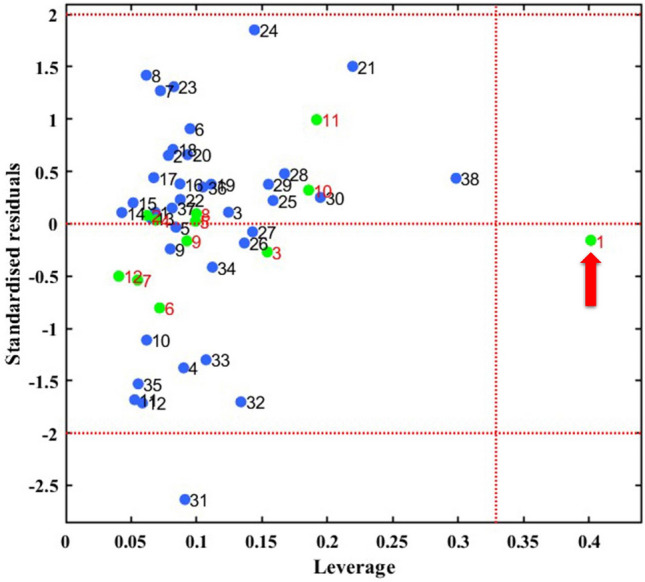
Williams plots of the QSAR models developed by the MLR. Blue circles represent the train set while the green circles represent the test set. Red arrow refers to the mixture completely outside the AD.
SVM-QSAR regression model
To enhance the correlation between the fungicidal activity and the selected molecular descriptors obtained by the MLR model, the four chosen descriptors were employed as inputs for the SVM regression modeling. Support vector regression has been utilized in various regression problems61. Gaussian kernel function, box constraint level of 904.61, and kernel scale of 6.479 were chosen as the optimal hyperparameters through Bayesian optimization. The mean square error (MSE) is 0.01, with the coefficient of determination (R2) and R2cv being 0.91 and 0.78, respectively (Table 4), indicating the superior predictive ability of the SVM-based QSAR model over the MLR model. It can be inferred that the predicted values align well with the experimental values, as shown in Fig. 2.
Table 4.
Comparison of MLR, SVM and ANN generated models.
| Model | Train set | Test set | ||||
|---|---|---|---|---|---|---|
| R2 | MSE | R2cv | MSEcv | R2test | MSEtest | |
| MLR | 0.625 | 0.044 | 0.55 | 0.056 | 0.551 | 0.052 |
| SVM | 0.91 | 0.01 | 0.78 | 0.025 | 0.77 | 0.026 |
| ANN | 0.91 | 0.01 | 0.81 | 0.017 | 0.845 | 0.018 |
Support vector regression is presently widely employed for QSAR modeling in various fields like solubility of solid solutes62, dipeptide datasets44, Materials63, and drug design and screening64. The high predictive capability of the SVM regression model in our study renders it potentially useful as a powerful tool for designing novel fungicide mixtures to address the resistance problem encountered in modern agriculture.
ANN-QSAR model
Multi-layer perceptron networks are the most widely used feedforward artificial neural networks for solving nonlinear relationships in QSAR studies65. The same input used for the SVM-QSAR model was also used for the ANN-QSAR model. In this study, a backpropagation algorithm was utilized for training the ANN-QSAR model. The number of neurons in the hidden layer was varied from 1 to 30 in order to determine the optimal number of neurons based on the root mean square error values. It was determined that the network possessed an architecture of 4/4/1 (with one hidden layer consisting of 4 neurons) exhibited the most optimal performance for our inputs. The dataset was divided into three subsets in a random manner for the ANN model: 65% for the training set, 15% for the testing set, and 20% for the validation set. The training set showed an R2 value of 0.91 and an MSE value of 0.011, indicating the excellent predictability of the non-linear model generated by ANN. The R2cv value was 0.81, which surpassed the other models (Table 4). The MLP-ANN has been successfully employed as a powerful modeling tool for various modeling and predicting studies, such as predicting the normal boiling point temperature and relative liquid density66, predicting protein structure65, and the bioactivity of drugs and pesticides67–69. The statistical parameters of the developed ANN-QSAR model in this study demonstrated the high performance of the MLP-ANN in predicting the fungicidal activity of the mixtures.
There is no agreement on a universally accepted optimal algorithm for model development in field of QSAR and QSPR70. A comparative analysis of the statistical parameters obtained from the generated QSAR models in this investigation revealed that both ANN and SVM models exhibited a high level of predictive performance in comparison to the MLR model, as evidenced by the MSE and R2cv values (Table 4). The residuals of both the SVM and ANN models were found to be distributed randomly on either side of zero and closer to the zero line when compared to the MLR model. This observation suggests the superiority of the ML-based QSAR model over the classic MLR model. However, the high R2cv value indicated that the ANN-QSAR model achieved higher accuracy than the SVM model, highlighting the robustness of the ANN model even when excluding a portion of the training set data as the validation set during model development. Furthermore, the results of the external validation demonstrated the superiority of the ANN model over both the MLR and SVM models, based on the R2test and MSEtest values as indicated in Table 4.
Conclusions
In the current investigation, the fixed ratio Ray design was employed to formulate 50 potential binary mixtures using 5 fungicides extensively utilized in the agricultural field. The interaction type of the mixture components was determined through the utilization of the CA and IA models. Various interactions were observed among the fungicides, with the majority being additive based on the models utilized. Additionally, QSAR models were developed to predict the fungicidal activity of these mixtures. The ML-based QSAR models SVM and ANN displayed a high level of predictive performance when compared to the MLR model. Nevertheless, the ANN-QSAR model achieved greater accuracy than the SVM model. This study emphasizes the potential use of these models in developing improved fungicide mixtures for agriculture purposes. The findings could have a significant influence on managing plant disease resistance.
Supplementary Information
Acknowledgements
Many thanks to Dr. Mohammad Almokdad at the Department of Agriculture Economics, Faculty of Agriculture, Al-Baath University for their help in statistical analysis.
Author contributions
M. A. supervised the study and was responsible for designing the experiments. A. M. actively participated in the experimental study. M. A. assumed responsibility for the writing of the manuscript and the execution of the QSAR analysis. All authors thoroughly reviewed the manuscript.
Data availability
The authors confirm that the data supporting the findings of this study are available within the article and its supplementary materials.
Competing interests
The authors declare no competing interests.
Footnotes
Publisher's note
Springer Nature remains neutral with regard to jurisdictional claims in published maps and institutional affiliations.
Supplementary Information
The online version contains supplementary material available at 10.1038/s41598-024-63708-2.
References
- 1.Brent, K.J., & Hollomon, D.W., 1995. Fungicide resistance in crop pathogens: How can it be managed?. 48.
- 2.Bolton, N. J. E., & Smith, J. M. 1988. Strategies to combat fungicide resistance in barley powdery mildew. in British Crop Protection Conference, Pests & Diseases 367–372.
- 3.Van Den Bosch, F., Oliver, R., Van Den Berg, F. & Paveley, N. Governing principles can guide fungicide-resistance management tactics. Annu Rev Phytopathol.52, 175–195 (2014). [DOI] [PubMed] [Google Scholar]
- 4.Oliver, R.P., & Hewitt, H.G. (2014). Fungicides in crop protection. Cabi. 200pp.
- 5.Birch, C. P. D., & Shaw, M. W. When can reduced doses and pesticide mixtures delay the build-up of pesticide resistance? A mathematical model. J. Appl. Ecol. (1997): 1032–1042
- 6.Campitelli, M., Zeineddine, N., Samaha, G. & Maslak, S. Combination antifungal therapy: A review of current data. J. Clin. Med. Res.9(6), 451 (2017). [DOI] [PMC free article] [PubMed] [Google Scholar]
- 7.Altenburger, R., Nendza, M. & Schüürmann, G. Mixture toxicity and its modeling by quantitative structure-activity relationships. Environ. Toxicol. Chem. Int. J.22(8), 1900–1915 (2003). [DOI] [PubMed] [Google Scholar]
- 8.Altenburger, R., Walter, H. & Grote, M. What contributes to the combined effect of a complex mixture?. Environ. Sci. Technol.38(23), 6353–6362 (2004). [DOI] [PubMed] [Google Scholar]
- 9.Belden, J. B., Gilliom, R. J. & Lydy, M. J. How well can we predict the toxicity of pesticide mixtures to aquatic life?. Integrated Environ. Assess. Manag. Int. J.3(3), 364–372 (2007). [PubMed] [Google Scholar]
- 10.Liu, L., Liu, S. S., Yu, M. & Chen, F. Application of the combination index integrated with confidence intervals to study the toxicological interactions of antibiotics and pesticides in Vibrio qinghaiensis sp-Q67. Environ. Toxicol. Pharmacol.39(1), 447–456 (2015). [DOI] [PubMed] [Google Scholar]
- 11.Loewe, S. T. Effect of combinations: mathematical basis of problem. Arch. Exp. Pathol. Pharmakol.114, 313–326 (1926). [Google Scholar]
- 12.Bliss, C. I. The toxicity of poisons applied jointly 1. Ann. Appl. Biol.26(3), 585–615 (1939). [Google Scholar]
- 13.Lydy, M., Belden, J., Wheelock, C., Hammock, B., Denton, D., 2004. Challenges in regulating pesticide mixtures. Ecol. Soc.9(6).
- 14.Todeschini, R. & Consonni, V. Handbook of Molecular Descriptors 688 (Wiley, New York, 2008). [Google Scholar]
- 15.Keyvanpour, M. R. & Shirzad, M. B. An analysis of QSAR research based on machine learning concepts. Curr. Drug Discov. Technol.18(1), 17–30 (2021). [DOI] [PubMed] [Google Scholar]
- 16.Czermiński, R., Yasri, A. & Hartsough, D. Use of support vector machine in pattern classification: Application to QSAR studies. Quant. Struct. Activity Relation.20(3), 227–240 (2001). [Google Scholar]
- 17.Rumelhart, D. E., Hinton, G. E. & Williams, R. J. Learning representations by back-propagating errors. Nature323(6088), 533–536 (1986). [Google Scholar]
- 18.Johnson, S. R. The trouble with QSAR (or how I learned to stop worrying and embrace fallacy). J. Chem. Inf. Model.48(1), 25–26 (2008). [DOI] [PubMed] [Google Scholar]
- 19.Zhang, L., Tan, J., Han, D. & Zhu, H. From machine learning to deep learning: progress in machine intelligence for rational drug discovery. Drug Discovery Today22(11), 1680–1685 (2017). [DOI] [PubMed] [Google Scholar]
- 20.Zhang, F., Wang, Z., Peijnenburg, W. J. & Vijver, M. G. Machine learning-driven QSAR models for predicting the mixture toxicity of nanoparticles. Environ. Int.177, 108025 (2023). [DOI] [PubMed] [Google Scholar]
- 21.Chatterjee, M. & Roy, K. Chemical similarity and machine learning-based approaches for the prediction of aquatic toxicity of binary and multicomponent pharmaceutical and pesticide mixtures against Aliivibrio fischeri. Chemosphere308, 136463 (2022). [DOI] [PubMed] [Google Scholar]
- 22.Chatterjee, M. et al. Machine learning-based q-RASAR modeling to predict acute contact toxicity of binary organic pesticide mixtures in honey bees. J. Hazardous Mater.460, 132358 (2023). [DOI] [PubMed] [Google Scholar]
- 23.Wang, Z. J., Liu, S. S., Feng, L. & Xu, Y. Q. BNNmix: A new approach for predicting the mixture toxicity of multiple components based on the back-propagation neural network. Sci. Total Environ.738, 140317 (2020). [DOI] [PubMed] [Google Scholar]
- 24.Schmitz, H. Poisoned food technique. Ind. Eng. Chem. Anal. Edition2(4), 361–363 (1930). [Google Scholar]
- 25.GraphPad Prism (Version 7) [Computer software]. La Jolla, CA: GraphPad Software, Inc. Retrieved from http://www.graphpad.com/scientific-software/prism/.
- 26.Casey, M., Gennings, C., Carter, W. H., Moser, V. C. & Simmons, J. E. Detecting interaction (s) and assessing the impact of component subsets in a chemical mixture using fixed-ratio mixture ray designs. J. Agric. Biol., Environ. Stat.9, 339–361 (2004). [Google Scholar]
- 27.Gennings, C. et al. Analysis of functional effects of a mixture of five pesticides using a ray design. Environ. Toxicol. Pharmacol.18(2), 115–125 (2004). [DOI] [PubMed] [Google Scholar]
- 28.Cedergreen, N. Quantifying synergy: a systematic review of mixture toxicity studies within environmental toxicology. PloS one9(5), e96580 (2014). [DOI] [PMC free article] [PubMed] [Google Scholar]
- 29.Froimowitz, M. HyperChem: a software package for computational chemistry and molecular modeling. Biotechniques14(6), 1010–1013 (1993). [PubMed] [Google Scholar]
- 30.Frisch, M. J. et al.Gaussian 09, rev (Gaussian Inc, 2009). [Google Scholar]
- 31.Del Bene, J. E., Person, W. B. & Szczepaniak, K. Properties of hydrogen-bonded complexes obtained from the B3LYP functional with 6–31G (d, p) and 6–31+ G (d, p) basis sets: Comparison with MP2/6-31+ G (d, p) results and experimental data. J. Phys. Chem.99(27), 10705–10707 (1995). [Google Scholar]
- 32.Todeschini, R., Consonni, V., & Pavan, M., DRAGON–Software for the calculation of molecular descriptors, rel. 1.12 for Windows. Free download available at http://www.disat.unimib/chm (2001).
- 33.Costa, A. S., Martins, J. P. A. & de Melo, E. B. SMILES-based 2D-QSAR and similarity search for identification of potential new scaffolds for development of SARS-CoV-2 MPRO inhibitors. Struct. Chem.33(5), 1691–1706 (2022). [DOI] [PMC free article] [PubMed] [Google Scholar]
- 34.Rosell-Hidalgo, A., Moore, A. L. & Ghafourian, T. Prediction of drug-induced mitochondrial dysfunction using succinate-cytochrome c reductase activity, QSAR Molecular docking. Toxicology485, 153412 (2023). [DOI] [PubMed] [Google Scholar]
- 35.Qin, L. T., Liu, S. S., Chen, F. & Wu, Q. S. Development of validated quantitative structure–retention relationship models for retention indices of plant essential oils. J. Sep. Sci.36(9–10), 1553–1560 (2013). [DOI] [PubMed] [Google Scholar]
- 36.Gaudin, T., Rotureau, P. & Fayet, G. Mixture descriptors toward the development of quantitative structure–property relationship models for the flash points of organic mixtures. Ind. Eng. Chem. Res.54(25), 6596–6604 (2015). [Google Scholar]
- 37.Tang, K. S., Man, K. F., Kwong, S. & He, Q. Genetic algorithms and their applications. IEEE Signal Process. Mag.13(6), 22–37 (1996). [Google Scholar]
- 38.MATLAB, V., 2019. 9.7. 0 (R2019b). The MathWorks Inc, Natick, Massachusetts.
- 39.Leonard, J. T. & Roy, K. On selection of training and test sets for the development of predictive QSAR models. QSAR Combinat. Sci.25(3), 235–251 (2006). [Google Scholar]
- 40.Aiken, L.S., West, S.G. and Reno, R.R., 1991. Multiple regression: Testing and interpreting interactions. Sage. 212pp.
- 41.Ghanei-Nasab, S., Hadizadeh, F., Foroumadi, A. & Marjani, A. A QSAR study for the prediction of inhibitory activity of coumarin derivatives for the treatment of Alzheimer’s disease. Arab. J. Sci. Eng.46(6), 5523–5531 (2021). [Google Scholar]
- 42.Žuvela, P., David, J., Yang, X., Huang, D. & Wong, M. W. Non-linear quantitative structure–activity relationships modelling, mechanistic study and in-silico design of flavonoids as potent antioxidants. Int. J. Mol. Sci.20(9), 2328 (2019). [DOI] [PMC free article] [PubMed] [Google Scholar]
- 43.King, R. D., Hirst, J. D. & Sternberg, M. J. New approaches to QSAR: neural networks and machine learning. Perspect. Drug Discov. Des.1, 279–290 (1993). [Google Scholar]
- 44.Mei, H., Zhou, Y., Liang, G. & Li, Z. Support vector machine applied in QSAR modelling. Chinese Sci. Bull.50, 2291–2296 (2005). [Google Scholar]
- 45.Doucet, J. P., Barbault, F., Xia, H., Panaye, A. & Fan, B. Nonlinear SVM approaches to QSPR/QSAR studies and drug design. Curr. Comput. Aided Drug Des.3(4), 263–289 (2007). [Google Scholar]
- 46.Liu, H. X. et al. Prediction of the isoelectric point of an amino acid based on GA-PLS and SVMs. J. Chem. Inf. Comput. Sci.44(1), 161–167 (2004). [DOI] [PubMed] [Google Scholar]
- 47.Suter, B. W. The multilayer perceptron as an approximation to a Bayes optimal discriminant function. IEEE Trans. Neural Netw.1(4), 291 (1990). [DOI] [PubMed] [Google Scholar]
- 48.Gardner, M. W. & Dorling, S. R. Artificial neural networks (the multilayer perceptron)—a review of applications in the atmospheric sciences. Atmos. Environ.32(14–15), 2627–2636 (1998). [Google Scholar]
- 49.Beale, M. H., Hagan, M. T. & Demuth, H. B. Neural network toolbox. User’s Guide, MathWorks2, 77–81 (2010). [Google Scholar]
- 50.Airola, A., Pahikkala, T., Waegeman, W., De Baets, B. & Salakoski, T. An experimental comparison of cross-validation techniques for estimating the area under the ROC curve. Comput. Stat. Data Anal.55(4), 1828–1844 (2011). [Google Scholar]
- 51.Huang, W. et al. Prediction of human clearance based on animal data and molecular properties. Chem. Biol. Drug Des.86(5), 990–997 (2015). [DOI] [PubMed] [Google Scholar]
- 52.Golbraikh, A. & Tropsha, A. Beware of q2!. J. Mol. Gr. Modell.20(4), 269–276 (2002). [DOI] [PubMed] [Google Scholar]
- 53.Kennedy, P. E. & Cade, B. S. Randomization tests for multiple regression. Commun. Stat. Simul. Comput.25(4), 923–936 (1996). [Google Scholar]
- 54.Rücker, C., Rücker, G. & Meringer, M. Y-randomization–a useful tool in QSAR validation, or folklore. J. Chem. Inf. Model47, 2345–2357 (2007). [DOI] [PubMed] [Google Scholar]
- 55.OECD. Guidance Document on the Validation of (Quantitative) Structure-Activity Relationship [(Q)SAR] Models (OECD, 2014). 10.1787/9789264085442-en. [Google Scholar]
- 56.Roy, K., Kar, S. & Ambure, P. On a simple approach for determining applicability domain of QSAR models. Chemomet. Intell. Lab. Syst.145, 22–29 (2015). [Google Scholar]
- 57.Todeschini, R., Consonni, V. and Gramatica, P., 2009. Chemometrics in QSAR. In Comprehensive chemometrics (Vol. 4, pp. 129–172). Elsevier.
- 58.Gadaleta, D., Mangiatordi, G. F., Catto, M., Carotti, A. & Nicolotti, O. Applicability domain for QSAR models: Where theory meets reality. Int. J. Quant. Struct. Prop. Relations. (IJQSPR)1(1), 45–63 (2016). [Google Scholar]
- 59.Geiger, E., Hornek-Gausterer, R. & Saçan, M. T. Single and mixture toxicity of pharmaceuticals and chlorophenols to freshwater algae Chlorella vulgaris. Ecotoxicol. Environ. Saf.129, 189–198 (2016). [DOI] [PubMed] [Google Scholar]
- 60.Zhang, Y.H., & Liu, Z., 2015. Study on the mixture toxicity of organophosphorus (OP) pesticides. Toxic Pollutants in China: Study of Water Quality Criteria, pp.129–140.
- 61.Smola, A. J. & Schölkopf, B. A tutorial on support vector regression. Stat. Comput.14, 199–222 (2004). [Google Scholar]
- 62.Moussaoui, M., Laidi, M., Hanini, S. & Hentabli, M. Artificial neural network and support vector regression applied in quantitative structure-property relationship modelling of solubility of solid solutes in supercritical CO 2. Kemija u industriji: Časopis kemičara i kemijskih inženjera Hrvatske69(11–12), 611–630 (2020). [Google Scholar]
- 63.Lu, W. C. et al. Using support vector machine for materials design. Adv. Manuf.1, 151–159 (2013). [Google Scholar]
- 64.Yao, X. et al. QSAR and classification study of 1, 4-dihydropyridine calcium channel antagonists based on least squares support vector machines. Mol. Pharmaceut.2(5), 348–356 (2005). [DOI] [PubMed] [Google Scholar]
- 65.Salt, D. W., Yildiz, N., Livingstone, D. J. & Tinsley, C. J. The use of artificial neural networks in QSAR. Pesticide Sci.36(2), 161–170 (1992). [Google Scholar]
- 66.Fissa, M. R., Lahiouel, Y., Khaouane, L. & Hanini, S. QSPR estimation models of normal boiling point and relative liquid density of pure hydrocarbons using MLR and MLP-ANN methods. J. Mol. Gr. Modell.87, 109–120 (2019). [DOI] [PubMed] [Google Scholar]
- 67.Žuvela, P., David, J. & Wong, M. W. Interpretation of ANN-based QSAR models for prediction of antioxidant activity of flavonoids. J. Comput. Chem.39(16), 953–963 (2018). [DOI] [PubMed] [Google Scholar]
- 68.Kianpour, M., Mohammadinasab, E. & Isfahani, T. M. Prediction of oral acute toxicity of organophosphates using QSAR methods. Curr. Comput. Aided Drug Des.17(1), 38–56 (2021). [DOI] [PubMed] [Google Scholar]
- 69.Hamadache, M., Benkortbi, O., Hanini, S. & Amrane, A. Application of multilayer perceptron for prediction of the rat acute toxicity of insecticides. Energy Procedia139, 37–42 (2017). [Google Scholar]
- 70.Wu, Z. et al. Do we need different machine learning algorithms for QSAR modeling? A comprehensive assessment of 16 machine learning algorithms on 14 QSAR data sets. Brief. Bioinform.22(4), 321 (2021). [DOI] [PubMed] [Google Scholar]
Associated Data
This section collects any data citations, data availability statements, or supplementary materials included in this article.
Supplementary Materials
Data Availability Statement
The authors confirm that the data supporting the findings of this study are available within the article and its supplementary materials.