



Abstract
Adverse pregnancy outcomes are associated with poor short- and long-term cardiovascular health. However, patients and their health care providers may not have knowledge of this risk or of the healthful practices that can reduce this risk. Childbirth care can be a pivotal time in the patient–clinician relationship to build awareness and spur prevention planning. As part of the American Heart Association–supported program entitled Providing an Optimized and Empowered Pregnancy for You (P3OPPY), our team collaborated with a community advisory board to create a teaching handout about adverse pregnancy outcomes for incorporation into hospital-based postpartum care. This handout can be used by pregnancy and maternity care providers, including postpartum nurses, to provide health education on how adverse pregnancy outcomes can influence risk for future cardiovascular disease and what can be done for prevention.
Keywords: adverse pregnancy outcomes, birth, cardiovascular disease, cardiovascular health, discharge teaching, disparities, health education, nurses, postpartum, pregnancy
Graphical Abstract

Pregnancy leads to dramatic physiologic changes that support healthy fetal development and growth (Parikh et al., 2021; Lewey, et al., 2024). This unique period has been called a stress test for the heart due to significant cardiovascular, hematologic, structural, and hemodynamic adaptations, including increased blood volume, cardiac workload and remodeling, and decreased vascular resistance (American College of Obstetricians and Gynecologists, 2019). Although the physiologic stress of these changes is a normal part of pregnancy, it can also uncover or accentuate the risk of adverse maternal and fetal outcomes in some individuals (Grandi et al., 2019; Parikh et al., 2021). Cardiovascular adverse pregnancy outcomes (APOs) include gestational diabetes mellitus (GDM), hypertensive disorders of pregnancy, birthing a small-for-gestational age neonate, placental abruption, preterm birth, and pregnancy loss (see Table 1 for clinical definitions of each type of APO).
TABLE 1.
ADVERSE PREGNANCY OUTCOME DEFINITION
| Adverse Pregnancy Outcome | Definition |
|---|---|
| Hypertensive disorders of pregnancy | High blood pressure disorders in pregnancy consisting of chronic hypertension (elevated blood pressure before pregnancy or at <20 weeks gestation), gestational hypertension (new-onset hypertension at >20 weeks gestation), or preeclampsia (elevated blood pressure after 20 weeks gestation with end-organ dysfunction that may include protein in the patient’s urine) |
| Gestational diabetes mellitus | New-onset glucose intolerance during pregnancy |
| Preterm birth | Birth of a neonate at <37 weeks of gestation |
| Placental abruption | Bleeding between the placenta and uterus that results in placenta separation |
| Small-for-gestational-age neonate | Neonate with birth weight of <10th percentile. |
| Pregnancy loss | Miscarriage or stillbirth |
Source: Parikh et al. (2021).
These adverse outcomes are caused by related underlying pathophysiologic processes originating in abnormal placentation. During a normal pregnancy, trophoblasts invade the maternal spiral arteries, causing them to remodel and widen, ensuring a low-resistance blood flow to the uterus and placenta. However, in a pregnancy affected by APOs, this invasion by trophoblasts is insufficient, leading to poor remodeling of the uterine spiral arteries. This is thought to reduce blood flow to the placenta, causing ischemia and the release of antiangiogenic proteins into the maternal bloodstream (Lane-Cordova et al., 2019). APOs are prevalent, affecting approximately 10% to 20% of all pregnancies in the United States (Cho et al., 2020; Lane-Cordova et al., 2019; Roberts & Hubel, 2009).
Black, American Indian, Asian, Pacific Islander, and Hispanic individuals often bear a greater burden of maternal and cardiovascular mortality in the United States due to the structural racism they encounter, and they also disproportionately experience APOs (Rattan & Bartlett, 2023; Yee et al., 2022). Addressing the high pregnancy-related cardiovascular mortality and unacceptable racial disparities in maternal health in the United States requires urgent intervention in these common adverse outcomes.
APOs affect the pregnant individual and the neonate. Pregnant women with one or more APOs also have a two- to fourfold increased risk of future cardiovascular disease (CVD) with the risk spanning from as young as 30 years of age to later in life (Hallum et al., 2023; Lane-Cordova et al., 2019). Hypertensive disorders of pregnancy are strongly associated with an increased risk of atherosclerotic CVD, including coronary artery disease, peripheral artery disease, and ischemic stroke, and moderately associated with an increased risk of hemorrhagic stroke and heart failure. GDM, placental abruption, preterm childbirth, pregnancy loss, and birthing a small-for-gestational-age neonate are strongly linked to an elevated risk of atherosclerotic CVD (Lane-Cordova et al., 2019). APOs are now designated as risk-enhancing by the American College of Cardiology, meaning that individuals at intermediate risk of CVD should be considered high risk if they have experienced an APO (Bello, 2023).
Neonates of women who have experienced an APO, especially those who are small or preterm, have an increased risk of adverse immediate outcomes, including respiratory distress syndrome, infection, intracranial hemorrhage, and even death (Owens et al., 2018). Poor outcomes may also extend past the neonatal period. Young adolescents whose mothers have experienced one or more APOs also appear to be at risk for less-than-ideal cardiovascular health, as measured by body mass index, blood pressure, blood lipids, and blood glucose (Venkatesh et al., 2024).
A Gap Between Evidence and Practice
Despite the mounting evidence of the prevalence of APOs and the significant lifetime risks associated with them, intervention research and clinical practice lag. Although there is some evidence of promising interventions that may reduce long-term cardiometabolic risk (see Box 1), no specific guidelines direct the postpartum care of individuals with APOs (Jowell et al., 2022).
BOX 1. POTENTIAL INTERVENTIONS TO REDUCE CVD RISK AFTER APOS.
Transitional clinics and postpartum care that support patients at high risk for future CVD to connect to primary care
Breastfeeding
Lifestyle interventions that increase physical activity and improve diet quality for people with history of HDPs and GDM
Pharmacotherapy (metformin hydrochloride) for people with prediabetes and a history of GDM
Integrating APOs into CVD risk assessment to guide statin prescription for people with intermediate CVD risk
Blood pressure optimization
Maintenance of healthy weight
Note. APO = adverse pregnancy outcome; CVD = cardiovascular disease; GDM = gestational diabetes mellitus; HDP = hypertensive disorder of pregnancy. Source: Jowell et al. (2022).
Providers’ and patients’ knowledge of the long-term adverse effects of APOs is low (Jowell et al., 2022). Many pregnant people and their providers are unaware of the potential harm of APOs that persists after immediate postpartum complications resolve, regardless of the number of years since pregnancy (Crump et al., 2023). There is a critical need to design and test tools to support awareness, education, and planning among individuals who have experienced an APO (Parikh et al., 2021). Similar to the so-called “golden hour” for managing stroke or providing evidence-based care for neonates during their first hour, the “golden year” of pregnancy, birth, and the early postpartum period can be an extended opportunity to offer impactful care to people who have experienced an APO (Ebinger et al., 2015; Miller, 2022; Schofield & Winter, 2024).
Recommendations From the American Heart Association
In its scientific statement, the American Heart Association (AHA) advocates for tailored education and improved care transitions for women with APOs to decrease the long-term risk of CVD. Specifically, the AHA recommends breastfeeding, optimizing blood pressure, eating a heart-healthy diet, increasing physical activity, maintaining a healthy weight, and identifying and managing dyslipidemia (Parikh et al., 2021). Breastfeeding improves infant outcomes but also may protect against future CVD, Type 2 diabetes, and hypertension (Feng et al., 2018; Jowell et al., 2022; Schwarz et al., 2009). A heart-healthy diet that includes a high proportion of vegetables, fruits, nuts, legumes, and fish with a corresponding low intake of processed and red meats is cardioprotective and is recommended throughout the life course (Jowell et al., 2022; Parikh et al., 2021). Lifestyle interventions that include physical exercise and heart-healthy diets are associated with reduced postpartum weight retention and decreased risk of Type 2 diabetes in people with GDM (Ferrara, 2007; Holmes et al., 2018; Jowell et al., 2022; Nicklas et al., 2014; Ratner et al., 2008). Finally, optimizing blood pressure and lipid profiles are evidence-based strategies for primary CVD prevention across the life span (Cho et al., 2020).
The P3OPPY Project and Development of a Teaching Tool
Our initiative, the AHA-supported Providing an Optimized and Empowered Pregnancy for You (P3OPPY) project, pairs pregnant people with community health workers who support them through pregnancy, childbirth, and the early postpartum period with the aim of reducing APOs. Drawing on the AHA guidance and related evidence described, our research team realized that in-hospital postpartum care could be a critical touchpoint for providing health education about APOs and CVD risk. To increase patients’ and providers’ awareness of the increased CVD risk for people experiencing APOs, the P3OPPY team designed a teaching handout for incorporation into hospital-based postpartum care at discharge. We requested that P3OPPY’s community advisory board, composed of experts in the lived experience of complex childbirth and professionals from organizations working on maternal health interventions and advocacy in Alabama, give us critical feedback on the language and image in the handout. After several iterations, we collected further insights from nurses, physicians, and maternal health researchers to refine the visual. Our feedback process helped transform AHA’s APO guidelines into a reader-friendly, one-page visual handout that postpartum nurses can use to spark a conversation that emphasizes practical steps patients can take to decrease future CVD risk (see Figure 1). We created an image of a Black pregnant person who best represented our patient community and paired that image with recommendations for simple, actionable steps, such as seeing a primary care provider each year postbirth and alerting them to one’s APO history. Members of the community advisory board also provided critical input on the challenges of identifying a primary care provider. This insight is leading to a change in obstetric provider workflow in our institution that will offer a primary care physician referral around the time of the standard 1-hour glucose challenge test, with the goal that each person sees a primary care provider within 1 year of childbirth.
FIGURE 1.
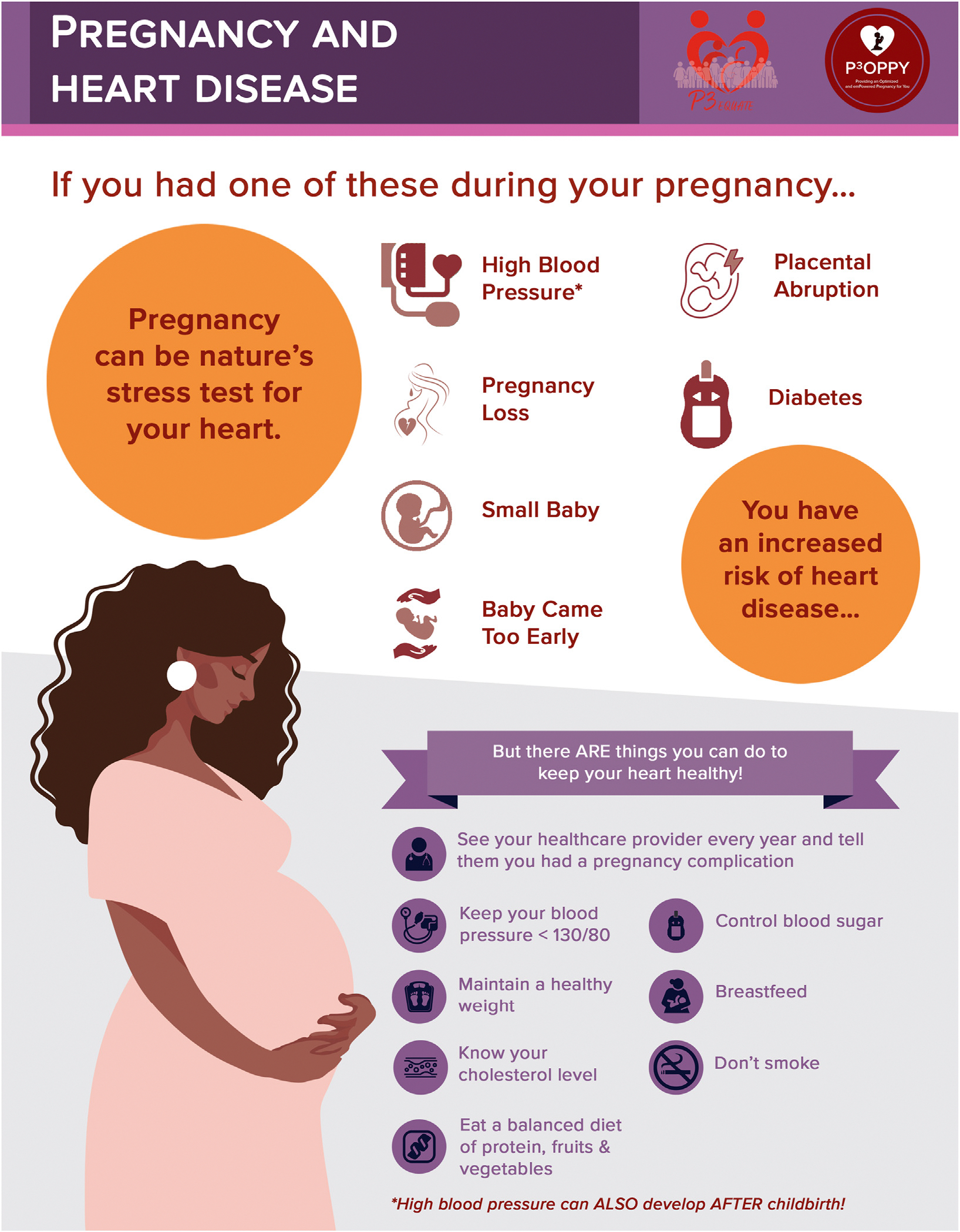
PREGNANCY AND HEART DISEASE EDUCATIONAL HANDOUT
Implications for Practice
Discharge teaching is not the only opportunity to increase patients’ awareness of the risks of APOs. There are multiple touchpoints across the golden year of pregnancy, birth, and the early postpartum period to improve understanding and mitigate the CVD risk that comes with experiencing an APO. As with the changes the P3OPPY team is making to ensure that prenatal patients are connected to a primary care provider at about 20 weeks gestation, nurses can include APO education as well as identification of a primary care provider early in prenatal care—as soon as an individual knows they are pregnant.
Although pregnancy can be a time of intensive engagement with the health care system, there are multiple barriers to postpartum and later well-woman care, meaning that only approximately 40% of individuals return for one or more postpartum visits, and fewer than half receive primary care within the first year after childbirth (American College of Obstetricians and Gynecologists, Committee on Obstetric Practice, 2018; Jowell et al., 2022; Yee et al., 2022). The AHA has called for concerted cardiovascular risk factor modification during this “fourth trimester” for individuals with APOs (Mehta et al., 2020, p. e897), in addition to community health worker interventions such as those being tested through the P3OPPY project.
There are promising interventions being led by nurses that can close the distance between the AHA recommendations and reality. Nurse-led telehealth interventions are effective for outcomes such as hypertension, and nurse-led care offered remotely during the first year after childbirth could be a strategy to reach people who have experienced an APO with support, education, and remote monitoring (Kappes et al., 2023). Postpartum home visiting interventions, such as the Nurse-Family Partnership, are another evidence-based strategy that could be adapted to bridge the gap in effective care and education after birth for individuals who experienced an APO (Dawley et al., 2007; Miller, 2015). Nurse practitioners trained in holistic, person-centered care are also well positioned to fill the primary care role that many individuals who experienced APOs urgently need in the postpartum period, especially in underserved areas with high levels of poor cardiovascular health (Streeter et al., 2020).
Pregnancy and maternity care providers, including nurses, can test the acceptability, feasibility, and potential effectiveness of this teaching tool in improving postpartum discharge education. This handout is free to use with proper attribution. For more information and access to this handout, contact the authors.
Conclusion
The science related to APOs and future CVD risk is clear, yet health care practice lags. Few postpartum people or their health care providers are aware of this heightened risk. However, simple follow-up and management of modifiable cardiovascular risk factors can positively alter a person’s life trajectory. An educational tool that sparks awareness and understanding of the risks associated with APOs can help health care providers and patients plan for ongoing cardiovascular monitoring and prevention.
CLINICAL IMPLICATIONS.
Adverse pregnancy outcomes (APOs) include hypertensive disorders of pregnancy, preterm birth, gestational diabetes, birthing a small-for-gestational-age neonate, placental abruption, and pregnancy loss.
APOs are associated with increased maternal and perinatal morbidity and mortality but also with poor short- and long-term maternal cardiovascular health, yet patients and providers are often unaware of this increased risk.
Lifestyle factors associated with lower risk for cardiovascular disease include breastfeeding, optimizing blood pressure, eating a heart-healthy diet, increasing physical activity, and maintaining a healthy weight.
An essential prevention component is identifying a primary care provider who can support the optimal management of hypertension, diabetes, and dyslipidemia as necessary.
Funding
The authors received funding from American Heart Association award numbers 22HERNPMI985239 and 24POST1198805 and National Institutes of Health award numbers NHLBI K23159331 and NHLBI K23HL157618. NWH
Footnotes
Author Disclosures
The authors report no conflicts of interest or relevant financial relationships.
Contributor Information
Jesse Rattan, University of Alabama at Birmingham, in Birmingham, AL.
Molly B. Richardson, University of Alabama at Birmingham in Birmingham, AL.
Angelina A. Toluhi, University of Alabama at Birmingham, in Birmingham, AL.
Henna Budhwani, Florida State University in Tallahassee, FL.
Vivek V. Shukla, University of Alabama at Birmingham in Birmingham, AL.
Colm P. Travers, University of Alabama at Birmingham in Birmingham, AL.
Jonathan Steen, University of Alabama at Birmingham, in Birmingham, AL..
Martha Wingate, University of Alabama at Birmingham in Birmingham, AL.
Alan Tita, University of Alabama at Birmingham in Birmingham, AL..
Janet M. Turan, University of Alabama at Birmingham in Birmingham, AL.
Waldemar A. Carlo, University of Alabama at Birmingham in Birmingham, AL.
Rachel Sinkey, University of Alabama at Birmingham in Birmingham, AL..
References
- American College of Obstetricians and Gynecologists. (2019). ACOG Practice Bulletin No. 212: Pregnancy and heart disease. Obstetrics & Gynecology, 133(5), e320–e356. 10.1097/aog.0000000000003243 [DOI] [PubMed] [Google Scholar]
- American College of Obstetricians and Gynecologists, Committee on Obstetric Practice. (2018). Presidential task force on redefining the postpartum visit committee on obstetric practice. Obstetrics & Gynecology, 131(5), e140–e150. 10.1097/aog.0000000000002633 [DOI] [PubMed] [Google Scholar]
- Bello NA (2023). Adverse pregnancy outcomes-risk enhancers whose time has finally arrived. JAMA, 329(5), 373–375. 10.1001/jama.2022.24387 [DOI] [PMC free article] [PubMed] [Google Scholar]
- Cho L, Davis M, Elgendy I, Epps K, Lindley KJ, Mehta PK, … Volgman AS (2020). Summary of updated recommendations for primary prevention of cardiovascular disease in women: JACC state-of-the-art review. Journal of the American College of Cardiology, 75(20), 2602–2618. 10.1016/j.jacc.2020.03.060 [DOI] [PMC free article] [PubMed] [Google Scholar]
- Crump C, Sundquist J, McLaughlin MA, Dolan SM, Govindarajulu U, Sieh W, & Sundquist K (2023). Adverse pregnancy outcomes and long-term risk of ischemic heart disease in mothers: National cohort and co-sibling study. BMJ, 380, Article e072112. 10.1136/bmj-2022-072112 [DOI] [PMC free article] [PubMed] [Google Scholar]
- Dawley K, Loch J, & Bindrich I (2007). The nurse–family partnership. American Journal of Nursing, 107(11), 60–67. 10.1097/01.NAJ.0000298065.12102.41 [DOI] [PubMed] [Google Scholar]
- Ebinger M, Kunz A, Wendt M, Rozanski M, Winter B, Waldschmidt C, … Audebert HJ (2015). Effects of golden hour thrombolysis: A prehospital acute neurological treatment and optimization of medical care in stroke (PHANTOM-S) substudy. JAMA Neurology, 72(1), 25–30. 10.1001/jamaneurol.2014.3188 [DOI] [PubMed] [Google Scholar]
- Feng L, Xu Q, Hu Z, & Pan H (2018). Lactation and progression to type 2 diabetes in patients with gestational diabetes mellitus: A systematic review and meta-analysis of cohort studies. Journal of Diabetes Investigation, 9(6), 1360–1369. 10.1111/jdi.12838 [DOI] [PMC free article] [PubMed] [Google Scholar]
- Ferrara A (2007). Increasing prevalence of gestational diabetes mellitus: A public health perspective. Diabetes Care, 30(Suppl. 2), S141–S146. 10.2337/dc07-s206 [DOI] [PubMed] [Google Scholar]
- Grandi SM, Filion KB, Yoon S, Ayele HT, Doyle CM, Hutcheon JA, … Platt RW (2019). Cardiovascular disease-related morbidity and mortality in women with a history of pregnancy complications. Circulation, 139(8), 1069–1079. 10.1161/circulationaha.118.036748 [DOI] [PubMed] [Google Scholar]
- Hallum S, Basit S, Kamper-Jørgensen M, Sehested TSG, & Boyd HA (2023). Risk and trajectory of premature ischaemic cardiovascular disease in women with a history of pre-eclampsia: A nationwide register-based study. European Journal of Preventive Cardiology, 30(6), 506–516. 10.1093/eurjpc/zwad003 [DOI] [PubMed] [Google Scholar]
- Holmes VA, Draffin CR, Patterson CC, Francis L, Irwin J, McConnell M, … McCance DR (2018). Postnatal lifestyle intervention for overweight women with previous gestational diabetes: A randomized controlled trial. Journal of Clinical Endocrinology & Metabolism, 103(7), 2478–2487. 10.1210/jc.2017-02654 [DOI] [PubMed] [Google Scholar]
- Jowell AR, Sarma AA, Gulati M, Michos ED, Vaught AJ, Natarajan P, … Honigberg MC (2022). Interventions to mitigate risk of cardiovascular disease after adverse pregnancy outcomes: A review. JAMA Cardiology, 7(3), 346–355. 10.1001/jamacardio.2021.4391 [DOI] [PMC free article] [PubMed] [Google Scholar]
- Kappes M, Espinoza P, Jara V, & Hall A (2023). Nurse-led telehealth intervention effectiveness on reducing hypertension: A systematic review. BMC Nursing, 22(1), Article 19. 10.1186/s12912-022-01170-z [DOI] [PMC free article] [PubMed] [Google Scholar]
- Lane-Cordova AD, Khan SS, Grobman WA, Greenland P, & Shah SJ (2019). Long-term cardiovascular risks associated with adverse pregnancy outcomes: JACC review topic of the week. Journal of the American College of Cardiology, 73(16), 2106–2116. 10.1016/j.jacc.2018.12.092 [DOI] [PubMed] [Google Scholar]
- Mehta LS, Warnes CA, Bradley E, Burton T, Economy K, Mehran R, … Volgman AS (2020). Cardiovascular considerations in caring for pregnant patients: A scientific statement from the American Heart Association. Circulation, 141(23), e884–e903. 10.1161/CIR.0000000000000772 [DOI] [PubMed] [Google Scholar]
- Miller EC (2022). Pregnancy is the “golden year” for cardiovascular disease prevention in women. American Heart Association. https://professional.heart.org/en/science-news/adverse-pregnancy-outcomes-and-cardiovascular-disease-risk/commentary [Google Scholar]
- Miller TR (2015). Projected outcomes of nurse-family partnership home visitation during 1996–2013, USA. Prevention Science, 16(6), 765–777. 10.1007/s11121-015-0572-9 [DOI] [PMC free article] [PubMed] [Google Scholar]
- Nicklas JM, Zera CA, England LJ, Rosner BA, Horton E, Levkoff SE, & Seely EW (2014). A web-based lifestyle intervention for women with recent gestational diabetes mellitus: A randomized controlled trial. Obstetrics & Gynecology, 124(3), 563–570. 10.1097/aog.0000000000000420 [DOI] [PMC free article] [PubMed] [Google Scholar]
- Owens A, Yang J, Nie L, Lima F, Avila C, & Stergiopoulos K (2018). Neonatal and maternal outcomes in pregnant women with cardiac disease. Journal of the American Heart Association, 7(21), Article e009395. 10.1161/JAHA.118.009395 [DOI] [PMC free article] [PubMed] [Google Scholar]
- Parikh NI, Gonzalez JM, Anderson CAM, Judd SE, Rexrode KM, Hlatky MA, … Vaidya D (2021). Adverse pregnancy outcomes and cardiovascular disease risk: Unique opportunities for cardiovascular disease prevention in women: A scientific statement from the American Heart Association. Circulation, 143(18), e902–e916. 10.1161/CIR.0000000000000961 [DOI] [PubMed] [Google Scholar]
- Ratner RE, Christophi CA, Metzger BE, Dabelea D, Bennett PH, Pi-Sunyer X, … Kahn SE (2008). Prevention of diabetes in women with a history of gestational diabetes: Effects of metformin and lifestyle interventions. Journal of Clinical Endocrinology & Metabolism, 93(12), 4774–4779. 10.1210/jc.2008-0772 [DOI] [PMC free article] [PubMed] [Google Scholar]
- Rattan J, & Bartlett TR (2023). Potential influence of nurses’ implicit racial bias on maternal mortality. Public Health Nursing, 40(5), 773–781. 10.1111/phn.13201 [DOI] [PMC free article] [PubMed] [Google Scholar]
- Roberts JM, & Hubel CA (2009). The two-stage model of preeclampsia: Variations on the theme. Placenta, 30(Suppl. A), S32–S37. 10.1016/j.placenta.2008.11.009 [DOI] [PMC free article] [PubMed] [Google Scholar]
- Schofield EE, & Winter LW (2024). 9 — Golden hour and thermoregulation. In Maheshwari A (Ed.), Principles of neonatology (pp. 57–61). Elsevier. 10.1016/B978-0-323-69415-5.00009-6 [DOI] [Google Scholar]
- Schwarz EB, Ray RM, Stuebe AM, Allison MA, Ness RB, Freiberg MS, & Cauley JA (2009). Duration of lactation and risk factors for maternal cardiovascular disease. Obstetrics & Gynecology, 113(5), 974–982. 10.1097/01.AOG.0000346884.67796.ca [DOI] [PMC free article] [PubMed] [Google Scholar]
- Streeter RA, Snyder JE, Kepley H, Stahl AL, Li T, & Washko MM (2020). The geographic alignment of primary care health professional shortage areas with markers for social determinants of health. PLOS ONE, 15(4), Article e0231443. 10.1371/journal.pone.0231443 [DOI] [PMC free article] [PubMed] [Google Scholar]
- Venkatesh K, Perak A, Khan S, Scholtens D, Lowe W, & Grobman WA (2024). Association between HDP and GDM and child cardiovascular health in early adolescence. American Journal of Obstetrics & Gynecology, 230(1), S2–S3. 10.1016/j.ajog.2023.11.016 [DOI] [PubMed] [Google Scholar]
- Yee LM, Miller EC, & Greenland P (2022). Mitigating the long-term health risks of adverse pregnancy outcomes. JAMA, 327(5), 421–422. 10.1001/jama.2021.23870 [DOI] [PubMed] [Google Scholar]
- Lewey J, Beckie TM, Brown HL, Brown SD, Garovic VD, Khan SS, Miller EC, Sharma G, Mehta LS, & American Heart Association Cardiovascular Disease and Stroke in Women and Underrepresented Populations Committee of the Council on Clinical Cardiology; Council on Cardiopulmonary, Critical Care, Perioperative and Resuscitation; & Council on Cardiovascular and Stroke Nursing. (2024). Opportunities in the postpartum period to reduce cardiovascular disease risk after adverse pregnancy outcomes: A scientific statement from the American Heart Association. Circulation, 149(7), e330–e346. 10.1161/CIR.0000000000001212 [DOI] [PMC free article] [PubMed] [Google Scholar]