



Abstract
Aim
Most of the literature on the environmental impact of surgery has analysed operating theatre practice in terms of its contribution to global warming (by greenhouse gas effects). The aim of this study was to assess the overall environmental impact of a complete perioperative pathway with and without implementation of an enhanced recovery programme (ERP).
Method
We compared two scenarios: an ERP scenario and a conventional scenario (CONV) for colorectal surgery. We carried out a lifecycle analysis for perioperative procedures, devices and consumables. We measured the impact on 17 environmental variables in addition to global warming.
Results
The overall environmental impact of ERP was 6% lower than that of conventional care. The reduction of impact due to ERP ranged from 5% for greenhouse gas emissions (18 kg CO2 equivalent less per intervention) to 27% for water consumption (3 m3 less). The stages that had the most impact on the environment were the preoperative stage (essentially owing to patient travel) and the intraoperative stage with the surgical part (medical devices representing 83.3% of the impact of the procedure) and the anaesthesia part (halogenated gases and ventilation representing 54.9% of the impact of anaesthesia care).
Conclusion
This study found an ERP approach to be more eco‐responsible than conventional care. This is an additional benefit of ERP implementation. The impact of ERP implementation might be further reduced by action on the preoperative and intraoperative stages.
Keywords: surgery, colorectal, enhanced recovery after surgery, environment, greenhouse gas, sustainability
What does this paper add to the literature?
This simulation study is the first to assess the environmental impact (not limited to greenhouse gases) using a lifecycle analysis of an enhanced recovery pathway in colorectal surgery. It demonstrated that applying such a pathway reduces the environmental impact by 6% compared with the conventional care.
INTRODUCTION
The contribution of medical care to global warming has been estimated: according to the most recent figures, healthcare is responsible for 8%–10% of greenhouse gas (GHG) emissions in the US [1], UK [2] and France [3]. This is twice the world average [4]. Among all the various care facilities, the operating theatre is the one that emits the most GHGs [5]. Given the growing share of surgery in healthcare, we can readily understand why almost all studies on the sustainability of surgery have focused on the operating theatre [6]. Only one editorial [7] and one systematic review in cardiology [8] (not limited to surgery) have addressed this limitation.
Currently, every clinical surgical pathway must be designed according to the rules of an enhanced recovery programme (ERP). ERPs have gradually become mandatory over the past 20 years, particularly in digestive surgery where they are the gold standard [9]. To our knowledge, the literature reports no studies assessing the sustainability and environmental impact of ERPs. The advantages of ERP surgery over conventional surgery in terms of morbidity and mortality [10], care costs [11, 12], quality of convalescence and teamworking [13] can be sources of sustainability. However, prehabilitation [14] (with repeated travel), minimally invasive surgery [15] (with its energy consumption and waste generation) and intraoperative monitoring [16] may be sources of increased GHG emissions and cause a greater general impact on the environment.
This study set out to assess the environmental impact of a typical ERP scenario, using lifecycle analysis (LCA) of care, medical devices and consumables.
METHOD
Scenarios
We made a simulated comparative study of the environmental (ecological) impact of a clinical care pathway in laparoscopic colorectal surgery according to two scenarios: a conventional care pathway (CONV) and an ERP pathway. We took as an example a man aged 55, a smoker (10 pack‐years), no undernutrition, living 50 km from a surgical unit and 20 km from a care centre, with sigmoid colonic cancer (no distant metastasis) that is considered operable. The ERP scenario was in line with our daily practice and followed the guidelines of ERAS [17] and relevant French learned societies [18]. The CONV scenario was its historical counterpart, i.e. the usual practice before the implementation of ERP. The entire care pathway was itemized: travel to see the GP, preoperative examinations, consultation with surgeon, anaesthetist and specialized nurse, travel for surgery, operation (anaesthesia part and surgical part), postsurgery care room, postoperative hospital stay, discharge, and home follow‐up. The differences between the ERP and CONV scenarios are set out in Table 1.
TABLE 1.
Main differences between enhanced recovery programme (ERP) and conventional (CONV) scenarios.
| Pathway | ERP scenario | CONV scenario | ||
|---|---|---|---|---|
| Preoperative stage | Entry | Prehabilitation | Counselling. Therapeutic education, shared medical decision‐making | Simple information |
| Intraoperative stage | Anaesthesia | Solutions | 1 Ringer lactate | 2 Ringer lactate |
| Body heating | Heat blanket | – | ||
| Fan motor | ||||
| Specific drugs | Lidocaine | – | ||
| Dexamethasone | ||||
| Analgesia | Ropivacaine | Tubing | ||
| Protection ultrasound probe | Electric syringe motor | |||
| Ropivacaine | Peridural set | |||
| Surgery | Colorectal resection | – | Tube drain | |
| Drainage bag | ||||
| Bladder probe | ||||
| Stomach probe | ||||
| Drain collector bag | ||||
| Syringe | ||||
| Post‐surgery room | Wake‐up | Oesophageal temperature probe | – | |
| Postoperative stage | Hospitalization | Duration | 5.5 days | 8 days |
| Complication | – | Wall infection | ||
| Home | Follow‐up | 6 SMS | 2 SMS |
Lifecycle analysis
We applied LCA to all the processes in each successive stage of the care pathway, pre‐, intra‐ and postoperative. Items examined covered devices and consumables, technical procedures, energy use and waste generation.
Several analyses were performed: (a) analysis of function with the functional unit ‘colorectal surgery by laparoscopy’ according to the two scenarios stated above, (b) analysis of the whole lifecycle of inputs (cradle to grave), (c) analysis of several environmental impact variables (Table 2).
TABLE 2.
Environmental impact items analysed.
| Item | Analysis |
|---|---|
| Global warming | Global warming measured in kg equivalent CO2 (CO2e), not limited to CO2, the main greenhouse gas linked to human activities, and including methane (CH4) linked to fermentation, and nitrous oxide (N2O) |
| Stratospheric ozone depletion | Measured in kg equivalent CFC11 (CFC11e), trichlorofluoromethane, which serves as a standard for all gases causing depletion of the stratospheric ozone layer and so an increased risk of cancer (especially skin cancer) |
| Ionizing radiation | Ionization is measured in kilobecquerels equivalent cobalt‐60 (cobalt‐60e) which serves as a standard for emissions of ionizing radiation. Ionizing radiation comes from nuclear power stations and other human activities (e.g. coal and uranium mining) |
| Ozone formation (low altitude) | Expressed in kg equivalent Nox, combining nitrogen oxides NO and NO2. Photochemical ozone in smog is formed in the troposphere (low altitude) by reaction of volatile compounds with nitrogen oxides induced by solar radiation. Photochemical ozone is responsible for respiratory disorders |
| Fine particulate matter formation | Expressed in kg equivalent particulate matter 2.5 (PM2.5e). This measures the effects of various particles emitted into the air and of airborne chemicals that decompose to form particles. Their effects range from simple respiratory discomfort to life‐threatening complications |
| Terrestrial acidification | Expressed in kg of sulphur dioxide (SO2e). This measures the increase in the quantity of acidic substances in the soil. Acid rain due to the acidification of the atmosphere harms fauna and flora and damage forests |
| Freshwater and marine eutrophication | Expressed in kg equivalent nitrogen (Ne) and equivalent phosphorus (Pe), this measures nutrient enrichment of aquatic ecosystems that causes an imbalance in biodiversity |
| Environmental toxicity | Calculated in kg equivalent of 1.4‐dichlorobenzene (1.4‐DCBe), a toxic chemical used as an insecticide and chosen as a standard to totalize the impacts of various ecotoxic chemicals |
| Human toxicity (carcinogenic and noncarcinogenic) | Expressed in the same units as environmental toxicity, kg eq1.4‐DCBe. This chemical has ranging effects on human health, with irritation of mucosae, convulsions and anaemia. It is carcinogenic in rats |
| Land use | Measured in m2 year CROPe. This unit is the area in m3 needed to grow a crop multiplied by the time from planting to harvest (months to years). A standard (CROPe) is set to compare impacts of different crops. For example, 1 m2 year CROPe corresponds to the impact of 100 sheets of paper: 1 m2 of land for a year is needed to grow the wood to produce 100 sheets |
| Nonrenewable resource scarcity | Nonrenewable resource scarcity is calculated in kg equivalent copper (Cue). Fossil resource scarcity is calculated in kg oil equivalent (Oile). These units serve as a standard both for minerals (copper, iron, silver, lead, lithium, etc.), and for fossil energy (oil, gas, coal, etc.) present in finite amounts on earth. A total of 1 kg Oile is consumed to make three 1.5 L plastic bottles |
| Water consumption | Measured in m3 of water. Water can be consumed directly (drinking, bathing, plant watering) or indirectly in consumer products (cereal crops, livestock products, plastics). A total of 1 m3 of water is used to produce half a ground beef patty |
The rules of calculation methods for environmental impacts and cutting rules are summarized in Data S1 and S2.
Attribution rules
Attribution ascribes part of the total environmental impact to a particular function, a device, consumable or service. Listing all the attributions made in the course of this work would be unwieldy. Precisely itemized attributions were determined. For example, when hands were disinfected using an alcohol solution, care staff used an estimated quantity of 3 mL; the environmental impact of this consumable was thus estimated at 0.003 of that of a litre of solution. The amount of CO2 equivalent (CO2e) generated by sevoflurane is known per 250 mL. In a colorectal surgery procedure lasting about 3 h with a low flow rate as recommended by the French Society of Anaesthesia and Intensive Care [19], the quantity used was estimated at 15 mL; the impact of the sevoflurane in this case was estimated at 0.06 of the known impact of 250 mL of sevoflurane. The lifespan of a multiple‐use medical device is estimated at 500 sterilization cycles; the environmental impact for one surgical procedure is thus estimated at 1/500 of the total known impact of a multiple‐use medical device.
The calculation methods for environmental impacts are given in Data S1, and the cutting rules in Data S2.
The characteristics of the staplers were supplied by Medtronic, but the ACL was calculated by us.
Modelling
Modelling was done by the Primum‐Non‐Nocere Company (Rue Franklin, 34500 Béziers, France). We used Simapro 3.8 (v.9.4) software to calculate impacts from the Ecoivent (v.3.10) database. Data on raw materials, origin and method of sterilization were taken from the items' technical data sheets and items were weighted. Data were then converted in global warming (but also ecotoxicity, land use, resource scarcity, water consumption, etc) indicators using Ecoinvent. The results are reported according to ISO Standard 14 040. Median values were used in comparisons between the two chosen scenarios, with the CONV scenario as reference.
The results were analysed with ReCiPe 2016 Midpoint (H) v.1.08/World (2010) H/Characterization software.
RESULTS
Overall results
The ERP scenario had systematically less impact than the CONV scenario for all 18 variables analysed (Figure 1), with a median reduction of 5.8%. The ERP scenario had markedly less impact on water consumption (−27.3%, 3 m3 less water per intervention) and on ionizing radiation (−24.5%, 17 kBq less cobalt‐60e per intervention). The reduction in environmental impact was between 5% and 9.3% for the other variables, specifically 5% for fossil resource scarcity (5 kg oil less per intervention) and 5% for GHG emissions (18 kg CO2e less per intervention). The reduction in carbon footprint for an annual number of about 60 000 colorectal interventions in France [20] is estimated at about 1000 tons of CO2e per year (assuming all the interventions use an ERP).
FIGURE 1.

Overall and relative environmental impacts of conventional (CONV; blue) and an enhanced recovery programme (ERP; orange) scenarios.
Results per pathway stage
Preoperative stage
The difference in impact between the two scenarios was negligible and always less than 0.2%. We calculated that for the ERP scenario, transport made up 92.4% of the impact of this stage on global warming due to GHGs. In this study, we considered that the patient travelled in a medium‐to‐high‐end automobile emitting 107 g CO2 per kilometre [21] covering a total distance of 500 km preoperatively. GHG emissions due to travel were estimated at 53.5 kg CO2e in the ERP scenario.
Intraoperative stage
For the colorectal resection surgery part (Figure 2), the ERP scenario had overall and systematically less impact than the CONV scenario for all the variables studied, with an overall median reduction of 14.8%. The surgery with ERP had 17.3% less impact on GHGs and 34.2% less impact on stratospheric ozone depletion. The reduction ranged from 1% to 25% for the other variables. In the ERP scenario, the impact of the colorectal surgery components representing more than 6% of total impact is depicted in Figure 3. The colorectal resection procedure represented 81.3% of the impact on global warming; installation of the patient and operating theatre occupancy (heating, energy) represented only 16.3%.
FIGURE 2.

Relative environmental impacts of the surgical procedure (colectomy by laparoscopy) in conventional (CONV; blue) and an enhanced recovery programme (ERP; orange) scenarios.
FIGURE 3.

Relative shares of processes and medical devices in the environmental impact of the surgical procedure (laparoscopic colectomy) in the ERP scenario. Only items representing more than 6% of total impact were included.
For the perioperative anaesthesia/analgesia part (Figure 4), the ERP scenario had less impact than the CONV scenario for 17 variables, with a median reduction of 9.5% (range 2.8%–17.5%), but had more impact for one variable, ionizing radiation, which rose by 35.8%. The respective shares in ionizing radiation emissions for patient body heating and pulmonary ventilation were 46.4% and 21%.
FIGURE 4.

Relative environmental impacts of anaesthesia in conventional (CONV; blue) and an enhanced recovery programme (ERP; orange) scenarios.
In the ERP scenario, the impact of the various means and agents of anaesthesia representing more than 5% of total impact is depicted in Figure 5. Pulmonary ventilation and the use of sevoflurane represented 54.9% of the impact on global warming; filling solutions, electrodes and needle box represented 22.3%.
FIGURE 5.
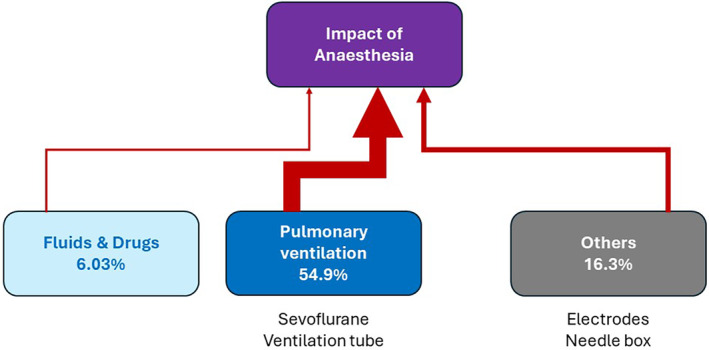
Relative shares of processes and medical devices in environmental impact of anaesthesia in the enhanced recovery programme (ERP) scenario. Only items representing more than 5% of total impact were included.
Postoperative stage
The ERP scenario had systematically and overall less impact on the environment than the CONV scenario for all 18 variables analysed, with a median reduction of 23.3%. The reduction of the environmental impact was distributed evenly among the variables analysed (range 22%–32%).
Hospital stay is 2.5 days shorter after ERP according to the literature and the GRACE database. Here, hospitalization in the ERP scenario was associated with a reduction of 31% for ionizing radiation and water consumption compared with the CONV scenario. In the ERP scenario, there were twice as many SMS calls (n = 6) after patient discharge. The difference between the two scenarios was 0.014 g per SMS, coming to 0.04 g.
Overall
Figure 6 shows the respective median shares of each stage of the care pathway in the total environmental impact of the ERP scenario. The preoperative stage made up 49.1%, the intraoperative stage 40.2% and the postoperative stage 10.6% of the total environmental impact of an ERP pathway.
FIGURE 6.

Relative shares of the three perioperative stages in the environmental impact of the enhanced recovery programme (ERP) scenario (orange, preoperative; green, intraoperative; blue, postoperative).
DISCUSSION
To our knowledge, this study is the first to assess the environmental impact of the whole care pathway of a surgery patient, specifically a colorectal ERP pathway. The published systematic reviews have focused essentially on the impact of the activity in the operating theatre, for surgery and anaesthesia [6, 22, 23, 24] and on global warming secondary to GHG emissions. By contrast, this study analysed the lifecycle of many items (care procedures, devices, consumables) in the ERP pathway and their relative environmental impact, not limited to global warming due to GHG emissions. We found consistently that ERP had a lower environmental impact that conventional care. This reduction was estimated at about 6% overall and 5% for GHG emissions. Our findings argue for adding the environmental benefits of ERP implementation to its other benefits (at least in colorectal surgery), namely lower postoperative morbidity, better convalescence, lower mortality and a shorter hospital stay. The results of this LCA bring a further argument for persuading surgeons and anaesthetists to implement more ERPs in their routine practice.
It may be argued that ERP reduces the environmental impact of colorectal surgery only slightly (overall by 6%). However, our study points to ways in which ERP can be made even more eco‐responsible.
Several aspects of perioperative care have been analysed in earlier work and have even given rise to practical guidelines to reduce the carbon footprint of care [6, 7, 22, 23, 25, 26, 27]. This also applies to the ERP pathway, whether for energy consumption, waste management, water consumption, disposable medical devices, wasteful practices, and so on. For the sake of conciseness, we will not discuss the impact of measures common to both colorectal surgery care pathway scenarios, but only certain specific features of the ERP pathway.
Figure 6 shows that for the ERP pathway the two stages with the greatest environmental impact were the preoperative and intraoperative stages.
Preoperative stage
Our study found that transport represented 92.4% of the impact of the preoperative stage on global warming. An ERP engages the patient's active participation, through detailed information, shared medical decision‐making and therapeutic education. These measures usually require a visit with the surgeon and are relayed by a specialist nurse at the consultation together with the anaesthetist. To reduce the environmental impact of this stage, some have recommended using IT, in particular teleconsultation [28, 29], videos or Internet sites for therapeutic mentoring of patients included in ERPs [30, 31]. We will return to the importance of telemedicine below.
The scenario that we chose does not comprise any multimodal prehabilitation as recommended in fragile patients who are to undergo cancer surgery, which was not the case here. In our scenario, management of tobacco use did not imply repeated travel, but a single consultation with the anaesthetist and the use of nicotine patches, rather than multimodal prehabilitation. However, if we take a hypothetical ERP pathway comprising multimodal prehabilitation, the latter will classically include at least three items: physical exercise, nutritional support and psychological support [32]. A programme of this type was recently evaluated in a randomized trial and proved significantly effective in reducing morbidity after colorectal surgery [33]. In this 4‐week programme, physical exercises must be done under the supervision of a physiotherapist or sports physician three times a week; the nutritional support requires a weekly consultation and the psychological support three or more consultations spread over 4 months. Added to this is the management of any comorbidities. The example of the prehabilitation protocol given by Molenaar et al. [33] implies at least 20 round trips over a distance of 20 km or 50 km in our scenario (according to whether the care centre has a physiotherapist, nutritionist and psychologist or not, according to our ERP scenario) before surgery. Considering that an automobile emits 107 g CO2e per km, travel to and from the care centre for multimodal prehabilitation would emit 107 kg CO2e. To reduce the environmental impact of these multiple trips, recourse whenever possible to digital health coaching with exercises at home and remote supervision should be considered. Preliminary results of studies assessing this solution [34, 35, 36] have suggested that it is feasible and acceptable to patients, but a larger‐scale evaluation is still needed.
The impact of preoperative blood tests could not be analysed in our study for lack of accurate and interpretable data. An early study conducted in the UK and Canada [37] on this variable in a small series of 83 patients found that 76% of them had undergone unnecessary blood tests. The carbon footprint of routine tests was 332 g CO2e, plus 462 g CO2e if liver function tests are performed [37]. This impact becomes a major one if we multiply these figures by the number of tests done unnecessarily worldwide [38].
Concentrating the preoperative work‐up and consultations so as to minimize travelling is an effective way to reduce the environmental impact of the preoperative stage. The feasibility of concentrating diagnostic examinations in a single visit has been demonstrated in specialities other than colorectal surgery [39].
Intraoperative stage
Surgically, except for less recourse to drains and probes (Table 1), the ERP approach does not differ from the conventional one. The environmental impact of minimally invasive surgery (here laparoscopy) is essentially that of disposables (61% of the impact made by the surgical procedure; Figure 3). Replacing disposables by multiple‐use devices offers one way to reduce the environmental impact of laparoscopy [40, 41, 42]. Some authors have suggested that robot‐assisted colorectal surgery might improve the clinical results of ERPs [43, 44], but no randomized trials have been conducted to test this hypothesis. LCA and environmental impact assessment of robot‐assisted surgery could not be carried out in this study for lack of data. However, a systematic review published in 2022 clearly showed that the greater environmental impact of robot‐assisted surgery was not offset by proven clinical benefits [45]. Furthermore, a recent meta‐analysis showed that even for cancers of the mid to lower rectum, where robot‐assisted surgery might have been expected to offer advantages, it did not perform significantly better than conventional laparoscopy [46]. The place of robot‐assisted surgery in ERPs needs reassessment on three‐way clinical–economic–environmental criteria [47].
As regards anaesthesia, the means of pulmonary ventilation and halogenated gases (here sevoflurane) represented about 55% of the environmental impact of anaesthesia. The options available to reduce the environmental impact of anaesthetic gases are, as in this study, a low flow rate and use of a gas recovery unit that allows 70% of the gas used to be recycled and emit the same amount of CO2e (1 kg) as propofol [48]. However, a large‐scale study (more than 47 000 patients) conducted in France showed that the carbon footprint of intravenous anaesthetic drugs was 20 times lower than mixed anaesthesia (halogenated gas plus intravenous agent), with respective emissions of 2.4 CO2e and 48.8 CO2e [49].
World and European guidelines state that total intravenous anaesthesia (TIVA) is preferable to inhaled gases [50, 51]. The expert guidelines of the French Society of Anaesthesia and Intensive Care [19] state that sevoflurane, with its high impact on global warming, must be balanced against propofol (as part of TIVA), which is associated with proven marine and terrestrial ecotoxicity, the magnitude of which remains to be evaluated [52], but which may be some tens of times greater than current estimates [53].
Lastly, the finding that the ERP scenario had a 36% greater impact on ionizing radiation (Figure 4) is explained by the use of a heated blanket and monitoring devices powered by French nuclear‐generated electricity [54]. However, this increase specific to anaesthesia in the ERP scenario is cancelled in the calculated overall environmental impact, which is favourable to the ERP scenario (Figure 1), by lower energy consumption elsewhere in the pathway.
Postoperative stage
When there are no minor or major complications (requiring a stay in an intensive care unit), the postoperative stage has little environmental impact in the ERP approach. In our ERP scenario the patient was contacted twice more by SMS than in the CONV scenario because discharge home was prompter. In this scenario, the reduced hospital stay (2.5 days shorter) implies a reduction of 455 kg CO2e (according to French data, [55]), largely offsetting the minor impact of the additional SMS calls.
e‐Health reduces impact on the environment [56], by reducing travel by patients to and from care centres and by carers to and from the patient's home. Reduction of GHG emissions depends on how much travelling is avoided.
According to Holmner et al. [57], e‐health offers several advantages: less global warming, less pollution due to travel (fewer cardiorespiratory disorders), lower health costs, better quality of life for patients and easier sharing of information between patients and the care team. However, an evaluation of e‐health tools must take account of electronic waste disposal. Such waste is a source of pollutants and toxic agents that may be harmful to already vulnerable persons, particularly children [58].
For the risk management linked to early discharge, ERPs make systematic use of e‐health tools. Even so, to control environmental impact the best frameworks, methods and tools must be identified when designing e‐health tools compliant with the three pillars of sustainable development in both industrial and developing countries.
CONCLUSION
This LCA for clinical scenarios found that a colorectal ESP was more eco‐responsible than a conventional care pathway in our example of colorectal surgery, with an overall reduction of 6% in environmental impact, covering 18 environmental variables. The stages with the greatest impact were the preoperative stage and the intraoperative stage. To make the ERP approach even more eco‐responsible, the two stages with the most impact should first be examined, addressing repeated preoperative travel and intraoperative disposable medical devices, together with all the other measures that can be taken to reduce the environmental impact of surgery.
AUTHOR CONTRIBUTIONS
Karem Slim: Conceptualization; methodology; formal analysis; validation; writing – review and editing; writing – original draft; project administration; funding acquisition; investigation; supervision. Julie Veziant: Validation; formal analysis. Audrey Enguix: Methodology; validation; writing – review and editing. Laurent Zieleskiewicz: Validation; project administration; writing – review and editing.
FUNDING INFORMATION
This work was funded by the Francophone Group for Enhanced Recovery After Surgery: GRACE (nonprofit organization).
CONFLICT OF INTEREST STATEMENT
KS declares a conflict of interest with Sanofi and Lillial, with no relationship with the present work.
ETHICS STATEMENT
The ethical approval was not required because this is a simulation study.
Supporting information
Data S1.
Data S2.
ACKNOWLEDGEMENTS
We thank Medtronic for providing us with the data for their staplers. We thank Ugo Fraysse, Valérie Sautou and Alice Belmas‐Digard for their help in collecting the data and Zélie Charuel from Primum Non Nocere for her participation in this work.
Slim K, Veziant J, Enguix A, Zieleskiewicz L. Environmental impact of the enhanced recovery pathway in colorectal surgery: A simulation study. Colorectal Dis. 2025;27:e17247. 10.1111/codi.17247
DATA AVAILABILITY STATEMENT
Data are available upon reuqest to the corresponding author.
REFERENCES
- 1. Eckelman MJ, Sherman J. Environmental impacts of the U.S. health care system and effects on public health. PLoS One. 2016;11(6):e0157014. 10.1371/journal.pone.0157014 [DOI] [PMC free article] [PubMed] [Google Scholar]
- 2. Tennison I, Roschnik S, Ashby B, Boyd R, Hamilton I, Oreszczyn T, et al. Health care's response to climate change: a carbon footprint assessment of the NHS in England. Lancet Planet Health. 2021;5(2):e84–e92. 10.1016/S2542-5196(20)30271-0 [DOI] [PMC free article] [PubMed] [Google Scholar]
- 3. https://theshiftproject.org/article/decarboner‐sante‐rapport‐2023/
- 4. Karliner J, Slotterback S, Boyd R, Ashby B, Steele K, Wang J. Health care's climate footprint. How the health sector contributes to the global climate crisis and opportunities for action. Vol 30. Reston, VA: Health Care Without Harm; 2019. [Google Scholar]
- 5. MacNeill AJ, Lillywhite R, Brown CJ. The impact of surgery on global climate: a carbon footprinting study of operating theatres in three health systems. Lancet Planet Health. 2017;1(9):e381–e388. 10.1016/S2542-5196(17)30162-6 [DOI] [PubMed] [Google Scholar]
- 6. Rizan C, Steinbach I, Nicholson R, Lillywhite R, Reed M, Bhutta MF. The carbon footprint of surgical operations: a systematic review. Ann Surg. 2020;272(6):986–995. 10.1097/SLA.0000000000003951 [DOI] [PubMed] [Google Scholar]
- 7. Aldoori J, Hartley J, MacFie J. Sustainable surgery: in and out of the operating theatre. Br J Surg. 2021;108(6):e219–e220. 10.1093/bjs/znab073 [DOI] [PubMed] [Google Scholar]
- 8. Barratt AL, Li Y, Gooroovadoo I, Todd A, Dou Y, McAlister S, et al. Environmental impact of cardiovascular healthcare. Open Heart. 2023;10(1):e002279. 10.1136/openhrt-2023-002279 [DOI] [PMC free article] [PubMed] [Google Scholar]
- 9. Ljungqvist O, Scott M, Fearon KC. Enhanced recovery after surgery: a review. JAMA Surg. 2017;152(3):292–298. 10.1001/jamasurg.2016.4952 [DOI] [PubMed] [Google Scholar]
- 10. Slim K, Theissen A. Enhanced recovery after elective surgery. A revolution that reduces post‐operative morbidity and mortality. J Visc Surg. 2020;157(6):487–491. 10.1016/j.jviscsurg.2020.07.005 [DOI] [PubMed] [Google Scholar]
- 11. Bizard F, Boudemaghe T, Delaunay L, Léger L, Slim K. Medico‐economic impact of enhanced rehabilitation after surgery: an exhaustive, nation‐wide claims study. BMC Health Serv Res. 2021;21(1):1341. 10.1186/s12913-021-07379-z [DOI] [PMC free article] [PubMed] [Google Scholar]
- 12. de Boer HD, Scott MJ, Fawcett WJ. Anaesthesia role in enhanced recovery after surgery: a revolution in care outcomes. Curr Opin Anaesthesiol. 2023;36(2):202–207. 10.1097/ACO.0000000000001248 [DOI] [PubMed] [Google Scholar]
- 13. Slim K. The benefits of enhanced recovery after surgery. J Visc Surg. 2016;153(6S):S41–S44. 10.1016/j.jviscsurg.2016.09.001 [DOI] [PubMed] [Google Scholar]
- 14. Molenaar CJ, van Rooijen SJ, Fokkenrood HJ, Roumen RM, Janssen L, Slooter GD. Prehabilitation versus no prehabilitation to improve functional capacity, reduce postoperative complications and improve quality of life in colorectal cancer surgery. Cochrane Database Syst Rev. 2023;5(5):CD013259. 10.1002/14651858.CD013259.pub3 [DOI] [PMC free article] [PubMed] [Google Scholar]
- 15. Pietrabissa A, Sylla P. Green surgery: time to make a choice. Surg Endosc. 2023;37(9):6609–6610. 10.1007/s00464-023-10229-0 [DOI] [PubMed] [Google Scholar]
- 16. Feldheiser A, Aziz O, Baldini G, Cox BP, Fearon KC, Feldman LS, et al. Enhanced recovery after surgery (ERAS) for gastrointestinal surgery, part 2: consensus statement for anaesthesia practice. Acta Anaesthesiol Scand. 2016;60(3):289–334. 10.1111/aas.12651 [DOI] [PMC free article] [PubMed] [Google Scholar]
- 17. Gustafsson UO, Scott MJ, Hubner M, Nygren J, Demartines N, Francis N, et al. Guidelines for perioperative care in elective colorectal surgery: Enhanced Recovery After Surgery (ERAS) Society recommendations: 2018. World J Surg. 2019;43(3):659–695. 10.1007/s00268-018-4844-y [DOI] [PubMed] [Google Scholar]
- 18. Alfonsi P, Slim K, Chauvin M, Mariani P, Faucheron JL, Fletcher D. Working Group of Société Française d'Anesthésie et Réanimation (SFAR); Société Française de Chirurgie Digestive (SFCD). French guidelines for enhanced recovery after elective colorectal surgery. J Visc Surg. 2014;151(1):65–79. 10.1016/j.jviscsurg.2013.10.006 [DOI] [PubMed] [Google Scholar]
- 19. Pauchard JC, Hafiani EM, Bonnet L, Cabelguenne D, Carenco P, Cassier P, et al. Guidelines for reducing the environmental impact of general anaesthesia. Anaesth Crit Care Pain Med. 2023;42(5):101291. 10.1016/j.accpm.2023.101291 [DOI] [PubMed] [Google Scholar]
- 20. https://www.chru‐strasbourg.fr/chirurgie‐colorectale/. Accessed 30 Apr 2024
- 21. https://carlabelling.ademe.fr/chiffrescles/r/moyenneEmissionCo2Gamme
- 22. McGain F, Muret J, Lawson C, Sherman JD. Environmental sustainability in anaesthesia and critical care. Br J Anaesth. 2020;125(5):680–692. 10.1016/j.bja.2020.06.055 [DOI] [PMC free article] [PubMed] [Google Scholar]
- 23. Pradere B, Mallet R, de La Taille A, Bladou F, Prunet D, Beurrier S, et al. Climate‐smart actions in the operating theatre for improving sustainability practices: a systematic review. Eur Urol. 2023;83(4):331–342. 10.1016/j.eururo.2022.01.027 [DOI] [PubMed] [Google Scholar]
- 24. Perry H, Reeves N, Ansell J, Cornish J, Torkington J, Morris DS, et al. Innovations towards achieving environmentally sustainable operating theatres: a systematic review. Surgeon. 2023;21(3):141–151. 10.1016/j.surge.2022.04.012 [DOI] [PubMed] [Google Scholar]
- 25. Rouvière N, Chkair S, Auger F, Alovisetti C, Bernard MJ, Cuvillon P, et al. Ecoresponsible actions in operating rooms: a health ecological and economic evaluation. Int J Surg. 2022;101:106637. 10.1016/j.ijsu.2022.106637 [DOI] [PubMed] [Google Scholar]
- 26. Shoham MA, Baker NM, Peterson ME, Fox P. The environmental impact of surgery: a systematic review. Surgery. 2022;172(3):897–905. 10.1016/j.surg.2022.04.010 [DOI] [PubMed] [Google Scholar]
- 27. Rizan C, Lillywhite R, Reed M, Bhutta MF. The carbon footprint of products used in five common surgical operations: identifying contributing products and processes. J R Soc Med. 2023;116(6):199–213. 10.1177/01410768231166135 [DOI] [PMC free article] [PubMed] [Google Scholar]
- 28. Grüßer L, Bayram B, Ziemann S, Wallqvist J, Wienhold J, Rossaint R, et al. Teleconsultation for preoperative anesthesia evaluation: identifying environmental potentials by life cycle assessment. Telemed J E Health. 2024;30:e2050–e2058. 10.1089/tmj.2023.0700 [DOI] [PubMed] [Google Scholar]
- 29. Romero CS, Filipovic MG, Luedi MM. Beyond the consulting room and telemedicine: unveiling the future of anesthesiology with virtual preoperative assessment. Anesthesiol Clin. 2024;42(1):27–32. 10.1016/j.anclin.2023.08.002 [DOI] [PubMed] [Google Scholar]
- 30. Hansen JB, Sørensen JFL, Glassou EN, Homilius M, Hansen TB. Reducing patient‐staff contact in fast‐track total hip arthroplasty has no effect on patient‐reported outcomes, but decreases satisfaction amongst patients with self‐perceived complications: analysis of 211 patients. Acta Orthop. 2022;93:264–270. 10.2340/17453674.2022.1617 [DOI] [PMC free article] [PubMed] [Google Scholar]
- 31. Panda N, Perez N, Tsangaris E, Edelen M, Pusic A, Zheng F, et al. Enhancing patient‐centered surgical care with mobile health technology. J Surg Res. 2022;274:178–184. 10.1016/j.jss.2022.01.005 [DOI] [PubMed] [Google Scholar]
- 32. Gillis C, Fenton TR, Sajobi TT, Minnella EM, Awasthi R, Loiselle SÈ, et al. Trimodal prehabilitation for colorectal surgery attenuates post‐surgical losses in lean body mass: a pooled analysis of randomized controlled trials. Clin Nutr. 2019;38(3):1053–1060. 10.1016/j.clnu.2018.06.982 [DOI] [PubMed] [Google Scholar]
- 33. Molenaar CJL, Minnella EM, Coca‐Martinez M, Ten Cate DWG, Regis M, Awasthi R, et al. Effect of multimodal Prehabilitation on reducing postoperative complications and enhancing functional capacity following colorectal cancer surgery: the PREHAB randomized clinical trial. JAMA Surg. 2023;158(6):572–581. 10.1001/jamasurg.2023.0198 [DOI] [PMC free article] [PubMed] [Google Scholar]
- 34. Shelton E, Barreto NB, Bidwell S, Folk‐Tolbert M, Shelton A, Trickey AW, et al. Engagement and adherence with a web‐based prehabilitation program for patients awaiting abdominal colorectal surgery. J Gastrointest Surg. 2021;25(12):3198–3207. 10.1007/s11605-021-05171-2 [DOI] [PubMed] [Google Scholar]
- 35. Muschol J, Heinrich M, Heiss C, Hernandez AM, Knapp G, Repp H, et al. Economic and environmental impact of digital health app video consultations in follow‐up care for patients in orthopedic and trauma surgery in Germany: randomized controlled trial. J Med Internet Res. 2022;24(11):e42839. 10.2196/42839 [DOI] [PMC free article] [PubMed] [Google Scholar]
- 36. Ip N, Zhang K, Karimuddin AA, Brown CJ, Campbell KL, Puyat JH, et al. Preparing for colorectal surgery: a feasibility study of a novel web‐based multimodal prehabilitation programme in Western Canada. Color Dis. 2024;26(3):534–544. 10.1111/codi.16851 [DOI] [PubMed] [Google Scholar]
- 37. Spoyalo K, Lalande A, Rizan C, Park S, Simons J, Dawe P, et al. Patient, hospital and environmental costs of unnecessary bloodwork: capturing the triple bottom line of inappropriate care in general surgery patients. BMJ Open Qual. 2023;12(3):e002316. 10.1136/bmjoq-2023-002316 [DOI] [PMC free article] [PubMed] [Google Scholar]
- 38. O'Neill F, Carter E, Pink N, Smith I. Routine preoperative tests for elective surgery: summary of updated NICE guidance. BMJ. 2016;354:i3292. 10.1136/bmj.i3292 [DOI] [PubMed] [Google Scholar]
- 39. Cherkaoui Z, Seeliger B, Faucher V, Biermann C, Kock A, Pessaux P. Evaluation of an innovative care pathway in the diagnostic and therapeutic management of hepatobiliary and pancreatic pathologies: ‘one‐day diagnosis’. J Pers Med. 2022;13(1):12. 10.3390/jpm13010012 [DOI] [PMC free article] [PubMed] [Google Scholar]
- 40. Drew J, Christie SD, Tyedmers P, Smith‐Forrester J, Rainham D. Operating in a climate crisis: a state‐of‐the‐science review of life cycle assessment within surgical and anesthetic care. Environ Health Perspect. 2021;129(7):76001. 10.1289/EHP8666 [DOI] [PMC free article] [PubMed] [Google Scholar]
- 41. Chan KS, Lo HY, Shelat VG. Carbon footprints in minimally invasive surgery: good patient outcomes, but costly for the environment. World J Gastrointest Surg. 2023;15(7):1277–1285. 10.4240/wjgs.v15.i7.1277 [DOI] [PMC free article] [PubMed] [Google Scholar]
- 42. Chauvet P, Enguix A, Sautou V, Slim K. A systematic review comparing the safety, cost and carbon footprint of disposable and reusable laparoscopic devices. J Visc Surg. 2024;161(2S):25–31. 10.1016/j.jviscsurg.2023.10.006 [DOI] [PubMed] [Google Scholar]
- 43. Cristóbal Poch L, Cagigas Fernández C, Gómez‐Ruiz M, Ortega Roldán M, Cantero Cid R, Castillo Diego J, et al. Implementation of an enhanced recovery after surgery program with robotic surgery in high‐risk patients obtains optimal results after colorectal resections. J Robot Surg. 2022;16(3):575–586. 10.1007/s11701-021-01281-w [DOI] [PubMed] [Google Scholar]
- 44. Hung CY, Lin CY, Chen MC, Chiu TY, Chiang TW, Chiang FF. Developing a robotic surgical platform is beneficial to the implementation of the ERAS program for colorectal surgery: an outcome and learning curve analysis. J Clin Med. 2023;12(7):2661. 10.3390/jcm12072661 [DOI] [PMC free article] [PubMed] [Google Scholar]
- 45. Papadopoulou A, Kumar NS, Vanhoestenberghe A, Francis NK. Environmental sustainability in robotic and laparoscopic surgery: systematic review. Br J Surg. 2022;109(10):921–932. 10.1093/bjs/znac191 [DOI] [PubMed] [Google Scholar]
- 46. Slim K, Tilmans G, Occéan BV, Dziri C, Pereira B, Canis M. Meta‐analysis of randomized clinical trials comparing robotic versus laparoscopic surgery for mid‐low rectal cancers. J Visc Surg. 2024;162:76–89. 10.1016/j.jviscsurg.2024.01.004 [DOI] [PubMed] [Google Scholar]
- 47. Slim K. Robotic colonic surgery‐the debate is not over. Color Dis. 2023;25(3):497. 10.1111/codi.16431 [DOI] [PubMed] [Google Scholar]
- 48. Hu X, Pierce JMT, Taylor T, Morrissey K. The carbon footprint of general anaesthetics: a case study in UK. Resour Conserv Recycl. 2021;167:105411. 10.1016/j.resconrec.2021.105411 [DOI] [Google Scholar]
- 49. Bernat M, Boyer A, Roche M, Richard C, Bouvet L, Remacle A, et al. Reducing the carbon footprint of general anaesthesia: a comparison of total intravenous anaesthesia vs. a mixed anaesthetic strategy in 47,157 adult patients. Anaesthesia. 2024;79(3):309–317. 10.1111/anae.16221 [DOI] [PubMed] [Google Scholar]
- 50. White SM, Shelton CL, Gelb AW, Lawson C, McGain F, Muret J, et al. Principles of environmentally‐sustainable anaesthesia: a global consensus statement from the world Federation of Societies of Anaesthesiologists. Anaesthesia. 2022;77(2):201–212. 10.1111/anae.15598 [DOI] [PMC free article] [PubMed] [Google Scholar]
- 51. Gonzalez‐Pizarro P, Brazzi L, Koch S, Trinks A, Muret J, Sperna Weiland N, et al. European Society of Anaesthesiology and Intensive Care consensus document on sustainability: 4 scopes to achieve a more sustainable practice. Eur J Anaesthesiol. 2024;41(4):260–277. 10.1097/EJA.0000000000001942 [DOI] [PubMed] [Google Scholar]
- 52. Waspe J, Orr T. Environmental risk assessment of propofol in wastewater: a narrative review of regulatory guidelines. Anaesthesia. 2023;78(3):337–342. 10.1111/anae.15967 [DOI] [PubMed] [Google Scholar]
- 53. Petre MA, Malherbe S. Environmentally sustainable perioperative medicine: simple strategies for anesthetic practice. Can J Anaesth. 2020;67(8):1044–1063. 10.1007/s12630-020-01726-0 [DOI] [PubMed] [Google Scholar]
- 54. https://www.ecologie.gouv.fr/installations‐nucleaires‐en‐france
- 55. https://www.aphp.fr/contenu/premiers‐resultats‐du‐bilan‐carboner‐de‐lap‐hp‐sur‐lensemble‐de‐ses‐activites. Accessed 10 May 2024
- 56. Purohit A, Smith J, Hibble A. Does telemedicine reduce the carbon footprint of healthcare? A systematic review. Future Healthc J. 2021;8(1):e85–e91. 10.7861/fhj.2020-0080 [DOI] [PMC free article] [PubMed] [Google Scholar]
- 57. Holmner A, Rocklöv J, Ng N, Nilsson M. Climate change and eHealth: a promising strategy for health sector mitigation and adaptation. Glob Health Action. 2012;5:18428. 10.3402/gha.v5i0.18428 [DOI] [PMC free article] [PubMed] [Google Scholar]
- 58. Lokmic‐Tomkins Z, Davies S, Block LJ, Cochrane L, Dorin A, von Gerich H, et al. Assessing the carbon footprint of digital health interventions: a scoping review. J Am Med Inform Assoc. 2022;29(12):2128–2139. 10.1093/jamia/ocac196 [DOI] [PMC free article] [PubMed] [Google Scholar]
Associated Data
This section collects any data citations, data availability statements, or supplementary materials included in this article.
Supplementary Materials
Data S1.
Data S2.
Data Availability Statement
Data are available upon reuqest to the corresponding author.