


Abstract
Asthma is considered severe if it remains uncontrolled despite optimal conventional therapy, characterised by poor symptom control, frequent exacerbations and increased exposure to systemic corticosteroids. This has a significant impact on morbidity, mortality and healthcare resource utilisation. Recent advances in the understanding of asthma heterogeneity and immunopathogenesis have helped delineate precise disease pathways. The discovery of these pivotal pathways has led to the development of highly effective biologic therapies. Currently available asthma biologics target immunoglobulin E, interleukin (IL)-5/IL-5Rα, IL-4Rα and thymic stromal lymphopoietin. Identification of specific asthma phenotypes, utilising easily measurable biomarkers, has paved the way towards personalised and precision asthma management. Biologic therapies play a significant role in reducing exacerbations, hospitalisations and the need for maintenance systemic steroids, while also improving the quality of life in patients with severe asthma. The evidence for their clinical efficacy comes from randomised controlled trials (RCTs), extension studies, metanalyses and real-world data. This review synthesises findings from early, pivotal RCTs and subsequent studies following the approval of biologics for severe asthma. The safety and efficacy data from these studies, completed in a variety of settings, provide practical perspectives on their application and enhance their generalisability.
Shareable abstract
Biologics have revolutionised management of severe asthma. This state-of-the art review summarises evidence from key clinical trials as well as extension and real-world studies with latest insights into their efficacy, safety and predictors of response. https://bit.ly/3C5K2jN
Introduction
Advances in the understanding of heterogeneity and immunobiology of asthma have led to the recognition of two main inflammatory phenotypes: type 2 (T2)-high and T2-low. While inflammation in T2-high asthma is mediated by interleukin (IL)-4, IL-5 and IL-13 and characterised by elevated T2 biomarkers (blood/sputum eosinophils, immunoglobulin E (IgE) level and fractional exhaled nitric oxide (FENO)), T2-low asthma may be neutrophilic or paucigranulocytic [1, 2]. These clinical phenotypes in severe asthma result from distinct biological pathways (endotypes). The ability to identify and target key inflammatory pathways has paved the way for personalised asthma management [3].
Although severe asthma affects fewer than 10% of asthma patients, it is responsible for the majority of morbidity and healthcare costs [4–6], is relatively refractory to conventional treatment, and is associated with worse outcomes [5, 7, 8]. Four classes of biologic therapies are currently available for severe asthma, targeting IgE, the IL-5 pathway, the IL-4 receptor (IL-4R) and thymic stromal lymphopoietin (TSLP) (figure 1) [1, 9]. Biologic therapies are effective in reducing exacerbations, healthcare resource utilisation (HCRU), maintenance oral corticosteroid (mOCS) dependence and in improving quality of life (QoL).
FIGURE 1.

Severe asthma immunopathogenesis in type 2 (T2)-high asthma and the specific targets of biologic therapies. In the T2-high pathway, on exposure to allergens, pollutants or microbes, the airway epithelium releases alarmins such as interleukin (IL)-33, IL-25 and thymic stromal lymphopoietin (TSLP). The dendritic cells (DCs) present these aeroallergens to naïve CD4+ T-cells (Th0), which promotes their differentiation into Th2 cells. IL-4 plays a key role in this differentiation. The Th2 cells, along with type 2 innate lymphoid cells (ILC2), produce high levels of type 2 cytokines such as IL-4, IL5 and IL-13. Besides promoting the differentiation of Th0 to Th2, IL-4, along with IL-13, plays a major role in driving IgE isotype switching in B-lymphocytes. IgE then binds to the high-affinity receptors (FcεRI) on the surface of mast cells and basophils. On re-exposure to the same allergens, these interact with the IgE and induces the mast cells/basophils to release histamines, leukotrienes and prostaglandins resulting in bronchoconstriction. Omalizumab inhibits the binding of IgE to the high-affinity receptors on mast cells/basophils. IL-5 stimulates proliferation, differentiation and activation of eosinophils. Activated eosinophils release leukotrienes and toxic granules, which leads to airway inflammation, tissue damage and acute asthma flare. Three biologics, mepolizumab, reslizumab and benralizumab, target the IL-5 pathway. Besides its important role in recruiting eosinophils along with IL-4, IL-13 induces nitric oxide synthase, elicits mucus hypersecretion and stimulates airway smooth muscle contraction. Dupilumab inhibits the IL-4 and IL-13 signalling pathways. Inflammation in T2-low asthma is neutrophilic or absent (pauci-granulocytic). The alarmins TSLP and IL-33 may contribute to airway hyperresponsiveness in T2-low asthma. Tezepelumab inhibits the TSLP and the downstream inflammatory cascade. Created with BioRender.com.
This review provides a detailed examination of currently available asthma biologics, including their mechanisms of action, clinical efficacy and safety data from randomised controlled trials (RCTs), open-label extensions (OLEs) and real-world studies in adults with severe asthma. While RCTs are the benchmark for assessing treatment efficacy and safety, they are subject to highly selective inclusion criteria, rigorous protocols with close oversight, strict medication adherence and pre-specified duration, and do not reflect real-world clinical environments. Real-world evidence (RWE) is very important as it supplements the findings from RCTs, addresses the complexities of clinical decision-making at the bedside and provides additional effectiveness data [10].
Literature review
We performed the search in Google Scholar and PubMed databases using keywords including “asthma biologics”, “omalizumab/mepolizumab/reslizumab/benralizumab/dupilumab/tezepelumab and asthma”, “biologic and OCS dependent asthma”, “real-world evidence and asthma biologic”, “post marketing studies and asthma biologic”, “asthma biologic extension studies”, “anti-IgE”, “anti-IL4”, “anti-IL5/IL5R”, “anti-TSLP”, “long term efficacy”, “eosinophilic asthma” and “allergic asthma”. The keywords were used individually and in combination to identify relevant studies. We also screened references from identified papers.
Anti-IgE therapy: omalizumab
Overview
IgE-mediated allergic asthma is a subset of T2-high asthma characterised by increased symptoms due to exposure to aeroallergens and represents roughly 70% of all asthma [3]. The T2 cytokines, IL-4 and IL-13, promote class-switching of allergen-specific B-cells to produce IgE antibodies, which then bind to high-affinity receptors (FcεRI) on mast cells and basophils. Cross-linking of cell-surface IgE by the allergen results in cell degranulation, as well as the activation and release of pro-inflammatory mediators.
Omalizumab is a humanised, recombinant, monoclonal antibody (mAb) IgG1k that binds to the Fc fragment of IgE and reduces free IgE levels in serum, inhibits binding of IgE to FcεRI, and reduces FcεRI expression on target cells.
Omalizumab received approval from the US Food and Drug Administration (FDA) in 2003 and the European Medicines Agency (EMA) in 2005 for the treatment of moderate-to-severe allergic asthma [11, 12]. It is currently approved for use in individuals 6 years and older and administered subcutaneously every 2 or 4 weeks. The dose is based on body weight and total serum IgE level (30–700 IU·mL−1 in the US and 30–1500 IU·mL−1 in the EU for adults) with a higher dose range approved in the EU. Omalizumab is also approved for the treatment of chronic rhinosinusitis with nasal polyposis (CRSwNP), IgE-mediated food allergy (US only) and chronic spontaneous urticaria.
Evidence from pivotal trials
Evidence for omalizumab's efficacy as an add-on therapy in moderate-to-severe allergic asthma comes from several large RCTs (table 1). Omalizumab therapy was associated with a relative risk reduction in asthma exacerbation rate (AER) of 25–61%, improved disease-related QoL and a risk reduction in HCRU of 44%, while also reducing inhaled corticosteroid (ICS) dose [13–19]. The number needed to treat in the INNOVATE study was 2.7 to prevent one clinically significant exacerbation over 1 year [20].
TABLE 1.
Summary of pivotal trials for each approved asthma biologic including adverse events
| Study, year (overview) | Patient phenotype | Duration | Total patients | Primary outcome | Secondary outcomes (drug versus placebo) | Lung function (drug versus placebo) | Adverse events (drug versus placebo) |
|---|---|---|---|---|---|---|---|
| Omalizumab | |||||||
| Solèr [14], 2001 (s.c. omalizumab versus placebo to high-dose ICS±LABA) | Symptomatic, allergic asthma with positive skin-prick test, total IgE levels of 30–700 IU·mL−1, baseline FEV1 from ≥40% to ≤80% pred | 28 weeks | 546 | Relative risk reduction in mean asthma exacerbation rate by 58% in ICS stable and by 52% in ICS reduction phase | Improved median TASS and nocturnal asthma symptom score Reduction in ICS dose by ≥50% (79% versus 55%) Withdrawal of ICS (43% versus 19%) |
Improvement in morning median PEF from 375 to 395 L·min−1 at week 28 versus no change in placebo Mean FEV1 % predicted changed from 69% to 72% at week 28 versus no change in placebo |
Similar overall incidence rate of DRAEs Fatigue and paraesthesia (1.1% versus 0%), headache (1.1% versus 1.1%), mild local injection site symptoms (11.8% versus 7.7%), asthma exacerbations (0% versus 2.2%) |
| Busse [13], 2001 (s.c. omalizumab versus placebo to medium- to high-dose ICS) | Severe, persistent allergic asthma with positive skin-prick test, IgE levels of 30–700 IU·mL−1, baseline FEV1 ≥40% to <80% pred | 28 weeks | 525 | Relative risk reduction in mean asthma exacerbation rate by 48% in ICS stable phase and by 40.9% in ICS reduction phase | Decreased proportion of patients with ≥1 exacerbations (14.6% versus 23.3%) Reduction in mean duration of exacerbations with omalizumab (7.8 versus 12.7 days) Improved median reduction in ICS (75% versus 50%) |
Improvement in the morning PEF from 320 to 335 L·min−1
versus no change in the placebo Improvement in mean FEV1 % pred (from 68.2% to 72.5% versus from 67.7% to 69.1%) |
Identical incidence rate of DRAEs Comparable SAE rate URTI (31.3% versus 29.6%), viral infection (26.5% versus 31.1%), sinusitis (19.4% versus 21.8%), arthralgia (9.7% versus 3.5%), local injection site reactions (8.6% versus 6.5%) |
| Humbert [18] (INNOVATE), 2004 (s.c. omalizumab versus placebo to high-dose ICS+LABA±OCS) | Severe persistent asthma with positive skin-prick test, total IgE levels of 30–700 IU·mL−1 | 28 weeks | 419 | Relative risk reduction in clinically significant asthma exacerbation rate by 26% | Relative risk reduction of severe exacerbations by 50% and ER visits by 44% Improved mean AQLQ score from baseline by 0.45 points greater than placebo (MCID, 0.5 points) Improvement in GETE |
Improvement in mean morning PEF from baseline Improvement in mean FEV1 (190 mL versus 96 mL) |
Similar overall incidence rate of DRAEs SAEs (11.8% versus 15.6%) LRTI (11% versus 10.1%), nasopharyngitis (9.8% versus 9.3%), headache (6.9% versus 9.3%), sinusitis (5.7% versus 7.6%), local injection site reactions (5.3% versus 1.3%) |
| Hanania [19] (EXTRA), 2011 (s.c. omalizumab versus placebo to high dose ICS+LABA±mOCS) | Severe allergic asthma with positive skin-prick test or in vitro RAST, IgE level of 30–700 IU·mL−1, baseline FEV1 ≥40% to <80% Patients on mOCS included |
48 weeks | 850 | Relative risk reduction in protocol defined asthma exacerbation rate by 25% | Improved mean AQLQ scores from baseline by 0.23 points greater than placebo Improved mean TASS −0.26 points |
No changes in % pred FEV1 | Similar incidence rate of DRAEs (80.4% versus 79.5%) including SAEs (9.3% versus 10.5%) Anaphylaxis (0.23% versus 0.48%), cancer (0.23% versus 0.71%), urticaria (2.1% versus 3.1%), hypersensitivity (1.6% versus 2.9%), thrombocytopenia (0.47% versus 0.48%), local reaction (1.2% versus 3.1%) |
| Mepolizumab | |||||||
| Pavord [55] (DREAM), 2012 (i.v. mepolizumab versus placebo to high-dose ICS±LABA±OCS) | Severe eosinophilic asthma, ≥2 exacerbations, evidence of eosinophilic inflammation: sputum eosinophils ≥3%, FENO ≥50 ppb, peripheral blood eosinophils ≥300 cells·µL−1 Patients on mOCS included |
52 weeks | 621 | Relative risk reduction in annual AER by 48% at 75 mg, 39% at 250 mg and 52% at 750 mg dose | Delayed time to first exacerbations versus placebo (HR 0.45 with 75 mg, 0.60 with 250 mg, and 0.46 with 750 mg versus placebo) Change in ACQ from baseline (from −0.75 to −0.87 versus −0.59), not significant Change in AQLQ from baseline (0.77–0.93 versus 0.71), not significant |
Improvement in FEV1 from baseline versus placebo (115–121 mL versus 60 mL), not significant | Comparable frequency of SAEs (13–16% versus 16%) Headache (21% versus 17%), nasopharyngitis (19–22% versus 15%), infusion-related reaction (5–12% versus 6%), infections (3–5% versus 3%) |
| Ortega [56] (MENSA), 2014 (i.v. or s.c. mepolizumab versus add-on placebo) | Severe eosinophilic asthma with ≥2 exacerbations, elevated eosinophils ≥150 cells·µL−1 at screening or ≥300 cells·µL−1 during previous year before screening, baseline FEV1 <80% or FEV1/FVC <0.8 | 32 weeks | 576 | Relative risk reduction in clinically significant exacerbation by 47% in the i.v. group and by 53% in the s.c. group | Relative risk reduction in rate of exacerbations leading to hospitalisation or ER visits by 32% in the i.v. and 61% in the s.c. group Improvement in SGRQ score from baseline by 6.4 and 7.0 points greater than in placebo (MCID, 4 points) Improvement in ACQ-5 from baseline by 0.42–0.44 points greater than in placebo (MCID, 0.5 points) |
Increase in prebronchodilator FEV1 from baseline (mean difference versus placebo: 100 mL in i.v. and 98 mL in s.c.) Increase in morning PEF (22.9 L·min−1 in the i.v. and by 29.5 L·min−1 in the s.c. group versus 1.8 L·min−1 in placebo) |
Overall incidence of DRAEs similar in three groups SAEs lower in mepolizumab (7–8% versus 14%) Nasopharyngitis (17–24% versus 24%), headache (20–24% versus 17%), URTI (12% versus 14%), sinusitis (6–9% versus 9%), local injection site reactions (3–9% versus 3%), worsening of asthma (7–9% versus 15%) |
| Bel [57] (SIRIUS), 2014 (s.c. mepolizumab versus placebo to OCS+high-dose ICS and additional controller) | Severe asthma on mOCS, elevated eosinophils ≥150 cells·µL−1 at screening or ≥300 cells·µL−1 during previous year before screening | 24 weeks | 135 | Higher proportion of patients with 90–100% reduction in mOCS dose (23% versus 11%) and 70–<90% reduction in mOCS (17% versus 8%). OR 2.39 for reduction in mOCS dose with mepolizumab |
Reduction in annual AER versus placebo (1.44 versus 2.12) Improvement in ACQ-5 score from baseline by 0.52 points greater than in placebo (MCID, 0.5 points) Improvement in SGRQ score from baseline by 5.8 points greater than in placebo |
Improved FEV1 from baseline (between group difference 114 mL), not significant | Overall comparable incidence of DRAEs SAEs lower in mepolizumab (1% versus 18%) Worsening asthma (3% versus 12%), headache (20% versus 21%), nasopharyngitis (14% versus 15%), bronchitis (10% versus 9%), fatigue (10% versus 6%), adrenal insufficiency (4% versus 6%), local injection site reactions (6% versus 3%) |
| Reslizumab | |||||||
| Castro [82], 2015 (i.v. reslizumab versus placebo to medium-dose ICS) | Moderate to severe asthma with ≥1 exacerbation, blood eosinophil ≥400 cells·µL−1 Patient on mOCS included |
52 weeks | 953 | Relative risk reduction in annual AER by 50–59% versus placebo | Improvement in AQLQ score from baseline by 0.27 points greater than in placebo at week 52 Improvement in ACQ-7 score from baseline by 0.25 points greater than in placebo at week 52 |
Improvement in FEV1 from baseline versus placebo (220 mL versus 120 mL) at week 52 | Comparable incidence of DRAEs SAEs were higher in placebo (8–10% versus 10–14%) Worsening asthma (29–40% versus 51–52%), URTI (3–16% versus 7–13%), nasopharyngitis (11–19% versus 14–24%), headache (8–14% versus 7–12%) SAEs: asthma (1–4% versus 3–5%), pneumonia (<1% versus 3%) |
| Bjermer [83], 2016 (i.v. reslizumab at 0.3 mg·kg−1 and 3 mg·kg−1 versus placebo to medium-dose ICS+blood eosinophil ≥400 cells·µL−1) | Inadequately controlled asthma with poor ACQ-7, blood eosinophils ≥400 cells·µL−1 Patients on mOCS excluded |
16 weeks | 315 | Improved FEV1 (absolute increase by 115 mL and 160 mL for 0.3 mg·kg−1 and 3 mg·kg−1, respectively) Improved FVC (absolute increase by 48 mL and 130 mL for 0.3 mg·kg−1 and 3 mg·kg−1 respectively) |
Improvement in mean ACQ score from baseline by 0.238–0.359 greater than in placebo (MCID, 0.5 points) Improvement in mean AQLQ score from baseline by 0.359 in 3 mg·kg−1 than in placebo (MCID, 0.5 points) |
See primary outcome | Lower proportion of patients receiving reslizumab experienced AEs versus placebo DRAEs reported in 6–12% in reslizumab versus 8% in placebo SAEs: 4% versus 1% Worsening asthma (6–16% versus 20%), headache (8–11% versus 6%), nasopharyngitis (6% versus 4%), URTI (3–5% versus 3%), bronchitis (2–5% versus 5%) |
| Corren [88], 2016 (i.v. reslizumab versus placebo to medium-dose ICS) | Inadequately controlled asthma Patients on mOCS were excluded |
16 weeks | 492 | No significant difference in FEV1 (255 mL versus 187 mL with between-group difference of 68 mL) | Improvement in mean ACQ-7 score from baseline by 0.195 greater than in placebo (MCID, 0.5 points) No significant difference in FVC, and SABA use unselected for baseline eosinophils |
Improvement in FEV1 by 270 mL by subgroup analysis in patients with high eosinophils (≥400 cells·µL−1) versus placebo | Lower proportion of DRAEs in reslizumab (55% versus 74%) Equal proportions of SAEs between the groups Worsening asthma (13% versus 20%), URTI (11% versus 11%), sinusitis (6% versus 7%), nasopharyngitis (3% versus 5%), headache (3% versus 4%), allergic rhinitis (2% versus 3%) Overall infection rate (31% versus 47%) |
| Benralizumab | |||||||
| Bleecker [93] (SIROCCO), 2016 (s.c. benralizumab versus placebo to medium- to high-dose ICS+LABA±mOCS) | Severe asthma with ≥2 exacerbations, baseline FEV1 <80% at screening Patients on mOCS included |
48 weeks | 1205 | Reduction in annual AER with rate ratio of 0.55 every 4 weeks and rate ratio of 0.49 every 8 weeks over 48 weeks versus the placebo | Improvement in TASS from baseline at week 48 by 0.25 points greater (every 8 weeks) than in placebo Improvement in mean ACQ-6 score from baseline by 0.29 points greater (every 8 weeks) than in placebo Improvement in mean AQLQ from baseline by 0.30 points greater (every 8 weeks) than in placebo |
Improvement in FEV1 from baseline (345 mL every 4 weeks and 398 mL every 8 weeks) Between-group difference in FEV1 versus placebo (106 mL every 4 weeks and 159 mL every 8 weeks dosing) |
Similar AEs between the groups including SAEs (12–13% versus 14%) Worsening asthma (11–15% versus 19%), URTI (8–11% versus 9%), nasopharyngitis (12% versus 12%), headache (7–9% versus 5%), sinusitis (4–6% versus 7%), hypersensitivity (3% versus 3%), local injection site reactions (4% versus 2%) |
| FitzGerald [94] (CALIMA), 2016 (s.c. benralizumab versus placebo to medium- or high-dose ICS+LABA±mOCS) | Severe uncontrolled asthma with ≥2 exacerbations, baseline FEV1 <80% at screening Patients on mOCS included |
56 weeks | 1306 | Reduction in annual AER with rate ratio of 0.64 at every 4 weeks and rate ratio of 0.72 at every 8 weeks over 56 weeks versus the placebo | Improvement in TASS from baseline by 0.23 points with every 8 weeks dosing than in placebo Improvement in mean ACQ-6 from baseline by 0.19 points (every 4 weeks) and by 0.25 points (every 8 weeks) greater than in placebo Improvement in mean AQLQ (S)+12 from baseline by 0.24 points greater (every 8 weeks) than in placebo |
Improvement in FEV1 from baseline by 340 mL and 330 mL with every 4 weeks and every 8 weeks dosing Between-group difference in FEV1 versus placebo (125 mL with every 4 weeks and 116 mL with every 8 weeks dosing) |
Similar AEs between the groups including SAEs (9–10% versus 14%) Worsening asthma (11–14% versus 15%), nasopharyngitis (18–21% versus 21%), URTI (7–8% versus 9%), headache (8% versus 7%), allergic rhinitis (3–4% versus 5%), cough (2–3% versus 2%), local injection site reactions (2% versus 2%), hypersensitivity reactions (3% versus 4%) |
| Nair [109] (ZONDA), 2017 (s.c. benralizumab versus placebo to medium- to high-dose ICS+LABA+OCS) | Severe asthma with blood eosinophil ≥150 cells·µL−1, on mOCS for at least 6 months | 28 weeks | 220 | Median reduction in mOCS from baseline by 75% versus 25% in placebo Higher proportion of patients with ≥90% reduction in mOCS dose (33% with every 4 weeks and 37% with every 8 weeks dosing versus 12% with placebo) Higher proportion of patients with ≥75% reduction in mOCS dose (53% with every 4 weeks and 51% with every 8 weeks dosing versus 20% with placebo) |
Higher proportion of patients who could discontinue mOCS (56% with every 4 weeks and 52% with every 8 weeks, versus 19% in placebo) Reduction in annual AER with rate ratio of 0.45 in every 4 weeks and rate ratio of 0.30 in every 8 weeks over 28 weeks dosing versus placebo Improvement in mean ACQ-6 score from baseline by 0.55 points greater than in placebo Improvement in mean AQLQ(S)+12 score from baseline by 0.45 points greater than in placebo |
Improvement in FEV1 from baseline by 256 mL and 222 mL with every 4 weeks and every 8 weeks dosing versus placebo at week 20 No significant difference in FEV1 between benralizumab and placebo at week 28 |
Slightly lower rate of AEs in benralizumab than placebo (68–75% versus 83%), including SAEs (10% versus 19%) Nasopharyngitis (15% versus 20%), worsening asthma (11% versus 24%), URTI (7% versus 7%), headache (7% versus 5%), cough (1–3% versus 5%) |
| Dupilumab | |||||||
| Wenzel [115], 2016 (s.c. dupilumab versus placebo to medium- or high-dose ICS+LABA) Dupilumab dose-ranging trial (200 mg every 2 weeks and every 4 weeks, and 300 mg every 2 weeks and every 4 weeks) |
Persistent moderate to severe asthma with T2 inflammation as measured by blood eosinophils ≥300 cells·µL−1, baseline FEV1 40–80% pred at screening | 24 weeks | 769 | Improvement in mean FEV1 change from baseline 230 mL to 290 mL versus 130 mL with placebo at week 24 Improvement in mean FEV1 change was higher in subgroup with blood eosinophil ≥300 cells·µL−1 |
Relative risk reduction in annual AER by 53.7–70.5% versus placebo across different dosage regimens Improvement in mean change in ACQ-5 score from baseline by 0.31–0.35 greater in every 2 weeks dosing regimen than in placebo Improvement in mean change in AQLQ from baseline by 0.23 to 0.36 points greater than in placebo |
Mean between-group difference in FEV1 dupilumab versus placebo ranged from 100 to 160 mL | Comparable DRAEs across all dosing regimen versus placebo SAEs comparable as well (7% versus 6%) URTI (14% versus 18%), local injection site reactions were dose-dependent (13% versus 8%), headache (10% versus 13%) Infectious complications similar in drug versus placebo |
| Castro [116] (LIBERTY ASTHMA QUEST), 2018 (s.c. dupilumab versus placebo to medium- or high-dose ICS+LABA, LAMA, anti-leukotriene and methylxanthines) | Moderate to severe, uncontrolled asthma with ≥1 exacerbations, baseline FEV1 ≤80% pred at screening Inclusion irrespective of baseline blood eosinophil count or biomarkers of T2 inflammation |
52 weeks | 1902 | Relative risk reduction in annual AER by 47.7% and 46% with 200 mg and 300 mg, respectively, versus placebo | Relative risk reduction in annual AER by 65.8% and 67.4% with 200 mg and 300 mg, respectively, versus placebo in subgroup with eosinophils ≥300 Improvement in mean change in ACQ-5 score from baseline at week 52 by 0.39 and 0.22 points greater than in placebo with 200 mg and 300 mg dosing, respectively Improvement in mean change in AQLQ from baseline at week 52 by 0.29 and 0.26 points greater than in placebo, respectively, with 200 mg and 300 mg dosing |
Improvement in mean FEV1 change from baseline by 320 mL versus 180 mL with 200 mg dose and 340 mL versus 210 mL with 300 mg dose FEV1 change was greatest in subgroup with eosinophils ≥300 This benefit sustained throughout the 52-week period with mean between-group difference of 200 mL and 130 mL for 200 mg and 300 mg, respectively |
Comparable DRAEs across all intervention groups SAEs comparable (7.8–8.7% versus 8.3%) Local injection site reactions (15.2–18.4% versus 5.4–10.3%), eosinophilia (4.1% versus 0.6%), URTI (17.6–18.9% versus 19.9%), bronchitis (11.2% versus 13–15%), headache (6.3–7.3% versus 7.8–8.3%), allergic rhinitis (2.8–3.3% versus 4.7–5.1%) |
| Rabe [117] (LIBERTY ASTHMA VENTURE), 2018 (s.c. dupilumab versus placebo to mOCS+high-dose ICS+LABA/LAMA) | Severe asthma on mOCS for at least previous 6 months, baseline FEV1 ≤80% pred at screening Inclusion irrespective of baseline blood eosinophil count or biomarkers of type 2 inflammation |
24 weeks | 210 | Reduction in mOCS dose from baseline to week 24 was 70% versus 42% in placebo | Higher proportion of patients with at least 50% reduction in OCS dose at week 24 (80% in dupilumab versus 50% in placebo) Greater proportion of patients had mOCS dose reduction to <5 mg·day−1 in dupilumab (69% versus 33% in placebo) Cessation of mOCS at week 24 was 52% with dupilumab versus 29% with placebo |
Improvement in mean FEV1 change from baseline by 220 mL in dupilumab versus 10 mL in placebo | Comparable incidence of AEs and SAEs (9% versus 6%) Viral URTI (9% versus 18%), bronchitis (7% versus 6%), sinusitis (7% versus 4%), eosinophilia >3000 cells·µL−1 (13% versus 1%), local injection site reactions (9% versus 4%) |
| Tezepelumab | |||||||
| Corren [136] (PATHWAY), 2017 (s.c. tezepelumab versus placebo to medium- or high-dose ICS+LABA) Tezepelumab dose-ranging trial (70 mg every 4 weeks, 210 mg every 4 weeks and 280 mg every 2 weeks) |
Uncontrolled moderate or severe asthma with ≥2 exacerbations, baseline FEV1 40–80% pred at screening Patients on mOCS included |
52 weeks | 550 | Relative risk reduction in annual AER at week 52 by 62–71% with the different doses of tezepelumab versus placebo | Longer time to first exacerbation in tezepelumab versus placebo Improvement in mean change in ACQ-6 score from baseline at week 52 by 0.29 and 0.31 points greater than in placebo with medium and high dose, respectively Improvement in mean change in AQLQ(S) +12 from baseline at week 52 by 0.34 points greater than in placebo with high dose |
Improvement in mean FEV1 change from baseline by 70 mL to 100 mL in different tezepelumab groups versus −60 mL in placebo FEV1 mean between-group difference with tezepelumab versus placebo ranged from 120 mL to 150 mL |
Similar AEs across the trial groups with SAEs (9.5–13.1% versus 13%) Bronchitis (3.6–6.6% versus 5.1%), nasopharyngitis (10.9–13.9% versus 11.6%), headache (3.6–8% versus 4.3%) and worsening asthma (19.7–27.7% versus 36.2%) |
| Menzies-Gow [137] (NAVIGATOR), 2021 (s.c. tezepelumab versus placebo to medium or high dose ICS±one controller medication±mOCS) | Uncontrolled, moderate to severe asthma with ≥2 exacerbations, baseline FEV1 <80% pred at screening Patients on mOCS included |
52 weeks | 1061 | Reduction in annual AER with rate ratio of 0.44 at 52 weeks versus placebo Reduction in annual AER size in the subgroup with blood eosinophils ≤300 cells·µL−1 with rate ratio of 0.59 at week 52 versus placebo |
Improvement in mean change in ACQ-6 score from baseline at week 52 by 0.33 points greater with tezepelumab than in placebo Improvement in mean change in AQLQ(S) +12 from baseline at week 52 by 0.34 points greater than in placebo |
Improvement in mean FEV1 change from baseline by 230 mL in tezepelumab versus 90 mL in placebo (mean between-group difference of 130 mL) at week 52 | Comparable DRAEs in tezepelumab versus placebo with SAEs of 9.8% versus 13.7% Nasopharyngitis (21.4% versus 21.5%), URTI (11.2% versus 16.4%), headache (8.1% versus 8.5%), worsening asthma (5.1% versus 11.1%), bronchitis (4.7% versus 6.2%), infections and infestations (2.5% versus 2.4%), neoplasms (0.9% versus 0.9%) |
| Wechsler [145] (SOURCE), 2022 (s.c. tezepelumab versus placebo to medium- or high-dose ICS+LABA±additional controller) | Uncontrolled moderate or severe asthma with ≥1 exacerbations on stable mOCS for at least 6 months, baseline FEV1 <80% pred at screening Patients on mOCS included |
48 weeks | 150 | Cumulative odds of categorised % reduction from baseline in daily mOCS dose at week 48 was similar between tezepelumab versus placebo (did not meet primary end-point) 54% of patients in tezepelumab and 46% of patients in the placebo reduced daily mOCS by 90–100% |
Reduction in annual AER with rate ratio of 0.69 at 48 weeks versus placebo Median % reduction from baseline in daily mOCS dose at week 48 was 100% in tezepelumab versus 75% in the placebo |
Improvement in mean FEV1 change from baseline by 210 mL in tezepelumab versus −40 mL in placebo (mean between-group difference of 260 mL) at week 48 | Slightly lower DRAEs in tezepelumab (72%) placebo (86%) with SAEs of 16% versus 21% Nasopharyngitis (16% versus 25%), worsening asthma (12% versus 17%), URTI (12% versus 11%), bronchitis (8% versus 9%), headache (4% versus 11%) and sinusitis (1% versus 7%) |
AE: adverse event; AER: annual exacerbation rate; ACQ: Asthma Control Questionnaire; AQLQ: Asthma Quality of Life Questionnaire; AQLQ(S)+12: Asthma Quality of Life Questionnaire (standardised) for ≥12 years of age; DRAE: drug-related adverse event; ER: emergency room; FENO: exhaled nitric oxide fraction; FEV1: forced expiratory volume in 1 s; FVC: forced vital capacity; GETE: Global Evaluation of Treatment Effectiveness; HR: hazard ratio; ICS: inhaled corticosteroid; LABA: long-acting beta agonist; LAMA: long-acting muscarinic antagonist; LRTI: lower respiratory tract infection; MCID: minimal clinical important difference; mOCS: maintenance oral corticosteroid; OCS: oral corticosteroid; OR: odds ratio; PEF: peak expiratory flow; QoL: Quality of Life; RAST: radioallergosorbent test; SAE: serious adverse event; SABA: short-acting beta-agonist; SGRQ: St. George's Respiratory Questionnaire; TASS: total asthma symptom severity score; URTI: upper respiratory tract infection.
Extension studies and RWE
Subsequent RCTs in adults using the Global Evaluation of Treatment Effectiveness, which is a simple tool to measure treatment effectiveness, demonstrated a superior response to omalizumab versus placebo [21, 22]. Omalizumab therapy led to a consistent reduction in clinically significant AER, HCRU and improved asthma-related QoL. A pooled analysis and comprehensive Cochrane review reaffirmed its efficacy in reducing exacerbations and HCRU [23, 24].
Omalizumab has been in clinical use globally for over two decades and the RWE on efficacy and safety mirror evidence from clinical trials [25–29]. A recent review confirmed that omalizumab maintains its long-term effectiveness in reducing exacerbations, HCRU and mOCS use, while also improving lung function and disease-related QoL. These benefits are observed to last for up to 9 years of continuous treatment [29]. Systematic reviews and meta-analyses of real-world studies have confirmed findings from RCTs while also demonstrating improvement in lung function and daily mOCS dose [30–33].
Evidence on the impact of omalizumab discontinuation on asthma outcomes is limited. Continuation of omalizumab after long-term treatment was associated with a greater benefit in terms of symptom control and exacerbation frequency versus cessation in a multicentre RCT [34]. Analysis of the French national healthcare database found that while HCRU and mOCS use remained stable at 2 years in those who discontinued omalizumab therapy, only 24% of adults who discontinued omalizumab while their asthma was stable continued to experience controlled asthma at 3 years [35].
Predictors of response
Predictors of omalizumab response include clinical history of allergic diseases, childhood-onset asthma and CRSwNP but not baseline IgE levels [25, 36, 37]. Post hoc analysis of two pivotal trials showed a pronounced effect of omalizumab in those with more severe disease and higher blood eosinophil count (BEC) (≥300 cells·µL−1) [38]. Post hoc analysis of the EXTRA study found increased efficacy with FENO ≥19.5 ppb, BEC ≥260 cells·µL−1 and serum periostin level ≥50 ng·mL−1 [39]. Lower baseline forced expiratory volume in 1 s (FEV1) and higher IL-13 levels in sputum were also associated with a favourable response [40]. The PROSPERO real-world and SoMOSA open-label studies, however, found omalizumab to be effective independent of traditionally used biomarkers [41, 42]. Additionally, the SoMOSA study used the omics method and identified volatile organic compounds and plasma lipid biomarkers as novel predictors of omalizumab response; this approach needs further study [42]. Higher serum IgE and BEC and a shorter disease duration were associated with a slower response, necessitating a prolonged treatment course [43].
The variability of these findings highlights that baseline characteristics may not reliably predict treatment outcomes and a careful assessment after an appropriate treatment duration is needed to evaluate the response.
Efficacy in mOCS-dependent asthma
Although the steroid-sparing effect of omalizumab has not been systematically evaluated in large RCTs, a small RCT by Mukherjee et al. [44] demonstrated an inability to control sputum eosinophilia and suggested that it may not have a steroid-sparing effect. However, analysis of pooled data from France and Germany, along with a meta-analysis of real-world studies, supports some mOCS-sparing efficacy of omalizumab, with a 40–50% dose reduction in mOCS compared to baseline [33, 45].
Safety
The safety and tolerability of omalizumab have been extensively evaluated in both controlled and real-world studies, with reassuring results (table 1). Adverse effects (AEs) are mild to moderate in severity and comparable to placebo [29]. Studies do not suggest a causal link with malignancy [20, 46]. The EXCELS study initially raised concerns about a possible association with arterial thromboembolic events. After controlling for confounders, the hazard ratio was 1.32 [47]. A post-marketing surveillance study from Japan was reassuring in terms of its safety profile, including among older patients [48]. The frequency of anaphylaxis attributed to omalizumab use was estimated at 0.2% in post-marketing reports. The US FDA has included a boxed warning for anaphylaxis [11].
A prospective pregnancy registry study (EXPECT) of 250 pregnant women with asthma exposed to omalizumab did not find a difference in the prevalence of major birth defects when compared to matched controls [49]. Additional data from registries and post-marketing reports is also reassuring and does not suggest an increased risk of major congenital anomalies, miscarriage or prematurity.
Anti-IL-5/5R therapy: mepolizumab, reslizumab and benralizumab
Overview
IL-5 is a key cytokine that stimulates the growth and maturation of eosinophils in the bone marrow, extends their lifespan, and triggers eosinophil activation [50]. Eosinophil activation results in the release of leukotrienes and toxic granules that in turn cause tissue injury and airway inflammation.
Three biologics target the IL-5 pathway and are approved as add-on therapy for management of severe eosinophilic asthma (SEA). Mepolizumab and reslizumab are mAbs that target the ligand IL-5, while benralizumab binds to the alpha subunit of IL-5R (IL-5Rα).
Mepolizumab
Mepolizumab is a humanised mAb (IgG1k) that blocks IL-5's binding to the IL-5R expressed on the eosinophil and basophil cell surfaces. The US FDA and the EMA approved subcutaneous mepolizumab at a dose of 100 mg every 4 weeks in 2015 for treatment of SEA [51, 52]. Mepolizumab is currently approved for use in individuals 6 years or older. Mepolizumab is also approved for the treatment of CRSwNP, hypereosinophilic syndrome and eosinophilic granulomatosis with polyangiitis.
Evidence from pivotal trials
After initial negative trials [53, 54], three pivotal studies (DREAM, MENSA and SIRIUS) focusing on eosinophilic severe asthma confirmed the efficacy of mepolizumab [55–57] (table 1). The presence of eosinophilic inflammation was determined by a BEC ≥150 cells·µL−1 at screening or ≥300 cells·µL−1 within 12 months of enrolment (DREAM also used FENO ≥50 ppb or sputum eosinophil count ≥3%).
The DREAM study investigated three different doses of mepolizumab and demonstrated a significant reduction in AER by 39–52% while also delaying the time to first exacerbation when compared with placebo. A similar effect size for exacerbation reduction was observed in the MENSA study (47–53%). Furthermore, mepolizumab therapy was associated with improvements in FEV1 and peak expiratory flow rate [55, 56], as well as asthma-related QoL measured by St. George's Respiratory Questionnaire [55, 56, 58].
Extension studies and RWE
OLE studies, including COSMOS, COLUMBA and COSMEX, of pivotal RCTs have provided us with reassuring long-term safety and efficacy data for up to 5 years [59–61]. Continued mepolizumab therapy was associated with a sustained improvement in AER, mOCS dose, lung function and asthma control.
The clinical benefits of mepolizumab have been confirmed in several real-world studies and systematic reviews [62–69]. REALITI-A, a prospective observational cohort study, demonstrated the real-world effectiveness of mepolizumab, with a 70% reduction in clinically significant AER, a 77% reduction in exacerbation rate requiring emergency visits or hospitalisations and a 75% reduction in mOCS dose [62, 70].
The clinical impact of stopping mepolizumab after long-term use was assessed in the COMET study [71]. Patients who discontinued mepolizumab experienced a deterioration of asthma control and an increase in clinically significant exacerbations compared to those who continued the biologic [67]. Difference in efficacy outcomes between the two groups was observed starting at week 12 of mepolizumab discontinuation [71].
Predictors of response
Clinical features associated with a greater response to mepolizumab include high sputum eosinophils, comorbid CRSwNP, higher baseline exacerbation frequency, later age of onset, lower body mass index and lower mOCS dose [64, 72–75]. A strong correlation between baseline BEC and the effectiveness of mepolizumab in SEA was observed in the post hoc analysis of the data from the DREAM and MENSA studies [72].
Efficacy in mOCS-dependent asthma
The efficacy of mepolizumab in individuals with SEA requiring mOCS was demonstrated in the SIRIUS study [57, 58]. Mepolizumab therapy was associated with 50% relative reduction in mOCS dose while improving asthma control and reducing exacerbation frequency [57]. The steroid-sparing efficacy of mepolizumab was also demonstrated in an earlier study of 20 patients with sputum eosinophilia despite mOCS use [76]. Real-world studies have replicated these findings, showing a >50% reduction in mOCS dose, including complete discontinuation in 34% of patients in the REALITI-A study [62, 65, 70, 74, 77].
Safety profile
Results from COSMOS, COSMEX and COLUMBA studies showed a favourable long-term safety profile [59–61], also confirmed by systematic reviews and meta-analysis of RCTs and RWE (table 1) [78, 79]. An increased incidence of herpes zoster infection with mepolizumab versus placebo was observed in RCTs. Herpes zoster infection occurred in 2% of patients in the COLUMBA study, which extended the follow-up period to up to 4.5 years [60]. The US FDA recommends considering vaccination for herpes zoster when medically appropriate [51].
The safety of mepolizumab during pregnancy in humans is not known. Pregnancy exposure registries are underway to address this important question.
Reslizumab
Reslizumab is a humanised mAb (IgG4k) that binds to IL-5. The US FDA and the EMA approved intravenous reslizumab at 3.0 mg·kg−1 dose every 4 weeks in 2016 for the treatment of SEA. It is currently approved for use in individuals 18 years or older [80, 81].
Evidence from pivotal trials
Two phase 3 studies by Castro et al. [82] demonstrated the efficacy of reslizumab in SEA. Both studies included individuals with uncontrolled asthma, one or more asthma exacerbation in the past year and a BEC ≥400 cells·µL−1. Reslizumab therapy was associated with a significant reduction in AER (50–59%), an increase in time to first asthma exacerbation and an improvement in FEV1 (+150 mL). While there was a trend towards reduced HCRU, these reductions were not statistically significant. In another pivotal study that specifically looked at lung function, significant increases in FEV1 and forced vital capacity (FVC) were observed [83] (table 1).
Extension studies and RWE
An OLE study demonstrated efficacy and safety of reslizumab for up to 3 years, with sustained improvements in lung function and asthma control [84]. In a real-world observational cohort study by the Dutch Severe Asthma Registry, reslizumab was associated with reductions in exacerbations and mOCS use [85]. This efficacy was comparable in biologic-naïve patients and those who switched from a different T2 biologic. Another retrospective study of 215 patients in the US on reslizumab therapy also confirmed improved asthma control, decreased exacerbations and less HCRU [86].
Predictors of response
Post hoc analyses of pooled data from two phase 3 studies found that SEA with comorbid CRSwNP, with or without aspirin sensitivity, was highly responsive to reslizumab [87]. Another phase 3 study found that a BEC ≥400 cells·µL−1 was associated with a greater improvement in FEV1 and FVC [88].
Efficacy in mOCS-dependent asthma
Reslizumab has not been systematically studied for its steroid-sparing efficacy in RCTs involving mOCS-dependent asthma. Nair et al. [89] performed a post hoc analysis of pooled data from phase 3 RCTs in patients on mOCS and found that reslizumab was effective in improving asthma outcomes in this subgroup compared to placebo.
Safety profile
Results from RCTs and pooled analysis from five placebo-controlled and one OLE study of at least 1 year duration confirmed the safety and tolerability of reslizumab (table 1) [90]. In RCTs, 0.6% of patients in the reslizumab group compared to 0.3% in the placebo group were diagnosed with a malignancy. The majority were diagnosed within 6 months from the start of treatment making causal association unlikely, but this requires ongoing pharmacovigilance. The frequency of anaphylaxis attributed to reslizumab was 0.3% in placebo-controlled studies. The US FDA has included a boxed warning for anaphylaxis [80].
Data on safety of reslizumab during pregnancy in humans are lacking.
Benralizumab
Benralizumab is a humanised afucosylated mAb (IgG1k) that targets the IL-5Rα expressed on eosinophils and basophils. The absence of fucose in the Fc domain facilitates binding to FcγRIII receptors on immune effector cells resulting in apoptosis of eosinophils via antibody-dependent cell-mediated cytotoxicity (figure 2) [2]. The US FDA and the EMA approved benralizumab for the treatment of SEA in 2017 and 2018, respectively [91, 92]. Benralizumab (30 mg) is administered subcutaneously every 4 weeks for the first three doses followed by 30 mg every 8 weeks. It is currently approved for use in individuals 6 years and older in the US and 18 years and older in the EU.
FIGURE 2.

Mechanism of action of the biologics targeting interleukin (IL)-5 pathway. Mepolizumab and reslizumab are monoclonal antibodies that target the ligand IL-5. Benralizumab binds to the anti-IL5Rα (alpha subunit of IL-5 receptor) subunit. In addition to blocking the effects of IL-5, benralizumab also binds to the FcγRIIIα receptor for IgG expressed on natural killer (NK) cells, macrophages and neutrophils, and induces eosinophil apoptosis via antibody-dependent cell-mediated cytotoxicity (ADCC). ab: antibody. Created with BioRender.com.
Evidence from pivotal trials
The efficacy and safety of benralizumab in severe asthma with elevated eosinophils was confirmed in two large placebo-controlled phase 3 trials, SIROCCO and CALIMA, evaluating dosing frequencies of every 4 weeks and every 8 weeks [93, 94] (table 1). In SIROCCO, the use of benralizumab reduced AER by 45–51% compared to placebo, depending on the dosing regimen. Treatment with benralizumab led to an improvement in FEV1 from baseline, with higher improvement (up to +160 mL) observed in the dosing frequency of every 8 weeks [93]. The effect size for AER was slightly lower in the CALIMA trial, underscoring disease heterogeneity [94]. Asthma control and asthma-related QoL improved significantly in both studies.
Extension studies and RWE
The BORA double-blind extension study and the MELTEMI OLE study further confirmed the long-term efficacy and safety of benralizumab for up to 5 years [95–98]. In the 2-year integrated analysis of the BORA study, the efficacy improvements observed in the first year persisted through to the second year. Notably, AER remained consistently low with dosing of every 8 weeks in both BEC-high and BEC-low cohorts at 0.56 and 0.65 per patient-year, respectively, comparable with the initial trial results. These findings emphasise that not all eosinophilic airway inflammation can be clearly identified through BEC alone [96]. The improvement in lung function (mean change in FEV1 from baseline) was also sustained throughout the extension period at +364 mL in the every 8 weeks cohort with a BEC ≥300 cells·µL−1, mirroring the results from the SIROCCO and CALIMA studies. Its positive impact on health-related QoL in SEA was noted in ANDHI, a phase 3b RCT [99]. Real-life studies of benralizumab in refractory SEA also confirm its efficacy and safety [100–105].
Predictors of response
A pooled post hoc analysis of the SIROCCO and CALIMA studies demonstrated the greater efficacy of benralizumab in SEA patients with higher baseline BEC, frequent exacerbations, mOCS use, poor lung function (FEV1<65%) and coexisting nasal polyps [106, 107]. Allergic rhinitis, less severe disease and elevated BEC ≥300 cells·µL−1 were identified as significant predictors for complete treatment response with anti-IL5/5R biologics in the Danish Severe Asthma Registry [108].
Efficacy in mOCS-dependent asthma
The OCS-sparing efficacy of benralizumab was systematically assessed in the 28-week ZONDA RCT [109]. Two dosing regimens (every 4 weeks ×3 followed by every 8 weeks or every 4 weeks) were compared with placebo. Patients treated with benralizumab achieved an mOCS dose reduction of 75% compared to 25% with placebo, while also achieving a lower AER [109].
A subsequent open-label single-arm study (PONENTE) evaluated the safety and effectiveness of a rapid individualised mOCS dose reduction algorithm utilising adrenal insufficiency (AI) monitoring [110]. Adrenal function was assessed with early morning serum cortisol, followed by adrenocorticotropic stimulation test when indicated. 63% of patients were able to completely discontinue mOCS and 82% could either completely stop or only required physiologic doses of mOCS for AI indication. 60% had evidence of AI during initial testing, decreasing to 38% on repeat testing at 2–3 months. This was an important study that provided a road map for rapid, safe and individualised mOCS reduction in patients with severe OCS-dependent asthma.
Safety profile
The AE rates for patients receiving benralizumab in RCTs and OLE studies were low and remained stable over time, with no new or unexpected occurrence of AEs with continued exposure, confirming its excellent safety profile (table 1) [96, 98]. Anaphylactic reaction and bacterial pneumonia occurred at a frequency of <1%. Malignancy rates were low with similar incidence rate observed in the pivotal and extension periods with the every 8 weeks cohorts.
The data on pregnancy exposure from clinical trials are insufficient to inform risk. Pregnancy exposure registries are underway to try and address this important question.
Anti-IL-4R therapy: dupilumab
Overview
IL-4 facilitates IgE isotype switching in B-lymphocytes, while IL-13 induces airway smooth-muscle contraction and upregulates nitric oxide synthase in bronchial epithelial cells, resulting in elevated FENO levels [2]. Dupilumab is a humanised mAb (IgG4) that inhibits both IL-4 and IL-13 signalling by binding to IL-4Rα subunit shared by IL-4 and IL-13 receptor complexes (figure 3) [111].
FIGURE 3.
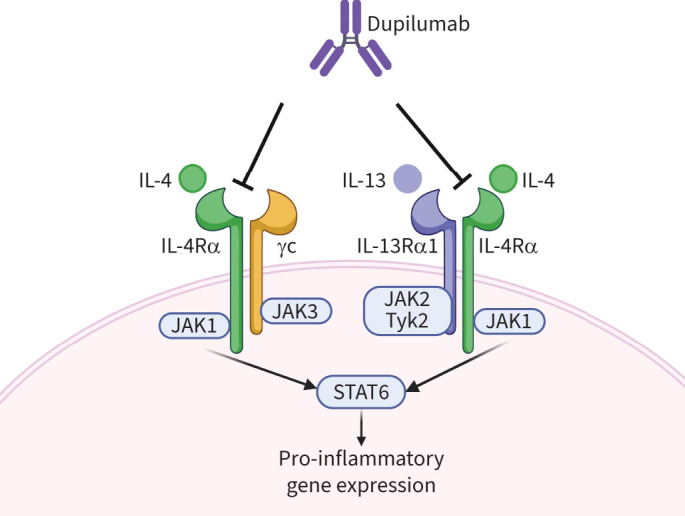
Signal transduction via interleukin (IL)-4R complexes and mechanism of action of dupilumab. IL-4 or IL-13 binds to the receptors as shown and activates the Janus family protein kinases (JAKs). JAK activation initiates a cascade of phosphorylation leading to activation of the signal transducer and activator of transcription 6 (STAT6) signalling pathway and pro-inflammatory gene expression. Dupilumab is a monoclonal antibody that inhibits both IL-4 and IL-13 signalling by binding to the IL-4Rα subunit shared by IL-4 and IL-13 receptor complexes. IL-4Ra/γc: alpha subunit of IL-4R receptor pairing with γc chain to form a heterodimeric complex receptor and binds IL-4 exclusively; IL-13Ra1/IL-4Ra: alpha subunit of IL-4R pairing with alpha 1 subunit of IL-13 receptor to form a IL-13- and IL-4-binding heterodimeric complex. Created with BioRender.com.
The US FDA and the EMA approved dupilumab as an add-on treatment for SEA and mOCS-dependent asthma in 2018 and 2019, respectively [112, 113]. Dupilumab is administered subcutaneously at an initial loading dose of 400–600 mg followed by 200–300 mg every 2 weeks. The higher dose is recommended in OCS-dependent severe asthma. Dupilumab is currently approved for ages 6 years and older with SEA. Additional approved indications include atopic dermatitis, CRSwNP, prurigo nodularis and eosinophilic oesophagitis [112].
Evidence from pivotal trials
Early evidence of dupilumab's efficacy in moderate-to-severe eosinophilic asthma was demonstrated in 2013 with an 87% reduction in exacerbations despite phased discontinuation of background long-acting beta agonist and ICS therapy [114]. This was followed by three pivotal studies, namely Phase 2b, QUEST and VENTURE, that paved the way for dupilumab approval as an add-on therapy in SEA [115–117] (table 1). In the QUEST study, dupilumab therapy decreased AER by 52% and increased FEV1 (+320 mL) compared to placebo [116]. Greater benefits were seen in patients with higher baseline BEC.
Extension studies and RWE
The long-term safety and efficacy of dupilumab has been evaluated in two OLE studies. The TRAVERSE study included individuals who had previously participated in a phase 2 or 3 RCT and followed them for up to 96 weeks [118, 119]. The TRAVERSE continuation study further assessed the safety and efficacy of dupilumab for up to an additional 144 weeks in individuals who had previously completed the TRAVERSE study [120]. Patients exposed to dupilumab for up to 3 years experienced a sustained reduction in AER, improved lung function (+450–520 mL), better asthma control and reduced mOCS use [118–121], independent of the ICS dose [122].
A large real-world retrospective study, US ADVANTAGE, evaluated dupilumab in moderate-to-severe asthma [123]. This cohort had elevated baseline BEC and the majority of patients had atopic comorbidities such as allergic rhinitis, CRSwNP and atopic dermatitis. Dupilumab was highly effective in reducing AER regardless of baseline exacerbation rate and mean BEC. Findings were similar in a Dutch cohort with severe uncontrolled asthma where dupilumab significantly reduced AER and improved asthma control and lung function after 12 months of therapy [124].
Predictors of response
A higher baseline BEC (≥300 cells·µL−1) predicted greater efficacy in the QUEST study. Post hoc analysis of this study found an increased clinical efficacy of dupilumab in patients with elevated baseline FENO [125]. A greater reduction in severe exacerbations was seen with FENO ≥50 ppb (70% versus 23% in FENO <25). This effect was independent of BEC. A real-world study from Japan showed increased efficacy in the subgroup with BEC >150 or 300 cells·µL−1, FENO >25 ppb and IgE >167 IU·mL−1 [126]. Together, these findings confirm the biologic activity of dupilumab in T2-high asthma. These effects were consistent with results from a real-world Dutch cohort study [124].
Efficacy in mOCS-dependent asthma
The VENTURE study evaluated the efficacy of dupilumab in severe OCS-dependent asthma in 210 patients, with or without blood eosinophilia. Dupilumab treatment was associated with a significant reduction in mOCS dose (70% versus 42% placebo) while improving asthma control and lung function [117]. Improvement in clinical outcomes and a sustained reduction in mOCS dose with long-term dupilumab treatment was also confirmed in a post hoc analysis of the VENTURE and TRAVERSE studies [127]. Patients who switched from placebo in the VENTURE study to dupilumab in the TRAVERSE study also experienced a rapid and sustained improvement in FEV1 and reductions in mOCS dose. A real-life French cohort study found a similar OCS-sparing effect of dupilumab [128].
Safety profile
Dupilumab appeared safe in pivotal studies with injection site reaction being the most common AEs (table 1). Treatment-emergent blood eosinophilia was observed during the initial weeks of therapy in 4% of patients assigned to dupilumab in the QUEST study, which resolved by week 24. BEC exceeded 3000 cells·mL−1 in 1.2% of the patients assigned dupilumab. The mechanisms and clinical implications of treatment-emergent eosinophilia are not well understood and require further study. A proposed mechanism involves blockade of eosinophil tissue trafficking by inhibition of IL4-regulated adhesion molecules [129]. BEC >1500 cells·mL−1 was an exclusion criterion for the QUEST study and the Global Initiative for Asthma (GINA) recommends avoiding dupilumab in patients with BEC ≥1500 cells·mL−1 [116, 130]. Ocular AEs including keratitis, conjunctivitis and blepharitis were noted to occur more frequently with dupilumab in studies of atopic dermatitis but pooled data from asthma RCTs did not find a significant difference between dupilumab and placebo [131].
Anti-TSLP therapy: tezepelumab
Overview
The airway epithelium, traditionally thought to function as a passive barrier, is now recognised to play an active role as a central driver of early and dysregulated immune responses to external triggers such as infectious agents, allergens and pollutants [132]. This results in a downstream inflammatory cascade through a group of epithelial cytokines known as alarmins, including TSLP, IL-33 and IL-25. These alarmins can serve as key therapeutic targets in both T2-high and T2-low asthma [133].
Tezepelumab is a human mAb (IgG2λ) that targets TSLP. The US FDA and the EMA approved tezepelumab for the treatment of severe asthma (regardless of T2 status) in 2021 and 2022, respectively [134, 135]. Tezepelumab is currently approved for use in individuals 12 years and older. The recommended dose is 210 mg subcutaneously every 4 weeks.
Evidence from pivotal trials
The efficacy of tezepelumab in severe asthma was established in two RCTs, namely PATHWAY and NAVIGATOR [136, 137] (table 1). In the PATHWAY trial, tezepelumab therapy reduced AER by 60–70% versus placebo, independent of baseline BEC or FENO, and improved FEV1 (+120–150 mL), asthma symptom score and QoL measures [136]. While PATHWAY was a dose-ranging study, the NAVIGATOR study utilised a fixed dose of tezepelumab 210 mg every 4 weeks. Tezepelumab therapy was associated with a 56% relative reduction in the rate of severe exacerbations and this effect remained significant across all baseline BEC.
Extension studies and RWE
DESTINATION, a double-blind extension study for up to 2 years, evaluated the safety and efficacy of tezepelumab in severe uncontrolled asthma [138]. Tezepelumab treatment resulted in sustained and clinically meaningful reduction in annualised AER. Extended follow-up of this cohort showed persistent benefits of continued treatment compared to stopping treatment after 2 years [139]. A blinded systematic review of NAVIGATOR data showed a substantial reduction in unscheduled visits, telephone calls, emergency visits and hospitalisations versus placebo [140]. Pooled analysis from the PATHWAY and NAVIGATOR studies showed a consistent reduction in exacerbation rates, improved HCRU, asthma control and lung function irrespective of baseline biomarker levels [141].
Predictors of response
Across clinical studies, tezepelumab reduced annual AER versus placebo by 58–68% in severe allergic asthma, 63–71% in SEA, 67–71% in allergic and eosinophilic severe asthma, 34–49% in T2-low asthma, and 31–41% in mOCS-dependent asthma [142]. Although studies have shown the efficacy of tezepelumab in both T2-high and T2-low asthma [141, 143], greater clinical efficacy was observed in patients with higher baseline BEC and FENO [137]. Tezepelumab therapy decreased airway submucosal eosinophils compared with placebo in the CASCADE bronchoscopy study but did not affect other cell types [143]. Tezepelumab reduced airway hyperresponsiveness to mannitol, subepithelial and bronchoalveolar lavage eosinophils, and showed a trend towards reduction in airway tissue mast cells in the UPSTREAM study [144].
Efficacy in mOCS-dependent asthma
The SOURCE study evaluated the efficacy of tezepelumab in mOCS-dependent asthma [145]. While tezepelumab therapy did not result in a significant reduction in mOCS dose for the overall population, an improvement was observed in patients with BEC ≥150 cells·mL−1. The SUNRISE study is currently underway evaluating efficacy of tezepelumab in OCS-dependent severe asthma with elevated BEC (ClinicalTrials.gov: NCT05398263).
Safety profile
Tezepelumab was well tolerated in the above-mentioned studies with a favourable safety profile in terms of overall AEs and SAEs compared to placebo (table 1) [137, 138].
Safety data for tezepelumab use in pregnancy in humans is lacking.
Research needs and future directions
Standardised assessment of clinical response
Assessing the response to biologic therapy in asthma continues to challenge clinicians due to the lack of well-defined and universally accepted criteria for measuring treatment response [146]. Significant improvements in asthma outcomes, including a reduction in mOCS, have been observed even in patients randomised to placebo in RCTs [117, 145]. This is likely a result of improved adherence and rigorous oversight in RCTs. It is imperative to consider both subjective and objective parameters (e.g. asthma exacerbations, asthma control scores using validated measures, lung function and mOCS dose) as well as side-effects and overall patient satisfaction when assessing treatment response. Assessment of blood or sputum biomarkers, both at baseline and during exacerbations, can provide additional insights into treatment response in patients with T2 asthma. Efforts have been made recently to standardise core outcomes in clinical trials and similar guidance is needed in clinical practice [147, 148].
GINA recommends an initial biologic trial for at least 4 months with careful assessment of clinical response using the measures discussed above [36]. The therapeutic trial can be extended in patients with partial or uncertain response. In nonresponders, switching to a different biologic needs to be considered, taking into account biomarker profile, comorbidities and patient preference [36]. The development of neutralising antibodies is an infrequent occurrence but could potentially contribute to loss of efficacy over time [149, 150].
Factors associated with poor clinical response and treatment failures
While biologic therapies have demonstrated efficacy in reducing exacerbations and mOCS dependence, the clinical response to treatment is highly variable, with studies reporting up to 21% of patients experiencing no response after 1 year of treatment [151, 152]. Nonresponders to biologics in the Danish Severe Asthma Registry were more likely to use mOCS at baseline, as well as have fewer exacerbations and lower BEC. Bult et al. [152] found that nonresponse to dupilumab was associated with low total IgE level, low FENO and younger age. Preliminary results from another study found that higher baseline eosinophil levels and lower baseline asthma control were associated with treatment failures [153]. Late treatment failures after initial clinical response have been observed in real-world studies and may be attributable to worsening airway eosinophilia, development of neutralising drug antibodies and comorbidities [149, 154]. The multicentre, prospective, observational MEX study conducted in the UK attempted to characterise breakthrough exacerbations in patients with severe asthma receiving mepolizumab therapy and identified two distinct patterns of exacerbations, 1) eosinophilic with high FENO and 2) noneosinophilic, driven by infection, with low FENO and high C-reactive protein levels [155].
Recent studies have highlighted the discordance between blood and airway eosinophilia and existence of distinct eosinophil subpopulations, such as CD26Lint and CD62Lhi, which are associated with treatment failure [75, 150]. Clinical factors such as mOCS dependence (suggests higher burden of airway inflammation), late-onset asthma (often more severe disease and may have a different inflammatory profile) and chronic sinus disease (represents a persistent inflammatory state) have been identified as predictors of a suboptimal response to anti-IL5 therapies [150]. Suboptimal responders also demonstrated autoimmune response in the airways with elevated anti-eosinophil peroxidase IgG and potential formation of immune complexes that may compromise the efficacy of these treatments [150]. An inadequate neutralisation of IL-5 in the airways due to insufficient dosing of the anti-IL5 mAb leading to persistent eosinophilic inflammation could also contribute to suboptimal response as well as delayed treatment failures. Treatment with weight-adjusted intravenous reslizumab or anti-IL5R ab (benralizumab) has been associated with further benefit in patients with persistent airway eosinophilia on fixed-dose mepolizumab [156–158]. Together, these findings underscore the necessity for better biomarkers, a deeper understanding of the mechanisms driving poor response to the biologics and personalised dosing strategies. There is still a significant gap in our understanding of predictors of treatment failure and represents an unmet need in the management of severe asthma. Addressing this gap is crucial for the continued advancement of personalised medicine in asthma management.
Comparative efficacy, switching and combining asthma biologics
There is an urgent need for comparative efficacy studies to inform the initial selection of biologics in patients with overlapping T2 biomarkers and comorbidities. Analysis of data from the International Severe Asthma Registry and CHRONICLE study in over 3500 patients found that 10% of patients stopped and 11% switched from their initial biologic [159]. Patients who stopped or switched were more likely to have a higher baseline BEC, exacerbation rate and HCRU, and lower lung function. Real-world studies have shown that in SEA patients with suboptimal control on mepolizumab or reslizumab, switching to benralizumab led to an improvement in asthma symptom control [100, 158]. Similarly, switching from anti-IL5/5R therapies to dupilumab following suboptimal control among those with elevated FENO led to a significant improvement in clinical outcomes [160]. Therefore, factors such as baseline biomarker status, the presence of comorbid conditions and previous responses to therapy need to be considered to optimise treatment outcomes.
Furthermore, studies are needed that evaluate combining biologic therapies that target different pathways when asthma remains uncontrolled on monotherapy [161]. There appears to be some redundancy in T2 pathways, as demonstrated by Wechsler et al. [162] in a phase 2 study evaluating the combination of anti-IL-33 antibody (itepekimab) plus dupilumab compared to monotherapy with each and to placebo. Itepekimab in combination with dupilumab did not offer an additional benefit compared to either biologic therapy alone.
Role of mucus plugs in severe asthma and the potential impact of biologics
Mucus plugs in asthma are associated with increased severity, frequent exacerbations and reduced lung function [163]. Multidetector computed tomography has been used as a noninvasive method to measure airway mucus accumulation [164]. Mucus in severe asthma may represent a specific clinical phenotype contributing to airway obstruction and impaired ventilation and provide an opportunity for targeted therapy, as seen in recent studies of benralizumab, dupilumab and tezepelumab [165–167]. A reduction in mucus plugging leading to improvements in ventilation and lung function was observed with dupilumab, which would be consistent with its anti-IL-13 effects [167]. Similarly, tezepelumab, which targets TSLP, an epithelial cytokine that increases activity of IL-5 and IL-13 in the airways, has also been shown to reduce mucus plugs in moderate-to-severe uncontrolled asthma [166].
Clinical remission in asthma
The primary focus of asthma treatment has been disease control. With the advent of asthma biologics and recognition of “super responders”, the conversation has shifted to the concept of clinical remission as a viable treatment goal in severe asthma [168, 169]. It is estimated that approximately 20–40% of patients on asthma biologics could achieve “on-treatment” remission using pre-defined criteria [170]. Efforts are also underway to identify factors that may predict clinical remission on-treatment [151, 171–173]. Remission is one step closer to cure [174] and could be important for two reasons, 1) overall long-term prognosis and 2) an opportunity to reduce background or biologic therapy [151]. The SHAMAL study evaluated the feasibility of tapering background asthma therapy in patients on benralizumab and found that over 90% of patients could successfully reduce their ICS-formoterol dose without experiencing exacerbations [175]. The recently published OPTIMAL algorithm provides a potential framework for safe down-titration of biologics in patients with well-controlled asthma [176]. This is an active area of current research and hopefully will shed light on potential disease-modifying effects of asthma biologics in the near future.
Summary
Improved understanding of asthma's immunopathology has enabled the identification of specific biologic pathways and tailor treatments to individual phenotypes. The advent of biologic therapies has revolutionised the management of severe asthma. These therapies offer targeted, personalised treatment options that decrease reliance on systemic corticosteroids and improve patient outcomes.
This review presents an in-depth analysis of asthma biologics, detailing their mechanisms of action, clinical efficacy and safety profiles. We underscore the value of integrating RWE with clinical trial data to broaden the applicability of findings. We hope this review serves as a foundational resource for understanding safety and effectiveness of these advanced therapies in asthma and stimulates further research towards achieving remission and potential cure.
Points for clinical practice
Severe asthma has a significant impact on QoL, lung health, HCRU and corticosteroid exposure, contributing to overall disease-related morbidity and mortality.
Biologic therapies offer highly effective, targeted and personalised treatment options in severe asthma.
Understanding of the mechanisms of action of these biologics coupled with careful consideration of the patient's phenotype and associated comorbidities is crucial for achieving optimal disease control and providing a better overall long-term prognosis.
Achieving clinical remission in severe asthma is a possibility and should be the therapeutic goal moving forward.
Evidence from clinical trials, extension studies and real-world studies confirm their safety and efficacy as well as provide practical perspectives on their application.
Omalizumab appears safe in pregnancy, but the absence of safety data on the use of other biologics in pregnancy is a critical gap in the current literature.
Application of standardised core outcomes in trials as well as clinical practice are necessary for meaningful assessment of efficacy and an area that needs further research.
Footnotes
Provenance: Commissioned article, peer reviewed.
Conflict of interest: All authors report no conflicts of interest associated with the publication of this manuscript and there is no financial support for this work. Outside of this work: B. Gyawali has nothing to disclose. S.N. Georas reports research grants from NIH, consulting fees from AstraZeneca, ARS Pharma, Chiesi inc, Amarin Pharma and GH Research, payment or honoraria for lectures, presentations, speakers’ bureaus, manuscript writing or educational events from Exchange CME, and acts as Chair of PreciSE Asthma Network steering committee (NIH/NHLBI) and Chair of DSMB for COPDGene study (NIH/NHLBI). S. Khurana reports research grants from the American Lung Association, royalties from Springer Nature, CME honoraria from CHEST/ACCP, European Respiratory Society, Healio, NYU, Cleveland Clinic, Thai Asthma Council, Eastern Pulmonary Conference, and serves as Regent-at-large for CHEST and Chair of DSMB for an NIH study.
References
- 1.Varricchi G, Ferri S, Pepys J, et al. Biologics and airway remodeling in severe asthma. Allergy 2022; 77: 3538–3552. doi: 10.1111/all.15473 [DOI] [PMC free article] [PubMed] [Google Scholar]
- 2.Brusselle GG, Koppelman GH. Biologic therapies for severe asthma. N Engl J Med 2022; 386: 157–171. doi: 10.1056/NEJMra2032506 [DOI] [PubMed] [Google Scholar]
- 3.McGregor MC, Krings JG, Nair P, et al. Role of biologics in asthma. Am J Respir Crit Care Med 2019; 199: 433–445. doi: 10.1164/rccm.201810-1944CI [DOI] [PMC free article] [PubMed] [Google Scholar]
- 4.Settipane RA, Kreindler JL, Chung Y, et al. Evaluating direct costs and productivity losses of patients with asthma receiving GINA 4/5 therapy in the United States. Ann Allergy Asthma Immunol 2019; 123: 564–572. doi: 10.1016/j.anai.2019.08.462 [DOI] [PubMed] [Google Scholar]
- 5.Chung KF, Wenzel SE, Brozek JL, et al. International ERS/ATS guidelines on definition, evaluation and treatment of severe asthma. Eur Respir J 2014; 43: 343–373. doi: 10.1183/09031936.00202013 [DOI] [PubMed] [Google Scholar]
- 6.Hekking PW, Wener RR, Amelink M, et al. The prevalence of severe refractory asthma. J Allergy Clin Immunol 2015; 135: 896–902. doi: 10.1016/j.jaci.2014.08.042 [DOI] [PubMed] [Google Scholar]
- 7.Burnette A, Wang Y, Rane PB, et al. Incremental cost burden among patients with severe uncontrolled asthma in the United States. J Manag Care Spec Pharm 2023; 29: 825–834. [DOI] [PMC free article] [PubMed] [Google Scholar]
- 8.Engelkes M, de Ridder MA, Svensson E, et al. Multinational cohort study of mortality in patients with asthma and severe asthma. Respir Med 2020; 165: 105919. doi: 10.1016/j.rmed.2020.105919 [DOI] [PubMed] [Google Scholar]
- 9.Schleich F, Bougard N, Moermans C, et al. Cytokine-targeted therapies for asthma and COPD. Eur Respir Rev 2023; 32: 220193. doi: 10.1183/16000617.0193-2022 [DOI] [PMC free article] [PubMed] [Google Scholar]
- 10.Lee Y, Lee JH, Park SY, et al. Roles of real-world evidence in severe asthma treatment: challenges and opportunities. ERJ Open Res 2023; 9: 00248-2022. doi: 10.1183/23120541.00248-2022 [DOI] [PMC free article] [PubMed] [Google Scholar]
- 11.Genentech . Highlights of prescribing information. Date last accessed: April 2024. Date last updated: July 2016. www.accessdata.fda.gov/drugsatfda_docs/label/2016/103976s5225lbl.pdf
- 12.European Medicines Agency . Committee for medicinal products for human use post-authorisation summary of positive opinion for Xolair. Date last accessed: April 2024. Date last updated: 25 June 2009. www.ema.europa.eu/en/documents/smop/chmp-post-authorisation-summary-positive-opinion-xolair-25-june-2009_en.pdf
- 13.Busse W, Corren J, Lanier BQ, et al. Omalizumab, anti-IgE recombinant humanized monoclonal antibody, for the treatment of severe allergic asthma. J Allergy Clin Immunol 2001; 108: 184–190. doi: 10.1067/mai.2001.117880 [DOI] [PubMed] [Google Scholar]
- 14.Solèr M, Matz J, Townley R, et al. The anti-IgE antibody omalizumab reduces exacerbations and steroid requirement in allergic asthmatics. Eur Respir J 2001; 18: 254–261. doi: 10.1183/09031936.01.00092101 [DOI] [PubMed] [Google Scholar]
- 15.Buhl R, Soler M, Matz J, et al. Omalizumab provides long-term control in patients with moderate-to-severe allergic asthma. Eur Respir J 2002; 20: 73–78. doi: 10.1183/09031936.02.00278102 [DOI] [PubMed] [Google Scholar]
- 16.Vignola AM, Humbert M, Bousquet J, et al. Efficacy and tolerability of anti-immunoglobulin E therapy with omalizumab in patients with concomitant allergic asthma and persistent allergic rhinitis: SOLAR. Allergy 2004; 59: 709–717. doi: 10.1111/j.1398-9995.2004.00550.x [DOI] [PubMed] [Google Scholar]
- 17.Ayres JG, Higgins B, Chilvers ER, et al. Efficacy and tolerability of anti-immunoglobulin E therapy with omalizumab in patients with poorly controlled (moderate-to-severe) allergic asthma. Allergy 2004; 59: 701–708. doi: 10.1111/j.1398-9995.2004.00533.x [DOI] [PubMed] [Google Scholar]
- 18.Humbert M, Beasley R, Ayres J, et al. Benefits of omalizumab as add-on therapy in patients with severe persistent asthma who are inadequately controlled despite best available therapy (GINA 2002 step 4 treatment): INNOVATE. Allergy 2005; 60: 309–316. doi: 10.1111/j.1398-9995.2004.00772.x [DOI] [PubMed] [Google Scholar]
- 19.Hanania NA, Alpan O, Hamilos DL, et al. Omalizumab in severe allergic asthma inadequately controlled with standard therapy: a randomized trial. Ann Intern Med 2011; 154: 573–582. doi: 10.7326/0003-4819-154-9-201105030-00002 [DOI] [PubMed] [Google Scholar]
- 20.Buhl R. Anti-IgE: lessons from clinical trials in patients with severe allergic asthma symptomatic despite optimised therapy. Eur Respir Rev 2007; 16: 73–77. doi: 10.1183/09059180.00010403 [DOI] [Google Scholar]
- 21.Bousquet J, Siergiejko Z, Swiebocka E, et al. Persistency of response to omalizumab therapy in severe allergic (IgE-mediated) asthma. Allergy 2011; 66: 671–678. doi: 10.1111/j.1398-9995.2010.02522.x [DOI] [PubMed] [Google Scholar]
- 22.Bardelas J, Figliomeni M, Kianifard F, et al. A 26-week, randomized, double-blind, placebo-controlled, multicenter study to evaluate the effect of omalizumab on asthma control in patients with persistent allergic asthma. J Asthma 2012; 49: 144–152. doi: 10.3109/02770903.2011.648296 [DOI] [PubMed] [Google Scholar]
- 23.Bousquet J, Cabrera P, Berkman N, et al. The effect of treatment with omalizumab, an anti-IgE antibody, on asthma exacerbations and emergency medical visits in patients with severe persistent asthma. Allergy 2005; 60: 302–308. doi: 10.1111/j.1398-9995.2004.00770.x [DOI] [PubMed] [Google Scholar]
- 24.Normansell R, Walker S, Milan SJ, et al. Omalizumab for asthma in adults and children. Cochrane Database Syst Rev 2014; 2014: CD003559. doi: 10.1002/14651858.CD003559.pub4 [DOI] [PMC free article] [PubMed] [Google Scholar]
- 25.Brusselle G, Michils A, Louis R, et al. “Real-life” effectiveness of omalizumab in patients with severe persistent allergic asthma: the PERSIST study. Respir Med 2009; 103: 1633–1642. doi: 10.1016/j.rmed.2009.06.014 [DOI] [PubMed] [Google Scholar]
- 26.Grimaldi-Bensouda L, Zureik M, Aubier M, et al. Does omalizumab make a difference to the real-life treatment of asthma exacerbations?: results from a large cohort of patients with severe uncontrolled asthma. Chest 2013; 143: 398–405. doi: 10.1378/chest.12-1372 [DOI] [PubMed] [Google Scholar]
- 27.Braunstahl GJ, Chen CW, Maykut R, et al. The eXpeRience registry: the “real-world” effectiveness of omalizumab in allergic asthma. Respir Med 2013; 107: 1141–1151. doi: 10.1016/j.rmed.2013.04.017 [DOI] [PubMed] [Google Scholar]
- 28.Adachi M, Kozawa M, Yoshisue H, et al. Real-world safety and efficacy of omalizumab in patients with severe allergic asthma: a long-term post-marketing study in Japan. Respir Med 2018; 141: 56–63. doi: 10.1016/j.rmed.2018.06.021 [DOI] [PubMed] [Google Scholar]
- 29.Hanania NA, Niven R, Chanez P, et al. Long-term effectiveness and safety of omalizumab in pediatric and adult patients with moderate-to-severe inadequately controlled allergic asthma. World Allergy Organ J 2022; 15: 100695. doi: 10.1016/j.waojou.2022.100695 [DOI] [PMC free article] [PubMed] [Google Scholar]
- 30.Abraham I, Alhossan A, Lee CS, et al. “Real-life” effectiveness studies of omalizumab in adult patients with severe allergic asthma: systematic review. Allergy 2016; 71: 593–610. doi: 10.1111/all.12815 [DOI] [PubMed] [Google Scholar]
- 31.Alhossan A, Lee CS, MacDonald K, et al. “Real-life” effectiveness studies of omalizumab in adult patients with severe allergic asthma: meta-analysis. J Allergy Clin Immunol Pract 2017; 5: 1362–1370 e2. doi: 10.1016/j.jaip.2017.02.002 [DOI] [PubMed] [Google Scholar]
- 32.MacDonald KM, Kavati A, Ortiz B, et al. Short- and long-term real-world effectiveness of omalizumab in severe allergic asthma: systematic review of 42 studies published 2008–2018. Expert Rev Clin Immunol 2019; 15: 553–569. doi: 10.1080/1744666X.2019.1574571 [DOI] [PubMed] [Google Scholar]
- 33.Bousquet J, Humbert M, Gibson PG, et al. Real-world effectiveness of omalizumab in severe allergic asthma: a meta-analysis of observational studies. J Allergy Clin Immunol Pract 2021; 9: 2702–2714. doi: 10.1016/j.jaip.2021.01.011 [DOI] [PubMed] [Google Scholar]
- 34.Ledford D, Busse W, Trzaskoma B, et al. A randomized multicenter study evaluating Xolair persistence of response after long-term therapy. J Allergy Clin Immunol 2017; 140: 162–169. doi: 10.1016/j.jaci.2016.08.054 [DOI] [PubMed] [Google Scholar]
- 35.Humbert M, Bourdin A, Taille C, et al. Real-life omalizumab exposure and discontinuation in a large nationwide population-based study of paediatric and adult asthma patients. Eur Respir J 2022; 60: 2103130. doi: 10.1183/13993003.03130-2021 [DOI] [PMC free article] [PubMed] [Google Scholar]
- 36.Global Initiative for Asthma . 2023 GINA report, global strategy for asthma management and prevention. Date last accessed: 21 April 2024. Date last updated 10 July 2023. https://ginasthma.org/2023-gina-main-report/
- 37.Maza-Solano J, Callejon-Leblic A, Martin-Jimenez D, et al. Omalizumab treatment in uncontrolled asthma and CRSwNP patients, with previous endoscopic sinus surgery, to improve quality of life and endoscopic outcomes: a two-year real-life study. Curr Allergy Asthma Rep 2023; 23: 555–566. doi: 10.1007/s11882-023-01106-w [DOI] [PubMed] [Google Scholar]
- 38.Casale TB, Chipps BE, Rosen K, et al. Response to omalizumab using patient enrichment criteria from trials of novel biologics in asthma. Allergy 2018; 73: 490–497. doi: 10.1111/all.13302 [DOI] [PMC free article] [PubMed] [Google Scholar]
- 39.Hanania NA, Wenzel S, Rosen K, et al. Exploring the effects of omalizumab in allergic asthma: an analysis of biomarkers in the EXTRA study. Am J Respir Crit Care Med 2013; 187: 804–811. doi: 10.1164/rccm.201208-1414OC [DOI] [PubMed] [Google Scholar]
- 40.Kallieri M, Papaioannou AI, Papathanasiou E, et al. Predictors of response to therapy with omalizumab in patients with severe allergic asthma – a real life study. Postgrad Med 2017; 129: 598–604. doi: 10.1080/00325481.2017.1321945 [DOI] [PubMed] [Google Scholar]
- 41.Casale TB, Luskin AT, Busse W, et al. Omalizumab effectiveness by biomarker status in patients with asthma: evidence from PROSPERO, a prospective real-world study. J Allergy Clin Immunol Pract 2019; 7: 156–164. doi: 10.1016/j.jaip.2018.04.043 [DOI] [PubMed] [Google Scholar]
- 42.Djukanovic R, Brinkman P, Kolmert J, et al. Biomarker predictors of clinical efficacy of the anti-IgE biologic, omalizumab, in severe asthma in adults: results of the SoMOSA study. Am J Respir Crit Care Med 2024; 210: 288–297. doi: 10.1164/rccm.202310-1730OC [DOI] [PMC free article] [PubMed] [Google Scholar]
- 43.Bousquet J, Rabe K, Humbert M, et al. Predicting and evaluating response to omalizumab in patients with severe allergic asthma. Respir Med 2007; 101: 1483–1492. doi: 10.1016/j.rmed.2007.01.011 [DOI] [PubMed] [Google Scholar]
- 44.Mukherjee M, Kjarsgaard M, Radford K, et al. Omalizumab in patients with severe asthma and persistent sputum eosinophilia. Allergy Asthma Clin Immunol 2019; 15: 21. doi: 10.1186/s13223-019-0337-2 [DOI] [PMC free article] [PubMed] [Google Scholar]
- 45.Molimard M, Buhl R, Niven R, et al. Omalizumab reduces oral corticosteroid use in patients with severe allergic asthma: real-life data. Respir Med 2010; 104: 1381–1385. doi: 10.1016/j.rmed.2010.06.001 [DOI] [PubMed] [Google Scholar]
- 46.Long A, Rahmaoui A, Rothman KJ, et al. Incidence of malignancy in patients with moderate-to-severe asthma treated with or without omalizumab. J Allergy Clin Immunol 2014; 134: 560–567 e4. doi: 10.1016/j.jaci.2014.02.007 [DOI] [PubMed] [Google Scholar]
- 47.Iribarren C, Rahmaoui A, Long AA, et al. Cardiovascular and cerebrovascular events among patients receiving omalizumab: results from EXCELS, a prospective cohort study in moderate to severe asthma. J Allergy Clin Immunol 2017; 139: 1489–1495. doi: 10.1016/j.jaci.2016.07.038 [DOI] [PubMed] [Google Scholar]
- 48.Nagase H, Suzukawa M, Oishi K, et al. Biologics for severe asthma: the real-world evidence, effectiveness of switching, and prediction factors for the efficacy. Allergol Int 2023; 72: 11–23. doi: 10.1016/j.alit.2022.11.008 [DOI] [PubMed] [Google Scholar]
- 49.Namazy J, Cabana MD, Scheuerle AE, et al. The Xolair Pregnancy Registry (EXPECT): the safety of omalizumab use during pregnancy. J Allergy Clin Immunol 2015; 135: 407–412. doi: 10.1016/j.jaci.2014.08.025 [DOI] [PubMed] [Google Scholar]
- 50.Nagase H, Ueki S, Fujieda S. The roles of IL-5 and anti-IL-5 treatment in eosinophilic diseases: asthma, eosinophilic granulomatosis with polyangiitis, and eosinophilic chronic rhinosinusitis. Allergol Int 2020; 69: 178–186. doi: 10.1016/j.alit.2020.02.002 [DOI] [PubMed] [Google Scholar]
- 51.GlaxoSmithKline . Highlights of prescribing information. Date last accessed: April 2024. Date last updated: March 2023. www.gsksource.com/pharma/content/dam/GlaxoSmithKline/US/en/Prescribing_Information/Nucala/pdf/NUCALA-PI-PIL-IFU-COMBINED.PDF
- 52.European Medicines Agency . Summary of product characteristics. Date last accessed: April 2024. Date last updated: 16 July 2024. www.ema.europa.eu/en/documents/product-information/nucala-epar-product-information_en.pdf
- 53.Leckie MJ, ten Brinke A, Khan J, et al. Effects of an interleukin-5 blocking monoclonal antibody on eosinophils, airway hyper-responsiveness, and the late asthmatic response. Lancet 2000; 356: 2144–2148. doi: 10.1016/S0140-6736(00)03496-6 [DOI] [PubMed] [Google Scholar]
- 54.Flood-Page P, Swenson C, Faiferman I, et al. A study to evaluate safety and efficacy of mepolizumab in patients with moderate persistent asthma. Am J Respir Crit Care Med 2007; 176: 1062–1071. doi: 10.1164/rccm.200701-085OC [DOI] [PubMed] [Google Scholar]
- 55.Pavord ID, Korn S, Howarth P, et al. Mepolizumab for severe eosinophilic asthma (DREAM): a multicentre, double-blind, placebo-controlled trial. Lancet 2012; 380: 651–659. doi: 10.1016/S0140-6736(12)60988-X [DOI] [PubMed] [Google Scholar]
- 56.Ortega HG, Liu MC, Pavord ID, et al. Mepolizumab treatment in patients with severe eosinophilic asthma. N Engl J Med 2014; 371: 1198–1207. doi: 10.1056/NEJMoa1403290 [DOI] [PubMed] [Google Scholar]
- 57.Bel EH, Wenzel SE, Thompson PJ, et al. Oral glucocorticoid-sparing effect of mepolizumab in eosinophilic asthma. N Engl J Med 2014; 371: 1189–1197. doi: 10.1056/NEJMoa1403291 [DOI] [PubMed] [Google Scholar]
- 58.Chupp GL, Bradford ES, Albers FC, et al. Efficacy of mepolizumab add-on therapy on health-related quality of life and markers of asthma control in severe eosinophilic asthma (MUSCA): a randomised, double-blind, placebo-controlled, parallel-group, multicentre, phase 3b trial. Lancet Respir Med 2017; 5: 390–400. doi: 10.1016/S2213-2600(17)30125-X [DOI] [PubMed] [Google Scholar]
- 59.Lugogo N, Domingo C, Chanez P, et al. Long-term efficacy and safety of mepolizumab in patients with severe eosinophilic asthma: a multi-center, open-label, phase IIIb study. Clin Ther 2016; 38: 2058–2070. doi: 10.1016/j.clinthera.2016.07.010 [DOI] [PubMed] [Google Scholar]
- 60.Khatri S, Moore W, Gibson PG, et al. Assessment of the long-term safety of mepolizumab and durability of clinical response in patients with severe eosinophilic asthma. J Allergy Clin Immunol 2019; 143: 1742–1751. doi: 10.1016/j.jaci.2018.09.033 [DOI] [PubMed] [Google Scholar]
- 61.Khurana S, Brusselle GG, Bel EH, et al. Long-term safety and clinical benefit of mepolizumab in patients with the most severe eosinophilic asthma: the COSMEX study. Clin Ther 2019; 41: 2041–2056. doi: 10.1016/j.clinthera.2019.07.007 [DOI] [PubMed] [Google Scholar]
- 62.Harrison T, Canonica GW, Chupp G, et al. Real-world mepolizumab in the prospective severe asthma REALITI-A study: initial analysis. Eur Respir J 2020; 56: 2000151. doi: 10.1183/13993003.00151-2020 [DOI] [PMC free article] [PubMed] [Google Scholar]
- 63.Llanos JP, Ortega H, Bogart M, et al. Real-world effectiveness of mepolizumab in patients with severe asthma: an examination of exacerbations and costs. J Asthma Allergy 2020; 13: 77–87. doi: 10.2147/JAA.S236609 [DOI] [PMC free article] [PubMed] [Google Scholar]
- 64.Kavanagh JE, d'Ancona G, Elstad M, et al. Real-world effectiveness and the characteristics of a “super-responder” to mepolizumab in severe eosinophilic asthma. Chest 2020; 158: 491–500. doi: 10.1016/j.chest.2020.03.042 [DOI] [PubMed] [Google Scholar]
- 65.Kroes JA, Alfonso-Cristancho R, Bansal AT, et al. Evaluation of real-world mepolizumab use in severe asthma across Europe: the SHARP experience with privacy-preserving federated analysis. ERJ Open Res 2023; 9: 00745-2022. doi: 10.1183/23120541.00745-2022 [DOI] [PMC free article] [PubMed] [Google Scholar]
- 66.Israel E, Canonica GW, Brusselle G, et al. Real-life effectiveness of mepolizumab in severe asthma: a systematic literature review. J Asthma 2022; 59: 2201–2217. doi: 10.1080/02770903.2021.2008431 [DOI] [PubMed] [Google Scholar]
- 67.Lugogo NL, Bogart M, Corbridge T, et al. Impact of mepolizumab in patients with high-burden severe asthma within a managed care population. J Asthma 2023; 60: 811–823. doi: 10.1080/02770903.2022.2102036 [DOI] [PubMed] [Google Scholar]
- 68.Ortega H, Hahn B, Bogart M, et al. Impact of mepolizumab on exacerbations in severe asthma: results from a US insurance claims data base. Allergy Asthma Proc 2020; 41: 341–347. doi: 10.2500/aap.2020.41.200043 [DOI] [PubMed] [Google Scholar]
- 69.Schleich F, Graff S, Nekoee H, et al. Real-word experience with mepolizumab: does it deliver what it has promised? Clin Exp Allergy 2020; 50: 687–695. doi: 10.1111/cea.13601 [DOI] [PubMed] [Google Scholar]
- 70.Pilette C, Canonica GW, Chaudhuri R, et al. REALITI-a study: real-world oral corticosteroid-sparing effect of mepolizumab in severe asthma. J Allergy Clin Immunol Pract 2022; 10: 2646–2656. doi: 10.1016/j.jaip.2022.05.042 [DOI] [PubMed] [Google Scholar]
- 71.Moore WC, Kornmann O, Humbert M, et al. Stopping versus continuing long-term mepolizumab treatment in severe eosinophilic asthma (COMET study). Eur Respir J 2022; 59: 2100396. doi: 10.1183/13993003.00396-2021 [DOI] [PMC free article] [PubMed] [Google Scholar]
- 72.Ortega HG, Yancey SW, Mayer B, et al. Severe eosinophilic asthma treated with mepolizumab stratified by baseline eosinophil thresholds: a secondary analysis of the DREAM and MENSA studies. Lancet Respir Med 2016; 4: 549–556. doi: 10.1016/S2213-2600(16)30031-5 [DOI] [PubMed] [Google Scholar]
- 73.Liu MC, Bagnasco D, Matucci A, et al. Mepolizumab in patients with severe asthma and comorbidities: 1-year REALITI-A analysis. J Allergy Clin Immunol Pract 2023; 11: 3650–3661. doi: 10.1016/j.jaip.2023.07.024 [DOI] [PubMed] [Google Scholar]
- 74.Harvey ES, Langton D, Katelaris C, et al. Mepolizumab effectiveness and identification of super-responders in severe asthma. Eur Respir J 2020; 55: 1902420. doi: 10.1183/13993003.02420-2019 [DOI] [PubMed] [Google Scholar]
- 75.Gerday S, Graff S, Moermans C, et al. Super-responders to anti-IL-5/anti-IL-5R are characterised by high sputum eosinophil counts at baseline. Thorax 2023; 78: 1138–1141. doi: 10.1136/thorax-2022-219781 [DOI] [PMC free article] [PubMed] [Google Scholar]
- 76.Nair P, Pizzichini MM, Kjarsgaard M, et al. Mepolizumab for prednisone-dependent asthma with sputum eosinophilia. N Engl J Med 2009; 360: 985–993. doi: 10.1056/NEJMoa0805435 [DOI] [PubMed] [Google Scholar]
- 77.Casale T, Molfino NA, Silver J, et al. Real-world effectiveness of mepolizumab in patients with severe asthma and associated comorbidities. Ann Allergy Asthma Immunol 2021; 127: 354–362. doi: 10.1016/j.anai.2021.05.021 [DOI] [PubMed] [Google Scholar]
- 78.Li W, Tang SC, Jin L. Adverse events of anti-IL-5 drugs in patients with eosinophilic asthma: a meta-analysis of randomized controlled trials and real-world evidence-based assessments. BMC Pulm Med 2024; 24: 70. doi: 10.1186/s12890-024-02885-2 [DOI] [PMC free article] [PubMed] [Google Scholar]
- 79.Charles D, Shanley J, Temple SN, et al. Real-world efficacy of treatment with benralizumab, dupilumab, mepolizumab and reslizumab for severe asthma: a systematic review and meta-analysis. Clin Exp Allergy 2022; 52: 616–627. doi: 10.1111/cea.14112 [DOI] [PMC free article] [PubMed] [Google Scholar]
- 80.Teva Respiratory . Highlights of prescribing information. Date last accessed: April 2024. Date last updated: 9 January 2019. www.accessdata.fda.gov/drugsatfda_docs/label/2016/761033lbl.pdf
- 81.European Medicines Agency . Cinqaero. Date last accessed: April 2024. Date last updated: 26 May 2023. www.ema.europa.eu/en/medicines/human/EPAR/cinqaero
- 82.Castro M, Zangrilli J, Wechsler ME, et al. Reslizumab for inadequately controlled asthma with elevated blood eosinophil counts: results from two multicentre, parallel, double-blind, randomised, placebo-controlled, phase 3 trials. Lancet Respir Med 2015; 3: 355–366. doi: 10.1016/S2213-2600(15)00042-9 [DOI] [PubMed] [Google Scholar]
- 83.Bjermer L, Lemiere C, Maspero J, et al. Reslizumab for inadequately controlled asthma with elevated blood eosinophil levels: a randomized phase 3 study. Chest 2016; 150: 789–798. doi: 10.1016/j.chest.2016.03.032 [DOI] [PubMed] [Google Scholar]
- 84.Murphy K, Jacobs J, Bjermer L, et al. Long-term safety and efficacy of reslizumab in patients with eosinophilic asthma. J Allergy Clin Immunol Pract 2017; 5: 1572–1581. doi: 10.1016/j.jaip.2017.08.024 [DOI] [PubMed] [Google Scholar]
- 85.Hashimoto S, Kroes JA, Eger KA, et al. Real-world effectiveness of reslizumab in patients with severe eosinophilic asthma – first initiators and switchers. J Allergy Clin Immunol Pract 2022; 10: 2099–20108. doi: 10.1016/j.jaip.2022.04.014 [DOI] [PubMed] [Google Scholar]
- 86.Wechsler ME, Peters SP, Hill TD, et al. Clinical outcomes and health-care resource use associated with reslizumab treatment in adults with severe eosinophilic asthma in real-world practice. Chest 2021; 159: 1734–1746. doi: 10.1016/j.chest.2020.11.060 [DOI] [PubMed] [Google Scholar]
- 87.Weinstein SF, Katial RK, Bardin P, et al. Effects of reslizumab on asthma outcomes in a subgroup of eosinophilic asthma patients with self-reported chronic rhinosinusitis with nasal polyps. J Allergy Clin Immunol Pract 2019; 7: 589–596. doi: 10.1016/j.jaip.2018.08.021 [DOI] [PubMed] [Google Scholar]
- 88.Corren J, Weinstein S, Janka L, et al. Phase 3 study of reslizumab in patients with poorly controlled asthma: effects across a broad range of eosinophil counts. Chest 2016; 150: 799–810. doi: 10.1016/j.chest.2016.03.018 [DOI] [PubMed] [Google Scholar]
- 89.Nair P, Bardin P, Humbert M, et al. Efficacy of intravenous reslizumab in oral corticosteroid-dependent asthma. J Allergy Clin Immunol Pract 2020; 8: 555–564. doi: 10.1016/j.jaip.2019.09.036 [DOI] [PubMed] [Google Scholar]
- 90.Virchow JC, Katial R, Brusselle GG, et al. Safety of reslizumab in uncontrolled asthma with eosinophilia: a pooled analysis from 6 trials. J Allergy Clin Immunol Pract 2020; 8: 540–548. doi: 10.1016/j.jaip.2019.07.038 [DOI] [PubMed] [Google Scholar]
- 91.AstraZeneca . Highlights of prescribing information. Date last accessed: April 2024. Date last updated: 3 October 2019. www.accessdata.fda.gov/drugsatfda_docs/label/2017/761070s000lbl.pdf
- 92.European Medicines Agency . Summary of product characteristics. Date last accessed: April 2024. Date last updated: 13 February 2024. https://ec.europa.eu/health/documents/communityregister/2018/20180108139598/anx_139598_en.pdf
- 93.Bleecker ER, FitzGerald JM, Chanez P, et al. Efficacy and safety of benralizumab for patients with severe asthma uncontrolled with high-dosage inhaled corticosteroids and long-acting β2-agonists (SIROCCO): a randomised, multicentre, placebo-controlled phase 3 trial. Lancet 2016; 388: 2115–2127. doi: 10.1016/S0140-6736(16)31324-1 [DOI] [PubMed] [Google Scholar]
- 94.FitzGerald JM, Bleecker ER, Nair P, et al. Benralizumab, an anti-interleukin-5 receptor α monoclonal antibody, as add-on treatment for patients with severe, uncontrolled, eosinophilic asthma (CALIMA): a randomised, double-blind, placebo-controlled phase 3 trial. Lancet 2016; 388: 2128–2141. doi: 10.1016/S0140-6736(16)31322-8 [DOI] [PubMed] [Google Scholar]
- 95.Busse WW, Bleecker ER, FitzGerald JM, et al. Long-term safety and efficacy of benralizumab in patients with severe, uncontrolled asthma: 1-year results from the BORA phase 3 extension trial. Lancet Respir Med 2019; 7: 46–59. doi: 10.1016/S2213-2600(18)30406-5 [DOI] [PubMed] [Google Scholar]
- 96.FitzGerald JM, Bleecker ER, Bourdin A, et al. Two-year integrated efficacy and safety analysis of benralizumab in severe asthma. J Asthma Allergy 2019; 12: 401–413. doi: 10.2147/JAA.S227170 [DOI] [PMC free article] [PubMed] [Google Scholar]
- 97.Busse WW, Bleecker ER, FitzGerald JM, et al. Benralizumab for adolescent patients with severe, eosinophilic asthma: safety and efficacy after 3 years of treatment. J Allergy Clin Immunol 2021; 148: 266–271. doi: 10.1016/j.jaci.2021.02.009 [DOI] [PubMed] [Google Scholar]
- 98.Korn S, Bourdin A, Chupp G, et al. Integrated safety and efficacy among patients receiving benralizumab for up to 5 years. J Allergy Clin Immunol Pract 2021; 9: 4381–4392. doi: 10.1016/j.jaip.2021.07.058 [DOI] [PubMed] [Google Scholar]
- 99.Harrison TW, Chanez P, Menzella F, et al. Onset of effect and impact on health-related quality of life, exacerbation rate, lung function, and nasal polyposis symptoms for patients with severe eosinophilic asthma treated with benralizumab (ANDHI): a randomised, controlled, phase 3b trial. Lancet Respir Med 2021; 9: 260–274. doi: 10.1016/S2213-2600(20)30414-8 [DOI] [PubMed] [Google Scholar]
- 100.Kavanagh JE, Hearn AP, Dhariwal J, et al. Real-world effectiveness of benralizumab in severe eosinophilic asthma. Chest 2021; 159: 496–506. doi: 10.1016/j.chest.2020.08.2083 [DOI] [PubMed] [Google Scholar]
- 101.Padilla-Galo A, Levy-Abitbol R, Olveira C, et al. Real-life experience with benralizumab during 6 months. BMC Pulm Med 2020; 20: 184. doi: 10.1186/s12890-020-01220-9 [DOI] [PMC free article] [PubMed] [Google Scholar]
- 102.Hearn AP, Hug OD, Somani ZA, et al. Real world effectiveness of anti-IL-5/5R therapies is independent of co-eligibility for anti-IgE therapy. Eur Respir J 2021; 57: 2100166. doi: 10.1183/13993003.00166-2021 [DOI] [PubMed] [Google Scholar]
- 103.Pelaia C, Crimi C, Benfante A, et al. Therapeutic effects of benralizumab assessed in patients with severe eosinophilic asthma: real-life evaluation correlated with allergic and non-allergic phenotype expression. J Asthma Allergy 2021; 14: 163–173. doi: 10.2147/JAA.S297273 [DOI] [PMC free article] [PubMed] [Google Scholar]
- 104.Jackson DJ, Pelaia G, Emmanuel B, et al. Benralizumab in severe eosinophilic asthma by previous biologic use and key clinical subgroups: real-world XALOC-1 programme. Eur Respir J 2024; 64: 2301521. doi: 10.1183/13993003.01521-2023 [DOI] [PMC free article] [PubMed] [Google Scholar]
- 105.Schleich F, Moermans C, Seidel L, et al. Benralizumab in severe eosinophilic asthma in real life: confirmed effectiveness and contrasted effect on sputum eosinophilia versus exhaled nitric oxide fraction – PROMISE. ERJ Open Res 2023; 9: 00383-2023. doi: 10.1183/23120541.00383-2023 [DOI] [PMC free article] [PubMed] [Google Scholar]
- 106.FitzGerald JM, Bleecker ER, Menzies-Gow A, et al. Predictors of enhanced response with benralizumab for patients with severe asthma: pooled analysis of the SIROCCO and CALIMA studies. Lancet Respir Med 2018; 6: 51–64. doi: 10.1016/S2213-2600(17)30344-2 [DOI] [PubMed] [Google Scholar]
- 107.Bleecker ER, Wechsler ME, FitzGerald JM, et al. Baseline patient factors impact on the clinical efficacy of benralizumab for severe asthma. Eur Respir J 2018; 52: 1800936. doi: 10.1183/13993003.00936-2018 [DOI] [PMC free article] [PubMed] [Google Scholar]
- 108.Soendergaard MB, Hansen S, Bjerrum AS, et al. Complete response to anti-interleukin-5 biologics in a real-life setting: results from the nationwide Danish Severe Asthma Register. ERJ Open Res 2022; 8: 00238-2022. doi: 10.1183/23120541.00238-2022 [DOI] [PMC free article] [PubMed] [Google Scholar]
- 109.Nair P, Wenzel S, Rabe KF, et al. Oral glucocorticoid-sparing effect of benralizumab in severe asthma. N Engl J Med 2017; 376: 2448–2458. doi: 10.1056/NEJMoa1703501 [DOI] [PubMed] [Google Scholar]
- 110.Menzies-Gow A, Gurnell M, Heaney LG, et al. Oral corticosteroid elimination via a personalised reduction algorithm in adults with severe, eosinophilic asthma treated with benralizumab (PONENTE): a multicentre, open-label, single-arm study. Lancet Respir Med 2022; 10: 47–58. doi: 10.1016/S2213-2600(21)00352-0 [DOI] [PubMed] [Google Scholar]
- 111.Gandhi NA, Pirozzi G, Graham NMH. Commonality of the IL-4/IL-13 pathway in atopic diseases. Expert Rev Clin Immunol 2017; 13: 425–437. doi: 10.1080/1744666X.2017.1298443 [DOI] [PubMed] [Google Scholar]
- 112.Regeneron Pharmaceuticals . Highlights of prescribing information. Date last accessed: April 2024. Date last updated: 12 April 2024. www.accessdata.fda.gov/drugsatfda_docs/label/2024/761055s057lbl.pdf
- 113.European Medicines Agency . Summary of product characteristics. Date last accessed: April 2024. Date last updated: 15 July 2024. www.ema.europa.eu/en/documents/product-information/dupixent-epar-product-information_en.pdf
- 114.Wenzel S, Ford L, Pearlman D, et al. Dupilumab in persistent asthma with elevated eosinophil levels. N Engl J Med 2013; 368: 2455–2466. doi: 10.1056/NEJMoa1304048 [DOI] [PubMed] [Google Scholar]
- 115.Wenzel S, Castro M, Corren J, et al. Dupilumab efficacy and safety in adults with uncontrolled persistent asthma despite use of medium-to-high-dose inhaled corticosteroids plus a long-acting β2 agonist: a randomised double-blind placebo-controlled pivotal phase 2b dose-ranging trial. Lancet 2016; 388: 31–44. doi: 10.1016/S0140-6736(16)30307-5 [DOI] [PubMed] [Google Scholar]
- 116.Castro M, Corren J, Pavord ID, et al. Dupilumab efficacy and safety in moderate-to-severe uncontrolled asthma. N Engl J Med 2018; 378: 2486–2496. doi: 10.1056/NEJMoa1804092 [DOI] [PubMed] [Google Scholar]
- 117.Rabe KF, Nair P, Brusselle G, et al. Efficacy and safety of dupilumab in glucocorticoid-dependent severe asthma. N Engl J Med 2018; 378: 2475–2485. doi: 10.1056/NEJMoa1804093 [DOI] [PubMed] [Google Scholar]
- 118.Wechsler ME, Ford LB, Maspero JF, et al. Long-term safety and efficacy of dupilumab in patients with moderate-to-severe asthma (TRAVERSE): an open-label extension study. Lancet Respir Med 2022; 10: 11–25. doi: 10.1016/S2213-2600(21)00322-2 [DOI] [PubMed] [Google Scholar]
- 119.Sher LD, Wechsler ME, Rabe KF, et al. Dupilumab reduces oral corticosteroid use in patients with corticosteroid-dependent severe asthma: an analysis of the phase 3, open-label extension TRAVERSE trial. Chest 2022; 162: 46–55. doi: 10.1016/j.chest.2022.01.071 [DOI] [PubMed] [Google Scholar]
- 120.Maspero JF, Peters AT, Chapman KR, et al. Long-term safety of dupilumab in patients with moderate-to-severe asthma: TRAVERSE Continuation Study. J Allergy Clin Immunol Pract 2024; 12: 991–997. doi: 10.1016/j.jaip.2023.12.043 [DOI] [PubMed] [Google Scholar]
- 121.Papi A, Castro M, Corren J, et al. Dupilumab sustains lung function improvements in patients with moderate-to-severe asthma. Respir Med 2024; 224: 107535. doi: 10.1016/j.rmed.2024.107535 [DOI] [PubMed] [Google Scholar]
- 122.Pavord ID, Bourdin A, Papi A, et al. Dupilumab sustains efficacy in patients with moderate-to-severe type 2 asthma regardless of inhaled corticosteroids dose. Allergy 2023; 78: 2921–2932. doi: 10.1111/all.15792 [DOI] [PubMed] [Google Scholar]
- 123.Blaiss M, Bleecker ER, Jacob-Nara J, et al. Real-world effectiveness of dupilumab in patients with asthma: findings from the US ADVANTAGE study. Ann Allergy Asthma Immunol 2024; 132: 463–468. doi: 0.1016/j.anai.2023.11.006 [DOI] [PubMed] [Google Scholar]
- 124.Thelen JC, van Zelst CM, van Brummelen SE, et al. Efficacy and safety of dupilumab as add-on therapy for patients with severe asthma: a real-world Dutch cohort study. Respir Med 2023; 206: 107058. doi: 10.1016/j.rmed.2022.107058 [DOI] [PubMed] [Google Scholar]
- 125.Pavord ID, Deniz Y, Corren J, et al. Baseline FeNO independently predicts the dupilumab response in patients with moderate-to-severe asthma. J Allergy Clin Immunol Pract 2023; 11: 1213–1220. doi: 10.1016/j.jaip.2022.11.043 [DOI] [PubMed] [Google Scholar]
- 126.Numata T, Araya J, Miyagawa H, et al. Real-world effectiveness of dupilumab for patients with severe asthma: a retrospective study. J Asthma Allergy 2022; 15: 395–405. doi: 10.2147/JAA.S357548 [DOI] [PMC free article] [PubMed] [Google Scholar]
- 127.Domingo C, Rabe KF, Price D, et al. Long-term efficacy of dupilumab in severe asthma by baseline oral corticosteroid dose. ERJ Open Res 2023; 9: 00056-2023. doi: 10.1183/23120541.00056-2023 [DOI] [PMC free article] [PubMed] [Google Scholar]
- 128.Dupin C, Belhadi D, Guilleminault L, et al. Effectiveness and safety of dupilumab for the treatment of severe asthma in a real-life French multi-centre adult cohort. Clin Exp Allergy 2020; 50: 789–798. doi: 10.1111/cea.13614 [DOI] [PubMed] [Google Scholar]
- 129.Wechsler ME, Klion AD, Paggiaro P, et al. Effect of dupilumab on blood eosinophil counts in patients with asthma, chronic rhinosinusitis with nasal polyps, atopic dermatitis, or eosinophilic esophagitis. J Allergy Clin Immunol Pract 2022; 10: 2695–2709. doi: 10.1016/j.jaip.2022.05.019 [DOI] [PubMed] [Google Scholar]
- 130.Global Initiative for Asthma . Difficult-to-treat & severe asthma in adolescent and adult patients. Date last accessed: April 2024. Date last updated: July 2016. https://ginasthma.org/wp-content/uploads/2019/04/GINA-Severe-asthma-Pocket-Guide-v2.0-wms-1.pdf
- 131.Wu D, Daniel BS, Lai AJX, et al. Dupilumab-associated ocular manifestations: a review of clinical presentations and management. Surv Ophthalmol 2022; 67: 1419–1442. doi: 10.1016/j.survophthal.2022.02.002 [DOI] [PubMed] [Google Scholar]
- 132.Georas SN, Khurana S. Update on asthma biology. J Allergy Clin Immunol 2024; 153: 1215–1228. doi: 10.1016/j.jaci.2024.01.024 [DOI] [PubMed] [Google Scholar]
- 133.Porsbjerg CM, Sverrild A, Lloyd CM, et al. Anti-alarmins in asthma: targeting the airway epithelium with next-generation biologics. Eur Respir J 2020; 56: 2000260. doi: 10.1183/13993003.00260-2020 [DOI] [PMC free article] [PubMed] [Google Scholar]
- 134.AstraZeneca . Highlights of prescribing information. Date last accessed: April 2024. Date last updated: 26 May 2023. www.accessdata.fda.gov/drugsatfda_docs/label/2021/761224s000lbl.pdf
- 135.European Medicines Agency . Summary of product characteristics. Date last accessed: April 2024. Date last updated: 30 January 2024. www.ema.europa.eu/en/documents/product-information/tezspire-epar-product-information_en.pdf
- 136.Corren J, Parnes JR, Wang L, et al. Tezepelumab in adults with uncontrolled asthma. N Engl J Med 2017; 377: 936–946. doi: 10.1056/NEJMoa1704064 [DOI] [PubMed] [Google Scholar]
- 137.Menzies-Gow A, Corren J, Bourdin A, et al. Tezepelumab in adults and adolescents with severe, uncontrolled asthma. N Engl J Med 2021; 384: 1800–1809. doi: 10.1056/NEJMoa2034975 [DOI] [PubMed] [Google Scholar]
- 138.Menzies-Gow A, Wechsler ME, Brightling CE, et al. Long-term safety and efficacy of tezepelumab in people with severe, uncontrolled asthma (DESTINATION): a randomised, placebo-controlled extension study. Lancet Respir Med 2023; 11: 425–438. doi: 10.1016/S2213-2600(22)00492-1 [DOI] [PubMed] [Google Scholar]
- 139.Brightling CE, Caminati M, Llanos JP, et al. Biomarkers and clinical outcomes after tezepelumab cessation: extended follow-up from the 2-year DESTINATION study. Ann Allergy Asthma Immunol 2024; 133: 310–317. doi: 10.1016/j.anai.2024.04.031 [DOI] [PubMed] [Google Scholar]
- 140.Menzies-Gow A, Bourdin A, Chupp G, et al. Effect of tezepelumab on healthcare utilization in patients with severe, uncontrolled asthma: the NAVIGATOR study. Ann Allergy Asthma Immunol 2023; 131: 343–348 e2. doi: 10.1016/j.anai.2023.05.028 [DOI] [PubMed] [Google Scholar]
- 141.Corren J, Menzies-Gow A, Chupp G, et al. Efficacy of tezepelumab in severe, uncontrolled asthma: pooled analysis of the PATHWAY and NAVIGATOR clinical trials. Am J Respir Crit Care Med 2023; 208: 13–24. doi: 10.1164/rccm.202210-2005OC [DOI] [PMC free article] [PubMed] [Google Scholar]
- 142.Panettieri R, Jr, Lugogo N, Corren J, et al. Tezepelumab for severe asthma: one drug targeting multiple disease pathways and patient types. J Asthma Allergy 2024; 17: 219–236. doi: 10.2147/JAA.S342391 [DOI] [PMC free article] [PubMed] [Google Scholar]
- 143.Diver S, Khalfaoui L, Emson C, et al. Effect of tezepelumab on airway inflammatory cells, remodelling, and hyperresponsiveness in patients with moderate-to-severe uncontrolled asthma (CASCADE): a double-blind, randomised, placebo-controlled, phase 2 trial. Lancet Respir Med 2021; 9: 1299–1312. doi: 10.1016/S2213-2600(21)00226-5 [DOI] [PubMed] [Google Scholar]
- 144.Sverrild A, Hansen S, Hvidtfeldt M, et al. The effect of tezepelumab on airway hyperresponsiveness to mannitol in asthma (UPSTREAM). Eur Respir J 2022; 59: 2101296. doi: 10.1183/13993003.01296-2021 [DOI] [PubMed] [Google Scholar]
- 145.Wechsler ME, Menzies-Gow A, Brightling CE, et al. Evaluation of the oral corticosteroid-sparing effect of tezepelumab in adults with oral corticosteroid-dependent asthma (SOURCE): a randomised, placebo-controlled, phase 3 study. Lancet Respir Med 2022; 10: 650–660. doi: 10.1016/S2213-2600(21)00537-3 [DOI] [PubMed] [Google Scholar]
- 146.Rogers L, Jesenak M, Bjermer L, et al. Biologics in severe asthma: a pragmatic approach for choosing the right treatment for the right patient. Respir Med 2023; 218: 107414. doi: 10.1016/j.rmed.2023.107414 [DOI] [PubMed] [Google Scholar]
- 147.Khaleva E, Rattu A, Brightling C, et al. Development of core outcome measures sets for paediatric and adult severe asthma (COMSA). Eur Respir J 2023; 61: 2200606. doi: 10.1183/13993003.00606-2022 [DOI] [PMC free article] [PubMed] [Google Scholar]
- 148.Tejwani V, Chang HY, Tran AP, et al. A multistakeholder Delphi consensus core outcome set for clinical trials in moderate-to-severe asthma (coreASTHMA). Ann Allergy Asthma Immunol 2021; 127: 116–122 e7. doi: 10.1016/j.anai.2021.03.022 [DOI] [PubMed] [Google Scholar]
- 149.Chen ML, Nopsopon T, Akenroye A. Incidence of anti-drug antibodies to monoclonal antibodies in asthma: a systematic review and meta-analysis. J Allergy Clin Immunol Pract 2023; 11: 1475–1484 e20. doi: 10.1016/j.jaip.2022.12.046 [DOI] [PMC free article] [PubMed] [Google Scholar]
- 150.Mukherjee M, Forero DF, Tran S, et al. Suboptimal treatment response to anti-IL-5 monoclonal antibodies in severe eosinophilic asthmatics with airway autoimmune phenomena. Eur Respir J 2020; 56: 2000117. doi: 10.1183/13993003.00117-2020 [DOI] [PubMed] [Google Scholar]
- 151.Hansen S, Baastrup Sondergaard M, von Bulow A, et al. Clinical response and remission in patients with severe asthma treated with biologic therapies. Chest 2024; 165: 253–266. doi: 10.1016/j.chest.2023.10.046 [DOI] [PubMed] [Google Scholar]
- 152.Bult L, Thelen JC, Rauh SP, et al. Dupilumab responder types and predicting factors in patients with type 2 severe asthma: a real-world cohort study. Respir Med 2024; 231: 107720. doi: 10.1016/j.rmed.2024.107720 [DOI] [PubMed] [Google Scholar]
- 153.Reihman AERP, Peterson R, Cruse M, et al. Clinical predictors of biological treatment failure in patients with severe eosinophilic asthma. Am J Respir Crit Care Med 2022; 205: A4830. doi: 10.1164/ajrccm-conference.2022.205.1_MeetingAbstracts.A4830 [DOI] [Google Scholar]
- 154.Elsey L, Pantin T, Holmes LJ, et al. Outcomes over the first two years of treatment with mepolizumab in severe asthma. Eur Respir J 2021; 58: 2101313. doi: 10.1183/13993003.01313-2021 [DOI] [PMC free article] [PubMed] [Google Scholar]
- 155.McDowell PJ, Diver S, Yang F, et al. The inflammatory profile of exacerbations in patients with severe refractory eosinophilic asthma receiving mepolizumab (the MEX study): a prospective observational study. Lancet Respir Med 2021; 9: 1174–1184. doi: 10.1016/S2213-2600(21)00004-7 [DOI] [PubMed] [Google Scholar]
- 156.Mukherjee M, Aleman Paramo F, Kjarsgaard M, et al. Weight-adjusted intravenous reslizumab in severe asthma with inadequate response to fixed-dose subcutaneous mepolizumab. Am J Respir Crit Care Med 2018; 197: 38–46. doi: 10.1164/rccm.201707-1323OC [DOI] [PubMed] [Google Scholar]
- 157.Cook A, Harrington J, Simpson JL, et al. Mepolizumab asthma treatment failure due to refractory airway eosinophilia, which responded to benralizumab. Respirol Case Rep 2021; 9: e00743. doi: 10.1002/rcr2.742 [DOI] [PMC free article] [PubMed] [Google Scholar]
- 158.Mukherjee M, Huang C, Venegas-Garrido C, et al. Benralizumab normalizes sputum eosinophilia in severe asthma uncontrolled by anti-IL-5 antibodies: a single-blind, placebo-controlled clinical trial. Am J Respir Crit Care Med 2023; 208: 1330–1335. doi: 10.1164/rccm.202308-1413LE [DOI] [PubMed] [Google Scholar]
- 159.Menzies-Gow AN, McBrien C, Unni B, et al. Real world biologic use and switch patterns in severe asthma: data from the International Severe Asthma Registry and the US CHRONICLE Study. J Asthma Allergy 2022; 15: 63–78. doi: 10.2147/JAA.S328653 [DOI] [PMC free article] [PubMed] [Google Scholar]
- 160.Gates J, Hearn A, Mason T, et al. Long-term effectiveness of anti-IL-4R therapy following suboptimal response to anti-IL-5/5R therapy in severe eosinophilic asthma. J Allergy Clin Immunol Pract 2024; 12: 1794–1800. doi: 10.1016/j.jaip.2024.03.049 [DOI] [PubMed] [Google Scholar]
- 161.Carriera L, Fanto M, Martini A, et al. Combination of biological therapy in severe asthma: where we are? J Pers Med 2023; 13: 1594. doi: 10.3390/jpm13111594 [DOI] [PMC free article] [PubMed] [Google Scholar]
- 162.Wechsler ME, Ruddy MK, Pavord ID, et al. Efficacy and safety of itepekimab in patients with moderate-to-severe asthma. N Engl J Med 2021; 385: 1656–1668. doi: 10.1056/NEJMoa2024257 [DOI] [PubMed] [Google Scholar]
- 163.Chan R, Duraikannu C, Lipworth B. Clinical associations of mucus plugging in moderate to severe asthma. J Allergy Clin Immunol Pract 2023; 11: 195–199 e2. doi: 10.1016/j.jaip.2022.09.008 [DOI] [PubMed] [Google Scholar]
- 164.Georas SN. All plugged up – noninvasive mucus score to assess airway dysfunction in asthma. J Clin Invest 2018; 128: 906–909. doi: 10.1172/JCI99726 [DOI] [PMC free article] [PubMed] [Google Scholar]
- 165.Sakai N, Koya T, Murai Y, et al. Effect of benralizumab on mucus plugs in severe eosinophilic asthma. Int Arch Allergy Immunol 2023; 184: 783–791. doi: 10.1159/000530392 [DOI] [PubMed] [Google Scholar]
- 166.Nordenmark LH, Hellqvist A, Emson C, et al. Tezepelumab and mucus plugs in patients with moderate-to-severe asthma. NEJM Evid 2023; 2: EVIDoa2300135. doi: 10.1056/EVIDoa2300135 [DOI] [PubMed] [Google Scholar]
- 167.Svenningsen S, Kjarsgaard M, Haider E, et al. Effects of dupilumab on mucus plugging and ventilation defects in patients with moderate-to-severe asthma: a randomized, double-blind, placebo-controlled trial. Am J Respir Crit Care Med 2023; 208: 995–997. doi: 10.1164/rccm.202306-1102LE [DOI] [PubMed] [Google Scholar]
- 168.Menzies-Gow A, Bafadhel M, Busse WW, et al. An expert consensus framework for asthma remission as a treatment goal. J Allergy Clin Immunol 2020; 145: 757–765. doi: 10.1016/j.jaci.2019.12.006 [DOI] [PubMed] [Google Scholar]
- 169.Blaiss M, Oppenheimer J, Corbett M, et al. Consensus of an American College of Allergy, Asthma, and Immunology, American Academy of Allergy, Asthma, and Immunology, and American Thoracic Society workgroup on definition of clinical remission in asthma on treatment. Ann Allergy Asthma Immunol 2023; 131: 782–785. doi: 10.1016/j.anai.2023.08.609 [DOI] [PubMed] [Google Scholar]
- 170.Lugogo NL, Mohan A, Akuthota P, et al. Are we ready for asthma remission as a clinical outcome? Chest 2023; 164: 831–834. doi: 10.1016/j.chest.2023.04.028 [DOI] [PMC free article] [PubMed] [Google Scholar]
- 171.Moermans C, Brion C, Bock G, et al. Sputum type 2 markers could predict remission in severe asthma treated with Anti-IL-5. Chest 2023; 163: 1368–1379. doi: 10.1016/j.chest.2023.01.037 [DOI] [PubMed] [Google Scholar]
- 172.Couillard S, Cote A. Predicting on-biologic remission in asthma: insight from the airways. Chest 2023; 163: 1341–1343. doi: 10.1016/j.chest.2023.04.030 [DOI] [PubMed] [Google Scholar]
- 173.Perez-de-Llano L, Scelo G, Tran TN, et al. Exploring definitions and predictors of severe asthma clinical remission post-biologic in adults. Am J Respir Crit Care Med 2024; 210: 869–880. doi: 10.1164/rccm.202311-2192OC [DOI] [PMC free article] [PubMed] [Google Scholar]
- 174.Thomas D, McDonald VM, Pavord ID, et al. Asthma remission: what is it and how can it be achieved? Eur Respir J 2022; 60: 2102583. doi: 10.1183/13993003.02583-2021 [DOI] [PMC free article] [PubMed] [Google Scholar]
- 175.Jackson DJ, Heaney LG, Humbert M, et al. Reduction of daily maintenance inhaled corticosteroids in patients with severe eosinophilic asthma treated with benralizumab (SHAMAL): a randomised, multicentre, open-label, phase 4 study. Lancet 2024; 403: 271–281. doi: 10.1016/S0140-6736(23)02284-5 [DOI] [PubMed] [Google Scholar]
- 176.Soendergaard MB, Bjerrum AS, Rasmussen LM, et al. OPTIMAL: titration of anti-IL5 biologics in severe asthma – an open label randomised controlled trial. Eur Respir J 2024; 64: 2400404. doi: 10.1183/13993003.00404-2024 [DOI] [PMC free article] [PubMed] [Google Scholar]