



ABSTRACT
The article presents the LGBTQIA + inclusivity analysis of the Medical Termination of Pregnancy (Amendment) Act 2021, which aims to provide safe abortion services across India. The analysis reports the use of cisgender-heteronormative language, instead of gender-neutral terms and pronouns in the legislation. Sexual assault/rape as an eligibility criterion for permitting abortion under this act does not apply to non-binary, trans- and queer individuals due to non-inclusivity in Rape Laws (Indian Penal Code 375 and 376). The analysis highlights the necessity for critical amendments to expand its scope to ensure LGBTQIA+ inclusive abortion services.
Keywords: Abortion, lgbtqia+, medical termination of pregnancy
Introduction
World Health Organization (WHO) defines ‘Abortion’ as a common health intervention.[1] Abortion is defined as the loss of pregnancy before the foetus/foetuses are potentially capable of life independent of their mother.[2] It can be natural or medically induced. It is also defined as a medical procedure that can be efficiently performed by various healthcare providers using medication (abortifacients) or surgery. During the initial 12 weeks of pregnancy, a woman can also safely self-administer a medical abortion outside of a healthcare facility. This method requires the availability of reliable information, high-quality medications, and access to assistance from a trained healthcare professional if desired or necessary.[1]
Unsafe abortion, as defined by the WHO, occurs when an unintended pregnancy is terminated in an unsafe manner that does not meet established medical standards or involves individuals lacking the necessary skills.[3] In simpler terms, it refers to terminating a pregnancy in an unsafe way due to either inadequate expertise or facilities that do not meet basic medical requirements. Between 2003–2009 globally, 7.9% of the total maternal deaths were attributed to unsafe abortions.[4] According to 2012 estimates, 7 million women were treated in hospitals for consequences of unsafe abortions in underdeveloped nations alone.[5] According to global estimates between 2010 and 2014, approximately 25% of all induced abortions were categorized as unsafe. Out of these unsafe abortions, around one-third were carried out in the most hazardous circumstances, involving untrained individuals utilizing risky and invasive methods.[6] The weight of unsafe abortions is predominantly borne by developing countries, accounting for 97% of the total. Asia, particularly South and Central Asia, is the region where more than half of all unsafe abortions occur.[6] Therefore, a framework that allows abortion based on various social, legal, and medical grounds is of utmost importance to reduce these numbers.
In India, the Medical Termination of Pregnancy Act was first introduced in 1971. As per the Ministry of Health and Family Welfare, it is. ‘An Act to provide for the termination of certain pregnancies by registered medical practitioners and for matters connected therewith or incidental thereto’.[7] The Medical Termination of Pregnancy (MTP) Act 1971, specifies the conditions under which registered medical practitioners in India can terminate pregnancies. It states that a medical practitioner will not be held accountable for terminating a pregnancy if it is conducted in accordance with the Act. The Act allowed for the termination of pregnancies up to 12 weeks if the medical practitioner thinks that it poses a risk to the woman’s life or could result in severe physical or mental harm. If the pregnancy exceeds 12 weeks but does not exceed 20 weeks, the opinion of at least two medical practitioners was required. The Act permitted termination in cases of pregnancies resulting from rape or contraceptive failure. The termination must take place in a government-established hospital or an approved facility. The Act also empowered the central government to make rules concerning the qualifications of medical practitioners and other relevant matters.[7,8]
In 2002, revisions were made to the Medical Termination of Pregnancy Act, expanding the circumstances under which women could legally access abortion services. According to the MTP Amendment Act 2021, a married woman can terminate a pregnancy up to 24 weeks, if the contraceptive method or device fails. It allows unmarried women to avail of abortion services. The act directs the state governments to establish a Medical Board to determine whether a pregnancy can be terminated after 24 weeks in cases of significant foetal abnormalities. This Board consists of a gynaecologist, paediatrician, radiologist/sonologist, and other members appointed by the state government. The Act also prohibits registered medical practitioners from disclosing the details of a woman who has undergone an MTP, except to authorized individuals. The violation of this act carries a penalty of imprisonment, a fine, or both.[8,9]
Abortion is a medical procedure guided by the law of the land and can be clearly seen through medico-legal lenses. The term ‘medico-legal’ encompasses the intersection of medicine and law, particularly within the field of forensic medicine. It is important to note that abortion attempted outside the MTP Act remains illegal in India, which transforms unsafe abortion conducted outside the provisions of this Act into a medico-legal issue both domestically. The medico-legal paradigm, as highlighted by Madeleine Belfrage in 2023, has predominantly shaped the international legal perspective on abortion.[10] This perspective highlights the inherent risks associated with illegal abortions and has been widely recognized in discussions on global public health and the advocacy of human rights, as previously discussed by Berer in 2004.[11]
As the discourse on health as a right is gaining momentum, the need to expand the scope of abortion services to include persons with varied gender identities is becoming obvious. Gender identity refers to the extent to which a person experience oneself to be like others of one gender. However, as stated by Steensma (2013) gender goes beyond the male and female, people of such identities fall under a different spectrum and may use various terms of identification such as ‘third gender’ ‘gender fluid’ ‘poly/omnigender’, etc., without the need of any sex reassignment surgery.[12] Female to male transgenders who do not complete or interrupt their transitioning can also get pregnant due to functioning ovaries. The February 2023 news of a transman getting is a clear indication of these populations to conceive and birth a baby. Even though the knowledge around gender identity is increasingly recognized as a varied spectrum that extends beyond the binary conceptions of male and female, LGBTQIA+ and other gender non-confirming individuals still face significant barriers when seeking safe and authorized abortions across the world. In 2014, a study conducted in the USA on abortion patients found that 4.1% identified as bisexual, 1.1% as something else, and 0.4% as lesbian. Lesbian and heterosexual patients had similar before birth rates, while ‘something else’ respondents had a higher before abortion rate. Sexual violence exposure was higher among sexual minority groups, and lesbian and bisexual respondents reported more physical violence by the man involved in the pregnancy.[13] Another study reported that transgender, non-binary and gender expansive (TGE) individuals encounter obstacles in accessing clinical abortion care due to both structural and social barriers.
The reasons provided for obtaining abortion services without clinical supervision varied from seeking efficiency and privacy to facing structural challenges such as inadequate health insurance coverage, legal restrictions, denials of or mistreatment within clinical care, and financial constraints.[14] Regardless of the geographical setting of these studies, it states examples and reasons relevant not only in the USA but also emphasize the need for safe abortion services for non-heterosexual persons across the world. The actual number of genders non-confirming, trans-population cannot be stated due to the lack of inclusivity in the provisions in the government documents and frameworks. As per the UNFPA India, unsafe abortions are the third leading cause of maternal mortality in India, and close to eight women die from causes related to unsafe abortions each day, according to the United Nations Population Fund (UNFPA)’s State of the World Population Report 2022. Between 2007 and 2011, 67% of abortions in India were classified as unsafe.[15] However, there is no data on pregnancy and abortion practices among the LGBTQIA+ population in India due to a multitude of social stigma, procedural and policy-related barriers.
This article is very important to general practitioners, mainly because they are usually the first people contacted in a health centre and also are involved in the full provision of reproductive health services. This article highlights that there is a big need for all-inclusive healthcare practices under the current 2021 Medical Termination of Pregnancy Act by looking at the limiting circumstances faced by LGBTQIA+ persons in terms of legality, healthcare, sociology and regulations. A greater awareness that individuals besides women who are cisgender including men who are transgender as well as those who are non-binary can experience pregnancy is highlighted through the most recent use of the phrase ‘pregnant persons’ by the Supreme Court of India underscoring the need for healthcare policy that is all-embracing.[16] Additionally, this article attempts to highlight the issues faced by the LGBTQIA+ community with regard to unsafe abortion and the pressing need for them to be included in the Abortion Act, thereby expanding the scope for safe and dignified abortion rights to all and suggesting further amendment in the Medical Termination of Pregnancy (Amendment) Act 2021.
Method
A literature review was conducted on the MTP Act 2021 and its descriptive analysis reported by relevant experts in India. Ethics Committee approval was sought from the Institutional Ethics Committee [Figure 1]. This policy research was conducted in the following two steps:
Figure 1.
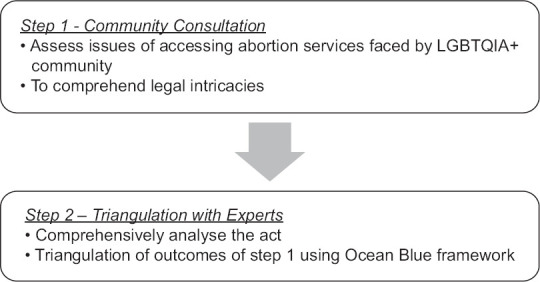
Diagrammatic representation of the method applied
Step 1 - Community Consultation: A community consultation was conducted to understand the challenges faced by the LGBTQIA+ community in accessing abortion services in accordance with the MTP Act 2021. Assistance from an expert was sought to comprehend the intricacies of abortion laws. The consultation was carried out via a video call with six members each from the trans men, lesbian, non-binary, queer women, gay and trans women communities who were sexually active and in reproductive age groups.
Step 2 – Triangulation with Experts: A team of policy, public health, and legal experts from the community conducted a comprehensive analysis of the Act. The findings of step 1 were triangulated during the analysis.
To ensure a well-rounded approach, relevant stakeholders from the aforementioned communities were actively engaged in constructive discussions, providing their valuable insights and views on the Act. The results present the key findings from community consultation and discussion with experts and relevant stakeholders.
Result
The 2021 amendment broadens the scope of abortion even further by granting abortion rights to all eligible women including unmarried women, rape survivors and women with specific foetal abnormalities up to 24 weeks of pregnancy. The act continues to exclusively focus on cisgender heterosexual females and not on other ‘persons with uterus/uteri’. The findings of the research presented are derived using the Ocean Blue Framework in the following sections [Table 1].
Table 1.
Recommendation based on ocean blue framework
| Factors | Description | Recommendation |
|---|---|---|
| Non-inclusive Language | The MTP Act focuses on cisgender heterosexual women | Use gender-neutral terms to increase inclusivity in the act |
| Legal Constraints | Limitations in abortion criteria, lack of inclusivity in rap law | Expand eligibility criteria in abortion law and recognize sexual assault among LGBTQIA+community |
| Medical Constraints | Limited knowledge among health care providers and lack of LGBTQIA+friendly health care providers | Training and sensitization of healthcare provider on LGBTQIA+community and their needs |
| Social Constraints | Stigma and discrimination against LGBTQIA + individuals | Create awareness through culturally appropriate advocacy and educate the public |
| Lack of inclusivity in reporting systems | The absence of inclusion in LGBTQIA + reporting systems hinders the understanding of their needs thereby policy development | Include indicators addressing the needs of the LGBTQIA + community in the existing government health reporting and monitoring systems |
| Regulatory Constraints | Lack of transparency and inclusivity among the healthcare professionals and community members on the board thereby creating a biased environment | Ensure designating healthcare providers with appropriate expertise and including community representatives in the process |
| Decision-Making for Abortion | The unsaid need for having a cisgender male partner | Expanding the idea of family and partner beyond cisgender relationships making it open and inclusive of other types relations |
Non-inclusive language
The experts highlighted the language used in legislation, which predominantly focuses on a hetero-normative perspective by exclusively referring to ‘pregnancy’, for instance, ‘[T] he pregnant woman or of grave injury to her physical or mental health…’ and ‘[T] he pregnant woman to have been caused by rape…’[9] while neglecting to include gender-neutral terminology and certain pronouns. As the legal provisions under the MTP Act focus on cisgender heterosexual women, it is non-inclusive of LGBTQIA+ individuals thus leading to their further marginalization in accessing healthcare services.
Legal constraints
The MTP Amendment Act of 2021 maintains the fundamental structure of the existing law. In other words, unless the termination adheres to the guidelines outlined in the MTP Act, abortion remains illegal, even for a cisgender woman. This implies that the woman requesting the abortion as well as the service provider could face legal consequences under the Bharatiya Nyaya Sanhita (BNS) unless the abortion is performed in accordance with the Act’s specifications. If a woman decides not to take a pregnancy to term, she does not have the right to an abortion[17] thereby establishing that while abortion may be legal, it is not yet a woman’s right. In relation to the Amended Act of 2021, amidst ongoing discussions about pregnancy challenges, a community participant during consultation has remarked that ‘if the situation is so dire for cis-gender heterosexual female, given the challenges faced by individuals belonging to non-conforming sexualities and genders, it is contradictory to claim that healthcare systems adequately address the need for safer abortion services for LGBTQIA+ communities.’
The sexual assault/rape as eligibility criteria for allowing abortion under this act does not apply to non-binary, trans- and queer individuals due to limited inclusivity in Indian Penal Code Section 375 and 376, India’s rape law legislation.[18] The exclusion of queer inclusion in anti-sexual harassment laws (section 354 IPC, which discusses sexual offences such as rape and elaborates on what exactly falls under this category, as well as circumstances, and POSH Act; a 2013 Indian governmental law designed to combat workplace sexual harassment experienced by women) exacerbates the problem. The POSH Act is especially pertinent to the subject of abortion access because it provides a framework for understanding the difficulties that LGBTQIA + people confront in finding safe and legal abortion services. Because the Act does not recognize same-gender harassment or harassment of transgender people, LGBTQIA + people who are sexually attacked may not have the same legal protections and support as women. Consequently, acts of sexual harassment committed by men against other men or transgender persons often go unpunished, leaving lesbians, gays, and transgenders outside the protective scope of these laws.[19] Therefore, while efforts have been made to ensure safe abortion services in India through legislative amendments, certain marginalized groups, such as the LBTQIA+ community, still face challenges when seeking legal and secure abortion options. The medico-legal framework provides a lens through which the complex dynamics of abortion laws, public health, and human rights can be analysed, emphasizing the need for comprehensive and inclusive approaches to address the issue of unsafe abortions.
Medical constraints
The community consultation disclosed various medical hindrances that acted as significant barriers for LGBTQIA+ individuals in accessing safe and legal abortion services. The absence of LGBTQIA+-friendly healthcare providers was cited as one of the major challenges. This results in limited access to accurate information about reproductive health and rights, as well as a lack of appropriate medical services. ‘Since the doctor aren’t aware of the transgender physiology it’s very difficult to make them understand about our situation, they make uncomfortable remarks and ask unnecessary question’ commented a trans community representative. Another member asserted that in India, many healthcare providers lack the necessary knowledge and training to offer culturally sensitive care to LGBTQIA+ individuals, including those seeking abortions. ‘The doctors look confused when I go for a check-up as transman with women’s reproductive organ’, mentioned another community representative. Moreover, the stigma and discrimination faced by LGBTQIA+ individuals in India can further impede their access to abortions.[20] They often encounter discrimination and violence in their daily lives, which can be particularly pronounced within healthcare settings. As a result, LGBTQIA+ individuals may struggle to seek care, including safe and legal abortions, due to the fear of being judged or harassed.
Social constraints
The Transgender Persons (Protection of Rights) Act (2019),[21] gave individuals the right to self-identify themselves as transgender. This means the person does not have to necessarily undergo sex reassignment surgeries. Consequently, these populations can still have all or some primary sexual organs: ovaries, uterus, vagina, penis, and testes or secondary sex characteristics: body hair and beard, etc. This makes these individuals completely capable of normal pregnancy process.
The fact that lesbians, bisexual women, and transgenders-transmen (LBT), intersex, gender non-confirming individuals, and non-binary population who have sexual organs since birth is capable of conception has not been taken into consideration and there is a need for safer abortion services for this population. Even though, this amendment promises broadened avenues for safer abortion for cisgender heterosexual females, this revised version is less aware of the increasing need and demand for abortion services in India’s LGBTQIA+ populations. Discrimination and stigma against LGBTQIA+ individuals in healthcare settings are a major barrier to accessing safe and legal abortions. LGBTQIA+ individuals may be afraid to seek medical care due to the risk of discrimination or even violence and may be reluctant to disclose their sexual orientation or gender identity to healthcare providers. This can lead to delayed or inadequate medical care, including access to safe and legal abortions. Non-binary, transgender, and queer people are not covered by the sexual assault/rape eligibility requirements for abortion under this act because rape statutes do not include the population despite a higher incidence of sexual harassment.
Lack of inclusivity in reporting systems
So far, no comprehensive analysis has been conducted to ascertain whether the revision of this act in India encompasses inclusive reporting measures. During the literature review, it was observed that LGBTQIA+ individuals are often ignored in health data reporting systems and surveys such as the Health Management Information System (HMIS), National Family Health Survey (NFHS) or even the Census. The absence of inclusion in LGBTQIA+ reporting systems is a significant impediment to identifying their health needs and implementing appropriate policies and laws. There is currently no comprehensive data-gathering system in place to measure abortion rates or abortion-related factors for LGBTQIA+ people. This is despite the fact that the Union of India declared transgenders to be a third gender in 2014. The present binary approach to data gathering ignores the variety of the LGBTQIA+ group and their health factors. This makes understanding the specific requirements of this community and developing inclusive policies and regulations difficult. An absence of data on LGBTQIA+ health issues is especially concerning in the field of sexual and reproductive health. This is because LGBTQIA+ people are more likely to experience sexual and reproductive health issues, such as sexually transmitted illnesses and undesired pregnancies. It is critical to increase reporting systems in these areas to better understand the health needs of LGBTQIA+ individuals and build appropriate policies and regulations. This would entail gathering information on LGBTQIA+ people’s health as well as their social, behavioural, and economic circumstances.
Regulatory constraints
The ‘Medical Board’ deciding the fate of abortion is constituted using an institutional approach with no community representation. There is also no psychiatrist or psychologist on the board who would assess the mental health of the person seeking an abortion. It is of paramount importance to understand that when there is limited understanding of sex, gender and sexuality even in health professionals, individual biases may lead to denial and delay in decision-making for an LGBTQIA+ person needing abortion services.
Decision making for abortion
The unsaid requirement of a cisgender man as an ‘attending and decision-making partner’ to avail these services and ‘single’ status pregnancy poses a significant challenge to delivering LGBTQIA+ inclusive abortion services. This further keeps nonbinary individuals, transgenders, and individuals with gender non-confirming identities out of the purview to access safe abortion as they mostly would not have a ‘cisgender man as an attending partner’. The Medical Termination of Pregnancy Act (Amendment) Act 2021 specifies ‘a pregnancy may be terminated by a registered medical practitioner’. However, there is no legal recognition of these individuals and acceptance of such people in India; this can make it difficult for them to access healthcare services, including safe and legal abortions, as healthcare providers may not be willing to provide care to individuals whose gender identity does not match their legal identification documents, forcing them to seek abortion from crooks, who may do more harm than good.
Discussion and Conclusion
India has made significant progress on LGBTQI rights in the form of the NALSA, Section 377 as well as progressive judgements pronounced by various high courts. As the LGBTQIA+ communities are increasingly becoming vocal and demanding their health rights, it becomes imperative that we make the existing MTP Act inclusive towards them. To ensure that the act is more inclusive towards non-cisgender individuals for accessing safe and legal abortions in India, it is important to address the legal barriers. Based on the problems encountered when trying to get secure abortion services, it is necessary for general practice physicians to have in mind those experienced by LGBTQIA+ persons, such as using non-inclusive language or the absence of legal protection by the LGBTQIA+ community. Such understanding is vital if we are truly going to have an accepting non-judgmental climate for all patients. It is essential for suitable provision of healthcare that health workers undergo training and are educated on matters to do with LGBTQIA+ health.
With the implementation of suggestions given in the document, it is possible for general practitioners to campaign for revision of policies, encourage gender-neutral language in medical records and take part in forming comprehensive health statistics. To work towards achieving WHO’s aim of ‘health for all’, policy changes are a must. The other social and structural barriers can only be overcome by increasing awareness, education and access to resources and healthcare services. These changes and actions will ensure that while the citizens of India LGBTQIA + can make informed decisions about their reproductive health, the healthcare systems would also be stigma and discrimination-free in addition to being affordable and accessible. Towards achieving this goal, the Indian LGBTQIA+ community can play a key role in shaping policies for LGBTQIA+ inclusive abortion services.
Conflicts of interest
There are no conflicts of interest.
Funding Statement
Nil
References
- 1.World Health Organization. World Health Organization. World Health Organization; 2021. Abortion. [Google Scholar]
- 2.Potts M, Diggory P. Abortion. Cambridge University Press; 1977. [Google Scholar]
- 3.World Health Organization. The prevention and management of unsafe abortion: Report of a technical working group, Geneva, 12-15 April 1992 (No WHO/MSM/92.5. Unpublished) World Health Organization; 1993. [Google Scholar]
- 4.Say L, Chou D, Gemmill A, Tunçalp Ö, Moller AB, Daniels J, et al. Global causes of maternal death: A WHO systematic analysis. Lancet Glob Health. 2014;2:e323–33. doi: 10.1016/S2214-109X(14)70227-X. [DOI] [PubMed] [Google Scholar]
- 5.Singh S, Maddow-Zimet I. Facility-based treatment for medical complications resulting from unsafe pregnancy termination in the developing world, 2012: A review of evidence from 26 countries. BJOG. 2015;123:1489–98. doi: 10.1111/1471-0528.13552. [DOI] [PMC free article] [PubMed] [Google Scholar]
- 6.Ganatra B, Gerdts C, Rossier C, Johnson BR, Tunçalp Ö, Assifi A, et al. Global, regional, and subregional classification of abortions by safety, 2010–14: Estimates from a Bayesian hierarchical model. Lancet. 2017;390:2372–81. doi: 10.1016/S0140-6736(17)31794-4. [DOI] [PMC free article] [PubMed] [Google Scholar]
- 7.The Medical Termination of Pregnancy Act, 1971 Act No. 34 of 1971, India Code [Google Scholar]
- 8.The Medical Termination of Pregnancy (Amendment) Bill, 2020. PRS Legislative Research [Google Scholar]
- 9.The Gazette of India Extraordinary;The Medical Termination of Pregnancy (Amendment) Act, 2021, Page 2. PRS Legislative Research [Google Scholar]
- 10.Belfrage M. Revolutionary pills? Feminist abortion, pharmaceuticalization, and reproductive governance. Int Fem J Polit. 2023;25:6–29. [Google Scholar]
- 11.Berer M. National laws and unsafe abortion: The parameters of change. Reprod Health Matters. 2004;12:1–8. doi: 10.1016/s0968-8080(04)24024-1. [DOI] [PubMed] [Google Scholar]
- 12.Steensma TD, Kreukels BP, de Vries AL, Cohen-Kettenis PT. Gender identity development in adolescence. Horm Behav. 2013;64:288–97. doi: 10.1016/j.yhbeh.2013.02.020. [DOI] [PubMed] [Google Scholar]
- 13.Jones RK, Jerman J, Charlton BM. Sexual orientation and exposure to violence among U. S. patients undergoing abortion. Obstet Gynecol. 2018;132:605–11. doi: 10.1097/AOG.0000000000002732. [DOI] [PMC free article] [PubMed] [Google Scholar]
- 14.Moseson H, Fix L, Gerdts C, Ragosta S, Hastings J, Stoeffler A, et al. Abortion attempts without clinical supervision among transgender, nonbinary and gender-expansive people in the United States. BMJ Sex Reprod Health. 2022;48:e22–30. doi: 10.1136/bmjsrh-2020-200966. [DOI] [PMC free article] [PubMed] [Google Scholar]
- 15.Chandra A, Shree S, Satish MSM. Legal barriers to accessing sage abortion services in India: A fact finding study. 2021 [Google Scholar]
- 16.Sinha B. ‘Pregnant person’—not just women, trans men and others can also be with child, says Supreme Court. The Print. 2024 [Google Scholar]
- 17.THE INDIAN PENAL CODE, 1860 [Google Scholar]
- 18.Ghosh A. The inclusion of queer identities in the Indian anti-sexual harassment laws. Legal Service India-Law, Lawyers and Legal Resources [Google Scholar]
- 19.Handbook on Sexual Harassment of Women at Workplace (Prevention, Prohibition and Redressal) Act 2013, for Employers/Institutions/Organisations/Internal Complaints Committee/Local Complaints Committee, Government of India, Ministry of Women and Child Development. 2015 [Google Scholar]
- 20.The Legal Services Authorities Act, 1987. 2019. Available from: nalsa.gov.in .
- 21.The Transgender Persons (Protection of Rights) Act, 2019, Chapter III, Section 4, Subsection 2. India Code, Digital Repository of Law – A System of Laws for Communication. 2019 [Google Scholar]