



Bilevel erector spinae plane block at the third and fifth thoracic vertebrae reduces incision pain and pain in axilla in patients with cancer undergoing modified radical mastectomy.
Keywords: ESPB, Morphine, Cancer, Breast, Analgesia, Pain
Abstract
Introduction:
Management of pain associated with breast cancer surgeries is crucial in reducing incidence of postmastectomy pain syndrome. The pain distribution involves the anterior chest wall, axillary area and ipsilateral upper limb.
Objective:
This study was designed to investigate the effect of bilevel erector spinae plane block (ESPB) with high thoracic block vs the conventional unilevel ESPB vs opioids in patients with cancer undergoing modified radical mastectomy regarding pain control and reducing pain in axilla.
Methods:
One hundred twenty-six female patients with cancer and American Society of Anesthesiology II, III were randomized into 3 groups: bilevel ESPB, unilevel ESPB, and control group. The primary outcome was total postoperative morphine consumption.
Results:
Total postoperative morphine consumption was higher for the control group compared with the bilevel and unilevel groups (5.5 ± 1.8 vs 3.0 ± 0.0 and 4.3 ± 1.6 mg, P = 0.038). First time to receive morphine was longer for bilevel and unilevel groups compared with the control group (20.7 ± 3.1 and 17.7 ± 4.1 vs 8.2 ± 5 hours, P < 0.001). There was 96.1% and 90.3% reduction in morphine intake with odds ratio 25.6 (95% confidence interval [CI]: 6.6–100) and 10.3 (95% CI: 3.7–28.6) for the bilevel and unilevel groups compared with the control group. There was 98.5% and 65.4% reduction in the incidence of pain in axilla with odds ratio 66.6 (95% CI: 16.9–250) and 21.7 (95% CI: 6.75–66.6) for the bilevel and unilevel groups compared with the control group. Postoperative visual analog scale was lower for the bilevel group after 2, 4, and 24 hours compared with both the control group and the unilevel groups, P < 0.005.
Conclusion:
Both conventional unilevel and high thoracic bilevel ESPB had better analgesic profile when compared with opioids. Although the bilevel ESPB had additional merits to the unilevel ESPB in analgesic effects, both can be used effectively.
1. Introduction
The incidence of breast cancer has increased over the last years with over 2 million newly diagnosed cases till 2020.22 The higher incidence might be related to the increased awareness and early screening.3,10 Several modalities are implemented in the management of patients with breast cancer including chemotherapy, radiotherapy, hormonal therapy, and surgery. Surgical options include either radical excision of the breast with or without axillary lymph nodes evacuation or conservative management.18
Acute postoperative pain is considered as one of the risk factors for development of chronic postmastectomy pain syndrome following breast surgeries.4 The pain distribution usually involves the anterior chest wall, axillary area, and the ipsilateral upper limb.4 Various modalities including pharmacological and nonpharmacological approaches have been used for proper control and prevention of perioperative pain associated with breast surgeries.17,24 Multimodal approach for pain control can result in better analgesia. In recent years, regional blocks have evolved as more favored approach for perioperative pain control.19
Regional blocks for breast surgeries include thoracic epidural, paravertebral block, and interfascial blocks as pectoral nerve block (PECS), serratus anterior plane block, and erector spinae plane block (ESPB).7,15 The use of ultrasound in performing regional wall blocks facilitated and improved their results.13 Ultrasound-guided interfascial blocks carry a promising role in perioperative pain control in the thoracic region owing to the merits of easy performance, the possibility of catheter insertion, and lower complication risks.6,7
Since first introduced by Forero et al.,9 ESPB has gained increased popularity in different surgeries involving the thoracic region.11,26 The erector spinae group of muscles lie in the paraspinal gutter on both sides of the vertebral column starting from the base of the skull down to the pelvis and is formed of a group of muscles; the spinalis, longissimus, and the iliocostalis arranged from medial to lateral.14
The analgesic effect of ESPB depends on the craniocaudal spread of local anesthetic through the costovertebral foramina and epidural space.20 It spreads between the erector spinae muscle and the transverse process to achieve analgesia through blocking the ventral and dorsal rami of the spinal nerves.9 This spread results in analgesia of the ipsilateral hemithorax covering the anterior, lateral, and posterior chest wall.2
Recently, bilevel ESPB was introduced offering a better analgesic profile for breast surgeries.1 Performing the ESPB at 2 levels might increase the analgesic efficacy of the block and help in providing analgesia to the anterolateral chest wall region as well as to the axillary region.1 The aim of this study was to compare bilevel ESPB and unilevel ESPB vs opioids in patients undergoing modified radical mastectomy for breast cancer regarding pain control, reducing pain in the axilla and possible side effects.
2. Methodology
This double-blinded (Intraoperative investigator, Outcomes Assessor), parallel, prospective randomized controlled trial was conducted at the National Cancer Institute, Cairo Egypt, from June 2022 to December 2023 after Institutional Review Board approval (2205-501-007) and clinical trial registration (NCT05429489) at ClinicalTrials.gov. The study was done after obtaining a written informed consent and followed the Declaration of Helsinki.
2.1. Sample size
Sample size was estimated based on the previous work by Aksu et al.1 and Elsabeeny et al.8 The morphine consumption was reported to be 3.02 ± 2.06 for the bilevel group and 4.20 ± 1.64 mg for the unilevel group, respectively. The reported difference in total morphine consumption was 1.18 ± 1.85 mg, using a power of 80% and 5% significance level; at least 40 patients were required in each group. Sample size was calculated by PS: power and sample size calculation software Version 3.1. 2 (Vanderbilt University, Nashville, TN). The number of recruited patients was increased by 15% for compensation of any possible attrition.
2.2. Statistical analyses
Data were analyzed using IBM Statistical Package for Social Sciences (SPSS) advanced statistics, version 27 (SPSS, Inc, Chicago, IL). Numerical data were expressed either in the form of mean and standard deviation or in the form of median and range as needed. Normality of data was assessed by Kolmogorov–Smirnov test or Shapiro–Wilk test. Comparative analysis for normally distributed numerical variables between 3 groups was conducted using the analysis of variance, followed by Bonferroni post hoc test while for non-normally distributed numeric variables, it was done by Kruskal–Wallis test, followed by Dunn test. Categorical data were expressed in the form of numbers and percentages while comparisons were done by the chi square test. Odds ratio and its corresponding confidence interval (CI) were calculated. A P-value less than or equal to 0.05 was considered statistically significant. The tests used were 2-tailed.
2.3. Inclusion and exclusion criteria
Patients were assessed for eligibility in the preoperative anesthesia clinic. After assessment for the eligibility, 138 female patients scheduled for breast surgeries (modified radical mastectomy), within the age from 18 to 65 years, American Society of Anesthesiology (ASA) II-III were enrolled into the study. Patients with impaired coagulation profile, low platelet count, impaired kidney or liver functions, bony metastases, and systemic or local infection were excluded.
2.4. Randomization and concealment
In the holding area, patients fulfilling eligibility criteria were allocated in a 1:1 ratio into the ESPB unilevel group (n = 40), bilevel ESPB group (n = 40), and control group (n = 40) based on computer-generated randomization codes kept in sealed envelopes. These envelopes were provided to the anesthetist in charge of performing the block by an investigator that was not involved in patient care.
Patients enrolled in the unilevel and bilevel groups received preoperative ultrasound-guided ESPB on the ipsilateral side of the operation, at the level of fifth thoracic vertebra and at the level of third and fifth vertebrae, respectively. The anesthesiologist who collected data was blinded to the intervention done.
2.5. Outcomes
The primary outcome was set as the total postoperative morphine consumption in the first 24 hours. Secondary outcomes were pain in axilla, perioperative hemodynamics, visual analog scale (VAS) scores, Ramsay Sedation Scale scores, first time to receive morphine, percentage of patients who required rescue intraoperative fentanyl, postoperative morphine and ketorolac, and any possible side effects.
2.6. Anesthetic consideration
In the holding area, eligible patients were recruited, and standard ASA monitoring was connected (electrocardiogram) ECG, noninvasive automated blood pressure, and pulse oximetry). After routine patient examination and assessment of the investigations, an intravenous line was inserted, and patients received 2 mg intravenous midazolam.
2.7. Study interventions
Unilevel and bilevel groups: Before induction of general anesthesia, patients were positioned in the sitting position leaning forward. Unilevel group: The fifth vertebral spinous process was first identified, and then, the block area was adequately sterilized and draped. Bilevel group: The third and fifth vertebral spinous processes were first identified, and then, the block area was adequately sterilized and draped. The block was done as needed using either a high frequency linear probe (6–13 MHz) or a curved (2–5 MHz) probe of SonoSite (M-Turbo: FUJIFILM SonoSite-inc., Bothel, WA) ultrasound machine. The probe was used to identify the hyperechoic transverse process shadow at approximately 1.5 to 2 cm distance from the spinous process deep to the trapezius, rhomboid major, and erector spinae muscles at the third, fifth vertebrae. Then, an 18-gauge epidural needle was inserted in a cephalad-to-caudad direction to reach the transverse process deep to the erector spinae muscle. Correct positioning of the needle was confirmed through real-time visualization of 2-mL saline hydro dissection at the fifth vertebra for the unilevel group and at both the third and fifth vertebrae for the bilevel group.
After confirmation of needle position, the unilevel group: 30 mL of bupivacaine 0.25% was injected and the bilevel group: 15 mL of bupivacaine 0.25% was injected at each level. The block was assessed using a light pinprick test to ensure block adequacy after 20 minutes from injection of the local anesthetics. The block was assessed on a 3-point scale compared with the contralateral side: 2 = Full equal sensation, 1 = Decreased sensation, 0 = No sensation. In case of block failure defined as the presence of full sensation after 30 minutes, patients were excluded from the study. Control group: Patients underwent induction of general anesthesia, and then, intraoperative analgesia was attained using intravenous morphine sulfate 0.1 mg/kg.
2.8. Intraoperative
In the operating theater, patients were monitored using the standard ASA monitors, and then, induction of anesthesia was held using propofol 2 mg/kg, fentanyl 2 µg/kg, and rocuronium 0.6 mg/kg to facilitate tracheal intubation. A masked 10-mL syringe (prepared by anesthesia resident not involved in the study) with 0.1 mg/kg morphine for the control group and 10-mL saline for the other 2 groups was used. Anesthesia was maintained using inhalational anesthesia and top-up rocuronium doses as needed. Intraoperative analgesia was achieved using fentanyl, in the form of 25-µg boluses, in case of increase in baseline heart rate or blood pressure values after exclusion of inadequate anesthesia. In the postoperative anesthesia care (PACU), all patients were assessed for their VAS scores, Ramsay Sedation Scale scores, and hemodynamics. Ramsay Sedation Scale was assessed on a scale from (1–6) (Table 1). Postoperative analgesic protocol included using paracetamol 1 g every 8 hours for all the patients, ketorolac tromethamine 30 mg if VAS score was reported to be 3. If VAS score reported to be ≥4, morphine sulfate was given as a bolus of 3 mg, which was repeated as needed to control pain in a dose not exceeding 0.1 mg/kg per dose.
Table 1.
Ramsay Sedation Scale.
| Score | Interpretation |
|---|---|
| 1 | Anxious and or agitated |
| 2 | Oriented, cooperative, and tranquil |
| 3 | Responds to commands |
| 4 | Brisk response to light glabellar tap or loud auditory stimulus |
| 5 | Sluggish response to light glabellar tap or loud auditory stimulus |
| 6 | No response to stimulus |
3. Results
Data from 126 patients were included and analyzed in this study (Fig. 1). There was no significant difference between the groups in their demographic data and clinical characteristics except for duration of the block where bilevel block duration was longer than the unilevel block duration (14.2 ± 1.1 and 12.5 ± 1.4 minutes, respectively), which was of statistical significance P < 0.001 but of no clinical significance (Table 2).
Figure 1.
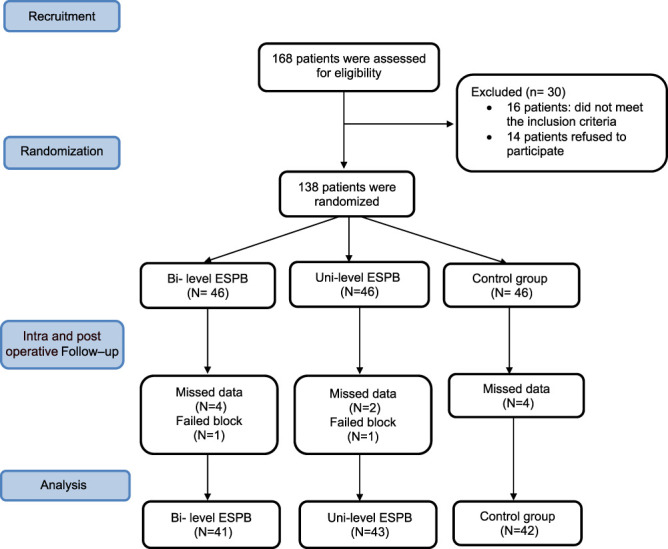
Consort flow diagram. ESPB, erector spinae plane block.
Table 2.
Demographic data, clinical characteristics, and duration of surgery and procedure.
| Bilevel, N = 41 (%) | Unilevel, N = 43 (%) | Control, N = 42 (%) | P | |
|---|---|---|---|---|
| Age (y) | ||||
| Mean ± SD | 49.8 ± 11 | 50.7 ± 11.6 | 49 ± 11.3 | 0.792 |
| Range | 24–65 | 25–65 | 24–65 | |
| BMI (kg/m2) | ||||
| Mean ± SD | 26.5 ± 2.5 | 26.9 ± 2.8 | 26.2 ± 1.9 | 0.433 |
| Range | 21.5–32.0 | 22.5–32.0 | 23.0–32.0 | |
| CTH | ||||
| Yes | 16 (39.0) | 21 (48.8) | 20 (47.6) | 0.619 |
| Comorbidity | ||||
| Yes | 16 (39.0) | 21 (48.8) | 21 (50.0) | 0.545 |
| Type of comorbidity* | ||||
| HTN | 12 (29.3) | 16 (37.2) | 16 (38.1) | 0.650 |
| DM | 9 (22.0) | 11 (25.6) | 14 (33.3) | 0.489 |
| Anti HTN drug | ||||
| ACE I | 2 (16.7) | 2 (12.5) | 1 (6.3) | NA |
| ARBS | 2 (16.7) | 2 (12.5) | 1 (6.3) | |
| BB | 7 (58.3) | 7 (43.8) | 7 (43.8) | |
| CCB | 1 (8.3) | 3 (18.8) | 4 (25.0) | |
| Diuretics | 0 (0.0) | 2 (12.5) | 3 (18.8) | |
| Surgery duration (min) | ||||
| Mean ± SD | 127.7 ± 13.5 | 124.5 ± 14.8 | 122.9 ± 14.5 | 0.300 |
| Procedure time (min) | ||||
| Mean ± SD | 14.2 ± 1.1 | 12.5 ± 1.4 | NA | <0.001 |
Patients experience multiple comorbidities at the same time.
ACE, angiotensin-converting enzyme inhibitor; ARBS, angiotensin receptor blocker; BB, beta blocker; BMI, body mass index; CCB, calcium channel blocker; CTH, chemotherapy; DM, diabetes mellitus; HTN, hypertension; NA, not applicable.
The results for comparison of perioperative hemodynamic measurements for the groups showed no difference in heart rate values throughout the study time, P > 0.05. However, the mean arterial blood pressure values were significantly lower for the bilevel group compared with the control group throughout the intraoperative and postoperative period, P < 0.05. In addition, the bilevel group had significantly lower mean arterial blood pressure values compared with the unilevel group throughout the intraoperative and postoperative period, P < 0.05, except for the first 30 minutes intraoperative and after 120 minutes, P > 0.05 (Figs. 2 and 3).
Figure 2.
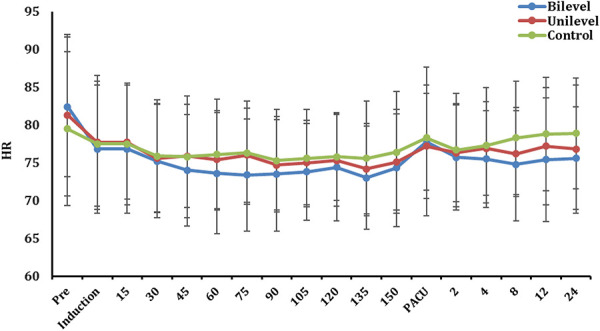
Perioperative heart rate values for the 3 groups.
Figure 3.
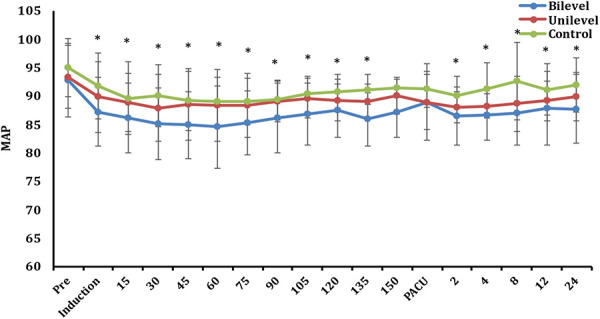
Perioperative mean arterial blood pressure values for the 3 groups. MAP, mean arterial blood pressure; PACU, postoperative anesthesia care.
Three patients (9.5%) in the control group needed intraoperative rescue fentanyl vs 3 (7.3%) and 4 patients (9.3%) in the bilevel and unilevel groups, respectively, P = 1.000 (Table 3). Table 4 presents that in PACU, the level of sedation was higher for the control group compared with the other 2 groups, P < 0.001, with no significant difference between the unilevel and bilevel groups P = 0.910.
Table 3.
Pain in axilla, ketorolac, morphine, fentanyl intake, postoperative nausea, and vomiting.
| Bilevel, N = 41 (%) | Unilevel, N = 43 (%) | Control, N = 42 (%) | OR (95% CI), bilevel/control | OR (95%CI), unilevel/control | P | |
|---|---|---|---|---|---|---|
| Pain in axilla | 4 (9.8) | 11 (25.6) | 37 (88.1) | 66.6 (16.9–250) | 21.7 (6.75–66.6) | <0.001 |
| Ketorolac intake | 5 (12.2) | 13 (30.2) | 22 (52.4) | 7.4 (2.6–24.4) | 2.5 (1–6.17) | <0.001 |
| Morphine intake | 3 (7.3) | 7 (16.3) | 28 (66.7) | 25.6 (6.6–100) | 10.3 (3.66–28.6) | <0.001 |
| Fentanyl intake | 3 (7.3) | 4 (9.3) | 3 (9.5) | 1.3 (0.27–8) | 1 (0.24–4.4) | 1.000 |
| PONV | 1 (2.4) | 5 (11.6) | 10 (23.8) | 12.5 (1.5–100) | 2.37 (0.73–7.7) | 0.013 |
P < 0.05 is statistically significant.
CI, confidence interval; OR, odds ratio; PONV, postoperative nausea and vomiting.
Table 4.
Ramsay sedation score.
| Bilevel | Unilevel | Control | P | |
|---|---|---|---|---|
| Median (range) | Median (range) | Median (range) | ||
| RSS PACU | 2 (2–3) | 2 (2–3) | 4 (2–4)* | <0.001 |
P < 0.05 is statistically significant, analysis done by the Kruskal–Wallis test followed by the Dunn test.
Control is statistically significant from the other 2 groups.
PACU, postoperative anesthesia care; RSS, Ramsay Sedation Scale.
Postoperative VAS scores were comparable between the 3 groups in PACU, after 8 and 12 hours, P > 0.05. After 2, 4, and 24 hours, the bilevel group had lower VAS scores compared with both the control group and the unilevel groups, P < 0.05, while the control group and the unilevel groups had comparable values at the same time points, P > 0.05 (Fig. 4).
Figure 4.
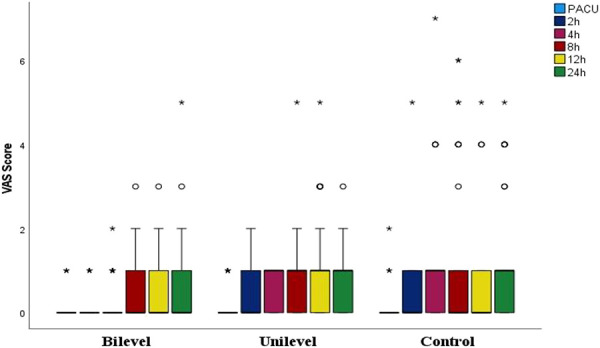
Postoperative VAS scores. PACU, postoperative anesthesia care; VAS, visual analog scale.
Percentage of patients who experienced pain in the axilla in the bilevel group was only 9.8% of participants (4 of 41) compared with 25.6% of the unilevel group (11 of 43) and both were statistically lower than the control group, 88.1% (37 of 42), P < 0.001. There was 98.5% reduction in patients who sensed pain in axilla for the bilevel group compared with 65.4% reduction for the unilevel group in comparison with the control group (Tables 3 and 5). Furthermore, Table 3 presents that the odds of experiencing pain in the axilla were 66.6 times higher in the control group compared with the bilevel group, with a wide range of uncertainty (95% CI: 16.9–250). Similarly, the odds of experiencing pain in the axilla were 21.7 times higher in the control group compared with the unilevel group (95% CI: 6.8–66.6), with no significant difference between the unilevel and bilevel groups, P = 0.058.
Table 5.
Percent reduction.
| % reduction | |
|---|---|
| Pain in axilla | |
| Bilevel | 98.5 |
| Unilevel | 65.4 |
| Ketorolac intake | |
| Bilevel | 87.4 |
| Unilevel | 60.6 |
| Morphine intake | |
| Bilevel | 96.1 |
| Unilevel | 90.3 |
The percentage of patients who needed morphine was significantly higher for the control group compared with the unilevel and bilevel groups (66.7 vs 16.3 and 7.3%), respectively, P < 0.001. While there was no difference between the bilevel and unilevel groups, P = 0.205. There was a 96.1% reduction in morphine intake for the bilevel group compared with the control group with an odds ratio 25.6 and a wide range of uncertainty (95% CI: 6.6–100) while the reduction in morphine intake in the unilevel group compared with the control group showed to be 90.3% with odds ratio 10.3 (95% CI: 3.7–28.6) (Tables 3 and 5). Table 6 shows significant difference in total morphine consumption between groups being 5.5 ± 1.8 for the control group compared with the unilevel and bilevel groups (4.3 ± 1.6 and 3.0 ± 0.0), respectively, P = 0.039, with significant difference between the bilevel group and control group, P = 0.026.
Table 6.
First time to receive morphine and total morphine consumption.
| Bilevel | Unilevel | Control | ||
|---|---|---|---|---|
| Mean ± SD | Mean ± SD | Mean ± SD | P | |
| First time to receive morphine (h) | 20.7 ± 3.1 | 17.7 ± 4.1 | 8.2 ± 5* | <0.001 |
| Total morphine (mg) | 3.0 ± 0.0 | 4.3 ± 1.6 | 5.5 ± 1.8* | 0.038 |
P < 0.05 is statistically significant, analysis done by one way analysis of variance, followed by Bonferroni post hoc test.
Control is statistically significant from other groups.
In the first 8 hours postoperatively, no patients required morphine in either the unilevel or the bilevel group vs 24 patients (85.7%) in the control group (Fig. 5). First time to receive morphine was significantly longer for the bilevel compared with both the unilevel and control groups (20.7 ± 3.1 vs 17.7 ± 4.1 and 8.2 ± 5 hours, respectively) P < 0.001 (Table 6).
Figure 5.
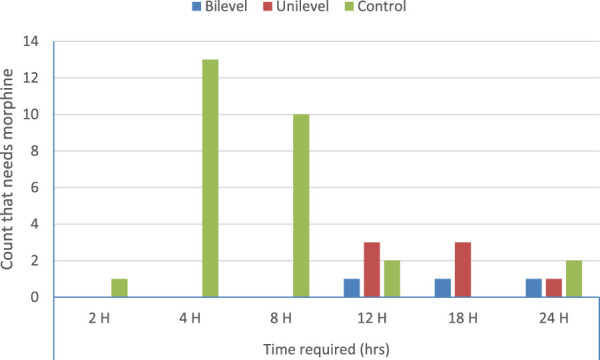
Number of patients who needed morphine over the study time points.
Tables 3 and 5 presents that the percentage of patients who received ketorolac was 12.2% (5 of 41) for the bilevel group and 30.2% (13 of 43) for the unilevel group. Both showed statistically lower values compared with the control group, 52.4% (22 of 42), P < 0.001. In the bilevel group, there was 87.4% reduction in ketorolac consumption compared with the control group with an odds ratio of 7.4 (95% CI: 2.6–24.4). Whereas for the unilevel group, there was a 60.6% reduction in consumption compared with the control group with an odds ratio of 2.5 (95% CI: 1–6.2). A significant difference was noticed between the 3 groups which was imminent when comparing the bilevel group with the control group, P < 0.001, while was of borderline significance when comparing the unilevel group with the bilevel group, P = 0.044, and P = 0.038 for the unilevel group compared with the control group.
There were no reported cases of drug or block-related side effects. However, in Table 3, it was observed that the incidence of postoperative nausea and vomiting showed significant difference between the 3 groups, P = 0.013, being higher for the control group compared with the bilevel group, P = 0.004.
4. Discussion
The breast region is innervated through thoracic spinal nerves T2 to T6; therefore, a unilevel ESPB can be considered efficient for analgesia of the breast region. However, additional nerve supply through the long thoracic nerve, medial and lateral pectoral nerves are involved in part of the breast region and the axilla; thus, blocking of nerve supply from C5 to T6 may be required to achieve full analgesic coverage of the breast and axillary areas.12
We assumed that for the bilevel group, the injection site at the level of third thoracic vertebrae may be safer than higher levels to avoid potential higher cervical spread. Moreover, we speculated that the injection of a volume of 30 mL might allow wider craniocaudal spread in the unilevel group and intensify the block. This study was performed to investigate whether performing ESPB at 2 levels would result in superior analgesic profile over unilevel block or not.
The results of this study revealed that there was a noticeable reduction in the incidence of pain in axilla for both the bilevel and unilevel groups compared with the control group. Similarly, both the bilevel and unilevel groups had lower incidence in their need for postoperative analgesics (morphine and ketorolac) compared with the control group. Total morphine consumption was reported to be higher for the control group compared with the bilevel group with no difference between the bilevel and unilevel groups. The first time to receive opioids was significantly longer for the bilevel group compared with the unilevel and control groups; in addition, the unilevel group had a statistically longer time compared with the control group. Accordingly, the results revealed that both unilevel and bilevel ESPB resulted in adequate perioperative pain control during breast surgeries with reduced postoperative need for analgesics when compared with opioids. In addition, the results showed that at some points, the bilevel group had lower postoperative pain scores when compared with both unilevel and control groups. It was noticed that bilevel block resulted in lower blood pressure values compared with the control group while there was no difference between the unilevel and the control group, which may be explained by the extended spread achieved by the 2-needle injection technique used in the bilevel block. However, although some of the results showed statistical differences between the bilevel and unilevel groups, the authors considered these differences of no clinical significance from their point of view.
In 2019, Can et al. introduced the idea of administering the erector spinae block at 2 levels to achieve additional analgesia during breast surgery. They documented that bilevel ESPB resulted in superior analgesia compared with no block anesthesia.1 Liu et al. studied the potential merits of bilevel ESPB in a patient with multiple rib fractures. They reported a noticeable analgesic effect of the bilevel technique with favorable effect on the patient prognosis.16
Furthermore, Altlparmak et al. investigated the possible result of applying bilateral bilevel ESPB in 2 breast cancer patients with multiple vertebral metastases. They reached a conclusion that bilateral bilevel ESPB can result in pain control that covers a wide dermatomal scale.2 However, a study conducted by Tuğcugil et al. reported that a unilevel ESPB was more efficient than bilevel ESPB in controlling pain following thoracotomy. They explained their results by the possibility of inadequate spread following the lower volume 10 mL used for each level of the bilevel vs the higher volume 20 mL bupivacaine they used in the unilevel.23
One of the merits of using bilevel block is the potential adequacy of block coverage. This point was addressed in a case report by Sinha et al. who assumed that bilevel ESPB could allow for wider craniocaudal spread in a patient with kyphosis undergoing spine correction surgery.21 We intended to use higher volume in the single injection to assess the effect of higher volume on extended craniocaudal spread and to compare it with the injection at 2 levels. However, although increasing the volume of local anesthetics resulted in favorable analgesic effects, injecting at 2 levels achieved wider craniocaudal spread which might be reflected by reduced incidence of pain in axilla with reduced need for postoperative analgesic requirements.
In another study, Cesur et al. compared the analgesic effects of modified PECS to bilevel ESPB in patients undergoing radical mastectomies. They stated that patients who received bilevel ESPB had favorable postoperative pain management compared with those who received PECS block.5 In a recent study conducted by Zengin et al., they reported that bilevel ESPB achieved superior earlier postoperative analgesia with lower VAS scores than unilevel block with no significant difference in morphine consumption in patients undergoing video-assisted thoracic surgeries.25 In accordance with the previous studies, our results showed that both unilevel and bilevel ESPBs carry more favorable analgesic effect when compared with no block. Interpretation of the study results showed that in clinical settings, analgesic efficacy can be considered comparable for both unilevel and bilevel ESPB.
5. Conclusion
Both bilevel and unilevel ESPB had a better postoperative analgesic profile when compared with opioids. However, this study showed that although the bilevel ESPB with high thoracic injection level had additional merits to the unilevel ESPB in perioperative analgesic effects, both can be considered of comparable clinical efficacy with less manipulation, needle site insertion, and, consequently, less potential hazardous effects and intervention time for the unilevel compared with the bilevel technique.
Disclosures
The authors have no conflicts of interest to declare.
Data availability: data generated will be available for 1 year through contacting the corresponding author upon reasonable request.
Institutional Review Board number: 2205-501-007.
Clinical trial registration: NCT05429489.
Footnotes
Sponsorships or competing interests that may be relevant to content are disclosed at the end of this article.
Contributor Information
Reham M. Fahmy, Email: Rehammahmoudamr@gmail.com.
Fatma H. Elshamy, Email: fatmaelshamy19@gmail.com.
Nahla N. Shehab, Email: nahla.shehab2@gmail.com.
Sayed M. Abed, Email: sydabed2020@outlook.com.
Walid S. Taha, Email: w_saad1968@yahoo.com.
Mostafa A. Ibrahim, Email: sydabed2020@outlook.com.
Ahmed F. Gad, Email: drfahmof@gmail.com.
References
- [1].Aksu C, Kuş A, Yörükoğlu HU, Tor Kiliç C, Gürkan Y. Analgesic effect of the bi-level injection erector spinae plane block after breast surgery: a randomized controlled trial. Agri 2019;31:132–7. [DOI] [PubMed] [Google Scholar]
- [2].Altlparmak B, Korkmaz M, Uysal AAH, Gumus Demirbilek S. Bi-level erector spinae plane block for the control of severe back pain related to vertebral metastasis. BMJ Case Rep 2019;12:2018–20. [DOI] [PMC free article] [PubMed] [Google Scholar]
- [3].Arnold M, Morgan E, Rumgay H, Mafra A, Singh D, Laversanne M, Vignat J, Gralow JR, Cardoso F, Siesling S, Soerjomataram I. Current and future burden of breast cancer: global statistics for 2020 and 2040. Breast 2022;66:15–23. [DOI] [PMC free article] [PubMed] [Google Scholar]
- [4].Capuco A, Urits I, Orhurhu V, Chun R, Shukla B, Burke M, Kaye RJ, Garcia AJ, Kaye AD, Viswanath O. A comprehensive review of the diagnosis, treatment, and management of postmastectomy pain syndrome. Curr Pain Headache Rep 2020;24:41. [DOI] [PubMed] [Google Scholar]
- [5].Cesur S, Aksu C, Güler SA, Kuş A. Modified pectoral nerve block versus bi-level erector spinae plane block for postoperative analgesia after radical mastectomy surgery: a prospective, randomized, controlled trial. Korean J Anesthesiol 2023;76:317–25. [DOI] [PMC free article] [PubMed] [Google Scholar]
- [6].Cheng GS, Ilfeld BM. An evidence-based review of the efficacy of perioperative analgesic techniques for breast cancer-related surgery. Pain Med 2017;18:1344–65. [DOI] [PubMed] [Google Scholar]
- [7].Chin KJ, Pawa A, Forero M, Adhikary S. Ultrasound-guided fascial plane blocks of the thorax: pectoral I and II, serratus anterior plane, and erector spinae plane blocks. Adv Anesth 2019;37:187–205. [DOI] [PubMed] [Google Scholar]
- [8].Elsabeeny WY, Shehab NN, Wadod MA, Elkady MA. Perioperative analgesic modalities for breast cancer surgeries: a prospective randomized controlled trial. J Pain Res 2020;13:2885–94. [DOI] [PMC free article] [PubMed] [Google Scholar]
- [9].Forero M, Adhikary SD, Lopez H, Tsui C, Chin KJ. The erector spinae plane block a novel analgesic technique in thoracic neuropathic pain. Reg Anesth Pain Med 2016;41:621–7. [DOI] [PubMed] [Google Scholar]
- [10].Grogan Fleege NM, Cobain EF. Breast cancer management in 2021: a primer for the obstetrics and gynecology. Best Pract Res Clin Obstet Gynaecol 2022;82:30–45. [DOI] [PubMed] [Google Scholar]
- [11].Guan HY, Yuan Y, Gao K, Luo HX. Efficacy and safety of erector spinae plane block for postoperative analgesia in breast cancer surgery—a systematic review and meta-analysis. J Surg Oncol 2023;127:905–20. [DOI] [PubMed] [Google Scholar]
- [12].He W, Wu Z, Zu L, Sun H, Yang X. Application of erector spinae plane block guided by ultrasound for postoperative analgesia in breast cancer surgery: a randomized controlled trial. Cancer Commun 2020;40:122–5. [DOI] [PMC free article] [PubMed] [Google Scholar]
- [13].Khemka R, Chakraborty A. Ultrasound-guided modified serratus anterior plane block for perioperative analgesia in breast oncoplastic surgery: a case series. Indian J Anaesth 2019;63:231–4. [DOI] [PMC free article] [PubMed] [Google Scholar]
- [14].Kot P, Rodriguez P, Granell M, Cano B, Rovira L, Morales J, Broseta A, De Andrés J. The erector spinae plane block: a narrative review. Korean J Anesthesiol 2019;72:209–20. [DOI] [PMC free article] [PubMed] [Google Scholar]
- [15].Kurdi M, Agrawal P, Thakkar P, Arora D, Barde S, Eswaran K. Recent advancements in regional anaesthesia. Indian J Anaesth 2023;67:63–70. [DOI] [PMC free article] [PubMed] [Google Scholar]
- [16].Liu R, Clark L, Bautista A. Unilateral bilevel erector spinae plane catheters for flail chest: a case report. A A Pract 2020;14:e01211. [DOI] [PubMed] [Google Scholar]
- [17].Maniker RB, Damiano J, Ivie RMJ, Pavelic M, Woodworth GE. Perioperative breast analgesia: a systematic review of the evidence for perioperative analgesic medications. Curr Pain Headache Rep 2022;26:299–321. [DOI] [PubMed] [Google Scholar]
- [18].Nardin S, Mora E, Varughese FM, D'Avanzo F, Vachanaram AR, Rossi V, Saggia C, Rubinelli S, Gennari A. Breast cancer survivorship, quality of life, and late toxicities. Front Oncol 2020;10:864. [DOI] [PMC free article] [PubMed] [Google Scholar]
- [19].Rao R, Jackson RS, Rosen B, Brenin D, Cornett W, Fayanju OM, Chen SL, Golesorkhi N, Ludwig K, Ma A, Mautner SK, Sowden M, Wilke L, Wexelman B, Blair S, Gary M, Grobmyer S, Hwang ES, James T, Kapoor NS, Lewis J, Lizarraga I, Miller M, Neuman H, Showalter S, Smith L, Froman J; American Society of Breast Surgeons: Patient Safety and Quality Committee, Research Committee. Pain control in breast surgery: survey of current practice and recommendations for optimizing management—American Society of Breast Surgeons Opioid/Pain Control Workgroup. Ann Surg Oncol 2020;27:985–90. [DOI] [PMC free article] [PubMed] [Google Scholar]
- [20].Schwartzmann A, Peng P, Maciel MA, Forero M. Mechanism of the erector spinae plane block: insights from a magnetic resonance imaging study. Can J Anesth 2018;65:1165–6. [DOI] [PubMed] [Google Scholar]
- [21].Sinha C, Kumar A, Kumar A, Kumari P, Agrawal P, Sk A. Two-level bilateral ultrasound-guided erector spinae plane block for kyphosis corrective surgery—a case report. Anesth Pain Med (Seoul) 2022;17:327–30. [DOI] [PMC free article] [PubMed] [Google Scholar]
- [22].Sung H, Ferlay J, Siegel RL, Laversanne M, Soerjomataram I, Jemal A, Bray F. Global cancer statistics 2020: GLOBOCAN estimates of incidence and mortality worldwide for 36 cancers in 185 countries. CA Cancer J Clin 2021;71:209–49. [DOI] [PubMed] [Google Scholar]
- [23].Tuğcugil E, Beşir A, Şen A. Comparison of ultrasound-guided single vs bi-level erector spinae plane block for postoperative pain in benign thoracotomy operations. Ann Clin Anal Med 2021;12:470–3. [Google Scholar]
- [24].Woodworth GE, Ivie RMJ, Nelson SM, Walker CM, Maniker RB. Perioperative breast analgesia: a qualitative review of anatomy and regional techniques. Reg Anesth Pain Med 2017;42:609–31. [DOI] [PubMed] [Google Scholar]
- [25].Zengin EN, Zengin M, Yiğit H, Sazak H, Şekerci S, Alagöz A. Comparison of the effects of one-level and bi-level pre-incisional erector spinae plane block on postoperative acute pain in video-assisted thoracoscopic surgery; a prospective, randomized, double-blind trial. BMC Anesthesiol 2023;23:270. [DOI] [PMC free article] [PubMed] [Google Scholar]
- [26].Zhang Y, Liu T, Zhou Y, Yu Y, Chen G. Analgesic efficacy and safety of erector spinae plane block in breast cancer surgery: a systematic review and meta-analysis. BMC Anesthesiol 2021;21:59. [DOI] [PMC free article] [PubMed] [Google Scholar]