



Abstract
Multiple linear regression models were trained to predict the degree of substitution (DS) of cellulose acetate based on raw infrared (IR) spectroscopic data. A repeated k-fold cross validation ensured unbiased assessment of model accuracy. Using the DS obtained from 1H NMR data as reference, the machine learning model achieved a mean absolute error (MAE) of 0.069 in DS on test data, demonstrating higher accuracy compared to the manual evaluation based on peak integration. Limiting the model to physically relevant areas unexpectedly showed the  peak to be the strongest predictor of DS. By applying a n-best feature selection algorithm based on the F-statistic of the Pearson correlation coefficient, several relevant areas were identified and the optimized model achieved an improved MAE of 0.052. Predicting the DS of other cellulose acetate data sets yielded similar accuracy, demonstrating that the developed models are robust and suitable for efficient and accurate routine evaluations. The model solely trained on cellulose acetate was further able to predict the DS of other cellulose esters with an accuracy of
  in DS and model architectures for a more general analysis of cellulose esters were proposed.
Keywords: Machine learning, Degree of substitution, Infrared spectroscopy, Cellulose ester, Cellulose acetate
Subject terms: Chemistry, Analytical chemistry, Cheminformatics, Green chemistry, Organic chemistry
Introduction
Fossil resource depletion combined with the increased pollution of our environment are the main reasons for a change towards biobased polymeric materials. Cellulose, as the most abundant biopolymer on earth ( tons p.a.)1,2, plays a key role in establishing biobased alternatives to fossil based polymers due to its unique properties. Besides biocompatibility and biodegradability, cellulose also possesses high thermal and mechanical resistance, both being important requirements for potential industrial applications3,4. Up to the present day, cellulose esters (CEs) are the most important cellulose derivatives from an industrial point of view5. The synthesis of CEs can be performed according to several synthetic procedures in a homogeneous1,4,6–8 or heterogeneous fashion9–12. The material properties and processability of CEs depend on the applied synthesis procedures as well as on their structural composition, i.e., the nature of the ester and the degree of substitution (
 )6,13. The
  is defined as the average number of substituted hydroxyl groups per anhydroglucose (AGU) unit and can adopt values between 0 and 3. CEs find applications in coatings, drug delivery, food packaging, membrane and fiber industry, or bio-medicine3,4,14,15. Especially cellulose acetate (CA), which is most commonly known as the material used for cigarette filters, can be recognized as the CE with the highest industrial interest so far5.
The material properties of CA can be adjusted by varying the  . Thus, it is essential to have reliable, simple and fast analytical tools for the determination of the
  of CAs and other CEs. The most common method for
  determination, which is also recognized as the most time- and labor-intensive one, is the hydrolysis of CEs in an alkaline medium and subsequent titration8,16. Additionally, this method suffers from a large sample demand and is also categorized as a destructive analysis method. A more straightforward non-destructive alternative for
  determination of CEs based on nuclear magnetic resonance spectroscopy (NMR) are 1H- and 13C-NMR1,14,15,17–20. These approaches are limited by the solubility of the CEs in solvents suitable for NMR analysis. This is especially challenging for CEs with low
  , and requires the synthesis of more elaborate solvent systems and adjusted NMR protocols21. A supplemental requirement for accurate
  determination via 1H- and 13C-NMR is that the magnetic resonances of the introduced substituents do not overlap with the signals of the anhydro glucuse units (AGU). King et al.22 introduced a more advanced technique that involves the derivatization of unmodified hydroxyl groups with a phosphorous reagent and a subsequent quantitative 31P NMR evaluation. Other analytical techniques, such as gas chromatography23, elemental analysis24,25 or UV–Vis spectroscopy26 are reported, but limited with respect to precision and applicability. Wolfs et al.27 reported a supplemental and more convenient
  determination for CEs via attenuated total reflection Fourier transform infrared (ATR-FTIR) spectroscopy by simple integration of the
  ,
,  , and
, and  stretching vibration bands. After fitting of calibration curves,
  values could be determined with an average relative error between 5.5 % and 7.3 % depending on the evaluated peaks. These values are similar to the reported accuracy of the 1H NMR method and—compared to the labor-intensive NMR-based characterization methods—this approach does not require elaborate sample preparation and measurements are very fast (
 s). Nevertheless, as this
  determination via ATR-FTIR still requires the manual selection and integration of the corresponding peaks in the spectra, this study raises the question whether the procedure can be automated, streamlined and/or enhanced by applying machine learning techniques.
Machine learning (ML) is a branch of artificial intelligence that aims at inferring solutions to problems by applying statistical methods to data instead of explicitly programming the solution. Regression is a subset of ML tasks and describes the prediction of dependent variables (outcomes) based on independent variables (inputs, features). Different algorithms can be used to achieve this, including multiple linear regression (MLR) or neural networks (NN). The adjustment (optimization) of internal parameters to the specific data set is referred to as learning and the obtained parameter set in conjunction with the algorithm is considered a model. If learning is based on provided, static data of input-output pairs, this is referred to as supervised learning.
ML, although currently an omnipresent term, is by no means a new idea and has been tied to spectroscopy from the very beginning. It can be argued that one of the earliest examples is the well-known work of Beer28, who—although without computers at the time—fitted extinction coefficients of a linear model to experimental observations. More contemporary examples, actually based on algorithmic learning without human evaluation, are often summarized under the term chemometrics29 and are applied to various spectroscopic measurements30, like Raman spectroscopy31,32, UV/Vis absorption spectroscopy33,34, NMR spectroscopy35,36, or IR spectroscopy37,38. The combination of IR and regression analysis was applied to determine the degree of oxidation of dialdehyde cellulose39 and the  of both carboxymethyl starch40 and methylesterified pectic polysaccharides41. The
  of CA specifically, was accurate determined by regression analysis of FT Raman spectra42. Further, ML was applied to determine the cellulose and lignin content of lignocellulose originating from different sources with high accuracy43. ML techniques applied to NIR measurements were able to accurately predict cellulose pulp dryness in real time44, and the hemicellulose, cellulose and lignin content of moso bamboo45.
The aim of this work is to find accurate ML models for predicting the  of CA based on raw IR spectra, which has not been reported before. Such a model would be fast and not require any manual data processing or evaluation, two properties that are highly relevant for quality control in industry and unbiased analytical procedures in academia. Multiple linear regression models are trained, while a repeated k-fold cross-validation allows for an unbiased evaluation of model accuracy. The results are compared to the values obtained from 31P NMR, 1H NMR and the integration-based method proposed by Wolfs et al.27 to assess accuracy. However, this study is not solely concerned with predicting
  values. Features (wavenumbers) are selected based on physical knowledge and algorithms to reveal the most relevant areas of the spectra, i.e. areas that contain most information. Finally, an optimized model is applied to CA data of different experimenters and different synthesis routes as well as to IR spectra of other CEs to quantify the robustness and extrapolation capabilities of the model. This has not been reported before and paves the way for more generalized analytical models.
Data overview
All data sets used in this study were obtained by us in our laboratory and have been previously published1,6,27. Table 1 provides an overview of the different data sets with corresponding reference, number of data points N,  -range and additional details. Data sets are marked with monospace font and named after the first author (e.g. Wolfs.A). All data sets contain 1H NMR spectroscopy and IR spectroscopy data. The reference set Wolfs.A additionally contains 31P NMR spectroscopy data for
  (insolubility below).
  values were determined in various ways:
  and
and  are obtained by applying the routine described in the methods section and22 to 1H NMR and 31P NMR data, respectively.
  is obtained via peak integration of IR data and corresponds to
  of27.
of27.  is obtained by the ML evaluation methods proposed in this study. More information on the sample preparation and analyses is found in the supporting information for this article or the respective publications. All compiled data is provided in open access46.
Table 1.
Data overview.
| Name | Refs. | N |
 -range -range |
Details |
|---|---|---|---|---|
| Wolfs.A | 27 | 16 |  |
Cellulose acetate, reference data seta. |
| Wolfs.B | 1 | 5 |  |
Cellulose acetate, same chemistrya, partially different experimenter |
| Sehn.A | 6 | 7 |  |
Cellulose acetate, different chemistryb, different experimenter |
| Sehn.B | 6 | 5 |  |
Cellulose esters of different chain lengths with  , different chemistryb, different experimenter , different chemistryb, different experimenter |
| Sehn.C | 6 | 5 |  |
Cellulose esters of different chain lengths (mixtures) with  , different chemistryb, different experimenter , different chemistryb, different experimenter |
 Modification of MCC with vinyl acetate in a DMSO/DBU/CO2 switchable solvent system at
  C (conventional heating) within
  h (see supporting information).
 Modification of MCC with vinyl acetate in a DMSO/TMG/CO2 switchable solvent system at
  C (microwave heating) within
  min (see supporting information)
Results and discussion
31P NMR versus 1H NMR versus IR integration accuracy based on data set Wolfs.A
The obtained  values based on the described integration routine and reported
  values are compared to the reported
  values of Wolfs.A. It is assumed that 31P NMR provides the most accurate
  values. Please note that only data points with
  can be considered due to insolubility of the samples below this
  value. 1H NMR data achieved a better
  of 0.032 (
 ), while IR integration reported previously showed a
  of 0.078 (
 ). The results are visualized in Fig. 1.
Fig. 1.
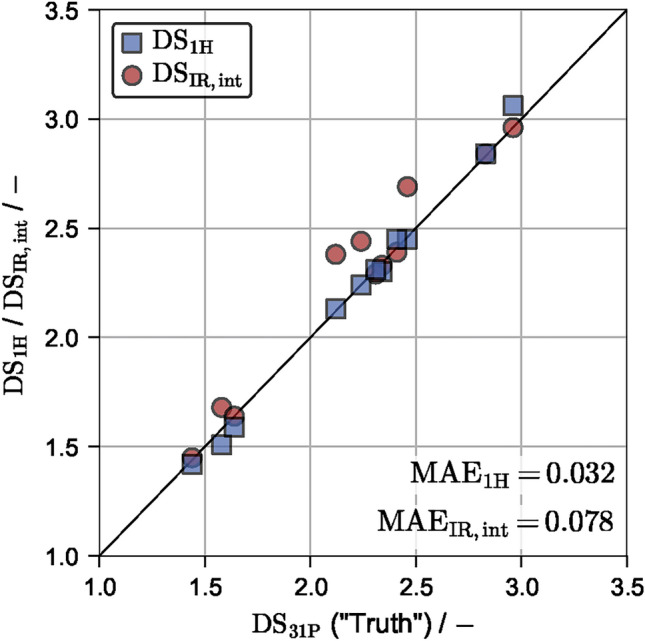
 values versus
  and
and  for the Wolfs.A data set. Only
  values are considered due to insolubility of the samples below this value.
To extend the study also to  values smaller than 1.21, all following investigations are performed with
  values as ground truth, i.e. as training data. Based on Fig. 1 and considering that 31P NMR data is also susceptible to experimental errors, this assumption appears justified.
ML prediciton accuracy on data set Wolfs.A
Baseline accuracy
A repeated k-fold cross validation (CV, see methods section) was performed with randomized data assignment between repetitions on the  data of Wolfs.A. A multiple linear regression (MLR) model is used with
  repetitions and
  folds, meaning that roughly
  of the data points were reserved for testing in each iteration. The results are shown in Fig. 2. A
  of 0.069 (
 ) is obtained. Additionally, the
  values are plotted against the
  values. A
  of 0.083 (
 ) is obtained. Hence, the ML evaluation achieved a slightly smaller
  and slightly larger
  than the manual IR integration method, although both evaluation methods are precise and achieve
  . This immediately demonstrates that a simple linear regression model is able to make good predictions on the
  based on provided raw IR spectra. It should be highlighted that only the prediction accuracy on the test data, i.e. unseen data that has not been used in training, is shown, while for IR integration data, no test/train split was performed. It is apparent that the integration method consistently overpredicts the
  values, while the ML evaluation appears less biased. The opposing behavior in
  and
and  can be explained by the large prediction error of the ML model at the relatively small
  value of 0.70, resulting in a larger relative error.
Fig. 2.

 vs.
vs.  and
and  values for the Wolfs.A data set. The mean values and corresponding standard deviation of all test data points from N repetitions and k folds are shown.
Influence of k-fold
To investigate the influence of the amount of training data, the parameter k was varied between  . These values correspond to
  of the data being used for testing, i.e. higher k values result in less data reserved for the test set and more data being used for training. The results are given in Fig. 3 as a box plot. The box spans from the first (Q1) to the third quartile (Q3) and contains the central
  of the data, while the whiskers extend to the farthest data point lying within 1.5 times the inter-quartile range (IQR). The median value is indicated by a horizontal line and the mean value by a point inside the box.
Fig. 3.

 for varying k during k-fold.
  corresponds to
  ,
,  ,
,  and
and  of the data being used for testing.
Increasing k, i.e. increasing the amount of data being used for training versus testing, lowers both the mean and median  across all
  folds. However, even for
  , i.e. only
  of the data being used for training, an
  is achieved in the majority of folds. This shows that the linear regression model is robust with respect to the required amount of training data and is not prone to overfitting. The span of the whiskers are quite large, which means that the
  exceeds 0.1 in some folds and predictions are less accurate than the IR-based method. However, these cases are retraced to extreme test/train splits, like e.g. only training for small
  , while predicting only large
  values. Please note that this is only due to the applied cross validation with randomized test/train splits and will not be relevant for production models, i.e. routine evaluation. Here, either all or sensibly selected data is used for training, effectively eliminating these extreme cases.
Influence of wavenumeber ranges and feature selection
To evaluate if and how different parts of the spectrum hold more or less information relevant for model training, model training was performed on specific wavenumber ranges, while any data outside the specific range was omitted. Fig. 4c visualizes the investigated ranges together with an exemplary spectrum: A non-fingerprint region is defined for  and a fingerprint region for
  . Additionally, peak specific ranges for
  (
( ),
),  (
( ),
),  (
( ) and a combined range
  ,
,  ,
,  (
( ) are defined. For reference, both the full range and a randomly selected area with no apparent information (
 ) are investigated. For each area, a repeated CV was performed with
  and
and  . The resulting
  values are given as box-plot in Fig. 4a and compared to the integration-based result from above indicted by a horizontal line.
Fig. 4.

(a) Box-plots of  for varying wavenumber ranges viszualized in (c). (b) Box-plots of
  for varying n of n-best feature selection. The optimum value (
 ) is colored in red and the selected wavelengths are visualized in (c).
As expected, the randomly selected area was not able to yield reliable predictions of the  . Similarly, predicting the
  solely based on the
  or
or  peaks produced large deviations and is less accurate than the integration-based method. The best predictions were obtained for the full and
  range, followed by the fingerprint region. These results are surprising in the sense that Wolfs et al.27 reported highest accuracy for evaluation of the
  , followed by the
  and lastly the
  peak. These differences can be attributed to the different model architecture used, with the
  peak being more suited towards a linear regression. Fig. 4a highlights the counter-intuitive fact that manually selecting specific wavenumber ranges, a routinely applied procedure in academia and industry, does not necessarily improve model accuracy. In fact, it might lead to drastically worse predictions.
However, the search for the region that contains most information and yields the best predictions can also be performed automatically via an n-best feature selection algorithm described in the methods section. A parameter study was performed varying n between  in steps of 100 performing a repeated CV for each with
  and
and  . The resulting
  values are shown as box plots in Fig. 4b. The full data set contains 1750 features and is shown on the far right. Reducing the number of features reduces both the
  and its spread until
  , while further reduction initially increases the prediction error. Reducing n further yields a global minimum at
  , where
  is achieved. This represents a significant increase in prediction accuracy compared to the integration-based evaluation method. Increasing prediction accuracy by limiting the amount of features, i.e. information, seems counter-intuitive, however, this can be explained by a reduced amount of overfitting. The initially present 1750 features contain plenty of wavenumbers that do not store information on the
  . Excluding these from training makes the resulting models more robust and more accurate on unseen data. Vividly, the model is forced to learn the underlying relationships rather than experiment-specific random deviations. Fig. 4c shows the selected wavenumbers as scattered points at
  . Besides the expected peaks for
  ,
,  and
and  , the model also evaluates in the range
  ,
,  and, most surprisingly, in the range
  of the fingerprint region. For conventional, i.e. manual ATR-FTIR characterization of organic and polymeric compounds (including cellulose derivatives), especially vibrational bands at higher wavenumbers (
 1500
1500  ) outside the fingerprint region are essential. Particularly, the finger print region is not frequently examined in data evaluation due to its complexity. The ML approach thus seems to provide benefits for data analysis a researcher would not easily identify. Hence, not only did the n-best feature selection increase the overall prediction accuracy, it simultaneously returned relevant information about where information on the
  is stored in the IR spectrum. It should be noted that only raw IR data was used for model training and the feature select algorithm identified the chemically relevant areas without additional mechanistic information or guidance.
Application to other data sets
To assess the applicability of the ML evaluation method, i.e. the extrapolation to other data sets, two linear regression models were trained on the entire Wolfs.A data set. No cross validation is required as all points are included in training. One model is trained on the optimum amount of features found in the previous section ( ) and one is trained on the entire range of wavelengths. Both models are used to predict the
  for samples contained in the Wolfs.B, Sehn.A, Sehn.B and Sehn.C data sets, which are compared to the respective
  values. Fig. 5a shows the results for the model with feature selection and Fig. 5b for the one without. The resulting
  and
and  values are given in Tab. 2.
Fig. 5.

 versus
  values for the Wolfs.B, Sehn.A, Sehn.B and Sehn.C data set with applied n-best feature select (
 ) (a) and without feature selection (b). All models were trained on the full Wolfs.A data set. Exemplary IR spectra at
  .
.
Table 2.
 and
and  values for the Wolfs.B, Sehn.A, Sehn.B and Sehn.C data set with applied n-best feature select (
 ) (left) and without feature selection (right). All models were trained on the full Wolfs.A data set.
| Name | Feature Select ( ) ) |
No Feature Select | ||
|---|---|---|---|---|
 |
 |
 |
 |
|
| Wolfs.B | 0.056 | 3.82 | 0.061 | 3.76 |
| Sehn.A | 0.080 | 5.00 | 0.118 | 7.58 |
| Sehn.B | 1.281 | 59.73 | 0.266 | 12.37 |
| Sehn.C | 0.592 | 28.19 | 0.125 | 5.88 |
Both Wolfs.B and Sehn.A are predicted with a high accuracy, demonstrating that the MLR model is robust and can be applied to IR data of different experimenters (Wolfs.B) and even different synthesis routes (Sehn.A). Additionally, the selected features seem to be universal for CA, as using the optimized model with feature select results in overall lower errors. These results show that routine evaluations of the  of CAs can be performed without the need for laborious and time-consuming 1H or even 31P NMR measurements and without the need for manual peak integration and evaluation of IR data as was done by Wolfs et al.27. It should be noted that all IR data was measured on the same instrument and future studies should include the influence of instrument-specific deviations on the robustness of the evaluation. However, the applied normalization in Eq. 1 alleviates this effect as long as the relative intensities between wavenumbers stay similar.
Applying the trained model to Sehn.B and Sehn.C, i.e. to other cellulose esters than CA, should be regarded as a large extrapolation task, as no IR data of different CEs was included during training. However, Fig. 5b shows that when the MLR model has access to all wavenumbers it is indeed capable of predicting the  to an accuracy of
  , with only cellulose hexanoate of Sehn.B being predicted poorly (
 ). This shows that to some degree, the
  influences the IR spectra of different CEs quite similarly and that a machine learning model is capable of learning these effects. However, the model with feature select shown in Fig. 5a is unable to predict other esters, with the
  even exceeding 1 for Sehn.B. To discuss this drastically different behavior, exemplary IR spectra of all data sets are visualized in Fig. 5c. The samples closest to
  were selected, meaning that for the linear model to yield similar predictions, all curves need to be similar. Again the selected wavenumbers (
 ) are indicated with scattered points. In general, all spectra are similar, especially in the expected ranges for the
  ,
,  and
and  peaks, but also at
  . However, both the peak at
  and the fingerprint region differ quite strongly for different CEs. As these regions contain many of the selected wavenumbers, it is not surprising that the reduced model has difficulties in predicting the
  . By not applying any feature selection, these areas are less important and prediction accuracy is increased for these different CEs.
It should be noted that the objective of the trained model was not to predict the  of CEs other than CA and that it lacked the required data to accurately do so. Nevertheless, Fig. 5c suggests that this may indeed be possible with enough relevant training data. Two adjusted model structures can be conceptualized: First, a combined model with two output parameters—one being the
  and one being e.g. the chain length of the ester or smiles string of the substituent—could be trained. Secondly, it is sensible to train multiple ester-specific models for prediction of the
  and combine them with a superordinate classification model, which predicts the type of ester and hence, which model to apply.
A note on model architecture
This work did not apply other model architectures than the MLR, although in the contemporary machine learning trend, neural networks (NN) are often displayed as somehow superior. It is important to stress that NN are only one of many different model architectures and that all have specific benefits and downsides. The MLR achieved a prediction accuracy close to 1H-based evaluation, especially after feature selection. Considering that  values also contain experimental errors, it is argued that a NN has not much room for improvement and even if slightly lower numbers were obtained, this might not represent an improvement with respect to the true
  . Therefore, if multiple models do not differ significantly in accuracy, one should always choose the one with fewer hyper-parameters. For a NN to perform well, the number of layers, number of nodes in each layer and activation functions have to be chosen correctly, i.e. optimized with respect to the training data. Otherwise NN are highly prone to overfitting and are known for their poor extrapolation capabilities. A previous study showed how this can be done directly during training47, however, the increased work and complexity did not seem to be justified in this context. Additionally, a NN is a black box without any apparent meaning to the individual weights, while the magnitude of the specific weights of the MLR herein directly corresponds to the relative importance of a specific wavenumber.
Conclusions
This work demonstrates that a simple multiple linear regression model can be trained based on a small data set of raw IR spectra of CAs and corresponding  values, which is capable of predicting the
  of unseen spectra with high accuracy, i.e. mean absolute errors of
  . This approach does neither require any manual IR data processing like baseline corrections nor manual evaluations like integration or calibration and is therefore highly interesting for fast and unbiased routine analyses in industry and academia. Applying a feature selection algorithm did not only result in lower prediction errors, but simultaneously provided insights into the wavenumber areas, where information on the
  is stored. The fingerprint region was identified as relevant, which would commonly be neglected when evaluating manually. This methodology can generally be applied to other spectroscopic measurements, as long as information on the DS is stored within. The trained model was able to predict the
  based on raw IR data of other experimenters applying a different synthesis route, demonstrating the robustness of the approach. It should be emphasized that the data used in this study was not specifically generated to train regression models. When training a model for production, i.e. routine evaluations of
  , more and most importantly evenly spaced data should be recorded to build an even more reliable model without bias towards certain
  ranges.
The trained model was applied to different CEs and achieved overall good prediction accuracy. This is surprising considering the degree of extrapolation, as only CAs were used during training. A closer inspection of the IR spectra suggests that with enough data, not only  prediction, but also ester identification should become feasible. Future work should focus on applying design of experiment techniques to systematically extend the data set to different CEs. With this data, the proposed model architectures should be tested, to obtain a more generalized evaluation model for cellulose esters. If necessary, the models could be extended with other forms of input data, such as images or different spectroscopic measurements, to allow for a more differentiated prediction.
Methods
1H integration routine
As discussed in the introduction, DS determination via 1H NMR is a frequently employed tool. However, the method may suffer from individual baseline correction and integration, i.e. the process depends on individual researchers and thus may include individual bias. Hence, the following step-by-step protocol for the DS determination of CA via 1H NMR using MestReNova is introduced and was used in this study to avoid such errors:
Reference ppm values to solvent signal (DMSO-d
 = 2.50 ppm)
Choose “Multipoint Baseline Correction”
- Apply “Multipoint Baseline Correction” in the following areas:
- From 0.00 ppm to 0.50 ppm
- From 6.00 ppm to 10.0 ppm
- Integration of magnetic resonances in the following areas:
- From 1.40 ppm to 2.25 ppm (acetyl signal)
- From 2.73 ppm to 6.00 ppm (AGU signal)
IR data normalization
Before use, the raw IR transmission spectrum of each sample j, denoted by  , where M is the number of wavenumbers, is scaled according to the min-max normalization in Eq. 1. Throughout this publication, arrays are notated in bold to distinguish them from integers.
 |
1 |
ML model structure and implementation
The goal of this work was to train and evaluate regression models that are able to predict the  based on a provided IR spectrum. Training was achieved using static data, so supervised learning was applied. The main success-defining factor is the chosen model architecture. In this study, one of the simplest model architectures, a multiple linear regression (MLR) model was used that is based on ordinary least squares. For any given training set, the
  data is structured in a
  array, while the corresponding spectroscopic data is structured in a
  . S is the number of samples and M is the amount of wavenumbers (features), while in this case the amount of predicted values (outputs) is one (i.e. the
  ). A MLR model
  is defined by a set of weights
  , so that
 |
2 |
During training, the weights are optimized according to
 |
3 |
and the model was implemented with the scikit-learn48 class LinearRegression in Python. As  values can only be positive, the ReLU (rectified linear unit) function
  is applied to the MLR output to enforce this physical constraint. The beauty of a MLR model is that it has only one relevant hyper parameter: A constant term can be included in the features and the corresponding weights correspond to the wavenumber-specific intercepts. This option fit_intercept was set to False in this study.
Quality metrics
The mean absolute error (MAE) between any reference  and evaluation data set
  of size
  is defined as
 |
4 |
and has the same dimension as  . Similarly, the mean relative error (MRE) is defined as
 |
5 |
Repeated cross validation
To quantify the predictive performance of any supervised learning model, it is important to test it on unseen data that has not been used during training. Hence, the full data set available is initially split into a train and test subset, with self-explanatory intention. However, this is problematic because the model performance, e.g. the MAE in Eq. 4, is only evaluated on the test subset. To quantify the model performance on the entire data set, a k-fold cross validation (CV) is routinely used that is visualized in Fig. 6. The full data set is split into k subsets, ensuring that every data point is exclusively contained in one subset. Subsequently, these subsets are used as test data, while the remaining points are used for model training. In essence, k individual models are trained and each is evaluated on the respective test data. Subsequently, Eq. 4 can be applied to the combined predictions of the k test subsets, yielding an objective metric for model accuracy. As the assignment into k subsets is generally done randomly, there are various possible data combinations that differ in model performance. To eliminate this stochastic behavior, the k-fold CV is repeated N times with randomized data assignment between repetitions. The RepeatedKFold class of the scikit-learn48 package was used.
Fig. 6.

Visualization of the repeated cross validation procedure.
Feature select
The idea of a feature select (FS) algorithm is to only train the model on the most relevant features (wavenumbers). This can generally improve model performance and make a model more robust, as noisy or non-informative features are omitted. Obviously, one hast to define what relevant means in this context. In this work, the SelectKBest class based on the f_regression metric of scikit-learn48 was used. Here, the Pearson correlation coefficient
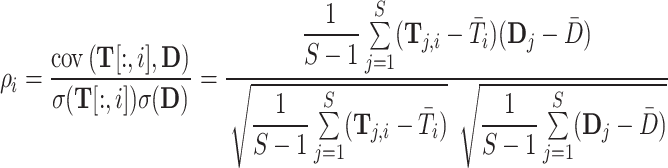 |
6 |
is calculated for each individual feature i that measures the linear correlation between any wavenumber and the  .
.  is a normalized measure of covariance and can take values between
  and 1. Subsequently, the F-statistic
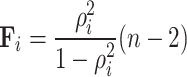 |
7 |
is computed, which ranks the features between 0 and 1 and therefore also ranks strong negative correlations highly. Providing an integer n, the algorithm selects the n-best features from  , i.e. the wavenumbers with the highest F values.
Supplementary Information
Acknowledgements
The authors acknowledge Jonas Wolfs for data provision.
Author contributions
Conceptualization, F.R., M.M.; methodology, F.R., T.S., M.M.; formal analysis, F.R., T.S.; investigation, T.S.; data curation, F.R., T.S.; writing—original draft preparation, F.R., T.S.; writing—review and editing, M.M.; visualization, F.R.; software, F.R.; supervision, F.R., M.M.; project administration, F.R., M.M.. All authors have read and agreed to the published version of the manuscript.
Funding
Open Access funding enabled and organized by Projekt DEAL.
Data availibility
All data used in this study is available at KITopen46. This includes both raw ATR-FTIR spectra as well as  values based on IR integration, 1H NMR and 31P NMR. The Python scripts for reproducing the results presented in this study are publicly available in the Github repository pdhs-group/DS_IR_ML.
Declarations
Competing interests
The authors declare no competing interests.
Footnotes
Publisher’s note
Springer Nature remains neutral with regard to jurisdictional claims in published maps and institutional affiliations.
Contributor Information
Frank Rhein, Email: frank.rhein@kit.edu.
Michael A. R. Meier, Email: m.a.r.meier@kit.edu
Supplementary Information
The online version contains supplementary material available at 10.1038/s41598-025-86378-0.
References
- 1.Wolfs, J. & Meier, M. A. R. A more sustainable synthesis approach for cellulose acetate using the DBU/CO2 switchable solvent system. Green Chem.23, 4410–4420. 10.1039/D1GC01508G (2021). [Google Scholar]
- 2.Klemm, D., Heublein, B., Fink, H.-P. & Bohn, A. Cellulose: Fascinating biopolymer and sustainable raw material. Angew. Chem. Int. Ed.44, 3358–3393. 10.1002/anie.200460587 (2005). [DOI] [PubMed] [Google Scholar]
- 3.Zhao, X. et al. Thermal and barrier characterizations of cellulose esters with variable side-chain lengths and their effect on PHBV and PLA bioplastic film properties. ACS Omega6, 24700–24708. 10.1021/acsomega.1c03446 (2021). [DOI] [PMC free article] [PubMed] [Google Scholar]
- 4.Esen, E., Hädinger, P. & Meier, M. A. R. Sustainable fatty acid modification of cellulose in a CO2-based switchable solvent and subsequent Thiol-Ene modification. Biomacromol22, 586–593. 10.1021/acs.biomac.0c01444 (2020). [DOI] [PubMed] [Google Scholar]
- 5.Erdal, N. B. & Hakkarainen, M. Degradation of cellulose derivatives in laboratory, man-made, and natural environments. Biomacromol23, 2713–2729. 10.1021/acs.biomac.2c00336 (2022). [DOI] [PMC free article] [PubMed] [Google Scholar]
- 6.Sehn, T. & Meier, M. A. R. Structure-property relationships of short chain (mixed) cellulose esters synthesized in a DMSO/TMG/CO2 switchable solvent system. Biomacromol24, 5255–5264. 10.1021/acs.biomac.3c00762 (2023). [DOI] [PubMed] [Google Scholar]
- 7.Heinze, T. et al. Effective preparation of cellulose derivatives in a new simple cellulose solvent. Macromol. Chem. Phys.201, 627–631. https://doi.org/10.1002/(SICI)1521-3935(20000301)201:6<627::AID-MACP627>3.0.CO;2-Y (2000). [Google Scholar]
- 8.Wu, J. et al. Homogeneous acetylation of cellulose in a new ionic liquid. Biomacromol5, 266–268. 10.1021/bm034398d (2004). [DOI] [PubMed] [Google Scholar]
- 9.Fischer, S. et al. Properties and applications of cellulose acetate. Macromol. Symp.262, 89–96. 10.1002/masy.200850210 (2008). [Google Scholar]
- 10.Steinmeier, H. 3. Acetate manufacturing, process and technology 3.1 Chemistry of cellulose acetylation. Macromol. Symp.208, 49–60. 10.1002/masy.200450405 (2004). [Google Scholar]
- 11.Huang, L., Wu, Q., Wang, Q. & Wolcott, M. One-step activation and surface fatty acylation of cellulose fibers in a solvent-free condition. ACS Sustain. Chem. Eng.7, 15920–15927. 10.1021/acssuschemeng.9b01974 (2019). [Google Scholar]
- 12.Li, M.-L. et al. One-step solvent-free strategy to efficiently synthesize high-substitution cellulose esters. ACS Sustain. Chem. Eng.12, 9669–9681. 10.1021/acssuschemeng.4c00953 (2024). [Google Scholar]
- 13.Duchatel-Crépy, L. et al. Substitution degree and fatty chain length influence on structure and properties of fatty acid cellulose esters. Carbohyd. Polym.234, 115912. 10.1016/j.carbpol.2020.115912 (2020). [DOI] [PubMed] [Google Scholar]
- 14.Tanaka, S., Iwata, T. & Iji, M. Long/short chain mixed cellulose esters: Effects of long acyl chain structures on mechanical and thermal properties. ACS Sustain. Chem. Eng.5, 1485–1493. 10.1021/acssuschemeng.6b02066 (2017). [Google Scholar]
- 15.Chen, Z., Zhang, J., Xiao, P., Tian, W. & Zhang, J. Novel thermoplastic cellulose esters containing bulky moieties and soft segments. ACS Sustain. Chem. Eng.6, 4931–4939. 10.1021/acssuschemeng.7b04466 (2018). [Google Scholar]
- 16.Jogunola, O. et al. Ionic liquid mediated technology for synthesis of cellulose acetates using different co-solvents. Carbohyd. Polym.135, 341–348. 10.1016/j.carbpol.2015.08.092 (2016). [DOI] [PubMed] [Google Scholar]
- 17.Gao, X. et al. Rapid transesterification of cellulose in a novel DBU-derived ionic liquid: Efficient synthesis of highly substituted cellulose acetate. Int. J. Biol. Macromol.242, 125133. 10.1016/j.ijbiomac.2023.125133 (2023). [DOI] [PubMed] [Google Scholar]
- 18.Yao, Z. et al. Rapid homogeneous acylation of cellulose in a CO2 switchable solvent by microwave heating. ACS Sustain. Chem. Eng.10, 17327–17335. 10.1021/acssuschemeng.2c05872 (2022). [Google Scholar]
- 19.Tezuka, Y. & Tsuchiya, Y. Determination of substituent distribution in cellulose acetate by means of a 13C NMR study on its propanoated derivative. Carbohyd. Res.273, 83–91. 10.1016/0008-6215(95)00107-5 (1995). [Google Scholar]
- 20.Kono, H., Hashimoto, H. & Shimizu, Y. NMR characterization of cellulose acetate: Chemical shift assignments, substituent effects, and chemical shift additivity. Carbohyd. Polym.118, 91–100. 10.1016/j.carbpol.2014.11.004 (2015). [DOI] [PubMed] [Google Scholar]
- 21.Fliri, L. et al. Solution-state nuclear magnetic resonance spectroscopy of crystalline cellulosic materials using a direct dissolution ionic liquid electrolyte. Nat. Protoc.18, 2084–2123. 10.1038/s41596-023-00832-9 (2023). [DOI] [PubMed] [Google Scholar]
- 22.King, A. W. et al. A new method for rapid degree of substitution and purity determination of chloroform-soluble cellulose esters, using 31P NMR. Anal. Methods2, 1499–1505. 10.1039/C0AY00336K (2010). [Google Scholar]
- 23.Freire, C., Silvestre, A., Pascoal Neto, C. & Rocha, R. An efficient method for determination of the degree of substitution of cellulose esters of long chain aliphatic acids. Cellulose12, 449–458. 10.1007/s10570-005-2203-2 (2005). [Google Scholar]
- 24.Peydecastaing, J., Vaca-Garcia, C. & Borredon, E. Accurate determination of the degree of substitution of long chain cellulose esters. Cellulose16, 289–297. 10.1007/s10570-008-9267-8 (2009). [Google Scholar]
- 25.Wolfs, J., Nickisch, R., Wanner, L. & Meier, M. A. R. Sustainable one-pot cellulose dissolution and derivatization via a tandem reaction in the DMSO/DBU/CO2 switchable solvent system. J. Am. Chem. Soc.143, 18693–18702. 10.1021/jacs.1c08783 (2021). [DOI] [PubMed] [Google Scholar]
- 26.Casarano, R., Fidale, L. C., Lucheti, C. M., Heinze, T. & El Seoud, O. A. Expedient, accurate methods for the determination of the degree of substitution of cellulose carboxylic esters: Application of UV-vis spectroscopy (dye solvatochromism) and FTIR. Carbohyd. Polym.83, 1285–1292. 10.1016/j.carbpol.2010.09.035 (2011). [Google Scholar]
- 27.Wolfs, J., Scheelje, F. C. M., Matveyeva, O. & Meier, M. A. R. Determination of the degree of substitution of cellulose esters via ATR-FTIR spectroscopy. J. Polym. Sci.61, 2697–2707. 10.1002/pol.20230220 (2023). [Google Scholar]
- 28.Beer, A. Bestimmung der Absorption des rothen Lichts in farbigen Flüssigkeiten. Ann. Phys.162, 78–88. 10.1002/andp.18521620505 (1852). [Google Scholar]
- 29.Kowalski, B. R. Chemometrics: Views and propositions. J. Chem. Inf. Comput. Sci.15, 201–203. 10.1021/ci60004a002 (1975). [Google Scholar]
- 30.Meza Ramirez, C. A., Greenop, M., Ashton, L. & Rehman, I. u. Applications of machine learning in spectroscopy. Appl. Spectrosc. Rev.56, 733–763. 10.1080/05704928.2020.1859525 (2021). [Google Scholar]
- 31.Ralbovsky, N. M. & Lednev, I. K. Towards development of a novel universal medical diagnostic method: Raman spectroscopy and machine learning. Chem. Soc. Rev.49, 7428–7453. 10.1039/D0CS01019G (2020). [DOI] [PubMed] [Google Scholar]
- 32.Guo, S., Popp, J. & Bocklitz, T. Chemometric analysis in Raman spectroscopy from experimental design to machine learning-based modeling. Nat. Protoc.16, 5426–5459. 10.1038/s41596-021-00620-3 (2021). [DOI] [PubMed] [Google Scholar]
- 33.Winkler, M., Gleiss, M. & Nirschl, H. Soft sensor development for real-time process monitoring of multidimensional fractionation in tubular centrifuges. Nanomaterials.[SPACE]10.3390/nano11051114 (2021). [DOI] [PMC free article] [PubMed] [Google Scholar]
- 34.Maris, M. A., Brown, C. W. & Lavery, D. S. Nonlinear multicomponent analysis by infrared spectrophotometry. Anal. Chem.55, 1694–1703. 10.1021/ac00261a013 (1983). [Google Scholar]
- 35.Cobas, C. NMR signal processing, prediction, and structure verification with machine learning techniques. Magn. Reson. Chem.58, 512–519. 10.1002/mrc.4989 (2020). [DOI] [PubMed] [Google Scholar]
- 36.Kern, S. et al. Artificial neural networks for quantitative online NMR spectroscopy. Anal. Bioanal. Chem.412, 4447–4459. 10.1007/s00216-020-02687-5 (2020). [DOI] [PMC free article] [PubMed] [Google Scholar]
- 37.Lansford, J. L. & Vlachos, D. G. Infrared spectroscopy data- and physics-driven machine learning for characterizing surface microstructure of complex materials. Nat. Commun.11, 1513. 10.1038/s41467-020-15340-7 (2020). [DOI] [PMC free article] [PubMed] [Google Scholar]
- 38.Nogueira, M. S. et al. Rapid diagnosis of COVID-19 using FT-IR ATR spectroscopy and machine learning. Sci. Rep.11, 15409. 10.1038/s41598-021-93511-2 (2021). [DOI] [PMC free article] [PubMed] [Google Scholar]
- 39.Simon, J. et al. A fast method to measure the degree of oxidation of dialdehyde celluloses using multivariate calibration and infrared spectroscopy. Carbohyd. Polym.278, 118887. 10.1016/j.carbpol.2021.118887 (2022). [DOI] [PubMed] [Google Scholar]
- 40.Liu, J., Chen, J., Dong, N., Ming, J. & Zhao, G. Determination of degree of substitution of carboxymethyl starch by Fourier transform mid-infrared spectroscopy coupled with partial least squares. Food Chem.132, 2224–2230. 10.1016/j.foodchem.2011.12.072 (2012). [Google Scholar]
- 41.Barros, A. S. et al. Determination of the degree of methylesterification of pectic polysaccharides by FT-IR using an outer product PLS1 regression. Carbohyd. Polym.50, 85–94. 10.1016/S0144-8617(02)00017-6 (2002). [Google Scholar]
- 42.Zhang, K., Feldner, A. & Fischer, S. Ft Raman spectroscopic investigation of cellulose acetate. Cellulose18, 995–1003. 10.1007/s10570-011-9545-8 (2011). [Google Scholar]
- 43.Pancholi, M. J., Khristi, A., Athira, K. M. & Bagchi, D., Comparative analysis of lignocellulose agricultural waste and pre-treatment conditions with FTIR and machine learning modeling. BioEnergy Res.16, 123–137. 10.1007/s12155-022-10444-y (2023). [Google Scholar]
- 44.Costa, L. R., Tonoli, G. H. D., Milagres, F. R. & Hein, P. R. G. Artificial neural network and partial least square regressions for rapid estimation of cellulose pulp dryness based on near infrared spectroscopic data. Carbohyd. Polym.224, 115186. 10.1016/j.carbpol.2019.115186 (2019). [DOI] [PubMed] [Google Scholar]
- 45.Li, X., Sun, C., Zhou, B. & He, Y. Determination of hemicellulose, cellulose and lignin in moso bamboo by near infrared spectroscopy. Sci. Rep.5, 17210. 10.1038/srep17210 (2015). [DOI] [PMC free article] [PubMed] [Google Scholar]
- 46.Rhein, F., Sehn, T. & Meier, M. A. R. Degree of substitution of cellulose acetate and other esters: Raw ATR-FTIR spectra and DS data obtained from IR integration, 1H NMR and 31P NMR [dataset]. RADAR4KIT. 10.35097/tvwlylbMvDXhEcRt (2024).
- 47.Rhein, F., Hibbe, L. & Nirschl, H. Hybrid modeling of hetero-agglomeration processes: A framework for model selection and arrangement. Eng. Comput.[SPACE]10.1007/s00366-023-01809-8 (2023). [Google Scholar]
- 48.Pedregosa, F. et al. Scikit-learn: Machine learning in Python. J. Mach. Learn. Res.12, 2825–2830 (2011). [Google Scholar]
Associated Data
This section collects any data citations, data availability statements, or supplementary materials included in this article.
Supplementary Materials
Data Availability Statement
All data used in this study is available at KITopen46. This includes both raw ATR-FTIR spectra as well as values based on IR integration, 1H NMR and 31P NMR. The Python scripts for reproducing the results presented in this study are publicly available in the Github repository pdhs-group/DS_IR_ML.