



ABSTRACT
Background
For three decades, fractional ablative CO2 lasers have been used for skin rejuvenation. With breakthroughs in laser technology and expanding popularity, new recommendations and suggestions arise on a regular basis.
Objective
To develop up‐to‐date clinical recommendations on safety measures, therapeutic framework, and techniques to improve treatment outcomes.
Methods
Using Google Forms, a questionnaire with 188 questions was given to a varied sample of 21 dermatologists and plastic surgeons from various countries and practice contexts. A second questionnaire with 11 items was created to resolve any gaps or discrepancies.
Results
Active face infections are considered a treatment contraindication by 95% of panelists. Burns, recent sun exposure, and pregnancy or breastfeeding were also considered contraindications (according to 67% of panelists). Over 90% employ bacterial and viral prophylaxis, however the majority (67%) do not prescribe antifungal prophylaxis. The most often stated anesthetic treatments by panelists are topical anesthetic cream, nerve blocks, and oral analgesics (according to 95%, 81%, and 62% of panelists respectively). Over 90% of panel members suggested treatment setting alterations for individuals with Fitzpatrick skin types III–IV. Following reepithelization, which happens between 8 and 42 days after the treatment, the majority (76%) of panelists advocate continuing standard skin care routines including active ingredients. Eighty‐one percent of panelists recommend using supplementary treatment to maximize results. Supplementary treatment recommendations included use of neuromodulators (76% of panelists), Intense Pulsed Light Therapy treatments pre and postprocedure (61% of panelists), and injection‐based therapies such as (Hyaluronic Acid fillers, and biostimulatory fillers) (recommended by 48% of panelists). 60% of panelists perform FACL to improve skin laxity treatment in nonfacial areas and adjust their settings accordingly.
Limitations
Our results reflect only a modest panel size; with a focus on a specific device. Although experienced, the small number of panelists, recommendations, and personal adverse reactions encounters for resurfacing indication, might be biased.
Conclusion
Fractional CO2 laser is a popular and effective skin rejuvenation treatment with minimal downtime and side effects. This study presents new therapy recommendations to resolve treatment uncertainty and provide complete care suggestions for best results.
Keywords: fractional ablative CO2 laser, laser treatment, postcare, precare, skin rejuvenation, treatment parameters
Summary
Fractional ablative CO2 laser is a reliable and long‐tested treatment method for skin rejuvenation that is used all over the world. This article offers a revised and complete protocol with precise clinical recommendations for precare, postcare, treatment parameters, and adjuvant treatment to improve outcomes and reduce side effects.
1. Introduction
There are many treatment options to improve skin quality. Aggressive therapies may result in more dramatic improvement, while gentle procedures produce subtle improvements with less downtime. In recent years, fractional ablative CO2 lasers (FACL) have become the gold standard for nonsurgical skin rejuvenation, enhancing skin texture, laxity, and tone while reducing the signs of aging. There are numerous FACL currently available in the market, and not all CO2 lasers are equal regarding safety and performance. To establish consensus‐based clinical recommendations, a known platform (UltraPulse [UP] Encore, Lumenis, Inc., Yokneam Israel) was chosen as a reference device. This device was chosen due to its wide availability of over 20 countries, large literature footprint of over 100 articles, and its long duration in the market of 26 years. A multidisciplinary panel of international facial skin resurfacing experts using this platform was convened. Our objectives are to highlight the potential utility of laser skin resurfacing, discuss the risks, patient selection, pre‐ and postcare instructions, safety precautions, optimal settings, and provide specific treatment recommendation on six mostly encountered real‐life clinical scenarios.
2. Methods
An international panel of 21 dermatologists and plastic surgeons with an average of 21 years (range: 10–35 years) of experience performing resurfacing procedures, collaborated to develop a revised treatment recommended consensus. The authors (OA, TL, and IL) contacted the company, Lumenis, for a list of physicians with the most years of experience using the reference device. After providing the list of names, the company had no further involvement in the project. Panelists were individually contacted by the authors and offered participation in the project; the ones who agreed were included. Members of the panel came from seven different nations and had a variety of experiences in academic, private practice, and hospital settings. Two sets of email questionnaires were used in our modified Delphi approach. The authors created a questionnaire with 188 items (multiple choice, check box, and open‐ended). The questionnaire covered four major topics: precare (treatment preparation and preventative measures), treatment parameters (generic FACL treatment recommendations for distinct patient phototypes and treatment locations), and postcare (posttreatment rules and managing adverse effects). The questionnaire included more than 60% of questions that apply to general resurfacing protocols, that are not device specific. At the completion of the questionnaire, the panelists were presented with six real‐life clinical situations and asked to select treatment approaches for the best aesthetic outcome. A second questionnaire was created to collect missing information and address points of contention. The second questionnaire had 11 questions (checkbox, free response, and drop‐down questions). Consensus was defined as panelist agreement of above 51%, any recommendation with agreement of 50% or less was also mentioned but was not defined as consensus.
3. Results
The following includes the main conclusions and answers, in the specified topics, chosen by panelist (in brackets the percentage of panelists who back up the claim).
3.1. The Ideal Patient
According to panelists, the ideal patient for a fractional ablative CO2 resurfacing procedure is a middle‐aged patient, 40–60 years old (chosen by 82% of panelists), with fair skin: Fitzpatrick type I or II (chosen by 76% and 100% of panelists respectively). Panelists reached a consensus regarding the conduction of FACL laser in Fitzpatrick types III (65%), and only 12% of panelists conduct FACL laser in Fitzpatrick types III and IV. Panelists preferred patients with thin to moderate skin thickness (chosen by 76% and 94% of panelists respectively). A Glogau Wrinkle scale (GWS) of moderate to advanced, with mild and/or moderate dyspigmentation were deemed ideal according to 76% of panelists. Prior patient experience with aesthetic procedures was not considered important when recommending the FACL procedure. There was no consensus regarding the importance of patient familiarity with milder aesthetic procedures (such as injections and neuromodulators) before first time FACL procedure. However, prior FACL patient experience was considered ideal by 41% of the panelists. 94% of panelists expect and promise a moderate improvement following FACL treatment.
3.2. Contraindications and Patient Selection
The Contraindications for CO2 resurfacing, according to the panel members, are active herpetic lesions in the treatment area, sun burns or overexposure to sun in the past few weeks preceding to treatment, and pregnancy or breastfeeding (reported by 95%, 67%, and 67% of panelists respectively). Figure 1 depicts other relative contraindications considered by panelists.
Figure 1.

Diagram demonstrating the percentage of panelists considering certain conditions as contraindications for FACL treatment.
3.3. Expected Sequelae
Swelling was the most frequently encountered expected sequela by 94% of panelists, and 59% of them considered it an undesirable impact if it lasted more than 1–2 weeks. For severe or prolonged swelling, no consensus was reached among the panelists regarding treatment, but the three most reported recommendations were oral steroids (reported by 41% of panelists), followed by cold compresses and reassurance (reported by 29% of panelists). Erythema was considered an expected sequela by most panelists; however, panel members did not reach a consensus regarding recommended treatment. Most reported treatments for persisted or severe erythema by panelists were pulse dye lasers (PDL) (reported by 29% of panelists), intense pulse light therapy (IPL) (reported by 29% of panelists), or topical steroids (reported by 12% of panelists). Other common sequelae reported by 65% of panelists included crusting, which becomes a concern when it lasts longer than 5–14 days. Less frequently reported expected sequelae included oozing, pruritus, and acneiform eruption, for which opinions on the time frame after which they will be regarded an unfavorable reaction were ambiguous. Table 1 summarizes the treatment options for crusting, oozing, pruritus, and acneiform eruption.
Table 1.
Expected sequela post‐FACL treatment, and suggested treatment by panel members.
| Type of prolonged/persisting sequela | Suggested treatment by panel members |
|---|---|
| Crusting | Hydration and moisturizing, vinegar soaks, and hydrocolloid dressings. |
| Acneiform eruption | Oral antibiotics, oral antihistamines, change ointment + topical antibiotics. |
| Pruritus | Cool soaks, vinegar soaks, hypochlorous acid, oral antihistamine. |
| Oozing | Wet dressing and reassurance. |
3.4. Adverse Reactions
Panelists reported observing the following side effects post FACL treatment: hyperpigmentation, contact dermatitis, and local infection (encountered by 95%, 67%, and 62% of panelists respectively). Hypopigmentation, scarring, telangiectasias/capillary fragility, were less common and were encountered by 47%, 33%, and 33% of panelists respectively. More rare reactions such as Ectropion, koebnerization (as vitiligo or psoriasis), and Erosive pustular dermatosis were observed by less than 5% of panelists.
3.5. Postinflammatory Hyperpigmentation (PIH)
PIH is a concern for all skin types undergoing FACL procedure. Although skin Fitzpatrick types III–VI are more susceptible, panel members advise all patients to practice PIH prevention methods before FACL treatment.
Prevention: According to all panelists, sun avoidance is key to prevent PIH, but no consensus was reached regarding the pretreatment sun avoidance timeframe: 47% of panelists recommend 2–4 weeks of sun avoidance whereas 41% recommend 1–2 weeks before procedure. There is a consensus of a pretreatment skin regimen consisting of stringent sunscreen use before treatment, beginning no later than 4 weeks before treatment (recommended by 67% of panelists). Furthermore, to prevent PIH, 81% of panelists recommend using a topical treatment starting 4 weeks before treatment and stopping 4–14 days before the procedure. Consensus was reached regarding PIH prevention using hydroquinone alone (according to 52% of panelists), other recommendations that did not reach consensus included: the application of a modified Kligman's formula (tretinoin, hydroquinone, and hydrocortisone in a water‐based cream) (according to 22% of panelists), and application of topical vitamin C of at least 5% concentration (according to 33% of panelists). Fifteen percent of panelists reported using the following steroid regimens for PIH prevention: clobetasol propionate (1–5 days after treatment), betamethasone (up to 7 days after treatment), or desonide (up to 10 days after treatment).
Management : If PIH occurs, it can be addressed by multiple methods. All panelists recommend conservative management including stringent sun avoidance and topical application of sunscreen of several months. Other recommendations that did not reach consensus included: a topical formulation containing Vitamin C, kojic acid, hydroquinone 4%, and mild steroids (recommended by 30% of panelists). In resistant cases, a 532 or 755 nm picosecond laser was recommended by 33% of panelists. Other less commonly reported treatments for PIH were: IPL, PDL, chemical peels, and micro needling.
3.6. Contact Dermatitis
Contact dermatitis should be a concern post‐FACL resurfacing. Lanolin, topical antibiotics, fragrance and preservatives, topical moisturizers, keratinolytic agents, and topical anesthetics were reported to cause contact dermatitis post‐FACL.
3.7. Infections
According to panelists, the most common infectious agents encountered were bacterial, viral, and rarely fungal diseases (reported by 41%, 24%, and 6% of panelists respectively).
Bacterial prophylaxis: 90% of panelists recommend a course of prophylactic antibiotic therapy, however, there was no consensus regarding the specific antibiotic use. Doxycycline 100 mg, for 3–7 days, beginning the day before or on the same day as the procedure, was the most prescribed antibiotic (according to 43% of panelists). Cephalexin, 250–500 mg 2–4 times a day, for 1–3 days before and 3–7 days after treatment was recommended by 19% of panelists. Other less commonly recommended antibiotics are trimethoprim/sulfamethoxazole, cefepime, and clindamycin (each reported by 5% of panelists).
Viral prophylaxis : Antiviral prophylaxis is recommended by most panelists (95%). The treatment option recommendation that reached consensus by 76% of panelists was valacyclovir 500 mg for 5–7 days beginning the day before or on the day of the procedure. Other nonconsensus treatment recommendation (recommended by 14% of panelists) is acyclovir: 400–800 mg 2 days prior for a total of 5 days, 1–2 daily beginning on the day of therapy for at least a week.
Fungal prophylaxis: There was a consensus among panel members (67%) to not prescribe prophylactic antifungals. Twenty‐nine percent of panelists prescribe Fluconazole 150 mg, once, 1–3 days posttreatment.
3.8. Pain Control
There is a consensus among 91% of panel members that general anesthesia or sedation is not required for full face resurfacing. In chosen cases, only 10% of panelists advocate sedation. Panelists reached consensus regarding the following methods to relieve pain and ease patients: topical anesthetic formulation, nerve block, oral analgesics, and intradermal/hypodermal infiltration with lidocaine‐based formulations (recommended by 95%, 81%, 62%, and 57% of panelists respectively). Other reported techniques that did not reach consensus were: cryoanesthesia and inhaled 50:50 mixture of nitrous oxide and oxygen gas (used by 43% and 14% of panelists respectively). It is worth noting that 57% of panel members felt that topical anesthetics alone do not give adequate pain relief for aggressive resurfacing.
3.9. Topical Anesthetics
Most panelists (91%) agreed that topical anesthetics are most effective when applied 30–60 min before resurfacing (average 43 min). The following formulations were highlighted by most panelists: a topical formula containing a combination of benzocaine (20%), lidocaine (5%–10%), and tetracaine (4%–7%) (BLT); a topical cream containing lidocaine (2.5%) and prilocaine (2.5%); and hydrophobic Basis gel (a mixture of hydrophobic solvents mixed with some of the anesthetics mentioned above). Seventy‐six percent of respondents have experienced side effects from the above‐mentioned topical anesthetics, including erythema, swelling, chemical keratitis, stinging around the eyes, and foreign body‐induced corneal abrasion.
3.10. Oral Analgesics
There is a consensus among panel members to prescribe oral analgesics before FACL procedure (according to 76% of panelists), however, there is no consensus regarding the specific oral analgesic recommendation. Forty‐seven percent of panelists advised a single dose of opioid medications 30–60 min before the procedure. The following drugs were reported: two pills of oxycodone paracetamol (10 mg), tramadol 50 mg, or dihydromorphinone 2–8 mg. Milder drugs such as ibuprofen or metamizole are prescribed by 34% of panelists. In addition to opioids or nonopioid drugs, 29% of panel members prescribe a single dose of a benzodiazepine (lorazepam 1–2 mg, diazepam 10–20 mg or midazolam in adjusted dosage) given 30–60 min before the procedure.
3.11. Postcare Measures and Instruction to Mitigate Abnormal Wound Healing
Various therapies can be used to maximize results, alleviate postprocedural discomfort, and reduce the occurrence of sequelae and adverse responses.
3.12. Discontinuing Medications
There is a consensus among panelists that drug cessation before FACL procedure is not necessary (according to 52% of panelists). Forty‐eight percent of panelists advise considering the discontinuation of numerous medications before treatment, aiming to better regulating wound healing. Within the group of panelists that recommend drug discontinuation, the majority (59% of panelists) advocate stopping oral isotretinoin at least 1 month before FACL procedure. Additionally, 59% of panelists recommend stopping topical retinoids use at least 1 week before FACL procedure. 41% of panelists recommend stopping oral steroids 1–2 weeks before treatment if possible. Only 29% of panelists recommend stopping steroid sparing/nonsteroidal immunosuppressive drugs before treatment. Seventy‐six percent of panelists would not stop anticoagulant and or aspirin before procedure.
3.13. Post‐FACL Care
Immediately following FACL procedure: panelists reached consensus regarding the use of cold compresses, and topical petrolatum (according to 67% and 57% of panelists respectively). Other methods that did not reach consensus among panelists were the use of thermal water (reported by 43% of panelists), and topical low‐potency steroids (reported by 24% of panelists). Other products recommendations: Cicaplast Balm B5 (La Roche‐Posay Dermatological Laboratory, Levallois‐Perret, France), and Vaniply (Pharmaceutical Specialties Inc., Rochester, Minnesota) both used by 25% of panelists. Thirteen percent of panelists use the following: vinegar soaks and wound healing formulations such as Regenerating Skin Nectar (ALASTIN Skincare, Inc., Carlsbad, California) and Stratacel Advanced Dressing (Stratacel; Stratapharma AG, Basel, Switzerland).
In the first 3 days following FACL procedure: the consensus among panelists is to recommend topical petrolatum on the treated area (76% of panelists). Other recommendations that did not reach consensus were: hypochlorous acid use, and thermal water (according to 24%, and 19% of panelists respectively). Only 19% of panelists allow the use of a facial cleanser in the first 24 h, compared to 62% that allow to start use of facial cleanser on the second and third days. Exosomes, and peroxide soaks for exudate were also reported by 6% of panelists.
3.14.
4–7 days after FACL procedure: The consensus among panelists is to recommend topical petrolatum use (57% of panelists). Switching to a regular moisturizer is recommended by 48% of panelists. Thirty‐eight percent recommend starting using a gentle facial cleanser.
8–42 days after FACL treatment: The consensus among panelists is to advise gradually restarting typical skincare routines, including those containing active ingredients (according to 76% of panelists). Twenty‐four percent of panelists recommend a more cautious regimen that includes only topical petrolatum and sunscreen with no active components until 4–6 weeks after the procedure.
3.15. Treatment Parameters
Panelists consider several factors when deciding on laser settings for a specific patient. The factors that reached consensus among panel members include wrinkle depth, patient's tendency to develop hyper‐ or hypopigmentation, phototype, and facial area of treatment (reported by 81%, 62%, 52%, and 52% of panelists respectively). Other common factors that did not reach consensus among panelists were skin thickness and patient preference for aggressive versus mild treatment (each reported by 43% of panelists). The main treatment parameter to adjust is density (reported by 52% of panelists) followed by energy and scanner type (reported by 24% of panelists each). General recommendations for mild‐moderate versus high FACL UP resurfacing parameters are elaborated in Table 2. Most panelists recommend a single treatment using high settings in Fitzpatrick types 1–2, and several consecutive treatments using mild‐moderate settings in Fitzpatrick types 3–4. Fifty‐seven percent of panelists recommend the handpiece combination of DeepFX followed by ActiveFX. Forty‐three percent of panel members recommend using only ActiveFX. The painting technique is used by most panelists using slightly lower settings of energy and density than the treatment settings to soften the border of the resurfaced area. Sixty percent of panelists perform FACL treatments in nonfacial areas. For the neck/decollate area, panelists agree on using ActiveFX handpiece with mild‐moderate settings. For other nonfacial areas such as: arms, abdomen, leg, and thigh areas; panelists use mild‐moderate settings DeepFX.
Table 2.
Relative settings for skin resurfacing with different ablative fractional CO2 lasers.
| Device | UltraPulse Encore | eCO2 | Tetra SmartXide | CO2RE | AcuPulse |
|---|---|---|---|---|---|
| Company | Lumenis | Lutronic | DEKA | Candela Laser Corporation, | Lumenis |
| Mild‐moderate resurfacing |
DeepFX: 10–15 mJ Density:5%–10% ActiveFX: 60–100 mJ Density‐ 2–4 125–200 Hz |
120‐micron spot size 120 mJ Density: 30%–40% |
22 w Dwell time: 800 ms, 1 stack Density:15% 2–3 passes |
60 mJ Density: 5% 4–6 passes |
Deep: 12.5 mJ Density: 5%–10% Superficial: 80 mJ Density: 40% |
| Aggressive, high Settings, resurfacing |
DeepFX: 17.5–30 mJ Density: 10‐15% ActiveFX: 125–150 mJ Density‐5–6 200–350 Hz |
120‐micron spot size 200 mJ Density: 50%–70% |
30 w Dwell time: 600–800 ms 1–2 stacks Density: 15%–20% 2–4 passes |
80 mJ Density: 5% 7–9 passes |
Deep: 15–17.5 mJ Density: 10% Superficial: 100 mJ Density: 60% |
Note: Products mentioned in this table.
UltraPulse Encore Lumenis, Inc., Yokneam Israel.
AcuPulse, Lumenis, Inc., Yokneam Israel.
eCO2, Lutronic, Goyang, South Korea.
SmartXide, DEKA Medical Inc., San Francisco, California.
CO2RE Candela Laser Corporation, Wayland, Massachusetts.
3.16. Complementary Treatments
The consensus among 67% of panelists is to combine other modalities with FACL resurfacing to maximize results. The most reported combinations are summarized in Table 3. Other less commonly reported suggestions to combine included: platelet‐rich plasma therapy, exosomes (For non‐USA physicians), fat transfer, and micro fractionated picosecond laser. No panelist has recommended any oral supplements before or posttreatment (such as collagen, hyaluronic acid, or pycnogenol).
Table 3.
Most considered treatment combinations with FACL by panel members, with percentage of physicians in favor and recommended timeframe post‐ and pre‐FACL treatment.
| Procedure | Physicians in favor (%) | Timeframe recommended by most experts | Comments |
|---|---|---|---|
| Neuromodulators | 76 | 2 weeks before | |
| IPL | 61 | 3–4 weeks or immediately before |
Panelists recommend 1–4 IPL treatments before FACL. 45% of panelists recommend an IPL treatment immediately before FACL. |
| Filler injections | 48 | Minimum of 4 weeks before or after FACL | |
| Biostimulators (Polylactic acid or calcium hydroxyapatite based) | 48 | Before | Panel members recommend 2–3 sessions 45–90 days apart. Last session between 2 and 6 weeks before. |
| High‐intensity Focused Ultrasound or Radiofrequency | 33 | Before | Panel members recommend at least 1 session, 1 month before FACL procedure. Few panelists recommend an Ultrasound treatment immediately before FACL. |
4. Discussion and Conclusions
4.1. Patient Selection
The consensus among the panelists for the ideal FACL skin rejuvenation candidate is a 40–60‐year‐old patient with Fitzpatrick skin phototype I–III, with thin to moderate skin thickness, moderate to advanced GWS, and mild to moderate dyspigmentation. The contraindications highlighted by our panelists align with established guidelines [1] Panelists' consensus for most emphasized contraindications includes active herpetic lesions, recent sunburn, or overexposure within the preceding weeks, as well as conditions related to pregnancy or breastfeeding. Although not considered as a contraindication, only 12% of our panelists perform FACL on skin types IV and up.
4.2. Treatment Parameters and Complementary Treatments
Understanding and controlling the settings of a CO2 laser procedure is critical for attaining desired clinical outcomes and ensuring patient safety. When choosing FACL parameters, the consensus among the panelists is to examine several patient characteristics, including facial area of treatment, wrinkle depth, patient prototype, and tendency for dyspigmentation, to maximize safety and efficacy [2]. These patient characteristic alongside area of treatment, including nonfacial areas [3, 4], are determining factors taken into consideration when deciding whether to perform mild‐moderate or high treatment settings, as elaborated in Table 2. To allow FACL users who do not have access to the UP device to extrapolate the information to their practice, relative settings of other common fractional ablative CO2 devices in the market are enclosed in Table 2. It is important to mention that although the authors aim to provide some analogy between UP and the devices in the table, a full comparison is not appropriate. FACL devices differ by characteristics such as peak power, level of thermal damage (measured by the ablation/coagulation zones), beam characteristics, and laser/tissue interaction. These factors are important components which will determine the efficacy and safety of the resurfacing treatment. To maximizes skin rejuvenation results, the consensus among 81% of panelists is to incorporate different modalities, such as IPL and neuromodulators, before FACL therapy, as elaborated in Table 3. These combination therapies are documented in literature and include combining FACL with other nonablative energy sources such as High‐intensity Focused Ultrasound [5] radio frequency [6] or IPL, to improve skin pigmentation [7]. Neuromodulator pretreatment is used as a pretreatment worldwide to improve results and healing time before FACL treatment [8]. Fillers and biostimulators are complimentary to FACL and are usually performed before or after procedure to enhance result and target other factors such as area volume loss [9]. When it comes to FACL procedure tolerance, efficient pain management measures are critical in allowing treatment tolerability and reducing the patient's need for posttreatment analgesics [10]. The consensus among 90% of our panelists is to opt for topical anesthetic formulation for an average duration of 43 min before procedure as the main pain control method.
4.3. Prevention and Treatment of Adverse Reactions
To ensure optimal healing and avoid complications, it is important to distinguish expected sequela from adverse reactions. Erythema, swelling, and crusting are reported by our panelists as common sequela and are also mentioned in earlier studies as mostly transient and not requiring treatment [11]. At times, these common finding can become prolonged or severe, and can be treated by the according methods mentioned in Table 1. Panel members reported the following most encountered adverse reactions: hyperpigmentation, contact dermatitis and local or systemic infections, similarly mentioned in recent studies [12]. In contrast to previous studies which highlight acneiform eruption as the most common complication post‐FACL procedures, our panelists reported PIH encounters more commonly. There is a large consensus among panelists regarding recommendation of antibacterial and antiviral prophylaxis to reduce the incidence of infections, while antifungal prophylaxis is not routinely considered. It is important to mention that the true incidence of infection related to adverse reactions cannot be estimated because of the wide use of prophylaxis, and thus difficult to assess whether the incidence rate would be higher without taking prophylactic measures. A cautious approach to prevent contact dermatitis was emphasized by most panelists. Several preventative measures were emphasized to minimize the occurrence of PIH regardless of patients' skin type: skin care regimen comprising of sun avoidance, stringent sunscreen use, and the use of topical hydroquinone. To note, these prophylactic treatments done before resurfacing procedures do not have strong PIH prevention evidence in the literature [13].
4.4. Postcare
The consensus among panelists for immediate post‐FACL care is cold compress application and the use of a petrolatum‐based formula. This is consistent with the general guidelines described in literature, which advocate for the use of a simple skin care regimen with few ingredients until re‐epithelialization occurs. Keeping skin cool and hydrated while emphasizing sun avoidance appears to be the primary goal until the 7–14‐day mark [14, 15]. Other postcare alternatives, such as hydrocolloid dressings [16] vinegar soaks, and exosomes, are documented in previous guidelines but were recommended by a smaller number of panelists (less than 10% each). Panelists agreed on resuming a regular skincare routine with the integration of active ingredients by the 42nd day posttreatment as reepithelialization had already happened by this time [14].
4.5. Limitations
This paper has several limitations. First, the involvement of a small number of professionals from diverse practice location and patient demographics complicates the process of reaching a consensus, although this allows for a broader range of perspectives and versatility of opinions. Second, this paper focuses on a single device to efficiently collect and standardize the recommendations, consequently we do not know how well we represented current users of fractional ablative CO2 technology. Therefore, steps were taken to generalize the recommendations such as the majority of panelist resurfacing recommendations not pertaining to a specific device and including parameters of other devices in the market in Table 2. Third, several of the recommendations of density on the UP ActiveFX handpiece, reach closer to full‐field ablation or even overlap but since the handpieces are still considered fractional, these recommendations were included. Finally, as the findings may primarily reflect the practices of highly experienced fractional CO2 laser users, less experienced physicians with FACL resurfacing treatments, should use the recommended settings with caution and start with lower settings.
5. Conclusions and Areas of Future Study
Fractional CO2 resurfacing treatment is widely established and is used by specialists all over the world to treat skin rejuvenation. As technology advances, downtime, and side effects are dramatically minimized, and a broader population becomes eligible for FACL treatment. It is important to address the ambiguity that exists in treatment preparation, setting recommendations, and postprocedural care. Our study summarizes the knowledge and recommendations of 21 international physicians with vast experience of FACL resurfacing. The recommendations, tips and pearls, as well as the settings of the chosen reference device can be used by physicians to maximize performance and safety.
6. Cases
At the end of the questionnaire, panelists were presented with six cases. With the patient's picture, information, and the type of treatment the case patient is interested in. The cases provide insight into patient‐specific recommendations Figures 2, 3, 4, 5, 6, 7.
Figure 2.

Case 1 Images of Dr. Matteo Tretti Clemantonni's patient before (a) and after (b) facial FACL treatment.
Case 1: 60‐year‐old female, bothered by wrinkles and pigmentation in the facial area, aiming for single treatment with maximal results.
Agreed upon intervention:
-
−
48% of panelists agreed upon using only ActiveFX handpiece.
-
−
43% of panelists agreed upon using a combination of DeepFX followed by ActiveFX.
Panelists agreed on the following parameters:
Perioral area:
-
−
DeepFX: 15–20 mj/5%–15%, ActiveFX: 100–125 mj/D4–5/150–250 Hz.
Periorbital area:
-
−
DeepFX: 15–20 mj/5%–10%, ActiveFX: 100–125 mj/D4–5/200–300 Hz.
Rest of the face:
-
−
DeepFX: energy 15–20 mj/5%–10%, ActiveFX: 100–125 mj/D4–5/200–300 Hz.
Lentigines/Seborrheic keratosis (SK)
Thirty‐three percent of panelists use multiple, small focal, low fluence, high density of ActiveFX (40–125 mj/D9/350 Hz) to treat lentigines or SK before undergoing a full fractional procedure.
Case 2: 64‐year‐old female, mostly bothered by the periorbital area. Aiming for a single treatment with maximal results.
Agreed upon intervention:
-
−
Most panelists (71%) recommended upper blepharoplasty as first line treatment. If considered, laser resurfacing treatment should be performed at least 3 months postsurgery (according to 65% of panelists).
-
−
52% of panelists agree upon using only ActiveFX handpiece.
-
−
38% of panelists agree upon using both DeepFX followed by ActiveFX.
-
−
DeepFX: 12.5–15 mj/5%–10% and for ActiveFX: 100–150 mj/D3–5/150–250 Hz.
Tips and Pearls suggested by panelists:
-
−
Some panelists indicated performing upper blepharoplasty and laser resurfacing treatment at the same time.
-
−
More than one pass is required to achieve the best results.
-
−
On the lower lid, to prevent ectropion, it is essential to reduce power and number of passes.
-
−
If treatment needs to be repeated, 57% of panelists recommend waiting 3–6 months after initial treatment.
Figure 3.
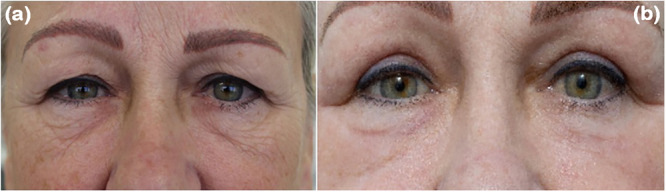 Case 2 Images of Dr. Davin Lim's patient before (a) and after (b) periorbital FACL treatment.
Case 3: 60‐year‐old female, bothered by wrinkles and pigmentation in the facial area. Aiming for single treatment with maximal results.
Agreed upon intervention:
Regarding the periorbital area
-
−
Majority of panelists (71%) recommended using fully ablative CO2.
-
−
29% recommended using high density fractional ablative CO2.
-
−
19% of panelists recommended using fully ablative Erbium:YAG instead of CO2.
-
−
If FACL is chosen, the majority of panelists (55%) agreed upon using ActiveFX handpiece alone with at least two passes. Settings: 100–125 mj/D4–6/250–300 Hz.
-
−
A notable number of panelists (40%) agreed upon using both DeepFX followed by ActiveFX with the following parameters: DeepFX: 10–15 mj/10%–15%, ActiveFX: 100–125 mj/D4–5/250–300 Hz.
Regarding the perioral area
-
−
Some panelists prefer Erbium:YAG over CO2 laser resurfacing for the perioral area.
-
−
33% of panelists recommend the use of only ActiveFX handpiece. Multiple high‐density passes are required to achieve the best results. ActiveFX: 125–150 mj/D4–7/300 Hz.
-
−
Most panelists (67%) agreed upon using both ActiveFX and DeepFX: DeepFX: 15–30 mj/10%–15%, 300 Hz, ActiveFX: 125–150 mj/D4–7/300 Hz.
Tips and Pearls suggested by panelists for the perioral area:
-
−
29% of panelists agreed on a neuromodulator treatment to the area before procedure.
-
−
A wet scrub in between ActiveFX passes within 1.5 cm of the lip vermillion was recommended to produce more dramatic results.
-
−
Feathering the outlines of treatment to blend in results.
Regarding the rest of the face
-
−
52% of panelists agreed upon using both ActiveFX and DeepFX handpieces. DeepFX: 20–30 mj/5%–15%, ActiveFX: 100–125 mj/D5–6/200–300 Hz.
-
−
43% agreed upon using just the ActiveFX handpiece, with 21% recommending high density/nearly ablative parameters.
Figure 4.
 Case 3 Images of Dr. Jill Waibel's patient before (a) and after (b) facial FACL treatment.
Case 4: 70‐year‐old female, willing to go through several milder procedures with 3–4 days maximum downtime even if results would be inferior to a more aggressive procedure.
Agreed upon intervention:
-
−
52% of panelists agreed upon using the ActiveFX handpiece alone.
-
−
DeepFX: 10–15 mj/10%–20%, ActiveFX:100–125 mj/D2–3/100–150 Hz.
-
−
Most panelists recommended 2–4 sessions for maximal results. The optimal intervals between sessions are 6–8 weeks (according to 45% of panelists).
Figure 5.
 Case 4 Images of Dr J. Kevin Duplechain's patient before (a) and after (b) facial FACL treatment.
Case 5: 70‐year male mainly bothered by the nose area. Interested in a single treatment with maximal results without downtime limitations.
Agreed upon intervention:
Regarding the nose
-
−
73% of panelists indicated using 2 mm TrueSpot handpiece (or other debulking device) to excise excess rhinophyma tissue followed by SCAARFX or/and ActiveFX.
-
−
48% of panelists agreed upon using a combination of SCAARFX (150 mJ/5%/2–3 passes) and ActiveFX (125–200 mj, D‐5–9, 300 Hz).
-
−
43% of panelists agreed upon using ActiveFX alone.
Regarding the periorbital area
-
−
Most panelists (57%) agreed upon using the ActiveFX handpiece alone.
-
−
33% of panelists agreed upon using both DeepFX followed by ActiveFX
-
−
DeepFX: 10–20 mj/5%–15%, ActiveFX: 100–150 mj/D3‐5/150–300 Hz.
Regarding the rest of the face
-
−
47% of panelists agree upon using both DeepFX followed by ActiveFX.
-
−
38% of panelists would use ActiveFX alone.
-
−
DeepFX: 15–25 mj/5%–15%, ActiveFX:90–125 mj/D3–5/150–400 Hz.
Postoperation instruction tips for rhinophyma treatment:
-
−
Use of topical antibiotic.
-
−
Administration of low‐dose isotretinoin postprocedure.
-
−
Adequate sun protection.
Figure 6.
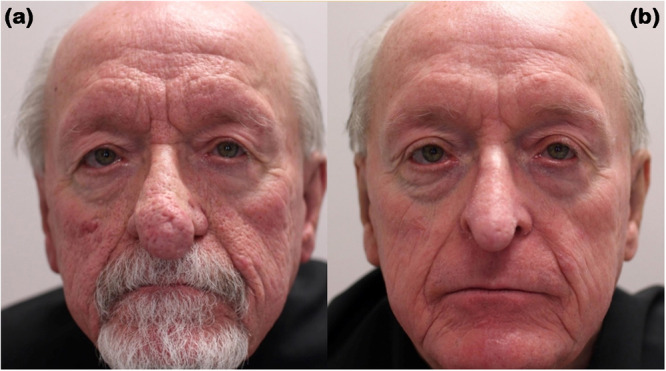 Case 5 Images of Dr Gilly Munavalli's patient before (a) and after (b) facial FACL treatment.
Case 6: 60‐year‐old patient, concerned with the tissue laxity of lower face and neck. Aiming for a single treatment with maximal results.
Agreed upon intervention:
Regarding the lower face area:
-
−
38% of panelists agree upon using both DeepFX followed by ActiveFX.
-
−
DeepFX: 15–20 mj/5%–10%, ActiveFX: 100–150 mj/D3–5/200–300 Hz.
-
−
28% of panelists indicated that laser resurfacing procedure should not be considered in this patient. Treatment options included surgery (face or neck lift) or other nonlaser procedures (examples: Subdermal injectable, helium driven radiofrequency). If considered, FACL should be performed 6 months after surgery.
Regarding the neck area:
-
−
57% of panelists would consider surgery for this patient (neck lift).
-
−
48% of panelists agree that laser skin resurfacing should not be considered for the neck area in this patient.
-
−
if considered, the following setting should be used with caution: DeepFX 12.5–15 mJ/10%–15%, ActiveFX: 80–100 mj/D1–3/125–250 Hz.
Figure 7.
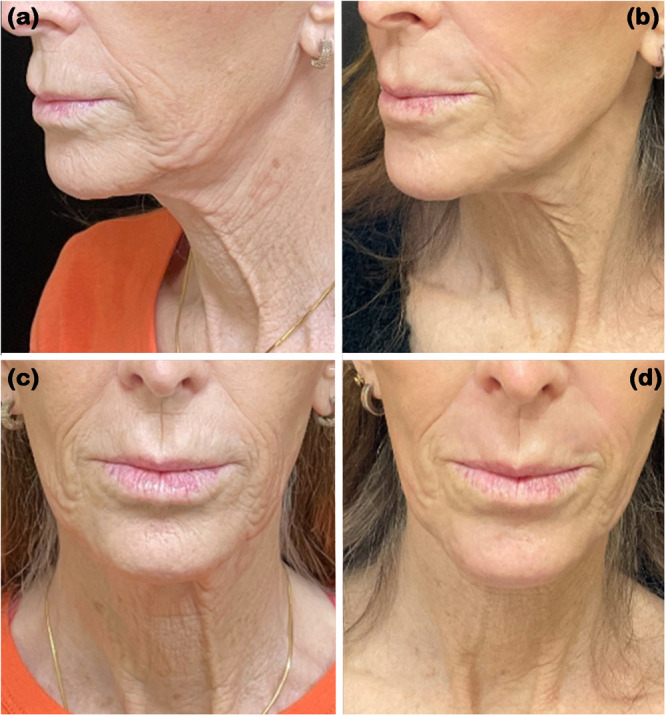 Case 6 Images of Dr Suzanne L. Kilmer's patient before (a, c) and after (b, d) lower face and neck FACL treatment.
Ethics Statement
Consent for the publication of recognizable patient photographs or other identifiable material was obtained by the authors and included at the time of article submission to the journal stating that all patients gave consent with the understanding that this information may be publicly available. The study follows all the tenets of the Declaration of Helsinki.
Conflicts of Interest
Thomas M. Beachkofsky: Works as a clinical trainer and provide consulting services for Lumenis. E. Victor Ross: Past work as a researcher, speaker, and consultant for Lumenis. Kevin Duplechain: Works as a speaker for Lumenis and past honoraria for speaking. Brian S. Biesman: Past research support from Lumenis. Gilly Munavalli: Works with Lumenis as an investigator. Arielle Kauvar: Past research support from Lumenis. Peter Peng: Works as a speaker for Lumenis and past honoraria for speaking. Shangli Lin: Works as a key opinion leader for Lumenis. Jill Waibel: Past work as speaker, advisor and performed paid clinical trials for Lumenis. Matteo T. Clementoni: Works as a consultant of lumenis, received honorarium for travel, workshops, courses, and lectures. Ofir Artzi: Works as a consultant of Lumenis, received honorarium for lectures. Suzanne L. Kilmer: Worked as a consultant for Lumenis. Robert Langdon: Worked as a consultant for Lumenis for developing protocols for single‐pass CO2 laser resurfacing. Daniel P. Friedmann: Works as a consultant, speaker, and performed clinical research for Lumenis. The remaining authors declare no conflicts of interest.
Supporting information
Supporting information.
Acknowledgments
The authors have nothing to report.
References
- 1. Krupa Shankar D., Chakravarthi M., and Shilpakar R., “Carbon Dioxide Laser Guidelines,” Journal of Cutaneous and Aesthetic Surgery 2, no. 2 (2009): 72–80. [DOI] [PMC free article] [PubMed] [Google Scholar]
- 2. Ramsdell W., “Fractional Carbon Dioxide Laser Resurfacing,” Seminars in Plastic Surgery 26, no. 3 (2012): 125–130. [DOI] [PMC free article] [PubMed] [Google Scholar]
- 3. Bonan P. and Verdelli A., “Combined Microwaves and Fractional Microablative CO2 Laser Treatment for Postpartum Abdominal Laxity,” Journal of Cosmetic Dermatology 20, no. 1 (January 2021): 124–131. [DOI] [PubMed] [Google Scholar]
- 4. Oram Y. and Akkaya A. D., “Neck Rejuvenation With Fractional CO2 Laser: Long‐Term Results,” Journal of Clinical and Aesthetic Dermatology 7, no. 8 (2014): 23–29. [PMC free article] [PubMed] [Google Scholar]
- 5. Woodward J. A., Fabi S. G., Alster T., and Colón‐Acevedo B., “Safety and Efficacy of Combining Microfocused Ultrasound With Fractional CO2 Laser Resurfacing for Lifting and Tightening the Face and Neck,” Dermatologic Surgery 40, no. Suppl 12 (2014): S190–S193. [DOI] [PubMed] [Google Scholar]
- 6. Seong G. H., Jin E. M., Ryu T. U., Kim M. H., Park B. C., and Hong S. P., “Fractional Radiofrequency Microneedling Combined With Fractional Carbon Dioxide Laser Treatment for Striae Distensae,” Lasers in Surgery and Medicine 53, no. 2 (2021): 219–226. [DOI] [PubMed] [Google Scholar]
- 7. Mei X. L. and Wang L., “Ablative Fractional Carbon Dioxide Laser Combined With Intense Pulsed Light for the Treatment of Photoaging Skin in Chinese Population: A Split‐Face Study,” Medicine 97, no. 3 (2018): e9494. [DOI] [PMC free article] [PubMed] [Google Scholar]
- 8. Zimbler M. S., Holds J. B., Kokoska M. S., et al., “Effect of Botulinum Toxin Pretreatment on Laser Resurfacing Results: A Prospective, Randomized, Blinded Trial,” Archives of Facial Plastic Surgery 3, no. 3 (2001): 165–169. [DOI] [PubMed] [Google Scholar]
- 9. Friedmann D. P., Fabi S. G., and Goldman M. P., “Combination of Intense Pulsed Light, Sculptra, and Ultherapy for Treatment of the Aging Face,” Journal of Cosmetic Dermatology 13, no. 2 (2014): 109–118. [DOI] [PubMed] [Google Scholar]
- 10. Edkins R. E., Hultman C. S., Collins P., Cairns B., Hanson M., and Carman M., “Improving Comfort and Throughput for Patients Undergoing Fractionated Laser Ablation of Symptomatic Burn Scars,” Annals of Plastic Surgery 74, no. 3 (2015): 293–299. [DOI] [PubMed] [Google Scholar]
- 11. Mirza H. N., Mirza F. N., and Khatri K. A., “Outcomes and Adverse Effects of Ablative vs Nonablative Lasers for Skin Resurfacing: A Systematic Review of 1093 Patients,” Dermatologic Therapy 34, no. 1 (2021): e14432. [DOI] [PubMed] [Google Scholar]
- 12. Shamsaldeen O., Peterson J. D., and Goldman M. P., “The Adverse Events of Deep Fractional CO2: A Retrospective Study of 490 Treatments in 374 Patients,” Lasers in Surgery and Medicine 43, no. 6 (2011): 453–456. [DOI] [PubMed] [Google Scholar]
- 13. Wong I. T. Y. and Richer V., “Prophylaxis of Post‐Inflammatory Hyperpigmentation From Energy‐Based Device Treatments: A Review,” Journal of Cutaneous Medicine and Surgery 25, no. 1 (2021): 77–86. [DOI] [PubMed] [Google Scholar]
- 14. Weinstein C., Ramirez O., and Pozner J., “Postoperative Care Following Carbon Dioxide Laser Resurfacing. Avoiding Pitfalls,” Dermatologic Surgery 24, no. 1 (1998): 51–56. [DOI] [PubMed] [Google Scholar]
- 15. Mysore V., Goel A., Krupashankar D., Aurangabadkar S., Nischal K., and Omprakash H., “Fractional Lasers in Dermatology‐‐Current Status and Recommendations,” Indian Journal of Dermatology, Venereology, and Leprology 77, no. 3 (2011): 369–379. [DOI] [PubMed] [Google Scholar]
- 16. Krupa Shankar D., Chakravarthi M., and Shilpakar R., “Carbon Dioxide Laser Guidelines,” Journal of Cutaneous and Aesthetic Surgery 2, no. 2 (2009): 72–80. [DOI] [PMC free article] [PubMed] [Google Scholar]
Associated Data
This section collects any data citations, data availability statements, or supplementary materials included in this article.
Supplementary Materials
Supporting information.