



Summary
Background
Population-based incidence data on young-adult-onset type 1 diabetes and type 2 diabetes are limited. We aimed to examine secular trends in the incidence of diagnosed type 1 diabetes and type 2 diabetes with an age of onset between 15 and 39 years.
Methods
In this multicountry aggregate data analysis, we assembled eight administrative datasets from high-income jurisdictions and countries (Australia, Denmark, Finland, Hungary, Japan, Scotland, South Korea, and Spain [Catalonia]) that had appropriate data available from an international diabetes consortium (GLOBODIAB) describing incidence by diabetes type among people aged 15–39 years from 2000 to 2020. We modelled type 1 diabetes and type 2 diabetes incidence rates using Poisson regression including age and calendar time by sex.
Findings
During the years 2000–20, there were 349 591 incident diabetes (both types) cases from 346 million personyears of follow-up among people aged 15–39 years. Over time, there was no statistically significant change in the incidence of type 1 diabetes in Hungary and Japan. The incidence of type 1 diabetes significantly increased in Australia, Denmark, Finland, Scotland, South Korea, and Spain, with annual changes ranging from 0·5% to 6·0%. The incidence of type 2 diabetes significantly increased in four of eight jurisdictions (Denmark, Finland, Japan, and South Korea), with annual increases from 2·0% to 8·5%. The magnitude of increase in incidence of type 2 diabetes was greater in Asian than non-Asian jurisdictions. There was no statistically significant change in type 2 diabetes incidence in Australia and Hungary. The incidence of type 2 diabetes significantly decreased in Scotland and Spain, with annual changes of −0·7% and −1·5%, respectively.
Interpretation
There is variability in the trajectory of the incidence of young-adult-onset type 2 diabetes among high-income countries or jurisdictions, with a greater evidence of increase in Asian than non-Asian countries. Evolving trends in the incidence of type 1 and type 2 diabetes in young adults call for the ongoing surveillance of diabetes incidence and a greater research focus on this population.
Funding
US Centers for Disease Control and Prevention, Diabetes Australia Research Programme, and Victoria State Government Operational Infrastructure Support Programme.
Introduction
Reports on the incidence of type 1 diabetes have almost all focused on children, whereas the incidence of type 2 diabetes has typically been reported in the adult population.1,2 These approaches ignore adult-onset type 1 diabetes, and typically obscure young-adult-onset type 2 diabetes, despite the increasing recognition that younger adults represent a growing part of the spectrum of both diabetes types. Evidence from some studies, such as the SEARCH study, suggests that type 2 diabetes diagnosed at a younger age has an aggressive phenotype and a rapidly progressing trajectory of complications.3–5 The incidence of either major type of diabetes in young adulthood might have different trends over time than those seen in the age groups that are well characterised, but there are few data on these trends.5 Notably, in 2021, we have reported that the incidence of type 2 diabetes across the whole population is falling in many high-income countries,6 but whether this applies to younger adults is unknown.
There are several reasons why there is little knowledge of the incidence of young-adult-onset diabetes. First, there is an absence of sufficiently large cohort studies with data on young adults with diabetes; this is because both type 1 and type 2 diabetes in young adults are still too uncommon to be efficiently measured in standard cohort studies. Second, there are challenges in distinguishing type 1 diabetes from type 2 diabetes, especially in youth and early adulthood.7 However, since studies suggest that more than a third of the cases of type 1 diabetes are now occurring in young adulthood8 and type 2 diabetes in children and teenagers and young adults has increased across the globe,3,4 distinguishing diabetes type in young adults is becoming more difficult. Third, no clinical gold standard method to distinguish diabetes type exists. Testing for the presence of autoantibodies might provide some certainty of a diagnosis of type 1 diabetes, but the sensitivity and specificity of these tests are suboptimal.9 The absence of C-peptide is useful for identifying type 1 diabetes, but with the caveat that people with type 1 diabetes have been known to have measurable amounts of C-peptide, especially in the first few years after diagnosis.10 Furthermore, autoantibodies and C-peptide are not routinely measured in all people with diabetes.
Population-based administrative datasets and registries provide an alternative way of estimating the occurrence rates of young-adult-onset diabetes, but there is still a problem with distinguishing diabetes type in such databases,11 because autoantibody status and C-peptide status are rarely available in administrative databases. However, these data resources include other factors that are useful in the ascertainment of diabetes type—namely, time from diagnosis to initiation of insulin therapy, persistence of insulin use, and age at diagnosis of diabetes. Applying criteria on the basis of such variables can allow many cases of diabetes that present with typical clinical features of either type 1 or type 2 diabetes to have their diabetes type readily classified. One analytical approach is to recognise this, and to classify individuals as typical type 1 diabetes, typical type 2 diabetes, and uncertain diabetes type. This approach would allow for an informative analysis of the trends of the incidence of type 1 diabetes and type 2 diabetes in young adults, while recognising the uncertainty in classification.
Therefore, we assembled data from eight nationally or regionally representative administrative datasets to examine the incidence rates and trends of type 1 diabetes and type 2 diabetes among people aged 15–39 years over the time period from 2000 to 2020, or part thereof.
Methods
Study design and data sources
In this multicountry, aggregate data analysis, we used data from a subset of countries or jurisdictions from an international diabetes consortium (GLOBODIAB) that covers more than 20 nationally or regionally representative administrative data sources across the world.6,12 The initial eligibility criteria for inclusion into the consortium have been previously described.6 For this analysis, data sources were required to: (1) have ongoing enrolment of people with diabetes (or regular recruitment of new independent cohorts); (2) record new-onset (incident) diabetes; (3) record sex-specific and age-specific data; and (4) have linkage to medication use or prescription data. Data sources were also required to have accurate information about the number of people in the whole population of the country or jurisdiction (the denominator), the number of people with prevalent diabetes, and the number of deaths among people with and without diabetes.
Algorithm for assessing diabetes type
The definitions of diabetes used in each data source are shown in the appendix (p 6). We classified incident diabetes into typical type 1 diabetes (ie, those with typical clinical features), typical type 2 diabetes, and uncertain diabetes type, based on criteria listed in the panel. Women and girls with gestational diabetes were excluded according to the criteria outlined in the appendix (p 7).
Quality of the included data
Two authors (DJM and LC) independently assessed the quality of data sources using an adaption of the Newcastle-Ottawa Scale (appendix pp 5, 8).13 The quality of the data was classified as low (score 0–4), medium (5–6), or high (7–8).
Statistical analysis
We modelled incidence rates for the three categories of diabetes, using age and calendar time. Data were tabulated into each calendar year and 5-year age groups, with each interval assigned the midpoint value of each age group and calendar time interval. We estimated the incidence rates of diabetes using a Poisson generalised linear model, with a Poisson outcome distribution, log-link function, and log of person-years as the offset. Age–period cohort models14 were fitted using restricted cubic splines for the age, calendar time, and cohort effects. Knots for the splines were placed at evenly spaced quantiles of events at the three variables in the model (age, calendar time, and cohort [calendar time minus age]).
For each data source and sex, we plotted the predicted incidence rates by calendar time for a specific set of ages that were evenly spaced (15, 20, 25, 30, and 35 years). We used the predicted rates in single-year age intervals from the age–period–cohort models for each data source to calculate age-standardised incidence rates using direct standardisation to the 2010 European standard population by calendar time, stratified by sex. We also fitted a set of age–period models with spline age effects but a linear effect of calendar time for each data source to provide an estimate of the annual change in the incidence of diabetes over each period, both overall and by sex. The annual change was expressed as an annual percent change, calculated as (eb–1)*100, where b is the coefficient for calendar time from these models. We calculated 95% CIs using the Wald method, back transformed from log rates within 1·96 SE above and below the point estimate.
Sensitivity analyses
To restrict both types of diabetes to exactly the same age range, we conducted sensitivity analyses where we used the same age range of 15–34 years in people with type 1 and type 2 diabetes. To assess the potential effect of reclassifying uncertain diabetes, we also conducted sensitivity analyses where we apportioned the cases with uncertain diabetes type to typical type 1 diabetes and then to typical type 2 diabetes and repeated the analyses.
This study was approved by the Human Ethics Committee of Alfred Health (VIC, Australia). For all data sources, data were collected as part of routine clinical care and only data custodians had access to individual unit record data. Stata software (version 17.0) was used for the analysis.
Role of the funding sources
The US Centers for Disease Control and Prevention is the employer of MEP. MEP was involved in study design, data interpretation, and editing of the report. All other funders had no role in study design, data collection, data analysis, data interpretation, or writing of the report.
Results
We collected data from 2000 to 2020 or part thereof. Among the consortium members, eight data sources (from Australia, Denmark, Finland, Hungary, Japan, Scotland, South Korea, and Spain [Catalonia]) met the aforementioned criteria. Each data source provided aggregate data for each calendar year on the incidence of diabetes stratified by sex and 5-year age group (15–19 years, 20–24 years, 25–29 years, 30–34 years, and 35–39 years) over the time period from 2000 to 2020 (or a subset thereof; table).
Table:
Summary characteristics of the included data sources, by country or jurisdiction
| Origin of data | Type of data | Years analysed for incidence | Person-years (1000s) | Number of incident diabetes cases* | |
|---|---|---|---|---|---|
| Australia | National Diabetes Services Scheme and Pharmaceutical Benefits Scheme | Registry | 2005–17 | 80 593 | 65 177 |
| Denmark | National Patient Register, prescription database, health insurance database, diabetes quality database, and eye screening database | Registry | 2000–20 | 36 516 | 29 035 |
| Finland | FinDM (Diabetes in Finland) research database | Registry | 2000–17 | 29 596 | 30 258 |
| Hungary | National Health Insurance Fund database | Administrative | 2014–18 | 15 531 | 14 624 |
| Japan | National Database of Health Insurance Claims and Specific Health Check-ups of Japan | Health insurance | 2015–18 | 132 106 | 147 653 |
| Scotland | Scottish Diabetes Research Network–National Diabetes Dataset 2021 | Registry | 2010–20 | 18 568 | 19 808 |
| South Korea | National Health Insurance Service–National Sample Cohort† | Health insurance | 2007–19 | 4778 | 9661 |
| Spain (Catalonia) | Information System for the Development of Research in Primary Care | Administrative | 2006–20 | 28 743 | 33 375 |
Number of cases using the definitions derived for this analysis.
The South Korean data represent 2% of the entire population of South Korea.
The table shows the details for the eight data sources. All sources were from high-income countries or jurisdictions: five from Europe (Denmark, Finland, Hungary, Scotland, and Spain), two from east Asia (Japan and South Korea), and one from Australia. Except for Catalonia, Spain, all other sources included nationally representative data. Source quality scores ranged from 6 to 8 (appendix p 8), indicating adequate quality for each data source.
There were 349 591 incident cases of diabetes, from 346 million person-years of follow-up among people aged 15–39 years (appendix pp 9–10). Trends in the crude incidence rate by diabetes type and jurisdiction in the total population and by sex are shown in the appendix (pp 13–28).
Figure 1 shows age-standardised incidence rates of diabetes by diabetes type, jurisdiction, and sex for all jurisdictions, and figure 2 and the appendix (p 10) show the annual change in age-standardised incidence for people aged 15–39 years by diabetes type, jurisdiction, and sex. Among the total population, there was no statistically significant change in the incidence of typical type 1 diabetes in Hungary and Japan. There was significant increase in the incidence of typical type 1 diabetes in Australia, Denmark, Finland, Scotland, South Korea, and Spain (Catalonia; appendix pp 10,28).
Figure 1: Trends in age-standardised incidence of diagnosed diabetes for people aged 15–39 years, by jurisdiction, sex, and diabetes type.

South Korea is excluded from type 1 diabetes due to insufficient numbers. Shaded areas represent 95% CI.
Figure 2: Annual percentage change in the age-standardised incidence of diagnosed diabetes, by jurisdiction, sex, and diabetes type.

Bars indicate 95% CI. Blue lines indicate men and boys and red lines indicate women and girls.
Among men and boys, there was no statistically significant change in the incidence of typical type 1 diabetes in Australia, Finland, Hungary, and Scotland. The incidence of typical type 1 diabetes significantly decreased in Spain (Catalonia). For Denmark, Japan, and South Korea, the incidence of typical type 1 diabetes significantly increased in men and boys over the study period. For women and girls, the incidence of typical type 1 diabetes significantly increased in Australia, Denmark, Finland, and Spain (Catalonia). There was no statistically significant change in the incidence of typical type 1 diabetes in the other four jurisdictions. The largest increase in the incidence of typical type 1 diabetes in men and boys was observed in South Korea, with an annual change of 15·9% (95% CI 6·3 to 26·2), and in women and girls was observed in Spain (Catalonia), with an annual change of 6·3% (5·5 to 7·1). The largest decrease in the incidence of typical type 1 diabetes was observed in Catalonian men and boys, with an annual change of −3·1% (−4·1 to −2·1). No declines in the incidence of typical type 1 diabetes were seen in women and girls (figure 2; appendix p 10).
Among the total population, there was no statistically significant change in the incidence of typical type 2 diabetes in Australia and Hungary. There was a significant increase in the incidence of typical type 2 diabetes in Denmark, Finland, Japan, and South Korea. In Spain (Catalonia) and Scotland, the incidence of typical type 2 diabetes significantly decreased (appendix pp 10,28).
An increasing incidence of typical type 2 diabetes was observed in both sexes in Denmark, Finland, Japan, and South Korea over the entire observation period (figure 2; appendix p 10). There was no statistically significant change in the incidence of typical type 2 diabetes in Hungary in both sexes. In Australia, Spain (Catalonia), and Scotland, the incidence patterns were mixed by sex (figure 2; appendix p 10).
The highest annual change in the incidence of typical type 2 diabetes was observed in Japanese men and boys at 10·5% (9·8 to 11·2) and South Korean men and boys at 5·4% (4·7 to 6·2). In Australia, the incidence of typical type 2 diabetes significantly increased among men and boys but significantly decreased among women and girls. In Spain (Catalonia) and Scotland, there was a significant decrease in the incidence of typical type 2 diabetes in men and boys and there was no statistically significant change in type 2 diabetes incidence in women and girls (figures 1 and 2; appendix p 10). The largest decrease in typical type 2 diabetes incidence was observed in Spanish men and boys, with an annual change of −2·8% (−3·2 to −2·3) and Australian women and girls at −2·5% (−2·9 to −2·1).
The incidence of type 1 diabetes in both sexes from Australia, Denmark, Finland, and Scotland, Hungarian women and girls, and men and boys from South Korea and Spain (Catalonia) was the highest at the age of 15 years and declined slightly until the age of 35 years. In both sexes from Japan and women and girls from South Korea and Spain (Catalonia), the incidence of type 1 diabetes was lowest at the age of 15 years and peaked at the age of 35 years. For Hungarian men and boys, the age with lowest incidence of type 1 diabetes was 20–25 years and peaked at 35 years (appendix pp 29–36).
When looking at trends in the incidence of diabetes by age, for most jurisdictions, there was no strong evidence to suggest that trends in incidence of typical type 1 diabetes varied by age, except among Australian and Spanish women and girls where the rate of increase in incidence was greater with increasing age (appendix pp 37–52).
The incidence of typical type 2 diabetes increased with increasing age. For most jurisdictions, there was no strong evidence to suggest that the patterns of incidence trends over time differed by age except for Hungary and South Korea, where the rate of increase in incidence over time reduced with increasing age (appendix pp 37–52).
Across the entire observation period, and in all jurisdictions, the overall crude incidence of typical type 2 diabetes was higher than that of typical type 1 diabetes (appendix p 9). When modelled by age, in Japan and South Korea, the incidence of typical type 2 diabetes was higher than that of typical type 1 diabetes at all ages in both sexes (figure 3; appendix pp 41, 43). In Australia, Denmark, Finland, Hungary, Scotland, and Spain (Catalonia), the age at which the incidence of typical type 2 diabetes exceeded the incidence of typical type 1 diabetes for men and boys was approximately 24 years (range 23–25 years) (figure 3; appendix pp 37–40, 42, 44). For women and girls, the age at which the incidence of typical type 2 diabetes exceeded that of typical type 1 diabetes varied by jurisdiction. For Australia and Scotland, the age was 20–21 years, and in Finland and Denmark, it was between 15 and 20 years. For women and girls from Hungary and Spain (Catalonia), the incidence of typical type 2 diabetes was higher than typical type 1 diabetes throughout the whole age range studied.
Figure 3: Incidence rate ratio for typical type 2 diabetes versus typical type 1 diabetes, by sex.
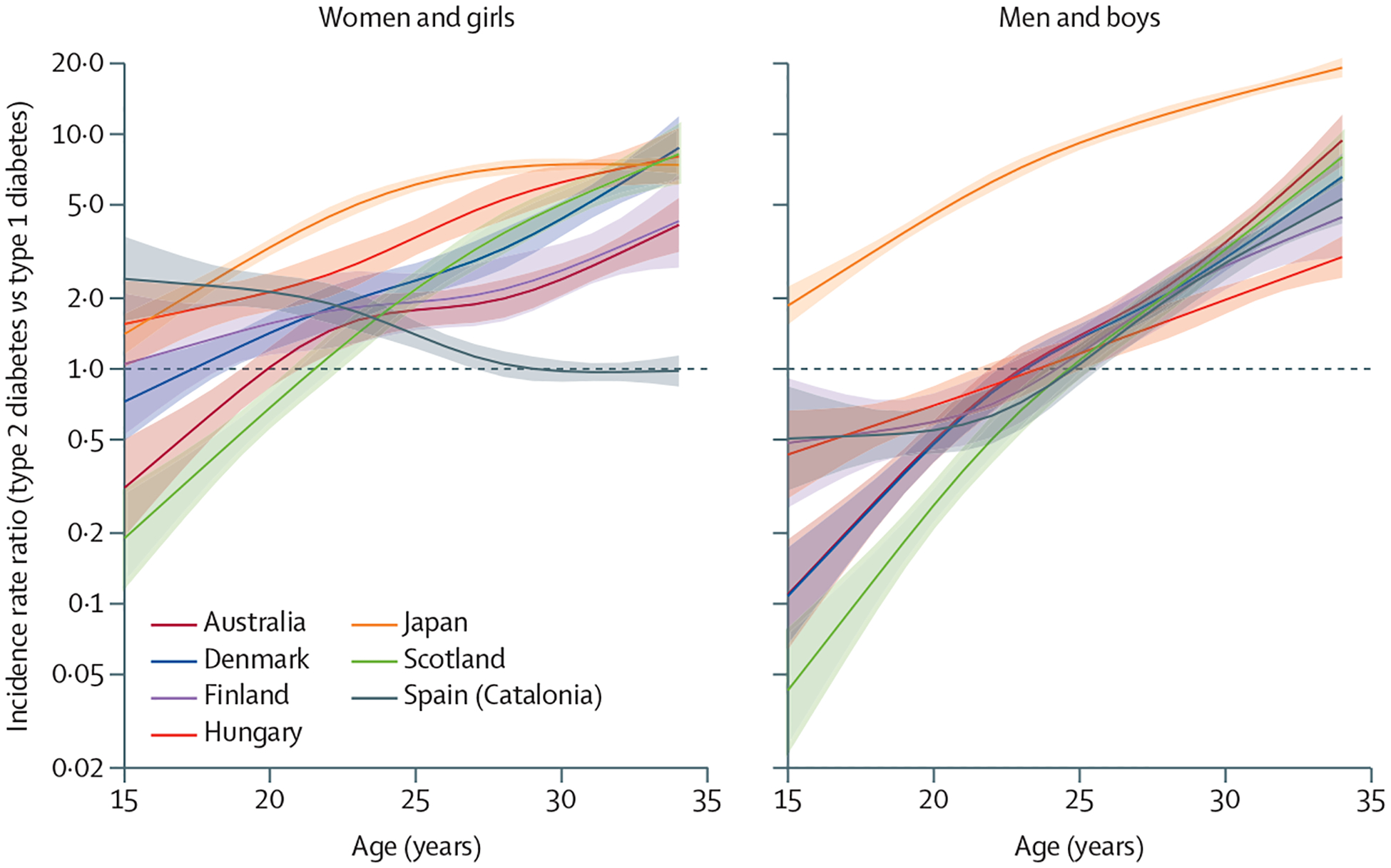
Incidence rate ratio is calculated as the incidence of type 2 diabetes divided by the incidence of type 1 diabetes. South Korea is excluded from this plot due to insufficient numbers in the type 1 diabetes group. Shaded areas represent 95% CI.
Our results were largely similar when we restricted the analyses of incidence trends of type 1 diabetes and type 2 diabetes to a common age range of 15–34 years (appendix pp 11, 53). In sensitivity analyses where all the cases with uncertain diabetes type were assumed to be either type 2 diabetes or type 1 diabetes, trends in the incidence of type 2 diabetes and type 1 diabetes were similar to the primary analysis (appendix pp 12, 54).
Discussion
This analysis of people aged 15–39 years from eight high-income jurisdictions had three main findings. First, the incidence of diagnosed type 1 diabetes significantly increased over time in most countries and jurisdictions (Australia, Denmark, Finland, Scotland, South Korea, and Spain [Catalonia]); there was no statistically significant change in the incidence of type 1 diabetes in Hungary and Japan. Second, the incidence of diagnosed type 2 diabetes significantly increased in 50% of jurisdictions (Denmark, Finland, Japan, and South Korea); there was no statistically significant change or slightly decreasing in the incidence of type 2 diabetes in the others. Of note, the magnitude of increase in type 2 diabetes incidence was greater in Japan and South Korea compared with all other countries or jurisdictions. Third, the incidence of type 2 diabetes exceeded that of type 1 diabetes across all ages examined in Asian countries. For other countries or jurisdictions, the incidence of type 2 diabetes exceeded that of type 1 diabetes starting at the age of 23–25 years in men and boys and the age of 15–21 years in women and girls. Lastly, we did not observe a notable fall in the incidence of type 1 diabetes before the age of 35 years, suggesting that the incidence of type 1 diabetes might persist at meaningful levels well into the fourth and fifth decades of life.
In a previous multi-country analysis among people aged 20 years and older from 24 population-based data sources,6 we showed that the incidence of diabetes was declining in 19 jurisdictions from 2010 onwards. In each of the six jurisdictions (Australia, Denmark, Hungary, Scotland, South Korea, and Spain) included in both studies, the incidence of type 2 diabetes declined when considering the total adult population.6 However, we now show that, in younger people (aged 15–39 years), over the same time period, the incidence of type 2 diabetes significantly increased in Denmark and South Korea. There was no statistically significant change in Australia and Hungary. In Scotland and Spain (Catalonia), the incidence fell in the younger age group, but the rate of decline was much less than previously reported for the whole adult age range. In the current analysis of younger adults, the incidence of type 2 diabetes only increased in four of eight countries or jurisdictions. This finding was somewhat surprising given the many reviews showing increases in the prevalence of young-onset type 2 diabetes.3,4 In Japan and South Korea, the increase in incidence in type 2 diabetes is clear, but it is unclear why there is an absence of increases in other populations with a predominantly European background, and suggests that the epidemic of young-adult-onset type 2 diabetes might be a more important feature of non-White than White populations.
A novel feature of these results is the documentation of the approximate age at which the incidence of type 2 diabetes exceeds the incidence of type 1 diabetes. In our data, in men and boys from all countries and jurisdictions, except Japan and South Korea, the age at which the incidence of typical type 2 diabetes became higher than typical type 1 diabetes was consistent at 23–25 years. For men and boys from Japan and South Korea, the incidence of type 2 diabetes was higher than type 1 diabetes across all ages within the 15–39-year range. For women and girls, the age at which incidence of type 2 diabetes exceeded that of type 1 diabetes was lower, ranging from 15 to 21 years. Potential explanations for the lower crossover age in women and girls could be the inadvertent inclusion of gestational diabetes and the higher incidence of type 2 diabetes in women and girls than men and boys, commonly reported during the teenage years.15–17 The presentation of the diabetes incidence data in this way is unique and is informative of the relative likelihood that a newly diagnosed diabetes case at a given age is either type 2 diabetes or type 1 diabetes.
Our observation that the incidence of type 1 diabetes was highest at the youngest included age (15 years) in most European populations was consistent with previous data.18 However, we also showed that the decline after the age of 15 years is not as sharp as once was thought, and in some countries and jurisdictions (Japan, and women and girls in South Korea and Spain [Catalonia]), the incidence of type 1 diabetes did in fact rise from the ages of 15–35 years. The reason why we observed this is not clear and might relate to the strict definition of diabetes type that we adopted. Further studies exploring how to better validate diabetes type in registers are warranted.
Trends in the incidence of type 2 diabetes in people aged 15–39 years were reported in 2022 using Global Burden of Diseases, Injuries, and Risk Factors Study (GBD) modelled data. Xie and colleagues19 reported that the incidence of type 2 diabetes in young people is increasing in almost all countries globally. Estimates of the incidence rates of type 2 diabetes in this GBD study are 5–6 times higher than our data. The reasons for this are not clear, but the GBD incidence data are derived from the modelling of prevalence and mortality rates rather than from counts of actual incident cases, as is the case with our data, and they include undiagnosed diabetes, whereas our data is only diagnosed diabetes. We further strengthened our analysis by adopting a robust approach to assigning diabetes type.
The prevalence of young-onset type 2 diabetes is consistently higher in Asian populations than in White populations.4,20 Our findings, demonstrating the largest increases in type 2 diabetes incidence over time and the greater magnitude of type 2 diabetes incidence in the two non-White populations compared with the six predominantly White populations, corroborate published data showing a higher incidence of type 2 diabetes among young people in Asian versus non-Asian populations.4,21
A key strength of this work is the large and representative data sources. The relatively narrow 95% CIs around the data for most countries and jurisdictions (except Japan and South Korea for typical type 1 diabetes, and for Hungary) confirm the benefits of such large numbers for addressing the primary aims. Additionally, data were prepared under a detailed and predefined protocol to ensure the age groups and classification of diabetes type were harmonised as much as possible. Furthermore, we assessed the quality of these data to be high in most of these data sources.6,13 However, our work has limitations. First, there is no currently accepted method to separate type 2 diabetes from type 1 diabetes in administrative databases. We used standard clinical criteria to classify diabetes type. However, our classification algorithm excluded people with type 1 diabetes onset at the age of 35–39 years from the typical type 1 diabetes group, even if their clinical picture might otherwise have been typical of type 1 diabetes. All those with type 2 diabetes who went onto insulin therapy within the first 2 years were also excluded from category of typical type 2 diabetes, even if some might have typical type 2 diabetes. Second, we assumed that there were no trends in underlying data availability in the populations studied over time. Third, the number of incident cases of type 1 diabetes in South Korea was small and thus we were not able to discern clear trends by age among those with type 1 diabetes. Fourth, we only had 4–5 years of data from Hungary and Japan, which hampered our ability to understand long-term trends of incidence in these countries. Fifth, despite the fact that we harmonised our strict definitions of diabetes type and were careful in excluding gestational diabetes from the data, some misclassification of diabetes type might still be present. Sixth, 10–22% of cases of incident diabetes were classified as uncertain diabetes type, raising the possibility that, were we able to accurately classify each individual, the observed trends in type 1 diabetes or type 2 diabetes might have differed. However, sensitivity analyses in which all cases with uncertain diabetes type were allocated to either type 1 diabetes or to type 2 diabetes had no material influence on the observed trends of either diabetes type. Seventh, we cannot exclude the possibility that diabetes-specific International Classification of Diseases 10 codes used to capture diabetes type might not be applied reliably in all settings. It is possible that there were variations over time in the reliability of capturing all new cases of diabetes and of their typing. Eighth, the quality assessment score might not fully capture the absence of the reliability of the data used in this analysis. Lastly, we assumed that time trends were linear, which might not be the case.
Although we showed that the incidence of young-adult-onset type 2 diabetes is increasing in several high-income countries and jurisdictions, the magnitude of the increase tended to be greater in the younger ages of the 15–39 year age range and was higher in Asian countries compared with all other countries. We also showed that type 1 diabetes is increasing over time, albeit modestly in most jurisdictions. Against the background of young-onset type 2 diabetes being associated with an aggressive phenotype and a rapid trajectory of complications,4,22 and current data on the lifetime burden of type 1 diabetes, our results might cause concern. Given the considerable health and economic effect of diabetes over a lifetime, the prevention of diabetes and its complications needs to be a priority.
Supplementary Material
Research in context.
Evidence before this study
Although trends in the incidence of type 1 diabetes in children and adolescents and trends in the incidence of type 2 diabetes in adults are both well characterised, the incidence of type 1 diabetes and type 2 diabetes in young adults is poorly reported, at least in part due to challenges in distinguishing diabetes type in this age group. Well documented rises in the prevalence of type 2 diabetes in younger adults indicate the importance of understanding incidence.
We previously published a systematic review of studies reporting trends in the incidence of total diabetes or type 2 diabetes from Jan 1, 1980, to Dec 31, 2017. We observed that incidence trends of type 2 diabetes in adults are well characterised, but not in young people. We subsequently searched MEDLINE for reports in English of population-based studies on trends in the incidence of diabetes from Jan 1, 2018, to March 13, 2024, using the search terms (“diabetes” OR “diabetes, type 1” OR “diabetes, type 2”) AND (“incidence” OR “follow up studies” OR “cohort studies” OR “longitudinal studies” OR “prospective studies” OR “registry”) AND “young adult”. We also reviewed studies reporting trends in the incidence of type 1 diabetes and type 2 diabetes that were included in the International Diabetes Federation Diabetes Atlas tenth edition (2022). We noted that most papers reported trends in the incidence of type 1 diabetes among children younger than 15 years or adolescents.
Added value of this study
To the best of our knowledge, this is the first study to examine trends in the incidence of type 1 and type 2 diabetes in a series of population-based data among people aged 15–39 years. We applied strict algorithms to separate diabetes type using well described distinguishing features. We showed that increases in the incidence of type 2 diabetes among the young adult population were not consistent across the included jurisdictions. Increases in the incidence of type 2 diabetes were substantially greater in the two Asian jurisdictions than in all other jurisdictions. Type 1 diabetes increased modestly across most jurisdictions in young adults.
Implications of all the available evidence
Our findings indicate that the increase in the burden of young-adult-onset diabetes (15–39 years) is not consistent between countries and suggest that young-adult-onset type 2 diabetes might be increasing more in populations in Asia. Changing patterns in the incidence of type 1 and type 2 diabetes in young adults call for a greater research focus on this population.
Panel: Classification of diabetes type among people with incident diagnosed diabetes.
Definition of typical type 1 diabetes
Meeting all four of the following criteria:
Clinical diabetes diagnosis before the age of 35 years
The time between date of diagnosis and date of first insulin prescription was less than 1 year
Continuous insulin use since its initiation
Never been treated with non-insulin glucose-lowering drugs other than metformin
Definition of typical type 2 diabetes
No insulin therapy within the first 2 years of clinical diabetes diagnosis
Definition of uncertain diabetes type
All other people with diagnosed diabetes
Those with gestational diabetes, secondary diabetes, maturity-onset diabetes of the young (MODY), and rare forms of diabetes were excluded from the analysis.
Acknowledgments
We thank the people with diabetes, health service staff, and organisations involved in providing data and setting up, maintaining, and overseeing the collation of data for people with diabetes in Scotland. Scottish data linkage was performed, and data were provided, by the Information Services Division of NHS National Services Scotland. We acknowledge the work of Diabetes Australia and the Australian Institute of Health and Welfare for supplying the Australian data. We thank Toshimasa Yamauchi (The University of Tokyo, Tokyo, Japan), Takehiro Sugiyama (Diabetes and Metabolism Information Center, Research Institute; Institute for Global Health Policy Research, Bureau of International Health Cooperation; National Center for Global Health and Medicine, Tokyo, Japan; Department of Health Services Research, University of Tsukuba, Tsukuba, Japan), Tatsuya Noda (Nara Medical University, Nara, Japan), and Tomoya Myojin (Nara Medical University, Nara, Japan) for their comments and analytical support. This study was funded by the US Centers for Disease Control and Prevention (contract #75D30121P11718) and a Diabetes Australia Research Programme grant (number Y18G-MAGD). This work was also partly supported by the Victoria State Government Operational Infrastructure Support Programme. Data for Scotland were submitted on behalf of the Scottish Diabetes Research Network epidemiology group; this network is supported by NHS Research Scotland. Data for Japan were supported by labour research grants from the Ministry of Health, Labour and Welfare of Japan (grant numbers 20FA1016 and 21IA1006). Toshimasa Yamauchi was supported by the Health and Labor Sciences Research Grant (grant numbers 23FA1020 and 20FA1016). In South Korea, this study used the National Health Insurance Service (NHIS) National Sample Cohort (research approval number NHIS-2023–2-229) made by the NHIS. The authors declare no conflict of interest with the NHIS. EWG was supported by Science Foundation Ireland (grant number 22/RP/10091) at Royal College of Surgeons in Ireland. The findings and conclusions in this report are those of the authors and do not necessarily represent the official position of the US Centers for Disease Control and Prevention.
Declaration of interests
BC has received stock or stock options from Novo Nordisk. HMC has received payments or honoraria for speakers bureaus from Novo Nordisk; has been supported for participation on an Advisory Board from Novo Nordisk and Bayer AG; and has received stock or stock options from Roche Pharmaceuticals and Bayer AG. ZK is employed by MSD Pharma Hungary, outside the current work. YN received payment or honoraria for lectures, presentations, speakers bureaus, manuscript writing, or educational events from Sanofi, Daiichi Sankyo, and DeSC Healthcare. DM has received consulting fees from AB Biotics, Amarna, Ferrer, Eli Lilly, MSD, Novo Nordisk, and Sanofi; and has received payment or honoraria for lectures, presentations, speakers bureaus, manuscript writing, or educational events from Abbott, Amgen, AstraZeneca, Gilead, Eli Lilly, Menarini, Novo Nordisk, and Sanofi. JES has received consulting fees from AstraZeneca, Sanofi, Novo Nordisk, MSD, Eli Lilly, Pfizer, and GSK; and has also received payment or honoraria for lectures, presentations, speakers bureaus, manuscript writing, or educational events from AstraZeneca, Mylan, Sanofi, Boehringer Ingelheim, Zuellig, and Abbott.
Footnotes
See Online for appendix
Data sharing
Aggregated data might be made available upon reasonable request to the corresponding author (dianna.magliano@baker.edu.au). There might be limitations on what the data can be used for, subject to approval from the data custodians.
References
- 1.Ogle GD, James S, Dabelea D, et al. Global estimates of incidence of type 1 diabetes in children and adolescents: results from the International Diabetes Federation Atlas, 10th edition. Diabetes Res Clin Pract 2022; 183: 109083. [DOI] [PubMed] [Google Scholar]
- 2.Magliano DJ, Islam RM, Barr ELM, et al. Trends in incidence of total or type 2 diabetes: systematic review. BMJ 2019; 366: l5003. [DOI] [PMC free article] [PubMed] [Google Scholar]
- 3.Viner R, White B, Christie D. Type 2 diabetes in adolescents: a severe phenotype posing major clinical challenges and public health burden. Lancet 2017; 389: 2252–60. [DOI] [PubMed] [Google Scholar]
- 4.Magliano DJ, Sacre JW, Harding JL, Gregg EW, Zimmet PZ, Shaw JE. Young-onset type 2 diabetes mellitus - implications for morbidity and mortality. Nat Rev Endocrinol 2020; 16: 321–31. [DOI] [PubMed] [Google Scholar]
- 5.Dabelea D, Stafford JM, Mayer-Davis EJ, et al. Association of type 1 diabetes vs type 2 diabetes diagnosed during childhood and adolescence with complications during teenage years and young adulthood. JAMA 2017; 317: 825–35. [DOI] [PMC free article] [PubMed] [Google Scholar]
- 6.Magliano DJ, Chen L, Islam RM, et al. Trends in the incidence of diagnosed diabetes: a multicountry analysis of aggregate data from 22 million diagnoses in high-income and middle-income settings. Lancet Diabetes Endocrinol 2021; 9: 203–11. [DOI] [PMC free article] [PubMed] [Google Scholar]
- 7.Thomas NJ, Jones AG. The challenges of identifying and studying type 1 diabetes in adults. Diabetologia 2023; 66: 2200–12. [DOI] [PMC free article] [PubMed] [Google Scholar]
- 8.Australian Institute of Health and Welfare. Diabetes: Australian facts. 2023. https://www.aihw.gov.au/reports/diabetes/diabetes/contents/how-common-is-diabetes/type-1-diabetes (accessed Feb 2, 2024).
- 9.Jones AG, McDonald TJ, Shields BM, Hagopian W, Hattersley AT. Latent autoimmune diabetes of adults (LADA) is likely to represent a mixed population of autoimmune (type 1) and nonautoimmune (type 2) diabetes. Diabetes Care 2021; 44: 1243–51. [DOI] [PMC free article] [PubMed] [Google Scholar]
- 10.Jones AG, Hattersley AT. The clinical utility of C-peptide measurement in the care of patients with diabetes. Diabet Med 2013; 30: 803–17. [DOI] [PMC free article] [PubMed] [Google Scholar]
- 11.Sajjadi SF, Sacre JW, Chen L, Wild SH, Shaw JE, Magliano DJ. Algorithms to define diabetes type using data from administrative databases: a systematic review of the evidence. Diabetes Res Clin Pract 2023; 203: 110859. [DOI] [PubMed] [Google Scholar]
- 12.Magliano DJ, Chen L, Carstensen B, et al. Trends in all-cause mortality among people with diagnosed diabetes in high-income settings: a multicountry analysis of aggregate data. Lancet Diabetes Endocrinol 2022; 10: 112–19. [DOI] [PMC free article] [PubMed] [Google Scholar]
- 13.Wells G, Shea B, O’Connell D, et al. The Newcastle–Ottawa Scale (NOS) for assessing the quality of nonrandomised studies in meta-analyses. 2014. http://www.ohri.ca/programs/clinical_epidemiology/oxford.asp (accessed Sept 1, 2023).
- 14.Carstensen B Age-period-cohort models for the Lexis diagram. Stat Med 2007; 26: 3018–45. [DOI] [PubMed] [Google Scholar]
- 15.Shah AS, Nadeau KJ, Dabelea D, Redondo MJ. Spectrum of phenotypes and causes of type 2 diabetes in children. Annu Rev Med 2022; 73: 501–15. [DOI] [PMC free article] [PubMed] [Google Scholar]
- 16.Lawrence JM, Divers J, Isom S, et al. Trends in prevalence of type 1 and type 2 diabetes in children and adolescents in the US, 2001–2017. JAMA 2021; 326: 717–27. [DOI] [PMC free article] [PubMed] [Google Scholar]
- 17.Divers J, Mayer-Davis EJ, Lawrence JM, et al. Trends in incidence of type 1 and type 2 diabetes among youths - selected counties and Indian reservations, United States, 2002–2015. MMWR Morb Mortal Wkly Rep 2020; 69: 161–65. [DOI] [PMC free article] [PubMed] [Google Scholar]
- 18.Norris JM, Johnson RK, Stene LC. Type 1 diabetes-early life origins and changing epidemiology. Lancet Diabetes Endocrinol 2020; 8: 226–38. [DOI] [PMC free article] [PubMed] [Google Scholar]
- 19.Xie J, Wang M, Long Z, et al. Global burden of type 2 diabetes in adolescents and young adults, 1990–2019: systematic analysis of the Global Burden of Disease Study 2019. BMJ 2022; 379: e072385. [DOI] [PMC free article] [PubMed] [Google Scholar]
- 20.Bjornstad P, Chao LC, Cree-Green M, et al. Youth-onset type 2 diabetes mellitus: an urgent challenge. Nat Rev Nephrol 2023; 19: 168–84. [DOI] [PMC free article] [PubMed] [Google Scholar]
- 21.Wagenknecht LE, Lawrence JM, Isom S, et al. Trends in incidence of youth-onset type 1 and type 2 diabetes in the USA, 2002–18: results from the population-based SEARCH for Diabetes in Youth study. Lancet Diabetes Endocrinol 2023; 11: 242–50. [DOI] [PMC free article] [PubMed] [Google Scholar]
- 22.Misra S, Ke C, Srinivasan S, et al. Current insights and emerging trends in early-onset type 2 diabetes. Lancet Diabetes Endocrinol 2023; 11: 768–82. [DOI] [PubMed] [Google Scholar]
Associated Data
This section collects any data citations, data availability statements, or supplementary materials included in this article.
Supplementary Materials
Data Availability Statement
Aggregated data might be made available upon reasonable request to the corresponding author (dianna.magliano@baker.edu.au). There might be limitations on what the data can be used for, subject to approval from the data custodians.