



Abstract
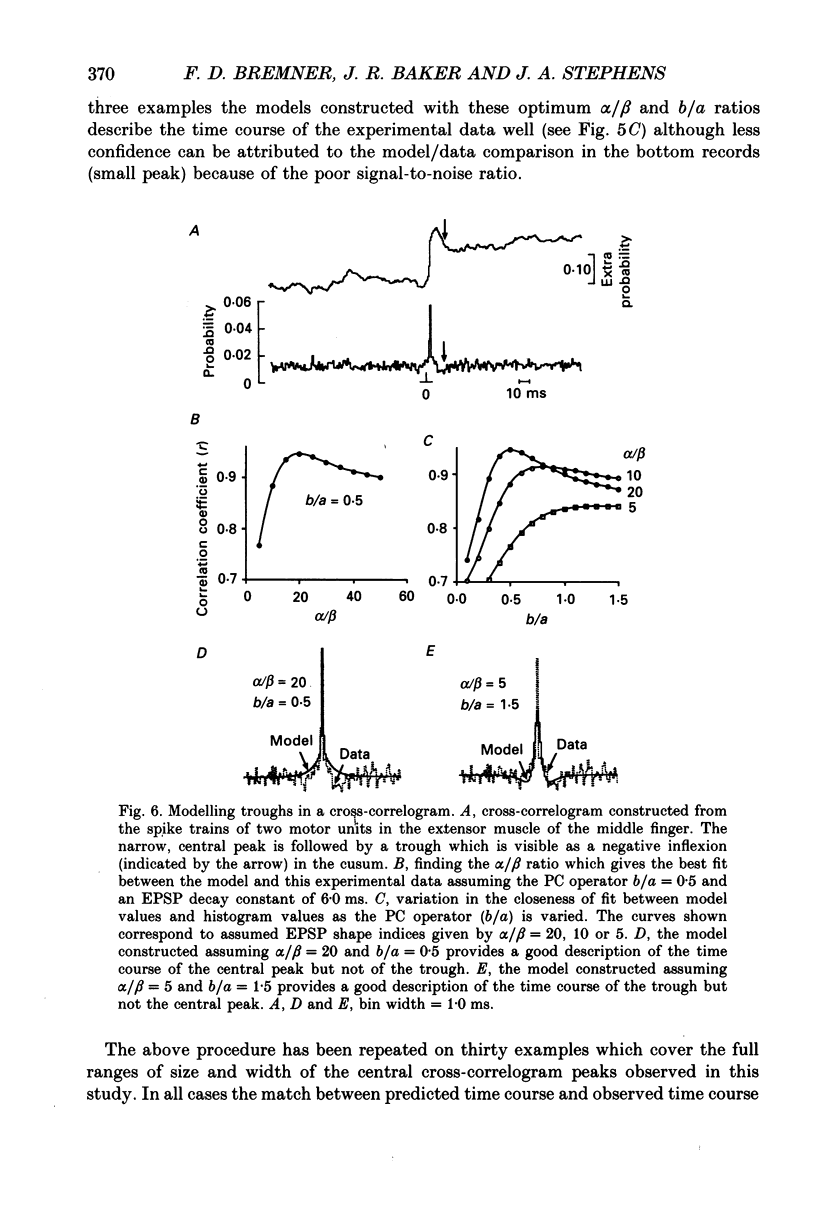
1. Cross-correlation analysis of the discharges of individual motor units recorded from various different finger muscles has been performed during weak, isometric, voluntary contractions in man. 2. The dominant feature in 88% of the cross-correlograms studied was a narrow, central peak, the area of which significantly exceeded that expected for independent processes (P less than 0.001). The highest bin counts in these central peaks were mostly within 5 ms of time zero in the histograms, and the base of these peaks extended between 5 and 31 ms (modal value = 13 ms with 90% of the values lying between 8 and 18 ms). The width and displacement of the central cross-correlogram peaks were similar irrespective of whether the contributory spike trains were recorded from motor units active in the same finger muscle or recorded from motor units in different, co-activated finger muscles. 3. The time course of the central peaks in this study was found to be consistent with the hypothesis that it is generated by the joint occurrence of EPSPs evoked in motoneurones by branches of common stem presynaptic fibres using the theoretical model developed by Kirkwood (Kirkwood & Sears, 1978). The model parameters providing the best fit with our experimental data imply that synaptic contacts on motoneurones made by these common inputs lie on average peripherally in the dendritic tree and generate small (less than 300 microV) EPSPs superimposed on a high level of background synaptic noise. 4. Minima (troughs) were found either side of the central peak in 27% of the cross-correlograms studied, and their appearance was invariably associated with a large central peak. These secondary features could not be modelled with the same operator parameters that describe the central peaks. Their presence was particularly noticed in association with very regular discharges from the output motoneurones. 5. Smaller and broader secondary peaks symmetrically displaced 30-55 ms either side of the large, narrow central peak were observed in 7% of the cross-correlograms studied. We suggest that these secondary features which were found at lags shorter than the interspike interval of the contributory motor unit spike trains reflect the autocorrelation functions of the spike trains of common input fibres. On this basis the observed displacement of these secondary peaks from the primary feature in the cross-correlogram indicate firing rates for common input fibres in the range 18-33 impulses s-1. 6. In a small number of cases (1.4%) the cross-correlogram was flat and indistinguishable from the results of cross-correlating independent spike train data.
Full text
PDF




Selected References
These references are in PubMed. This may not be the complete list of references from this article.
- Adams L., Datta A. K., Guz A. Synchronization of motor unit firing during different respiratory and postural tasks in human sternocleidomastoid muscle. J Physiol. 1989 Jun;413:213–231. doi: 10.1113/jphysiol.1989.sp017650. [DOI] [PMC free article] [PubMed] [Google Scholar]
- Adrian E. D., Bronk D. W. The discharge of impulses in motor nerve fibres: Part I. Impulses in single fibres of the phrenic nerve. J Physiol. 1928 Sep 18;66(1):81–101. doi: 10.1113/jphysiol.1928.sp002509. [DOI] [PMC free article] [PubMed] [Google Scholar]
- Bremner F. D., Baker J. R., Stephens J. A. Variation in the degree of synchronization exhibited by motor units lying in different finger muscles in man. J Physiol. 1991 Jan;432:381–399. doi: 10.1113/jphysiol.1991.sp018390. [DOI] [PMC free article] [PubMed] [Google Scholar]
- Conradi S. Ultrastructure of dorsal root boutons on lumbosacral motoneurons of the adult cat, as revealed by dorsal root section. Acta Physiol Scand Suppl. 1969;332:85–115. [PubMed] [Google Scholar]
- Datta A. K., Stephens J. A. Synchronization of motor unit activity during voluntary contraction in man. J Physiol. 1990 Mar;422:397–419. doi: 10.1113/jphysiol.1990.sp017991. [DOI] [PMC free article] [PubMed] [Google Scholar]
- Davey N. J., Ellaway P. H., Stein R. B. Statistical limits for detecting change in the cumulative sum derivative of the peristimulus time histogram. J Neurosci Methods. 1986 Aug;17(2-3):153–166. doi: 10.1016/0165-0270(86)90068-3. [DOI] [PubMed] [Google Scholar]
- De Luca C. J., Mambrito B. Voluntary control of motor units in human antagonist muscles: coactivation and reciprocal activation. J Neurophysiol. 1987 Sep;58(3):525–542. doi: 10.1152/jn.1987.58.3.525. [DOI] [PubMed] [Google Scholar]
- Dietz V., Bischofberger E., Wita C., Freund H. J. Correlation between the dischanges of two simultaneously recorded motor units and physiological tremor. Electroencephalogr Clin Neurophysiol. 1976 Jan;40(1):97–105. doi: 10.1016/0013-4694(76)90183-8. [DOI] [PubMed] [Google Scholar]
- Edwards F. R., Hirst G. D., Silinsky E. M. Interaction between inhibitory and excitatory synaptic potentials at a peripheral neurone. J Physiol. 1976 Aug;259(3):647–663. doi: 10.1113/jphysiol.1976.sp011487. [DOI] [PMC free article] [PubMed] [Google Scholar]
- Ellaway P. H. Cumulative sum technique and its application to the analysis of peristimulus time histograms. Electroencephalogr Clin Neurophysiol. 1978 Aug;45(2):302–304. doi: 10.1016/0013-4694(78)90017-2. [DOI] [PubMed] [Google Scholar]
- Feldman A. G., Orlovsky G. N. Activity of interneurons mediating reciprocal 1a inhibition during locomotion. Brain Res. 1975 Feb 7;84(2):181–194. doi: 10.1016/0006-8993(75)90974-9. [DOI] [PubMed] [Google Scholar]
- Fetz E. E., Gustafsson B. Relation between shapes of post-synaptic potentials and changes in firing probability of cat motoneurones. J Physiol. 1983 Aug;341:387–410. doi: 10.1113/jphysiol.1983.sp014812. [DOI] [PMC free article] [PubMed] [Google Scholar]
- Gustafsson B., McCrea D. Influence of stretch-evoked synaptic potentials on firing probability of cat spinal motoneurones. J Physiol. 1984 Feb;347:431–451. doi: 10.1113/jphysiol.1984.sp015074. [DOI] [PMC free article] [PubMed] [Google Scholar]
- Jack J. J., Miller S., Porter R., Redman S. J. The time course of minimal excitory post-synaptic potentials evoked in spinal motoneurones by group Ia afferent fibres. J Physiol. 1971 Jun;215(2):353–380. doi: 10.1113/jphysiol.1971.sp009474. [DOI] [PMC free article] [PubMed] [Google Scholar]
- Kirkwood P. A. On the use and interpretation of cross-correlations measurements in the mammalian central nervous system. J Neurosci Methods. 1979 Aug;1(2):107–132. doi: 10.1016/0165-0270(79)90009-8. [DOI] [PubMed] [Google Scholar]
- Kirkwood P. A., Sears T. A. Proceedings: The average common excitation (ACE) potential and its significance. J Physiol. 1976 Jul;259(1):36P–37P. [PubMed] [Google Scholar]
- Kirkwood P. A., Sears T. A., Stagg D. Proceedings: Synchronized firing of respiratory motoneurones during spontaneous breathing in the anaesthetized cat. J Physiol. 1974 May;239(1):11P–13P. [PubMed] [Google Scholar]
- Kirkwood P. A., Sears T. A. The effects of single afferent impulses on the probability of firing of external intercostal motoneurones in the cat. J Physiol. 1982 Jan;322:315–336. doi: 10.1113/jphysiol.1982.sp014039. [DOI] [PMC free article] [PubMed] [Google Scholar]
- Kirkwood P. A., Sears T. A. The synaptic connexions to intercostal motoneurones as revealed by the average common excitation potential. J Physiol. 1978 Feb;275:103–134. doi: 10.1113/jphysiol.1978.sp012180. [DOI] [PMC free article] [PubMed] [Google Scholar]
- Kirkwood P. A., Sears T. A., Tuck D. L., Westgaard R. H. Variations in the time course of the synchronization of intercostal motoneurones in the cat. J Physiol. 1982 Jun;327:105–135. doi: 10.1113/jphysiol.1982.sp014223. [DOI] [PMC free article] [PubMed] [Google Scholar]
- Knox C. K. Cross-correlation functions for a neuronal model. Biophys J. 1974 Aug;14(8):567–582. doi: 10.1016/S0006-3495(74)85936-9. [DOI] [PMC free article] [PubMed] [Google Scholar]
- Knox C. K., Poppele R. E. Correlation analysis of stimulus-evoked changes in excitability of spontaneously firing neurons. J Neurophysiol. 1977 May;40(3):616–625. doi: 10.1152/jn.1977.40.3.616. [DOI] [PubMed] [Google Scholar]
- Lemon R. N., Mantel G. W. The influence of changes in discharge frequency of corticospinal neurones on hand muscles in the monkey. J Physiol. 1989 Jun;413:351–378. doi: 10.1113/jphysiol.1989.sp017658. [DOI] [PMC free article] [PubMed] [Google Scholar]
- Moore G. P., Segundo J. P., Perkel D. H., Levitan H. Statistical signs of synaptic interaction in neurons. Biophys J. 1970 Sep;10(9):876–900. doi: 10.1016/S0006-3495(70)86341-X. [DOI] [PMC free article] [PubMed] [Google Scholar]
- Munson J. B., Sypert G. W. Properties of single fibre excitatory post-synaptic potentials in triceps surae motoneurones. J Physiol. 1979 Nov;296:329–342. doi: 10.1113/jphysiol.1979.sp013008. [DOI] [PMC free article] [PubMed] [Google Scholar]
- Perkel D. H., Gerstein G. L., Moore G. P. Neuronal spike trains and stochastic point processes. II. Simultaneous spike trains. Biophys J. 1967 Jul;7(4):419–440. doi: 10.1016/S0006-3495(67)86597-4. [DOI] [PMC free article] [PubMed] [Google Scholar]
- Porter R., Hore J. Time course of minimal corticomotoneuronal excitatory postsynaptic potentials in lumbar motoneurons of the monkey. J Neurophysiol. 1969 May;32(3):443–451. doi: 10.1152/jn.1969.32.3.443. [DOI] [PubMed] [Google Scholar]
- Rall W., Burke R. E., Smith T. G., Nelson P. G., Frank K. Dendritic location of synapses and possible mechanisms for the monosynaptic EPSP in motoneurons. J Neurophysiol. 1967 Sep;30(5):1169–1193. doi: 10.1152/jn.1967.30.5.1169. [DOI] [PubMed] [Google Scholar]
- Sears T. A., Stagg D. Short-term synchronization of intercostal motoneurone activity. J Physiol. 1976 Dec;263(3):357–381. doi: 10.1113/jphysiol.1976.sp011635. [DOI] [PMC free article] [PubMed] [Google Scholar]
- Stein R. D., Weaver L. C. Multi- and single-fibre mesenteric and renal sympathetic responses to chemical stimulation of intestinal receptors in cats. J Physiol. 1988 Feb;396:155–172. doi: 10.1113/jphysiol.1988.sp016956. [DOI] [PMC free article] [PubMed] [Google Scholar]
- TAYLOR A. The significance of grouping of motor unit activity. J Physiol. 1962 Jul;162:259–269. doi: 10.1113/jphysiol.1962.sp006930. [DOI] [PMC free article] [PubMed] [Google Scholar]