


Abstract
Background
Small bowel obstruction (SBO) is one of the most common emergent complications of general surgery. Intra‐abdominal adhesions are the leading cause of SBO. Because surgery can induce new adhesions, non‐operative management is preferred in the absence of signs of peritonitis or strangulation. Oral traditional Chinese herbal medicine has long been used as a non‐operative therapy to treat adhesive SBO in China. Many controlled trials have been conducted to investigate its therapeutic value in resolving adhesive SBO.
Objectives
The aim of this review was to assess the efficacy and safety of oral traditional Chinese medicine (TCM) for adhesive small bowel obstruction.
Search methods
We searched the following databases, without regard to language or publishing restrictions: the Cochrane Central Register of Controlled Trials (CENTRAL), MEDLINE, EMBASE, Chinese Biomedical Database (CBM), China National Knowledge Infrastructure/Chinese Academic Journals full‐text Database (CNKI), and VIP (a full‐text database of Chinese journals). The searches were conducted in November 2011.
Selection criteria
Randomised controlled trials and quasi‐randomised controlled trials comparing Chinese medicines administered orally, via the gastric canal, or both with a placebo or conventional therapy in participants diagnosed with adhesive SBO were considered. We also considered trials of TCM (oral administration, gastric tube perfusion, or both) plus conventional therapy compared with conventional therapy alone for patients with adhesive SBO. Studies addressing the safety and efficacy of oral traditional Chinese medicinal agents in the treatment of adhesive SBO were also considered.
Data collection and analysis
Two authors collected the data independently. We assessed the risk of bias according to the following methodological criteria: random sequence generation, allocation concealment, blinding, incomplete outcome data, selective outcome reporting and other sources of bias. Dichotomous data are presented as risk ratios (OR) and 95% confidence intervals (CI); continuous outcomes are presented as mean differences (MD) and 95% CIs. The data analyses were carried out using Review Manager 5.1. For cases in which necessary information was not reported in the paper, we contacted the primary authors for additional information.
Main results
Five randomised trials involving 664 participants were analysed. Five different herbal medicines were tested in these trials, including Huo‐Xue‐Tong‐Fu decoction, Xiao‐Cheng‐Qi‐Tang decoction, a combination of Xiao‐Cheng‐Qi‐Tang and Si‐Jun‐Zi‐Tang decoctions, Chang‐Nian‐Lian‐Song‐Jie‐Tang decoction, and Fufang‐Da‐Cheng‐Qi‐Tang decoction. There were variations in the tested herbal compositions and methods of medicine administration. The main outcomes reported in the trials were effects on abdominal pain, abdominal distension, constipation defection, time of first defecation after treatment, and reoperation rate during the course of the disease. Secondary outcomes selected for this review were not available, including complications such as small bowel perfusion (bowel resection, system complications, and other possible complications), length of hospital stay, cost of hospitalisation, and time from admission to surgical intervention. The results of five trials showed that patients receiving TCM combined with conventional therapy seemed to have improved outcomes compared with patients receiving conventional treatment alone (OR 4.24, 95% CI 2.83 to 6.36).
However, we cannot conclusively determine the efficacy of TCM in this review due to inadequate reporting, low methodological quality, and the prevalence of various biases in the reviewed studies. Furthermore, because none of the reviewed trials discussed adverse events, we could not evaluate the safety of TCM for adhesive SBO patients. All trials were conducted and published in China.
Authors' conclusions
Although many studies have assessed the use of TCM products for adhesive SBO, most were excluded from this review due to their methodological limitations. This systematic review did not find sufficient evidence to support the objective efficacy and safety of TCM for patients with adhesive SBO. The positive evidence should be interpreted with caution given the insufficient number of studies with large sample sizes, the absence of well‐designed, high‐quality trials, and the lack of safety information. Therefore, further studies with larger sample sizes and high‐quality, randomised, and controlled trials are necessary to produce more accurate and meaningful data on the efficacy of Chinese herbal medicines for adhesive SBO.
Keywords: Humans; Intestine, Small; Drug Combinations; Drugs, Chinese Herbal; Drugs, Chinese Herbal/administration & dosage; Intestinal Obstruction; Intestinal Obstruction/drug therapy; Intestinal Obstruction/etiology; Medicine, Chinese Traditional; Medicine, Chinese Traditional/methods; Phytotherapy; Phytotherapy/methods; Plant Extracts; Postoperative Complications; Postoperative Complications/drug therapy; Randomized Controlled Trials as Topic; Tissue Adhesions; Tissue Adhesions/drug therapy
Plain language summary
Taking traditional Chinese medication (TCM) orally for adhesive small bowel obstruction (SBO)
SBO is one of the most common emergent complications of general surgery. Intra‐abdominal adhesions are the most frequent complication of abdominal surgery. SBO due to postoperative intra‐abdominal adhesions is associated with a high rate of rehospitalisation and huge costs. Thus, non‐operative management is preferred. Chinese herbal medicine is frequently used to treat adhesive SBO in China. This review examined five randomised trials with five different Chinese herbal medicines, involving a total of 664 participants. All trials were conducted and published in China. None of the trials mentioned adverse effects. The methodological limitations in these studies are quite obvious, and any conclusions based on their results should be made with caution. This systematic review did not find sufficient evidence to support the objective efficacy and safety of TCM for adhesive SBO patients. Further high‐quality trials evaluating oral TCM for adhesive SBO are urgently needed.
Background
Description of the condition
Small bowel obstruction (SBO) is one of the most common emergent complications of general surgery. Intra‐abdominal adhesions are the cause of approximately 74% (Bizer 1981) of this postoperative complication after abdominal surgery. Other factors, such as blunt abdominal injury or infection/peritonitis, can also cause SBO. Intra‐abdominal adhesions are composed of strands or membranes of fibrous tissue that can be attached to the various intra‐abdominal organs, gluing them strongly together. This process can start within a few hours after an operation. SBO due to postoperative intra‐abdominal adhesions is associated with significant morbidity, long hospitalisation times, a significant number of readmissions and a high cost, which is almost equal to that of gastric cancer in Sweden (Tingstedt 2007; Tingstedt 2008). The incidence rate of abdominal adhesion formation after laparotomy has been estimated to be as high as 94% to 95% (Coleman 2000). A large follow‐up study found a mean of 50% readmissions after open abdominal or pelvic surgery due to intra‐abdominal adhesions (Hill 1999). Another study concluded that the readmission rate was even higher than had been reported previously (Tingstedt 2007). In addition to the above study in Sweden (Tingstedt 2007; Tingstedt 2008), the cost of adhesive SBO was found to be equal to that of rectal cancer in a study from Finland (Kossi 2003). Furthermore, these conditions have psychological, social, emotional, and economic dimensions as well as physical impacts. Despite advances in surgical techniques, the burden of adhesion‐related SBO has not changed significantly.
Adhesive SBO can be either congenital or acquired. Congenital adhesive SBO is rare, usually found in children, and can be caused by dysplasia or meconium peritonitis. Acquired adhesive SBO is much more common, and postoperative adhesive SBO is the most common acquired form. Aside from postoperative adhesions, adhesive obstruction can be caused by inflammatory conditions such as pelvic inflammatory disease or resolved gastrointestinal inflammation, such as appendicitis or diverticular disease, Crohn's disease, ulcerative colitis, trauma, haemorrhage, or the presence of other foreign materials. The most important risk factor for the development and progression of postoperative adhesive SBO is the type of surgery and the extent of peritoneal damage. Surgeries of the colon and rectum are associated with a higher risk of adhesion‐related problems (Parker 2001). Total colectomy with ileal pouch‐anal anastomosis has the highest incidence for adhesion‐related problems among all abdominal surgeries, with an overall SBO incidence of 19.3%. Other high‐risk procedures include gynaecological surgeries (11.1%) and open colectomy (9.5%) (Parker 2005). Other risk factors include age under 60 years, previous laparotomy within 5 years, peritonitis, multiple laparotomies, emergency surgery, omental resection, and penetrating abdominal trauma, especially gunshot wounds (Catena 2011).
An understanding of the pathogenesis of adhesive SBO requires an understanding of the pathogenesis of adhesion formation. In simple terms, adhesions are abnormal attachments between tissues and organs (Wiseman 1994), but the pathogenesis of adhesion formation is complex and involves many factors (Molinas 2006). The process of adhesion formation begins at the moment of peritoneal injury, which triggers the inflammatory cascade (DeWilde 2007). In general, abrasion and other traumas during surgery disrupt the peritoneal mesothelium, releasing fibrin along with a cascade of other elements, including leukocytes and mesothelial cells. During wound healing, fibrin deposits from damaged mesothelia enlarge to form a bridge between opposing tissue surfaces. Locally generated fibrinolytic factors are released, and they may degrade all or part of this fibrin bridge. However, surgery, infection, and hypoxia dramatically diminish fibrinolytic activity, and, under these circumstances, fibroblasts and other cells may migrate across the bridge remnants, transforming it into an adhesion (Holmdahl 1999; DeWilde 2007). Intestinal adhesions can cause intestinal obstruction under certain conditions. For example, adhesions between closely juxtaposed bowel loops or between bowel loops and the abdominal wall, intestinal tubes looping at an acute angle due to adhesion, bowel oppression by the adhesion, adhesions throughout the intestinal tract forming a ring around the bowel, and bowel loops shifting for protection from adhesions can all cause intestinal obstruction. In patients with the above lesions, obstruction is often triggered by intestinal tract function disorder, overeating, excess drinking, or changing position (Wu 2008).
The clinical presentation of adhesive SBO includes four critical symptoms (colicky abdominal pain, nausea with or without vomiting, abdominal distension, and constipation or inability to defecate) and five clinical signs (abdominal distension, intestinal contour and peristaltic wave, hyperactive bowel sounds, abdominal tenderness, and the presence of an abdominal mass) (Moran 2007; Wu 2008). Generally, plain abdominal X‐rays in patients with adhesive SBO reveal free intraperitoneal gas under the domes of the diaphragm and differential air‐fluid levels in the upper abdomen after 4 to 6 h (Moran 2007; Jiang 2009). These typical imaging findings may support a clinical diagnosis of SBO. Computed tomography (CT) scans are highly diagnostic for SBO and have a great value in all patients with plain films that are inconclusive for complete or high‐grade SBO (Obuz 2003). CT scans have also been used to determine the degree of obstruction (mild, moderate, or severe). CT is also useful for differentiating SBO caused by adhesive bands from SBO caused by matted adhesions (Delabrousse 2009). Based on patient medical history, clinical manifestations, and abdominal radiographic findings, it is typically not difficult to diagnose SBO. However, the management of SBO caused by adhesions is controversial because surgery (laparotomy or laparoscopy) can induce new adhesions, whereas conservative treatment does not remove the cause of the obstruction (Barkan 1995). Non‐operative management should be attempted in the absence of signs of peritonitis or strangulation. Patients treated non‐operatively have shorter hospital stays but higher recurrence rates and shorter times to readmission, although the risk of new surgically treated episodes of adhesive SBO is unchanged (Stephen 2005). Conservative treatment can include nasogastric intubation, the administration of intravenous fluid, traditional Chinese medicine (TCM), acupuncture, Gastrografin, hyperbaric oxygen (HBO) therapy, or sesame oil and clinical observation. Several trials have been conducted to assess the efficacy and safety of these management techniques. The available data show that these interventions all seem to have a positive effect in treating adhesive ileus. The details of these non‐operative management techniques will be presented in a future review.
Under conservative treatment, if an ileus persists for more than 3 d and the drainage volume on day 3 is > 500 mL, surgery for adhesive SBO is recommended (Sakakibara 2007). Surgery is also advised if the patient develops a fever and the leukocytosis level increases during the course of treatment (> 15,000/mm3) (Diaz Jr 2008). Adhesions and adhesive SBO are extremely common, and the cumulative recurrence rate for patients who have received an operation for adhesive SBO is 18% at 10 years and 29% at 30 years, as reported in a long‐term, follow‐up cohort study. The cumulative recurrence rate reaches 81% for patients with four or more admissions (Fevang 2004). In light of the incidence of adhesions and recurrence rates of adhesive SBO, as well as the magnitude of the medical problems and financial burdens related to adhesive SBO, the prevention or reduction of postoperative adhesions is a priority. Obviously, any prevention strategy should be safe, effective, practical, and cost‐effective. A combination of prevention strategies might be more effective than any single strategy (Cooke 1977; Catena 2011). First, all surgeons should obey general principles, such as avoiding unnecessary peritoneal dissection, avoiding the spillage of intestinal contents or gallstones (Soybir 1997), and the use of starch‐free gloves (Van den Tol 2001). These basic principles should be applied to all patients. Prevention strategies may also include various therapeutic methods, surgical techniques, mechanical barriers, chemical agents, and the use of TCM. The results of a prospective study showed that the risk of recurrence was significantly lower when adhesive SBO was treated surgically than when it was treated non‐surgically (risk ratio (RR) 0.55, 95% CI 0.35 to 0.86) (Fevang 2004). The operation method also seems to play a major role in the development of adhesive SBO. The incidence of adhesive SBO was 7.1% in open cholecystectomies versus 0.2% in laparoscopies; 15.6% in open total abdominal hysterectomies versus 0.0% in laparoscopies; and 23.9% in open adnexal operations versus 0.0% in laparoscopies (Barmparas 2010).
Mechanical barriers, such as Gastrografin, various bioabsorbable films or gels, solid membranes, and fluid barrier agents have been tested experimentally and in clinical trials. In a Cochrane review of 6 randomised trials in non‐gynaecologic surgical patients, Kumar et al. found that the use of Seprafilm significantly reduced the incidence of adhesions (OR 0.15, 95% CI 0.05 to 0.43; P < 0.001) and their extent (mean difference (MD) ‐25.9%, 95% CI ‐40.56 to ‐11.26; P < 0.001) (Kumar 2009). One experiment using a prokinetic agent showed that the agent could reduce both the number and type of adhesions after postoperative stimulation of gastrointestinal motility (Sparnon 1989). The oral administration of the herbal medicine Dai‐Kenchu‐To (DKT) was clinically effective in reducing the recurrence of postoperative ileus (Itoh 2002).
The mortality of non‐strangulated SBO is approximately 3%, while mortality due to strangulated intestinal obstruction can reach 15% to 20%. In general, TCM is considered a useful adjunct to standard treatment, although good‐quality evidence to support this assertion is lacking. The use of therapy combined with TCM has the obvious advantage of the presence of another treatment (Wang 2003; Jiang 2009).
Because the morbidity, recurrence, and mortality of postoperative adhesive SBO is so high, methods for effectively preventing its occurrence, increasing the efficacy of treatment, and reducing its recurrence are urgently needed. Although enormous measures have been used to address these problems, their effects have been limited, and there is still ample room to explore in this field.
TCM features a unique system of diagnosis and treatment and has been used widely in China for thousands of years. TCM includes therapies for opioid withdrawal syndrome (Li 2006a), idiopathic chronic fatigue and chronic fatigue syndrome (Adams 2009), endometriosis (Flower 2009), and insomnia (Xu 2009). TCM has a long history of use in the treatment of adhesive SBO (Sun 2005; Yuan 2007; Zhu 2008). There have also been several studies on the use of TCM to prevent adhesive SBO. A clinical study on the preventive effects of a Taozhizhipu mixture on postoperative intestinal adhesion concluded that Taozhizhipu mixture stimulates postoperational gastrointestinal peristalsis and prevents the occurrence of postoperative intestinal adhesions (Zhang 1999). DKT has also been reported to prevent postoperative adhesion‐induced intestinal obstructions (Tokita 2007). However, the evidence supporting TCM therapy in adhesive SBO patients has not been reviewed systematically.
The data from these trials indicate that TCM may be effective for the treatment of adhesive SBO. Due to the large number of potentially useful herbs, as well as their potential risks, there is a need to systematically review the effectiveness and safety of oral Chinese herbs for adhesive SBO to inform current practices and guide future management.
Description of the condition
Description of the intervention
Patients with adhesive SBO are usually managed conservatively. Nothing‐by‐mouth (NPO), nasogastric suction, intravenous fluid administration, and close clinical observation are the cornerstones of conservative treatment, and these methods have not changed for many years (Hill 2008). Emergency surgery is recommended when strangulation or ischaemia are detected.
Although NPO is the standard treatment, the use of water‐soluble contrast medium, HBO therapy, sesame oil, TCM, and acupuncture as adjuncts to the standard therapy for non‐operative resolution of adhesive SBO are recommended. The first evidence of the safety and efficacy of water‐soluble contrast medium (Gastrografin) use in adhesive SBO was published in the 1990s (Assalia 1994). Gastrografin has been reported to reduce the need for operation and shorten the hospital stay in patients with adhesive SBO that do not require surgery (Abbas 2007; Branco 2010). HBO therapy may be useful in the management of adhesive intestinal obstruction associated with abdominal surgery, even in patients who fail to respond to other conservative treatments. HBO therapy may be the preferred option for the treatment of patients with adhesive SBO for whom surgery should be avoided (Ambiru 2008). A study of the therapeutic value of sesame oil in the treatment of adhesive SBO concluded that sesame oil was a safe and effective adjunct to the standard treatment of partial adhesive SBO (Ji 2010). At the same time, several randomised clinical trials have suggested that TCM plus standard conservative treatments can improve or eliminate the symptoms of adhesive SBO and reduce reoperation rates without severe complications (Zhu 2005; Gong 2008; He 2009) Various reports from China in MEDLINE have presented the results of combining TCM with standard conservative treatments (Wang 1981). More references were found in the Chinese Database (http://www.cnki.net). The oral TCM compounds studied in those publications include Da‐Cheng‐Qi‐Tang, Gui‐Shao‐Tang, Gan‐Sui‐Tong‐Jie‐Tang, and their analogues.
How the intervention might work
Over its history of 2000 to 3000 years, TCM has developed a unique system of diagnosis and treatment, which is sharply different from that of Western medicine. TCM herbs, sometimes called Chinese herbs, often come from whole plants and are used as unpurified plant extracts containing several constituents. Several herbs may be used at the same time. Doctors always provide individualised formulations according to patients' specific symptoms. The mechanism of pathogenesis in TCM differs from that in Western medicine; disease is believed to be the result of imbalance and disharmony between organ systems in the body and between the body and the environment. Thus, the aim of TCM therapy is to restore balance and harmony between the body and the environment (Adams 2009). Adhesive SBO may be treated by TCM through several types of intervention, in which Chinese medicinal herbs may be used alone or in combination with Western medicines, acupuncture, or both. Different TCMs have different mechanisms of action on adhesive SBO. For example, the Da‐Cheng‐Qi‐Tang decoction, may act by enhancing gastrointestinal motility and improving gastric dysrhythmia by increasing the plasma motilin level (Qi 2007).
Why it is important to do this review
In recent years, an increasing number of clinical trials have been performed in China to study the efficacy of TCM on SBO. Most of these studies are written in Chinese and are not included in MEDLINE. The clinical outcomes of these trials have demonstrated better recovery rates in patients receiving TCM compared with controls receiving NPO only, without severe complications. The enhancement of gastrointestinal motility may carry the potential risk of twisting or even perforating the bowel. In China, there is a general perception that herbal medicines are safe to use for various conditions. This perception may be reflected in the low level of adverse‐event reporting in these trials; indeed, a considerable number of trials do not mention negative events at all. Due to the large number of potentially useful herbs, as well as their potential risks, it is not clear whether oral TCM (e.g. Da‐Cheng‐Qi‐Tang decoction) should be prohibited during the treatment of adhesive SBO. A systematic review is thus needed to evaluate whether the existing evidence is strong enough to verify the effectiveness and safety of oral Chinese herbs for adhesive SBO. Furthermore, TCM has not been widely recognised by doctors outside of China, some of whom are sceptical of TCM. Whether TCM can be understood and widely used all over the world is a considerable problem, and this is another motivation for this review. It may also be challenging to review the effects of TCM herbs using a system based on Western medicine.
Objectives
Objectives
This review aim to assess the efficacy and safety of oral TCM for adhesive SBO.
Methods
Criteria for considering studies for this review
Types of studies
Randomised controlled trials and quasi‐randomised controlled trials were included, regardless of blinding, publication status, or language. Trials that stated the specific method of randomisation (simple randomisation, block randomisation, or stratified randomisation) were preferred. Quasi‐randomised controlled studies of oral traditional Chinese medicinal agents in the treatment of adhesive SBO were also included only to assess the safety of TCM in this population. Randomised trials with unclear methods for random allocation of participants were selected with caution. Trials with a significantly skewed distribution of participants in groups that could not be explained by the randomisation principle were excluded.
Types of participants
All patients, regardless of age and sex, were included. All patients were diagnosed with SBO based on medical history, clinical symptoms, and radiological studies (X‐ray, CT scan, or both).
The patients included in these studies had to conform to the following diagnostic criteria:
A history of abdominal surgery, trauma, or infection
Symptoms appeared suddenly and signs indicated acute intestinal obstruction. Symptoms included colicky abdominal pain, nausea with or without vomiting, abdominal distension, and constipation/failure to defecate. Clinical signs included abdominal distension, intestinal pattern and peristaltic wave, hyperactive bowel sounds, abdominal tenderness, and the presence of an abdominal mass
Typical radiology (plain abdominal X‐rays or CT) demonstrated free intraperitoneal gas under the domes of the diaphragm and differential air‐fluid levels in the upper abdomen
The following exclusion criteria were used:
Symptoms of strangulation or ischaemias
Early postoperative inflammatory bowel obstruction
Dynamic ileus or paralytic ileus
Abnormal cardiopulmonary, liver, kidney, or other vital organ function
Types of interventions
Orally administered (including gastric canal infusion) Chinese herbs or oral Chinese herbs plus standard conservative therapy for adhesive bowel obstruction were compared with a placebo as part of a conservative treatment plan. There were no non‐intervention control groups because adhesive SBO is a severe emergency and withholding treatment would be unethical. The TCM included could be a single decoction or a combination of different decoctions. There were no restrictions on dosage or preparation. Studies that combined oral herbal medicine with other strategies, such as acupuncture or TCM enemas, were excluded.
Types of outcome measures
Primary outcomes
The rate of recuperation from SBO without surgery in patients receiving TCM or TCM plus conventional therapy was compared with that in patients receiving conventional therapy alone. The efficacy judgement standards were improvement or disappearance of abdominal pain, abdominal distension, and constipation. If possible, we considered the improvement or disappearance of free intraperitoneal gas under the domes of the diaphragm and differential air‐fluid levels in the upper abdomen.
Secondary outcomes
Reoperation during the disease course. Patients in both the experimental and control groups were given surgery (laparotomy or laparoscopy) if the conservative treatment was ineffective or adhesive SBO developed into a strangulation obstruction
Mortality (during hospitalisation and postoperatively)
Complications (small bowel perfusion, bowel resection, system complications, and other complications)
Length of hospital stay
Cost of hospitalisation
Time from administration of TCM to resolution
Time from admission to surgical intervention
Recurrence of symptoms associated with adhesive SBO after discharge
Search methods for identification of studies
The Trials Search Coordinator at the Cochrane Colorectal Cancer Group assisted in the development of the search strategy for this review. The search strategy in Chinese was discussed within our review group, and the search was performed by Zhang W.
Electronic searches
We searched for published randomised and quasi‐randomised controlled trials without language restrictions in the electronic databases listed below. All searches were last updated in November 2011.
The Cochrane Central Register of Controlled Trials (CENTRAL, latest issue)
MEDLINE
EMBASE
Chinese Biomedical Database (CBM)
China National Knowledge Infrastructure/Chinese Academic Journals Full‐text Database (CNKI)
VIP (a Chinese full‐text journal database)
Medical subject headings (MeSH) and free text words were searched, in combination with the search strategy for reported randomised controlled trials.
The detailed search strategy is listed in additional Tables (Table 1).
1. Table Detailed search strategy.
| Database | Search Strategy |
| MEDLINE (OvidSP) | 1 (Randomized Controlled Trial or Controlled Clinical Trial or Clinical Trial).pt. 2 Randomized Controlled Trial/ OR Clinical trial/ OR Comparative Study/ OR Evaluation Studies/ OR Follow‐Up Studies/ OR Prospective Studies/ OR Random Allocation/ OR Single‐Blind Method/ OR Double‐Blind Method/ OR Placebos/ 3 (Random$ or Trial$ or Placebo$ OR Control$).tw. 4 1 OR 2 OR 3 5 exp Intestinal Obstruction/ 6 (Intestinal Obstruct$ OR Bowel Obstruct$ OR Ileus$ OR SBO).tw. 7 5 OR 6 8 Medicine, Chinese Traditional/ OR Drugs, Chinese Herbal/ OR Plants Medicinal/ OR Medicine, Herbal/ OR Medicine, Oriental Tradition/ 9 (Chinese medicine$ OR TCM OR Traditional Medicine$ OR Herb$ OR Chinese Drug$ OR Chinese Materia Medica$ OR Chinese Decoct$ OR Plant* OR Phytotherap* OR TANG$).tw. 10 8 OR 9 11 (Humans not Animals).sh. 12 4 AND 7 AND 10 AND 11 |
| EMBASE | 1 [Controlled Clinical Trial]/lim OR [Randomized Controlled Trial]/lim 2 'Clinical Study'/exp OR 'Controlled Study'/exp OR 'Double Blind Procedure'/exp OR 'Single Blind Procedure'/exp OR 'Placebo'/exp 3 Random*:ab,ti OR Trial*:ab,ti OR Placebo*:ab,ti,de OR Control*:ab,ti,de 4 1 OR 2 OR 3 5 'Intestine Obstruction'/exp 6 'Intestinal Obstruction':de,ab,ti OR 'Bowel Obstruction':de,ab,ti OR Ileus*:de,ab,ti OR SBO:de,ab,ti 7 5 OR 6 8 'Herbaceous Agent'/exp OR 'Chinese Medicine'/exp OR 'Herbal Medicine'/exp OR 'Traditional Medicine'/exp 9 'chinese medicine':de,ab,ti OR tcm:de,ab,ti OR 'traditional medicine':de,ab,ti OR herb*:de,ab,ti OR 'chinese drug':de,ab,ti OR 'chinese materia medica':de,ab,ti OR 'chinese decoction':de,ab,ti OR plant*:de,ab,ti OR Phytotherap*:de,ab,ti OR TANG*:de,ab,ti 10 8 OR 9 11 [Humans]/lim 12 4 AND 7 AND 10 AND 11 |
| the Cochrane Central Register of Controlled Trials (CENTRAL) | 1 (Intestinal Obstruct* OR Bowel Obstruct* OR Ileus* OR SBO) in Title, Abstract, or Keywords 2 (Chinese medicine* OR TCM OR Traditional Medicine* OR Herb* OR Chinese Drug* OR Chinese Materia Medica* OR Chinese Decoct* OR Plant* OR Phytotherap* OR TANG*) in Title, Abstract, or Keywords 3 1 AND 2 |
| CBM (Chinese biomedical database) |
1 exp Intestinal Obstruction/ all subheadings 2 Default: Intestinal Obstruction 3 1 OR 2 4 exp Medicine, Chinese Traditional/all subheadings OR Medicine, Herbal/all subheadings OR exp Integrated Chinese and Western Medicine/all subheadings OR exp Plants, Medicinal/all subheadings 5 Default: 'Chinese medicine' OR 'Traditional Medicine' OR Herb OR 'Chinese Drug' OR PLANT OR TANG 6 4 OR 5 7 Default: 'Clinical Trial' OR Random OR Control OR Placebo 8 Limits: 'Clinical Trial' 9 7 OR 8 10 Limits: Humans 11 3 AND 6 AND 9 AND 10 All of the search terms were translated to Chinese terms in CBM database. |
| CNKI (China National Knowledge Infrastructure/Chinese Academic Journals full‐text Database) |
Title/Topic/Keyword='Intestine Obstruction' AND (Title/Topic/Keyword='Chinese medicine' OR Title/Topic/Keyword='Traditional Medicine' OR Title/Topic/Keyword=Herb OR Title/Topic/Keyword ='Chinese Drug' OR Title/Topic/Keyword=PLANT OR Title/Topic/Keyword=TANG OR Title/Topic/ Keyword='Integrated Chinese and Western Medicine') AND (Abstract='Clinical Trial' OR Abstract=Random OR Abstract=Control OR Abstract=Placebo All of the search terms were translated to Chinese terms in CNKI database. |
| VIP (a full‐text database of China/Journals full‐text Database) | 1 M/K='Intestine Obstruction' 2 M/K='Chinese medicine'+'Traditional Medicine'+Herb+'Chinese Drug'+PLANT+TANG+'Integrated Chinese and Western Medicine' 3 R='Clinical Trial'+Random+Control+Placebo 4 1*2*3 All of the search terms were translated to Chinese terms in VIP database. |
Searching other resources
We searched reference lists, conference proceedings, and the Chinese Cochrane Centre Controlled Trials Register to find further trials not identified by electronic searches.
Further information was obtained from the references of the obtained studies, conferences and abstracts. We attempted to contact researchers in this field to obtain information from unpublished studies.
Data collection and analysis
Selection of studies
Two authors (Suo T and Ma H) independently assessed the titles and abstracts of all studies yielded by the initial search according to the prespecified selection criteria. The authors excluded obviously non‐relevant studies. Full‐text articles were obtained for potentially relevant studies and studies without explanatory methodologies.
All studies were selected by two authors (Suo T and Ma H). Disagreements on the inclusion of specific studies were resolved in consensus with statisticians (Deng W and Zhang B).
Data extraction and management
The study setting, inclusion and exclusion criteria used, number and characteristics of participants allocated, risk of bias, intervention and outcome measures, number of study dropouts, and adverse events were extracted independently by the two investigators (Zhang B and Gu X).
Data were entered into Review Manager 5.1 by Suo T and Gu X and then checked by Deng W and Zhang B. The details are presented in the characteristics of included studies.
Assessment of risk of bias in included studies
We assessed the risk of bias in the included studies in terms of the generation of allocation sequence, allocation concealment, blinding, incomplete outcome data, selective outcome reporting and other potential threats to validity, classifying them as 'Yes', 'No', or 'unclear' according to the guidelines of the Cochrane Handbook for Systematic Reviews of Interventions 5.0.2 (Higgins 2008). Differences were resolved by discussion among the review authors. The following characteristics were assessed.
Generation of allocation sequence
Yes, adequate:
Sequence generation was achieved using computer random number generation or a random number table. Drawing lots, tossing a coin, shuffling cards and throwing dice are adequate if performed by an independent adjudicator.
Unclear:
The trial is described as randomised but the method of sequence generation was not specified.
No, inadequate:
The sequence generation method is not, or may not be, random. Quasi‐randomised studies, those using dates, names, or admittance numbers in order to allocate patients are inadequate and will be excluded for the assessment of benefits but not for harms.
Allocation concealment
Yes, adequate:
Allocation was controlled by a central and independent randomisations unit, opaque and sealed envelopes, or similar, so that intervention allocations could not have been foreseen in advance of, or during, enrolment.
Unclear:
The trial was described as randomised but the method used to conceal the allocation was not described, so that intervention allocations may have been foreseen in advance of, or during, enrolment.
No, inadequate:
The allocation sequence was known to the investigators, who assigned participants or, the study was quasi‐randomised. Quasi‐randomised studies will be excluded for the assessment of benefits but not for harms.
Blinding
Yes, adequate:
The trial was described as blinded and the details of blinding was specifically described, for example, using identical placebo or similar.
Unclear:
The trial was described as blinded, but the method of blinding was not described.
No, not performed:
No blinding was mentioned in the trial.
Incomplete outcome data
Yes, adequate:
Numbers and reasons for dropouts and withdrawals in all intervention groups were described or if it was specified that there were no dropouts or withdrawals.
Unclear:
The report gave the impression that there had been no dropouts or withdrawals, but this was not specifically stated.
No, inadequate:
The number or reasons for dropouts and withdrawals were not described.
Selective outcome reporting
Yes, adequate:
Predefined, or clinically relevant and reasonably expected outcomes are reported on.
Unclear:
Not all predefined, or clinically relevant and reasonably expected outcomes are reported on or are not reported fully, or it is unclear whether data on these outcomes were recorded or not.
No, inadequate:
One or more clinically relevant and reasonably expected outcomes were not reported on; data on these outcomes were likely to have been recorded.
Other sources of bias
Yes, adequate:
The trial appears to be free of other components that could put it at risk of bias.
Unclear:
The trial may or may not be free of other components that could put it at risk of bias.
No, inadequate:
There are other factors in the trial that could put it at risk of bias, for example, no sample size calculation made, early stopping, industry involvement, academic bias, or an extreme baseline imbalance.
We will summarise the risk of bias for each included study and for each above outcome.
Measures of treatment effect
We analysed the data using Review Manager 5.1, following the Cochrane Handbook for Systematic Reviews of Interventions recommendations (Higgins 2008).
Dichotomous outcomes were presented as odds ratios (OR) with 95% confidence intervals (CI). Continuous outcomes were presented as weighted mean differences (WMD) or standardised mean differences (SMD) with 95% CI. When numbers extracted by the two authors were different, a third author (Deng W) resolved the issue.
Unit of analysis issues
When trials had two or more active treatment arms to be compared, data were managed as follows:
Continuous data ‐ means, standart deviations (SDs), and numbers of participants for each active treatment group were pooled across treatment arms as a function of the number of participants in each arm and compared against the control group
Dichotomous data ‐ active treatment groups were collapsed into a single arm for comparison against the control group, or the control group was split equally into two
Dealing with missing data
If essential data were insufficient or unclear in the included studies, we attempted to contact the authors of the publications by e‐mail or telephone to request this information.
If data were missing due to participants dropping out of studies, we conducted an intention‐to‐treat analysis and treated dropouts as failures when they occurred.
Assessment of heterogeneity
Statistical heterogeneity between the results of different trials was explored using the chi2 test, with significance set at P < 0.1. We measured the likelihood that the percentage of variation between trial results was due to heterogeneity rather than chance using the I2 statistic. Scores from 0% to 40% indicate negligible heterogeneity, 30% to 60% represent moderate heterogeneity, 50% to 90% represent substantial heterogeneity, and 75% to 100% indicate considerable heterogeneity.
Assessment of reporting biases
If a sufficient number of trials had been included in the systematic review, potential publication bias would have been tested by using the funnel plot.
Data synthesis
When appropriate, data for dichotomous and continuous outcomes were pooled in meta‐analyses using a random‐effects model in Review Manager 5.1. We compared every type of herbal medicine individually with each control. The resulting comparisons were tabulated to summarise the five trials.
We identified patients with incomplete or missing data for inclusion in a sensitivity analysis by counting them as treatment failures to explore the possible effect of loss to follow‐up on the findings ('worst‐case' scenario). For three‐arm trials, the data from the control group were split in half such that half of the participants and half of the events were used in each comparison.
Subgroup analysis and investigation of heterogeneity
When data were available, we performed subgroup analyses based on the following factors:
Different prescriptions of TCM
Different doses of a particular TCM
Different causes of adhesions
We determined whether substantial heterogeneity existed between studies for the primary outcome, and reasons for clinical heterogeneity were explored using subgroup analyses.
Sensitivity analysis
When data were available, we performed sensitivity analyses to explore the influence of the following factors on effect size:
Repeating the analysis excluding unpublished studies (if any);
Repeating the analysis after taking study quality into account, for example, excluding studies that had not been conducted in a double‐blind fashion; and
Repeating the analysis using a fixed‐effect model.
Results
Description of studies
(See: Characteristics of included studies; Characteristics of excluded studies.)
Our primary electronic searches identified 388 trials published in Chinese or English. After reading the titles and abstracts, we excluded 345 studies that were obviously not relevant. None of the included trials were published in English or Japanese. A total of 43 randomised clinical trials published in Chinese were retrieved for further assessment. After screening the full text of the 43 selected papers, five studies met the inclusion criteria.
Results of the search
Our initial electronic searches identified 388 references from the above databases.
Included studies
(See: Characteristics of included studies)
Five randomised clinical trials were included in this review (Wang 2001; Wu 2003; Huang 2004; Lu 2008; Zhang 2010). None of the five experimental groups received TCM intervention alone. All of the studies reported a random allocation of participants with adhesive SBO to groups receiving Chinese herbal medicine plus conventional treatment or controls. All trials had a parallel design, and all were conducted and published in China.
Participants
A total of 664 participants with adhesive SBO were randomised in the five trials. The average size of each trial was 104 participants, ranging from 62 to 248 participants. Patients in three trials (Wang 2001; Wu 2003; Huang 2004) had a history of abdominal surgery, and patients in one study (Zhang 2010) had a history of abdominal surgery, trauma, or infection. The fifth trial (Lu 2008) did not present precise medical history data. All participants were hospital inpatients, and all trials had similar diagnostic criteria for adhesive SBO (colicky abdominal pain, nausea with or without vomiting, abdominal distension, constipation, X‐rays or CT demonstrating free intraperitoneal gas under the domes of the diaphragm and differential air‐fluid levels in the upper abdomen). Four trials provided specific patient ages, ranging from 10 years to 81 years, and one trial did not provide age data (Zhang 2010). None of the trials provided information on whether they had obtained informed consent from the included patients.
Interventions
Five Chinese herbal medicines were tested in the included trials, and they were administered orally, by gastric canal infusion, or both. There were significant variations in the formulations, dosages, and treatment durations used in each study. In contrast, all control groups received similar interventions (fasting, continuous gastrointestinal decompression, electrolyte supplementation, maintenance of acid‐base balance, and antibiotics).
The compositions of the TCM formulas and specific interventions used in every trial are presented in table 'Characteristics of included studies'. However, no trial reported the quality standards of the herbal preparations.
Outcomes
All trials reported the likelihood of recuperation after SBO without surgery in patients receiving TCM as the primary outcome. The secondary outcomes reported included the inefficacy rate (rate of reoperation during the actual disease course). All of the trials claimed that TCM had a positive effect on adhesive SBO. Two of the trials reported the time from admission of TCM to resolution, which was defined as the time of first defecation after treatment (Wang 2001; Wu 2003). One study (Zhang 2010) reported the average length of hospital stay and average time at which the patient's gastric tube was removed. No data on other secondary outcomes (mortality, complications, cost of hospitalisation, adhesive SBO symptom recurrence after discharge, time from admission to surgical intervention, or symptom recurrence) were available. None of the trials reported whether adverse events had been monitored. None of the studies included a follow‐up after the completion of treatment.
Excluded studies
The most frequent reasons for exclusion were as follows: modes of administration (not oral or gastric canal infusion, mainly retention enema plus gastric canal infusion or oral administration); the inclusion of two or three interventions in the experimental group; the control groups did not receive a placebo or conventional therapy; or the inclusion of participants with paralytic ileus, dynamic intestinal obstruction, or both. Eighteen studies were excluded due to unmatched modes of administration. Five studies were excluded because the control group did not have the appropriate inclusion criteria. Another five studies included two interventions in the experimental group. Two trials were replicated publications with excluded studies. Another two trials were excluded because participants did not meet the review criteria. One study compared three interventions in the experimental group. One trial was excluded due to age limits. One trial studied how the mode of administration influenced efficacy. One trial was deemed unlikely to have true randomisation due to large sampling discrepancies. Details are listed in the table Characteristics of excluded studies.
Risk of bias in included studies
All studies were considered to have a high risk of bias and low test quality, reflected by the features described below.
Allocation
Generation of allocation sequence
Risk assessment: unclear. All five trials were described as randomised, but the method of sequence generation was not specified.
Allocation concealment
Risk assessment: unclear. All five trials were described as randomised, but the methods used to conceal the allocations were not described.
Blinding
Risk assessment: inadequate. None of the five trials used blinding, and all were open‐label trials.
Incomplete outcome data
Risk assessment: adequate. No participants dropped out prematurely in any of the five trials.
Selective reporting
Risk assessment: unclear. All five trials described the same treatment‐related theory of TCM and expected the clinical effect, but the theory itself was not validated with strong evidence.
Other potential sources of bias
Risk assessment: inadequate. None of the trials reported safety outcomes. The assessment of adverse events/serious adverse events was thus blank.
All trials provided very limited information about trial design and methodology. No trial reported the number of dropouts or mentioned intention‐to‐treat analysis. No trial conducted a pretrial estimation of sample size. The studies also had a high risk of freedom from other apparent bias. The review authors' judgements about each 'Risk of bias' item for each included study are shown in Figure 1 and Figure 2. No meaningful sensitivity or study publication analysis bias could be performed due to the limited number of trials included.
1.
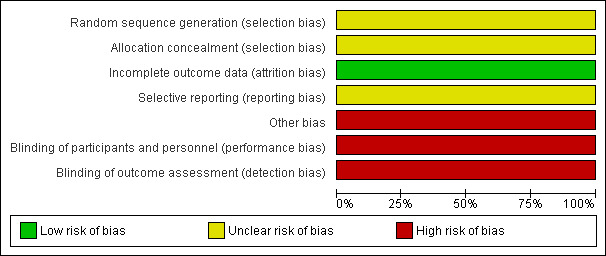
'Risk of bias' graph: review authors' judgements about each 'Risk of bias' item presented as percentages across all included studies.
2.
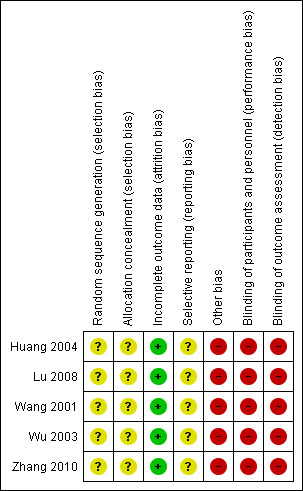
'Risk of bias' summary: review authors' judgements about each 'Risk of bias' item for each included study.
Effects of interventions
Five different Chinese herbal medicines for adhesive SBO were tested in the five included trials. All studies were co‐interventions and did not mention adverse events. We performed a meta‐analysis, treating these five types of TCM as a single type of intervention. We were not able to perform meta‐analyses on specific TCMs due to issues of heterogeneity, that is, data were not available from more than one study for any of the specific herbal medicines used. All details are shown in Figure 3 and Figure 4.
3.
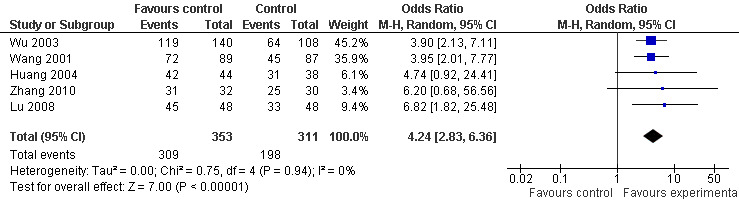
Forest plot of comparison: 1 Oral traditional Chinese medicine + conventional therapy versus conventional therapy, outcome: 1.1 Effective rate.
4.
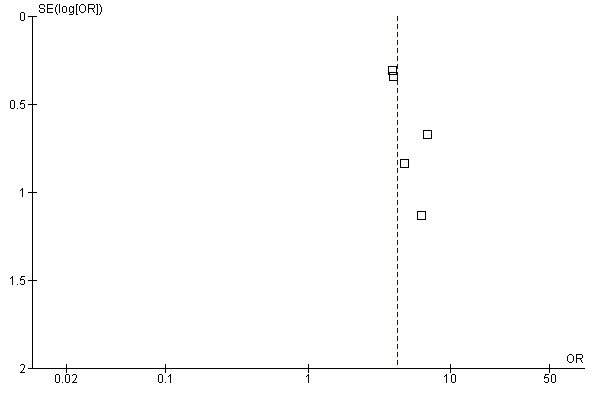
Funnel plot of comparison: 1 Oral traditional Chinese medicine + conventional therapy versus conventional therapy, outcome: 1.1 Effective rate.
Wang 2001: Huo‐Xue‐Tong‐Fu decoction
This trial tested the effects of a Huo‐Xue‐Tong‐Fu decoction in 176 participants with adhesive SBO. The combination of Huo‐Xue‐Tong‐Fu decoction plus conventional therapy increased the effective rate compared with conventional therapy alone (OR 3.95, 95% CI 2.01 to 7.77) (Figure 3; Figure 4). The experimental group had a shorter time to first defecation after treatment initiation compared with the control group (MD ‐18.00, 95% CI ‐20.56 to ‐15.44) (Figure 5; Figure 6).
5.

Forest plot of comparison: 2 Oral traditional Chinese medicine + conventional therapy versus conventional therapy, outcome: 2.1 Time of first defecating after treatment.
6.
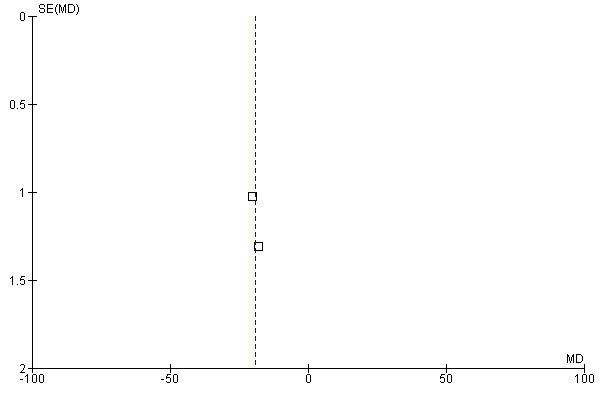
Funnel plot of comparison: 2 Oral traditional Chinese medicine + conventional therapy versus conventional therapy, outcome: 2.1 Time of first defecating after treatment.
Wu 2003: Xiao‐Cheng‐Qi‐Tang‐He‐Si‐Jun‐Zi‐Tang decoction
This trial tested a Xiao‐Cheng‐Qi‐Tang‐He‐Si‐Jun‐Zi‐Tang decoction in 248 participants with adhesive SBO. The combination of the Xiao‐Cheng‐Qi‐Tang‐He‐Si‐Jun‐Zi‐Tang decoction plus conventional therapy had a better effect on the effective rate than did conventional therapy alone (OR 3.90, 95% CI 2.13 to 7.11) (Figure 3; Figure 4). In addition, the experimental group had a shorter time to first defecation compared with the control group (MD ‐20.39, 95% CI ‐22.39 to ‐18.39) (Figure 5; Figure 6).
Lu 2008: Fufang‐Da‐Cheng‐Qi‐Tang decoction
This trial tested a Fufang‐Da‐Cheng‐Qi‐Tang decoction in 96 participants with adhesive SBO. The combination of the Fufang Da‐Cheng‐Qi‐Tang decoction with conventional therapy had a better effective rate than conventional therapy alone (OR 6.82, 95% CI 1.82 to 25.48) (Figure 3; Figure 4). The study did not provide any data on the time to first defecation after treatment.
Huang 2004: Chang‐Nian‐Lian‐Song‐Jie‐Tang decoction
This trial tested a Chang‐Nian‐Lian‐Song‐Jie‐Tang decoction in 82 participants with adhesive SBO. The combination of Chang‐Nian‐Lian‐Song‐Jie‐Tang decoction plus conventional therapy did not significantly affect the effective rate compared with conventional therapy alone (OR 4.74, 95% CI 0.92 to 24.41) (Figure 3; Figure 4). The study did not provide any data on the time to first defecation after treatment.
Zhang 2010: Xiao‐Cheng‐Qi‐Tang decoction
This trial tested a Xiao‐Cheng‐Qi‐Tang decoction in 62 participants with adhesive SBO. The combination of Xiao‐Cheng‐Qi‐Tang decoction plus conventional therapy was similar to conventional therapy alone in terms of the effective rate (OR 6.20, 95% CI 0.68 to 56.56) (Figure 3; Figure 4). There was a significant difference in the average period of treatment between the experimental group and the control group (9.2 d versus 13.8 d) and the average time of gastric tube removal (78.94 ± 29.31 h) versus (103.83 ± 37.94 h). The study did not provide any data on the time to first defecation after treatment.
Discussion
Summary of main results
Although the experimental groups included in the five reviewed trials all appeared to have higher rates of recuperation than the respective control groups, there is insufficient evidence to support the objective efficacy and safety of TCM for adhesive SBO. The positive evidence on effective rate is limited by insufficient sample sizes and methodological flaws. At the same time, no trial reported safety information. Thus, we could not assess the safety of TCM for adhesive SBO. Further studies with larger sample sizes and high‐quality, randomised, and controlled trials are urgently needed to produce more accurate data on the efficacy of TCM in adhesive SBO.
Overall completeness and applicability of evidence
The age and sex of the participants in the included trials were representative of the general global population?. Although these studies seemed to show that TCM plus conventional therapy increased the effective rate compared with conventional therapy, the evidence as assessed in this review was not sufficiently convincing to support a clinical recommendation due to various limitations of the trials.
Quality of the evidence
All studies were considered to have a high risk of bias and low test quality, and the publications provided very limited information about trial design and methodology. The serious methodological flaws of these studies mean that potential bias may have been present in participant selection, administration of treatment, and assessment of outcomes. There is also a lack of information about the composition, quality control, and adverse events caused by these TCM compounds. It is well known that there is a general perception in China that herbal medicines are safe to use as therapies for various ailments. Consistent with this general assumption, none of the trials reported data on adverse events induced by TCM. However, many reports (Gu Y 1995; Chan TY 1996; Qu M 2002; Lim YL 2005; Li H 2008) have demonstrated that liver toxicity and other adverse events may be caused by TCM.
Because the quality of the evidence on the efficacy and safety of TCM for adhesive SBO is low, we could not conclude that the TCM interventions had a positive effect, even though these trials showed positive results.
Potential biases in the review process
The 'Risk of bias' graphs summarising the review authors' judgements about each 'Risk of bias' item, presented as percentages across all included studies, are shown in Figure 1 and Figure 2. Both figures demonstrate a high potential bias in the review process. Furthermore, it is clear that there is a potential publication bias in China. Studies presenting positive results are more likely to be published, as may be evidenced by the fact that no published study on TCM for adhesive SBO reported its inefficacy or obvious negative effects.
Agreements and disagreements with other studies or reviews
Thus far, no published systematic review has focused on assessing the efficacy and safety of oral TCM for adhesive SBO.
Authors' conclusions
Implications for practice.
Based on this review, the use of herbal medicines for adhesive SBO may not be warranted. No guiding conclusion can be made until more firm evidence of TCM efficacy and safety can be acquired. First, there are serious methodological flaws in TCM studies in China. Second, there is a tendentious perception that it is generally safe to use herbal medicines, which is reflected in that no trials reported data on adverse events produced by TCM use. Third, because TCM and Western medicine are largely different paradigms, it may be difficult to review the effects of TCMs using a system based on Western medicine.
Implications for research.
Further studies with larger sample sizes and high‐quality, randomised, and controlled trials will be necessary to produce more accurate data on TCM. Future trials must be designed considering the following suggestions:
Trials should provide data on negative effects. Both the beneficial and harmful effects should receive equal attention to allow the assessment of treatment safety
We should pay attention to methods to improve the quality of the randomised controlled trials. It is essential that future trials adopt correct methods of randomisation and allocation concealment and clearly report the specific methods used
Double‐blind studies with the use of an adequate placebo should be conducted
Information about the rationale of TCM composition, formulation, preparation, and quality control, the species, geographical origin and collection season of the herbs, and the quality of the preparations should be provided clearly (Gagnier 2006) so that readers can attain a basic understanding of TCM
Trials should present clear descriptions of withdrawals and dropouts (reasons and analysis) during the trial
Attention should be given to informed consent and ethics committee approval; many trials do not mention this information
All future Chinese herbal medicine trials should be reported according to the elaborated CONSORT statement for reporting randomised controlled trials of herbal medicines (Gagnier 2006)
We are confident that we will obtain more credible information if future trials are designed and implemented according to the above suggestions. A systemic review of such trials would provide the appropriate guidance on clinical therapy and thus benefit patients.
Acknowledgements
The authors thank the American Journal Experts Company for providing help in language polishing.
Data and analyses
Comparison 1. Oral traditional Chinese medicine + conventional therapy versus conventional therapy.
| Outcome or subgroup title | No. of studies | No. of participants | Statistical method | Effect size |
|---|---|---|---|---|
| 1 Effective rate | 5 | 664 | Odds Ratio (M‐H, Random, 95% CI) | 4.24 [2.83, 6.36] |
1.1. Analysis.
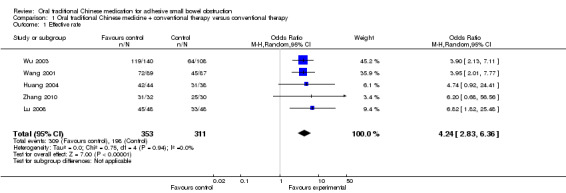
Comparison 1 Oral traditional Chinese medicine + conventional therapy versus conventional therapy, Outcome 1 Effective rate.
Comparison 2. Oral traditional Chinese medicine + conventional therapy versus conventional therapy.
| Outcome or subgroup title | No. of studies | No. of participants | Statistical method | Effect size |
|---|---|---|---|---|
| 1 Time of first defecating after treatment | 2 | 424 | Mean Difference (IV, Random, 95% CI) | ‐19.33 [‐21.66, ‐17.01] |
2.1. Analysis.
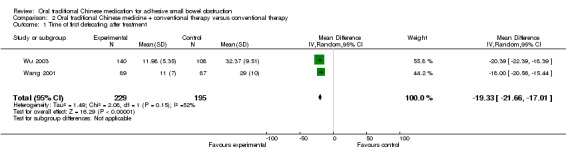
Comparison 2 Oral traditional Chinese medicine + conventional therapy versus conventional therapy, Outcome 1 Time of first defecating after treatment.
Characteristics of studies
Characteristics of included studies [ordered by study ID]
Huang 2004.
| Methods | Randomised controlled, open‐label trial | |
| Participants | Setting and location: inpatients at the second hospital of Nanping city, Nanping China. 82 patients were randomised into intervention group (n = 44, Male/Female (M/F) 25/19, mean age 40.8 years, range 17 to 68) and control group (n = 38, M/F 21/17, mean age 41.2 years, range 19 to 67). Diagnostic criteria: according to Wu JP 2000 and Zheng XY 2002 inclusion and exclusion criteria were specified as previous. |
|
| Interventions | Intervention: Chang‐Nian‐Lian‐Song‐Jie‐Tang decoction (Danggui 15 g, Muxiang 10 g, Wuyao 10 g, Chaocaifuzi 15 g, Taoren 10 g, Chishao 10 g, Panxiangye 10 g, Mangxiao 10 g) plus conventional therapy. A dose per day, taking two points at morning and evening. Control: conventional therapy ‐ fasting, continuous gastrointestinal decompression, supplementing electrolytic solution, maintaining acid‐base balance, and antibiotics. |
|
| Outcomes | Criteria of therapeutic effective rate: self‐conducted criteria Effective rate (intervention versus control): 95.45% versus 81.58% |
|
| User defined 1 | ||
| Notes | ||
| Risk of bias | ||
| Bias | Authors' judgement | Support for judgement |
| Random sequence generation (selection bias) | Unclear risk | Described as randomised, but the method of sequence generation was not specified |
| Allocation concealment (selection bias) | Unclear risk | Described as randomised, but the method used to conceal the allocation was not described |
| Incomplete outcome data (attrition bias) All outcomes | Low risk | No participant dropped out |
| Selective reporting (reporting bias) | Unclear risk | Described the same treatment‐related theory of TCM and expected the clinical effect but the theory itself was not claimed with strong evidence |
| Other bias | High risk | No safety data |
| Blinding of participants and personnel (performance bias) All outcomes | High risk | Open‐label trial |
| Blinding of outcome assessment (detection bias) All outcomes | High risk | Open‐label trial |
Lu 2008.
| Methods | Randomised controlled, open‐label trial | |
| Participants | Setting and location: inpatients at Jiangchuan Farm Workers Hospital, Heilongjiang, China. 96 patients (M/F 52/44, mean age 50 years, range 30 to 63) were randomised into intervention group (n = 48) and control group (n = 48). Diagnostic criteria were specified as previous. Inclusion and exclusion criteria were specified as previous. |
|
| Interventions | Intervention: Fufang‐Da‐Cheng‐Qi‐Tang decoction (Shengdahuang, Mangxiao, Zhishi, Houpu, Caocaifuzi, Taoren, Chisao, Yanhusuo) plus conventional therapy. Decoction (100 mL) was given via gastric tube then clamped gastric tube for 1 to 2 h twice per day. Control: conventional therapy ‐ fasting, continuous gastrointestinal decompression, supplementing electrolytic solution, maintaining acid‐base balance, and antibiotics. The treatment time was 7 d. |
|
| Outcomes | Criteria of therapeutic effective rate: according to criteria of Wu JP 2000. Effective rate (intervention versus control): 93.75% versus 68.75%. |
|
| User defined 1 | ||
| Notes | ||
| Risk of bias | ||
| Bias | Authors' judgement | Support for judgement |
| Random sequence generation (selection bias) | Unclear risk | Described as randomised, but the method of sequence generation was not specified |
| Allocation concealment (selection bias) | Unclear risk | Described as randomised, but the method used to conceal the allocation was not described |
| Incomplete outcome data (attrition bias) All outcomes | Low risk | No participant dropped out |
| Selective reporting (reporting bias) | Unclear risk | Described the same treatment‐related theory of TCM and expected the clinical effect but the theory itself was not claimed with strong evidence |
| Other bias | High risk | No safety data |
| Blinding of participants and personnel (performance bias) All outcomes | High risk | Open‐label trial |
| Blinding of outcome assessment (detection bias) All outcomes | High risk | Open‐label trial |
Wang 2001.
| Methods | Randomised controlled, open‐label trial | |
| Participants | Setting and location: inpatients at Anhui TCM College Affiliated No. 1 Hospital, Hefei, China 176 patients were randomised into intervention group (n = 89, M/F 63/26, mean age 47.2 years, range 6 to 79) and control group (n = 87). Diagnostic criteria: according to Wu JP 1992 Inclusion and exclusion criteria were specified as previous. |
|
| Interventions | Intervention: Huo‐Xue‐Tong‐Fu decoction (Dahuang 10 g, Houpu 10 g, Zhishi 10 g, Muxiang 10 g, Huangshi 15 g, Danggui 15 g, Danshen 15 g) plus conventional therapy. For patients with severe vomiting: Huo‐Xue‐Tong‐Fu decoction plus conventional therapy plus additional herbal medicine (Daizheshi 30 g, Xuanxiahua 10 g, Qingbanxia 10 g); for patients with severe seroperitoneum: Huo‐Xue‐Tong‐Fu decoction plus conventional therapy plus additional herbal medicine (Gansuimo 1 to 3 g); for old and infirm people: Huo‐Xue‐Tong‐Fu decoction plus conventional therapy plus additional herbal medicine (Dangshen 10 g, Baishu 10 g). Decoction (200 mL) was taken orally or was given via gastric tube every 4 to 6 h. For the administration via gastric tube, the tube was clamped for 2 h after intervention. Control: conventional therapy ‐ fasting, continuous gastrointestinal decompression, supplementing electrolytic solution, maintaining acid‐base balance, and antibiotics. |
|
| Outcomes | Criteria of therapeutic effect: according to criteria of Wu JP 1992. Effective rate (intervention versus control): 81.90% versus 51.72%; time of first defecating after treatment (intervention versus control): 11 ± 7 h versus 29 ± 10 h. |
|
| User defined 1 | ||
| Notes | ||
| Risk of bias | ||
| Bias | Authors' judgement | Support for judgement |
| Random sequence generation (selection bias) | Unclear risk | Described as randomised, but the method of sequence generation was not specified |
| Allocation concealment (selection bias) | Unclear risk | Described as randomised, but the method used to conceal the allocation was not described |
| Incomplete outcome data (attrition bias) All outcomes | Low risk | No participant dropped out |
| Selective reporting (reporting bias) | Unclear risk | Described the same treatment‐related theory of TCM and expected the clinical effect but the theory itself was not supported by strong evidence |
| Other bias | High risk | No safety data |
| Blinding of participants and personnel (performance bias) All outcomes | High risk | Open‐label trial |
| Blinding of outcome assessment (detection bias) All outcomes | High risk | Open‐label trial |
Wu 2003.
| Methods | Randomised controlled, open‐label trial | |
| Participants | Setting and location: inpatients at Linyi City Traditional Chinese Medicine Hospital, Linyi, China. 248 patients were randomised into intervention group (n = 140, M/F 104/36, mean age 40.2 years, range 12 to 65) and control group (N = 108, M/F 86/22, mean age 41.7 years, range 14 to 64). Diagnostic criteria: according to Wu JP 1992. Inclusion and exclusion criteria were specified as previous. |
|
| Interventions | Intervention: Xiao‐Cheng‐Qi‐Tang‐He‐Si‐Jun‐Zi‐Tang decoction (Dangshen 20 g, Fuling 20 g, Baishu 20 g, Dahuang 15 g, Zhishi 15 g, Houpu 15 g, Gancao 6 g) plus conventional therapy. Decoction (100 mL) was taken orally or was given via gastric tube twice a day. For the administration via gastric tube, the tube was clamped for 2 h after intervention. Control: conventional therapy ‐ fasting, continuous gastrointestinal decompression, supplementing electrolytic solution, maintaining acid‐base balance, and antibiotics. |
|
| Outcomes | Criterion of therapeutic effect: according Wu JP 1992. Effective rate (intervention versus control): 85.00% versus 59.23%; time of first defecating after treatment (intervention versus control):11.98 ± 5.35 h versus 32.37 ± 9.51 h. |
|
| User defined 1 | ||
| Notes | ||
| Risk of bias | ||
| Bias | Authors' judgement | Support for judgement |
| Random sequence generation (selection bias) | Unclear risk | Described as randomised, but the method of sequence generation was not specified |
| Allocation concealment (selection bias) | Unclear risk | Described as randomised, but the method used to conceal the allocation was not described |
| Incomplete outcome data (attrition bias) All outcomes | Low risk | No participant dropped out |
| Selective reporting (reporting bias) | Unclear risk | Described the same treatment‐related theory of TCM and expected the clinical effect but the theory itself was not claimed with strong evidence |
| Other bias | High risk | No safety data |
| Blinding of participants and personnel (performance bias) All outcomes | High risk | Open‐label trial |
| Blinding of outcome assessment (detection bias) All outcomes | High risk | Open‐label trial |
Zhang 2010.
| Methods | Randomised controlled, open‐label trial | |
| Participants | Setting and location: inpatients at Yueyang, Hospital of Integrated Traditional Chinese and Western Medicine, Shanghai, China. 62 patients were randomised into intervention group (n = 32, M/F 17/15) and control group (n = 30, M/F 16/14). Diagnostic criteria: was specified as previous. Inclusion and exclusion criteria were specified as previous. |
|
| Interventions | Intervention: Xiao‐Cheng‐Qi‐Tang decoction (Dahuang 12 g, Houpu 6 g, Zhishi 9 g) plus conventional therapy. A volume of 200 mL was given daily via a gastric tube. After intervention, the gastric tube was clamped for 2 h. Control: conventional therapy ‐ fasting, continuous gastrointestinal decompression, supplementing electrolytic solution, maintaining acid‐base balance, and antibiotics. |
|
| Outcomes | Criteria of therapeutic effective rate: according to Guiding Principles in Clinical Trials of new drugs of Chinese herbal medicine (Zheng XY 2002) and Diagnosis and therapeutic effect judgment of common diseases (Wu SZ 1999). Effective rate (intervention versus control): 96.87% versus 84.37%. |
|
| User defined 1 | ||
| Notes | ||
| Risk of bias | ||
| Bias | Authors' judgement | Support for judgement |
| Random sequence generation (selection bias) | Unclear risk | Described as randomised, but the method of sequence generation was not specified |
| Allocation concealment (selection bias) | Unclear risk | Described as randomised, but the method used to conceal the allocation was not described |
| Incomplete outcome data (attrition bias) All outcomes | Low risk | No participant dropped out |
| Selective reporting (reporting bias) | Unclear risk | Described the same treatment‐related theory of TCM and expected the clinical effect but the theory itself was not claimed with strong evidence |
| Other bias | High risk | No safety data |
| Blinding of participants and personnel (performance bias) All outcomes | High risk | Open‐label trial |
| Blinding of outcome assessment (detection bias) All outcomes | High risk | Open‐label trial |
Characteristics of excluded studies [ordered by study ID]
| Study | Reason for exclusion |
|---|---|
| Ao 2007 | The administration of TCM did not follow inclusion criteria. |
| Bao 2010 | The control intervention did not follow inclusion criteria (placebo or conventional therapy). The intervention was vegetable oil plus conventional therapy. |
| Chen 2004 | The major administration was retention enema and changed into oral administration according to condition, which did not fall into the category of the inclusion criteria. |
| Dai 2009 | The administration of TCM was retention enema plus gastric canal infusion. |
| Dong 2008 | Two interventions were used in the intervention group: Chinese herbal plus erythromycin. |
| Du 2010 | The administration of TCM was retention enema plus gastric canal infusion. |
| Gao 2007 | The administration of TCM did not follow inclusion criteria. |
| Guo 2009 | The control intervention in this trial was TCM acupuncture, which did not fall into the category of the inclusion criteria (placebo or conventional therapy). |
| Huang 2005 | The participants included dynamic ileus, which did not meet inclusion criteria ‐ all patients diagnosed with adhesive SBO. |
| Huang 2007 | Two interventions were used in the intervention group (Chinese herbal plus acupuncture therapy). |
| Jing 2007 | The control intervention did not fall into the category of the inclusion criteria (placebo or conventional therapy). The control intervention was paraffin oil plus conventional therapy. |
| Li 2002 | The participants were children (age range 6 months to 13 years), which did not fall into inclusion criteria ‐ regardless of age. |
| Li 2006 | The administration of TCM was retention enema plus gastric canal infusion. |
| Liu 2007 | The administration of TCM was retention enema plus oral administration. |
| Liu 2010 | The control intervention did not follow the inclusion criteria (placebo or conventional therapy).The control intervention in this trial were paraffin oil plus conventional therapy. |
| Lu 2005 | Considered as consecutive article with another excluded trial (Sun 2005), though they had different participants. |
| Peng 2010 | Two interventions were used in the intervention group (Chinese herbal plus somatostatin). |
| Song 2006 | This trial compared the efficacy of two different herbal preparations on adhesive SBO: the treatment group (TCM ‐ Zhudanheji) versus control group (TCM ‐ Dachengqitang) ‐ thus falling outside the scope of this review. |
| Sun 2005 | There were obvious skew in the numbers of patients between the two groups (30 versus 10), which could not be explained by randomisation. |
| Tang 2008 | The administration of TCM did not follow inclusion criteria. |
| Tang 2009 | Considered as consecutive article with another excluded trial (Tang 2008), though published at different times. |
| Wang 2004 | Three interventions were used in the intervention group (Chinese herbal plus acupuncture therapy plus Chinese medicine hot compress). |
| Wang 2009 | The participants included dynamic ileus, mechanical obstruction, and adhesive SBO, which did not meet inclusion criteria ‐ all patients diagnosed with adhesive SBO. |
| Wang 2009a | Two interventions were used in the intervention group (Chinese herbal plus acupuncture therapy) |
| Wei 2004 | The administration of TCM did not follow the inclusion criteria. |
| Xie 2008 | The administration of TCM did not follow the inclusion criteria. |
| Xu 2002 | The administration of TCM did not follow the inclusion criteria. |
| Yang 2009 | The administration of TCM did not follow the inclusion criteria. |
| Yang 2010 | The administration of TCM did not follow the inclusion criteria. |
| Yang 2010a | The administration of TCM did not follow inclusion criteria ‐ oral administration, gastric canal infusion, or both. The administration was retention enema plus gastric canal infusion. |
| Ye 2009 | The administration of TCM was retention enema plus gastric canal infusion. |
| Zeng 2001 | Compared therapeutic effect of one Chinese herbal medicine with different modes of administration, which falls outside the scope of this review. |
| Zeng 2010 | The administration of TCM did not follow the inclusion criteria. |
| Zhang 2007 | The administration of TCM was retention enema plus gastric canal infusion. |
| Zhang 2009 | Two interventions were used in the intervention group (Chinese herbal plus Gastrografin). |
| Zhao 2006 | The administration of TCM did not follow the inclusion criteria. |
| Zhou 2009 | The administration of TCM did not follow the inclusion criteria. |
| Zhu 2009 | Not a randomised controlled trial. |
Contributions of authors
Suo T drafted, Andersson R revised the protocol. Other authors provided their advice. All authors approved the final version of the protocol.
Suo T, Gu X, and Ma H collected the material for the background section of the review. Zhang W contributed to develop the search strategy in English and Chinese. Suo T, Gu X, and Ma H contributed to the selection and analysis of the trials.
Andersson R, Cai D, and Qin X provided advice in clinical fields. All authors approved the final version of the review.
Sources of support
Internal sources
-
General Surgery Department of Zhongshan Hospital, Fudan University, China.
Provide reward for the publication of this review
-
General Surgery Institute of Fudan University, China.
Provide reward for the publication of this review
External sources
No sources of support supplied
Declarations of interest
No potential conflict of interest is known.
New
References
References to studies included in this review
Huang 2004 {published data only}
- Huang G. Treatment of simple incomplete adhesive ileus with changnianliansongjie decoction. Journal of Beijing University of Traditional Chinese Medicine (Clinical Medicine) 2004;11(4):16‐7. [Google Scholar]
Lu 2008 {published data only}
- Lu Y, Wang L. Therapeutic effect observation on intestinal obstruction by TCM combined with western medicine. Chinese Journal of Modern Drug Application 2008;2(7):62‐3. [Google Scholar]
Wang 2001 {published data only}
- Wang W. Clinical research on mixture of "Huoxue Tongfu" for treatment of adhesive ileus. Chinese Journal of Information on Traditional Chinese Medicine 2001;8(12):49‐50. [Google Scholar]
Wu 2003 {published data only}
- Wu C, Wang N, Wu C. Clinical observation of integrative medicine for treatment of adhesive ileus. Journal of Linyi Medical College 2003;25(2):101‐2. [Google Scholar]
Zhang 2010 {published data only}
- Zhang X. Treatment of chronic incomplete adhesive ileus for 62 cases with Xiaochenqi decoction. Chinese Medicine Modern Distance Education of China 2010;8(9):119‐20. [Google Scholar]
References to studies excluded from this review
Ao 2007 {published data only}
- Ao X, Li Z, Liang Y. Treatment of 96 cases of adhesive intestinal obstruction by TCM combined with Western medicine. Jiangxi Journal of Traditional Chinese Medicine 2007;38(7):60‐1. [Google Scholar]
Bao 2010 {published data only}
- Bao X, Lin Q. Clinical analysis on adjuvant treating 56 cases of adhesive intestinal obstruction of by low pressure retention enema with Dacheng Qi decoction. Magazine of TCM Clinical Research 2010;2(13):95‐6. [Google Scholar]
Chen 2004 {published data only}
- Chen Z, Lu G. Thirty cases report on adhesive ileus treated by compound Da.chengqitang mainly given by retention enema. Chinese Medicine Clinical Magazine 2004;16(2):128. [Google Scholar]
Dai 2009 {published data only}
- Dai Y, Xu Z. Treatment of 36 cases of adhesive intestinal obstruction by TCM combined with Western medicine. Jiangxi Journal of Traditional Chinese Medicine 2009;40(3):46‐7. [Google Scholar]
Dong 2008 {published data only}
- Dong Z. Treatment of 40 cases of adhesive intestinal obstruction by Dachengqitang combined with erythromycin. Shanxi Journal of Traditional Chinese Medicine 2008;29(5):545‐6. [Google Scholar]
Du 2010 {published data only}
- Du B. TCM‐WM treatment of 126 cases of adhesive intestinal obstruction. Journal of Practical Traditional Chinese Internal Medicine 2010;24(7):74‐5. [Google Scholar]
Gao 2007 {published data only}
- Gao H, Yuan X, Lu X. Clinical observation on adhesive ileus treated by traditional Chinese medicine and Western medicine. Guangming Journal of Chinese Medicine 2007;22(11):82‐3. [Google Scholar]
Guo 2009 {published data only}
- Guo C, Meng G, Ding Y. Treatment of 30 cases of adhesive intestinal obstruction by Huayitongfu decoction. Journal of Hebei Traditional Chinese Medicine and Pharmacology 2009;24(1):33. [Google Scholar]
Huang 2005 {published data only}
- Huang D, Li G. Treatment of intestinal obstruction by TCM combined with Western medicine. Guangdong Medical Journal 2005;26(5):701‐2. [Google Scholar]
Huang 2007 {published data only}
- Huang J. Treatment of 52 cases of postoperative adhesive intestinal obstruction by TCM combined with Western medicine. Modern Journal of Integrated Traditional Chinese and Western Medicine 2007;15(24):3339‐40. [Google Scholar]
Jing 2007 {published data only}
- Jing B, Wei J. Treatment of postoperative adhesive intestinal obstruction by TCM combined with Western medicine. Journal of Shanxi College of Traditional Chinese Medicine 2007;30(5):36‐7. [Google Scholar]
Li 2002 {published data only}
- Li Y, Li Y. Therapeutic effect observation of 20 cases on adhesive intestinal obstruction by Xueteng Taohong Tang. Chinese Journal of Ethnomedicine and Ethnopharmacy 2002;1(54):17‐8. [Google Scholar]
Li 2006 {published data only}
- Li Y, Liu Z. Clinical observation of integrative medicine for treatment of adhesive ileus. Chinese Medicine Forum 2006;4(7):77‐8. [Google Scholar]
Liu 2007 {published data only}
- Liu Z. Treatment of 72 cases of adhesive intestinal obstruction by TCM combined with Western medicine. Journal of Sichuan Traditional Chinese Medicine 2007;25(4):89. [Google Scholar]
Liu 2010 {published data only}
- Liu A, Liu Z, Feng L. Treatment of 38 cases of adhesive intestinal obstruction by Fufang Dachengqi Tang. Chinese Journal of Modern Drug Application 2010;3(16):127‐8. [Google Scholar]
Lu 2005 {published data only}
- Lu X, Sun S, Wu L, Liu W, Ma T. Clinical observation on bowel obstruction by the method of Changnianlian Tongchang Tang. Journal of Emergency in Traditional Chinese Medicine 2005;14(11):2. [Google Scholar]
Peng 2010 {published data only}
- Peng D. Therapeutic effect observation on adhesive bowel obstruction treated by somatostatin plus Fufang Dachengqi Tang. Medical information 2010;5(9):2499‐500. [Google Scholar]
Song 2006 {published data only}
- Song Y, Jia L, Hao J. Treatment of 34 cases of adhesive intestinal obstruction by Zhudanheji combined with Western medicine. Journal of Sichuan Traditional Chinese Medicine 2006;24(6):61. [Google Scholar]
Sun 2005 {published data only}
- Sun S, Lu X, Wu L. Clinical observation of Changnianliantongchantan for treatment of adhesive ileus. Journal of Emergency in Traditional Chinese Medicine 2005;14(11):1062‐3. [Google Scholar]
Tang 2008 {published data only}
- Tang Z. Adhesive ileus treated by traditional Chinese medicine and Western medicine. Journal of Clinical and Laboratory Medicine 2008;7(11):93‐4. [Google Scholar]
Tang 2009 {published data only}
- Tang Z. Treatment of 96 cases of adhesive intestinal obstruction by TCM combined with Western medicine. The Fourth Session of National Integrated Traditional Chinese and Western Medicine in Perioperative Symposium on Medicine. Nanjing, 2009:143‐5.
Wang 2004 {published data only}
- Wang W, Tan Z, Qi Y. Clinical observation on adhesive ileus treated by traditional Chinese medicine and Western medicine. Practical Clinical Journal of Integrated Traditional Chinese and Western Medicine 2004;4(3):21‐2. [Google Scholar]
Wang 2009 {published data only}
- Wang X, Jia S. Clinical observation on bowel obstruction by the method of TCM combined with Western medicine. Liaoning Journal of Traditional Chinese Medicine 2009;36(3):420‐1. [Google Scholar]
Wang 2009a {published data only}
- Wang Y, Chen J. Integrated traditional and Western medicine treatment of adhesive intestinal obstruction with clinical observation. Journal of Putian University 2009;16(5):25‐7. [Google Scholar]
Wei 2004 {published data only}
- Wei A. Clinical study on adhesive ileus treated by Nianliansongjietang. Jilin Journal of Traditional Chinese Medicine 2004;24(7):35. [Google Scholar]
Xie 2008 {published data only}
- Xie Z. Clinical analysis of 63 cases of adhesive ileus treated by integration of traditional Chinese and Western medicine. Journal of China Medical Frontier 2008;3(3):1. [Google Scholar]
Xu 2002 {published data only}
- Xu Y, Xu H, Gong H. Clinical observation on adhesive ileus treated by Da.chengqitang. Chinese Association of the Integration of Traditional and Western Medicine. The Seventh National Rural, Grassroots Academic and Work Experience Exchange. Shanghai, 2002:121‐3.
Yang 2009 {published data only}
- Yang C, Zhu J. The summary of TCM‐WM treatment of 39 cases of adhesive intestinal obstruction. Hunan Journal of Traditional Chinese Medicine 2009;25(2):29‐30. [Google Scholar]
Yang 2010 {published data only}
- Yang G. Clinical analysis of adhesive ileus treated by integration of traditional Chinese and Western medicine. Modern Chinese Doctor 2010;48(33):181‐2. [Google Scholar]
Yang 2010a {published data only}
- Yang J, Sang X. Clinical observation of 62 case of adhesive bowel obstruction treated by Xiangshachengqi decoction. Jiangsu Journal of Traditional Chinese Medicine 2010;42(6):38‐9. [Google Scholar]
Ye 2009 {published data only}
- Ye B. Clinical analysis of 36 cases on bowel obstruction by the method of TCM combined with Western medicine. China Journal of Chinese Materia Medica 2009;11:32‐3. [Google Scholar]
Zeng 2001 {published data only}
- Zeng L, Zhang Y, Lu Z. Chinese herbs treating 76 cases of adhesive intestinal obstruction of by gastric canal infusion plus low pressure retention eneman. Nanjing University of Chinese Medicine Journal (Natural Science Edition) 2001;17(5):323‐4. [Google Scholar]
Zeng 2010 {published data only}
- Zeng L, Qian H, Zhao Q. Huo‐xue‐tong‐fu Fang (HXTFF) in adhesive intestinal obstruction: clinical observation of 56 cases. Journal of Nanjing University of Traditional Chinese Medicine 2010;26(3):178‐80. [Google Scholar]
Zhang 2007 {published data only}
- Zhang Y, Liu X, Jiang D. Therapeutic effect observation of 54 cases on intestinal obstruction by Fufang Dachengqi Tang. Journal of New Traditional Chinese Medicine 2007;39:13‐4. [Google Scholar]
Zhang 2009 {published data only}
- Zhang J, Fu Y. Clinical observation of utilizing self‐made "ankylenteron alleviation decoction" plus angiongrafin on adhesive ileus. Chinese Archives of Traditional Chinese Medicine 2009;26(10):2291‐3. [Google Scholar]
Zhao 2006 {published data only}
- Zhao Y, Peng J, Han H. Treatment of adhesive intestinal obstruction by TCM combined with Western medicine: a clinical observation of 65 cases. Journal of New Traditional Chinese Medicine 2006;38(3):53‐4. [Google Scholar]
Zhou 2009 {published data only}
- Zhou S, Li Z, Yang F. Clinical observation of 86 case of postoperative small bowel obstruction treated by therapy of combining traditional Chinese and Western medicine. Journal of Guiyang College of Traditional Chinese Medicine 2009;31(4):36‐7. [Google Scholar]
Zhu 2009 {published data only}
- Zhu W, Long X. Treatment and nursing of adhesive intestinal obstruction by TCM combined with Western medicine. Journal of Yichun University 2009;31(6):159‐60. [Google Scholar]
Additional references
Abbas 2007
- Abbas S, Bissett IP, Parry BR. Oral water soluble contrast for the management of adhesive small bowel obstruction. Cochrane Database of Systematic Reviews 2007, Issue 3. [DOI: 10.1002/14651858.CD004651.pub3] [DOI] [PMC free article] [PubMed] [Google Scholar]
Adams 2009
- Adams D, Wu T, Yang X, Tai S, Vohra S. Traditional Chinese medicinal herbs for the treatment of idiopathic chronic fatigue and chronic fatigue syndrome. Cochrane Database of Systematic Reviews 2009, Issue 4. [DOI: 10.1002/14651858.CD006348.pub2] [DOI] [PubMed] [Google Scholar]
Ambiru 2008
- Ambiru S, Furuyama N, Kimura F, Shimizu H, Yoshidome H, Miyazaki M, et al. Effect of hyperbaric oxygen therapy on patients with adhesive intestinal obstruction associated with abdominal surgery who have failed to respond to more than 7 days of conservative treatment. Hepatogastroenterology 2008;55(82‐3):491‐5. [PubMed] [Google Scholar]
Assalia 1994
- Assalia A, Schein M, Kopelman D, Hirshberg A, Hashmonai M. Therapeutic effect of oral Gastrografin in adhesive, partial small‐bowel obstruction: a prospective randomized trial. Surgery 1994;115(4):433‐7. [PubMed] [Google Scholar]
Barkan 1995
- Barkan H, Webster S, Ozeran S. Factors predicting the recurrence of adhesive small‐bowel obstruction. American Jounal of Surgery 1995;70:361‐5. [DOI] [PubMed] [Google Scholar]
Barmparas 2010
- Barmparas G, Branco BC, Schnüriger B, Lam L, Inaba K, Demetriades D. The incidence and risk factors of post‐laparotomy adhesive small bowel obstruction. Journal of Gastrointestinal Surgery 2010;14(10):1619‐28. [DOI] [PubMed] [Google Scholar]
Bizer 1981
- Bizer LS, Liebling RW, Delany HM, Gliedman ML. Small bowel obstruction: the role of non‐operative treatment in simple intestinal obstruction and predictive criteria for strangulation obstruction. Surgery 1981;89(4):407‐13. [PubMed] [Google Scholar]
Branco 2010
- Branco BC, Barmparas G, Schnuriger B, Inaba K, Chan LS, Demetriades D. Systematic review and meta‐analysis of the diagnostic and therapeutic role of water‐soluble contrast agent in adhesive small bowel obstruction. British Journal of Surgery 2010;97(4):470‐8. [DOI] [PubMed] [Google Scholar]
Catena 2011
- Fausto C, Saverio S, Kelly M. Bologna guidelines for diagnosis and management of adhesive small bowel obstruction (ASBO): 2010 evidence‐based guidelines of the World Society of Emergency Surgery. World Journal of Emergency Surgery 2011;6(1):5. [DOI] [PMC free article] [PubMed] [Google Scholar]
Chan TY 1996
- Chan TY, Critchley JA. Usage and adverse effects of Chinese herbal medicines. Hum Exp Toxicol 1996 Jan;15(1):5‐12. [DOI] [PubMed] [Google Scholar]
Coleman 2000
- Coleman G, McLain AD, Moran BJ. Impact of previous surgery on time taken for incision and division of adhesions during laparotomy. Diseases of the Colon & Rectum 2000;43:1297‐9. [DOI] [PubMed] [Google Scholar]
Cooke 1977
- Cooke A, Hamilton DG. The significance of starch powder contamination in the aetiology of peritoneal adhesions. British Journal of Surgery 1977;64:410‐2. [DOI] [PubMed] [Google Scholar]
Delabrousse 2009
- Delabrousse E, Lubrano J, Jehl J, et al. Small‐bowel obstruction from adhesive bands and matted adhesions: CT differentiation. American Journal of Roentgenology 2009;192(3):693‐7. [DOI] [PubMed] [Google Scholar]
DeWilde 2007
- DeWilde RD, Trew G. Postoperative abdominal adhesions and their prevention in gynaecological surgery. Gynecological Surgery 2007;4:161–8. [Google Scholar]
Diaz Jr 2008
- Diaz JJ Jr, Bokhari F, Mowery NT, Acosta JA, Block EF, Bromberg WJ, et al. Guidelines for management of small bowel obstruction. Journal of Trauma 2008;64(6):1651‐64. [DOI] [PubMed] [Google Scholar]
Fevang 2004
- Fevang BT, Fevang J, Lie SA, Søreide O, Svanes K, Viste A. Long‐term prognosis after operation for adhesive small bowel obstruction. Annals of Surgery 2004;240(2):193‐201. [DOI] [PMC free article] [PubMed] [Google Scholar]
Flower 2009
- Flower A, Liu JP, Chen S, Lewith G, Little P. Chinese herbal medicine for endometriosis. Cochrane Database of Systematic Reviews 2009, Issue 3. [DOI: 10.1002/14651858.CD006568.pub2] [DOI] [PubMed] [Google Scholar]
Gagnier 2006
- Gagnier JJ, Boon H, Rochon P, Moher D, Barnes J, Bombardier C. Reporting randomized, controlled trials of herbal interventions: an elaborated CONSORT statement. Annals of Internal Medicine 2006;144(5):364–7. [DOI] [PubMed] [Google Scholar]
Gong 2008
- Gong W. Clinical observation on combination of TCM and Western medicine for the treatment of 116 cases of bowel obstruction. Journal of Emergency in Traditional Chinese Medicine 2008;17(12):2. [Google Scholar]
Gu Y 1995
- Gu Y, Yuan H. A review of the adverse effects of Chinese herbal drugs as published in Chinese journals in 1993 and 1994. Zhongguo Zhong Yao Za Zhi 1995 Aug;20(8):502‐7. [PubMed] [Google Scholar]
He 2009
- He G, Wen G. Treating postoperative incomplete adhesion ileus by combining traditional Chinese and Western medicine. China Modern Doctor 2009;47(21):2. [Google Scholar]
Higgins 2008
- Higgins JPT, Green S (editors). Cochrane Handbook for Systematic Reviews of Interventions Version 5.0.2 [updated September 2009] The Cochrane Collaboration, 2008. Available from www.cochrane‐handbook.org.
Hill 1999
- Ellis H, Moran BJ, Thompson JN, Parker MC, Wilson MS, Menzies D, et al. Adhesion related readmissions after abdominal and pelvic surgery: a retrospective cohort study. Lancet 1999;353:1476–80. [DOI] [PubMed] [Google Scholar]
Hill 2008
- Hill AG. The management of adhesive small bowel obstruction ‐ an update. International Journal of Surgery 2008;6(1):77‐80. [DOI] [PubMed] [Google Scholar]
Holmdahl 1999
- Holmdahl L. Making and covering of surgical footprints. Lancet 1999;353:1456–7. [DOI] [PubMed] [Google Scholar]
Itoh 2002
- Itoh T, Yamakawa J, Mai M, Yamaguchi N, Kanda T. The effect of the herbal medicine Dai‐kenchu‐to on post‐operative ileus. Journal of International Medical Research 2002;30(4):428‐32. [DOI] [PubMed] [Google Scholar]
Ji 2010
- Ji Z, Li J, Yuan C, Chen W, Zhang Y, Ju X, et al. Therapeutic value of sesame oil in the treatment of adhesive small bowel obstruction. American Journal of Surgery 2010;199(2):160‐5. [DOI] [PubMed] [Google Scholar]
Jiang 2009
- Jiang W, Yang B. Intestinal obstruction. In: Chen Haozhu editor(s). Practice of Internal Medicine. Beijing: People's Medical Publishing House, 2009:2035‐40. [Google Scholar]
Kossi 2003
- Kossi J, Salminen P, Rantala A, Laato M. Population‐based study of the surgical workload and economic impact of bowel obstruction caused by postoperative adhesions. British Journal of Surgery 2003;90:1441–4. [DOI] [PubMed] [Google Scholar]
Kumar 2009
- Kumar S, Wong PF, Leaper DJ. Intra‐peritoneal prophylactic agents for preventing adhesions and adhesive intestinal obstruction after non‐gynaecological abdominal surgery. Cochrane Database of Systematic Reviews 2009, Issue 1. [DOI: 10.1002/14651858.CD005080.pub2] [DOI] [PMC free article] [PubMed] [Google Scholar]
Li 2006a
- Li B, Jia WN, Li F, Wu T. Traditional Chinese medicine for opioid withdrawal syndrome. Cochrane Database of Systematic Reviews 2006, Issue 2. [DOI: 10.1002/14651858.CD006038] [DOI] [Google Scholar]
Li H 2008
- Li H, Xiong J, Zhou QR. .TCM researches on chronic renal tubulointerstitial lesions. J Tradit Chin Med 2008 Dec;28(4):299‐304. [DOI] [PubMed] [Google Scholar]
Lim YL 2005
- Lim YL, Thirumoorthy T. Serious cutaneous adverse reactions to traditional Chinese medicines. Singapore Med J 2005 Dec;46(12):714‐7. [PubMed] [Google Scholar]
Molinas 2006
- Molinas CR, Binda MM, Koninckx PR. Angiogenic factors in peritoneal adhesion formation. Gynecological Surgery 2006;3:157–67. [Google Scholar]
Moran 2007
- Moran BJ. Adhesion‐related small bowel obstruction. Colorectal Research Unit, North Hampshire Hospital, Basingstoke, Hampshire, UK Journal compilation, The Association of Coloproctology of Great Britain and Ireland 2007;9:39‐44. [DOI] [PubMed] [Google Scholar]
Obuz 2003
- Obuz F, Terzi C, Sokmen S, Yilmaz E, Yildiz D, Fuzun M. The efficacy of helical CT in the diagnosis of small bowel obstruction. European Journal of Radiology 2003;48(3):299‐304. [DOI] [PubMed] [Google Scholar]
Parker 2001
- Parker MC, Ellis H, Moran BJ, Thompson JN, Wilson MS, Menzies D, et al. Postoperative adhesions: ten‐year follow‐up of 12,584 patients undergoing lower abdominal surgery. Diseases of the Colon & Rectum 2001;44:822‐30. [DOI] [PubMed] [Google Scholar]
Parker 2005
- Parker C, Wilson MS, Menzies D, Sunderland G, Clark DN, Knight AD, et al. The SCAR‐3 study: 5‐year adhesion‐related readmission risk following lower abdominal surgical procedures. Colorectal Disease 2005;7:551‐8. [DOI] [PubMed] [Google Scholar]
Qi 2007
- Qi Q, Wang J, Liang G, Wu X. Da‐Cheng‐Qi‐Tang promotes the recovery of gastrointestinal motility after abdominal surgery in humans. Digestive Diseases and Sciences 2007;52(6):1562‐70. [DOI] [PubMed] [Google Scholar]
Qu M 2002
- Qu M, Wang NS, Huang X. Stregthen the monitoring and studying on adverse reactions of Chinese herbal medicines. Zhongguo Zhong Xi Yi Jie He Za Zhi 2002 Feb;22(2):88‐92. [PubMed] [Google Scholar]
Sakakibara 2007
- Sakakibara T, Harada A, Yaguchi T, Koike M, Kodera Y, Nakao A. The indicator for surgery in adhesive small bowel obstruction patient managed with long tube. Hepatogastroenterology 2007;54(74):787‐90. [PubMed] [Google Scholar]
Soybir 1997
- Soybir GR, Koksoy F, Polat C, Ozşeker A, Yalçln O, Aker Y, et al. The effects of sterile or infected bile and dropped gallstones in abdominal adhesions and abscess formation. Surgical Endoscopy 1997;11:711‐3. [DOI] [PubMed] [Google Scholar]
Sparnon 1989
- Sparnon AL, Spitz L. Pharmacological manipulation of postoperative intestinal adhesions. Australian and New Zealand Journal of Surgery 1989;59:725‐9. [DOI] [PubMed] [Google Scholar]
Stephen 2005
- Stephen B, Williams BS, Greenspon J, Heather A, Young MPH, Bruce A, et al. Small bowel obstruction: conservative vs. surgical management. Diseases of the Colon & Rectum 2005;48:1140–6. [DOI] [PubMed] [Google Scholar]
Tingstedt 2007
- Tingstedt B, Isaksson J, Andersson R. Long‐term follow‐up and cost analysis following surgery for small bowel obstruction caused by intra‐abdominal adhesions. British Journal of Surgery 2007;94(6):743‐8. [DOI] [PubMed] [Google Scholar]
Tingstedt 2008
- Tingstedt B, Andersson E, Isaksson K, Andersson R. Clinical impact of abdominal adhesions: what is the magnitude of the problem?. Scandinavian Journal of Gastroenterology 2008;43(4):255‐61. [DOI] [PubMed] [Google Scholar]
Tokita 2007
- Tokita Y, Satoh K, Sakaguchi M, Endoh Y, Mori I, Yuzurihara M, et al. The preventive effect of Daikenchuto on postoperative adhesion‐induced intestinal obstruction in rats. Inflammopharmacology 2007;15(2):65‐6. [DOI] [PubMed] [Google Scholar]
Van den Tol 2001
- Tol P, Haverlag R, Rossen ME, Bonthuis F, Marquet RL, Jeekel J. Glove powder promotes adhesion formation and facilitates tumour cell adhesion and growth. British Journal of Surgery 2001;88:1258‐63. [DOI] [PubMed] [Google Scholar]
Wang 1981
- Wang X. Clinical observation of acute intestinal obstruction treated with combined traditional Chinese and western medicine. Zhong Xi Yi Jie He Za Zhi 1981;1(2):78‐9. [PubMed] [Google Scholar]
Wang 2003
- Wang B. Intestinal obstruction. In: Huang Zhiqiang, Lin Yanzhen editor(s). Abdominal Surgery Theory and Practice. Beijing: Science Publishing Company, 2003:600. [Google Scholar]
Wiseman 1994
- Wiseman D. Polymers for the prevention of surgical adhesions. In: Domb AJ editor(s). Polymeric Site‐Specific Pharmacotherapy. New York: John Wiley & Sons, 1994:370–421. [Google Scholar]
Wu 2008
- Wu Z, Wu Z. Surgery: Intestinal Obstruction. Beijing: People's Medical Publishing House, 2008:451‐457. [Google Scholar]
Wu JP 1992
- Wu JP, Qiu FZ. HuangJiasi Surgery. 5th Edition. Beijing, China: People's Medical Publishing House of China, 1992. [Google Scholar]
Wu JP 2000
- Wu JP, Qiu FZ (editors). Huangjiasi Surgery. 6th Edition. Beijing, China: People's Medical Publishing House, 2000. [Google Scholar]
Wu SZ 1999
- Wu SZ, Wu M. Diagnosis and therapeutic effect judgment of common diseases. Bejing, China: China Press of Traditional Chinese Medicine, 1999. [Google Scholar]
Xu 2009
- Xu L, Li J, Zhang M, Wang L, Yuan W, Ai C, et al. Chinese herbs for insomnia. Cochrane Database of Systematic Reviews 2009, Issue 2. [DOI: 10.1002/14651858.CD006348] [DOI] [Google Scholar]
Yuan 2007
- Yuan Y. Clinical observation on treating 30 cases of adhesive ileus with self‐made Wumochengqi decoction. Guiding Journal of Traditional Chinese Medicine and Pharmacology 2007;13(12):2. [Google Scholar]
Zhang 1999
- Zhang Y, Liang B, Jiang Z. Clinical study on preventive effect of Taozhi Zhipu mixture on postoperative intestinal adhesion. Chinese Journal of Integrated Traditional and Western Medicine 1999;19(5):273‐5. [PubMed] [Google Scholar]
Zheng XY 2002
- Zheng XY (Chief Editor). Guiding Principles in Clinical Trials of new drugs of Chinese herbal medicine. Beijing,China: Chinese Medical Science Press, 2002. [Google Scholar]
Zhu 2005
- Zhu L, Yu H, Hu H. Clinical analysis on the treatment of 203 cases of mechanism ileus with combination of traditional Chinese and Western medicine. Guiding Journal of Traditional Chinese Medicine and Pharmacology 2005;11(5):2. [Google Scholar]
Zhu 2008
- Zhu H, Liu Y. Curative effect study of the supplementary treatment of early postoperative small bowel obstruction by traditional Chinese medicine. China Modern Doctor 2008;46(29):2. [Google Scholar]