



Abstract
Background.
Pneumonia is common in adults hospitalized with laboratory-confirmed influenza, but the association between timeliness of influenza antiviral treatment and severe clinical outcomes in patients with influenza-associated pneumonia is not well characterized.
Methods.
We included adults aged ≥18 years hospitalized with laboratory-confirmed influenza and a discharge diagnosis of pneumonia over 7 influenza seasons (2012–2019) sampled from a multistate population-based surveillance network. We evaluated 3 treatment groups based on timing of influenza antiviral initiation relative to admission date (day 0, day 1, days 2–5). Baseline characteristics and clinical outcomes were compared across groups using unweighted counts and weighted percentages accounting for the complex survey design. Logistic regression models were generated to evaluate the association between delayed treatment and 30-day all-cause mortality.
Results.
A total of 26 233 adults were sampled in the analysis. Median age was 71 years and most (92.2%) had ≥1 non-immunocompromising condition. Overall, 60.9% started antiviral treatment on day 0, 29.5% on day 1, and 9.7% on days 2–5 (median, 2 days). Baseline characteristics were similar across groups. Thirty-day mortality occurred in 7.5%, 8.5%, and 10.2% of patients who started treatment on day 0, day 1, and days 2–5, respectively. Compared to those treated on day 0, adjusted odds ratio for death was 1.14 (95% confidence interval [CI], 1.01–1.27) in those starting treatment on day 1 and 1.40 (95% CI, 1.17–1.66) in those starting on days 2–5.
Conclusions.
Delayed initiation of antiviral treatment in patients hospitalized with influenza-associated pneumonia was associated with higher risk of death, highlighting the importance of timely initiation of antiviral treatment at admission.
Keywords: influenza, hospitalization, antiviral, oseltamivir, mortality
Influenza is a major cause of morbidity and mortality in the United States (US), leading to hundreds of thousands of hospitalizations and thousands of deaths annually [1]. Globally, an estimated 291 000–645 000 thousand deaths per year occur due to respiratory complications of influenza [2]. While annual vaccination is the primary intervention to reduce the burden of influenza-related illness and its sequelae, influenza antiviral therapy may also lower the risk of clinical complications after illness onset [3].
Guidelines recommend that adults hospitalized with suspected or confirmed influenza start treatment with influenza antiviral therapy as soon as possible [3]. While most US adults hospitalized with laboratory-confirmed influenza receive antiviral treatment [4, 5], timing of initiation may vary based on when a patient seeks care after illness onset, availability of influenza test results, and clinical suspicion for influenza, among other factors. Pneumonia is the most common acute diagnosis among patients hospitalized with influenza [6], but there are limited data from clinical trials on the efficacy of antiviral treatment of influenza-associated pneumonia and trials have not been sufficiently powered to evaluate critical outcomes such as death [7, 8]. Large real-world observational studies of influenza antiviral treatment can therefore help inform clinical management of patients hospitalized with influenza-associated pneumonia. Observational studies of adults hospitalized with influenza, with or without lower respiratory tract disease, suggest that early antiviral treatment initiation improves several clinical outcomes, such as reduction in hospital length of stay or decreased likelihood of intensive care unit (ICU) admission [9-17]. Studies that have examined the association between early influenza antiviral treatment initiation and mortality have often been limited to individual influenza seasons, influenza A subtype, or care setting, such as patients admitted to an ICU [9-11, 13, 17].
Using data from a large and geographically diverse population-based surveillance network, from 7 influenza seasons of adults hospitalized with influenza-associated pneumonia, we assessed the association between timing of antiviral treatment initiation relative to admission and 30-day mortality.
METHODS
Setting and Design
The Influenza Hospitalization Surveillance Network (FluSurv-NET) is a Centers for Disease Control and Prevention (CDC)–sponsored population-based surveillance network that collects information on influenza hospitalizations across all ages for residents within defined catchment areas [18, 19]. In this analysis, we used data collected over 7 influenza seasons (2012–2013 through 2018–2019). Surveillance areas included counties within 13 states (California, Colorado, Connecticut, Georgia, Maryland, Michigan, Minnesota, New Mexico, New York, Ohio, Oregon, Tennessee, Utah) representing approximately 9% of the US population.
We conducted a repeated, cross-sectional retrospective cohort study with an objective of evaluating whether timing of antiviral therapy among adults (aged ≥18 years) hospitalized with influenza-associated pneumonia was associated with risk of death. The primary exposure was timing of antiviral therapy initiation relative to the date of hospital admission and the main outcome was death from any cause within 2–30 days from the hospital admission date. The study population and analytic approach were prespecified.
Study Population
We included residents within a FluSurv-NET catchment area hospitalized with laboratory-confirmed influenza during typical periods of US influenza virus circulation (1 October through 30 April). All patients had respiratory specimens that tested positive for influenza virus by molecular assay, rapid antigen test, fluorescent antibody test, and/or viral culture within 14 days before or up to 3 days after the date of admission. Trained surveillance officers collected case report form information on influenza virus testing, patient demographics and clinical history, influenza vaccination history, influenza antiviral therapy including timing of initiation, and hospital course. Clinical diagnoses, such as pneumonia, were collected from discharge summaries and International Classification of Diseases, Ninth Revision (ICD-9) or International Classification of Diseases, Tenth Revision (ICD-10) discharge codes (Supplementary Table 1). Although FluSurv-NET collects information on chest X-rays, this was not used to define pneumonia in this analysis as imaging findings were not available for all patients. Information on death from any cause occurring within 2 to 30 days after the hospital admission date was obtained from medical charts and by linking cases to death certificate data using the National Centers for Health Statistics Electronic Death Registration System. Surveillance sites used several approaches to link FluSurv-NET cases to Electronic Death Registration System data, including probabilistic matching (6 sites), deterministic matching (4 sites), or by having the matching performed directly by state vital statistics departments. During 2012–2013 through the 2016–2017 seasons, detailed clinical information was collected on all patients. Due to a high number of influenza hospitalizations during the 2017–2018 and 2018–2019 seasons, some sites performed age-stratified random sampling of patients aged ≥50 years (2017–2018 season) or ≥65 years (2018–2019 season) for collection of detailed clinical information.
We excluded nonsampled cases or FluSurv-NET sites that did not contribute data across all influenza seasons, children (aged <18 years), adults without diagnosed pneumonia, hospital-onset cases (defined as influenza laboratory diagnosis >3 days after admission), pregnant people, and patients with missing or incomplete information on underlying medical conditions or antiviral treatment status (Supplementary Figure 1). We also excluded individuals who did not receive antiviral treatment, who started treatment before the date of hospital admission, those in whom treatment was delayed >5 days from admission, or patients in whom treatment start date was not documented. Finally, we excluded patients who died or were discharged from the hospital 0–1 day from the date of hospital admission to allow adequate time (>24 hours) for antiviral treatment to provide a benefit clinically and to mitigate immortal time bias, as patients started on antiviral treatment ≥2 days after admission must have been alive and still admitted to the hospital to initiate treatment.
We assigned 3 antiviral treatment groups based on the timing of antiviral initiation relative to the date of admission: patients who started treatment on the date of admission (day 0); those who started treatment the day following admission (day 1); and those with delayed treatment initiation (days 2–5). The precise clock time (hour and minute) of admission or treatment initiation was not available. A patient could be treated with any US Food and Drug Administration–approved influenza antiviral drug.
Statistical Analysis
Baseline demographic and clinical characteristics of patients by treatment start day were described using unweighted counts and weighted percentages accounting for FluSurv-NET’s complex survey design [18]. Distributions of categorical variables were compared across groups using the χ2 test and continuous variables using the Kruskal-Wallis test, the latter of which does not account for the complex survey design. Clinical measures of severe outcomes, including ICU admission, receipt of invasive mechanical ventilation (IMV), and death from any cause within 2–30 days after admission, were compared by treatment timing. For this part of the analysis, we evaluated treatment started on hospital day 0, 1, 2, 3, 4, and 5 separately rather than collapsing groups to assess differences in severe outcomes for each additional day of treatment delay.
We next estimated unadjusted and adjusted odds ratios (aORs) and 95% confidence intervals (CIs) using logistic regression with an outcome of 30-day mortality and a 3-level primary exposure variable of timing of treatment initiation (day 0, day 1, or day 2–5). Timely treatment (day 0) was used as a reference group and an odds ratio of >1 interpreted as later compared to timely treatment being associated with an increased risk of 30-day mortality. In the multivariable model, we adjusted for prespecified potential confounders, including influenza season, surveillance site, continuous age in years, sex, race and ethnicity, number of categories of non-immunocompromising underlying medical conditions (0, 1, 2, 3, ≥4), ≥1 documented immunocompromising condition, and influenza vaccination status for the current season (vaccinated, unvaccinated, or unknown). Models were further stratified by age and influenza type and accounted for FluSurv-NET’s complex survey design by including sampling weights and 1000 bootstrap replicate weights to calculate variance. We performed an additional analysis generating a 4-level primary exposure variable of timing of treatment initiation but with patients who initiated antiviral treatment within 14 days prior to admission (excluded from the primary analysis) used as a reference group (initiated treatment before admission, on hospital day 0, day 1, or days 2–5).
We performed several exploratory analyses, including a description of baseline characteristics and outcomes of patients excluded from the main analysis because they (1) started antiviral treatment before hospital admission; or (2) they were discharged on hospital day 0 or 1 or they died on day 0 or 1. Analyses were conducted using SAS version 9.4 (SAS Institute, Cary, North Carolina). This activity was determined to meet requirements for non-research public health surveillance by CDC and was conducted consistent with applicable federal laws. Individual FluSurv-NET sites obtained institutional review board approval from state health departments or partnering academic institutions, as needed.
RESULTS
Of 114 220 patients hospitalized with laboratory-confirmed influenza during 2012–2019, 91 371 were sampled adult cases aged ≥18 years from contributing FluSurv-NET sites (Supplementary Figure 1). Among these 91 371 sampled patients, 57 157 without a pneumonia diagnosis were excluded. Of the remaining 34 214 (weighted 36.2%) sampled patients diagnosed with pneumonia, the most common reasons for exclusion included missing antiviral treatment start date or unknown treatment status (n = 3547; 3496 treated but with unknown treatment start date and 51 with unknown treatment status), discharge or death on hospital day 0 or 1 (n = 1756; 1576 who were discharged and 180 who died on day 0 or 1), starting antiviral treatment before admission or >5 days after admission (n = 1438; 1338 who started treatment before and 100 who started treatment >5 days after admission), or hospital-onset infection (n = 998). After applying exclusions, 26 233 sampled patients were included in the primary analysis.
A majority of these 26 233 patients started influenza treatment on the day of admission (60.9%), with 29.5% starting treatment on hospital day 1, and 9.7% starting treatment on days 2–5, although most of these patients with delayed treatment started on day 2 (62.9%) or day 3 (25.2%) (Table 1). Most patients were treated with oseltamivir (99.7%). Absolute differences in baseline demographic and clinical characteristics across treatment groups were generally small (Table 1).
Table 1.
Baseline Demographic and Clinical Characteristics of Patients by Day of Influenza Antiviral Treatment Initiation
| Characteristic, Unweighted Count (Weighted %) | Overall (n = 26 233) |
Calendar Days From Hospital Admission to Start of Antiviral Treatment |
P Valuea | ||
|---|---|---|---|---|---|
| 0 d (n = 15 806) | 1 d (n = 7810) | 2–5 d (n = 2617) | |||
| Median (IQR) age, y | 71.0 (57.0–83.0) | 71.0 (58.0–83.0) | 71.0 (57.0–83.0) | 69.0 (56.0–82.0) | .024 |
| Male sex | 12 770 (48.6) | 7690 (48.5) | 3812 (48.8) | 1268 (49.0) | .855 |
| Race and ethnicity | |||||
| Hispanic | 1844 (7.1) | 1154 (7.3) | 517 (6.8) | 173 (6.9) | <.001 |
| White, non-Hispanic | 16 584 (63.4) | 10 131 (64.5) | 4889 (62.5) | 1564 (59.6) | |
| Black, non-Hispanic | 4390 (16.4) | 2515 (15.3) | 1329 (17.1) | 546 (20.9) | |
| Other, non-Hispanic | 1461 (6.1) | 888 (6.2) | 429 (5.8) | 144 (5.7) | |
| Unknown | 1954 (7.0) | 1118 (6.7) | 646 (7.9) | 190 (6.9) | |
| Influenza season | |||||
| 2012–2013 | 2548 (8.7) | 1352 (7.6) | 856 (9.9) | 340 (12.1) | <.001 |
| 2013–2014 | 2596 (8.9) | 1394 (7.9) | 811 (9.4) | 391 (13.9) | |
| 2014–2015 | 4275 (14.6) | 2469 (13.9) | 1336 (15.5) | 470 (16.7) | |
| 2015–2016 | 2349 (8.1) | 1314 (7.4) | 764 (8.8) | 271 (9.5) | |
| 2016–2017 | 4554 (15.6) | 2678 (15.1) | 1444 (16.7) | 432 (15.1) | |
| 2017–2018 | 5501 (26.9) | 3648 (29.3) | 1440 (24.0) | 413 (21.3) | |
| 2018–2019 | 4410 (17.2) | 2951 (18.9) | 1159 (15.6) | 300 (11.8) | |
| SVIb | |||||
| Low | 7847 (32.6) | 4761 (32.9) | 2341 (32.4) | 745 (31.3) | .033 |
| Medium | 7869 (32.5) | 4760 (32.7) | 2302 (31.7) | 807 (33.3) | |
| High | 8774 (34.9) | 5222 (34.4) | 2660 (36.0) | 892 (35.4) | |
| Smoking status | |||||
| Current | 5679 (20.8) | 3343 (20.2) | 1758 (21.7) | 578 (21.7) | .028 |
| Former | 8200 (32.1) | 4903 (32.0) | 2474 (32.3) | 823 (32.3) | |
| Never/unknown | 12 354 (47.1) | 7560 (47.9) | 3578 (45.9) | 1216 (45.9) | |
| Place of discharge | |||||
| Private residence | 16 391 (62.8) | 10 111 (64.3) | 4821 (62.0) | 1459 (55.8) | <.001 |
| Facility | 6531 (25.6) | 3839 (24.9) | 1926 (25.3) | 766 (30.1) | |
| Hospice | 713 (2.6) | 367 (2.5) | 250 (3.1) | 96 (3.4) | |
| Other/unknown | 2598 (9.1) | 1489 (8.6) | 813 (9.7) | 296 (10.6) | |
| ≥1 immunocompromising condition | 4994 (18.8) | 2925 (18.4) | 1493 (18.7) | 576 (21.5) | .002 |
| ≥1 condition in categories below | 24 099 (92.2) | 14 473 (91.8) | 7211 (92.6) | 2415 (92.8) | .063 |
| Asthma | 4573 (17.5) | 2772 (17.6) | 1383 (17.9) | 418 (15.8) | .089 |
| Blood disorder | 1250 (4.4) | 667 (3.9) | 425 (5.2) | 158 (5.9) | <.0001 |
| Cardiovascular disease | 13 253 (51.6) | 7876 (51.0) | 3981 (52.0) | 1396 (54.6) | .004 |
| Chronic lung disease other than asthma | 8665 (33.3) | 5143 (32.8) | 2645 (34.1) | 877 (34.1) | .157 |
| Chronic metabolic disease | 11 375 (44.0) | 6817 (43.8) | 3415 (44.5) | 1143 (44.2) | .725 |
| Liver disease | 1179 (4.5) | 655 (4.1) | 392 (5.1) | 132 (5.2) | <.0001 |
| Neurological or neuromuscular disease | 6897 (26.3) | 4036 (25.5) | 2156 (27.6) | 705 (26.7) | .006 |
| Obesity | 9220 (34.7) | 5677 (35.5) | 2662 (33.7) | 881 (33.1) | .011 |
| Renal disease | 5691 (22.3) | 3288 (21.5) | 1780 (23.4) | 623 (23.9) | .003 |
| No. of chronic medical condition categories (excluding immunocompromising conditions), of those with ≥1 condition | |||||
| 1 | 4743 (19.3) | 2895 (19.7) | 1375 (18.6) | 473 (19.0) | .120 |
| 2 | 6226 (25.7) | 3784 (25.9) | 1840 (25.5) | 602 (25.1) | |
| 3 | 5685 (23.8) | 3442 (24.0) | 1685 (23.5) | 558 (23.7) | |
| ≥4 | 7445 (31.2) | 4352 (30.4) | 2311 (32.5) | 782 (32.2) | |
| Influenza vaccination status at admission | |||||
| Yes | 12 273 (47.5) | 7488 (48.2) | 3630 (47.0) | 1155 (44.4) | .006 |
| No | 10 358 (38.4) | 6168 (37.8) | 3078 (38.8) | 1112 (41.7) | |
| Unknown | 3602 (14.1) | 2150 (14.0) | 1102 (14.2) | 350 (13.9) | |
| Antiviral treatment administered | |||||
| Oseltamivir | 26 165 (99.7) | 15 774 (99.8) | 7783 (99.6) | 2608 (99.6) | .215 |
| Other | 68 (0.3) | 32 (0.2) | 27 (0.4) | 9 (0.4) | |
| Median (IQR) days from illness onset to hospital admissionc | 3.0 (2.0–5.0) | 3.0 (2.0–5.0) | 3.0 (2.0–5.0) | 3.0 (1.0–5.0) | .021 |
| Median (IQR) days from first positive test to hospital admission | 0.0 (0.0–0.0) | 0.0 (0.0–0.0) | 0.0 (0.0–1.0) | 1.0 (0.0–2.0) | <.0001 |
| Influenza type | |||||
| Influenza A | 21 596 (81.4) | 13 077 (81.7) | 6356 (80.7) | 2163 (82.0) | .094 |
| Influenza B | 4463 (18.0) | 2619 (17.7) | 1402 (18.6) | 442 (17.6) | |
| Influenza A and B | 126 (0.5) | 73 (0.4) | 42 (0.6) | 11 (0.4) | |
| Other or unknown | 48 (0.2) | 37 (0.2) | 10 (0.1) | 1 (0.0) | |
Abbreviations: IQR, interquartile range; SVI, Social Vulnerability Index.
Kruskal-Wallis test used to compare the distribution of continuous variables and χ2 test for the distribution of categorical variables by timing of antiviral treatment initiation.
Of 26 233 patients, 24 490 (93.4%) had geocoded data available to calculate SVI. The Centers for Disease Control and Prevention/Agency for Toxic Substances and Disease Registry SVI measure was used; tertiles were calculated for the FluSurv-NET catchment area per influenza season.
Illness onset date abstracted where available from medical charts and documented for 22 731 (86.7%) patients.
Overall, 29.1% patients hospitalized with influenza-associated pneumonia were admitted to the ICU, 13.1% received IMV, and 8.0% died 2–30 days after admission. The median age of patients who died was 79.0 years versus 70.0 years in survivors. The proportion of patients who experienced each severe outcome increased with every additional day from admission until treatment initiation (Table 2). Compared to those who started on day 0, those starting treatment on day 5 were more likely to be admitted to the ICU (58.5% vs 26.6%), to receive IMV (40.2% vs 11.7%), or to die within 30 days after admission (19.5% vs 7.5%) (all P < .05 for differences across treatment groups).
Table 2.
Clinical Outcomes of Patients by Day of Influenza Antiviral Treatment Initiation
| Characteristic, Unweighted Count (Weighted %) |
Overall (n = 26 233) | Calendar Days From Date of Hospital Admission to Start of Antiviral Treatment |
P Valuea | |||||
|---|---|---|---|---|---|---|---|---|
| 0 d (n = 15 806) | 1 d (n = 7810) | 2 d (n = 1643) | 3 d (n = 650) | 4 d (n = 246) | 5 d (n = 78) | |||
| ICU admission | 7645 (29.1) | 4356 (26.6) | 2374 (29.7) | 511 (30.2) | 249 (37.0) | 109 (45.2) | 46 (58.5) | <.001 |
| Invasive mechanical ventilation | 3629 (13.1) | 1967 (11.7) | 1172 (14.5) | 257 (14.8) | 139 (20.2) | 62 (26.3) | 32 (40.2) | <.001 |
| Death within 30 d | 2343 (8.0) | 1323 (7.5) | 733 (8.5) | 170 (9.6) | 72 (10.1) | 29 (11.4) | 16 (19.5) | <.001 |
| Days to death among those who died during 30-d follow-up, median (IQR) | 10.0 (5.0–17.0) | 10.0 (5.0–17.0) | 10.0 (5.0–16.0) | 10.5 (6.0–18.0) | 12.0 (8.0–18.0) | 11.0 (9.0–17.0) | 12.5 (8.5–19.5) | .144 |
Abbreviations: ICU, intensive care unit; IQR, interquartile range.
Kruskal-Wallis test used to compare the distribution of continuous variables and χ2 test for the distribution of categorical variables by timing of antiviral treatment initiation.
Relative to those who started treatment on the day of admission, those who started on day 1 or days 2–5 had greater odds of dying within 30 days (crude OR, 1.16 [95% CI, 1.03–1.31] and 1.41 [95% CI, 1.21–1.64], respectively). Adjusting for potential confounders in multivariable models, findings were similar (aOR, 1.14 [95% CI, 1.01–1.27] and 1.40 [95% CI, 1.17–1.66], respectively) (Figure 1). Age-stratified models also found similar associations as did models for patients with influenza A virus infection; associations were nonsignificant for patients with influenza B. In a post hoc analysis using patients who initiated treatment on hospital day 1 as a reference, those who started treatment on days 2–5 also had a greater odds of dying compared to the day 1 treatment group (aOR, 1.23 [95% CI, 1.00–1.52]). Results from additional analyses considering patients treated before hospital admission as an alternative reference group are shown in Supplementary Table 2.
Figure 1.
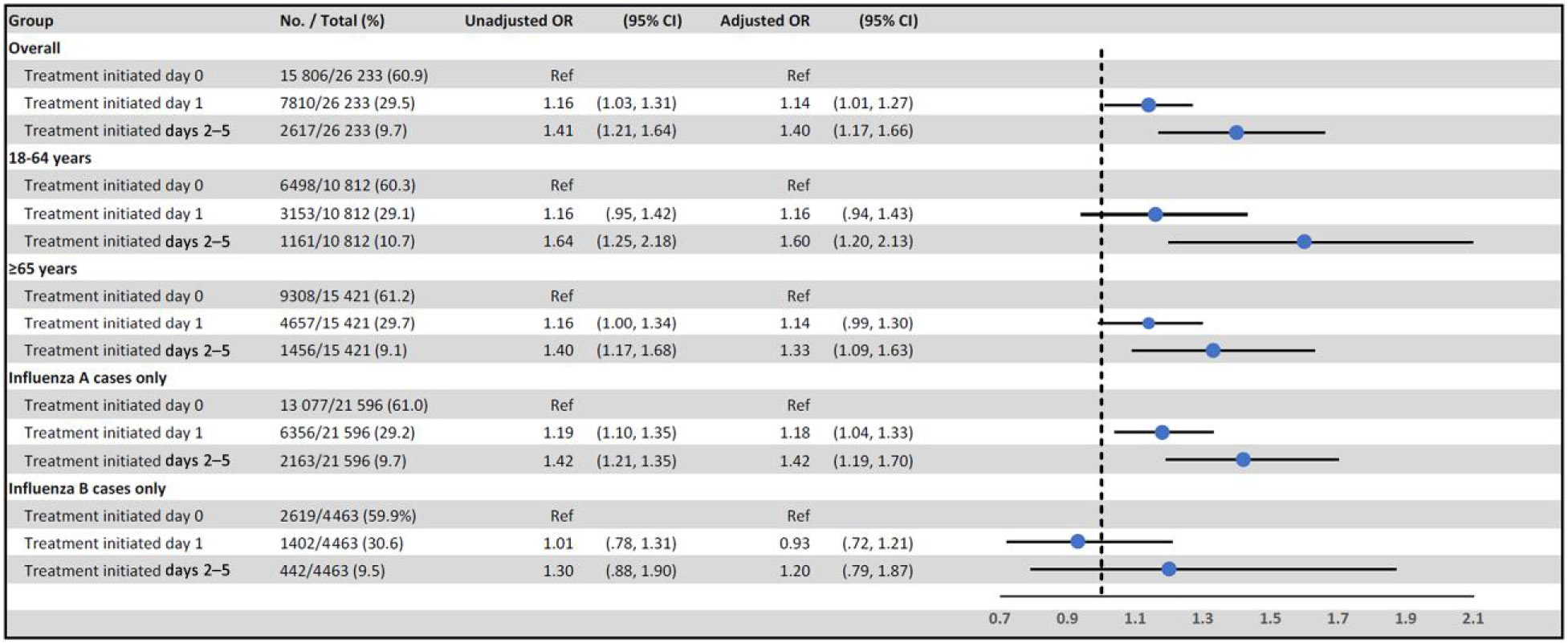
Association between timing of influenza antiviral therapy and 30-day mortality. Abbreviations: CI, confidence interval; OR, odds ratio.
In exploratory analyses, patients who received documented treatment before hospital admission were similar in age and other clinical characteristics to patients who started treatment after hospital admission (Supplementary Table 3). However, a lower percentage of these patients treated before admission were admitted to an ICU (15.4%) or received IMV (6.4%) compared to patients who started treatment on or after the admission date, and 7.1% died within 30 days of hospital admission (Supplementary Table 4). Patients excluded from the main analysis because they died on day 0 or 1 (n = 180) were generally older than patients included in the primary analysis (median age, 75 years) (Supplementary Table 3).
DISCUSSION
Over 7 influenza seasons, in a large sample of adults hospitalized with influenza-associated pneumonia, we found a strong association between timing of influenza antiviral therapy and odds of all-cause death. Compared to patients treated on the day of admission, those who started antiviral treatment 2–5 days after admission had 40% higher odds of dying within 30 days of hospital admission. We observed a weaker yet still statistically significant association between antiviral treatment started the day following admission and odds of death. Trends were consistent across other measures of clinical severity, such as ICU admission, with each additional day of antiviral treatment delay associated with a greater percentage of patients who experienced adverse clinical outcomes. These findings support the recommendation by the CDC and the Infectious Diseases Society of America guidelines to initiate antiviral treatment with oseltamivir as soon as possible to maximize benefit for patients being hospitalized with suspected or confirmed influenza, ideally with treatment started in the outpatient setting or emergency department [3].
Using data from a large population-based surveillance system with systematic data collection, this study provides insights into characteristics, clinical course, and outcomes of patients hospitalized with influenza and pneumonia in the US. Overall, more than one-third of patients had a diagnosis of pneumonia by ICD-9 or ICD-10 discharge code or discharge summary. Most patients were older adults and more than half of patients had 3 or more categories of underlying medical conditions. Pneumonia prevalence was consistent with prior estimates from FluSurv-NET and other studies among adults hospitalized with laboratory-confirmed influenza [6, 20-23]. Within this population, severe clinical outcomes were common, with approximately 30% of patients requiring ICU-level care and almost 10% dying within 2–30 days of admission.
This study also contributes to our understanding of the impact of antiviral treatment on clinical outcomes among patients hospitalized with influenza. Findings from our study are consistent with other published studies. In an individual patient data meta-analysis that included 5978 patients hospitalized with influenza A(H1N1)pdm09 virus infections with a diagnosis of influenza-related pneumonia [24], early antiviral treatment (within 2 days of symptom onset) versus delayed treatment was associated with a reduced odds of death (aOR, 0.70) and lower likelihood of ventilatory support (aOR, 0.68). In a study from China that included patients hospitalized with influenza who also had a diagnosis of pneumonia [25], early antiviral treatment (within 2 days of illness onset) was associated with a decreased risk of 30-day mortality (aOR, 0.53) and IMV (aOR, 0.51) compared to patients started on later treatment. Using days from admission to antiviral treatment initiation, in a larger sample of patients spanning multiple influenza seasons and geographic regions, we found a survival benefit associated with timely (day 0) versus delayed (day 1 or days 2–5) antiviral treatment initiation and an increase in the proportion of patients who experienced other severe outcomes with treatment delays.
Prior hospital-based observational studies have often included any hospitalized patient with an influenza diagnosis. However, patients with influenza may be hospitalized for a variety of reasons including direct influenza-related complications, exacerbations of chronic underlying medical conditions triggered by viral infection, or unrelated reasons with influenza incidentally recognized through routine testing. We used a more specific definition that included a diagnosis of pneumonia to capture a less heterogeneous population of patients with a more severe respiratory phenotype. However, our study population likely still represents a varied group of patients with primary viral pneumonia or mixed or secondary bacterial pneumonia, which are common among patients with influenza virus infection hospitalized with pneumonia [26-29]. Influenza antiviral treatment may provide varying clinical benefit within these subgroups. Of patients with pneumonia ICD-9 or ICD-10 discharge codes, influenza pneumonia (71.7%) and pneumonia with organism unspecified (19.1%) codes were most common and codes for bacterial pneumonia less commonly documented (Supplementary Table 1), although we did not have the granularity of clinical data necessary to definitively distinguish between pneumonia etiologies.
This study was subject to several limitations. First, we did not have information on exact timing of antiviral treatment initiation relative to hospital admission, precluding more precise treatment comparison groups, for example, treatment within 6 hours of admission. Furthermore, depending on timing of treatment within a calendar date, some patients treated on day 1 could potentially have had a shorter treatment delay than patients treated on day 0 (the day of admission), which could attenuate differences in observed risk of 30-day mortality between these groups. Second, we did not account for duration of illness prior to hospitalization as information on illness onset was captured through medical chart abstraction and subject to imperfect recall and/or inconsistent documentation in medical charts. Third, antiviral use prior to hospitalization may have been underascertained. If missingness is differential based on timing of antiviral treatment during admission, this could impact associations between timing of antiviral treatment and outcomes. Fourth, we did not evaluate clinical outcomes stratified by influenza A virus subtype, which may be associated with differences in influenza severity or antiviral treatment effectiveness [13, 30]. Fifth, in this observational study there may have been unmeasured confounders or uncaptured reasons why antiviral treatment may have been delayed for some patients. Sixth, antibiotic treatment information was not collected to stratify outcomes based on both influenza antiviral and antibiotic receipt and timing during hospitalization, given that some patients may have had mixed viral and bacterial or secondary bacterial pneumonia; additional treatment information (eg, use of systemic corticosteroids) was also not captured. Additionally, we evaluated all-cause mortality up to 30 days, and some deaths may not have been directly attributable to influenza.
CONCLUSIONS
Among adults hospitalized with laboratory-confirmed influenza with pneumonia across 7 influenza seasons, delayed influenza antiviral treatment initiation was associated with a greater odds of death within 30 days compared to patients who started treatment on the day of admission. Clinical testing and empiric influenza antiviral treatment should be started as soon as possible for patients being hospitalized with suspected influenza.
Supplementary Material
Acknowledgments.
The authors thank Charisse Cummings from the Centers for Disease Control and Prevention (CDC); Sherry Quach, Gretchen Rothrock, Jeremy Roland, Joelle Nadle, Ashley Coates, Monica Napoles, and Kimberly Gonzalez-Barrera from the California Emerging Infections Program; Sharon Emmerling, Breanna Kawasaki, Madelyn Lensing, Sarah McLafferty, Jordan Surgnier, and Millen Tsegaye from the Colorado Department of Public Health and Environment; Amber Maslar, Adam Misiorski, and Tamara Rissman from the Connecticut Emerging Infections Program, Yale School of Public Health; Emily Fawcett, Taylor Eisenstein, Katelyn Ward, Jeremiah Williams, and Andrew Martin from the Foundation for Atlanta Veterans Education and Research, Georgia Emerging Infections Program, Georgia Department of Public Health, Atlanta Veterans Affairs Medical Center; David Blythe, Alicia Brooks, Robert Sunkel, Brian Bachaus, Emily Blake, Molly Hyde, and Elisabeth Vaeth from the Maryland Emerging Infections Program, Maryland Department of Health; Jim Collins, Shannon Johnson, Justin Henderson, Sue Kim, Val Tellez Nunez, Lauren Leegwater, Elizabeth McCormick, and Lindsay Leigh from the Michigan Department of Health and Human Services; Cynthia Kenyon and Craig Morin from the Minnesota Influenza Hospitalization Surveillance Network (FluSurv-NET) Team, Minnesota Department of Health; Chad Smelser, Daniel M. Sosin, Salina Torres, Chelsea L. Esquibel, Sarah Shrum Davis, Carla Young, and Jeremy Espinoza from the New Mexico Department of Health; Sarah Lathrop, Kathy M. Angeles, Sarah A. Khanlian, Lisa Butler, Robert Mansmann, Marjorie McConnell, Katherine Gienger, Lori Morrow, and Joan Baumbach from the New Mexico Emerging Infections Program; Kerianne Engesser and Adam Rowe from the New York State Department of Health; Christine Long from the University of Rochester School of Medicine and Dentistry; Laurie Billing, Julie Freshwater, Denise Ingabire-Smith, Ann Salvator, and Rebekah Sutter from the Ohio Department of Health; Sam Hawkins at the Public Health Division, Oregon Health Authority; Tiffanie Markus, Katie Dyer, Karen Leib, Terri McMinn, Danielle Ndi, Gail Hughett, Bentley Akoko, Kathy Billings, Anise Elie, and Manideepthi Pemmaraju from Vanderbilt University Medical Center; and Amanda Carter, Andrea George, Ashley Swain, Mary Hill, Melanie Crossland, Ryan Chatelain, Holly Staten, Isabella Reyes, Hafsa Zahid, Emma Mendez, and Kristen Olsen from the Salt Lake County Health Department.
Financial support.
FluSurv-NET is a collaboration of state health departments, academic institutions, and local partners and is funded by the Centers for Disease Control and Prevention. This work was supported by the Centers for Disease Control and Prevention through an Emerging Infections Program cooperative agreement (grant number CK17-1701) and through a Council of State and Territorial Epidemiologists cooperative agreement (grant number NU38OT000297-02-00).
Footnotes
Supplementary Data
Supplementary materials are available at Clinical Infectious Diseases online. Consisting of data provided by the authors to benefit the reader, the posted materials are not copyedited and are the sole responsibility of the authors, so questions or comments should be addressed to the corresponding author.
Disclaimer. The findings and conclusions of this report are those of the authors and do not necessarily reflect the official position of the CDC. The findings and conclusions also do not necessarily represent the views or opinions of the California Department of Public Health or the California Health and Human Services Agency.
Potential conflicts of interest. K. Y.-H., J. M., I. A., and W. S. report grants from the CDC, during the conduct of the study. A. F. and L. R. report grants from the Michigan Department of Health and Human Services, during the conduct of the study. M. L. M. reports grants from the CDC Emerging Infections Program, during the conduct of the study. R. L. reports grants from the CDC Emerging Infections Program cooperative agreement, during the conduct of the study, and fee for work as Associate Editor for the American Academy of Pediatrics Report of the Committee on Infectious Diseases (Red Book), which donated to the Minnesota Department of Health. H. K. T. reports funding from CDC for this work and other areas of research. All other authors report no potential conflicts.
All authors have submitted the ICMJE Form for Disclosure of Potential Conflicts of Interest. Conflicts that the editors consider relevant to the content of the manuscript have been disclosed.
References
- 1.Centers for Disease Control and Prevention. Past seasons estimated influenza disease burden averted by vaccination. 2024. Available at: https://www.cdc.gov/flu/vaccines-work/past-burden-averted-est.html. Accessed 16 October 2023. [Google Scholar]
- 2.Iuliano AD, Roguski KM, Chang HH, et al. Estimates of global seasonal influenza-associated respiratory mortality: a modelling study. Lancet 2018; 391:1285–300. [DOI] [PMC free article] [PubMed] [Google Scholar]
- 3.Uyeki TM, Bernstein HH, Bradley JS, et al. Clinical practice guidelines by the Infectious Diseases Society of America: 2018 update on diagnosis, treatment, chemoprophylaxis, and institutional outbreak management of seasonal influenza. Clin Infect Dis 2019; 68:e1–47. [DOI] [PMC free article] [PubMed] [Google Scholar]
- 4.Appiah GD, Chaves SS, Kirley PD, et al. Increased antiviral treatment among hospitalized children and adults with laboratory-confirmed influenza, 2010–2015. Clin Infect Dis 2017; 64:364–7. [DOI] [PMC free article] [PubMed] [Google Scholar]
- 5.Tenforde MW, Cummings CN, O’Halloran AC, et al. Influenza antiviral use in patients hospitalized with laboratory-confirmed influenza in the United States, FluSurv-NET, 2015–2019. Open Forum Infect Dis 2023; 10:ofac681. [DOI] [PMC free article] [PubMed] [Google Scholar]
- 6.Chow EJ, Rolfes MA, O’Halloran A, et al. Respiratory and nonrespiratory diagnoses associated with influenza in hospitalized adults. JAMA Netw Open 2020; 3:e201323. [DOI] [PMC free article] [PubMed] [Google Scholar]
- 7.Ramirez J, Peyrani P, Wiemken T, Chaves SS, Fry MA. A randomized study evaluating the effectiveness of oseltamivir initiated at the time of hospital admission in adults hospitalized with influenza-associated lower respiratory tract infections. Clin Infect Dis 2018; 67:736–42. [DOI] [PubMed] [Google Scholar]
- 8.Wiemken LT, Furmanek PS, Carrico MR, et al. Effectiveness of oseltamivir treatment on clinical failure in hospitalized patients with lower respiratory tract infection. BMC Infect Dis 2021; 21:1106. [DOI] [PMC free article] [PubMed] [Google Scholar]
- 9.Hiba V, Chowers M, Levi-Vinograd I, Rubinovitch B, Leibovici L, Paul M. Benefit of early treatment with oseltamivir in hospitalized patients with documented 2009 influenza A (H1N1): retrospective cohort study. J Antimicrob Chemother 2011; 66:1150–5. [DOI] [PubMed] [Google Scholar]
- 10.Louie JK, Yang S, Acosta M, et al. Treatment with neuraminidase inhibitors for critically ill patients with influenza A (H1N1)pdm09. Clin Infect Dis 2012; 55:1198–204. [DOI] [PMC free article] [PubMed] [Google Scholar]
- 11.Muthuri SG, Venkatesan S, Myles PR, et al. Effectiveness of neuraminidase inhibitors in reducing mortality in patients admitted to hospital with influenza A H1N1pdm09 virus infection: a meta-analysis of individual participant data. Lancet Respir Med 2014; 2:395–404. [DOI] [PMC free article] [PubMed] [Google Scholar]
- 12.Chaves SS, Pérez A, Miller L, et al. Impact of prompt influenza antiviral treatment on extended care needs after influenza hospitalization among community-dwelling older adults. Clin Infect Dis 2015; 61:1807–14. [DOI] [PubMed] [Google Scholar]
- 13.Lytras T, Mouratidou E, Andreopoulou A, Bonovas S, Tsiodras S. Effect of early oseltamivir treatment on mortality in critically ill patients with different types of influenza: a multiseason cohort study. Clin Infect Dis 2019; 69:1896–902. [DOI] [PubMed] [Google Scholar]
- 14.Oboho IK, Reed C, Gargiullo P, et al. Benefit of early initiation of influenza antiviral treatment to pregnant women hospitalized with laboratory-confirmed influenza. J Infect Dis 2016; 214:507–15. [DOI] [PubMed] [Google Scholar]
- 15.Katzen J, Kohn R, Houk LJ, Ison GM. Early oseltamivir after hospital admission is associated with shortened hospitalization: a 5-year analysis of oseltamivir timing and clinical outcomes. Clin Infect Dis 2019; 69:52–8. [DOI] [PubMed] [Google Scholar]
- 16.Venkatesan S, Myles RP, Bolton JK, et al. Neuraminidase inhibitors and hospital length of stay: a meta-analysis of individual participant data to determine treatment effectiveness among patients hospitalized with nonfatal 2009 pandemic influenza A(H1N1) virus infection. J Infect Dis 2019; 221:356–66. [DOI] [PMC free article] [PubMed] [Google Scholar]
- 17.Viasus D, Paño-Pardo RJ, Pachón J, et al. Timing of oseltamivir administration and outcomes in hospitalized adults with pandemic 2009 influenza A(H1N1) virus infection. Chest 2011; 140:1025–32. [DOI] [PubMed] [Google Scholar]
- 18.Centers for Disease Control and Prevention. Influenza hospitalization surveillance network (FluSurv-NET). 2023. Available at: https://www.cdc.gov/flu/weekly/influenza-hospitalization-surveillance.htm. Accessed 11 January 2024.
- 19.Holstein R, Dawood FS, O’Halloran A, et al. Characteristics and outcomes of hospitalized pregnant women with influenza, 2010 to 2019: a repeated cross-sectional study. Ann Intern Med 2022; 175:149–58. [DOI] [PubMed] [Google Scholar]
- 20.Kalil AC, Thomas PG. Influenza virus-related critical illness: pathophysiology and epidemiology. Crit Care 2019; 23:258. [DOI] [PMC free article] [PubMed] [Google Scholar]
- 21.Garg S, Jain S, Dawood FS, et al. Pneumonia among adults hospitalized with laboratory-confirmed seasonal influenza virus infection—United States, 2005–2008. BMC Infect Dis 2015; 15:369. [DOI] [PMC free article] [PubMed] [Google Scholar]
- 22.Maruyama T, Fujisawa T, Suga S, et al. Outcomes and prognostic features of patients with influenza requiring hospitalization and receiving early antiviral therapy. Chest 2016; 149:526–34. [DOI] [PubMed] [Google Scholar]
- 23.Jain S, Benoit RS, Skarbinski J, Bramley MA, Finelli L. Influenza-associated pneumonia among hospitalized patients with 2009 pandemic influenza A (H1N1) virus—United States, 2009. Clin Infect Dis 2012; 54:1221–9. [DOI] [PubMed] [Google Scholar]
- 24.Muthuri GS, Venkatesan S, Myles RP, et al. Impact of neuraminidase inhibitors on influenza A(H1N1)pdm09-related pneumonia: an individual participant data meta-analysis. Influenza Other Respir Viruses 2016; 10:192–204. [DOI] [PMC free article] [PubMed] [Google Scholar]
- 25.Chen L, Han X, Li YL, Zhang C, Xing X. The impact of early neuraminidase inhibitor therapy on clinical outcomes in patients hospitalised with influenza A–related pneumonia: a multicenter, retrospective study. BMC Infect Dis 2020; 20:628. [DOI] [PMC free article] [PubMed] [Google Scholar]
- 26.Blyth CC, Webb RAS, Kok J, et al. The impact of bacterial and viral co-infection in severe influenza. Influenza Other Respir Viruses 2013; 7:168–76. [DOI] [PMC free article] [PubMed] [Google Scholar]
- 27.Klein YE, Monteforte B, Gupta A, et al. The frequency of influenza and bacterial coinfection: a systematic review and meta-analysis. Influenza Other Respir Viruses 2016; 10:394–403. [DOI] [PMC free article] [PubMed] [Google Scholar]
- 28.Shah SN, Greenberg AJ, Mcnulty CM, et al. Bacterial and viral co-infections complicating severe influenza: incidence and impact among 507 U.S. patients, 2013–14. J Clin Virol 2016; 80:12–9. [DOI] [PMC free article] [PubMed] [Google Scholar]
- 29.Macintyre RC, Chughtai AA, Barnes M, et al. The role of pneumonia and secondary bacterial infection in fatal and serious outcomes of pandemic influenza A(H1N1)pdm09. BMC Infect Dis 2018; 18:637. [DOI] [PMC free article] [PubMed] [Google Scholar]
- 30.Sumner KM, Masalovich S, O’Halloran A, et al. Severity of influenza-associated hospitalisations by influenza virus type and subtype in the USA, 2010–19: a repeated cross-sectional study. Lancet Microbe 2023; 4:e903–12. [DOI] [PMC free article] [PubMed] [Google Scholar]
Associated Data
This section collects any data citations, data availability statements, or supplementary materials included in this article.