



Abstract
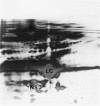
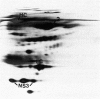
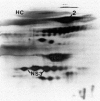
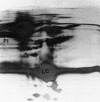
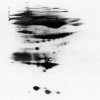
Serum samples from 15 age-matched normal male subjects and 15 male schizophrenic patients on neuroleptic medication were subjected to immunoprecipitation with anti-human prolactin (PRL) and analysis of the immunoprecipitate by two-dimensional gel electrophoresis. We report the unexpected immunoprecipitation of large amounts of an approximately 50 kD protein in 12/15 of the schizophrenic patients. Preliminary analyses suggest that this 50 kD protein may be an IgG heavy chain. Since total levels of IgG and each of the IgG subclasses are the same in the normal and schizophrenic group, the increased amount of the 50 kD protein in the schizophrenics is clearly specific to anti PRL precipitation. Since the anti-PRL does not directly recognize either the 50 kD protein or any immunoglobulin light chains in the precipitate, we suggest that the 50 kD protein is precipitated because it is bound to PRL. Perhaps immunoglobulin binding of PRL is a mechanism used to compensate for chronically elevated PRL levels during neuroleptic treatment.
Full text
PDF


Images in this article
Selected References
These references are in PubMed. This may not be the complete list of references from this article.
- Bernton E. W., Meltzer M. S., Holaday J. W. Suppression of macrophage activation and T-lymphocyte function in hypoprolactinemic mice. Science. 1988 Jan 22;239(4838):401–404. doi: 10.1126/science.3122324. [DOI] [PubMed] [Google Scholar]
- DiMattia G. E., Gellersen B., Bohnet H. G., Friesen H. G. A human B-lymphoblastoid cell line produces prolactin. Endocrinology. 1988 Jun;122(6):2508–2517. doi: 10.1210/endo-122-6-2508. [DOI] [PubMed] [Google Scholar]
- Farkouh N. H., Packer M. G., Frantz A. G. Large molecular size prolactin with reduced receptor activity in human serum: high proportion in basal state and reduction after thyrotropin-releasing hormone. J Clin Endocrinol Metab. 1979 Jun;48(6):1026–1032. doi: 10.1210/jcem-48-6-1026. [DOI] [PubMed] [Google Scholar]
- Gala R. R., Van De Walle C. Prolactin heterogeneity in the serum and milk during lactation. Life Sci. 1977 Jul 1;21(1):99–104. doi: 10.1016/0024-3205(77)90429-5. [DOI] [PubMed] [Google Scholar]
- Green A. I., Brown W. A. Prolactin and neuroleptic drugs. Endocrinol Metab Clin North Am. 1988 Mar;17(1):213–223. [PubMed] [Google Scholar]
- Jonsson S., Kronvall G. The use of protein A-containing Staphylococcus aureus as a solid phase anti-IgG reagent in radioimmunoassays as exemplified in the quantitation of alpha-fetoprotein in normal human adult serum. Eur J Immunol. 1974 Jan;4(1):29–33. doi: 10.1002/eji.1830040108. [DOI] [PubMed] [Google Scholar]
- Lorenson M. Y., Jacobs L. S. Thiol regulation of protein, growth hormone, and prolactin release from isolated adenohypophysial secretory granules. Endocrinology. 1982 Apr;110(4):1164–1172. doi: 10.1210/endo-110-4-1164. [DOI] [PubMed] [Google Scholar]
- Markoff E., Lee D. W., Hollingsworth D. R. Glycosylated and nonglycosylated prolactin in serum during pregnancy. J Clin Endocrinol Metab. 1988 Sep;67(3):519–523. doi: 10.1210/jcem-67-3-519. [DOI] [PubMed] [Google Scholar]
- Nyberg F., Roos P., Wide L. Human pituitary prolactin: isolation and characterization of three isohormones with different bioassay and radioimmunoassay activities. Biochim Biophys Acta. 1980 Oct 21;625(2):255–265. doi: 10.1016/0005-2795(80)90289-5. [DOI] [PubMed] [Google Scholar]
- Oakley B. R., Kirsch D. R., Morris N. R. A simplified ultrasensitive silver stain for detecting proteins in polyacrylamide gels. Anal Biochem. 1980 Jul 1;105(2):361–363. doi: 10.1016/0003-2697(80)90470-4. [DOI] [PubMed] [Google Scholar]
- Oetting W. S., Walker A. M. Differential isoform distribution between stored and secreted prolactin. Endocrinology. 1986 Sep;119(3):1377–1381. doi: 10.1210/endo-119-3-1377. [DOI] [PubMed] [Google Scholar]
- Oetting W. S., Walker A. M. Intracellular processing of prolactin. Endocrinology. 1985 Oct;117(4):1565–1569. doi: 10.1210/endo-117-4-1565. [DOI] [PubMed] [Google Scholar]
- Rogol A. D., Rosen S. W. Prolactin of apparent large molecular size: the major immunoactive prolactin component in plasma of a patient with a pituitary tumor. J Clin Endocrinol Metab. 1974 Apr;38(4):714–717. doi: 10.1210/jcem-38-4-714. [DOI] [PubMed] [Google Scholar]
- Russell D. H., Matrisian L., Kibler R., Larson D. F., Poulos B., Magun B. E. Prolactin receptors on human lymphocytes and their modulation by cyclosporine. Biochem Biophys Res Commun. 1984 Jun 29;121(3):899–906. doi: 10.1016/0006-291x(84)90762-9. [DOI] [PubMed] [Google Scholar]
- Russell D. H., Mills K. T., Talamantes F. J., Bern H. A. Neonatal administration of prolactin antiserum alters the developmental pattern of T- and B-lymphocytes in the thymus and spleen of BALB/c female mice. Proc Natl Acad Sci U S A. 1988 Oct;85(19):7404–7407. doi: 10.1073/pnas.85.19.7404. [DOI] [PMC free article] [PubMed] [Google Scholar]
- Shiu R. P., Elsholtz H. P., Tanaka T., Friesen H. G., Gout P. W., Beer C. T., Noble R. L. Receptor-mediated mitogenic action of prolactin in a rat lymphoma cell line. Endocrinology. 1983 Jul;113(1):159–165. doi: 10.1210/endo-113-1-159. [DOI] [PubMed] [Google Scholar]
- Walker A. M., Farquhar M. G. Preferential release of newly synthesized prolactin granules is the result of functional heterogeneity among mammotrophs. Endocrinology. 1980 Oct;107(4):1095–1104. doi: 10.1210/endo-107-4-1095. [DOI] [PubMed] [Google Scholar]