



Abstract
Aim
To explore the status of job crafting, leisure crafting, and burnout among nurses and to examine the impact of job crafting and leisure crafting variations on burnout using machine learning-based models.
Background
The prevalence of burnout among nurses poses a severe risk to their job performance, quality of healthcare, and the cohesiveness of nurse teams. Numerous studies have explored factors influencing nurse burnout; however, few involved job crafting and leisure crafting synchronously and elucidated the effect differences of the two crafting behaviors on nurse burnout.
Methods
Multicentre cross-sectional survey study. Nurses (n = 1235) from four Chinese tertiary hospitals were included. The Maslach Burnout Inventory-General Survey, the Job Crafting Scale, and the Leisure Crafting Scale were employed for data collection. Four machine learning algorithms (logistic regression model, support vector machine, random forest, and gradient boosting tree) were used to analyze the data.
Results
Nurses experienced mild to moderate levels of burnout and moderate to high levels of job crafting and leisure crafting. The AUC (in full) for the four models was from 0.809 to 0.821, among which the gradient boosting tree performed best, with 0.821 AUC, 0.739 accuracy, 0.470 sensitivity, 0.919 specificity, and 0.161 Brier. All models showed that job crafting was the most important predictor for burnout, while leisure crafting was identified as the second important predictor for burnout in the random forest model and gradient boosting tree model.
Conclusion
Even if nurses experienced mild to moderate burnout, nurse managers should develop efficient interventions to reduce nurse burnout. Job crafting and leisure crafting may be beneficial preventative strategies against burnout among nurses at present. Implications for Nursing Management. Job and leisure crafting were identified as effective methods to reduce nurse burnout. Nurse managers should provide more opportunities for nurses' job crafting and encourage nurses crafting at their leisure time.
1. Background
Nurses constitute the largest proportion of the healthcare workforce worldwide and play an essential role in clinical treatment, illness prevention, and health promotion. However, because of extensive job demands, scarce resources, work-family conflicts, and complex clinical work environments, nurses experience several burnout symptoms, such as emotional exhaustion, cynicism, and reduced professional efficacy [1, 2]. These phenomena adversely affect the quality of care, patient safety and satisfaction, job performance, turnover rate, and the physical and mental health of nurses [3, 4]. According to a nationwide survey conducted in the United States of America, 16.6%–30.0% of nurses (3,957,661 samples) reported experiencing burnout and 31.5% of them listed burnout as a contributing factor to their decision to leave their positions [5]. A cross-sectional survey in 12 European countries showed that 10%–78% of nurses had burnout symptoms [6]. In the mainland China, the burnout rate is also high; for example, in Shanghai, it is 45.1% [7], and in Hunan, it is at 34.9% [8]. Given the current high levels of burnout among nurses worldwide, it has become critical for hospital administrators, nurse managers, and nurses themselves to gain a deeper understanding of the factors that contribute to burnout to enhance the quality of clinical care, stabilize nurse retention, and improve the physical and mental health of nurses.
Job crafting is defined as the actions employees take in modifying their tasks and work relationships to promote their cognitive understanding of the job meaning and attain a greater person-job fit [9]. Previous studies have highlighted that job crafting is not only beneficial to employees' health (e.g., well-being and general health) [10, 11], work attitude (e.g., job satisfaction and organizational commitment) [12], and behavior (e.g., work engagement and creativity) [13] but is also conducive to organizational performance (e.g., quality of care and group innovation) [14, 15]. Literature review shows that increasing research had investigated the relationship between job crafting and burnout in nurses. Cumulative evidence has shown that job crafting can maintain a proactive balance between job demands and resources by fostering self-driven work behavior, consequently alleviating nurse burnout [16]. Several studies have found a moderate-to-high influence of job crafting on burnout [16, 17], whereas others have reported a rather small effect of job crafting on burnout [18]. Because the effect sizes of these studies were inconsistent, further investigation is required to provide new evidence.
Leisure crafting is a novel strategy for dealing with depleted resources and was firstly defined by Petrou and Bakker [19]. This strategy refers to individuals' proactive and self-initiated pursuit of off-job life to fulfill their goals, interpersonal connections, learning, and personal growth. Unlike job crafting, leisure crafting motivates individuals' passions and satisfies their psychological requirements by shaping their leisure activities in a proactive, deliberate, and serious manner [20, 21]. Existing studies indicated that leisure crafting can reshape the task and relational bounds of individuals' leisure, improve their sense of mastery, and help them acquire resources [22, 23]. Leisure crafting is believed to address individuals' needs and values and improve their ability to handle workplace stressors, thereby averting the negative effects of job demands [24]. Few studies have explored the effects of leisure crafting on work-related attitudes and behaviors, particularly burnout issues. Moreover, little is known about whether job crafting and leisure crafting have similar effects on burnout.
Conservation of resources' theory assumes that individuals have the motivation to invest their resources for accumulating additional resources to protect their health and well-being [25]. Based on the conservation of resources' theory, an excessive workload is a persistent threat to nurses' valued resources, which results in burnout [26]. While nurses' accumulation of resources can sustain and protect additional resources, which greatly alleviate burnout among nurses, several studies supported that both job crafting and leisure crafting play vital roles in acquiring and adjusting resources [10, 27]. Job crafting and leisure crafting represent resource gain processes as nurses cope with stressful job demands and enrich their leisure time that motivate them and enhance their ability to perform well [28]. Resources gained from job crafting can improve nurses' ability to better fulfill their work obligations, which is conducive to reduce burnout [29]. Resources activated and replenished from leisure crafting can spill over to the work domain to improve nurses' work engagement and hence lighten nurse burnout [27]. Therefore, based on theoretical basis and the empirical studies, the study puts forward hypothesis 1: job crafting and leisure crafting are negatively influencing nurse burnout.
At present, most studies have investigated the factors influencing burnout using multiple linear regression models, which have high requirements for data features (including normal distribution and homoscedasticity). Machine learning, a common artificial intelligence-driven technology, has been successfully integrated into the field of health risk assessment. Unlike traditional statistics, machine learning models do not have any rules for data distribution and learn from provided samples to explore the complex and nonlinear relations among measured variables [30]. Several studies have applied machine learning to test predictors of burnout and achieved good findings. However, most of them only used one type of machine learning model (e.g., convolutional neural network, multitask learning technique, and decision tree) [31, 32], which does not avoid bias caused by the model and confirms the most significant predictors of burnout.
The main objectives of this study were to provide a comprehensive description of job crafting, leisure crafting, and burnout among nurses from Chinese tertiary hospitals. We also aimed to evaluate the effects of job crafting and leisure crafting on burnout by developing and validating four machine learning-based models.
2. Methods
2.1. Study Design
The cross-sectional multicenter study design was employed to describe the status of job crafting, leisure crafting, and burnout among nurses and explore the associations among these variables.
2.2. Participants
There are 107 tertiary hospitals in Shandong Province, China (https://www.doc88.com/p-11461558491027.html). A convenience sampling method was used to recruit hospitals from the 107 tertiary hospitals. Nurses from the included hospitals, who met the inclusion and exclusion criteria, were required to participate in the online survey. The inclusion criteria included registered and licensed practical nurses who directly cared for patients. Nurses on sick leave or those in the process of turnover were excluded from the study.
A total of 1,754 nurses from the four tertiary hospitals were invited to complete the online questionnaires, and 1,235 responses were included in the final analysis (Supplementary file “Participation rate and sample size”).
2.3. Measures
A personal demographic form, the Maslach Burnout Inventory-General Survey (MBI-GS), the Job Crafting Scale (JCS), and the Leisure Crafting Scale (LCS) were used for the online survey.
The personal demographic form included 10 questions to investigate nurses' sociodemographic information, such as sex, age, years of service, academic degree, marital status, do they have a child/children, professional qualifications, specialty area, monthly income, and shift work.
The MBI-GS was used to assess the nurses' burnout status. This 16-item seven-Likert scale was developed by Maslach and Jackson [33]. The Chinese version was translated by Li and Shi [34]. Three dimensions of the MBI-GS are “emotional exhaustion,” “cynicism,” and “reduced professional efficacy.” A seven-point Likert scale (0 = never, 6 = every day) was used to score the items. The following equation, developed by Kalimo et al. [35], was used to calculate the total MBI-GS score. Total score for burnout = score for “emotional exhaustion” × 0.3 + score for “cynicism” × 0.3 + score for “reduced professional efficacy” × 0.4. The minimum and maximum scores for burnout range from zero to six, with higher scores indicating severe levels of burnout. Cronbach's alpha coefficients for the MBI-GS were 0.88 in the study.
The JCS used to measure job crafting was developed by Tims et al. [36]. The Chinese version's validity and reliability were tested by Liao [37]. This 21-item scale has four dimensions (increasing structural job resources, increasing social job resources, increasing challenging job demands, and reducing obstructive job demands) and scores on a five-point Likert scale. The score for job crafting is the average score of the total items. Higher scores indicated greater job crafting experienced by nurses. In this study, Cronbach's alpha coefficients for the JCS were 0.95.
The nine-item LCS, developed by Petrou and Bakker [19], measured nurses' crafting during their leisure time. The validity and reliability of the Chinese version were examined by Guo et al. [38]. A five-point Likert scale (1 = not at all, 5 = very many) was used to score each item. The LCS score is the average of nine items. The LCS had good validity and reliability, with Cronbach's alpha coefficients of 0.95 in the current study.
2.4. Data Collection
This study was conducted at four tertiary hospitals between June 3 and October 31, 2022. The Wenjuanxing-Enterprise edition (Changsha Ranxing Information Technology Co., Ltd., Changsha, China) was used to develop the online survey. Two research assistants were recruited from each hospital. All research assistants were given a three-hour investigation training session before conducting the survey. Research assistants delivered an online questionnaire link and explanatory statements to the nurses via e-mail, WeChat, and other communication apps. Nurses who met the inclusion criteria were asked to complete the survey. Two push notifications (Dear participants, please remember to complete the online survey. Thank you.) were sent to nurses. The survey took 10–15 minutes to complete.
2.5. Ethical Considerations
Ethical approval (Human Sciences Ethics Committee of School of ∗∗, one University No. 2020-R-030) and hospital permissions were obtained for this study. Nurses who submitted the online survey were considered to have provided informed consent.
2.6. Data Analyses
Data were analyzed using SPSS 24.0, with descriptive analysis, t-tests (to compare burnout scores between two groups), ANOVA (to compare burnout scores' differences among three or more groups), and correlation tests (to evaluate the correlations among the measured variables). Kurtosis and skewness were used to describe the normal distribution of measured variables. Values for kurtosis were from −0.237 to 1.002, and values for skewness were between −0.724 and 0.392, indicating that, generally, the data were normally distributed. According to the Harman single-factor analysis, 36.7% of the variance could be explained by one factor, which suggests that no significant common method variance was found in the study. K-means clustering analysis was used to divide burnout into a low burnout group and a high burnout group.
A computer-generated random number sequence divided the data into training (70%) and validation (30%) cohorts. Python 3.9 was employed to conduct four machine learning algorithms (logistic regression model, support vector machine, random forest, and gradient boosting tree) to obtain models for predicting nurse burnout. The logistic regression model is one kind of generalized linear regression categories. Support vector machine employs kernel functions to map linearly indivisible data to a multidimensional feature space, which could deal with complex data such as high dimensional, nonlinear, and small sample size. Random forest is an integrated algorithm which uses decision trees as the main classifier. Random forest is applied to issues of classification and regression. Gradient boosting tree includes decision tree and gradient boosting. It can deal with tasks of classification and regression via additive model and forward distribution algorithms.
The burnout prediction models included 16 variables (independent variables: job crafting and leisure crafting; covariates: significant demographic characteristics; dummy variables: eight variables). Five repetitions of the 10-fold cross-validation were conducted to optimize the model parameters. The area under the receiver operating characteristic curve (AUC), accuracy, sensitivity, specificity, and Brier were calculated to compare the predictive performance of the models. Brier represents the average-squared distance from the predicted probability of the model to the actual probability. The lower the Brier scores, the better the model performance. A two-sided p value ≤0.05 was considered statistically significant.
3. Results
3.1. Demographic Characteristics and Burnout of Nurses
Most nurses were women (95.8%), married (80.9%), held bachelor's degrees (85%), and had a child/children (76.2%). Over half were 30–39 years old, had temporary employment, had worked less than 11 years in medical and surgical departments, and had shift work more than four times per month. Of these, 46.4% were lead nurses, and only 23.3% of the nurses' income was higher than 9000 Yuan (1,231 $ USD) (Table 1).
Table 1.
Demographic characteristics and burnout among nurses (n = 1,235).
| Characteristics | n (%) | Burnout (M ± SD) | Test statistics |
|---|---|---|---|
| Sex | |||
| Men | 52 (4.2) | 1.98 ± 0.95 | t = −0.271 |
| Women | 1183 (95.8) | 2.02 ± 1.05 | |
|
| |||
| Age (years) | |||
| 20–29 | 303 (24.5) | 2.13 ± 1.05 | F = 9.077∗∗ |
| 30–39 | 734 (59.4) | 2.06 ± 1.03 | |
| 40–49 | 168 (13.6) | 1.72 ± 1.05 | |
| 50–59 | 30 (2.4) | 1.48 ± 0.97 | |
|
| |||
| Years of service | |||
| 0–11 | 800 (64.8) | 2.09 ± 1.03 | F = 8.211∗∗ |
| 12–23 | 349 (28.3) | 1.99 ± 1.06 | |
| 24–35 | 81 (6.6) | 1.49 ± 0.96 | |
| >35 | 5 (0.4) | 1.93 ± 1.28 | |
|
| |||
| Academic degree | |||
| Diploma | 8 (0.6) | 1.51 ± 1.32 | F = 1.569 |
| Associate degree | 144 (11.7) | 2.09 ± 1.00 | |
| Bachelor's degree | 1050 (85.0) | 2.01 ± 1.06 | |
| Master's degree and higher | 33 (2.7) | 2.27 ± 0.78 | |
|
| |||
| Marriage | |||
| Single | 209 (16.9) | 2.29 ± 1.08 | F = 6.002∗∗ |
| Married | 999 (80.9) | 1.96 ± 1.03 | |
| Divorced | 26 (2.1) | 2.05 ± 1.26 | |
| Widowed | 1 (0.1) | 3.12 ± 0.00 | |
|
| |||
| Had child/children | |||
| No | 294 (23.8) | 2.26 ± 1.10 | t = 4.470∗∗ |
| Yes | 941 (76.2) | 1.95 ± 1.02 | |
|
| |||
| Employment | |||
| Temporary | 696 (56.4) | 2.07 ± 1.04 | F = 2.649 |
| Personnel agency | 254 (20.6) | 2.03 ± 0.99 | |
| Authorized | 285 (23.1) | 1.90 ± 1.05 | |
|
| |||
| Professional qualification | |||
| Nurse | 192 (15.5) | 2.07 ± 0.96 | F = 3.584∗∗ |
| Senior nurse | 412 (33.4) | 2.11 ± 1.10 | |
| Lead nurse | 573 (46.4) | 1.98 ± 1.03 | |
| Associate chief nurse | 50 (4.0) | 1.74 ± 1.05 | |
| Chief nurse | 8 (0.6) | 1.10 ± 0.66 | |
|
| |||
| Specialty area | |||
| Medical | 402 (32.6) | 2.10 ± 1.03 | F = 2.592∗∗ |
| Surgical | 256 (20.7) | 2.08 ± 1.03 | |
| Gynaecology | 106 (8.6) | 1.86 ± 1.01 | |
| Paediatric | 89 (7.2) | 2.26 ± 1.18 | |
| Emergency | 27 (2.2) | 2.25 ± 1.01 | |
| Operating room | 55 (4.5) | 1.89 ± 0.96 | |
| Intensive care unit | 53 (4.3) | 1.92 ± 1.00 | |
| Outpatient services | 102 (8.3) | 1.81 ± 1.05 | |
| Others | 145 (11.7) | 1.86 ± 1.09 | |
|
| |||
| Monthly income# (RMB, after tax) | |||
| ≤3000 | 90 (7.3) | 2.25 ± 1.16 | F = 2.136 |
| 3001–5000 | 343 (27.8) | 2.09 ± 1.06 | |
| 5001–7000 | 345 (27.9) | 1.93 ± 1.02 | |
| 7001–9000 | 169 (13.7) | 2.01 ± 1.03 | |
| ≥9001 | 288 (23.3) | 1.99 ± 1.04 | |
|
| |||
| Shift work | |||
| No | 370 (30.0) | 1.88 ± 1.03 | F = 5.643∗∗ |
| <4 times/month | 143 (11.6) | 1.96 ± 1.01 | |
| ≥4 times/month | 722 (58.5) | 2.10 ± 1.06 | |
Note. ∗∗p < 0.01, #1 US dollar = 6.54 Chinese Yuan.
The results of the bivariate statistical analysis showed that nurse burnout levels were significantly different according to age, years of service, marital status, child/children status, professional qualifications, specialty area, and shift work (each p < 0.01).
3.2. Descriptive and Correlation Analyses among Burnout, Job Crafting, and Leisure Crafting
The burnout level for nurses was 2.02 ± 1.05, indicating that nurses experienced mild-to-moderate levels of burnout. The average score for job crafting was 4.05 ± 0.56. The average score for leisure crafting was 3.84 ± 0.78, suggesting that nurses had moderate-to-high levels of job and leisure crafting (Table 2).
Table 2.
Descriptive and correlation analyses among burnout, job crafting, and leisure crafting of nurses.
| M ± SD | Min-max | Burnout | Job crafting | Leisure crafting | |
|---|---|---|---|---|---|
| Burnout | 2.02 ± 1.05 | 0.00–5.85 | 1 | ||
| Job crafting | 4.05 ± 0.56 | 1.00–5.00 | −0.400∗∗ | 1 | |
| Leisure crafting | 3.84 ± 0.78 | 1.00–5.00 | −0.281∗∗ | 0.666∗∗ | 1 |
Note. ∗∗p < 0.01.
The correlation analysis showed that burnout was significantly negatively correlated with job and leisure crafting (each p < 0.01) (Table 2). Nurses who experienced high burnout generally engaged in less job and leisure crafting.
3.3. K-Means Clustering Analysis for Burnout
According to the K-means clustering analysis, two clusters for burnout were found: the low-burnout group (final cluster center 1.24, n = 678) and the high-burnout group (final cluster center 2.97, n = 557) (Table 3).
Table 3.
K-means clustering analysis for burnout.
| Groups | n | Final cluster centers | Scores |
|---|---|---|---|
| Low burnout group | 678 | 1.24 | 0.00–2.10 |
| High burnout group | 557 | 2.97 | 2.11–5.85 |
3.4. Model Performance
The binary logistic regression analysis showed that job crafting, age, medical department, paediatric department, and shift work significantly influenced nurse burnout. Nurses who had lower job crafting, were younger in age, worked in medical and paediatric departments, and shifted work had a higher risk of experiencing severe burnout. Supplementary Files eTable 1 and eFigure 1 present the regression model results.
Support vector machine (SVM), random forest, and gradient boosting tree were employed to evaluate significant factors influencing burnout. The importance of the permutation features was calculated using the three machine learning algorithms. In the SVM model, the top five predictors were job crafting, age, child/children status, years of service, and leisure crafting (Supplementary file eFigure 2). In the random forest and gradient boosting tree models, the top five predictors were job crafting, leisure crafting, age, years of service, and professional qualifications (Supplementary file eFigures 3 and 4).
The performance of each model is summarized in Table 4. The receiver operating characteristic (ROC) curves for the validation cohort are shown in Figures 1(a) and 1(b). The gradient boosting tree model performed the best, with an AUC of 0.821, accuracy of 0.739, sensitivity of 0.470, and specificity of 0.919. The Brier score for the gradient boosting tree was the lowest (0.161), indicating that the model was reliable.
Table 4.
Model performance in predicting burnout in the validation cohort.
| AUC | Accuracy | Sensitivity | Specificity | Brier | |
|---|---|---|---|---|---|
| Logistic | 0.809 | 0.647 | 0.128 | 0.995 | 0.253 |
| SVM | 0.803 | 0.720 | 0.409 | 0.928 | 0.180 |
| Random forest | 0.820 | 0.733 | 0.443 | 0.928 | 0.167 |
| Gradient boosting tree | 0.821 | 0.739 | 0.470 | 0.919 | 0.161 |
Figure 1.
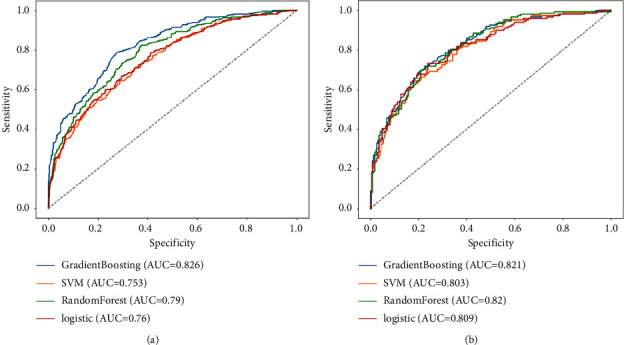
ROC curves of different machine learning models in (a) the training cohort and (b) the validation cohort.
4. Discussion
This study aimed to explore the status of job crafting, leisure crafting, and burnout among Chinese nurses and exam the effects of job crafting and leisure crafting on burnout using four machine learning algorithms. This study is one of the first investigations on this topic. We found that nurses experienced mild-to-moderate levels of burnout and moderate-to-high levels of job and leisure crafting. Furthermore, compared with leisure crafting, job crafting played a greater role in predicting burnout in SVM, random forest, and gradient boosting tree models. These important findings suggest that nurses plan their efforts to promote their job and leisure crafting and that nurse managers should adopt effective strategies to reduce burnout symptoms among nurses.
In the current study, nurses had mild-to-moderate levels of burnout. These results are supported by previous studies conducted in other countries [39, 40]. As nurses experience mild-to-moderate burnout, both nurse managers and nurses pay less attention to this chronic, persistent syndrome, which leads to severe outcomes in nurses' physical and mental health, job performance, and organizational commitment [41, 42]. Accordingly, raising managers' and nurses' concerns about burnout is vital, especially in mainland China. Furthermore, effective personal-oriented, organizational-oriented, and personal-organizational combined interventions should be implemented to reduce burnout among nurses.
In this study, the nurses experienced moderate-to-high levels of job crafting. This finding is consistent with the studies of Alharthi et al. [43] and Harbridge et al. [44]. A qualitative study revealed that nurses had passion and strengths in job crafting. They were actively job crafting in all aspects via activities, such as techniques' training, participating in working teams and committees, and being involved in programs [45]. Nurses proactively initiated and altered clinical tasks to address the requirements of their vulnerable patients, which could promote the quality of care and achieve more meaning in their jobs [46].
We found, quite interestingly, that nurses experienced moderate-to-high levels of leisure crafting. Studies have indicated that leisure crafting is an individual's adaptive behavior in leisure life, which can positively benefit work engagement, personal achievement, and organizational performance [47, 48]. Several leisure activities were believed to enhance individuals' leisure crafting, such as hobby participation, enjoying activities, and seeking a sense of purpose during leisure time [49]. Therefore, nurses are encouraged to pursue their hobbies and engage in leisure activities to produce crafting behaviors outside their work.
In the present study, four machine learning models were used to evaluate the effects of differences in job and leisure crafting on burnout among nurses. Although the predictive capacity of the models was less satisfactory (AUCs ranged from 0.803 to 0.821), they can help nurse burnout management and their prediction can be improved by including more influencing variables. The sensitivity of the four models ranged from 0.128 to 0.470, indicating a low capacity to target nurses at a high risk of burnout. A possible reason is that some important predictors were not included in the models; as a result, the models could not sensitively include nurses with burnout. The specificity of the four models (ranging from 0.919 to 0.995) was good in the study, indicating that the models specifically distinguished burnout from similar syndromes. Among the four models, the gradient boosting tree exhibited the best performance, with good sensitivity and calibration efficacy. The performance of the SVM model was similar to that of the random forest model, whereas that of the logistic model was far from satisfactory.
In this study, job crafting was the most important predictor of burnout in the four models. In contrast, the effect size of job crafting on burnout was small in the logistic regression analysis (odds ratio = 0.123). Martinez et al. [50] reported that job crafting can explain 15.7%–19.7% of the variance in burnout in four dimensions (personal impact dimension, job dissatisfaction, motivational abandonment, and social climate dimension) among male nurses. Roskova and Faragova [18] reported that job crafting combined with age and position explained 14% of the variability in burnout among full-time employees. According to the Job Demands-Resources model, overwhelming job demands and limited job resources lead to burnout and job crafting is one of the mediating factors in this relationship. High job crafting encourages individuals to reframe their perceptions of work, engage in more workplace relationships, and change the nature of their tasks, which could decrease burnout and increase job satisfaction and well-being [51]. Considering the mild but significant effect of job crafting on nurse burnout, nurse managers and nurses must foster nurses' crafting behaviors in their clinical work through several typical interventions (e.g., job crafting workshops and job crafting exercises) [52, 53].
In the study, we creatively revealed the predictive value of leisure crafting on burnout using four machine learning models. Leisure crafting was the second or fifth most important feature for burnout in the SVM, random forest, and gradient boosting tree models. However, leisure crafting was not included in the final logistic regression model. Studies have reported that off-job crafting enables individuals to learn new things, expand existing hobbies, and have new personal connections, which can help them overcome severe challenges, promote personal growth, and achieve a good balance between job and leisure [54, 55]. Ugwu [56] demonstrated that leisure crafting alleviates the negative effects of counterproductive work behaviors caused by high job demands. Therefore, nurse manager and nurses should be aware of the importance of leisure crafting in burnout. Various leisure activities should be organized in establishing new interpersonal relationships, developing new skills, and learning new meanings in work and life [57].
Despite the fact the correlations between job crafting, leisure crafting, and burnout had been tested in the study, several limitations in this present study need to be considered. First, data were collected from four Chinese tertiary hospitals. Data from other hospital levels were lacking, which might have influenced the performance of the model in the external dataset. We suggest collecting sufficient data from different hospitals to validate the model. Second, regarding the cross-sectional study design, the effects of job and leisure crafting on burnout did not present a cause-and-effect relationship. Therefore, a longitudinal study is needed to better understand the predictions of job and leisure crafting on nurse burnout. Third, the study focused only on limited characteristics of nurses, such as demographic, job crafting, and leisure crafting. This might be the primary reason for the low sensitivity of the models. Therefore, several significant factors influencing burnout (e.g., job stress, job resources, work-family conflict, collegial support, and leadership) should be investigated and analyzed in future studies. Fourth, 52 male nurses were included in the study. Generalization of the model for male nurses should be done with caution, and further surveys of this demographic are needed to clarify the model found in the study. Finally, nurses who were on sick leave and in the process of turnover were excluded from the study. Nurses in these conditions may experience high levels of burnout. Therefore, further studies could recruit nurses in these conditions to promote the generalization of the studies.
5. Conclusions
Burnout is a serious issue among nurses worldwide, raising great concerns among hospital administrators and nurse managers. In this study, nurses experienced mild-to-moderate levels of burnout; moreover, they had moderate-to-high levels of job and leisure crafting. These findings indicate that despite nurses having some burnout symptoms, they tend to apply crafting activities to increase their clinical skills and confidence and promote their interpersonal relationships and self-development. According to the machine learning-based predictive models, job crafting and leisure crafting were significant predictors of burnout, and job crafting was the most important predictor of burnout in the four models. Therefore, nurse managers are encouraged to create a casual crafting environment and take effective measures to improve nurses' crafting behaviors, ultimately reducing their burnout and promoting their clinical performance and organizational commitment.
6. Implications for Nursing Management
Burnout is a critical risk factor for the organizational health (e.g., organizational commitment and development) of hospitals and physical (e.g., inflammation, pain, and sleep disorder) and mental health (e.g., anxiety and depression) of nurses. Therefore, hospital administrators and nurse managers should pay more attention on this severe problem and take effective measures to alleviate burnout among nurses. According to the findings of this study, routine assessment of burnout among nurses should be added in health management strategies for nursing team.
In this study, job crafting was the most significant influencing factor for nurse burnout. Nurse managers should realize the positive effects of job crafting on nurse burnout. Several effective interventions (including job crafting training workshop, job crafting e-learning, and career crafting training) can be selected as training courses to meet the job crafting needs of nurses [58, 59]. Furthermore, nurse managers are encouraged to create a positive working environment and provide more organizational resources and opportunities for nurses to help them successfully deal with work challenges and achieve self-growth. In addition, several kinds of mutual-aid groups should be organized by nurse managers to support nurses find help from colleagues.
Leisure crafting is another new influencing factor for nurse burnout. According to this interesting finding, nurse managers are suggested to support nurses to cultivate personal hobbies and learn new knowledge via several group activities. Nurses are encouraged to fully use their leisure time to keep good personal relationships, develop new skills, and obtain a different experience. Setting achievable goals and keeping active thinking in leisure activities are also beneficial to nurses work attitude and performance.
Acknowledgments
The authors highly appreciate the contribution from Mr. Yi-Wei Zhang for data analysis and modelling. The authors also thank nurse participants, research assistants, and directors of nursing department from each hospital for their participation and unreserved help. This study was funded by the National Natural Science Foundation of China (72004120) and the Natural Science Foundation of Shandong Province (ZR2020QG058).
Data Availability
Data are available from the corresponding author upon reasonable request.
Conflicts of Interest
The authors declare that they have no conflicts of interest.
Supplementary Materials
The supplementary file presents the detailed results of the binary logistic regression analysis, support vector machine (SVM), random forest, and gradient boosting tree.
References
- 1.Copanitsanou P., Fotos N., Brokalaki H. Effects of work environment on patient and nurse outcomes. British Journal of Nursing . 2017;26(3):172–176. doi: 10.12968/bjon.2017.26.3.172. [DOI] [PubMed] [Google Scholar]
- 2.Murat M., Kose S., Savaşer S. Determination of stress, depression and burnout levels of front-line nurses during the COVID-19 pandemic. International Journal of Mental Health Nursing . 2021;30(2):533–543. doi: 10.1111/inm.12818. [DOI] [PMC free article] [PubMed] [Google Scholar]
- 3.Jun J., Ojemeni M. M., Kalamani R., Tong J., Crecelius M. L. Relationship between nurse burnout, patient and organizational outcomes: systematic review. International Journal of Nursing Studies . 2021;119 doi: 10.1016/j.ijnurstu.2021.103933.103933 [DOI] [PubMed] [Google Scholar]
- 4.Kelly L. A., Gee P. M., Butler R. J. Impact of nurse burnout on organizational and position turnover. Nursing Outlook . 2021;69(1):96–102. doi: 10.1016/j.outlook.2020.06.008. [DOI] [PMC free article] [PubMed] [Google Scholar]
- 5.Shah M. K., Gandrakota N., Cimiotti J. P., Ghose N., Moore M., Ali M. K. Prevalence of and factors associated with nurse burnout in the US. JAMA Network Open . 2021;4(2) doi: 10.1001/jamanetworkopen.2020.36469.e2036469 [DOI] [PMC free article] [PubMed] [Google Scholar]
- 6.Aiken H. L., Sermeus W., Van den Heede K., et al. Patient safety, satisfaction, and quality of hospital care: cross sectional surveys of nurses and patients in 12 countries in Europe and the United States. BMJ . 2012;233 doi: 10.1136/bmj.e1717.e1717 [DOI] [PMC free article] [PubMed] [Google Scholar]
- 7.Lu M., Ruan H., Xing W., Hu Y. Nurse burnout in China: a questionnaire survey on staffing, job satisfaction, and quality of care. Journal of Nursing Management . 2015;23(4):440–447. doi: 10.1111/jonm.12150. [DOI] [PubMed] [Google Scholar]
- 8.Zhou W., He G., Wang H., He Y., Yuan Q., Liu D. Job dissatisfaction and burnout of nurses in Hunan, China: a cross-sectional survey. Nursing and Health Sciences . 2015;17(4):444–450. doi: 10.1111/nhs.12213. [DOI] [PubMed] [Google Scholar]
- 9.Tims M., Bakker A. B. Job crafting: towards a new model of individual job redesign. SA Journal of Industrial Psychology . 2010;36(2):1–9. doi: 10.4102/sajip.v36i2.841. [DOI] [Google Scholar]
- 10.Shi Y., Li D., Zhang N., et al. Job crafting and employee’s general health: the role of work-nonwork facilitation and perceived boundary control. BMC Public Health . 2022;22(1):p. 1196. doi: 10.1186/s12889-022-13569-z. [DOI] [PMC free article] [PubMed] [Google Scholar]
- 11.Shi Y., She Z., Zhou Z. E., Zhang N., Zhang H. Job crafting and employee life satisfaction: a resource-gain-development perspective. Applied Psychology: Health and Well-Being . 2022;14(4):1483–1502. doi: 10.1111/aphw.12374. [DOI] [PubMed] [Google Scholar]
- 12.Zito M., Colombo L., Borgogni L., et al. The nature of job crafting: positive and negative relations with job satisfaction and work-family conflict. International Journal of Environmental Research and Public Health . 2019;16(7):p. 1176. doi: 10.3390/ijerph16071176. [DOI] [PMC free article] [PubMed] [Google Scholar]
- 13.Bakker A. B. Job crafting among health care professionals: the role of work engagement. Journal of Nursing Management . 2018;26(3):321–331. doi: 10.1111/jonm.12551. [DOI] [PubMed] [Google Scholar]
- 14.Rafiq M., Farrukh M., Attiq S., Shahzad F., Khan I. Linking job crafting, innovation performance, and career satisfaction: the mediating role of work engagement. Work . 2023;75(3):877–886. doi: 10.3233/wor-211363. [DOI] [PubMed] [Google Scholar]
- 15.Yepes-Baldo M., Romeo M., Westerberg K., Nordin M. Job crafting, employee well-being, and quality of care. Western Journal of Nursing Research . 2018;40(1):52–66. doi: 10.1177/0193945916680614. [DOI] [PubMed] [Google Scholar]
- 16.Singh V., Singh M. A burnout model of job crafting: multiple mediator effects on job performance. IIMB Management Review . 2018;30(4):305–315. doi: 10.1016/j.iimb.2018.05.001. [DOI] [Google Scholar]
- 17.Khan H. S. U. D., Ma Z. Q., Chughtai M. S., Li M. X. Investigation of cascading effects of perceiving a calling on occupational burnout: a mediated moderation model. Current Psychology . 2023;42(14):11428–11438. doi: 10.1007/s12144-021-02431-x. [DOI] [Google Scholar]
- 18.Roskova E., Faragova L. Job crafting, work engagement, burnout: mediating role of self-efficacy. Studia Psychologica . 2020;62(2):148–163. doi: 10.31577/sp.2020.02.797. [DOI] [Google Scholar]
- 19.Petrou P., Bakker A. B. Crafting one’s leisure time in response to high job strain. Human Relations . 2016;69(2):507–529. doi: 10.1177/0018726715590453. [DOI] [Google Scholar]
- 20.Fritsch T., Smyth K. A., Debanne S. M., Petot G. J., Friedland R. P. Participation in novelty-seeking leisure activities and Alzheimer’s disease. Journal of Geriatric Psychiatry and Neurology . 2005;18(3):134–141. doi: 10.1177/0891988705277537. [DOI] [PubMed] [Google Scholar]
- 21.Sonnentag S., Fritz C. The recovery experience questionnaire: development and validation of a measure for assessing recuperation and unwinding from work. Journal of Occupational Health Psychology . 2007;12(3):204–221. doi: 10.1037/1076-8998.12.3.204. [DOI] [PubMed] [Google Scholar]
- 22.Chen I. S., Wu S. H. Academy of Management Proceedings . 1. Vol. 2022. Academy of Management; 2022. Make an environmental impact beyond the organizational boundary through green leisure crafting. [DOI] [Google Scholar]
- 23.Jones D. R. Academic leisure crafting: more than a respite to breath? Brit. British Educational Research Journal . 2022;48(1):137–159. doi: 10.1002/berj.3757. [DOI] [Google Scholar]
- 24.Pijpker R., Kerksieck P., Tusl M., de Bloom J., Brauchli R., Bauer G. F. The role of off-job crafting in burnout prevention during COVID-19 crisis: a longitudinal study. International Journal of Environmental Research and Public Health . 2022;19(4):p. 2146. doi: 10.3390/ijerph19042146. [DOI] [PMC free article] [PubMed] [Google Scholar]
- 25.Hobfoll S. E. Conservation of resources: a new attempt at conceptualizing stress. American Psychologist . 1989;44(3):513–524. doi: 10.1037/0003-066x.44.3.513. [DOI] [PubMed] [Google Scholar]
- 26.Prapanjaroensin A., Patrician P. A., Vance D. E. Conservation of resources theory in nurse burnout and patient safety. Journal of Advanced Nursing . 2017;73(11):2558–2565. doi: 10.1111/jan.13348. [DOI] [PubMed] [Google Scholar]
- 27.Liu Q., Zhao L., Guo X., Zhang Y., Xin C., Gai Y. Leisure crafting and work engagement among Chinese ICU nurses: the multiple mediation effect of recovery experience and humanistic care ability. International Nursing Review . 2023 doi: 10.1111/inr.12914. [DOI] [PubMed] [Google Scholar]
- 28.Bai J., Tian Q., Liu X. Examining job complexity on job crafting within conservation of resources theory: a dual-path mediation model. Frontiers in Psychology . 2021;12 doi: 10.3389/fpsyg.2021.737108.737108 [DOI] [PMC free article] [PubMed] [Google Scholar]
- 29.Chu X., Zhang L., Li M. Nurses’ strengths use and turnover intention: the roles of job crafting and self-efficacy. Journal of Advanced Nursing . 2022;78(7):2075–2084. doi: 10.1111/jan.15124. [DOI] [PubMed] [Google Scholar]
- 30.Shoham G., Berl A., Shir-Az O., Shabo S., Shalom A. Predicting mohs surgery complexity by applying machine learning to patient demographics and tumor characteristics. Experimental Dermatology . 2022;31(7):1029–1035. doi: 10.1111/exd.14550. [DOI] [PMC free article] [PubMed] [Google Scholar]
- 31.Lee Y. L., Chou W., Chien T. W., Chou P. H., Yeh Y. T., Lee H. F. An app developed for detecting nurse burnouts using the convolutional neural networks in microsoft excel: population-based questionnaire study. JMIR Medical Informatics . 2020;8(5) doi: 10.2196/16528.e16528 [DOI] [PMC free article] [PubMed] [Google Scholar]
- 32.Taylor S., Jaques N., Nosakhare E., Sano A., Picard R. Personalized multitask learning for predicting tomorrow’s mood, stress, and health. IEEE Transactions on Affective Computing . 2020;11(2):200–213. doi: 10.1109/taffc.2017.2784832. [DOI] [PMC free article] [PubMed] [Google Scholar]
- 33.Maslach C., Jackson S. E. The measurement of experienced burnout. Journal of Organizational Behavior . 1981;2:99–113. doi: 10.1002/job.4030020205. [DOI] [Google Scholar]
- 34.Li C., Shi K. The influence of distributive justice and procedural justice on job burnout. Acta Psychology Sinica . 2003;35(5):677–684. [Google Scholar]
- 35.Kalimo R., Pahkin K., Mutanen P., Topipinen-Tanner S. Staying well or burning out at work: work characteristics and personal resources as long-term predictors. Work and Stress . 2003;17(2):109–122. doi: 10.1080/0267837031000149919. [DOI] [Google Scholar]
- 36.Tims M., Bakker A. B., Derks D. Development and validation of the job crafting scale. Journal of Vocational Behavior . 2012;80(1):173–186. doi: 10.1016/j.jvb.2011.05.009. [DOI] [Google Scholar]
- 37.Liao Q. J. Study on the Relationship of Proactive Personality, Employee-Organization Value Fit, Psychological Empowerment and Job Crafting . Suzhou, China: Suzhou University; 2013. [Google Scholar]
- 38.Guo Y., Wang Y., Wang C., Fan J. Translation and psychometric properties of the simplified Chinese version of leisure crafting scale among clinical nurses. Journal of Nursing Science . 2022;37(21):62–64. [Google Scholar]
- 39.Lewis H. S., Cunningham C. J. Linking nurse leadership and work characteristics to nurse burnout and engagement. Nursing Research . 2016;65(1):13–23. doi: 10.1097/nnr.0000000000000130. [DOI] [PubMed] [Google Scholar]
- 40.Simonetti M., Aqueveque A. M. V., Alejandra Galiano M. Environment, workload, and nurse burnout in public hospitals in Chile. Revista da Escola de Enfermagem da USP . 2021;55 doi: 10.1590/1980-220X-REEUSP-2020-0521.e20200521 [DOI] [PubMed] [Google Scholar]
- 41.Van Bogaert P., Clarke S., Roelant E., Meulemans H., Van de Heyning P. Impacts of unit-level nurse practice environment and burnout on nurse-reported outcomes: a multilevel modelling approach. Journal of Clinical Nursing . 2010;19(11-12):1664–1674. doi: 10.1111/j.1365-2702.2009.03128.x. [DOI] [PubMed] [Google Scholar]
- 42.Van Bogaert P., Clarke S., Willems R., Mondelaers M. Nurse practice environment, workload, burnout, job outcomes, and quality of care in psychiatric hospitals: a structural equation model approach. Journal of Advanced Nursing . 2013;69(7):1515–1524. doi: 10.1111/jan.12010. [DOI] [PubMed] [Google Scholar]
- 43.Alharthi N., Elseesy N., Aljohani W. The relationship between job crafting and nurses’ happiness in Bisha region, Kingdom of Saudi Arabia. Cureus . 2023;15(3) doi: 10.7759/cureus.35697.e35697 [DOI] [PMC free article] [PubMed] [Google Scholar]
- 44.Harbridge R., Ivanitskaya L., Spreitzer G., Boscart V. Psychological empowerment and job crafting among registered nurses working in public health: a quantitative study. Applied Nursing Research . 2023;69 doi: 10.1016/j.apnr.2022.151649.151649 [DOI] [PubMed] [Google Scholar]
- 45.Harbridge R., Ivanitskaya L., Spreitzer G., Boscart V. Job crafting in registered nurses working in public health: a qualitative study. Applied Nursing Research . 2022;64 doi: 10.1016/j.apnr.2021.151556.151556 [DOI] [PubMed] [Google Scholar]
- 46.Aung Po W. W., Wichaikhum O. A., Abhicharttibutra K., Suthakorn W. Factors predicting job performance of nurses: a descriptive predictive study. International Nursing Review . 2023 doi: 10.1111/inr.12873. [DOI] [PubMed] [Google Scholar]
- 47.Han M. C., Hwang P. C. Crafting job and leisure activities when you are overqualified. Journal of Hospitality and Tourism Management . 2021;48:146–154. doi: 10.1016/j.jhtm.2021.05.017. [DOI] [Google Scholar]
- 48.Petrou P., Bakker A. B., van den Heuvel M. Weekly job crafting and leisure crafting: implications for meaning-making and work engagement. Journal of Occupational and Organizational Psychology . 2017;90(2):129–152. doi: 10.1111/joop.12160. [DOI] [Google Scholar]
- 49.Berg J. M., Grant A. M., Johnson V. When callings are calling: crafting work and leisure in pursuit of unanswered occupational callings. Organization Science . 2010;21(5):973–994. doi: 10.1287/orsc.1090.0497. [DOI] [Google Scholar]
- 50.Martinez A. M., Jurado M. D. M., Perez-Fuentes M. D., Martin A. B. B., Linares J. J. G. Personal resources and their relationship to job crafting and burnout: a challenge for male nurses as a minority group. Journal of Men’s Health . 2022;18(12):24–37. doi: 10.22514/jomh.2022.007[. [DOI] [Google Scholar]
- 51.Zhang F., Parker S. K. Reorienting job crafting research: a hierarchical structure of job crafting concepts and integrative review. Journal of Organizational Behavior . 2019;40(2):126–146. doi: 10.1002/job.2332. [DOI] [Google Scholar]
- 52.Berg J. M., Dutton J. E., Wrzesniewski A. Job crafting and meaningful work. In: Dik B. J., Byrne Z. S., Steger M. F., editors. Purpose and Meaning in the Workplace . Washington, DC, USA: American Psychological Association; 2013. pp. 81–104. [Google Scholar]
- 53.Van den Heuvel M., Demerouti E., Peeters M. C. W. The job crafting intervention: effects on job resources, self-efficacy, and affective well-being. Journal of Occupational and Organizational Psychology . 2015;88(3):511–532. doi: 10.1111/joop.12128. [DOI] [Google Scholar]
- 54.Demerouti E., Hewett R., Haun V., De Gieter S., Rodriguez-Sanchez A., Skakon J. From job crafting to home crafting: a daily diary study among six European countries. Human Relations . 2020;73(7):1010–1035. doi: 10.1177/0018726719848809. [DOI] [Google Scholar]
- 55.Tsaur S. H., Yen C. H., Yang M. C., Yen H. H. Leisure crafting: scale development and validation. Leisure Sciences . 2020;45:71–91. doi: 10.1080/01490400.2020.1783728. [DOI] [Google Scholar]
- 56.Ugwu F. O. Contribution of perceived high workload to counterproductive work behaviors: leisure crafting as a reduction strategy. Practical Psychology . 2017;7(2):1–17. [Google Scholar]
- 57.Tsaur S. H., Yen C. H., Chen Y. T. Can leisure crafting enhance leisure engagement? The role of time structure and leisure type. Leisure Studies . 2021;40(6):747–763. doi: 10.1080/02614367.2021.1926529. [DOI] [Google Scholar]
- 58.Kooij D., van Woerkom M., Wilkenloh J., Dorenbosch L., Denissen J. J. A. Job crafting towards strengths and interests: the effects of a job crafting intervention on person-job fit and the role of age. Journal of Applied Psychology . 2017;102(6):971–981. doi: 10.1037/apl0000194. [DOI] [PubMed] [Google Scholar]
- 59.Sundar V., Brucker D. Today I felt like my work meant something: a pilot study on job crafting, a coaching-based intervention for people with work limitations and disabilities. Work . 2021;69(2):423–438. doi: 10.3233/wor-213488. [DOI] [PubMed] [Google Scholar]
Associated Data
This section collects any data citations, data availability statements, or supplementary materials included in this article.
Supplementary Materials
The supplementary file presents the detailed results of the binary logistic regression analysis, support vector machine (SVM), random forest, and gradient boosting tree.
Data Availability Statement
Data are available from the corresponding author upon reasonable request.