



Abstract
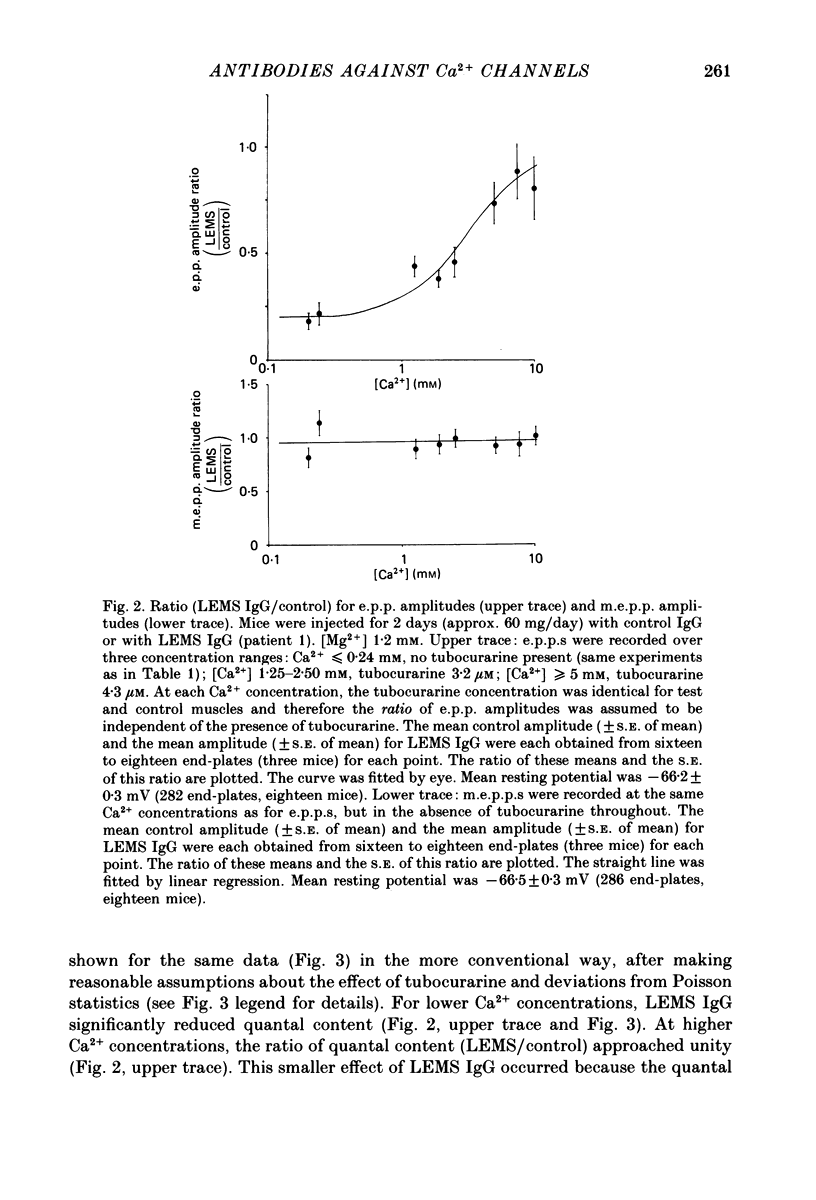
1. The action of immunoglobulin G obtained from patients with Lambert-Eaton myasthenic syndrome (LEMS IgG) was investigated by injecting mice, followed by intracellular recordings from the mouse diaphragm. 2. End-plate potential quantal content was studied over a range of Ca2+ concentrations. Curves of log quantal content versus log Ca2+ concentration were shifted to the right by LEMS IgG. For low Ca2+ concentrations, release continued to follow Poisson statistics after LEMS IgG treatment. 3. Miniature end-plate potential (m.e.p.p.) frequency was measured in solutions containing high K+ concentrations. LEMS IgG significantly reduced m.e.p.p. frequency at each K+ concentration studied. 4. M.e.p.p. frequency was measured at fixed high-K+ concentration (15.9 mM) for a range of Ca2+ concentrations. The log-log plot of m.e.p.p. frequency versus Ca2+ concentration was shifted downwards throughout by LEMS IgG. 5. M.e.p.p. frequency was not affected by LEMS IgG in Ca2+-free solutions (K+ concentration 15.9 mM) or in solutions of low Ca2+ concentration (K+ concentration 5.9 mM). 6. At each Ca2+ concentration studied, m.e.p.p. amplitudes were not affected by LEMS IgG. 7. The data suggest that LEMS IgG acts on presynaptic voltage-dependent Ca2+ channels to cause their loss of function, probably by down-regulation.
Full text
PDF




Selected References
These references are in PubMed. This may not be the complete list of references from this article.
- Baker P. F., Crawford A. C. A note of the mechanism by which inhibitors of the sodium pump accelerate spontaneous release of transmitter from motor nerve terminals. J Physiol. 1975 May;247(1):209–226. doi: 10.1113/jphysiol.1975.sp010928. [DOI] [PMC free article] [PubMed] [Google Scholar]
- DEL CASTILLO J., KATZ B. Quantal components of the end-plate potential. J Physiol. 1954 Jun 28;124(3):560–573. doi: 10.1113/jphysiol.1954.sp005129. [DOI] [PMC free article] [PubMed] [Google Scholar]
- Dodge F. A., Jr, Rahamimoff R. Co-operative action a calcium ions in transmitter release at the neuromuscular junction. J Physiol. 1967 Nov;193(2):419–432. doi: 10.1113/jphysiol.1967.sp008367. [DOI] [PMC free article] [PubMed] [Google Scholar]
- Fukunaga H., Engel A. G., Lang B., Newsom-Davis J., Vincent A. Passive transfer of Lambert-Eaton myasthenic syndrome with IgG from man to mouse depletes the presynaptic membrane active zones. Proc Natl Acad Sci U S A. 1983 Dec;80(24):7636–7640. doi: 10.1073/pnas.80.24.7636. [DOI] [PMC free article] [PubMed] [Google Scholar]
- HOREJSI J., SMETANA R. The isolation of gamma globulin from blood-serum by rivanol. Acta Med Scand. 1956 Jun 30;155(1):65–70. doi: 10.1111/j.0954-6820.1956.tb14351.x. [DOI] [PubMed] [Google Scholar]
- JENKINSON D. H. The nature of the antagonism between calcium and magnesium ions at the neuromuscular junction. J Physiol. 1957 Oct 30;138(3):434–444. doi: 10.1113/jphysiol.1957.sp005860. [DOI] [PMC free article] [PubMed] [Google Scholar]
- Lambert E. H., Elmqvist D. Quantal components of end-plate potentials in the myasthenic syndrome. Ann N Y Acad Sci. 1971 Sep 15;183:183–199. doi: 10.1111/j.1749-6632.1971.tb30750.x. [DOI] [PubMed] [Google Scholar]
- Lang B., Newsom-Davis J., Prior C., Wray D. Antibodies to motor nerve terminals: an electrophysiological study of a human myasthenic syndrome transferred to mouse. J Physiol. 1983 Nov;344:335–345. doi: 10.1113/jphysiol.1983.sp014943. [DOI] [PMC free article] [PubMed] [Google Scholar]
- Lang B., Newsom-Davis J., Wray D., Vincent A., Murray N. Autoimmune aetiology for myasthenic (Eaton-Lambert) syndrome. Lancet. 1981 Aug 1;2(8240):224–226. doi: 10.1016/s0140-6736(81)90474-8. [DOI] [PubMed] [Google Scholar]
- Nowycky M. C., Fox A. P., Tsien R. W. Three types of neuronal calcium channel with different calcium agonist sensitivity. Nature. 1985 Aug 1;316(6027):440–443. doi: 10.1038/316440a0. [DOI] [PubMed] [Google Scholar]
- Prior C., Lang B., Wray D., Newsom-Davis J. Action of Lambert-Eaton myasthenic syndrome IgG at mouse motor nerve terminals. Ann Neurol. 1985 Jun;17(6):587–592. doi: 10.1002/ana.410170610. [DOI] [PubMed] [Google Scholar]
- Roberts A., Perera S., Lang B., Vincent A., Newsom-Davis J. Paraneoplastic myasthenic syndrome IgG inhibits 45Ca2+ flux in a human small cell carcinoma line. Nature. 1985 Oct 24;317(6039):737–739. doi: 10.1038/317737a0. [DOI] [PubMed] [Google Scholar]
- Silinsky E. M. On the calcium receptor that mediates depolarization-secretion coupling at cholinergic motor nerve terminals. Br J Pharmacol. 1981 Jun;73(2):413–429. doi: 10.1111/j.1476-5381.1981.tb10438.x. [DOI] [PMC free article] [PubMed] [Google Scholar]
- Silinsky E. M. The biophysical pharmacology of calcium-dependent acetylcholine secretion. Pharmacol Rev. 1985 Mar;37(1):81–132. [PubMed] [Google Scholar]
- Wray D. Prolonged exposure to acetylcholine: noise analysis and channel inactivation in cat tenuissimus muscle. J Physiol. 1981 Jan;310:37–56. doi: 10.1113/jphysiol.1981.sp013536. [DOI] [PMC free article] [PubMed] [Google Scholar]