



Abstract
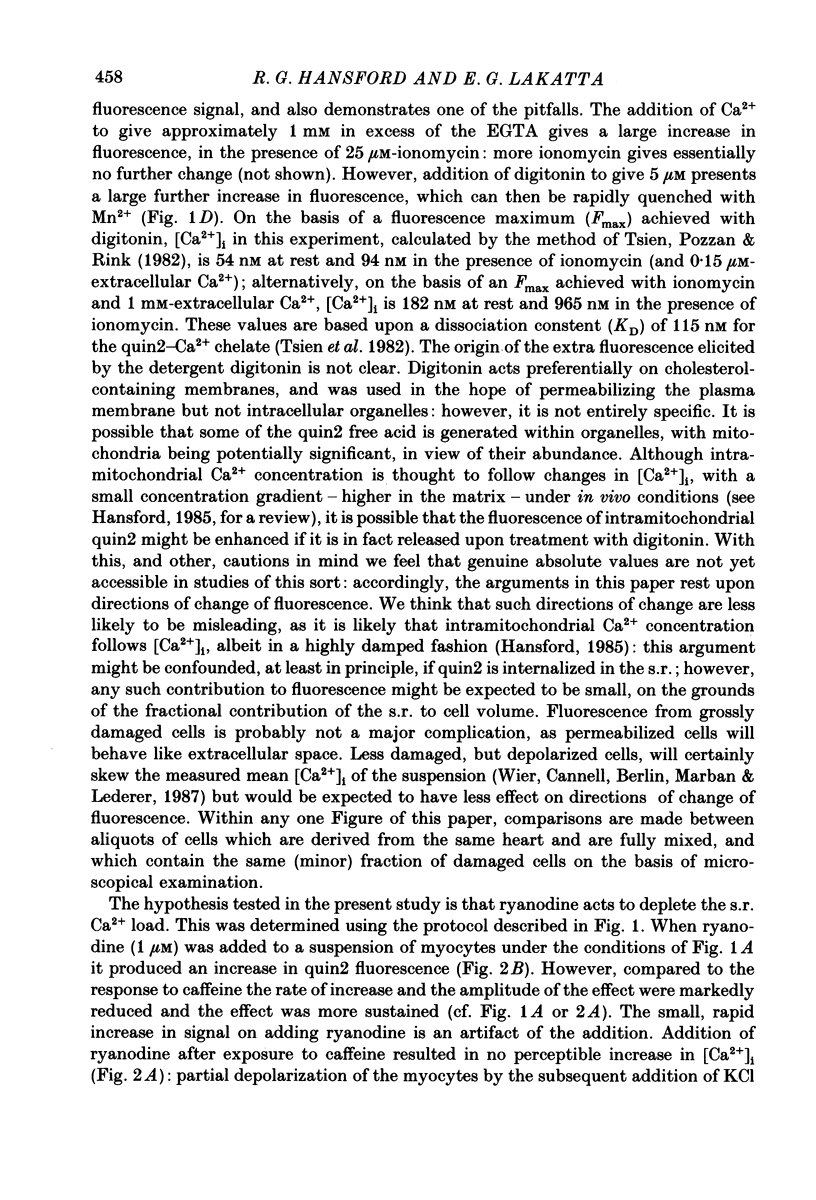
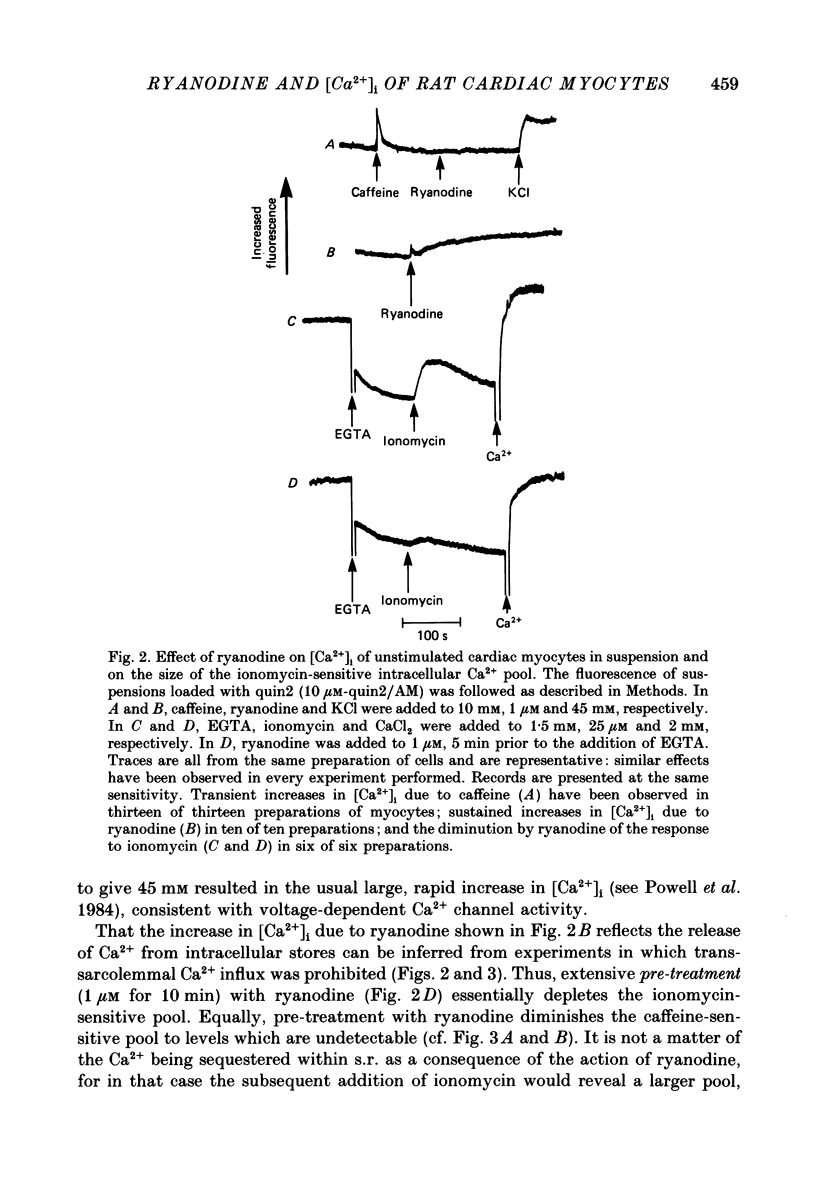
1. The hypothesis tested in this study is that ryanodine depletes sarcoplasmic reticulum (s.r.) Ca2+ loading in suspensions of single adult rat cardiac myocytes by effecting Ca2+ release into the myoplasm resulting in an increase in myoplasmic free [Ca2+] ([Ca2+]i). The latter was monitored by the fluorescent dye, quin2. 2. The competency of the technique to detect s.r. Ca2+ release was tested by using caffeine to induce Ca2+ release. The addition of 5-10 mM-caffeine to myocytes loaded with quin2 and incubated in a medium containing 1 mM-Ca2+ gives a large, transient increase in fluorescence, which is interpreted as indicating an increase in [Ca2+]i. If the chelating agent EGTA is added to the cell suspension 1-5 min prior to the caffeine, to a concentration sufficient to decrease extracellular Ca2+ to 0.1-0.15 microM, then caffeine again gives a large, transient increase in fluorescence, indicative of the fact that sarcolemmal Ca2+ transport is not necessary for this response. The ionophore ionomycin also raises [Ca2+]i in a transient manner when added after EGTA. The addition of caffeine prior to ionomycin largely diminishes the response to the latter; however, addition of ionomycin prior to caffeine totally abolishes its effect to increase [Ca2+]i. This is taken to indicate that the intracellular store which is releasable by caffeine--and which presumably reflects the s.r.--is also releasable by ionomycin: ionomycin, however, also gives access to another, minor intracellular pool. 3. The plant alkaloid, ryanodine, at concentrations of 10(-8) to 10(-6) M, consistently causes a slow and prolonged increase in [Ca2+]i when added to cell suspensions incubated with 1 mM-extracellular Ca2+. Under conditions precluding net entry of Ca2+ into the cell, viz. 0.1 microM-extracellular Ca2+, ryanodine causes a more limited, partially reversible, increase in [Ca2+]i. 4. When added prior to EGTA, ryanodine attenuates, or prevents, the subsequent response to caffeine: efficacy depends upon the time of pre-incubation (1-10 min) and the concentration of ryanodine (10(-8) to 10(-6) M). When the response to caffeine is largely prevented by ryanodine, the response to ionomycin is also severely attenuated, i.e. there is no evidence that ryanodine causes sequestration of Ca2+ within an ionomycin-sensitive pool.(ABSTRACT TRUNCATED AT 400 WORDS)
Full text
PDF




Selected References
These references are in PubMed. This may not be the complete list of references from this article.
- Bers D. M., MacLeod K. T. Cumulative depletions of extracellular calcium in rabbit ventricular muscle monitored with calcium-selective microelectrodes. Circ Res. 1986 Jun;58(6):769–782. doi: 10.1161/01.res.58.6.769. [DOI] [PubMed] [Google Scholar]
- Besch H. R., Jr Effects of ryanodine on cardiac subcellular membrane fractions. Fed Proc. 1985 Dec;44(15):2960–2963. [PubMed] [Google Scholar]
- Chapman R. A., Coray A., McGuigan J. A. Sodium/calcium exchange in mammalian ventricular muscle: a study with sodium-sensitive micro-electrodes. J Physiol. 1983 Oct;343:253–276. doi: 10.1113/jphysiol.1983.sp014891. [DOI] [PMC free article] [PubMed] [Google Scholar]
- Chapman R. A., Léoty C. The time-dependent and dose-dependent effects of caffeine on the contraction of the ferret heart. J Physiol. 1976 Apr;256(2):287–314. doi: 10.1113/jphysiol.1976.sp011326. [DOI] [PMC free article] [PubMed] [Google Scholar]
- Clusin W. T., Fischmeister R., DeHaan R. L. Caffeine-induced current in embryonic heart cells: time course and voltage dependence. Am J Physiol. 1983 Sep;245(3):H528–H532. doi: 10.1152/ajpheart.1983.245.3.H528. [DOI] [PubMed] [Google Scholar]
- Eisner D. A., Valdeolmillos M. A study of intracellular calcium oscillations in sheep cardiac Purkinje fibres measured at the single cell level. J Physiol. 1986 Mar;372:539–556. doi: 10.1113/jphysiol.1986.sp016024. [DOI] [PMC free article] [PubMed] [Google Scholar]
- Endo M., Tanaka M., Ogawa Y. Calcium induced release of calcium from the sarcoplasmic reticulum of skinned skeletal muscle fibres. Nature. 1970 Oct 3;228(5266):34–36. doi: 10.1038/228034a0. [DOI] [PubMed] [Google Scholar]
- Fabiato A. Effects of ryanodine in skinned cardiac cells. Fed Proc. 1985 Dec;44(15):2970–2976. [PubMed] [Google Scholar]
- Fabiato A. Time and calcium dependence of activation and inactivation of calcium-induced release of calcium from the sarcoplasmic reticulum of a skinned canine cardiac Purkinje cell. J Gen Physiol. 1985 Feb;85(2):247–289. doi: 10.1085/jgp.85.2.247. [DOI] [PMC free article] [PubMed] [Google Scholar]
- Hajdu S. Mechanism of the Woodworth staircase phenomenon in heart and skeletal muscle. Am J Physiol. 1969 Jan;216(1):206–214. doi: 10.1152/ajplegacy.1969.216.1.206. [DOI] [PubMed] [Google Scholar]
- Hansford R. G. Relation between cytosolic free Ca2+ concentration and the control of pyruvate dehydrogenase in isolated cardiac myocytes. Biochem J. 1987 Jan 1;241(1):145–151. doi: 10.1042/bj2410145. [DOI] [PMC free article] [PubMed] [Google Scholar]
- Hansford R. G. Relation between mitochondrial calcium transport and control of energy metabolism. Rev Physiol Biochem Pharmacol. 1985;102:1–72. doi: 10.1007/BFb0034084. [DOI] [PubMed] [Google Scholar]
- Hilgemann D. W. Extracellular calcium transients and action potential configuration changes related to post-stimulatory potentiation in rabbit atrium. J Gen Physiol. 1986 May;87(5):675–706. doi: 10.1085/jgp.87.5.675. [DOI] [PMC free article] [PubMed] [Google Scholar]
- Hohl C. M., Altschuld R. A., Brierley G. P. Effects of calcium on the permeability of isolated adult rat heart cells to sodium. Arch Biochem Biophys. 1983 Feb 15;221(1):197–205. doi: 10.1016/0003-9861(83)90136-4. [DOI] [PubMed] [Google Scholar]
- Hunter D. R., Haworth R. A., Berkoff H. A. Modulation of cellular calcium stores in the perfused rat heart by isoproterenol and ryanodine. Circ Res. 1983 Nov;53(5):703–712. doi: 10.1161/01.res.53.5.703. [DOI] [PubMed] [Google Scholar]
- Jones L. R., Besch H. R., Jr, Sutko J. L., Willerson J. T. Ryanodine-induced stimulation of net Ca++ uptake by cardiac sarcoplasmic reticulum vesicles. J Pharmacol Exp Ther. 1979 Apr;209(1):48–55. [PubMed] [Google Scholar]
- Kort A. A., Lakatta E. G., Marban E., Stern M. D., Wier W. G. Fluctuations in intracellular calcium concentration and their effect on tonic tension in canine cardiac Purkinje fibres. J Physiol. 1985 Oct;367:291–308. doi: 10.1113/jphysiol.1985.sp015825. [DOI] [PMC free article] [PubMed] [Google Scholar]
- Lakatta E. G., Capogrossi M. C., Kort A. A., Stern M. D. Spontaneous myocardial calcium oscillations: overview with emphasis on ryanodine and caffeine. Fed Proc. 1985 Dec;44(15):2977–2983. [PubMed] [Google Scholar]
- Lambert M. R., Johnson J. D., Lamka K. G., Brierley G. P., Altschuld R. A. Intracellular free Ca2+ and the hypercontracture of adult rat heart myocytes. Arch Biochem Biophys. 1986 Mar;245(2):426–435. doi: 10.1016/0003-9861(86)90234-1. [DOI] [PubMed] [Google Scholar]
- Meissner G. Ryanodine activation and inhibition of the Ca2+ release channel of sarcoplasmic reticulum. J Biol Chem. 1986 May 15;261(14):6300–6306. [PubMed] [Google Scholar]
- Mitchell M. R., Powell T., Terrar D. A., Twist V. W. The effects of ryanodine, EGTA and low-sodium on action potentials in rat and guinea-pig ventricular myocytes: evidence for two inward currents during the plateau. Br J Pharmacol. 1984 Mar;81(3):543–550. doi: 10.1111/j.1476-5381.1984.tb10107.x. [DOI] [PMC free article] [PubMed] [Google Scholar]
- Murphy E., Wheeler D. M., LeFurgey A., Jacob R., Lobaugh L. A., Lieberman M. Coupled sodium-calcium transport in cultured chick heart cells. Am J Physiol. 1986 Mar;250(3 Pt 1):C442–C452. doi: 10.1152/ajpcell.1986.250.3.C442. [DOI] [PubMed] [Google Scholar]
- Nieman C. J., Eisner D. A. Effects of caffeine, tetracaine, and ryanodine on calcium-dependent oscillations in sheep cardiac Purkinje fibers. J Gen Physiol. 1985 Dec;86(6):877–889. doi: 10.1085/jgp.86.6.877. [DOI] [PMC free article] [PubMed] [Google Scholar]
- Powell T., Tatham P. E., Twist V. W. Cytoplasmic free calcium measured by quin2 fluorescence in isolated ventricular myocytes at rest and during potassium-depolarization. Biochem Biophys Res Commun. 1984 Aug 16;122(3):1012–1020. doi: 10.1016/0006-291x(84)91192-6. [DOI] [PubMed] [Google Scholar]
- Powell T., Terrar D. A., Twist V. W. Electrical properties of individual cells isolated from adult rat ventricular myocardium. J Physiol. 1980 May;302:131–153. doi: 10.1113/jphysiol.1980.sp013234. [DOI] [PMC free article] [PubMed] [Google Scholar]
- Renlund D. G., Lakatta E. G., Mellits E. D., Gerstenblith G. Calcium-dependent enhancement of myocardial diastolic tone and energy utilization dissociates systolic work and oxygen consumption during low sodium perfusion. Circ Res. 1985 Dec;57(6):876–888. doi: 10.1161/01.res.57.6.876. [DOI] [PubMed] [Google Scholar]
- Sheu S. S., Sharma V. K., Uglesity A. Na+-Ca2+ exchange contributes to increase of cytosolic Ca2+ concentration during depolarization in heart muscle. Am J Physiol. 1986 Apr;250(4 Pt 1):C651–C656. doi: 10.1152/ajpcell.1986.250.4.C651. [DOI] [PubMed] [Google Scholar]
- Sutko J. L., Ito K., Kenyon J. L. Ryanodine: a modifier of sarcoplasmic reticulum calcium release in striated muscle. Fed Proc. 1985 Dec;44(15):2984–2988. [PubMed] [Google Scholar]
- Sutko J. L., Thompson L. J., Kort A. A., Lakatta E. G. Comparison of effects of ryanodine and caffeine on rat ventricular myocardium. Am J Physiol. 1986 May;250(5 Pt 2):H786–H795. doi: 10.1152/ajpheart.1986.250.5.H786. [DOI] [PubMed] [Google Scholar]
- Sutko J. L., Willerson J. T. Ryanodine alteration of the contractile state of rat ventricular myocardium. Comparison with dog, cat, and rabbit ventricular tissues. Circ Res. 1980 Mar;46(3):332–343. doi: 10.1161/01.res.46.3.332. [DOI] [PubMed] [Google Scholar]
- Thomas A. P., Selak M., Williamson J. R. Measurement of electrically-induced Ca2+ transients in Quin2-loaded cardiac myocytes. J Mol Cell Cardiol. 1986 May;18(5):541–545. doi: 10.1016/s0022-2828(86)80919-1. [DOI] [PubMed] [Google Scholar]
- Tsien R. Y., Pozzan T., Rink T. J. Calcium homeostasis in intact lymphocytes: cytoplasmic free calcium monitored with a new, intracellularly trapped fluorescent indicator. J Cell Biol. 1982 Aug;94(2):325–334. doi: 10.1083/jcb.94.2.325. [DOI] [PMC free article] [PubMed] [Google Scholar]
- Valdeolmillos M., Eisner D. A. The effects of ryanodine on calcium-overloaded sheep cardiac Purkinje fibers. Circ Res. 1985 Mar;56(3):452–456. doi: 10.1161/01.res.56.3.452. [DOI] [PubMed] [Google Scholar]
- Wier W. G., Cannell M. B., Berlin J. R., Marban E., Lederer W. J. Cellular and subcellular heterogeneity of [Ca2+]i in single heart cells revealed by fura-2. Science. 1987 Jan 16;235(4786):325–328. doi: 10.1126/science.3798114. [DOI] [PubMed] [Google Scholar]
- Wier W. G., Yue D. T., Marban E. Effects of ryanodine on intracellular Ca2+ transients in mammalian cardiac muscle. Fed Proc. 1985 Dec;44(15):2989–2993. [PubMed] [Google Scholar]