



Abstract
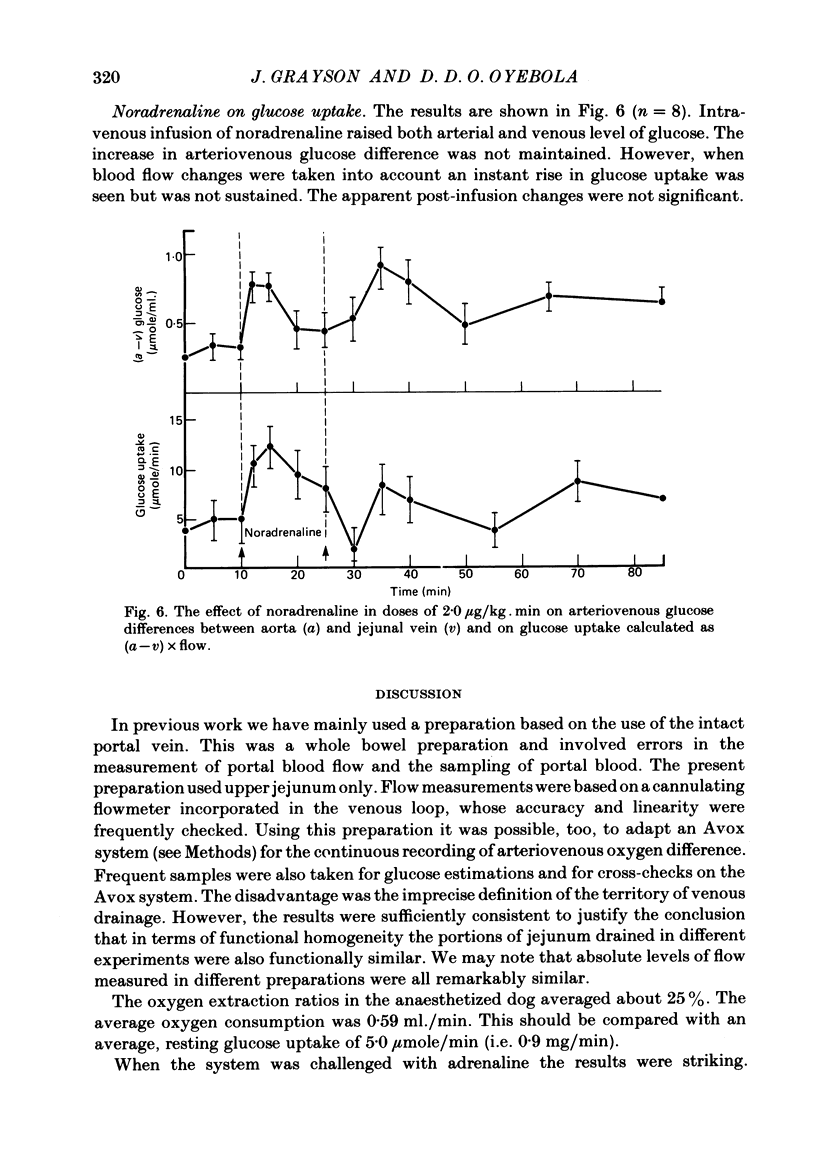
Using the anaesthetized dog, continuous recording was made of the oxygen and glucose contents of the artery and the vein draining the upper jejunum. Flow was also measured and results expressed as differences in oxygen and glucose between the aorta and the jejunal vein (a-v), also as oxygen consumption and glucose uptake. Resting glucose uptake was greater than could be accounted for on the basis of oxidation. When adrenaline (1 microgram/kg. min) or noradrenaline (2 micrograms/kg. min) was infused intravenously, oxygen uptake rose by about 50% whereas glucose uptake rose by 300-500%; moreover, the rise in glucose uptake was apparent before the rise in oxygen uptake. The beta-blocking agent, propranolol (0 X 5 mg/kg. min) had no effect on oxygen uptake but caused a three-fold rise in glucose uptake. Subsequently infusion of adrenaline had no effect on oxygen uptake and no effect on glucose uptake. However, on stopping the infusion there was a marked drop in glucose uptake, which was not maintained. It is suggested that the effects of catecholamines may be due to altered arterial blood glucose levels and that the jejunum may play a role in glucose homeostasis which requires the action of beta receptors.
Full text
PDF



Selected References
These references are in PubMed. This may not be the complete list of references from this article.
- Durotoye A. O., Grayson J. Heat production in the gastro-intestinal tract of the dog. J Physiol. 1971 May;214(3):417–426. doi: 10.1113/jphysiol.1971.sp009441. [DOI] [PMC free article] [PubMed] [Google Scholar]
- GRAYSON J., KINNEAR T. Observations on temperature, blood flow and heat production in the human liver in relation to environment and to glucose and insulin administration. Clin Sci. 1962 Feb;22:125–140. [PubMed] [Google Scholar]
- Grayson J., Irvine M., Kinnear T. Observations on temperature distribution in the cardiovascular system, thorax and abdomen of monkeys in relation to environment. J Physiol. 1966 Jun;184(3):581–593. doi: 10.1113/jphysiol.1966.sp007932. [DOI] [PMC free article] [PubMed] [Google Scholar]
- Greenway C. V., Lawson A. E. Effect of adrenaline and propranolol on the superior mesenteric artery blood flow. Can J Physiol Pharmacol. 1968 Nov;46(6):906–908. doi: 10.1139/y68-141. [DOI] [PubMed] [Google Scholar]
- Shepherd A. P., Burgar C. G. A solid-state arteriovenous oxygen difference analyzer for flowing whole blood. Am J Physiol. 1977 Apr;232(4):H437–H440. doi: 10.1152/ajpheart.1977.232.4.H437. [DOI] [PubMed] [Google Scholar]
- Shepherd A. P., Pawlik W., Mailman D., Burks T. F., Jacobson E. D. Effects of vasoconstrictors on intestinal vascular resistance and oxygen extraction. Am J Physiol. 1976 Feb;230(2):298–305. doi: 10.1152/ajplegacy.1976.230.2.298. [DOI] [PubMed] [Google Scholar]
- Swan K. G., Reynolds D. G. Effects of intraarterial catecholamine infusions on blood flow in the canine gut. Gastroenterology. 1971 Dec;61(6):863–871. [PubMed] [Google Scholar]
- Windmueller H. G., Spaeth A. E. Identification of ketone bodies and glutamine as the major respiratory fuels in vivo for postabsorptive rat small intestine. J Biol Chem. 1978 Jan 10;253(1):69–76. [PubMed] [Google Scholar]