



Abstract
Purpose
Acute exercise can transiently enhance cognitive flexibility. The cognitive demand of firefighters makes it relevant to understand if on-shift exercise could produce similar improvements in cognitive performance during subsequent occupational tasks. Metrics of heart rate variability (HRV), such as time- and frequency-domain outcomes, may shed light upon the influence exercise has on cognition, as they discern information related to cardiac autonomic (sympathetic/parasympathetic) function. We aimed to determine if acute resistance and aerobic exercise impact cognitive flexibility during occupational tasks and its relation to HRV.
Methods
32 participants completed a baseline Wisconsin Card Sorting Task (WCST) and three experimental trials: resistance exercise (RE), aerobic exercise (AE), or a rested control (CON). An occupational task assessment (OTA) including four rounds of 10 deadlifts and a 0.15-mile sandbag carry in an environmental chamber (35 °C/50% humidity) was completed after each trial. The second round was followed by the WCST. Repeated measures ANOVAs were used to analyze differences by condition.
Results
For the WCST, total, perseverative, and non-perseverative errors did not differ (ps > 0.39). Time-domain HRV metrics were not different (ps > 0.05). All frequency-domain metrics, other than low-frequency power, were not different (ps > 0.24). Low-frequency power was lower based on condition (p = 0.03). Post hoc analysis showed low-frequency power was lower following AE compared to RE and CON.
Conclusion
Results suggest an acute bout of on-shift aerobic or resistance exercise may not impact cognitive flexibility during subsequent simulated occupational tasks, despite depressed metrics of heart rate variability following aerobic exercise.
Keywords: Executive function, Tactical athletes, Heart rate variability, Heat stress, High-intensity interval training, Resistance training
Introduction
In addition to the obvious physical demands of firefighters, cognitive function is a vital component of their occupational responsibilities (Kujawski et al. 2018; Kwak et al. 2020). These occupational demands require high levels of executive function to make rapid life-or-death decisions in challenging situations and environments (Coehoorn et al. 2020; Sanfey 2007). Executive function refers to the grouping of effortful mental processes necessary for attention and decision-making (Diamond 2013). Cognitive flexibility, a subdomain of executive function, is the ability to utilize both inhibitory control and working memory to make quick, situational decisions. This ability to make situational decisions, suggest cognitive flexibility is a valuable component of occupational readiness in firefighters (Kujawski et al. 2018; Kwak et al. 2020).
Heart rate variability (HRV) is one potential factor that provides insight into the connection between exertion, physiology, and cognitive function. HRV is the measure of variation in the time interval between heartbeats (Jimenez Morgan & Molina Mora 2017; Thayer et al. 2010) and represents the body’s ability to adjust to changing demands through variations in parasympathetic and sympathetic activities (Capilupi et al. 2020; Hewett et al. 2017; Thayer et al. 2010). HRV decreases in response to an acute bout of exercise due to the rise in sympathetic activity needed to increase the cardiac output and systemic vascular tone required to meet physiological demands of exercise (Michael et al. 2017, 2016; Yılmaz et al. 2018). It has been proposed that neuroanatomical connections between the central and autonomic nervous systems provide an interaction between parasympathetic cardiac autonomic regulation and executive function controlled by the prefrontal cortex (Thayer et al. 2012). Various studies have reported individuals who performed better in cognitive tasks often have greater cardiac parasympathetic control than those with poorer cognitive performance (Hansen et al. 2003; Kimhy et al. 2013; Luque-Casado et al. 2016; Thayer et al. 2012). Consideration of physical and cognitive function in firefighters is important for the maintenance of occupational readiness.
Research has shown that executive functions (working memory and inhibitory control) and other cognitive functions (information processing and psychomotor control) (Kwak et al. 2020; Morley et al. 2012; Sumińska et al. 2021; Zare et al. 2018) decline during simulated firefighting. One potential method to mitigate these declines is on-shift exercise. Research indicates cognitive flexibility is transiently improved following an acute bout of aerobic exercise (Bae & Masaki 2019; Dupuy et al. 2018; Dwojaczny et al. 2020), however the acute effects of resistance exercise on cognitive performance have been less widely studied. Research suggests components of executive function such as inhibitory control are improved following acute resistance exercise, but the effect on cognitive flexibility and working memory remain unclear (Soga et al. 2018).
While evidence suggests that a single on-shift exercise session may transiently impair a firefighter’s ability to meet occupational demands (Dennison et al. 2012; Mason et al. 2023; Smith et al. 2001), there may be a cognitive benefit to acute on-shift exercise. However, no study to our knowledge has directly compared the acute impact of resistance training and aerobic endurance training on cognitive readiness in firefighters and its relation to HRV. Therefore, the aim of this study was to investigate the impact of resistance and aerobic endurance exercise on cognitive outcomes related to firefighter occupational performance and the influence of HRV on cognitive performance. We hypothesized that prior-aerobic exercise will result in improvement in cognitive flexibility and smaller decreases in HRV metrics, but prior resistance exercise will result in lower cognitive flexibility and larger decreases HRV metrics (Heffernan et al. 2006) during a cognitive occupational task assessment, when compared to a rested control condition.
Methods
Study participants
Data herein are part of a larger study approved by the Institutional Review Board at Auburn University (IRB protocol code #22-479 AR 2211). Of 41 participants recruited, 29 completed study requirements for the current investigation. These participants included 13 females and 16 males from the local community (not active firefighters) that met the following criteria: ages 19–45 years old, no current musculoskeletal injury, available to complete all study visits, comfortable exercising in an environmental chamber, agreed to adhere to study requirements, and passed a physical activity readiness questionnaire (PAR-Q) health screening. Exclusion criteria included known medical condition, physical or psychological condition preventing participation in exercise, diagnosed with asthma in the past 4 years, or recently experienced a heat-injury. Informed consent was obtained prior to enrollment in the study. A schematic of the study design can be found in Fig. 1.
Fig. 1.

Aerobic testing included VO2peak and lactate threshold assessments; strength testing included 3RM maximum lifts for bench, squat, and deadlift; WCST: Wisconsin Card Sorting Task; familiarization involved exposure to the occupational task assessment (OTA) and environmental conditions; *Pre-OTA exercise condition (aerobic, resistance, or rest) order was randomized. Transition was the time used to replicate response time and involved donning firefighter gear and walking to the environmental chamber. The WCST was completed halfway through the OTA. Heart rate variability was monitored continuously during the WCST
Research design
This manuscript reports a secondary analysis of variables measured during a repeated-measures quasi-randomized control study (Agostinelli et al. 2024). The quasi-randomization involved randomizing which acute exercise modality was completed first (AE or RE) with all participants completing the CON condition second. This was in effort to reduce the number of potential unique trial order group comparisons. Block randomization of exercise trial order was generated using Microsoft® Excel (Microsoft Corporations, Redmond, WA USA) by a co-investigator and allocations were reported to the lead author (PA). Participants completed a total of five visits, the first two visits including a baseline assessment for cognitive function, anaerobic fitness, and aerobic fitness. Participants then completed three experimental conditions: (1) resistance exercise (RE), (2) aerobic high-intensity interval training (AE), and (3) rested control (CON); each followed immediately with an occupational task assessment (OTA). A 7-day wash-out period was included between trials to reduce the risk of residual fatigue impacting subsequent trial performance. Randomization details have been previously submitted for publication (Agostinelli et al. 2024).
Wisconsin card sorting task (WCST) and resting heart rate
Participants first completed a 10-min resting period to assess resting heart rate for heart rate reserve (HRR) estimation for the aerobic exercise intensity prescription. A baseline assessment of cognitive flexibility was completed using the modified Wisconsin Card Sorting Task (WCST) to control for the practice effect associated with the task prior to completing all physically demanding baseline assessments (Basso et al. 2001). The modified WCST required participants to complete 60 total responses, instead of the traditional 60 correct responses with up to 128 total trials (Miles et al. 2021), for the sake of time efficiency during the OTA. The WCST uses a computer-based card sorting task completed in a quiet space with no potential distractors (devices, flashing lights, clocks, posters, etc.). During acute exercise trials the WCST was completed halfway through the occupational task assessment (OTA) while still in the active environmental chamber with no external noise or potential distractors. Participants sorted the cards based on three factors: color, shape, and number. The category (the sorting rule) changes after sorting 10 cards. This was repeated for a total of six sorting categories (60 total responses). While not a direct sensitivity or reliability analysis has been done on this version of the WCST, previous literature supports the sensitivity, reliability, and clinical use of shortened computerized modified-WCSTs (Greve 2001; Schretlen 2010; Steinke et al. 2021). Our primary variable was perseverative errors. These errors represent a participant’s inability to adapt to the new sorting rule and are representative of task-switching and cognitive flexibility (Landry & Mitchell 2021). Additional secondary measures include response time, correct responses, errors, and non-perseverative errors (Kohli & Kaur 2006). Participants were prompted to complete the assessment as fast as possible while minimizing errors. Instructions outlined on the computer screen reviewed the rules of the WCST before beginning the assessment to reduce the variability of instructions from individual researchers.
Baseline fitness testing
After the baseline WCST was completed three-repetition maximum testing (3RM) performance for barbell bench, squat, and hex-bar deadlift occurred. Participants started the 3RM protocol by completing the lift with a series of warm-up lifts (45-lb bar for 8–10 reps, 50% of projected 1-RM for 6–8 reps, 75% for 3–5 reps, and 85% for 1–3 reps). Their first attempt was at 95% of self-reported 3RM. Each set included a minimum of 2 min of rest and a maximum of 5 min of rest. The maximum weight completed for three reps while maintaining good form was utilized to project 1RM based on the National Strength and Conditioning Association’s (NSCA) guidelines (Landers 1984). If participants only achieved one or two reps at attempted weight, that value was taken and utilized to project 1RM. These assessments were used to determine training load during the acute resistance training session. Additional information related to the protocol used to obtain the participants 3RM has previously submitted for publication (Agostinelli et al. 2024). Participants were instructed on how to don standard firefighter personal protective equipment (PPE), including turn-out gear, gloves, boots, and helmet. They then entered the environmental chamber set at 35 °C (95°F) with 50% relative humidity and practiced one round of the OTA to reduce any learning effect during testing. Additionally on the second baseline testing visit peak oxygen consumption (VO2peak), lactate threshold, and max heart rate were collected utilizing a treadmill (Woodway, Waukesha, WI, USA) and the modified-Bruce protocol (Trabulo et al. 1994) while monitoring oxygen consumption and carbon dioxide indirect calorimetry via an automated open circuit system (Parvo Medics, Sandy UT). Max heart rate achieved during the assessment was utilized to calculated HRR for the acute aerobic exercise prescription. Oxygen consumption and lactate threshold measures unrelated to the current analysis have been submitted for publication previously (Agostinelli et al. 2024).
Acute exercise and control sessions
Participants were asked to refrain from caffeine and exercise during 24 h leading up to each visit. Urine specific gravity (USG) was assessed to determine if participants were adequately hydrated prior to completing the session (USG < 1.025). Those who did not meet this USG value were given water and reassessed prior to starting the visit. The RE condition included a full body resistance workout (Table 1) following National Strength and Conditioning Association (NSCA) guidelines for strength training (Sheppard & Triplett 2016). If the prescribed weight was too heavy for the participant, the weight was lowered to finish the set and all remaining sets. The AE session (Table 2) involved high-intensity interval training (HIIT) on a treadmill (Woodway, Waukesha, WI, USA). The HRR values were calculated with the Karvonen method (Karvonen et al. 1957). Exercise sessions were designed based on consideration of commonly accessible equipment for firefighters in the southeastern United States (Agostinelli et al. 2023) as well as the local fire departments insight on common exercise routines of their firefighters. A control session was completed to assess any effect of exercise in general, regardless of modality. During the control session participants were seated in a quiet, controlled environment. This session was 30 min in duration and participants were instructed to engage in activities they would normally do with 30 min of down time (i.e., working on laptops, answering emails, scrolling on their phone, or reading a book), but to avoid stressful/overstimulating activities. After all sessions, Participants then transitioned to the environmental chamber and put on standard issue firefighter gear including a helmet, bunker jacket and pants, gloves, and boots.
Table 1.
Resistance exercise session prescription
| Exercise | Weight | RPE | Sets | Reps |
|---|---|---|---|---|
| Barbell back squat | 80% 1RM | 8 | 4 | 6 |
| Barbell bench | 80% 1RM | 8 | 4 | 6 |
| Hex-bar deadlift | 80% 1RM | 8 | 4 | 6 |
| Barbell bent-over row | * | 8 | 4 | 6 |
1RM 1 repetition maximum lift, RPE rating of perceived exertion, Reps repetitions,
*prescribed weight for the barbell bent-over row weight was estimated based on RPE during warm-up sets
Table 2.
Aerobic exercise session prescription
| Exercise | Duration | Intensity | Rounds |
|---|---|---|---|
| Low-intensity intervals | 4 min | 50% of HRR | 4 |
| High-intensity intervals | 30 s | 90% of HRR | 4 |
HRR heart rate reserve [(max heart rate – resting heart rate)/resting heart rate)]
Occupational task assessment (OTA)
Participants then quickly transitioned from acute exercise or rest to the environmental chamber. The environmental conditions were set to 35 °C (95°F) and 50% humidity. This was chosen based on the prevalence of these conditions during firefighter emergency calls in the southeastern United States (Agostinelli et al. 2023; Aisbett et al. 2012; Williams-Bell et al. 2017). These conditions represent a hot summer day, outdoor emergencies, and salvage rather than structural fire conditions. The transition period was not controlled, but rather participants were encouraged to respond as quickly as possible. This was an intentional decision rather than standardizing the transition period, to reduce potential recovery from passive rest. The average transition time varied between 6–8 min, as reported in a separate manuscript currently under review (Agostinelli et al. 2024). These transition times accurately reflect the NFPA standard 1710 goal dispatch response time of ~ 5–9 min (National Fire Protection Association, 2020). Upon entering the chamber participants completed a series of repeated lift and carry movements. A Rogue Fitness® sandbag (Rogue Fitness, Columbus, OH, USA) was loaded to either 61.2 kg or 38.6 kg. A deadlift 3RM > 79.4 kg and deadlift to body weight ratio > 1.25 were used as criteria for the use of the 61.2 kg sandbag; all others used the 38.6 kg sandbag. The decision to have two separate loads based on strength level but not individual relative workloads was guided in accordance with suggestions from the local fire department based on realistic expectations of their firefighters. The circuit involved 10 repeated sandbag deadlifts followed by lifting and carrying an 18.1-kg Rogue Fitness® sandbag (mimicking a firehose) on a treadmill for 0.24 km. These movements were completed in a circuit fashion twice, before stopping to complete the WCST. Participants then completed two additional rounds to conclude the OTA. Participants were encouraged to complete the OTA to the best of their ability while doing so as quickly and safely as possible. Average time to complete the OTA was between ~ 19–20 min and was not significantly different by condition (Agostinelli et al. 2024). The tasks chosen in this assessment were after discussion with the local fire department and based on firefighter occupational demands outlined in previous research (Gledhill & Jamnik 1992).
HRV analysis
HRV RR intervals were measured continuously during the WCST portion of the OTA using the Equivital EQ02 + LifeMonitor (Equivital EQ02, Hidalgo, UK) 2-lead electrocardiogram (ECG). The 256 Hz sampling frequency ensured measures within 3.9 ms for each RR value were recorded. Sampling rates greater than 250 Hz have been shown to be acceptable for HRV time-domain and frequency-domain analysis (Kwon et al. 2018). RR intervals obtained from the EquivitalEQ02 + LifeMonitor have been previously validated for HRV analysis (Akintola et al. 2016). Our analysis included time- and frequency-domain HRV measures. The time-domain measures included the standard deviation of NN intervals (SDNN; NN intervals: normal RR intervals free of artifacts), root mean square of successive differences (RMSSD), and percent of detected RR intervals greater than 50 ms different from the immediately preceding NN intervals (pNN50). Our frequency-domain measures included low-frequency (LF; 0.04–0.15 Hz) and high-frequency (HF; 0.15–0.40 Hz) power as well as the low-frequency to high-frequency contribution ratio (LF/HF ratio). These measures were chosen based on their relevance and validity during short-term HRV measurement (4–6 min) (Baek et al. 2015; Cardiology & Electrophysiology, 1996; Salahuddin et al. 2007; Shaffer & Ginsberg 2017; F. Shaffer et al. 2014a, b). Raw RR interval recordings were processed through Kubios HRV software (Kubios Oy; Kuopio, Finland).
Statistical analysis
The Shapiro–Wilk’s test, Q–Q plot inspection, and Mauchly’s test were used to evaluate normality and sphericity, respectively. First, we conducted a repeated-measures ANOVA comparing perseverative errors by pre-OTA condition (aerobic, resistance, and control). Baseline WCST and HRV outcomes were not statistically compared to the experimental trial conditions as it was only used as a familiarization with the assessment due to the known practice effect of the assessment (Basso et al. 2001). HRV was assessed to investigate the physiological mechanism (cardiac autonomic function) behind cognitive performance. Data were assessed for outliers, which were defined as a data point greater than 3 standard deviations outside the mean. One participant’s low-frequency power, high-frequency power, and pNN50 values were classified as outliers and therefore their data were removed. A repeated-measures ANOVA was performed on HRV values during the WCST portion of the assessment to determine differences across pre-OTA conditions (aerobic, resistance, and control). For significant main effects detected, post hoc comparisons with Bonferroni adjustments were utilized for multiple comparisons. If sphericity was violated, statistical interpretations were made utilizing Greenhouse–Geisser adjusted degrees of freedom. Data are expressed as mean ± standard deviation. Significance in this investigation was set a priori at a p-value ≤ 0.05 for all measurements. R Statistical Programming Software Version 4.1.2 (RStudio; Boston, MA) was used for all statistical analyses (RStudio Team 2020). GraphPad Prism Version 9.2.0 (GraphPad Software, Boston, MA) was used to generate all figures. The application, G*Power, was utilized a priori to determine a sample size of 28 total participants necessary for a sufficiently powered study. The following values were used to estimate sample size: test family = F tests, repeated-measures ANOVA, one group, three measurements, correlation among repeated-measures = 0.5, non-sphericity correction ε = 1.0, α = 0.05, 1-β = 0.80, η2p = 0.06). The primary aim of the larger study was changes in time to complete occupational tasks, therefore the effect size was determined based on previous research related to this aim; outcomes of these studies yielded effect sizes ranging from 0.01 to 0.56 (Dennison et al. 2012; Mason et al. 2023).
Results
Demographics
Twenty-nine participants (female/male: 13/16) were included in the final analysis (24.90 ± 4.19 yrs; 174.47 ± 9.46 cm; 76.47 ± 12.17 kg). Average VO2peak was 46.2 ± 7.4 mL/kg/min and average lactate threshold at 64.5 ± 12.8% of VO2peak. The average total errors, perseverative errors, non-perseverative errors, and response time from the baseline WCST can be found in Table 3.
Table 3.
Baseline Wisconsin card sorting task results
| Variable | Mean ± SD |
|---|---|
| Total errors | 10.97 ± 5.16 |
| Perseverative errors | 7.03 ± 2.18 |
| Non-perseverative errors | 3.93 ± 3.31 |
| Response time (ms) | 1811 ± 616 |
ms milliseconds
Wisconsin card sorting task
Total errors were not significantly different by condition (F(2, 56) = 0.810; p = 0.45; η2p = 0.028). Perseverative errors were not significantly different by condition (F(2, 56) = 0.247; p = 0.782; η2p = 0.009). Non-perseverative errors were not significantly different by condition (F2, 56) = 0.947; p = 0.394; η2p = 0.033). Average response time did not significantly differ by condition (F(2, 46) = 2.288; p = 0.113; η2p = 0.090). Total time to complete the WCST was not significantly different by condition (F(2, 56) = 1.294; p = 0.282; η2p = 0.044). Visual representation of mean and standard deviation of WCST errors can be found in Fig. 2.
Fig. 2.
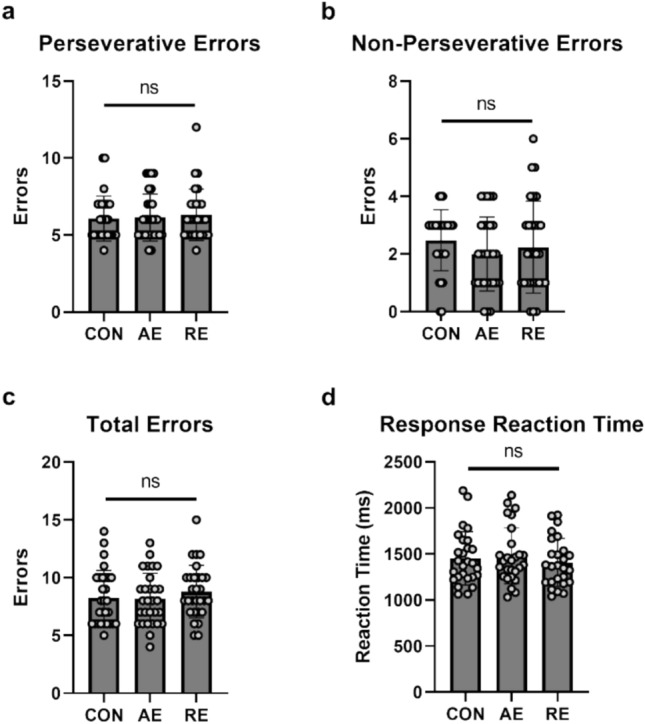
Wisconsin Card Sorting Task (WCST) outcomes; data are reported as mean ± standard deviation with individual data points overlaid; ns: not significant (p > 0.05)
Heart rate variability
Average RR intervals were significantly different by condition (F(2, 56) = 17.059; p < 0.001; η2p = 0.379). Post hoc analysis indicate CON Mean RR intervals were significantly higher than AE and RE conditions (ps < 0.004), but AE and RE were not significantly different (0.200). A visual representation of the mean RR intervals by condition can be found in Fig. 3.
Fig. 3.
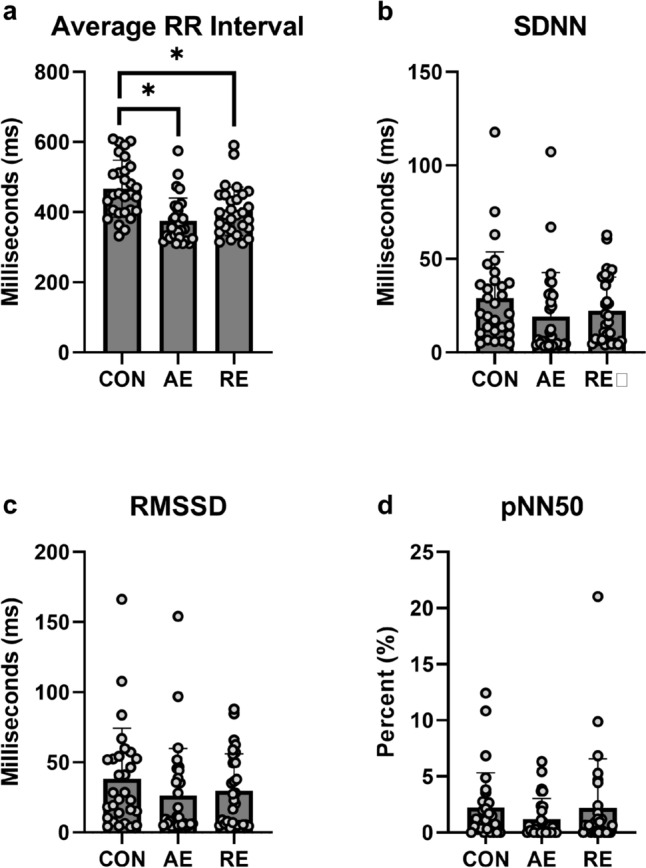
Average RR intervals and time-domain HRV outcomes; data are reported as mean ± standard deviation with individual data points overlaid. SDNN: standard deviation of NN intervals (normal RR intervals free of artifact); RMSSD: root mean square of successive RR interval differences; pNN50: percentage of successive RR intervals that differ by more than 50 ms; *denotes p < 0.05
Time domain analysis
SDNN did not significantly differ by condition (F(2, 58) = 3.075; p = 0.054; η2p = 0.096). RMSSD were not significantly different by condition (F2, 58) = 2.133; p = 0.128; η2p = 0.069). Participants’ pNN50 was not significantly different by condition (F(1.51, 40.88) = 0.793; p = 0.443; η2p = 0.028). Visual representation of mean and standard deviation for time-domain variables can be found in Fig. 3.
Frequency domain analysis
LF was significantly different by condition (F(1.57, 42.33) = 4.313; p = 0.028; η2p = 0.138). Post hoc analysis indicated that LF was significantly lower after AE when compared to control CON (p = 0.014). LF was not significantly different following RE when compared to CON or AE (ps > 0.085). HF was not significantly different by condition (1.44, 39) = 1.938; p = 0.167; η2p = 0.067). LF/HF ratio did not differ significantly by condition (F(1.65, 44.43) = 1.476; p = 0.239; η2p = 0.052). Visual representation of mean and standard deviation for frequency-domain variables can be found in Fig. 4.
Fig. 4.

Frequency-domain HRV outcomes, data are expressed as mean ± standard deviation with individual data points overlaid. LF/HF ratio: low-frequency to high-frequency power ratio; *denotes p < 0.05
Discussion
This study is the first to our knowledge to look at the influence of acute exercise on cognitive function during simulated firefighter occupational tasks, and its relation to HRV metrics associated with autonomic control. Our main findings suggest that there was not evidence that cognitive flexibility in a simulated occupational setting, as assessed by the WCST during the OTA, was impacted by prior acute exercise. Prior acute exercise (resistance and aerobic) did result in a significant decrease in mean RR interval during the cognitive assessment. This suggests that prior acute exercise resulted in an elevated heart rate during the cognitive assessment when compared to the control condition. Additionally, acute exercise only resulted in small, non-significant effects on time-domain HRV variables. Investigation of frequency-domain variables revealed high-frequency power and the low-frequency to high-frequency contribution ratio were minimally, and not significantly, different during the cognitive assessment based on condition. However, low-frequency power, which is associated with parasympathetic tone, was significantly lower during the cognitive assessment following aerobic exercise. Therefore, aerobic exercise before an emergency call may influence metrics of parasympathetic tone, during cognitively demanding occupational situations.
Contrary to our hypothesis, we observed negligible, non-significant differences in cognitive flexibility during simulated firefighter occupational tasks regardless of prior acute exercise (resistance or aerobic). Previous research has not looked at changes in cognitive flexibility while firefighting, but did observe differences in other domains of cognitive function during firefighting tasks (Morley et al. 2012; Zare et al. 2018). One possible explanation for the lack of change could be that the occupational task demands chosen for the OTA may have required less cognitive resources than other firefighting tasks. For example, breaching through a door or navigating debris and physical obstacles may require more cognitive recourses than the lift and carry tasks chosen in this investigation. If cognitive resources are drained from more complex occupational tasks, subsequent cognitive performance may be more sensitive to the effects of acute exercise (Head et al. 2016; Hutchinson & Tenenbaum 2007; Slimani et al. 2018).
The findings did not provide evidence supporting our original hypothesis that prior resistance exercise would impair cognitive flexibility in a simulated occupational setting, in part due to a reduction in metrics of HRV associated with parasympathetic tone. Our findings suggest that despite prior aerobic exercise resulting in reductions in some HRV metrics (low-frequency power) that are associated with both parasympathetic and sympathetic activity, there were negligible differences in cognitive flexibility. Taking a closer look at our frequency metric of HRV as a whole may provide more insight into the lack of significant change. Low-frequency power is often associated with parasympathetic, during short-term monitoring when seated and upright, but sympathetic activity, when in stressful situations or with recent exercise or activity (Axelrod et al. 2008; Fred Shaffer et al. 2014a, b) while high-frequency power, is almost exclusively associated with parasympathetic activity (Cardiology & Electrophysiology, 1996). While there was not a significant decrease in high-frequency power following aerobic exercise (mean difference from control = 307.10; mean differences from resistance exercise 551.15; p = 0.067), there was a large numeric decrease when compared to the control session. Additionally, prior acute exercise resulted in small, non-significant changes in LF/HF ratio, which is suggested to provide insight into the balance of parasympathetic and sympathetic activity (Fred Shaffer et al. 2014a, b). Since low-frequency power was monitored for a short duration in a seated, upright condition, but immediately after exertional tasks in a hot, humid environment the complexity of the setting may explain the lack of changes in cognitive outcomes as there may have a balance of parasympathetic and sympathetic activities allowing for a maintenance of cognitive flexibility, which may be further supported by the lack of difference in LF/HF ratio between pre-OTA exercise conditions (AE, RE, CON).
Average RR interval time during the cognitive assessment significantly decreased by condition, confirming that heart rate was in fact higher during the cognitive assessment following conditions that involved exercise; however, there was no evidence of a difference between the aerobic and resistance exercise conditions. Acute exercise resulted in small, non-significant effects on time-domain metrics of HRV during the WCST in a simulated occupational setting when compared to the control condition. Acute exercise resulted in small, non-significant effect on SDNN and RMSSD compared to control. These time-domain variables are indicators of parasympathetic activity (Shaffer & Ginsberg 2017). This may suggest that acute exercise (resistance or aerobic) prior to firefighter occupational tasks may not impair parasympathetic activity, which is responsible for regulating blood pressure and heart rate (Benarroch 2014). This is an important consideration when considering that these variables play an integral role in cognitive function and decision-making (Böhm et al. 2015).
Low-frequency power is often associated with parasympathetic and sympathetic activity, while high-frequency power reflects solely parasympathetic cardiac drive (Axelrod et al. 2008; Berntson et al. 1997; Fred Shaffer et al. 2014a, b). Therefore, depending on the conditions LF/HF ratio is thought to measure sympathetic/parasympathetic balance. It is worth noting that this has been challenged in recent work and therefore these findings should be taken with caution (Billman 2013; Von Rosenberg et al. 2017). Previous research suggests that when low-frequency power is decreased there is an increase in blood pressure variability, an impaired ability to respond to acute challenges to the maintenance of BP, and an increased risk of sudden cardiac events (Goldstein et al. 2011). If this impairment continues throughout occupational scenarios, this could suggest that acute on-shift aerobic exercise may increase risk for sudden cardiac events (Soteriades et al. 2011). This risk is especially important when considering the large proportion of firefighters with existing co-morbidities for cardiac disease (Gendron et al. 2018) and their high rates of sudden cardiac deaths (Smith et al. 2013). These deaths consist of over 45% of all duty-related fatalities. This risk should be considered when recommending on-shift exercise for firefighters. Resistance training exercise may provide a safer option for on-shift exercise, while aerobic exercise is completed off shift. This recommendation, however, should be taken with caution to assure that aerobic exercise is not neglected as it is a vital component of both health and performance in firefighters (Chizewski et al. 2021).
The differential effects seen across the literature could be related to exercise prescription variables such as volume and intensity varying between studies on acute exercise and cognitive function. Generally, positive effects are most prominent following acute aerobic exercise, but other literature has found no changes in cognition in agreeance with the results of our study (Gothe et al. 2013; Hogan et al. 2013; Jäger et al. 2014; Piepmeier et al. 2015; Soga et al. 2015; Weng et al. 2015). However, these prescription choices may be attributable to differences from previous research. We chose HIIT for its strong translation to the occupational demands of firefighters as well as considering the time effectiveness of it for practical implementation in fire services. Previous research commonly uses light to moderate continuous steady-state exercise (Chang et al. 2012) compared to the high-intensity interval training used in the current investigation. Research on the ideal intensity is still inconclusive as some research suggests the biggest effects are seen following high-intensity exercise (Barenberg et al. 2015; Córdova et al. 2009; Pindus et al. 2019). However, others suggest moderate intensity results in the largest enhancements in cognition (Brisswalter et al. 2002; McMorris & Hale 2012). Similarly, even though research in the past looking at the acute cognitive effect of resistance exercise commonly prescribed training with higher loads, lower set counts, and more total exercises (Huang et al. 2022), our exercise prescriptions were used to more accurately reflect the strength demands and time restriction of firefighters. This may suggest intensity or volume plays a large role in the enhancement of cognitive flexibility after aerobic and resistance exercise.
These exercise prescription differences between the current investigation and previous research may also influence our HRV metrics. One study that guided our hypothesis was an investigation into acute resistance and aerobic exercise’s influence on HRV during recovery. This previous research investigated the notion that resistance exercise caused a greater decline in HRV metrics, including low- and high-frequency power, that was still present during recovery (Heffernan et al. 2006). Their findings suggested that resistance exercise may result in a more dramatic decrease in parasympathetic tone compared to aerobic exercise due to different neural modulation following each mode of exercise. However, the previous study’s resistance exercise prescription included more exercises at a higher training volume, lower intensity, and with shorter rest periods, compared to our prescription. Additionally, this study used a steady-state cycling at 65% of VO2peak aerobic session, compared to our study which used alternating high (90% HRR) and low (50% HRR) intervals treadmill running. This interval structure may induce parasympathetic and sympathetic responses more akin to resistance exercise rather than steady-state aerobic exercise. Therefore, future work should consider investigating the impact of different exercise prescription variables and their impact on ensuing cognitive performance during firefighter occupational tasks.
In addition to the prescription considerations, a potential factor that explains differences in our findings from previous literature is highlighted in a 2012 meta-analysis which analyzed the time course effect of acute exercise on cognitive function. The summative data from the literature to determine the differences in cognitive performance changes both immediately after exercise and most prominently after 11–20 min post-exercise (Chang et al. 2012). During our investigation, the methods of exercise training were done approximately 18 min before the WCST, however the time between exercise and cognition included physically exerting occupational tasks that may have influenced this response. Additionally, the occupational tasks were completed as fast as possible by participants; therefore, there was variability in the time (~ 8–23 min) between the end of exercise and the start of the WCST.
Previous work in heart rate variability research highlights a limitation of this investigation, which is that cognitive function and HRV measures are complex and difficult to attribute to a single physiological response (Diamond 2013; Linder et al. 2023; Pham et al. 2021). Therefore, interpretations from these outcomes should be taken with caution. The variability of these measures along with the fact that our sample size was determined based on a separate aim of the larger study, it is possible that a larger sample size would improve the ability to detect differences in these outcomes. Additionally, there was not a baseline cognitive assessment prior to each experimental condition or more frequently throughout the OTA (i.e., pre- and post-assessment). This was an intentional decision to provide timely transitions between exercise, OTA, and recovery that would more accurately reflect the experience of a firefighter. Future research should consider the addition of assessments to understand the day-to-day variability and time course of cognitive performance in firefighters following acute exercise. The aim of this investigation was to assess the relation between HRV and cognitive flexibility during simulated firefighting after acute exercise, however there are many other areas of physiological changes such as lactate concentrations (Xue et al. 2022), blood flow (Leeuwis et al. 2018), and core temperature (Ashworth et al. 2021; Jung et al. 2022) after exercise that may contribute to cognitive performance. It is important to note that while our replication of relevant environmental conditions (Agostinelli et al. 2023; Aisbett et al. 2012; Williams-Bell et al. 2017) and tasks (Gledhill & Jamnik 1992) using previous literature and the guidance of the local fire department the simulated task assessment is still likely to vary from real-world scenarios. Specifically, it is impossible to create the level of stress experienced during a real emergency in a simulated environment which could impact HRV responses. Additionally, future research in this area should consider other domains of cognition (Harvey 2019; Kiely 2014; Lezama et al. 2004; Miyake et al. 2000) to help further elucidate the impacts of acute exercise on cognitive function during firefighter occupational tasks. Lastly, it is worth acknowledging that the current investigation we chose to use local community members rather than career firefighters to ensure a larger sample size was obtained, due to the limited number of local firefighters. Previous literature has highlighted that long-term career firefighters may have protective adaptations from heat which could influence the responses investigated in the current study (Wright et al. 2013).
Conclusions
The results of this investigation suggest that firefighters who perform acute aerobic or resistance exercise while on shift may not experience deleterious effects on cognitive flexibility. However, metrics of HRV may be depressed by prior performance of acute aerobic exercise, which may influence heart rate and blood pressure regulation. It is important to acknowledge that this is not a recommendation to avoid aerobic exercise, as it is vital to cardiovascular health and occupational safety in firefighters (Jeung et al. 2022). Instead, firefighters should be aware of this potential risk when scheduling aerobic exercise around their work schedule, such as completing aerobic training when off duty.
Acknowledgements
We would like to thank our research volunteers for assisting with data collection, and the participants for their time and efforts.
Abbreviations
- HRV
Heart rate variability
- PAR-Q
Physical activity readiness questionnaire
- RE
Resistance exercise
- AE
Aerobic (high-intensity interval) exercise
- CON
Rested control session
- OTA
Occupational task assessment
- HRR
Heart rate reserve
- 3RM
Three-repetition maximal lift
- VO2peak
Peak oxygen consumption
- WCST
Wisconsin card SORTING Task
- USG
Urine specific gravity
- NSCA
National strength and conditioning association
- HIIT
High-intensity interval training
- ECG
Electrocardiogram
- SDNN
Standard deviation of NN intervals
- RMSSD
Root mean square of successive differences
- pNN50
Percent detected RR intervals > 50 ms different from the immediately preceding NN interval
- LF
Low-frequency power
- HF
High-frequency power
- LF/HF
Low frequency/high frequency ratio
- ANOVA
Analysis of variance
Author contribution
PJA, JMS, CBM, MWM, WMM conceived and designed research. PJA, NCB, PLJ, AMR, LFR conducted experiments. PJA and BAL analyzed data. PJA and JMS wrote the manuscript. All authors read and approved the manuscript.
Funding
No funding was received for conducting this study.
Data availability
Data for this project is available on figshare 10.6084/m9.figshare.27411336.
Declarations
Ethical approval
Approval was obtained from the ethics committee of XX University (protocol code #22-479 AR 2211) and all study procedures adhere to the tenets of the Declaration of Helsinki.
Conflict of interest
The authors report no conflicts of interest.
Footnotes
Publisher's Note
Springer Nature remains neutral with regard to jurisdictional claims in published maps and institutional affiliations.
References
- Agostinelli PJ, Bordonie NC, Linder BA, Robbins AM, Jones PL, Mobley CB, Miller MW, Murrah WM, Sefton JM (2024) Impact of acute exercise on performance and physiological stress during simulated firefighter occupational tasks. Review 30(7):475 [DOI] [PMC free article] [PubMed] [Google Scholar]
- Agostinelli P, Hirschhorn R, Sefton J (2023) Exercise habits and resources for southeastern US firefighters. J Occup Environ Med 65(5):e351–e357 [DOI] [PubMed] [Google Scholar]
- Aisbett B, Wolkow A, Sprajcer M, Ferguson SA (2012) “Awake, smoky, and hot”: providing an evidence-base for managing the risks associated with occupational stressors encountered by wildland firefighters. Appl Ergon 43(5):916–925 [DOI] [PubMed] [Google Scholar]
- Akintola AA, van de Pol V, Bimmel D, Maan AC, van Heemst D (2016) Comparative analysis of the equivital EQ02 lifemonitor with holter ambulatory ECG device for continuous measurement of ECG, heart rate, and heart rate variability: a validation study for precision and accuracy. Front Physiol 7:391. 10.3389/fphys.2016.00391 [DOI] [PMC free article] [PubMed] [Google Scholar]
- Ashworth ET, Cotter JD, Kilding AE (2021) Impact of elevated core temperature on cognition in hot environments within a military context. Eur J Appl Physiol 121(4):1061–1071. 10.1007/s00421-020-04591-3 [DOI] [PMC free article] [PubMed] [Google Scholar]
- Axelrod S, Lishner M, Oz O, Bernheim J, Ravid M (2008) Spectral analysis of fluctuations in heart rate: an objective evaluation of autonomic nervous control in chronic renal failure. Nephron 45(3):202–206. 10.1159/000184117 [DOI] [PubMed] [Google Scholar]
- Bae S, Masaki H (2019) Effects of acute aerobic exercise on cognitive flexibility required during task-switching paradigm. Front Hum Neurosci 13:260. 10.3389/fnhum.2019.00260 [DOI] [PMC free article] [PubMed] [Google Scholar]
- Baek HJ, Cho CH, Cho J, Woo JM (2015) Reliability of ultra-short-term analysis as a surrogate of standard 5-min analysis of heart rate variability. Telemed J E Health 21(5):404–414. 10.1089/tmj.2014.0104 [DOI] [PubMed] [Google Scholar]
- Barenberg J, Berse T, Dutke S (2015) Ergometer cycling enhances executive control in task switching. J Cogn Psychol 27(6):692–703 [Google Scholar]
- Basso MR, Lowery N, Ghormley C, Bornstein RA (2001) Practice effects on the wisconsin card sorting test–64 card version across 12 months. Clin Neuropsychol 15(4):471–478. 10.1076/clin.15.4.471.1883 [DOI] [PubMed] [Google Scholar]
- Benarroch E (2014) Central autonomic network. Contemp Neurol Series 86(1):3–4 [Google Scholar]
- Berntson GG, Thomas Bigger J Jr, Eckberg DL, Grossman P, Kaufmann PG, Malik M, Nagaraja HN, Porges SW, Saul JP, Stone PH (1997) Heart rate variability: origins, methods, and interpretive caveats. Psychophysiology 34(6):623–648 [DOI] [PubMed] [Google Scholar]
- Billman GE (2013) The LF/HF ratio does not accurately measure cardiac sympatho-vagal balance. Frontiers Media SA 4:26 [DOI] [PMC free article] [PubMed] [Google Scholar]
- Böhm M, Schumacher H, Leong D, Mancia G, Unger T, Schmieder R, Custodis F, Diener H-C, Laufs U, Lonn E, Sliwa K, Teo K, Fagard R, Redon J, Sleight P, Anderson C, O’Donnell M, Yusuf S (2015) Systolic blood pressure variation and mean heart rate is associated with cognitive dysfunction in patients with high cardiovascular risk. Hypertension 65(3):651–661. 10.1161/HYPERTENSIONAHA.114.04568 [DOI] [PubMed] [Google Scholar]
- Brisswalter J, Collardeau M, Ren A (2002) Effects of acute physical exercise characteristics on cognitive performance. Sports Med 32(9):555–566. 10.2165/00007256-200232090-00002 [DOI] [PubMed] [Google Scholar]
- Cardiology and Electrophysiology (1996) Heart rate variability: standards of measurement, physiological interpretation and clinical use. Circulation 93:1043–1065 [PubMed] [Google Scholar]
- Capilupi MJ, Kerath SM, Becker LB (2020) Vagus nerve stimulation and the cardiovascular system. Cold Spring Harb Perspect Med. 10.1101/cshperspect.a034173 [DOI] [PMC free article] [PubMed] [Google Scholar]
- Chang YK, Labban JD, Gapin JI, Etnier JL (2012) The effects of acute exercise on cognitive performance: a meta-analysis. Brain Res 1453:87–101. 10.1016/j.brainres.2012.02.068 [DOI] [PubMed] [Google Scholar]
- Chizewski A, Box A, Kesler R, Petruzzello SJ (2021) Fitness fights fires: exploring the relationship between physical fitness and firefighter ability. Int J Environ Res Public Health. 10.3390/ijerph182211733 [DOI] [PMC free article] [PubMed] [Google Scholar]
- Coehoorn CJ, Stuart-Hill LA, Abimbola W, Neary JP, Krigolson OE (2020) Firefighter neural function and decision-making following rapid heat stress. Fire Safety J. 10.1016/j.firesaf.2020.103240 [Google Scholar]
- Córdova C, Silva VC, Moraes CF, Simões HG, Nóbrega OT (2009) Acute exercise performed close to the anaerobic threshold improves cognitive performance in elderly females. Braz J Med Biol Res 42(5):458–464. 10.1590/s0100-879x2009000500010 [DOI] [PubMed] [Google Scholar]
- Dennison KJ, Mullineaux DR, Yates JW, Abel MG (2012) The effect of fatigue and training status on firefighter performance. J Strength Cond Res 26(4):1101–1109. 10.1519/jsc.0b013e31822dd027 [DOI] [PubMed] [Google Scholar]
- Diamond A (2013) Executive functions. Annu Rev Psychol 64(1):135–168. 10.1146/annurev-psych-113011-143750 [DOI] [PMC free article] [PubMed] [Google Scholar]
- Dupuy O, Billaut F, Raymond F, Benraiss A, Theurot D, Bosquet L, Fraser S, Tremblay J (2018) Effect of acute intermittent exercise on cognitive flexibility: the role of exercise intensity. J Cogn Enhanc 2(2):146–156. 10.1007/s41465-018-0078-z [Google Scholar]
- Dwojaczny B, Iermakov S, Yermakova T, Cieślicka M (2020) The effect of acute exercise on cognition. Phys Educ Stud 24(6):325–331. 10.15561/20755279.2020.0604 [Google Scholar]
- Gendron P, Lajoie C, Laurencelle L, Trudeau F (2018) Cardiovascular disease risk factors in québec male firefighters. J Occup Environ Med 60(6):e300–e306. 10.1097/jom.0000000000001309 [DOI] [PubMed] [Google Scholar]
- Gledhill N, Jamnik VK (1992) Characterization of the physical demands of firefighting. Can J Sport Sci 17(3):207–213 [PubMed] [Google Scholar]
- Goldstein DS, Bentho O, Park MY, Sharabi Y (2011) Low-frequency power of heart rate variability is not a measure of cardiac sympathetic tone but may be a measure of modulation of cardiac autonomic outflows by baroreflexes. Exp Physiol 96(12):1255–1261 [DOI] [PMC free article] [PubMed] [Google Scholar]
- Gothe N, Pontifex MB, Hillman C, McAuley E (2013) The acute effects of yoga on executive function. J Phys Act Health 10(4):488–495 [DOI] [PubMed] [Google Scholar]
- Greve KW (2001) The WCST-64: a standardized short-Form of the Wisconsin card sorting test. Clin Neuropsychol 15(2):228–234. 10.1076/clin.15.2.228.1901 [DOI] [PubMed] [Google Scholar]
- Hansen AL, Johnsen BH, Thayer JF (2003) Vagal influence on working memory and attention. Int J Psychophysiol 48(3):263–274. 10.1016/S0167-8760(03)00073-4 [DOI] [PubMed] [Google Scholar]
- Harvey PD (2019) Domains of cognition and their assessment. Dialogues Clin Neurosci 21(3):227–237. 10.31887/DCNS.2019.21.3/pharvey [DOI] [PMC free article] [PubMed] [Google Scholar]
- Head JR, Tenan MS, Tweedell AJ, Price TF, LaFiandra ME, Helton WS (2016) Cognitive fatigue influences time-on-task during bodyweight resistance training exercise. Front Physiol 7:373. 10.3389/fphys.2016.00373 [DOI] [PMC free article] [PubMed] [Google Scholar]
- Heffernan KS, Kelly EE, Collier SR, Fernhall B (2006) Cardiac autonomic modulation during recovery from acute endurance versus resistance exercise. Eur J Cardiovasc Prev Rehabil 13(1):80–86. 10.1097/01.hjr.0000197470.74070.46 [DOI] [PubMed] [Google Scholar]
- Hewett ZL, Pumpa KL, Smith CA, Fahey PP, Cheema BS (2017) Effect of a 16-week Bikram yoga program on heart rate variability and associated cardiovascular disease risk factors in stressed and sedentary adults: a randomized controlled trial. BMC Complement Altern Med 17(1):1–11 [DOI] [PMC free article] [PubMed] [Google Scholar]
- Hogan M, Kiefer M, Kubesch S, Collins P, Kilmartin L, Brosnan M (2013) The interactive effects of physical fitness and acute aerobic exercise on electrophysiological coherence and cognitive performance in adolescents. Exp Brain Res 229(1):85–96 [DOI] [PubMed] [Google Scholar]
- Huang T-Y, Chen F-T, Li R-H, Hillman CH, Cline TL, Chu C-H, Hung T-M, Chang Y-K (2022) Effects of acute resistance exercise on executive function: a systematic review of the moderating role of intensity and executive function domain. Sports Med Open 8(1):141. 10.1186/s40798-022-00527-7 [DOI] [PMC free article] [PubMed] [Google Scholar]
- Hutchinson JC, Tenenbaum G (2007) Attention focus during physical effort: the mediating role of task intensity. Psychol Sport Exerc 8(2):233–245. 10.1016/j.psychsport.2006.03.006 [Google Scholar]
- Jäger K, Schmidt M, Conzelmann A, Roebers CM (2014) Cognitive and physiological effects of an acute physical activity intervention in elementary school children. Front Psychol 5:1473 [DOI] [PMC free article] [PubMed] [Google Scholar]
- Jeung DY, Hyun DS, Kim I, Chang SJ (2022) Effects of emergency duties on cardiovascular diseases in firefighters: a 13-year retrospective cohort study. J Occup Environ Med 64(6):510–514. 10.1097/jom.0000000000002490 [DOI] [PMC free article] [PubMed] [Google Scholar]
- Jimenez Morgan S, Molina Mora JA (2017) Effect of heart rate variability biofeedback on sport performance, a systematic review. Appl Psychophysiol Biofeedback 42:235–245 [DOI] [PubMed] [Google Scholar]
- Jung C-G, Kato R, Zhou C, Abdelhamid M, Shaaban EIA, Yamashita H, Michikawa M (2022) Sustained high body temperature exacerbates cognitive function and Alzheimer’s disease-related pathologies. Sci Rep 12(1):12273. 10.1038/s41598-022-16626-0 [DOI] [PMC free article] [PubMed] [Google Scholar]
- Karvonen MJ, Kentala E, Mustala O (1957) The effects of training on heart rate; a longitudinal study. Ann Med Exp Biol Fenn 35(3):307–315 [PubMed] [Google Scholar]
- Kiely KM (2014) Cognitive function. In: Michalos AC (ed) Encyclopedia of Quality of Life and Well-Being Research. Springer, Netherlands, Heidelberg, pp 974–978 [Google Scholar]
- Kimhy D, Crowley OV, McKinley PS, Burg MM, Lachman ME, Tun PA, Ryff CD, Seeman TE, Sloan RP (2013) The association of cardiac vagal control and executive functioning – findings from the MIDUS study. J Psychiat Res 47(5):628–635. 10.1016/j.jpsychires.2013.01.018 [DOI] [PMC free article] [PubMed] [Google Scholar]
- Kohli A, Kaur M (2006) Wisconsin card sorting test: normative data and experience. Indian J Psychiatry 48(3):181–184. 10.4103/0019-5545.31582 [DOI] [PMC free article] [PubMed] [Google Scholar]
- Kujawski S, Słomko J, Tafil-Klawe M, Zawadka-Kunikowska M, Szrajda J, Newton JL, Zalewski P, Klawe JJ (2018) The impact of total sleep deprivation upon cognitive functioning in firefighters. Neuropsychiatr Dis Treat 14:1171–1181. 10.2147/ndt.S156501 [DOI] [PMC free article] [PubMed] [Google Scholar]
- Kwak K, Kim BK, Jang TW, Sim CS, Ahn YS, Choi KS, Jeong KS (2020) Association between shift work and neurocognitive function among firefighters in south korea: a prospective before-after study. Int J Environ Res Public Health. 10.3390/ijerph17134647 [DOI] [PMC free article] [PubMed] [Google Scholar]
- Kwon O, Jeong J, Kim HB, Kwon IH, Park SY, Kim JE, Choi Y (2018) Electrocardiogram sampling frequency range acceptable for heart rate variability analysis. Healthc Inform Res 24(3):198–206. 10.4258/hir.2018.24.3.198 [DOI] [PMC free article] [PubMed] [Google Scholar]
- Landers J (1984) Maximum based on reps. Nat Strength Condit Assoc J 6(6):60 [Google Scholar]
- Landry O, Mitchell P (2021) An examination of perseverative errors and cognitive flexibility in autism. PLoS ONE 16(1):e0223160. 10.1371/journal.pone.0223160 [DOI] [PMC free article] [PubMed] [Google Scholar]
- Leeuwis AE, Smith LA, Melbourne A, Hughes AD, Richards M, Prins ND, Sokolska M, Atkinson D, Tillin T, Jäger HR, Chaturvedi N, van der Flier WM, Barkhof F (2018) Cerebral blood flow and cognitive functioning in a community-based, multi-ethnic cohort: the sabre study. Front Aging Neurosci 10:279. 10.3389/fnagi.2018.00279 [DOI] [PMC free article] [PubMed] [Google Scholar]
- Lezama GF, Muriel Deutsch Lezak H, Lezak PNP, Lezak MD, Howieson AP, Howieson DB, Loring PN, Loring DW, Hannay HJ, Hannay PP (2004) Neuropsychological assessment. Oxford University Press, Oxford [Google Scholar]
- Linder BA, Babcock MC, Pollin KU, Watso JC, Robinson AT (2023) Short-term high-salt consumption does not influence resting or exercising heart rate variability but increases MCP-1 concentration in healthy young adults. Am J Physiol-Regul, Integ Compara Physiol 324(5):R666–R676. 10.1152/ajpregu.00240.2022 [DOI] [PMC free article] [PubMed] [Google Scholar]
- Luque-Casado A, Perales JC, Cárdenas D, Sanabria D (2016) Heart rate variability and cognitive processing: the autonomic response to task demands. Biol Psychol 113:83–90. 10.1016/j.biopsycho.2015.11.013 [DOI] [PubMed] [Google Scholar]
- Mason MR, Heebner NR, Abt JP, Bergstrom HC, Shapiro R, Langford EL, Abel MG (2023) The acute effect of high-intensity resistance training on subsequent firefighter performance. J Strength Condit Res 37(7):1507–1514. 10.1519/jsc.0000000000004417 [DOI] [PubMed] [Google Scholar]
- McMorris T, Hale BJ (2012) Differential effects of differing intensities of acute exercise on speed and accuracy of cognition: a meta-analytical investigation. Brain Cogn 80(3):338–351. 10.1016/j.bandc.2012.09.001 [DOI] [PubMed] [Google Scholar]
- Michael S, Jay O, Halaki M, Graham K, Davis GM (2016) Submaximal exercise intensity modulates acute post-exercise heart rate variability. Eur J Appl Physiol 116:697–706 [DOI] [PubMed] [Google Scholar]
- Michael S, Graham KS, Davis GM (2017) Cardiac autonomic responses during exercise and post-exercise recovery using heart rate variability and systolic time intervals—a review. Front Physiol 8:301 [DOI] [PMC free article] [PubMed] [Google Scholar]
- Miles S, Howlett CA, Berryman C, Nedeljkovic M, Moseley GL, Phillipou A (2021) Considerations for using the Wisconsin Card Sorting Test to assess cognitive flexibility. Behav Res Methods 53(5):2083–2091. 10.3758/s13428-021-01551-3 [DOI] [PubMed] [Google Scholar]
- Miyake A, Friedman NP, Emerson MJ, Witzki AH, Howerter A, Wager TD (2000) The unity and diversity of executive functions and their contributions to complex “frontal lobe” tasks: a latent variable analysis. Cogn Psychol 41(1):49–100. 10.1006/cogp.1999.0734 [DOI] [PubMed] [Google Scholar]
- Morley J, Beauchamp G, Suyama J, Guyette FX, Reis SE, Callaway CW, Hostler D (2012) Cognitive function following treadmill exercise in thermal protective clothing. Eur J Appl Physiol 112(5):1733–1740. 10.1007/s00421-011-2144-4 [DOI] [PubMed] [Google Scholar]
- National Fire Protection Association. (2020). 1710, standard for the organization and deployment of fire suppression operations, emergency medical operations, and special operations to the public by career fire departments.
- Pham T, Lau ZJ, Chen SHA, Makowski D (2021) Heart rate variability in psychology: a review of hrv indices and an analysis tutorial. Sensors. 10.3390/s21123998 [DOI] [PMC free article] [PubMed] [Google Scholar]
- Piepmeier AT, Shih C-H, Whedon M, Williams LM, Davis ME, Henning DA, Park S, Calkins SD, Etnier JL (2015) The effect of acute exercise on cognitive performance in children with and without ADHD. J Sport Health Sci 4(1):97–104 [Google Scholar]
- Pindus DM, Drollette ES, Raine LB, Kao S-C, Khan N, Westfall DR, Hamill M, Shorin R, Calobrisi E, John D, Kramer AF, Hillman CH (2019) Moving fast, thinking fast: the relations of physical activity levels and bouts to neuroelectric indices of inhibitory control in preadolescents. J Sport Health Sci 8(4):301–314. 10.1016/j.jshs.2019.02.003 [DOI] [PMC free article] [PubMed] [Google Scholar]
- RStudio Team. (2020). RStudio: Integrated Development for R Studio. In RStudio, PBC. http://www.rstudio.com/
- Von Rosenberg W, Chanwimalueang T, Adjei T, Jaffer U, Goverdovsky V, Mandic DP (2017) Resolving ambiguities in the LF/HF ratio: LF–HF scatter plots for the categorization of mental and physical stress from HRV. Front Physiol 8:360 [DOI] [PMC free article] [PubMed] [Google Scholar]
- Salahuddin L, Cho J, Jeong MG, Kim D (2007) Ultra short term analysis of heart rate variability for monitoring mental stress in mobile settings. Annu Int Conf IEEE Eng Med Biol Soc 2007:4656–4659. 10.1109/iembs.2007.4353378 [DOI] [PubMed] [Google Scholar]
- Sanfey AG (2007) Social decision-making: insights from game theory and neuroscience. Science 318(5850):598–602 [DOI] [PubMed] [Google Scholar]
- Schretlen DJ. (2010). Modified Wisconsin Card Sorting Test®: M-WCST; Professional Manual. PAR.
- Shaffer F, Ginsberg JP (2017) An overview of heart rate variability metrics and norms. Front Public Health 5:258. 10.3389/fpubh.2017.00258 [DOI] [PMC free article] [PubMed] [Google Scholar]
- Shaffer F, McCraty R, Zerr CL (2014a) A healthy heart is not a metronome: an integrative review of the heart’s anatomy and heart rate variability. Front Psychol 5:1040. 10.3389/fpsyg.2014.01040 [DOI] [PMC free article] [PubMed] [Google Scholar]
- Shaffer F, McCraty R, Zerr CL (2014b) A healthy heart is not a metronome: an integrative review of the heart’s anatomy and heart rate variability. Front Psychol 5:1040 [DOI] [PMC free article] [PubMed] [Google Scholar]
- Sheppard J, Triplett T (2016) Program design for resistance training. In: Haff GG, Triplett T (eds) Essentials of Strength and Conditioning. Champaign, Human Kinetics, pp 439–468 [Google Scholar]
- Slimani M, Znazen H, Bragazzi NL, Zguira MS, Tod D (2018) The effect of mental fatigue on cognitive and aerobic performance in adolescent active endurance athletes: insights from a randomized counterbalanced cross-over trial. J Clin Med. 10.3390/jcm7120510 [DOI] [PMC free article] [PubMed] [Google Scholar]
- Smith DL, Barr DA, Kales SN (2013) Extreme sacrifice: sudden cardiac death in the US Fire Service. Extrem Physiol Med 2(1):6. 10.1186/2046-7648-2-6 [DOI] [PMC free article] [PubMed] [Google Scholar]
- Smith DL, Manning TS, Petruzzello SJ (2001) Effect of strenuous live-fire drills on cardiovascular and psychological responses of recruit firefighters. Ergonomics 44(3):244–254. 10.1080/00140130121115 [DOI] [PubMed] [Google Scholar]
- Soga K, Masaki H, Gerber M, Ludyga S (2018) Acute and long-term effects of resistance training on executive function. J Cogn Enhanc 2(2):200–207. 10.1007/s41465-018-0079-y [Google Scholar]
- Soga K, Shishido T, Nagatomi R (2015) Executive function during and after acute moderate aerobic exercise in adolescents. Psychol Sport Exercise. 10.1016/j.psychsport.2014.08.010 [Google Scholar]
- Soteriades ES, Smith DL, Tsismenakis AJ, Baur DM, Kales SN (2011) Cardiovascular disease in US firefighters: a systematic review. Cardiol Rev 19(4):202–215. 10.1097/CRD.0b013e318215c105 [DOI] [PubMed] [Google Scholar]
- Steinke A, Kopp B, Lange F (2021) The Wisconsin card sorting test: split-half reliability estimates for a self-administered computerized variant. Brain Sci. 10.3390/brainsci11050529 [DOI] [PMC free article] [PubMed] [Google Scholar]
- Sumińska S, Nowak K, Łukomska B, Cygan HB (2021) Cognitive functions of shift workers: paramedics and firefighters – an electroencephalography study. Int J Occup Saf Ergon 27(3):686–697. 10.1080/10803548.2020.1773117 [DOI] [PubMed] [Google Scholar]
- Thayer JF, Åhs F, Fredrikson M, Sollers JJ, Wager TD (2012) A meta-analysis of heart rate variability and neuroimaging studies: implications for heart rate variability as a marker of stress and health. Neurosci Biobehav Rev 36(2):747–756. 10.1016/j.neubiorev.2011.11.009 [DOI] [PubMed] [Google Scholar]
- Thayer JF, Yamamoto SS, Brosschot JF (2010) The relationship of autonomic imbalance, heart rate variability and cardiovascular disease risk factors. Int J Cardiol 141(2):122–131 [DOI] [PubMed] [Google Scholar]
- Trabulo M, Mendes M, Mesquita A, Seabra-Gomes R (1994) Does the modified Bruce protocol induce physiological stress equal to that of the Bruce protocol? Rev Port Cardiol 13(10):753–760 [PubMed] [Google Scholar]
- Weng TB, Pierce GL, Darling WG, Voss MW (2015) Differential effects of acute exercise on distinct aspects of executive function. Med Sci Sports Exerc 47(7):1460–1469 [DOI] [PubMed] [Google Scholar]
- Williams-Bell FM, Aisbett B, Murphy BA, Larsen B (2017) The effects of simulated wildland firefighting tasks on core temperature and cognitive function under very hot conditions. Front Physiol. 10.3389/fphys.2017.00815 [DOI] [PMC free article] [PubMed] [Google Scholar]
- Wright HE, Larose J, McLellan TM, Miller S, Boulay P, Kenny GP (2013) Do older firefighters show long-term adaptations to work in the heat? J Occup Environ Hyg 10(12):705–715. 10.1080/15459624.2013.821574 [DOI] [PubMed] [Google Scholar]
- Xue X, Liu B, Hu J, Bian X, Lou S (2022) The potential mechanisms of lactate in mediating exercise-enhanced cognitive function: a dual role as an energy supply substrate and a signaling molecule. Nutr Metab. 10.1186/s12986-022-00687-z [DOI] [PMC free article] [PubMed] [Google Scholar]
- Yılmaz M, Kayançiçek H, Çekici Y (2018) Heart rate variability: highlights from hidden signals. J Integr Cardiol 4:1–8 [Google Scholar]
- Zare S, Hemmatjo R, Allahyari T, Hajaghazadeh M, Hajivandi A, Aghabeigi M, Kazemi R (2018) Comparison of the effect of typical firefighting activities, live fire drills and rescue operations at height on firefighters’ physiological responses and cognitive function. Ergonomics 61(10):1334–1344. 10.1080/00140139.2018.1484524 [DOI] [PubMed] [Google Scholar]
Associated Data
This section collects any data citations, data availability statements, or supplementary materials included in this article.
Data Availability Statement
Data for this project is available on figshare 10.6084/m9.figshare.27411336.