



Abstract
William Bayliss and Ernest Starling are not only famous as pioneers in cardiovascular physiology, but also responsible for the discovery of the first hormone (from the Greek ‘excite or arouse’), the intestinal signalling molecule and neuropeptide secretin in 1902. Our research group focuses on neuropeptides and neuromodulators that influence cardiovascular autonomic control as potential biomarkers in disease and tractable targets for therapeutic intervention. Acute myocardial infarction (AMI) and chronic heart failure (CHF) result in high levels of cardiac sympathetic stimulation, which is a poor prognostic indicator. Although beta‐blockers improve mortality in these conditions by preventing the action of the neurotransmitter noradrenaline, a substantial residual risk remains. Recently, we have identified the sympathetic co‐transmitter neuropeptide‐Y (NPY) as being released during AMI, leading to larger infarcts and life‐threatening arrhythmia in both animal models and patients. Here, we discuss recently published data demonstrating that peripheral venous NPY levels are associated with heart failure hospitalisation and mortality after AMI, and all cause cardiovascular mortality in CHF, even when adjusting for known risk factors (including brain natriuretic peptide). We have investigated the mechanistic basis for these observations in human and rat stellate ganglia and cardiac tissue, manipulating NPY neurochemistry at the same time as using state‐of‐the‐art imaging techniques, to establish the receptor pathways responsible for NPY signalling. We propose NPY as a new mechanistic biomarker in AMI and CHF patients and aim to determine whether specific NPY receptor blockers can prevent arrhythmia and attenuate the development of heart failure.

Keywords: arrhythmia, autonomic nervous system, coronary microvascular function, heart failure, neuropeptide Y, sympathetic nervous system, ventricular fibrillation
Abstract figure legend The hallmark of cardiac disease is autonomic dysregulation, characterised by a state of chronic sympathoexcitation. Neuropeptide‐Y (NPY) is a sympathetic co‐transmitter that is released by sympathetic neurons and circulating venous levels are elevated in a range of cardiac disease, such as myocardial infarction and chronic heart failure. NPY has direct effects on cardiomyocytes, vascular smooth muscle cells and autonomic nerves through its Y receptors, resulting in adverse cardiac remodelling, pro‐arrhythmic electrophysiological changes, vasoconstriction and parasympathetic inhibition. Large prospective cohort studies have demonstrated that these effects ultimately lead to adverse cardiac events and increased mortality in patients. An understanding of the role of co‐transmitters such as NPY may ultimately lead to novel therapeutic targets and biomarkers to improve risk stratification and prognostication in patients with cardiac disease.
Introduction
In 1902, Bayliss first described that an isolated blood vessel responds to an increase in intravascular pressure with a paradoxical decrease in diameter, and vice versa (Bayliss, 1902). Thus was borne the concept of autoregulation of blood flow and, indeed, even today, the assessment of myotonic tone through pressure myography remains the gold standard for measuring blood vessel reactivity (Wilson et al., 2022). A few years later, working on canine heart–lung preparations, Starling and colleagues described the ability of the ventricle to augment its force of contraction as a function of myocardial stretch, allowing it to match cardiac output to increased venous blood return to the heart, the so called Frank–Starling law (Patterson et al., 1914). These are two of the earliest examples of intrinsic mechanisms within the circulatory system to finetune regional function in the face of local physiological perturbations.
Additionally, Bayliss and Starling, through experiments investigating the mechanisms of peristalsis, discovered that a substance released from the duodenum, named secretin, could stimulate pancreatic acid secretion independent of vagal tone (Bayliss & Starling, 1902). Subsequently, in a lecture to the Royal College of Physicians, Starling coined the word ‘hormone’ to describe the action of secretin and adrenaline (the only other identified hormone at the time) ‘These chemical messengers, however, or hormones (in Greek meaning to excite or arouse) as we might call them’ (Starling, 1905). Thus, it became clear that extrinsic factors such as circulating hormones also play important roles in regulating cardiovascular function.
The Physiological Society created the Bayliss Starling Prize Lecture as a joint memorial in 1960, and in 1979 the Bayliss and Starling Society was established. Its main objective was to ‘advance education and science by the promotion, for the benefit of the public, the study of the chemistry, physiology, and disorders of central and peripheral regulating peptides and by the dissemination of the results of such study and research’. It merged with the Physiological Society in 2014 enabling an annual Bayliss Starling Prize Lecture to be awarded. This was awarded in 2023 to Professor Neil Herring whose research group focuses on the role of neuropeptides and neuromodulators in cardiac autonomic regulation.
The autonomic nervous system is now recognised as an important extrinsic regulator of the circulatory system, able to co‐ordinate the function of the heart and vasculature. Modern techniques such as tissue clearing allow 3‐D imaging of cardiac innervation and reveal a dense network of nerve fibres throughout the myocardium (Hanna et al., 2021; Rajendran et al., 2019). The autonomic nervous system consists of two efferent arms: the sympathetic and parasympathetic systems. In the simplest terms, these two arms exert reciprocal control on cardiac indices acting like an ‘accelerator and brake’. Sympathetic tone increases inotropy, chronotropy and dromotropy, whereas parasympathetic tone results in a decrease in these parameters (Kollai & Koizumi, 1979; Levy & Martin, 1989). However, in reality, these are only part of a complex neurocardiac hierarchy containing efferent motor neurons and afferent sensory neurons, as well as local circuit neurons and interneurons (Armour, 2004). For conceptual purposes, this hierarchy can be considered to consist of three levels: (1) higher cortical centres in the brain stem and the spinal cord; (2) intrathoracic ganglia that receive input from higher cortical centres, afferent sensory neurons and local circuit neurons; and (3) the intrinsic cardiac nervous system (or ‘little brain’ of the heart) consisting of intrinsic cardiac neurons organised into ganglionic plexi that function as the final beat‐to‐beat co‐ordinator of regional cardiac indices, under the influence of the higher levels of the neurocardiac hierarchy (Armour, 2008; Armour et al., 1997). All levels of this hierarchy are independently able to influence cardiac performance, and collectively work together through multiple interacting feedback loops to provide cardiovascular stability (Ardell & Armour, 2016; Shivkumar et al., 2016). Examples include the arterial baroreceptor reflex, which is able to co‐ordinate cardiac output with vasomotor tone and renal water retention to optimise blood pressure control (Kaufmann et al., 2020), and respiratory sinus arrhythmia, which optimises heart lung interactions (Elstad et al., 2015; Giardino et al., 2003).
Historically, neurotransmission was considered to follow Dale's principle, which states that neurons use only a single neurotransmitter (Dale, 1935). In line with this, it was long believed that the parasympathetic system mediates it effects on the heart though ACh activation of cardiac muscarinic G protein coupled receptors (Saternos et al., 2018), whereas sympathetic effects are mediated though noradrenaline acting on alpha‐ and beta‐adrenergic G protein coupled receptors (Lymperopoulos et al., 2013). However, the discovery of non‐adrenergic, non‐cholinergic nerves in the 1970s has led to a the realisation that neurons can release more than one kind of neurotransmitter, called co‐transmission (Burnstock, 1980). A large number of co‐transmitters have since been implicated in modulating autonomic signalling such as ATP, nitric oxide (NO), and neuropeptides such as neuropeptide‐Y (NPY), galanin and vasoactive interstitial peptide (Burnstock, 2013).
Our group focusses on such neuropeptides and neuromodulators that influence cardiovascular autonomic control as potential biomarkers in disease and novel targets for therapeutic intervention. Here, we outline several neuromodulators that may play a key role in cardiovascular pathophysiology. We then focus on the group's current experimental approaches with respect to investigating NPY dynamics and its receptors’ signalling pathways in cardiomyocytes, the coronary vasculature and autonomic neurones. Finally, we highlight our recent translational clinical studies which demonstrate the importance of this signalling in acute myocardial infarction (MI) and chronic heart failure (CHF).
Sympatho‐vagal balance
In health, the neurocardiac axis exists in a state of intricate balance maintained through several mechanisms, including intrinsic neuromodulation, paracrine and endocrine effects, as well as via neuropeptides acting as co‐transmitters (Goldberger et al., 2019). Some of the key neuromodulators discussed here are outlined in Fig. 1.
Figure 1. Schematic demonstrating the various mechanisms involved in regulating autonomic balance at the end organ level.

Black arrows indicate the action of primary neurotransmitters noradrenaline and acetylcholine. Red (inhibition) and green (potentiation) arrows indicate the action of various co‐transmitters and hormones in modifying autonomic tone. In diseased states such as chronic heart failure and myocardial infection these mechanisms are perturbed, favouring sympathoexcitation and vagal withdrawal. ACh, acetylcholine; AT II, angiotensin II; β1, beta 1 adrenergic receptor; BNP, brain‐natriuretic peptide; CAPON, carboxy‐terminal PDZ ligand of nNOS; CHF, chronic heart failure; CNP, C‐type natriuretic peptide; M2, type 2 muscarinic receptor; MI, myocardial infarction; NA, noradrenaline; nNOS, neuronal nitric oxide synthase; NPY, neuropeptide Y.
NO and intrinsic neuromodulation
NO is an important modulator of autonomic neurotransmission. Its synthesis in autonomic neurons is regulated by neuronal NO synthase (nNOS) which has been localised to both cholinergic neurons in the intrinsic cardiac nervous system and efferent sympathetic neurons in the stellate ganglia (Choate et al., 2001; Herring et al., 2002; Paton et al., 2002).
Activation of nNOS in pre‐junctional parasympathetic neurons potentates ACh release (Herring et al., 2000). This is mediated through a cGMP‐PDE3‐dependent pathway, leading to cAMP‐PKA‐dependent phosphorylation of N‐type calcium channels, thus increasing calcium transients and ACh release (Herring & Paterson, 2001). Conversely in sympathetic neurons, nNOS activation reduces noradrenaline release (Choate & Paterson, 1999). Here, NO acts via cGMP‐PDE2‐dependent reduction of cAMP‐PKA activity to reduce neuronal calcium transients and noradrenaline release (Li et al., 2007; Wang et al., 2007, 2006).
Paracrine and endocrine modulation
Natriuretic peptides are a group of peptide hormones that have an important role in regulating cardiovascular homeostasis. Atrial natriuretic peptide and brain‐natriuretic peptide (BNP) are released by cardiomyocytes in the atria and ventricles in response to myocardial stretch, especially in conditions of fluid overload, resulting in elevated plasma levels in conditions such as heart failure. BNP is well established in the diagnosis, assessment of severity and prediction of mortality in CHF (McDonagh et al., 2021). C‐type natriuretic peptide (CNP) is primarily expressed in endothelial cells. Whilst circulating plasma concentrations of CNP are also increased in CHF, they are comparatively low compared to atrial natriuretic peptide and BNP (Kalra et al., 2003; Stingo et al., 1992). However, CNP concentrations within cardiac tissue are significantly elevated in CHF, suggesting that it acts locally (Kuwahara, 2021). Natriuretic peptides are considered cardioprotective because of their endocrine effects on vascular tone and renal function, reducing blood pressure and plasma volume (Chinkers et al., 1989; Espiner, 1994). They have also been shown to attenuate cardiac negative remodelling through anti‐fibrotic and anti‐hypertrophic effects (Lee & Burnett, 2007; Soeki et al., 2005).
Natriuretic peptides also have paracrine effects on autonomic nerves. In vivo natriuretic peptides augment vagal tone (Zeuzem et al., 1990). We have shown that BNP acts pre‐junctionally to increase ACh release. Similar to nNOS signalling, this is also mediated through cGMP‐PDE3‐dependent phosphorylation of N‐type calcium channels (Herring et al., 2001).
Natriuretic peptides have the opposite effect on sympathetic neurons where they reduce calcium currents and inhibit noradrenaline release. Here, BNP acts on pre‐junctional natriuretic peptide receptor (NPR)‐A receptors coupled to a cGMP/PKG‐dependent pathway (Li et al., 2015), whereas CNP acts through pre‐junctional NPR‐B receptors (Buttgereit et al., 2016).
Finally, the renin–angiotensin–aldosterone system (RAAS) has important endocrine effects on autonomic nerves (Zucker et al., 2004). Angiotensin II acts centrally on AT1 receptors in the brainstem to augment central sympathetic outflow (Zhu et al., 2004, 2002). Peripherally, AT1 receptor stimulation augments noradrenaline release from sympathetic neurons (Sasaoka et al., 2008). We have shown that AT1 receptors colocalise to sympathetic neurons in the stellate ganglia, and that angiotensin‐II acts pre‐juntionally to increase noradrenaline release (Herring et al., 2011).
Neuropeptides and cross‐talk
NPY
NPY is a 36 amino acid peptide distributed in many parts of the body. It is highly expressed in sympathetic neurons (Lundberg et al., 1983) and is the most abundant neuropeptide in the heart (Gu et al., 1983). Biologically active NPY1–36 is generated from pre‐pro‐NPY through a series of truncations. NPY1–36 can be further truncated by dipeptidyl peptidase IV (DPP‐4) to give NPY3–36, which remains biologically active. In peripheral sympathetic nerve endings, NPY is stored in synaptic vesicles (Ekblad et al., 1984; Fried et al., 1985) and co‐released with noradrenaline, particularly during strong or persistent sympathetic activation (Lundberg et al., 1990, 1989).
NPY mediates its action through six known G‐protein coupled receptors, of which only Y1, Y2 and Y5 are associated with cardiovascular effects. All three receptors are coupled to inhibitory GαI pathways, resulting in adenylyl cyclase inhibition and reduction in cellular cAMP. Additionally, Y1 is also coupled to a phospholipase C coupled pathway, causing calcium release from intracellular stores via inositol triphosphate (Tan et al., 2018). Generally, Y1 receptors are responsible for post‐junctional effects, whereas Y2 receptors mediate inhibitory pre‐junctional neuromodulator effects (Westfall, 2004). The role of Y5 is less well understood, but it appears to function as a modulator of Y1 and Y2 activity. The N‐terminal portion of NPY1–36 determines its binding affinity to the Y1 receptor. Conversation of NPY1–36 by DPP‐4 to NPY3–36 results in a loss of this N‐terminal potion, leading to a loss of Y1 affinity but retained high affinity for Y2 and Y5 receptors. DPP‐4 can thus be considered as a molecular switch that shifts NPY activity from Y1 to Y2 mediated effects (Zukowska et al., 2003).
Potter (1987, 1985) demonstrated that prolonged sympathetic activation reduces parasympathetic activity. This cross‐talk effect remains even in the presence of adrenergic blockade. Furthermore, it can be replicated through exogenous NPY application even in the absence of sympathetic stimulation.
We have shown that the Y2 receptor co‐localises with choline acetyltransferase containing neurons in the sinus node. Furthermore, NPY acts on these Y2 receptors to reduce ACh release from parasympathetic nerve terminals, through a protein kinase C‐dependent pathway (Herring et al., 2008). The importance of this pathway in mediating autonomic cross‐talk is demonstrated by the fact that genetic knockout of the Y2 receptor in mice, or selective antagonism of the Y2 receptor, reduces vagal bradycardia post synaptic stimulation (Ilebekk et al., 2005; Smith‐White et al., 2002).
NPY also acts as a negative‐feedback modulator of sympathetic transmission. Pre‐junctional Y2 receptors in sympathetic neurons reduce noradrenaline release through a protein kinase C‐dependent pathway (Martin et al., 1998; Wahlestedt et al., 1986; Westfall et al., 1987). Conversely, circulating noradrenaline increases NPY release via neuronal beta receptors, which can be blocked by propranolol (van Weperen et al., 2025).
Galanin
Galanin is another neuropeptide which is distributed throughout the central and peripheral nervous system (Crawley, 1995). Centrally galanin has modulatory effects on sympathetic outflow from the nucleus of the solitary tract (Díaz‐Cabiale et al., 2010). It is also expressed peripherally in sympathetic neurons (Kummer, 1987), particularly in response to neuronal injury (Schreiber et al., 1994; Strömberg et al., 1987). In humans, galanin concentrations increase with sympathetic activation during exercise (Legakis et al., 2000). Infusion of galanin increases resting heart rate and supresses respiratory sinus arrhythmia, suggesting anti‐vagal effects (Carey et al., 1993). We have shown that galanin co‐localises with sympathetic neurons in the stellate ganglion, and that the GalR1 receptor co‐localises to parasympathetic nerve terminals in the sinus node. Indeed, galanin is released following high frequency sympathetic stimulation, and attenuates ACh release via a PKC‐dependent pathway, independent of NPY (Herring et al., 2012).
Autonomic imbalance in heart disease
The intricate balance within the autonomic nervous system is lost in cardiac disease (Corr & Gillis, 1978). The hallmark of a wide range of cardiac diseases, irrespective of aetiology, is sympathetic activation and parasympathetic withdrawal (Florea & Cohn, 2014; Malliani et al., 1969).
In animal models of CHF, there is increased gain in sympathetic reflexes leading to enhanced sympathetic tone (Ishise et al., 1998; Ma et al., 1997; Motte et al., 2005; Sun et al., 1999). Direct neuronal recordings in dogs and sheep show persistently elevated sympathetic activity in the stellate ganglia following MI (Han et al., 2012; Jardine et al., 2005) and increased renal sympathetic nerve activity in CHF (DiBona et al., 1995; Ramchandra & Barrett, 2015; Zucker & Wang, 1991). Single‐cell patch clamp recordings of sympathetic neurons in the stellate ganglia of spontaneously hypertensive rats reveal a hyperactive phenotype, manifest as an increased firing rate and a depolarised resting membrane potential (Davis et al., 2020). These changes even precede the onset of hypertension, suggesting a causal role in pathogenesis (Li et al., 2012; Shanks et al., 2013).
Similar findings are seen in humans. Acute MI and CHF are both associated with increased plasma and urinary catecholamines (Corr & Gillis, 1978; Gazes et al., 1959; Nuzum & Bischoff, 1953) and noradrenaline spillover from the heart (Meredith et al., 1993), which are strongly predictive of adverse outcomes (Cohn et al., 1984). Patients with CHF, hypertension and MI demonstrate increased muscle sympathetic nerve activity according to microneurography studies (Grassi, 2009; Grassi et al., 1995; Gronda et al., 2014; Huang et al., 2022; Leimbach et al., 1986). In patients with CHF, or following acute MI, there is also a well‐documented alteration in the arterial baroreflex (Eckberg, 1997; Ferguson et al., 1992; Olivari et al., 1983; Thames et al., 1993) characterised by disinhibition of sympathetic output, and reduced vagal tone (Eckberg et al., 1971; Saul et al., 1988), which is predictive of mortality in these patients (De Ferrari et al., 2007; La Rovere et al., 1998, 2009; Pinna et al., 2005)
In addition to sympathetic activation, heart disease is associated with extensive neurohormonal activation, including elevated plasma levels of natriuretic peptides, catecholamines and the RAAS (Cohn et al., 1984; Sohaib et al., 2013). In particular, increases in angiotensin II further entrenches autonomic imbalance by maintaining central sympathetic activation via AT1 receptors in the rostral ventrolateral medulla (Zucker et al., 2004).
Remodelling of the autonomic nervous system in cardiac disease
The observed autonomic imbalance in cardiac disease is accompanied by functional and morphological remodelling within the neurocardiac hierarchy. This is outlined in detail in the translational white paper published in this issue of The Journal of Physiology. Here, we focus specifically on changes in neuromodulator expression and remodelling.
Cardiac disease is associated with changes in the nNOS pathway that predispose to sympathetic activation. In guinea‐pigs exposed to chronic intermittent cardiac ischaemia, enhanced sympathetic activity is associated with reduced nNOS expression (Mohan et al., 2001). Similarly, the heightened sympathetic activity seen in spontaneously hypertensive rats (Shanks et al., 2013) is associated with reduced expression of nNOS in the stellate ganglia, and can be reversed by targeted transgene nNOS delivery (Li et al., 2007). In Langendorff perfused rat hearts, inhibition of nNOS attenuates the anti‐fibrillatory action of the parasympathomimetic carbamylcholine, demonstrating the clinical importance of this pathway (Kalla et al., 2016).
Furthermore, we recently showed that reductions in CAPON (carboxy‐terminal PDZ ligand of nNOS) expression, also known as nNOS activator protein (NOS1‐AP), led to sympathetic activation (Lu et al., 2015). CAPON interacts with nNOS to escort it to specific protein targets within the cell (Jaffrey et al., 2002). This is important because the action of NO within a cell is determined by the location of nNOS as a result of the short half‐life and high reactivity of NO as a free radical gas. In spontaneously prehypertensive rats, CAPON co‐localises to sympathetic neurons in the stellate ganglia, although its expression is reduced compared to wild‐type controls. Delivery of CAPON to sympathetic neurons using a specific adenovirus vector can correct the heightened sympathetic phenotype observed in these animals. It is worth noting that genome‐wide association studies have highlighted single nucleotide polymorphisms in NOS1AP associated with QT interval variation (Arking et al., 2006) and sudden cardiac death (Eijgelsheim et al., 2009). Polymorphisms in NOS1AP have also been identified as risk modifiers for arrhythmic events and sudden cardiac death in patients with LQTS type 1 (Crotti et al., 2009) where sympathetic drive is a key trigger (Schwartz et al., 2001).
Sympathetic neurons also show an altered ion channel expression profile which predisposes to increased excitability. Single cell mRNA sequencing in spontaneously hypertensive rats reveals reduced expression of subunit genes associated with the M current (Davis et al., 2020), an inhibitory potassium current that has important influence on neuron resting potential and restricting neuron firing (Wladyka & Kunze, 2006). Similarly, in rats with ischaemic cardiomyopathy, there is enhanced sympathetic excitability due to increased N‐type calcium currents (Tu et al., 2014).
Finally, PDE2A activity is upregulated in patients with heart failure (Mehel et al., 2013; Mongillo et al., 2006) and in the stellate ganglia of spontaneously hypertensive rats (Li et al., 2015) or patients with refractory arrhythmia (Liu et al., 2018). PDE2A is a dual substrate esterase able to breakdown both cAMP and cGMP, with its selectivity depending on cAMP and cGMP coactivation (Zaccolo & Movsesian, 2007). In cardiomyocytes, activation of PDE2A leads to reduction in cAMP and thus a blunted response to beta‐adrenergic stimulation (Mehel et al., 2013; Mongillo et al., 2006). In sympathetic neurons, however, PDE2A appears to favour hydrolysis of cGMP while cAMP levels are less affected. In spontaneously hypertensive rats, increased PDE2A expression in sympathetic neurons depletes cGMP levels and reduces PKG activity, leading to increased calcium currents and augmented noradrenaline release. This upregulation of PDE2A also leads to a blunted response to BNP, thus limiting its sympathoinhibitory effects (Li et al., 2015; Liu et al., 2018).
The importance of natriuretic peptide mediated sympathoinhibition is illustrated in a rat model of sympathetic neuron‐specific overexpression of a negative mutant of NPR‐B (Buttgereit et al., 2016). In these animals, the blunted sympathoinhibitory action of CNP results in heightened sympathetic tone, leading to raised blood pressure, resting tachycardia and impaired left ventricular systolic function. Importantly, the fact that increased sympathetic tone results in heart failure even in the absence of cardiac injury demonstrates a causal role for sympathoexcitation in the pathophysiology of heart failure. Similar observations have been made in mice where genetic disruption alpha2 adrenergic receptors results in sympathoexcitation and heart failure before 4 months of age (Brum et al., 2002; Hein et al., 1999).
Cardiac disease is also associated with morphological remodelling within the neurocardiac hierarchy. In both ischaemic and non‐ischaemic heart failure, nuclear imaging consistently demonstrates reduced uptake of radiolabelled catecholaminergic tracers in the heart, consistent with denervation (Parthenakis et al., 2002). MI causes sympathetic denervation, which can even extend beyond the infarction zone, particularly in areas distal to the infarcted territory (Barber et al., 1983; Dae et al., 1991, 1995). Over time, there is some neuronal regeneration characterised by sympathetic nerve sprouting at the infarct border zone (Cao et al., 2000; Li & Li, 2015). The resultant hyperinnervation adjacent to denervated infarcted myocardium causes regional heterogeneity in sympathetic innervation, which is highly pro‐arrhythmic (Cao et al., 2000; Dajani et al., 2023; Vaseghi et al., 2012), whereas homogeneity of stimulation is anti‐arrhythmic (Tomek et al., 2019). Furthermore, denervation leads to supersensitivty to catecholamines (Tapa et al., 2020). MI also leads to morphological changes within the intrinsic cardiac nervous system, such as neuronal enlargement, which are associated with reduced functional network connectivity and altered responses to cardiac pre‐load and pacing (Rajendran et al., 2016).
Finally, there is well documented neural remodelling within the stellate ganglia. In animal models of CHF, there is an increase in synaptic density and size of sympathetic neurons (Han et al., 2012), as well as increased numbers of adrenergic and NPY containing neurons (Ajijola et al., 2015). Inflammation appears to play an important role in stellate ganglion remodelling. In rats, myocardial infarction is associated with macrophage expansion and expression of pro‐inflammatory cytokines tumour necrosis factor‐alpha and interleukin‐1B in the stellate ganglia (Zhang et al., 2021) and stellate ganglion injection of interleukin‐1B leads to increased sympathetic activity and reduced nNOS expression (Wang et al., 2017).
Stellate ganglion remodelling is also well documented in humans. In stellate ganglia of patients with cardiomyopathy or recurrent ventricular arrhythmias, sympathetic neurons demonstrate signs of oxidative stress and adrenergic profiles in keeping with sympathetic activation. There are also pro‐inflammatory changes such as neutrophil and T‐cell infiltration, as well as activation of satellite microglia (Ajijola et al., 2017; Rizzo et al., 2014).
Causal role of autonomic imbalance in cardiac disease
Sympathetic activation is initially a physiological response to maintain cardiac output and blood pressure following acute cardiac injury (Zucker et al., 2012, 2004). However, in the long‐term, persistent sympathetic hyperactivation becomes maladaptive, contributing to the progression of cardiac disease and predisposing to ventricular arrhythmias and sudden cardiac death (Herring et al., 2019a; Lymperopoulos et al., 2013; Vaseghi & Shivkumar, 2008).
In rodents, increased sympathetic activation leads to heart failure and fibrosis even in the absence of direct cardiac injury (Brouri et al., 2004; Brum et al., 2002; Buttgereit et al., 2016; Hein et al., 1999). Conversely, attenuating sympathetic activation is protective against negative remodelling (Wang et al., 2014; Yoshie et al., 2020) and reduces myocardial inflammation (Ziegler et al., 2017) following myocardial infarction. Chronic adrenergic stimulation of cardiomyocytes leads to desensitisation and downregulation of beta‐adrenergic receptors via G‐protein‐coupled receptor kinase 2, resulting in progressive loss of inotropic reserve (Eschenhagen, 2008; Huang et al., 2011). Furthermore, chronic sympathetic stimulation increases energy consumption (Spindler et al., 2003) and alters ventricular excitation–contraction coupling through alteration of cellular calcium handing (Joca et al., 2020). Ultimately, chronic sympathetic overstimulation causes calcium overload and the formation of reactive oxygen species, leading to cardiomyocyte hypertrophy and apoptosis (Communal et al., 1998; Fu et al., 2004).
Sympathetic stimulation is also highly pro‐arrhythmogenic. In animal models, stimulation of the stellate ganglia decreases fibrillatory threshold and induces ventricular arrhythmia (Harris et al., 1971; Schwartz & Vanoli, 1981; Schwartz et al., 1985). In patients with MI, arrhythmic risk increases with sympathetic activation (Huang et al., 2022). Beta‐adrenergic stimulation increases intracellular calcium loading in myocytes, predisposing to delayed afterdepolarisations, which are triggers for most pathological arrhythmias (Lubbe et al., 1992; Shiferaw et al., 2012; Tsien et al., 1986). Indeed, increasing sympathetic activation to the heart through stellate ganglion stimulation has been shown to induce delayed afterdepolarisations in vivo (Priori et al., 1988). The substrate required to sustain arrhythmias is usually in the form of re‐entry around an area of anatomical or functional block. In general, slow conduction velocities and shorter action potential durations are pro‐arrhythmic because they allow faster myocardial recovery from previous depolarisation, thus enabling reactivation as part of a re‐entry circuit. Beta‐adrenergic stimulation in known to increase I KS (slow outward potassium current), which results in shorter action potential duration (Sanguinetti et al., 1991). Furthermore, because of regional differences in sympathetic innervation, sympathetic activation has been shown to produce heterogeneity in cardiac myocyte electrical properties in the heart which predisposes to arrhythmia (Ng et al., 2009). In vivo stellate ganglion stimulation increases the time interval from the peak to the end of the electrocardiographic T wave, which is considered as a marker of dispersion of repolarisation in the heart, and is an independent predictor for risk of sudden cardiac death (SCD) (Yagishita et al., 2015). This effect is further accentuated by sympathetic nerve sprouting and supersensitivity following myocardial infarction (Cao et al., 2000).
Sympathetic activation also reduces parasympathetic tone through autonomic cross‐talk. Vagal nerve stimulation is generally cardioprotective, increasing the fibrillation threshold, preventing negative remodelling and having anti‐inflammatory effects (Beaumont et al., 2015; Del Rio et al., 2008; Díaz et al., 2020; Nash et al., 2001; Shinlapawittayatorn et al., 2013; Vanoli et al., 1991). By mitigating these protective effects, sympathetic activation further contributes to disease progression.
Overall, it is intuitive that pharmacological sympathetic blockade is cardioprotective. Indeed, beta‐blockers reduce adverse remodelling, are anti‐arrhythmic, and ultimately reduce mortality post MI and during CHF, as shown in randomised controlled trials such as CIBIS‐II (1999) and MERIT‐HF (1999). Similarly, pharmacological inhibition of the RAAS reduces sympathetic tone (Cody et al., 1982), increases vagal tone (Osterziel et al., 1990; Townend et al., 1992) and leads to improved survival in heart failure and following myocardial infarction (Pfeffer, 1995; Study, 1993; Yusuf et al., 1991). However, despite optimal medical therapy, the risk of arrhythmia and death in heart failure remains high, at ∼7–10% annually (Bardy et al., 2005; Moss et al., 2002). Increasingly, it is becoming clear that these residual adverse effects of sympathoexcitation are mediated by co‐transmitters such as NPY. Indeed, sympathoexcitation through stellate ganglion stimulation results in pro‐arrhythmic electrophysiological effects, even in the presence of supra‐clinical doses of beta‐blockers. However, this effect is blocked with the addition of a selective Y1 antagonist (Hoang et al., 2020).
NPY concentrations are elevated in heart disease
It has recently been shown that the heart is innervated predominantly by NPY‐expressing sympathetic neurons. Single cell mRNA sequencing of mouse stellate ganglia has identified a subpopulation of sympathetic neurons that express NPY and poses a distinct transcriptomic profile associated with increased excitability, a finding that has also been validated in humans. Viral retrograde tracing shows that that the heart is predominantly innervated by these NPY expressing neurons. Furthermore, selective targeting of these neurons in NPY‐hrGFP mice confirms they possess distinct electrophysiological properties, and that they are required to achieve maximal cardiac sympatho‐excitation (Sharma et al., 2025).
Indeed, it has long been observed that plasma NPY‐like activity is elevated in states of sympathetic hyperactivity such as CHF and MI (Maisel et al., 1989; Omland et al., 1994). Stellate ganglia from patients with heart failure show decreased NPY immunoreactivity despite unchanged NPY mRNA expression, implying increased release of NPY to the heart (Ajijola et al., 2020). Modern assays enable measurement of NPY levels without cross‐reactivity to similar peptides. As part of the Oxford Acute Myocardial Infarction (OxAMI) study, we confirmed that peripheral venous levels of NPY are significantly elevated in patients presenting with ST‐elevation myocardial infarction (STEMI) and remained elevated for at least 48 h despite successful culprit vessel percutaneous coronary intervention (PCI). Furthermore, NPY elevation was greatest in patients with angiographic no‐reflow despite successful PCI, and those with microvascular dysfunction as measured by coronary flow reserve and index of microvascular resistance (Cuculi et al., 2013).
However, because the liver and gut contribute significantly to NPY plasma levels, it remained unclear to what extent peripheral venous levels of NPY reflect cardiac NPY release (Morris et al., 1997). By measuring coronary sinus (CS) NPY levels, we were able to confirm that NPY elevations seen in STEMI where indeed a result of cardiac release (Herring et al., 2019b). We showed that, in addition to worse microvascular function, patients with higher cardiac levels of NPY experience more ventricular arrhythmias within 48 h of index PCI, have larger infarct size and end up with worse left ventricular function at 6 months post STEMI (Herring et al., 2019b; Kalla et al., 2020).
Importantly, NPY is also a predictor of mortality in both MI and CHF (Fig. 2). Following STEMI, plasma NPY levels are independent predictors of heart failure and death (Gibbs et al., 2022). In heart failure patients undergoing cardiac resynchronisation implantation, elevated CS NPY concentrations are associated with major adverse cardiac events (Ajijola et al., 2020). Similarly, in a cohort of 833 CHF patients, peripheral NPY concentrations are associated with all cause mortality and cardiovascular death, independent of serum BNP levels (McDowell et al., 2024). Interestingly, in heart failure, the degree of NPY elevation is not associated with severity of left ventricular systolic impairment or heart failure hospitalisations. Rather, the observation that NPY selectively predicts mortality in these patients suggests it plays a role in arrhythmogenesis, which is the most common mode of death in patients with structural heart disease (Mitrani & Myerburg, 2016).
Figure 2. Kaplan–Mayer plots.

Kaplan–Mayer plots demonstrating cumulative incidence of outcomes in STEMI (n = 163) and heart failure (n = 833) patients according to baseline plasma NPY concentrations. Reproduced from Gibbs et al. (2022) and McDowell et al. (2024). NPY, neuropeptide‐Y; STEMI, ST‐elevation myocardial infarction.
Another important observation is that elevations in CS NPY concentrations are generally mirrored by elevations in peripheral venous concentrations, supporting the use of peripheral venous NPY levels as a surrogate for cardiac NPY levels. This is clearly illustrated by comparing CS and peripheral venous NPY concentrations in patients across a spectrum of coronary artery disease and heart failure, as seen in Fig. 3.
Figure 3. Bar plot comparing mean coronary sinus and peripheral venous NPY concentrations across a spectrum of cardiac disease.
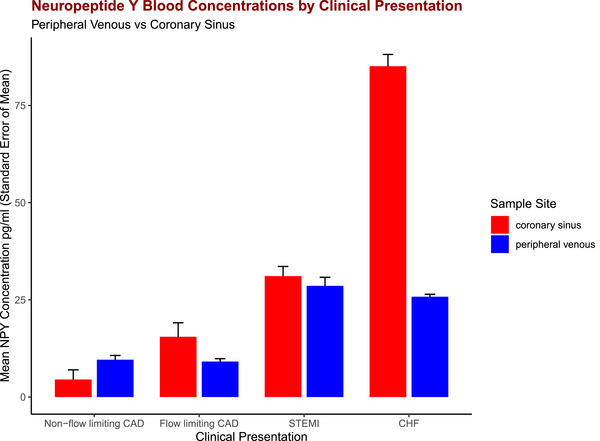
‘Non‐flow limiting CAD’ are patients without flow limiting epicardial coronary artery disease at the time of invasive coronary angiography. ‘Flow‐limiting CAD’ are patients who required percutaneous coronary intervention for significant epicardial coronary artery stenosis (including angina and non‐ST elevation myocardial infarction). Reproduced from Herring et al. (2019), Ajijola et al. (2020), Gibbs et al. (2022) and McDowell et al. (2024). CAD: coronary artery disease, CHF: chronic heart failure, NPY: neuropeptide Y, STEMI: ST‐elevation myocardial infarction.
Finally, it is worth noting that NPY has also been implicated in the pathogenesis of takotsubo syndrome where peripheral venous levels are acutely elevated (Szardien et al., 2011; Wittstein et al., 2005). Although the pathophysiology of takotsubo is still poorly understood, it is generally accepted that transient left ventricular impairment results from a surge of sympathetic stimulation of the heart (Ghadri et al., 2018; Lyon et al., 2021; Pelliccia et al., 2017). The resultant mass release of catecholamines and NPY then has direct cardiotoxic effects, and through vasoconstrictive effects on the microvasculature may lead to ischaemic stunning of the myocardium (Galiuto et al., 2010). In a mouse model of takotsubo syndrome, there is increased NPY expression in the stellate ganglia. Furthermore, elimination of NPY expression using small interfering RNA reduced the incidence of takotsubo in these mice, suggesting a causal role of NPY in this mouse model (Arai et al., 2022).
Pathophysiological role of NPY in heart disease
NPY can directly influence cardiac and vascular function through its Y receptors, independent of adrenergic activity.
NPY has positive inotropic effects on cardiomyocytes via its Y1 receptor. This is mediated through a phospholipase C‐dependent pathway leading to increased calcium transients (del Puy Heredia et al., 2005). NPY is also a potent vasoconstrictor. Infusion of NPY into human coronary arteries is able to induce ischaemic chest pain and ST elevation, even in the absence of epicardial coronary constriction (Clarke et al., 1987). Immunohistology confirms extensive expression of Y1 receptors on coronary microvascular smooth muscle cells. We have demonstrated that NPY acts directly on microvascular smooth muscle cells via its Y1 receptor to cause dose‐dependent vasoconstriction. This vasoconstrictive effect causes an increase in coronary vascular resistance in Langendorff perfused rat hearts. In the context of myocardial ischaemia, this leads to increased infarct size presumably though microvascular vasoconstriction in the vulnerable peri‐infarct zone (Herring et al., 2019b).
We have also demonstrated that NPY is pro‐arrhythmic, independent of beta‐adrenergic stimulation (Kalla et al., 2020). In isolated Langendorff heart preparations, stellate ganglion stimulation causes significant NPY release to the heart. Even in the presence of combined beta‐ and alpha‐adrenergic blockade, stellate ganglion stimulation causes an increase in ventricular calcium transients and reduced ventricular fibrillation threshold. This effect is abolished by selective Y1 blockade. Similar effects are seen in a mouse models of subarachnoid haemorrhage, a condition associated with increased risk of ventricular arrhythmias (Michael Frangiskakis et al., 2009), where upregulation of Y1 receptors is associated with a reduction in ventricular fibrillation threshold (Chen et al., 2023).
NPY also has trophic effects on cardiomyocytes. In vitro administration of NPY to isolated ventricular cardiomyocytes increases protein synthesis and causes hypertrophy through Ca2+/calmodulin‐dependent calcineurin signal pathways (Chen et al., 2005; Millar et al., 1994; Nicholl et al., 2002). This is also true in vivo where chronic administration of NPY causes cardiac dysfunction and hypertrophy (Zhang et al., 2015). NPY has also been shown to disrupt energy metabolism and mitochondrial integrity, adversely affecting cardiomyocyte viability (Hu et al., 2017; Luo et al., 2015). Transgenic mice with overexpression of NPY are more prone to doxorubicin mediated cardiomyopathy, whereas NPY knockout rats have improved cardiac function and reduced apoptosis following MI (Huang et al., 2019). However, unexpectedly, a different study using NPY knockout mice demonstrated larger infarct size and worsening cardiac function following MI in NPY knockout mice (Qin et al., 2022), leading to the suggestion that NPY might be cardioprotective in their mouse model. The cause of this discrepancy is unclear but might be a result of different co‐transmitter profiles in mice and rats. Interestingly in wild‐type mice, high concentrations of NPY remained detrimental.
It appears that the effect of NPY on cardiac remodelling depends on the local context, such as the ratio of Y1 to Y2 receptors and DPP‐4 activity. In vitro, selective stimulation of Y1 and Y2 receptors has opposite effects on inotropy. Y1 simulation leads to positive inotropic responses, whereas Y2 activation opposes the inotropic effects of beta‐adrenoreceptor stimulation (Allen et al., 2006). The Y2 receptor pathway may be cardioprotective. Selective activation of Y2 by NPY3−36 promotes angiogenesis (Lee et al., 2003; Saraf et al., 2016) and has been demonstrated to improve cell survival and reduce fibrosis in a swine model of myocardial ischaemia (Matyal et al., 2013; Robich et al., 2010). Conversely, Y1 signalling reduces cardiomyocyte viability and induces apoptosis (Huang et al., 2019). In patients with arrhythmogenic cardiomyopathy, there is increased Y1 receptor expression in cardiac mesenchymal stromal cells, leading to increased adipogenesis and fibrofatty myocardial replacement (Stadiotti et al., 2021). In CHF, there is a shift from Y1 to Y2 expression, possibly as a compensatory response to chronic sympathetic activation (Callanan et al., 2007).
DPP‐4 plays an important regulatory role on the action of NPY. For example, during exercise recovery, DPP‐4 rapidly converts NPY1–36 to NPY3–36 as the sympathetic tone declines (Eugster et al., 2022). DPP‐4 is expressed in human left ventricular cardiomyocytes and its expression is reduced in heart failure (Vörös et al., 2022). The clinical importance of DPP‐4 activity has been highlighted by the cardiotoxic effects seen in diabetic patients treated with DPP‐4 inhibitors (Scirica et al., 2013). Although inhibition of DPP‐4 prevents the degradation of incretins facilitating insulin secretion (Thornberry & Gallwitz, 2009), it also prevent conversion of NPY1–36 to NPY3–36, thus favouring cardiotoxic Y1 receptor signalling.
Finally, NPY has well documented immunomodulatory effects (Chen et al., 2020). It can influence macrophage differentiation between M1 and M2 phenotypes, which has important implications for cardiac remodelling (Nahrendorf & Swirski, 2013). However, these effects are again dependent on NPY concentration and DPP‐4 activity (Chen et al., 2020; Dimitrijević et al., 2008).
Therapeutic and diagnostic implications
Autonomic modulation is an emerging strategy for the treatment of heart failure and ventricular arrhythmia (VA). Reducing sympathetic tone through deep sedation has been shown to be effective with respect to reducing VAs in patients refractory to anti‐arrhythmic medication (Bundgaard et al., 2020). Percutaneous injection of local anaesthetic into the epidural space at level T1–T4 temporarily reduces sympathetic outflow to the heart and can be used to manage refractory arrhythmias in patients with structural heart disease (Bourke et al., 2010; Do et al., 2017). Stellate ganglion blockade through percutaneous local anaesthetic injection has similar effects (Tian et al., 2019).
A more permanent form of cardiac sympathetic denervation (CSD) can be achieved through surgical removal of the stellate ganglia. Surgical CSD is not a novel concept and pre‐dates coronary artery bybass grafting by several decades. Its application for treatment of angina was first suggested in 1899 (Francois‐Franck, 1899). This inspired Jonnesco in 1916 to perform surgical removal of the left stellate ganglion in a patient with intractable angina, abolishing both anginal attacks and ventricular arrhythmia (Jonnesco, 1921). Subsequently, the surgical technique has been refined and now involves resection of only the lower half of the stellate ganglion (to reduce incidence of Horner's syndrome) and the T2–T4 sympathetic ganglia (Bourke et al., 2010; Vaseghi et al., 2014), conducted as a video‐assisted thoracoscopic procedure. Studies have established the use of surgical CSD for prevention of sudden cardiac death in patients with long QT syndrome (Schwartz et al., 1991) and catecholaminergic polymorphic ventricular tachycardia (Wilde et al., 2008), where it is now guideline‐endorsed with a similar level of recommendation as implantable cardioverter defibrillator (ICD) implantation (Zeppenfeld et al., 2022). This concept has been further expanded by Vaseghi et al. (2017), who demonstrated that bilateral surgical CSD is safe and effective at preventing ventricular arrhythmia in patients with structural heart disease. Indeed, it is strikingly effective, with metanalysis demonstrating upward of 60% reduction in VAs in patients in whom arrhythmias are otherwise refractory to all other available treatments including maximally tolerated doses of betablockade (Shah et al., 2019). This observation may be related to the fact that CSD reduces not only noradrenergic drive to the heart, but also NPY release, thus also eliminating the arrhythmic effects of NPY (Hoang et al., 2020; Kalla et al., 2020). There is also limited evidence that bilateral surgical CSD can improve cardiac function and symptoms in patients with systolic heart failure (Conceição‐Souza et al., 2012) although these finding are hypothesis generating only, and require larger clinical trials to be investigated further.
Sympathetic tone can also be reduced through renal denervation (Hering et al., 2014). This has been shown to improve blood pressure control in several sham‐controlled clinical trials (Azizi et al., 2023, 2024). Furthermore, in animal models, renal denervation increases ventricular fibrillary threshold and reduces VAs (Ye et al., 2022; Zhang et al., 2018), and such findings have been replicated in case series of patients with refractory ventricular arrhythmia (Armaganijan et al., 2015).
Direct vagal nerve stimulation has shown promise in preventing arrhythmia and adverse cardiac remodelling in animal models (Myers et al., 1974; Nash et al., 2001; Zhang et al., 2009) and, although clinical benefits in heart failure patients were not seen in either the NECTAR‐HF or INOVATE‐HF trials (Gold et al., 2016; Zannad et al., 2015), the ANTHEM‐HF study did demonstrate improvements in symptoms and echocardiographic parameters at both 6 months and 12 months of follow up compared to baseline (Premchand et al., 2014, 2016). The larger randomised controlled ANTHEM‐HFrEF Pivotal trial (NCT03425422) is yet to report (Konstam et al., 2019). Vagal tone can also be increased through percutaneous stimulation of the auricular branch of the vagus nerve at the tragus (Jiang et al., 2020). In patients with STEMI, tragal stimulation has been shown to reduce inflammatory markers post infarct and lead to reduced VAs and better myocardial function (Yu et al., 2017). In patients with paroxysmal atrial fibrillation, tragus stimulation reduces inflammatory cytokines and supresses atrial fibrillation and NPY levels (Stavrakis et al., 2015, 2020).
Future therapies selectively targeting signalling pathways within the neurocardiac hierarchy could also be used to re‐establish autonomic balance. PDE2A is emerging as an important modulator of autonomic balance through its ability to modulate cAMP and cGMP levels in pre‐junctional sympathetic neurons. As already described, increased PDE2A activity favours cGMP breakdown, resulting in increased calcium transients and noradrenaline release in sympathetic neurons, and blunting of the sympathoinhibitoy effect of natriuretic peptides (Li & Paterson, 2016; Li et al., 2015). Indeed, PDE2A activity is elevated in the stellate ganglia of spontaneously hypertensive rats and patients with recurrent ventricular arrhythmias. Pharmacological inhibition of PDE2A and noradrenergic neuron‐specific gene transfer of a non‐functional form of PDE2A restores cGMP mediated inhibition of noradrenaline release, highlighting this as a potential therapeutic target to reduce sympathetic tone (Liu et al., 2018).
Targeting the nNOS signalling pathway to restore autonomic balance has shown promise in animal models. Targeted gene transfer of nNOS to parasympathetic neurons increases parasympathetic activity in pigs (Heaton et al., 2005) and guinea‐pigs (Mohan et al., 2002), and also restores parasympathetic function in spontaneously hypertensive rats (Heaton et al., 2007) and guinea pigs following acute MI (Dawson et al., 2008). Conversely, noradrenergic specific gene transfer of nNOS to sympathetic neurons decreases sympathetic neurotransmission in rats (Wang et al., 2007, 2006) and rescues impaired NO–cGMP signalling to reduce Ca2+‐dependent noradrenaline release in a rat model of sympathetic hyperactivity (Li et al., 2013, 2007). Similarly, delivery of CAPON to sympathetic neurons using a specific adenovirus vector has been shown to correct the heightened sympathetic phenotype of spontaneously hypertensive rats (Lu et al., 2015).
Selective modulation of NPY signalling has also shown therapeutic potential in animal models. Stimulation of Y2 receptors may be an emerging technique to encourage angiogenesis following MI. It has recently become possible to deliver NPY3–36 to areas of oxidative stress by incorporating it into H2O2 responsive copolyoxalate containing vanillyl alcohol (i.e. PVAX) nanoparticles. In mouse models of limb and myocardial ischaemia, this resulted in significantly improved blood flow and cardiac function compared to controls (Eshun et al., 2017; Mahmood et al., 2020). Similarly, in pig models of chronic cardiac ischemia, infusion of NPY3–36 resulted in improved cardiac blood flow, restoration of fatty acid metabolism, reduced fibrosis and improved left ventricular function (Matyal et al., 2013; Robich et al., 2010). Conversely, selective antagonism of Y1 receptors in pigs has been shown to prevent pro‐arrhythmic electrophysiological changes without adverse effects on inotropy (Hoang et al., 2020).
Finally, biomarkers such as NPY could also vastly improve the ability to predict SCD. Current methods are crude and, in CHF, primarily based on left ventricular function, previous ventricular arrhythmias and myocardial scar burden (Zeppenfeld et al., 2022). These methods are imperfect and predicting the risk of SCD remains challenging (Deyell et al., 2015). Although ICDs improve overall mortality on a population level (Bardy et al., 2005; Moss et al., 2002), many individuals never go on to require ICD therapy. Such individuals, however, are subjected to morbidity from device related complications and inappropriate device therapies (Ezzat et al., 2015; Hawkins et al., 2018). Elevated peripheral venous NPY levels are strongly associated with mortality following MI and CHF (Fig. 2) (Gibbs et al., 2022; McDowell et al., 2024). Importantly peripheral venous NPY levels appear to be an acceptable surrogate for cardiac NPY release (Fig. 3), making this a practical clinical tool to improve risk stratification. Indeed, the prognostic value of peripheral venous NPY concentrations in STEMI has recently been independently validated (Tiller et al., 2024). Whether additional prognostic information can be gained from investigating NPY dynamics in CHF patients during exercise remains to be determined. Numerous other measures of autonomic activity such as heart rate variability, heart rate recovery after exercise, abnormal baroreflex responses and altered sympathetic innervation on nuclear imaging have also been shown to independently predict mortality and SCD in patients with cardiac disease (Cole et al., 1999; De Ferrari et al., 2007; Fallavollita et al., 2017; La Rovere et al., 1998).
Conclusions
The autonomic nervous system is an important modulator of cardiac function, and normally exists in a state of balance between its parasympathetic and sympathetic limbs. The hallmark of cardiac disease is a loss of this intricate balance, leading to chronic hyperactivation of sympathetic output, which directly contributes to disease progression. Although beta‐blockers improve mortality in these conditions by preventing the action of noradrenaline, a substantial residual risk remains. This can be explained by the existence of co‐transmitters such as NPY, which can independently influence cardiac remodelling and arrhythmic risk.
Neuromodulatory interventions to limit sympathetic activation have recently been shown to be effective treatment for some patients with resistant hypertension or recurrent ventricular arrhythmias. This remains an area of active research, with ongoing randomised clinical trials recruiting patients with heart failure and high arrhythmic risk (ClinicalTrials.gov. Identifier NCT01013714; Chin et al., 2017; Zhouting et al., 2023). Interventions to selectively target autonomic co‐transmission and neuronal signalling pathways have shown promise in animal models but are not yet ready for human use. Finally, biomarkers such as NPY may prove to be a vital tool with respect to improving prediction of SCD and identifying patients most probably benefiting from ICD therapy.
Additional information
Competing interests
The authors declare that they have no competing interests.
Author contributions
B.B. drafted the manuscript. All authors were involved in the editing and proof reading of the final manuscript. All authors have approved the final version of the manuscript submitted for publication. All persons who meet authorship criteria are listed as authors, and all authors certify that they have participated sufficiently in the work to take public responsibility for the content in line with criteria set out but he International Committee of Medical Journal Editors.
Funding
B.B. is supported by a British Heart Foundation Clinical Research Fellowship (FS/CRTF/22/24437) and N.H. is supported by a British Heart Foundation Senior Clinical Research Fellowship (FS/SCRF/20/32005).
Supporting information
Peer Review History
Acknowledgements
Professors David Paterson and Keith Channon have been invaluable and important mentors over many years, and we are particularly grateful and indebted for their support. We are also extremely grateful to previous group members who have worked on NPY (in particular Julia Shanks, Chieh‐Ju Lu, Manish Kalla, Nidi Tapoulal, Guoliang Hao, Harvey Davis, Tom Gibbs, Jakub Tomek and Peregrine Green), as well as our many collaborators, in particular the OxAMI investigators, and Professors Ajijola, Vaseghi, Ardell and Shivkumar at UCLA, Professor Habecker at Oregon Health Sciences, and Professors Jhund and McMurray at the University of Glasgow, who have been instrumental in many of the studies described here.
Biography
Neil Herring completed his DPhil and medical degree at Oxford University before training in Cardiology. He was awarded Intermediate and Senior Fellowships from the British Heart Foundation and now leads a translational research group alongside clinical work as a Professor of Cardiovascular Medicine.
Ben Bussmann is a Cardiology Registrar undertaking a BHF funded DPhil who obtained his medical degree from Cambridge and Oxford Universities.
Thamali Ayagama is a postdoctoral researcher who received an MSc from the University of Bangalore, India, and DPhil from Oxford.
Kun (Kevin) Liu obtained his medical degree from Huazhong University of Science and Technology, China, an MPhil from Cambridge University and DPhil from Oxford where he is now a postdoctoral researcher.
Dan Li received her PhD from Chonbuk National University, South Korea before coming to the University of Oxford where she is now an Associate Professor (photograph left to right: Kevin, Dan, Neil, Thamali and Ben).

Handling Editors: Harold Schultz & Kalyanam Shivkumar
The peer review history is available in the Supporting Information section of this article (https://doi.org/10.1113/JP285370#support‐information‐section).
References
- Ajijola, O. A. , Chatterjee, N. A. , Gonzales, M. J. , Gornbein, J. , Liu, K. , Li, D. , Paterson, D. J. , Shivkumar, K. , Singh, J. P. , & Herring, N. (2020). Coronary sinus neuropeptide Y levels and adverse outcomes in patients with stable chronic heart failure. Journal of the American Medical Association Cardiology, 5(3), 318–325. [DOI] [PMC free article] [PubMed] [Google Scholar]
- Ajijola, O. A. , Hoover, D. B. , Simerly, T. M. , Brown, T. C. , Yanagawa, J. , Biniwale, R. M. , Lee, J. M. , Sadeghi, A. , Khanlou, N. , Ardell, J. L. , & Shivkumar, K. (2017). Inflammation, oxidative stress, and glial cell activation characterize stellate ganglia from humans with electrical storm. Joint Commission International Insight, 2(18), e94715. [DOI] [PMC free article] [PubMed] [Google Scholar]
- Ajijola, O. A. , Yagishita, D. , Reddy, N. K. , Yamakawa, K. , Vaseghi, M. , Downs, A. M. , Hoover, D. B. , Ardell, J. L. , & Shivkumar, K. (2015). Remodeling of stellate ganglion neurons after spatially targeted myocardial infarction: Neuropeptide and morphologic changes. Heart Rhythm, 12(5), 1027–1035. [DOI] [PMC free article] [PubMed] [Google Scholar]
- Allen, A. R. , Kelso, E. J. , Bell, D. , Zhao, Y. , Dickson, P. , & McDermott, B. J. (2006). Modulation of contractile function through neuropeptide Y receptors during development of cardiomyocyte hypertrophy. Journal of Pharmacology and Experimental Therapeutics, 319(3), 1286–1296. [DOI] [PubMed] [Google Scholar]
- Arai, T. , Kanazawa, H. , Kimura, K. , Munakata, M. , Yamakawa, H. , Shinmura, K. , Yuasa, S. , Sano, M. , & Fukuda, K. (2022). Upregulation of neuropeptide Y in cardiac sympathetic nerves induces stress (Takotsubo) cardiomyopathy. Frontiers in Neuroscience, 16, 1013712. [DOI] [PMC free article] [PubMed] [Google Scholar]
- Ardell, J. L. , & Armour, J. A. (2016). Neurocardiology: Structure‐based function. Comprehensive Physiology, 6(4), 1635–1653. [DOI] [PubMed] [Google Scholar]
- Arking, D. E. , Pfeufer, A. , Post, W. , Kao, W. H. , Newton‐Cheh, C. , Ikeda, M. , West, K. , Kashuk, C. , Akyol, M. , Perz, S. , Jalilzadeh, S. , Illig, T. , Gieger, C. , Guo, C. Y. , Larson, M. G. , Wichmann, H. E. , Marban, E. , O'Donnell, C. J. , Hirschhorn, J. N. , … Chakravarti, A. (2006). A common genetic variant in the NOS1 regulator NOS1AP modulates cardiac repolarization. Nature Genetics, 38(6), 644–651. [DOI] [PubMed] [Google Scholar]
- Armaganijan, L. V. , Staico, R. , Moreira, D. A. , Lopes, R. D. , Medeiros, P. T. , Habib, R. , Melo Neto, J. , Katz, M. , Armaganijan, D. , & Sousa, A. G. (2015). 6‐month outcomes in patients with implantable cardioverter‐defibrillators undergoing renal sympathetic denervation for the treatment of refractory ventricular arrhythmias. Journal of the American College of Cardiology: Cardiovascular Interventions, 8(7), 984–990. [DOI] [PubMed] [Google Scholar]
- Armour, J. A. (2004). Cardiac neuronal hierarchy in health and disease. American Journal of Physiology‐Regulatory, Integrative and Comparative Physiology, 287(2), R262–R271. [DOI] [PubMed] [Google Scholar]
- Armour, J. A. (2008). Potential clinical relevance of the ‘little brain’on the mammalian heart. Experimental Physiology, 93(2), 165–176. [DOI] [PubMed] [Google Scholar]
- Armour, J. A. , Murphy, D. A. , Yuan, B. X. , MacDonald, S. , & Hopkins, D. A. (1997). Gross and microscopic anatomy of the human intrinsic cardiac nervous system. The Anatomical Record: An Official Publication of the American Association of Anatomists, 247(2), 289–298. [DOI] [PubMed] [Google Scholar]
- Azizi, M. , Saxena, M. , Wang, Y. , Jenkins, J. S. , Devireddy, C. , Rader, F. , Fisher, N. D. L. , Schmieder, R. E. , Mahfoud, F. , Lindsey, J. , Sanghvi, K. , Todoran, T. M. , Pacella, J. , Flack, J. , Daemen, J. , Sharp, A. S. P. , Lurz, P. , Bloch, M. J. , Weber, M. A. , … RADIANCE II Investigators and Collaborators . (2023). Endovascular ultrasound renal denervation to treat hypertension: The RADIANCE II randomized clinical trial. Journal of the American Medical Association, 329(8), 651–661. [DOI] [PMC free article] [PubMed] [Google Scholar]
- Azizi, M. , Sharp, A. S. P. , Fisher, N. D. L. , Weber, M. A. , Lobo, M. D. , Daemen, J. , Lurz, P. , Mahfoud, F. , Schmieder, R. E. , Basile, J. , Bloch, M. J. , Saxena, M. , Wang, Y. , Sanghvi, K. , Jenkins, J. S. , Devireddy, C. , Rader, F. , Gosse, P. , … Claude, L. , RADIANCE Investigators . (2024). Patient‐level pooled analysis of endovascular ultrasound renal denervation or a sham procedure at 6 months following medication escalation: The RADIANCE clinical trial program. Circulation, 149(10), 747–759. [DOI] [PubMed] [Google Scholar]
- Barber, M. J. , Mueller, T. M. , Henry, D. P. , Felten, S. , & Zipes, D. (1983). Transmural myocardial infarction in the dog produces sympathectomy in noninfarcted myocardium. Circulation, 67(4), 787–796. [DOI] [PubMed] [Google Scholar]
- Bardy, G. H. , Lee, K. L. , Mark, D. B. , Poole, J. E. , Packer, D. L. , Boineau, R. , Domanski, M. , Troutman, C. , Anderson, J. , Johnson, G. , McNulty, S. E. , Clapp‐Channing, N. , Davidson‐Ray, L. D. , Fraulo, E. S. , Fishbein, D. P. , Luceri, R. M. , Ip, J. H. , & Sudden Cardiac Death in Heart Failure Trial (SCD‐HeFT) . (2005). Amiodarone or an implantable cardioverter‐defibrillator for congestive heart failure. New England Journal of Medicine, 352(3), 225–237. [DOI] [PubMed] [Google Scholar]
- Bayliss, W. M. (1902). On the local reactions of the arterial wall to changes of internal pressure. The Journal of physiology, 28(3), 220–231. [DOI] [PMC free article] [PubMed] [Google Scholar]
- Bayliss, W. M. , & Starling, E. H. (1902). The mechanism of pancreatic secretion. The Journal of physiology, 28, 325. [DOI] [PMC free article] [PubMed] [Google Scholar]
- Beaumont, E. , Southerland, E. M. , Hardwick, J. C. , Wright, G. L. , Ryan, S. , Li, Y. , KenKnight, B. H. , Armour, J. A. , & Ardell, J. L. (2015). Vagus nerve stimulation mitigates intrinsic cardiac neuronal and adverse myocyte remodeling postmyocardial infarction. American Journal of Physiology‐Heart and Circulatory Physiology, 309(7), H1198–H1206. [DOI] [PMC free article] [PubMed] [Google Scholar]
- Bourke, T. , Vaseghi, M. , Michowitz, Y. , Sankhla, V. , Shah, M. , Swapna, N. , Boyle, N. G. , Mahajan, A. , Narasimhan, C. , Lokhandwala, Y. , & Shivkumar, K. (2010). Neuraxial modulation for refractory ventricular arrhythmias: Value of thoracic epidural anesthesia and surgical left cardiac sympathetic denervation. Circulation, 121(21), 2255–2262. [DOI] [PMC free article] [PubMed] [Google Scholar]
- Brouri, F. , Hanoun, N. , Mediani, O. , Saurini, F. , Hamon, M. , Vanhoutte, P. M. , & Lechat, P. (2004). Blockade of beta 1‐ and desensitization of beta 2‐adrenoceptors reduce isoprenaline‐induced cardiac fibrosis. European Journal of Pharmacology, 485(1–3), 227–234. [DOI] [PubMed] [Google Scholar]
- Brum, P. C. , Kosek, J. , Patterson, A. , Bernstein, D. , & Kobilka, B. (2002). Abnormal cardiac function associated with sympathetic nervous system hyperactivity in mice. American Journal of Physiology‐Heart and Circulatory Physiology, 283(5), H1838–H1845. [DOI] [PubMed] [Google Scholar]
- Bundgaard, J. S. , Jacobsen, P. K. , Grand, J. , Lindholm, M. G. , Hassager, C. , Pehrson, S. , Kjaergaard, J. , & Bundgaard, H. (2020). Deep sedation as temporary bridge to definitive treatment of ventricular arrhythmia storm. European Heart Journal‐Acute Cardiovascular Care, 9(6), 657–664. [DOI] [PubMed] [Google Scholar]
- Burnstock, G. (1980). Do some nerve cells release more than one transmitter? Commentaries in the Neurosciences, 151–160. [DOI] [PubMed] [Google Scholar]
- Burnstock, G. (2013). Chapter 3 ‐ Cotransmission in the autonomic nervous system. In Buijs R. M., & Swaab D. F. (Eds.), Handbook of Clinical Neurology (pp. 23–35). Elsevier. [DOI] [PubMed] [Google Scholar]
- Buttgereit, J. , Shanks, J. , Li, D. , Hao, G. , Athwal, A. , Langenickel, T. H. , Wright, H. , da Costa Goncalves, A. C. , Monti, J. , Plehm, R. , Popova, E. , Qadri, F. , Lapidus, I. , Ryan, B. , Ozcelik, C. , Paterson, D. J. , Bader, M. , & Herring, N. (2016). C‐type natriuretic peptide and natriuretic peptide receptor B signalling inhibits cardiac sympathetic neurotransmission and autonomic function. Cardiovascular Research, 112(3), 637–644. [DOI] [PMC free article] [PubMed] [Google Scholar]
- Callanan, E. Y. , Lee, E. W. , Tilan, J. U. , Winaver, J. , Haramati, A. , Mulroney, S. E. , & Zukowska, Z. (2007). Renal and cardiac neuropeptide Y and NPY receptors in a rat model of congestive heart failure. American Journal of Physiology‐Renal Physiology, 293(6), F1811–F1817. [DOI] [PubMed] [Google Scholar]
- Cao, J.‐M. , Fishbein, M. C. , Han, J. B. , Lai, W. W. , Lai, A. C. , Wu, T.‐J. , Czer, L. , Wolf, P. L. , Denton, T. A. , & Shintaku, I. P. (2000). Relationship between regional cardiac hyperinnervation and ventricular arrhythmia. Circulation, 101(16), 1960–1969. [DOI] [PubMed] [Google Scholar]
- Carey, D. , Iismaa, T. , Ho, K. , Rajkovic, I. , Kelly, J. , Kraegen, E. , Ferguson, J. , Inglis, A. , Shine, J. , & Chisholm, D. (1993). Potent effects of human galanin in man: Growth hormone secretion and vagal blockade. The Journal of Clinical Endocrinology & Metabolism, 77(1), 90–93. [DOI] [PubMed] [Google Scholar]
- Chen, M. , Li, X. , Dong, Q. , Li, Y. , & Liang, W. (2005). Neuropeptide Y induces cardiomyocyte hypertrophy via calcineurin signaling in rats. Regulatory Peptides, 125(1–3), 9–15. [DOI] [PubMed] [Google Scholar]
- Chen, M. , Wang, Z. , Lai, X. , Wang, S. , Wu, Z. , Liu, Q. , & Zhou, S. (2023). Transient cardiac electrophysiological changes in a rat model of subarachnoid haemorrhage: A brain‐heart interaction. Europace, 25(6), euad171. [DOI] [PMC free article] [PubMed] [Google Scholar]
- Chen, W. C. , Liu, Y. B. , Liu, W. F. , Zhou, Y. Y. , He, H. F. , & Lin, S. (2020). Neuropeptide Y is an immunomodulatory factor: Direct and indirect. Frontiers in Immunology, 11, 580378. [DOI] [PMC free article] [PubMed] [Google Scholar]
- Chin, A. , Ntsekhe, M. , Viljoen, C. , Rossouw, J. , Pennel, T. , & Schwartz, P. J. (2017). Rationale and design of a prospective study to assess the effect of left cardiac sympathetic denervation in chronic heart failure. International Journal of Cardiology, 248, 227–231. [DOI] [PubMed] [Google Scholar]
- Chinkers, M. , Garbers, D. L. , Chang, M. S. , Lowe, D. G. , Chin, H. M. , Goeddel, D. V. , & Schulz, S. (1989). A membrane form of guanylate cyclase is an atrial natriuretic peptide receptor. Nature, 338(6210), 78–83. [DOI] [PubMed] [Google Scholar]
- Choate, J. , Danson, E. , Morris, J. , & Paterson, D. J. (2001). Peripheral vagal control of heart rate is impaired in neuronal NOS knockout mice. American Journal of Physiology‐Heart and Circulatory Physiology, 281(6), H2310–H2317. [DOI] [PubMed] [Google Scholar]
- Choate, J. K. , & Paterson, D. J. (1999). Nitric oxide inhibits the positive chronotropic and inotropic responses to sympathetic nerve stimulation in the isolated guinea‐pig atria. Journal of the Autonomic Nervous System, 75(2–3), 100–108. [DOI] [PubMed] [Google Scholar]
- CIBIS‐II Investigators and Committees. (1999). The cardiac insufficiency bisoprolol study II (CIBIS‐II): A randomised trial. The Lancet, 353(9146), 9–13. [PubMed] [Google Scholar]
- Clarke, J. G. , Kerwin, R. , Larkin, S. , Lee, Y. , Yacoub, M. , Davies, G. J. , Hackett, D. , Dawbarn, D. , Bloom, S. R. , & Maseri, A. (1987). Coronary artery infusion of neuropeptide Y in patients with angina pectoris. The Lancet, 1(8541), 1057–1059. [DOI] [PubMed] [Google Scholar]
- ClinicalTrials.gov. Identifier NCT01013714 . Cardiac Sympathetic Denervation for Prevention of Ventricular Tachyarrhythmias ‐ (PREVENT VT). https://clinicaltrialsgov/ct2/show/NCT01013714
- Cody, R. J. , Franklin, K. W. , Kluger, J. , & Laragh, J. H. (1982). Sympathetic responsiveness and plasma norepinephrine during therapy of chronic congestive heart failure with captopril. The American Journal Of Medicine, 72(5), 791–797. [DOI] [PubMed] [Google Scholar]
- Cohn, J. N. , Levine, T. B. , Olivari, M. T. , Garberg, V. , Lura, D. , Francis, G. S. , Simon, A. B. , & Rector, T. (1984). Plasma norepinephrine as a guide to prognosis in patients with chronic congestive heart failure. New England Journal of Medicine, 311(13), 819–823. [DOI] [PubMed] [Google Scholar]
- Cole, C. R. , Blackstone, E. H. , Pashkow, F. J. , Snader, C. E. , & Lauer, M. S. (1999). Heart‐rate recovery immediately after exercise as a predictor of mortality. New England Journal of Medicine, 341(18), 1351–1357. [DOI] [PubMed] [Google Scholar]
- Communal, C. , Singh, K. , Pimentel, D. R. , & Colucci, W. S. (1998). Norepinephrine stimulates apoptosis in adult rat ventricular myocytes by activation of the beta‐adrenergic pathway. Circulation, 98(13), 1329–1334. [DOI] [PubMed] [Google Scholar]
- Conceição‐Souza, G. E. , Pêgo‐Fernandes, P. M. , Cruz, F. , Guimarães, G. V. , Bacal, F. , Vieira, M. L. , Grupi, C. J. , Giorgi, M. C. , Consolim‐Colombo, F. M. , Negrão, C. E. , Rondon, M. U. , Moreira, L. F. , & Bocchi, E. A. (2012). Left cardiac sympathetic denervation for treatment of symptomatic systolic heart failure patients: A pilot study. European Journal of Heart Failure, 14(12), 1366–1373. [DOI] [PubMed] [Google Scholar]
- Corr, P. B. , & Gillis, R. A. (1978). Autonomic neural influences on the dysrhythmias resulting from myocardial infarction. Circulation Research, 43(1), 1–9. [DOI] [PubMed] [Google Scholar]
- Crawley, J. N. (1995). Biological actions of galanin. Regulatory Peptides, 59(1), 1–16. [DOI] [PubMed] [Google Scholar]
- Crotti, L. , Monti, M. C. , Insolia, R. , Peljto, A. , Goosen, A. , Brink, P. A. , Greenberg, D. A. , Schwartz, P. J. , & George, A. L., Jr (2009). NOS1AP is a genetic modifier of the long‐QT syndrome. Circulation, 120(17), 1657–1663. [DOI] [PMC free article] [PubMed] [Google Scholar]
- Cuculi, F. , Herring, N. , De Caterina, A. R. , Banning, A. P. , Prendergast, B. D. , Forfar, J. C. , Choudhury, R. P. , Channon, K. M. , & Kharbanda, R. K. (2013). Relationship of plasma neuropeptide Y with angiographic, electrocardiographic and coronary physiology indices of reperfusion during ST elevation myocardial infarction. Heart, 99(16), 1198–1203. [DOI] [PMC free article] [PubMed] [Google Scholar]
- Dae, M. W. , Herre, J. M. , O'Connell, J. W. , Botvinick, E. H. , Newman, D. , & Munoz, L. (1991). Scintigraphic assessment of sympathetic innervation after transmural versus nontransmural myocardial infarction. Journal of the American College of Cardiology, 17(6), 1416–1423. [DOI] [PubMed] [Google Scholar]
- Dae, M. W. , O'Connell, J. W. , Botvinick, E. H. , & Chin, M. C. (1995). Acute and chronic effects of transient myocardial ischemia on sympathetic nerve activity, density, and norepinephrine content. Cardiovascular Research, 30(2), 270–280. [PubMed] [Google Scholar]
- Dajani, A. J. , Liu, M. B. , Olaopa, M. A. , Cao, L. , Valenzuela‐Ripoll, C. , Davis, T. J. , Poston, M. D. , Smith, E. H. , Contreras, J. , Pennino, M. , Waldmann, C. M. , Hoover, D. B. , Lee, J. T. , Jay, P. Y. , Javaheri, A. , Slavik, R. , Qu, Z. , & Ajijola, O. A. (2023). Heterogeneous cardiac sympathetic innervation gradients promote arrhythmogenesis in murine dilated cardiomyopathy. Joint Commission International Insight, 8(22), e157956. [DOI] [PMC free article] [PubMed] [Google Scholar]
- Dale, H. H. (1935). “Walter Ernest Dixon Memorial Lecture. Pharmacology and Nerve‐endings.” Proceedings of the Royal Society of Medicine, 28, 15–28. [DOI] [PMC free article] [PubMed] [Google Scholar]
- Davis, H. , Herring, N. , & Paterson, D. J. (2020). Downregulation of M current is coupled to membrane excitability in sympathetic neurons before the onset of hypertension. Hypertension, 76(6), 1915–1923. [DOI] [PMC free article] [PubMed] [Google Scholar]
- Dawson, T. A. , Li, D. , Woodward, T. , Barber, Z. , Wang, L. , & Paterson, D. J. (2008). Cardiac cholinergic NO‐cGMP signaling following acute myocardial infarction and nNOS gene transfer. American Journal of Physiology‐Heart and Circulatory Physiology, 295(3), H990–H998. [DOI] [PMC free article] [PubMed] [Google Scholar]
- De Ferrari, G. M. , Sanzo, A. , Bertoletti, A. , Specchia, G. , Vanoli, E. , & Schwartz, P. J. (2007). Baroreflex sensitivity predicts long‐term cardiovascular mortality after myocardial infarction even in patients with preserved left ventricular function. Journal of the American College of Cardiology, 50(24), 2285–2290. [DOI] [PubMed] [Google Scholar]
- del Puy Heredia, M. , Delgado, C. , Pereira, L. , Perrier, R. , Richard, S. , Vassort, G. , Bénitah, J.‐P. , & Gómez, A. M. (2005). Neuropeptide Y rapidly enhances [Ca2+] i transients and Ca2+ sparks in adult rat ventricular myocytes through Y1 receptor and PLC activation. Journal of Molecular And Cellular Cardiology, 38(1), 205–212. [DOI] [PubMed] [Google Scholar]
- Del Rio, C. L. , Dawson, T. A. , Clymer, B. D. , Paterson, D. J. , & Billman, G. E. (2008). Effects of acute vagal nerve stimulation on the early passive electrical changes induced by myocardial ischaemia in dogs: Heart rate‐mediated attenuation. Experimental Physiology, 93(8), 931–944. [DOI] [PubMed] [Google Scholar]
- Deyell, M. W. , Krahn, A. D. , & Goldberger, J. J. (2015). Sudden cardiac death risk stratification. Circulation Research, 116(12), 1907–1918. [DOI] [PMC free article] [PubMed] [Google Scholar]
- DiBona, G. F. , Jones, S. Y. , & Brooks, V. L. (1995). ANG II receptor blockade and arterial baroreflex regulation of renal nerve activity in cardiac failure. American Journal of Physiology‐Regulatory, Integrative and Comparative Physiology, 269(5 Pt 2), R1189–R1196. [DOI] [PubMed] [Google Scholar]
- Dimitrijević, M. , Stanojević, S. , Mitić, K. , Kuštrimović, N. , Vujić, V. , Miletić, T. , & Kovačević‐Jovanović, V. (2008). The anti‐inflammatory effect of neuropeptide Y (NPY) in rats is dependent on dipeptidyl peptidase 4 (DP4) activity and age. Peptides, 29(12), 2179–2187. [DOI] [PubMed] [Google Scholar]
- Do, D. H. , Bradfield, J. , Ajijola, O. A. , Vaseghi, M. , Le, J. , Rahman, S. , Mahajan, A. , Nogami, A. , Boyle, N. G. , & Shivkumar, K. (2017). Thoracic epidural anesthesia can be effective for the short‐term management of ventricular tachycardia storm. Journal of the American Heart Association, 6(11), e007080. [DOI] [PMC free article] [PubMed] [Google Scholar]
- Díaz, H. S. , Toledo, C. , Andrade, D. C. , Marcus, N. J. , & Del Rio, R. (2020). Neuroinflammation in heart failure: New insights for an old disease. The Journal of Physiology, 598(1), 33–59. [DOI] [PubMed] [Google Scholar]
- Díaz‐Cabiale, Z. , Parrado, C. , Narváez, M. , Millón, C. , Puigcerver, A. , Fuxe, K. , & Narváez, J. A. (2010). Neurochemical modulation of central cardiovascular control: The integrative role of galanin. Experientia Supplementum, 102, 113–131. [DOI] [PubMed] [Google Scholar]
- Eckberg, D. L. (1997). Baroreflexes and the failing human heart. Circulation, 96(12), 4133–4137. [PubMed] [Google Scholar]
- Eckberg, D. L. , Drabinsky, M. , & Braunwald, E. (1971). Defective cardiac parasympathetic control in patients with heart disease. New England Journal of Medicine, 285(16), 877–883. [DOI] [PubMed] [Google Scholar]
- Eijgelsheim, M. , Newton‐Cheh, C. , Aarnoudse, A. L. , van Noord, C. , Witteman, J. C. , Hofman, A. , Uitterlinden, A. G. , & Stricker, B. H. (2009). Genetic variation in NOS1AP is associated with sudden cardiac death: Evidence from the Rotterdam Study. Human Molecular Genetics, 18(21), 4213–4218. [DOI] [PMC free article] [PubMed] [Google Scholar]
- Ekblad, E. , Edvinsson, L. , Wahlestedt, C. , Uddman, R. , Håkanson, R. , & Sundler, F. (1984). Neuropeptide Y co‐exists and co‐operates with noradrenaline in perivascular nerve fibers. Regulatory Peptides, 8(3), 225–235. [DOI] [PubMed] [Google Scholar]
- Elstad, M. , Walløe, L. , Holme, N. L. , Maes, E. , & Thoresen, M. (2015). Respiratory sinus arrhythmia stabilizes mean arterial blood pressure at high‐frequency interval in healthy humans. European Journal of Applied Physiology, 115(3), 521–530. [DOI] [PubMed] [Google Scholar]
- Eschenhagen, T. (2008). Beta‐adrenergic signaling in heart failure‐adapt or die. Nature Medicine, 14(5), 485–487. [DOI] [PubMed] [Google Scholar]
- Eshun, D. , Saraf, R. , Bae, S. , Jeganathan, J. , Mahmood, F. , Dilmen, S. , Ke, Q. , Lee, D. , Kang, P. M. , & Matyal, R. (2017). Neuropeptide Y3‐36 incorporated into PVAX nanoparticle improves functional blood flow in a murine model of hind limb ischemia. Journal of Applied Physiology, 122(6), 1388–1397. [DOI] [PubMed] [Google Scholar]
- Espiner, E. A. (1994). Physiology of natriuretic peptides. Journal of Internal Medicine, 235(6), 527–541. [DOI] [PubMed] [Google Scholar]
- Eugster, P. J. , Bourdillon, N. , Vocat, C. , Wuerzner, G. , Nguyen, T. , Millet, G. P. , & Grouzmann, E. (2022). Kinetics of neuropeptide Y, catecholamines, and physiological responses during moderate and heavy intensity exercises. Neuropeptides, 92, 102232. [DOI] [PubMed] [Google Scholar]
- Ezzat, V. A. , Lee, V. , Ahsan, S. , Chow, A. W. , Segal, O. , Rowland, E. , Lowe, M. D. , & Lambiase, P. D. (2015). A systematic review of ICD complications in randomised controlled trials versus registries: Is our ‘real‐world’ data an underestimation? Open Heart, 2(1), e000198. [DOI] [PMC free article] [PubMed] [Google Scholar]
- Fallavollita, J. A. , Dare, J. D. , Carter, R. L. , Baldwa, S. , & Canty J. M. Jr (2017). Denervated myocardium is preferentially associated with sudden cardiac arrest in ischemic cardiomyopathy: A pilot competing risks analysis of cause‐specific mortality. Circulation: Cardiovascular Imaging, 10(8), e006446. [DOI] [PMC free article] [PubMed] [Google Scholar]
- Ferguson, D. W. , Berg, W. J. , Roach, P. J. , Oren, R. M. , & Mark, A. L. (1992). Effects of heart failure on baroreflex control of sympathetic neural activity. American Journal of Cardiology, 69(5), 523–531. [DOI] [PubMed] [Google Scholar]
- Florea, V. G. , & Cohn, J. N. (2014). The autonomic nervous system and heart failure. Circulation Research, 114(11), 1815–1826. [DOI] [PubMed] [Google Scholar]
- Francois‐Franck, C. (1899). Signification physiologique de la résection du sympathique dans la maladie de Basedow, l’épilepsie, l'idiotie et le glaucome. Bulletin de l'Academie Nationale de Medecine (Paris), 41, 565–594. [Google Scholar]
- Fried, G. , Terenius, L. , Hökfelt, T. , & Goldstein, M. (1985). Evidence for differential localization of noradrenaline and neuropeptide Y in neuronal storage vesicles isolated from rat vas deferens. Journal of Neuroscience, 5(2), 450–458. [DOI] [PMC free article] [PubMed] [Google Scholar]
- Fu, Y. C. , Chi, C. S. , Yin, S. C. , Hwang, B. , Chiu, Y. T. , & Hsu, S. L. (2004). Norepinephrine induces apoptosis in neonatal rat cardiomyocytes through a reactive oxygen species‐TNF alpha‐caspase signaling pathway. Cardiovascular Research, 62(3), 558–567. [DOI] [PubMed] [Google Scholar]
- Galiuto, L. , De Caterina, A. R. , Porfidia, A. , Paraggio, L. , Barchetta, S. , Locorotondo, G. , Rebuzzi, A. G. , & Crea, F. (2010). Reversible coronary microvascular dysfunction: A common pathogenetic mechanism in Apical Ballooning or Tako‐Tsubo Syndrome. European Heart Journal, 31(11), 1319–1327. [DOI] [PubMed] [Google Scholar]
- Gazes, P. C. , Richardson, J. A. , & Woods, E. F. (1959). Plasma catechol amine concentrations in myocardial infarction and angina pectoris. Circulation, 19(5), 657–661. [DOI] [PubMed] [Google Scholar]
- Ghadri, J. R. , Wittstein, I. S. , Prasad, A. , Sharkey, S. , Dote, K. , Akashi, Y. J. , Cammann, V. L. , Crea, F. , Galiuto, L. , Desmet, W. , Yoshida, T. , Manfredini, R. , Eitel, I. , Kosuge, M. , Nef, H. M. , Deshmukh, A. , Lerman, A. , Bossone, E. , Citro, R. , … Templin, C. (2018). International expert consensus document on takotsubo syndrome (Part I): Clinical characteristics, diagnostic criteria, and pathophysiology. European Heart Journal, 39(22), 2032–2046. [DOI] [PMC free article] [PubMed] [Google Scholar]
- Giardino, N. D. , Glenny, R. W. , Borson, S. , & Chan, L. (2003). Respiratory sinus arrhythmia is associated with efficiency of pulmonary gas exchange in healthy humans. American Journal of Physiology‐Heart and Circulatory Physiology, 284(5), H1585–H1591. [DOI] [PubMed] [Google Scholar]
- Gibbs, T. , Tapoulal, N. , Shanmuganathan, M. , Burrage, M. K. , Borlotti, A. , Banning, A. P. , Choudhury, R. P. , Neubauer, S. , Kharbanda, R. K. , Ferreira, V. M. , Channon, K. M. , Herring, N. , & Ox, A. (2022). Neuropeptide‐Y levels in ST‐segment‐elevation myocardial infarction: Relationship with coronary microvascular function, heart failure, and mortality. Journal of the American Heart Association, 11(13), e024850. [DOI] [PMC free article] [PubMed] [Google Scholar]
- Gold, M. R. , Van Veldhuisen, D. J. , Hauptman, P. J. , Borggrefe, M. , Kubo, S. H. , Lieberman, R. A. , Milasinovic, G. , Berman, B. J. , Djordjevic, S. , Neelagaru, S. , Schwartz, P. J. , Starling, R. C. , & Mann, D. L. (2016). Vagus nerve stimulation for the treatment of heart failure: The INOVATE‐HF trial. Journal of the American College of Cardiology, 68(2), 149–158. [DOI] [PubMed] [Google Scholar]
- Goldberger, J. J. , Arora, R. , Buckley, U. , & Shivkumar, K. (2019). Autonomic nervous system dysfunction: JACC focus seminar. Journal of the American College of Cardiology, 73(10), 1189–1206. [DOI] [PMC free article] [PubMed] [Google Scholar]
- Grassi, G. (2009). Assessment of sympathetic cardiovascular drive in human hypertension: Achievements and perspectives. Hypertension, 54(4), 690–697. [DOI] [PubMed] [Google Scholar]
- Grassi, G. , Seravalle, G. , Cattaneo, B. M. , Lanfranchi, A. , Vailati, S. , Giannattasio, C. , Del Bo, A. , Sala, C. , Bolla, G. B. , & Pozzi, M. (1995). Sympathetic activation and loss of reflex sympathetic control in mild congestive heart failure. Circulation, 92(11), 3206–3211. [DOI] [PubMed] [Google Scholar]
- Gronda, E. , Seravalle, G. , Brambilla, G. , Costantino, G. , Casini, A. , Alsheraei, A. , Lovett, E. G. , Mancia, G. , & Grassi, G. (2014). Chronic baroreflex activation effects on sympathetic nerve traffic, baroreflex function, and cardiac haemodynamics in heart failure: A proof‐of‐concept study. European Journal of Heart Failure, 16(9), 977–983. [DOI] [PMC free article] [PubMed] [Google Scholar]
- Gu, J. , Adrian, T. , Tatemoto, K. , Polak, J. , Allen, J. , & Bloom, S. (1983). Neuropeptide tyrosine (NPY)—a major cardiac neuropeptide. The Lancet, 1(8332), 1008–1010. [DOI] [PubMed] [Google Scholar]
- Han, S. , Kobayashi, K. , Joung, B. , Piccirillo, G. , Maruyama, M. , Vinters, H. V. , March, K. , Lin, S.‐F. , Shen, C. , & Fishbein, M. C. (2012). Electroanatomic remodeling of the left stellate ganglion after myocardial infarction. Journal of the American College of Cardiology, 59(10), 954–961. [DOI] [PMC free article] [PubMed] [Google Scholar]
- Hanna, P. , Dacey, M. J. , Brennan, J. , Moss, A. , Robbins, S. , Achanta, S. , Biscola, N. P. , Swid, M. A. , Rajendran, P. S. , Mori, S. , Hadaya, J. E. , Smith, E. H. , Peirce, S. G. , Chen, J. , Havton, L. , Cheng, Z. J. , Vadigepalli, R. , Schwaber, J. S. , Lux, R. L. , … Shivkumar, K. (2021). Innervation and neuronal control of the mammalian sinoatrial node: A comprehensive atlas. Circulation Research, 28(9), 1279–1296. [DOI] [PMC free article] [PubMed] [Google Scholar]
- Harris, A. S. , Otero, H. , & Bocage, A. J. (1971). The induction of arrhythmias by sympathetic activity before and after occlusion of a coronary artery in the canine heart. Journal of Electrocardiology, 4(1), 34–43. [DOI] [PubMed] [Google Scholar]
- Hawkins, N. M. , Grubisic, M. , Andrade, J. G. , Huang, F. , Ding, L. , Gao, M. , & Bashir, J. (2018). Long‐term complications, reoperations and survival following cardioverter‐defibrillator implant. Heart, 104(3), 237–243. [DOI] [PubMed] [Google Scholar]
- Heaton, D. A. , Golding, S. , Bradley, C. P. , Dawson, T. A. , Cai, S. , Channon, K. M. , & Paterson, D. J. (2005). Targeted nNOS gene transfer into the cardiac vagus rapidly increases parasympathetic function in the pig. Journal of Molecular and Cellular Cardiology, 39(1), 159–164. [DOI] [PubMed] [Google Scholar]
- Heaton, D. A. , Li, D. , Almond, S. C. , Dawson, T. A. , Wang, L. , Channon, K. M. , & Paterson, D. J. (2007). Gene transfer of neuronal nitric oxide synthase into intracardiac ganglia reverses vagal impairment in hypertensive rats. Hypertension, 49(2), 380–388. [DOI] [PubMed] [Google Scholar]
- Hein, L. , Altman, J. D. , & Kobilka, B. K. (1999). Two functionally distinct α2‐adrenergic receptors regulate sympathetic neurotransmission. Nature, 402(6758), 181–184. [DOI] [PubMed] [Google Scholar]
- Hering, D. , Marusic, P. , Walton, A. S. , Lambert, E. A. , Krum, H. , Narkiewicz, K. , Lambert, G. W. , Esler, M. D. , & Schlaich, M. P. (2014). Sustained sympathetic and blood pressure reduction 1 year after renal denervation in patients with resistant hypertension. Hypertension, 64(1), 118–124. [DOI] [PubMed] [Google Scholar]
- Herring, N. , Cranley, J. , Lokale, M. N. , Li, D. , Shanks, J. , Alston, E. N. , Girard, B. M. , Carter, E. , Parsons, R. L. , & Habecker, B. A. (2012). The cardiac sympathetic co‐transmitter galanin reduces acetylcholine release and vagal bradycardia: Implications for neural control of cardiac excitability. Journal of Molecular and Cellular Cardiology, 52(3), 667–676. [DOI] [PMC free article] [PubMed] [Google Scholar]
- Herring, N. , Danson, E. J. , & Paterson, D. J. (2002). Cholinergic control of heart rate by nitric oxide is site specific. News in Physiological Sciences, 17, 202–206. [DOI] [PubMed] [Google Scholar]
- Herring, N. , Golding, S. , & Paterson, D. J. (2000). Pre‐synaptic NO‐cGMP pathway modulates vagal control of heart rate in isolated adult guinea pig atria. Journal of Molecular and Cellular Cardiology, 32(10), 1795–1804. [DOI] [PubMed] [Google Scholar]
- Herring, N. , Kalla, M. , & Paterson, D. J. (2019a). The autonomic nervous system and cardiac arrhythmias: Current concepts and emerging therapies. Nature Reviews Cardiology, 16(12), 707–726. [DOI] [PubMed] [Google Scholar]
- Herring, N. , Lee, C. W. , Sunderland, N. , Wright, K. , & Paterson, D. J. (2011). Pravastatin normalises peripheral cardiac sympathetic hyperactivity in the spontaneously hypertensive rat. Journal of Molecular and Cellular Cardiology, 50(1), 99–106. [DOI] [PMC free article] [PubMed] [Google Scholar]
- Herring, N. , Lokale, M. N. , Danson, E. J. , Heaton, D. A. , & Paterson, D. J. (2008). Neuropeptide Y reduces acetylcholine release and vagal bradycardia via a Y2 receptor‐mediated, protein kinase C‐dependent pathway. Journal of Molecular and Cellular Cardiology, 44(3), 477–485. [DOI] [PubMed] [Google Scholar]
- Herring, N. , & Paterson, D. J. (2001). Nitric oxide‐cGMP pathway facilitates acetylcholine release and bradycardia during vagal nerve stimulation in the guinea‐pig in vitro. The Journal of Physiology, 535(Pt 2), 507–518. [DOI] [PMC free article] [PubMed] [Google Scholar]
- Herring, N. , Tapoulal, N. , Kalla, M. , Ye, X. , Borysova, L. , Lee, R. , Dall'Armellina, E. , Stanley, C. , Ascione, R. , Lu, C. J. , Banning, A. P. , Choudhury, R. P. , Neubauer, S. , Dora, K. , Kharbanda, R. K. , Channon, K. M. , & Oxford Acute Myocardial Infarction (OxAMI) Study . (2019b). Neuropeptide‐Y causes coronary microvascular constriction and is associated with reduced ejection fraction following ST‐elevation myocardial infarction. European Heart Journal, 40(24), 1920–1929. [DOI] [PMC free article] [PubMed] [Google Scholar]
- Herring, N. , Zaman, J. A. , & Paterson, D. J. (2001). Natriuretic peptides like NO facilitate cardiac vagal neurotransmission and bradycardia via a cGMP pathway. American Journal of Physiology‐Heart and Circulatory Physiology, 281(6), H2318–H2327. [DOI] [PubMed] [Google Scholar]
- Hoang, J. D. , Salavatian, S. , Yamaguchi, N. , Swid, M. A. , David, H. , & Vaseghi, M. (2020). Cardiac sympathetic activation circumvents high‐dose beta blocker therapy in part through release of neuropeptide Y. Joint Commission International Insight, 5(11), e135519. [DOI] [PMC free article] [PubMed] [Google Scholar]
- Hu, J. , Xu, X. , Zuo, Y. , Gao, X. , Wang, Y. , Xiong, C. , Zhou, H. , & Zhu, S. (2017). NPY impairs cell viability and mitochondrial membrane potential through Ca2+ and p38 signaling pathways in neonatal rat cardiomyocytes. Journal of Cardiovascular Pharmacology, 70(1), 52–59. [DOI] [PubMed] [Google Scholar]
- Huang, T.‐C. , Lin, S.‐J. , Chen, C.‐J. , Jhuo, S.‐J. , Chang, C.‐W. , Lin, S.‐C. , Chi, N.‐Y. , Chou, L.‐F. , Tai, L.‐H. , Liu, Y.‐H. , Lin, T.‐H. , Liao, W.‐S. , Kao, P.‐H. , Cheng, M.‐C. , Hsu, P.‐C. , Lee, C.‐S. , Lin, Y.‐H. , Lee, H.‐C. , Lu, Y.‐H. , … Tsai, W.‐C. (2022). Skin sympathetic nerve activity and ventricular arrhythmias in acute coronary syndrome. Heart Rhythm, 19(10), 1613–1619. [DOI] [PubMed] [Google Scholar]
- Huang, W. , Zhang, Q. , Qi, H. , Shi, P. , Song, C. , Liu, Y. , & Sun, H. (2019). Deletion of neuropeptide Y attenuates cardiac dysfunction and apoptosis during acute myocardial infarction. Frontiers in Pharmacology, 10, 1268. [DOI] [PMC free article] [PubMed] [Google Scholar]
- Huang, Z. M. , Gold, J. I. , & Koch, W. J. (2011). G protein‐coupled receptor kinases in normal and failing myocardium. Frontiers in bioscience (Landmark edition), 16(8), 3047–3060. [DOI] [PMC free article] [PubMed] [Google Scholar]
- Ilebekk, A. , Bjorkman, J. A. , & Nordlander, M. (2005). Influence of endogenous neuropeptide Y (NPY) on the sympathetic‐parasympathetic interaction in the canine heart. Journal of Cardiovascular Pharmacology, 46(4), 474–480. [DOI] [PubMed] [Google Scholar]
- Ishise, H. , Asanoi, H. , Ishizaka, S. , Joho, S. , Kameyama, T. , Umeno, K. , & Inoue, H. (1998). Time course of sympathovagal imbalance and left ventricular dysfunction in conscious dogs with heart failure. Journal of Applied Physiology (1985), 84(4), 1234–1241. [DOI] [PubMed] [Google Scholar]
- Jaffrey, S. R. , Benfenati, F. , Snowman, A. M. , Czernik, A. J. , & Snyder, S. H. (2002). Neuronal nitric‐oxide synthase localization mediated by a ternary complex with synapsin and CAPON. Proceedings of the National Academy of Sciences, 99(5), 3199–3204. [DOI] [PMC free article] [PubMed] [Google Scholar]
- Jardine, D. L. , Charles, C. J. , Ashton, R. K. , Bennett, S. I. , Whitehead, M. , Frampton, C. M. , & Nicholls, M. G. (2005). Increased cardiac sympathetic nerve activity following acute myocardial infarction in a sheep model. The Journal of Physiology, 565(Pt 1), 325–333. [DOI] [PMC free article] [PubMed] [Google Scholar]
- Jiang, Y. , Po, S. S. , Amil, F. , & Dasari, T. W. (2020). Non‐invasive low‐level tragus stimulation in cardiovascular diseases. Arrhythmia & Electrophysiology Review, 9(1), 40–46. [DOI] [PMC free article] [PubMed] [Google Scholar]
- Joca, H. C. , Santos‐Miranda, A. , Joviano‐Santos, J. V. , Maia‐Joca, R. P. M. , Brum, P. C. , Williams, G. S. B. , & Cruz, J. S. (2020). Chronic sympathetic hyperactivity triggers electrophysiological remodeling and disrupts excitation‐contraction coupling in heart. Scientific Reports, 10(1), 8001. [DOI] [PMC free article] [PubMed] [Google Scholar]
- JONNESCO, T. (1921). Traitement chirurgical de l'angine de poitrine par la résection du sympathique cervico‐thoracique. Gaz. Hôp. 93, 1600 (1920). Ref Z org Chir, 11, 357. [Google Scholar]
- Kalla, M. , Chotalia, M. , Coughlan, C. , Hao, G. , Crabtree, M. J. , Tomek, J. , Bub, G. , Paterson, D. J. , & Herring, N. (2016). Protection against ventricular fibrillation via cholinergic receptor stimulation and the generation of nitric oxide. The Journal of Physiology, 594(14), 3981–3992. [DOI] [PMC free article] [PubMed] [Google Scholar]
- Kalla, M. , Hao, G. , Tapoulal, N. , Tomek, J. , Liu, K. , Woodward, L. , Oxford Acute Myocardial Infarction, S. , Dall'Armellina, E. , Banning, A. P. , Choudhury, R. P. , Neubauer, S. , Kharbanda, R. K. , Channon, K. M. , Ajijola, O. A. , Shivkumar, K. , Paterson, D. J. , & Herring, N. (2020). The cardiac sympathetic co‐transmitter neuropeptide Y is pro‐arrhythmic following ST‐elevation myocardial infarction despite beta‐blockade. European Heart Journal, 41(23), 2168–2179. [DOI] [PMC free article] [PubMed] [Google Scholar]
- Kalra, P. R. , Clague, J. R. , Bolger, A. P. , Anker, S. D. , Poole‐Wilson, P. A. , Struthers, A. D. , & Coats, A. J. (2003). Myocardial production of C‐type natriuretic peptide in chronic heart failure. Circulation, 107(4), 571–573. [DOI] [PubMed] [Google Scholar]
- Kaufmann, H. , Norcliffe‐Kaufmann, L. , & Palma, J. A. (2020). Baroreflex dysfunction. New England Journal of Medicine, 382(2), 163–178. [DOI] [PubMed] [Google Scholar]
- Kollai, M. , & Koizumi, K. (1979). Reciprocal and non‐reciprocal action of the vagal and sympathetic nerves innervating the heart. Journal of the Autonomic Nervous System, 1(1), 33–52. [DOI] [PubMed] [Google Scholar]
- Konstam, M. A. , Udelson, J. E. , Butler, J. , Klein, H. U. , Parker, J. D. , Teerlink, J. R. , Wedge, P. M. , Saville, B. R. , Ardell, J. L. , Libbus, I. , & DiCarlo, L. A. (2019). Impact of autonomic regulation therapy in patients with heart failure: ANTHEM‐HFrEF pivotal study design. Circulation: Heart Failure, 12(11), e005879. [DOI] [PubMed] [Google Scholar]
- Kummer, W. (1987). Galanin‐ and neuropeptide Y‐like immunoreactivities coexist in paravertebral sympathetic neurones of the cat. Neuroscience Letters, 78(2), 127–131. [DOI] [PubMed] [Google Scholar]
- Kuwahara, K. (2021). The natriuretic peptide system in heart failure: Diagnostic and therapeutic implications. Pharmacology & Therapeutics, 227, 107863. [DOI] [PubMed] [Google Scholar]
- La Rovere, M. T. , Bigger, J. T., Jr. , Marcus, F. I. , Mortara, A. , & Schwartz, P. J. (1998). Baroreflex sensitivity and heart‐rate variability in prediction of total cardiac mortality after myocardial infarction. ATRAMI (Autonomic Tone and Reflexes After Myocardial Infarction) Investigators. Lancet, 351(9101), 478–484. [DOI] [PubMed] [Google Scholar]
- La Rovere, M. T. , Pinna, G. D. , Maestri, R. , Robbi, E. , Caporotondi, A. , Guazzotti, G. , Sleight, P. , & Febo, O. (2009). Prognostic implications of baroreflex sensitivity in heart failure patients in the beta‐blocking era. Journal of the American College of Cardiology, 53(2), 193–199. [DOI] [PubMed] [Google Scholar]
- Lee, C. Y. , & Burnett, J. C., Jr (2007). Natriuretic peptides and therapeutic applications. Heart Failure Reviews, 12(2), 131–142. [DOI] [PubMed] [Google Scholar]
- Lee, E. W. , Michalkiewicz, M. , Kitlinska, J. , Kalezic, I. , Switalska, H. , Yoo, P. , Sangkharat, A. , Ji, H. , Li, L. , & Michalkiewicz, T. (2003). Neuropeptide Y induces ischemic angiogenesis and restores function of ischemic skeletal muscles. The Journal of Clinical Investigation, 111(12), 1853–1862. [DOI] [PMC free article] [PubMed] [Google Scholar]
- Legakis, I. , Mantzouridis, T. , Saramantis, A. , Phenekos, C. , Tzioras, C. , & Mountokalakis, T. (2000). Human galanin secretion is increased upon normal exercise test in middle‐age individuals. Endocrine Research, 26(3), 357–364. [DOI] [PubMed] [Google Scholar]
- Leimbach, W. N., Jr. , Wallin, B. G. , Victor, R. G. , Aylward, P. E. , Sundlöf, G. , & Mark, A. L. (1986). Direct evidence from intraneural recordings for increased central sympathetic outflow in patients with heart failure. Circulation, 73(5), 913–919. [DOI] [PubMed] [Google Scholar]
- Levy, M. N. , & Martin, P. J. (1989). Autonomic neural control of cardiac function. In Physiology and Pathophysiology of the Heart (pp. 361–379). Springer. [Google Scholar]
- Li, C.‐Y. , & Li, Y.‐G. (2015). Cardiac sympathetic nerve sprouting and susceptibility to ventricular arrhythmias after myocardial infarction. Cardiology Research and Practice, 2015, 698368. [DOI] [PMC free article] [PubMed] [Google Scholar]
- Li, D. , Lee, C. W. , Buckler, K. , Parekh, A. , Herring, N. , & Paterson, D. J. (2012). Abnormal intracellular calcium homeostasis in sympathetic neurons from young prehypertensive rats. Hypertension, 59(3), 642–649. [DOI] [PMC free article] [PubMed] [Google Scholar]
- Li, D. , Lu, C.‐J. , Hao, G. , Wright, H. , Woodward, L. , Liu, K. , Vergari, E. , Surdo, N. C. , Herring, N. , Zaccolo, M. , & Paterson, D. J. (2015). Efficacy of B‐type natriuretic peptide is coupled to phosphodiesterase 2A in cardiac sympathetic neurons. Hypertension, 66(1), 190–198. [DOI] [PMC free article] [PubMed] [Google Scholar]
- Li, D. , Nikiforova, N. , Lu, C.‐J. , Wannop, K. , McMenamin, M. , Lee, C.‐w , Buckler, K. J. , & Paterson, D. J. (2013). Targeted neuronal nitric oxide synthase transgene delivery into stellate neurons reverses impaired intracellular calcium transients in prehypertensive rats. Hypertension, 61(1), 202–207. [DOI] [PubMed] [Google Scholar]
- Li, D. , & Paterson, D. J. (2016). Cyclic nucleotide regulation of cardiac sympatho‐vagal responsiveness. The Journal of Physiology, 594(14), 3993–4008. [DOI] [PMC free article] [PubMed] [Google Scholar]
- Li, D. , Wang, L. , Lee, C.‐W. , Dawson, T. A. , & Paterson, D. J. (2007). Noradrenergic cell specific gene transfer with neuronal nitric oxide synthase reduces cardiac sympathetic neurotransmission in hypertensive rats. Hypertension, 50(1), 69–74. [DOI] [PubMed] [Google Scholar]
- Liu, K. , Li, D. , Hao, G. , McCaffary, D. , Neely, O. , Woodward, L. , Ioannides, D. , Lu, C. J. , Brescia, M. , Zaccolo, M. , Tandri, H. , Ajijola, O. A. , Ardell, J. L. , Shivkumar, K. , & Paterson, D. J. (2018). Phosphodiesterase 2A as a therapeutic target to restore cardiac neurotransmission during sympathetic hyperactivity. Joint Commission International Insight, 3(9), e98694. [DOI] [PMC free article] [PubMed] [Google Scholar]
- Lu, C. J. , Hao, G. , Nikiforova, N. , Larsen, H. E. , Liu, K. , Crabtree, M. J. , Li, D. , Herring, N. , & Paterson, D. J. (2015). CAPON modulates neuronal calcium handling and cardiac sympathetic neurotransmission during dysautonomia in hypertension. Hypertension, 65(6), 1288–1297. [DOI] [PMC free article] [PubMed] [Google Scholar]
- Lubbe, W. F. , Podzuweit, T. , & Opie, L. H. (1992). Potential arrhythmogenic role of cyclic adenosine monophosphate (AMP) and cytosolic calcium overload: Implications for prophylactic effects of beta‐blockers in myocardial infarction and proarrhythmic effects of phosphodiesterase inhibitors. Journal of the American College of Cardiology, 19(7), 1622–1633. [DOI] [PubMed] [Google Scholar]
- Lundberg, J. M. , Franco‐Cereceda, A. , Lacroix, J. S. , & Pernow, J. (1990). Neuropeptide Y and sympathetic neurotransmission. Annals of the New York Academy of Sciences, 611, 166–174. [DOI] [PubMed] [Google Scholar]
- Lundberg, J. M. , Rudehill, A. , Sollevi, A. , Fried, G. , & Wallin, G. (1989). Co‐release of neuropeptide Y and noradrenaline from pig spleen in vivo: Importance of subcellular storage, nerve impulse frequency and pattern, feedback regulation and resupply by axonal transport. Neuroscience, 28(2), 475–486. [DOI] [PubMed] [Google Scholar]
- Lundberg, J. M. , Terenius, L. , Hökfelt, T. , & Goldstein, M. (1983). High levels of neuropeptide Y in peripheral noradrenergic neurons in various mammals including man. Neuroscience Letters, 42(2), 167–172. [DOI] [PubMed] [Google Scholar]
- Luo, G. , Xu, X. , Guo, W. , Luo, C. , Wang, H. , Meng, X. , Zhu, S. , & Wei, Y. (2015). Neuropeptide Y damages the integrity of mitochondrial structure and disrupts energy metabolism in cultured neonatal rat cardiomyocytes. Peptides, 71, 162–169. [DOI] [PubMed] [Google Scholar]
- Lymperopoulos, A. , Rengo, G. , & Koch, W. J. (2013). Adrenergic nervous system in heart failure: Pathophysiology and therapy. Circulation Research, 113(6), 739–753. [DOI] [PMC free article] [PubMed] [Google Scholar]
- Lyon, A. R. , Citro, R. , Schneider, B. , Morel, O. , Ghadri, J. R. , Templin, C. , & Omerovic, E. (2021). Pathophysiology of takotsubo syndrome: JACC state‐of‐the‐art review. Journal of the American College of Cardiology, 77(7), 902–921. [DOI] [PubMed] [Google Scholar]
- Ma, R. , Zucker, I. H. , & Wang, W. (1997). Central gain of the cardiac sympathetic afferent reflex in dogs with heart failure. American Journal of Physiology, 273(6), H2664–H2671. [DOI] [PubMed] [Google Scholar]
- Mahmood, E. , Bae, S. , Chaudhary, O. , Feng, R. , Mahmood, F. , Robson, S. , Lee, D. , Kang, P. M. , & Matyal, R. (2020). Neuropeptide Y3‐36 incorporated into PVAX nanoparticle improves angiogenesis in a murine model of myocardial ischemia. European Journal of Pharmacology, 882, 173261. [DOI] [PubMed] [Google Scholar]
- Maisel, A. S. , Scott, N. A. , Motulsky, H. J. , Michel, M. C. , Boublik, J. H. , Rivier, J. E. , Ziegler, M. , Allen, R. S. , & Brown, M. R. (1989). Elevation of plasma neuropeptide Y levels in congestive heart failure. American Journal of Medicine, 86(1), 43–48. [DOI] [PubMed] [Google Scholar]
- Malliani, A. , Schwartz, P. J. , & Zanchetti, A. (1969). A sympathetic reflex elicited by experimental coronary occlusion. American Journal of Physiology, 217(3), 703–709. [DOI] [PubMed] [Google Scholar]
- Martin, C. , Annette, B. , Helen, C. , Henri, N. , Herbert, H. , Dan, L. , Remi, Q. , Thue, S. , & Thomas, W. (1998). International union of pharmacology recommendations for the nomenclature of neuropeptide Y, peptide YY, and pancreatic polypeptide receptors. Pharmacological Reviews, 50(1), 143–150. [PubMed] [Google Scholar]
- Matyal, R. , Sakamuri, S. , Wang, A. , Mahmood, E. , Robich, M. P. , Khabbaz, K. , Hess, P. E. , Sellke, F. W. , & Mahmood, F. (2013). Local infiltration of neuropeptide Y as a potential therapeutic agent against apoptosis and fibrosis in a swine model of hypercholesterolemia and chronic myocardial ischemia. European Journal of Pharmacology, 718(1–3), 261–270. [DOI] [PubMed] [Google Scholar]
- McDonagh, T. A. , Metra, M. , Adamo, M. , Gardner, R. S. , Baumbach, A. , Böhm, M. , Burri, H. , Butler, J. , Čelutkienė, J. , Chioncel, O. , Cleland, J. G. F. , Coats, A. J. S. , Crespo‐Leiro, M. G. , Farmakis, D. , Gilard, M. , Heymans, S. , Hoes, A. W. , Jaarsma, T. , Jankowska, E. A. , … Group ESD . (2021). 2021 ESC Guidelines for the diagnosis and treatment of acute and chronic heart failure: Developed by the Task Force for the diagnosis and treatment of acute and chronic heart failure of the European Society of Cardiology (ESC) With the special contribution of the Heart Failure Association (HFA) of the ESC. European Heart Journal, 42, 3599–3726. [DOI] [PubMed] [Google Scholar]
- McDowell, K. , Adamson, C. , Jackson, C. , Campbell, R. , Welsh, P. , Petrie, M. C. , McMurray, J. J. V. , Jhund, P. S. , & Herring, N. (2024). Neuropeptide Y is elevated in heart failure and is an independent predictor of outcomes. European Journal of Heart Failure, 26(1), 107–116. [DOI] [PubMed] [Google Scholar]
- Mehel, H. , Emons, J. , Vettel, C. , Wittköpper, K. , Seppelt, D. , Dewenter, M. , Lutz, S. , Sossalla, S. , Maier, L. S. , Lechêne, P. , Leroy, J. , Lefebvre, F. , Varin, A. , Eschenhagen, T. , Nattel, S. , Dobrev, D. , Zimmermann, W. H. , Nikolaev, V. O. , Vandecasteele, G. , … El‐Armouche, A. (2013). Phosphodiesterase‐2 is up‐regulated in human failing hearts and blunts β‐adrenergic responses in cardiomyocytes. Journal of the American College of Cardiology, 62(17), 1596–1606. [DOI] [PubMed] [Google Scholar]
- Meredith, I. T. , Eisenhofer, G. , Lambert, G. W. , Dewar, E. M. , Jennings, G. L. , & Esler, M. D. (1993). Cardiac sympathetic nervous activity in congestive heart failure. Evidence for increased neuronal norepinephrine release and preserved neuronal uptake. Circulation, 88(1), 136–145. [DOI] [PubMed] [Google Scholar]
- Merit‐HF Study Group . (1999). Effect of metoprolol CR/XL in chronic heart failure: Metoprolol CR/XL randomised intervention trial in‐congestive heart failure (MERIT‐HF). The Lancet, 353(9169), 2001–2007. [PubMed] [Google Scholar]
- Michael Frangiskakis, J. , Hravnak, M. , Crago, E. A. , Tanabe, M. , Kip, K. E. , Gorcsan, J. , Horowitz, M. B. , Kassam, A. B. , & London, B. (2009). Ventricular arrhythmia risk after subarachnoid hemorrhage. Neurocritical care, 10(3), 287–294. [DOI] [PMC free article] [PubMed] [Google Scholar]
- Millar, B. C. , Schlüter, K. D. , Zhou, X. J. , McDermott, B. J. , & Piper, H. M. (1994). Neuropeptide Y stimulates hypertrophy of adult ventricular cardiomyocytes. American Journal of Physiology, 266(5 Pt 1), C1271–C1277. [DOI] [PubMed] [Google Scholar]
- Mitrani, R. D. , & Myerburg, R. J. (2016). Ten advances defining sudden cardiac death. Trends in Cardiovascular Medicine, 26(1), 23–33. [DOI] [PubMed] [Google Scholar]
- Mohan, R. M. , Golding, S. , & Paterson, D. J. (2001). Intermittent hypoxia modulates nNOS expression and heart rate response to sympathetic nerve stimulation. American Journal of Physiology‐Heart and Circulatory Physiology, 281(1), H132–H138. [DOI] [PubMed] [Google Scholar]
- Mohan, R. M. , Heaton, D. A. , Danson, E. J. F. , Krishnan, S. P. R. , Cai, S. , Channon, K. M. , & Paterson, D. J. (2002). Neuronal nitric oxide synthase gene transfer promotes cardiac vagal gain of function. Circulation Research, 91(12), 1089–1091. [DOI] [PubMed] [Google Scholar]
- Mongillo, M. , Tocchetti, C. G. , Terrin, A. , Lissandron, V. , Cheung, Y. F. , Dostmann, W. R. , Pozzan, T. , Kass, D. A. , Paolocci, N. , Houslay, M. D. , & Zaccolo, M. (2006). Compartmentalized phosphodiesterase‐2 activity blunts beta‐adrenergic cardiac inotropy via an NO/cGMP‐dependent pathway. Circulation Research, 98(2), 226–234. [DOI] [PubMed] [Google Scholar]
- Morris, M. J. , Cox, H. S. , Lambert, G. W. , Kaye, D. M. , Jennings, G. L. , Meredith, I. T. , & Esler, M. D. (1997). Region‐specific neuropeptide Y overflows at rest and during sympathetic activation in humans. Hypertension, 29(1 Pt 1), 137–143. [DOI] [PubMed] [Google Scholar]
- Moss, A. J. , Zareba, W. , Hall, W. J. , Klein, H. , Wilber, D. J. , Cannom, D. S. , Daubert, J. P. , Higgins, S. L. , Brown, M. W. , Andrews, M. L. , & Multicenter Automatic Defibrillator Implantation Trial III . (2002). Prophylactic implantation of a defibrillator in patients with myocardial infarction and reduced ejection fraction. New England Journal of Medicine, 346(12), 877–883. [DOI] [PubMed] [Google Scholar]
- Motte, S. , Mathieu, M. , Brimioulle, S. , Pensis, A. , Ray, L. , Ketelslegers, J. M. , Montano, N. , Naeije, R. , van de Borne, P. , & Entee, K. M. (2005). Respiratory‐related heart rate variability in progressive experimental heart failure. American Journal of Physiology‐Heart and Circulatory Physiology, 289(4), H1729–H1735. [DOI] [PubMed] [Google Scholar]
- Myers, R. W. , Pearlman, A. S. , Hyman, R. M. , Goldstein, R. A. , Kent, K. M. , Goldstein, R. E. , & Epstein, S. E. (1974). Beneficial effects of vagal stimulation and bradycardia during experimental acute myocardial ischemia. Circulation, 49(5), 943–947. [DOI] [PubMed] [Google Scholar]
- Nahrendorf, M. , & Swirski, F. K. (2013). Monocyte and macrophage heterogeneity in the heart. Circulation Research, 112(12), 1624–1633. [DOI] [PMC free article] [PubMed] [Google Scholar]
- Nash, M. P. , Thornton, J. M. , Sears, C. E. , Varghese, A. , O'Neill, M. , & Paterson, D. J. (2001). Ventricular activation during sympathetic imbalance and its computational reconstruction. Journal of Applied Physiology (1985), 90(1), 287–298. [DOI] [PubMed] [Google Scholar]
- Ng, G. A. , Mantravadi, R. , Walker, W. H. , Ortin, W. G. , Choi, B. R. , de Groat, W. , & Salama, G. (2009). Sympathetic nerve stimulation produces spatial heterogeneities of action potential restitution. Heart Rhythm, 6(5), 696–706. [DOI] [PubMed] [Google Scholar]
- Nicholl, S. M. , Bell, D. , Paul Spiers, J. , & McDermott, B. J. (2002). Neuropeptide Y Y1 receptor regulates protein turnover and constitutive gene expression in hypertrophying cardiomyocytes. European Journal of Pharmacology, 441(1–2), 23–34. [DOI] [PubMed] [Google Scholar]
- Nuzum, F. R. , & Bischoff, F. (1953). The urinary output of catechol derivatives including adrenaline in normal individuals, in essential hypertension, and in myocardial infarction. Circulation, 7(1), 96–101. [DOI] [PubMed] [Google Scholar]
- Olivari, M. T. , Levine, T. B. , & Cohn, J. N. (1983). Abnormal neurohumoral response to nitroprusside infusion in congestive heart failure. Journal of the American College of Cardiology, 2(3), 411–417. [DOI] [PubMed] [Google Scholar]
- Omland, T. , Opstad, P. K. , & Dickstein, K. (1994). Plasma neuropeptide Y levels in the acute and early convalescent phase after myocardial infarction. American Heart Journal, 127(4 Pt 1), 774–779. [DOI] [PubMed] [Google Scholar]
- Osterziel, K. J. , Dietz, R. , Werner, S. , Mikulaschek, K. , Manthey, J. , & Kübler, W. (1990). ACE inhibition improves vagal reactivity in patients with heart failure. American Heart Journal, 120(5), 1120–1129. [DOI] [PubMed] [Google Scholar]
- Parthenakis, F. , Prassopoulos, V. , Koukouraki, S. , Zacharis, E. , Diakakis, G. , Karkavitsas, N. , & Vardas, P. (2002). Segmental pattern of myocardial sympathetic denervation in idiopathic dilated cardiomyopathy: Relationship to regional wall motion and myocardial perfusion abnormalities. Journal of Nuclear Cardiology, 9(1), 15–22. [DOI] [PubMed] [Google Scholar]
- Paton, J. F. R. , Kasparov, S. , & Paterson, D. J. (2002). Nitric oxide and autonomic control of heart rate: A question of specificity. Trends in Neurosciences, 25(12), 626–631. [DOI] [PubMed] [Google Scholar]
- Patterson, S. W. , Piper, H. , & Starling, E. (1914). The regulation of the heart beat. The Journal of physiology, 48(6), 465–513. [DOI] [PMC free article] [PubMed] [Google Scholar]
- Pelliccia, F. , Kaski, J. C. , Crea, F. , & Camici, P. G. (2017). Pathophysiology of Takotsubo Syndrome. Circulation, 135(24), 2426–2441. [DOI] [PubMed] [Google Scholar]
- Pfeffer, M. A. (1995). Left ventricular remodeling after acute myocardial infarction. Annual Review of Medicine, 46, 455–466. [DOI] [PubMed] [Google Scholar]
- Pinna, G. D. , Maestri, R. , Capomolla, S. , Febo, O. , Robbi, E. , Cobelli, F. , & La Rovere, M. T. (2005). Applicability and clinical relevance of the transfer function method in the assessment of baroreflex sensitivity in heart failure patients. Journal of the American College of Cardiology, 46(7), 1314–1321. [DOI] [PubMed] [Google Scholar]
- Potter, E. (1987). Presynaptic inhibition of cardiac vagal postganglionic nerves by neuropeptide Y. Neuroscience Letters, 83(1–2), 101–106. [DOI] [PubMed] [Google Scholar]
- Potter, E. K. (1985). Prolonged non‐adrenergic inhibition of cardiac vagal action following sympathetic stimulation: Neuromodulation by neuropeptide Y? Neuroscience Letters, 54(2–3), 117–121. [DOI] [PubMed] [Google Scholar]
- Premchand, R. K. , Sharma, K. , Mittal, S. , Monteiro, R. , Dixit, S. , Libbus, I. , DiCarlo, L. A. , Ardell, J. L. , Rector, T. S. , Amurthur, B. , KenKnight, B. H. , & Anand, I. S. (2014). Autonomic regulation therapy via left or right cervical vagus nerve stimulation in patients with chronic heart failure: Results of the ANTHEM‐HF trial. Journal of Cardiac Failure, 20(11), 808–816. [DOI] [PubMed] [Google Scholar]
- Premchand, R. K. , Sharma, K. , Mittal, S. , Monteiro, R. , Dixit, S. , Libbus, I. , DiCarlo, L. A. , Ardell, J. L. , Rector, T. S. , Amurthur, B. , KenKnight, B. H. , & Anand, I. S. (2016). Extended follow‐up of patients with heart failure receiving autonomic regulation therapy in the ANTHEM‐HF study. Journal of Cardiac Failure, 22(8), 639–642. [DOI] [PubMed] [Google Scholar]
- Priori, S. G. , Mantica, M. , & Schwartz, P. J. (1988). Delayed afterdepolarizations elicited in vivo by left stellate ganglion stimulation. Circulation, 78(1), 178–185. [DOI] [PubMed] [Google Scholar]
- Qin, Y. Y. , Huang, X. R. , Zhang, J. , Wu, W. , Chen, J. , Wan, S. , Yu, X. Y. , & Lan, H. Y. (2022). Neuropeptide Y attenuates cardiac remodeling and deterioration of function following myocardial infarction. Molecular Therapy, 30(2), 881–897. [DOI] [PMC free article] [PubMed] [Google Scholar] [Retracted]
- Rajendran, P. S. , Challis, R. C. , Fowlkes, C. C. , Hanna, P. , Tompkins, J. D. , Jordan, M. C. , Hiyari, S. , Gabris‐Weber, B. A. , Greenbaum, A. , Chan, K. Y. , Deverman, B. E. , Münzberg, H. , Ardell, J. L. , Salama, G. , Gradinaru, V. , & Shivkumar, K. (2019). Identification of peripheral neural circuits that regulate heart rate using optogenetic and viral vector strategies. Nature Communications, 10(1), 1944. [DOI] [PMC free article] [PubMed] [Google Scholar]
- Rajendran, P. S. , Nakamura, K. , Ajijola, O. A. , Vaseghi, M. , Armour, J. A. , Ardell, J. L. , & Shivkumar, K. (2016). Myocardial infarction induces structural and functional remodelling of the intrinsic cardiac nervous system. The Journal of Physiology, 594(2), 321–341. [DOI] [PMC free article] [PubMed] [Google Scholar]
- Ramchandra, R. , & Barrett, C. J. (2015). Regulation of the renal sympathetic nerves in heart failure. Frontiers in Physiology, 6, 238. [DOI] [PMC free article] [PubMed] [Google Scholar]
- Rizzo, S. , Basso, C. , Troost, D. , Aronica, E. , Frigo, A. C. , Driessen, A. H. , Thiene, G. , Wilde, A. A. , & van der Wal, A. C. (2014). T‐cell‐mediated inflammatory activity in the stellate ganglia of patients with ion‐channel disease and severe ventricular arrhythmias. Circulation: Arrhythmia and Electrophysiology, 7(2), 224–229. [DOI] [PubMed] [Google Scholar]
- Robich, M. P. , Matyal, R. , Chu, L. M. , Feng, J. , Xu, S.‐H. , Laham, R. J. , Hess, P. E. , Bianchi, C. , & Sellke, F. W. (2010). Effects of neuropeptide Y on collateral development in a swine model of chronic myocardial ischemia. Journal of molecular and cellular cardiology, 49(6), 1022–1030. [DOI] [PMC free article] [PubMed] [Google Scholar]
- Sanguinetti, M. C. , Jurkiewicz, N. K. , Scott, A. , & Siegl, P. K. (1991). Isoproterenol antagonizes prolongation of refractory period by the class III antiarrhythmic agent E‐4031 in guinea pig myocytes. Mechanism of action. Circulation Research, 68(1), 77–84. [DOI] [PubMed] [Google Scholar]
- Saraf, R. , Mahmood, F. , Amir, R. , & Matyal, R. (2016). Neuropeptide Y is an angiogenic factor in cardiovascular regeneration. European Journal of Pharmacology, 776, 64–70. [DOI] [PubMed] [Google Scholar]
- Sasaoka, T. , Egi, Y. , Tawa, M. , Yamamoto, A. , Ohkita, M. , Takaoka, M. , Maruyama, T. , Akira, T. , & Matsumura, Y. (2008). Angiotensin II type 2 receptor‐mediated inhibition of norepinephrine release in isolated rat hearts. Journal of Cardiovascular Pharmacology, 52(2), 176–183. [DOI] [PubMed] [Google Scholar]
- Saternos, H. C. , Almarghalani, D. A. , Gibson, H. M. , Meqdad, M. A. , Antypas, R. B. , Lingireddy, A. , & AbouAlaiwi, W. A. (2018). Distribution and function of the muscarinic receptor subtypes in the cardiovascular system. Physiological Genomics, 50(1), 1–9. [DOI] [PubMed] [Google Scholar]
- Saul, J. P. , Arai, Y. , Berger, R. D. , Lilly, L. S. , Colucci, W. S. , & Cohen, R. J. (1988). Assessment of autonomic regulation in chronic congestive heart failure by heart rate spectral analysis. American Journal of Cardiology, 61(15), 1292–1299. [DOI] [PubMed] [Google Scholar]
- Schreiber, R. C. , Hyatt‐Sachs, H. , Bennett, T. A. , & Zigmond, R. E. (1994). Galanin expression increases in adult rat sympathetic neurons after axotomy. Neuroscience, 60(1), 17–27. [DOI] [PubMed] [Google Scholar]
- Schwartz, P. J. , Locati, E. H. , Moss, A. J. , Crampton, R. S. , Trazzi, R. , & Ruberti, U. (1991). Left cardiac sympathetic denervation in the therapy of congenital long QT syndrome. A worldwide report. Circulation, 84(2), 503–511. [DOI] [PubMed] [Google Scholar]
- Schwartz, P. J. , Priori, S. G. , Spazzolini, C. , Moss, A. J. , Vincent, G. M. , Napolitano, C. , Denjoy, I. , Guicheney, P. , Breithardt, G. , Keating, M. T. , Towbin, J. A. , Beggs, A. H. , Brink, P. , Wilde, A. A. , Toivonen, L. , Zareba, W. , Robinson, J. L. , Timothy, K. W. , Corfield, V. , … Bloise, R. (2001). Genotype‐phenotype correlation in the long‐QT syndrome: Gene‐specific triggers for life‐threatening arrhythmias. Circulation, 103(1), 89–95. [DOI] [PubMed] [Google Scholar]
- Schwartz, P. J. , & Vanoli, E. (1981). Cardiac arrhythmias elicited by interaction between acute myocardial ischemia and sympathetic hyperactivity: A new experimental model for the study of antiarrhythmic drugs. Journal of Cardiovascular Pharmacology, 3(6), 1251–1259. [DOI] [PubMed] [Google Scholar]
- Schwartz, P. J. , Vanoli, E. , Zaza, A. , & Zuanetti, G. (1985). The effect of antiarrhythmic drugs on life‐threatening arrhythmias induced by the interaction between acute myocardial ischemia and sympathetic hyperactivity. American Heart Journal, 109(5 Pt 1), 937–948. [DOI] [PubMed] [Google Scholar]
- Scirica, B. M. , Bhatt, D. L. , Braunwald, E. , Steg, P. G. , Davidson, J. , Hirshberg, B. , Ohman, P. , Frederich, R. , Wiviott, S. D. , & Hoffman, E. B. (2013). Saxagliptin and cardiovascular outcomes in patients with type 2 diabetes mellitus. New England Journal of Medicine, 369(14), 1317–1326. [DOI] [PubMed] [Google Scholar]
- Shah, R. , Assis, F. , Alugubelli, N. , Okada, D. R. , Cardoso, R. , Shivkumar, K. , & Tandri, H. (2019). Cardiac sympathetic denervation for refractory ventricular arrhythmias in patients with structural heart disease: A systematic review. Heart Rhythm, 16(10), 1499–1505. [DOI] [PubMed] [Google Scholar]
- Shanks, J. , Manou‐Stathopoulou, S. , Lu, C.‐J. , Li, D. , Paterson, D. J. , & Herring, N. (2013). Cardiac sympathetic dysfunction in the prehypertensive spontaneously hypertensive rat. American Journal of Physiology‐Heart and Circulatory Physiology, 305(7), H980–H986. [DOI] [PMC free article] [PubMed] [Google Scholar]
- Sharma, S. , Littman, R. , Tompkins, J. , Arneson, D. , Contreras, J. , Dajani, A. H. , Ang, K. , Tsanhani, A. , Sun, X. , Jay, P. Y. , Herzog, H. , Yang, X. , & Ajijola, O. A. (2025). Tiered sympathetic control of cardiac function revealed by viral tracing and single cell transcriptome profiling. Advance online publication. 10.1101/2023.01.18.524575 [DOI] [PMC free article] [PubMed]
- Shiferaw, Y. , Aistrup, G. L. , & Wasserstrom, J. A. (2012). Intracellular Ca2+ waves, afterdepolarizations, and triggered arrhythmias. Cardiovascular Research, 95(3), 265–268. [DOI] [PMC free article] [PubMed] [Google Scholar]
- Shinlapawittayatorn, K. , Chinda, K. , Palee, S. , Surinkaew, S. , Thunsiri, K. , Weerateerangkul, P. , Chattipakorn, S. , KenKnight, B. H. , & Chattipakorn, N. (2013). Low‐amplitude, left vagus nerve stimulation significantly attenuates ventricular dysfunction and infarct size through prevention of mitochondrial dysfunction during acute ischemia‐reperfusion injury. Heart Rhythm, 10(11), 1700–1707. [DOI] [PubMed] [Google Scholar]
- Shivkumar, K. , Ajijola, O. A. , Anand, I. , Armour, J. A. , Chen, P. S. , Esler, M. , De Ferrari, G. M. , Fishbein, M. C. , Goldberger, J. J. , & Harper, R. M. (2016). Clinical neurocardiology defining the value of neuroscience‐based cardiovascular therapeutics. The Journal of Physiology, 594(14), 3911–3954. [DOI] [PMC free article] [PubMed] [Google Scholar]
- Smith‐White, M. A. , Herzog, H. , & Potter, E. K. (2002). Role of neuropeptide Y Y(2) receptors in modulation of cardiac parasympathetic neurotransmission. Regulatory Peptides, 103(2–3), 105–111. [DOI] [PubMed] [Google Scholar]
- Soeki, T. , Kishimoto, I. , Okumura, H. , Tokudome, T. , Horio, T. , Mori, K. , & Kangawa, K. (2005). C‐type natriuretic peptide, a novel antifibrotic and antihypertrophic agent, prevents cardiac remodeling after myocardial infarction. Journal of the American College of Cardiology, 45(4), 608–616. [DOI] [PubMed] [Google Scholar]
- Sohaib, S. M. , Chen, Z. , Whinnett, Z. I. , Bouri, S. , Dickstein, K. , Linde, C. , Hayes, D. L. , Manisty, C. H. , & Francis, D. P. (2013). Meta‐analysis of symptomatic response attributable to the pacing component of cardiac resynchronization therapy. European Journal of Heart Failure, 15(12), 1419–1428. [DOI] [PubMed] [Google Scholar]
- Spindler, M. , Engelhardt, S. , Niebler, R. , Wagner, H. , Hein, L. , Lohse, M. J. , & Neubauer, S. (2003). Alterations in the myocardial creatine kinase system precede the development of contractile dysfunction in β1‐adrenergic receptor transgenic mice. Journal of Molecular and Cellular Cardiology, 35(4), 389–397. [DOI] [PubMed] [Google Scholar]
- Stadiotti, I. , Di Bona, A. , Pilato, C. A. , Scalco, A. , Guarino, A. , Micheli, B. , Casella, M. , Tondo, C. , Rizzo, S. , Pilichou, K. , Thiene, G. , Frigo, A. C. , Pompilio, G. , Basso, C. , Sommariva, E. , Mongillo, M. , & Zaglia, T. (2021). Neuropeptide Y promotes adipogenesis of human cardiac mesenchymal stromal cells in arrhythmogenic cardiomyopathy. International Journal of Cardiology, 342, 94–102. [DOI] [PubMed] [Google Scholar]
- Starling, E. H. (1905). The Croonian Lectures. I. On the chemical correlation of the functions of the body. The Lancet, 166(4275), 339–341. [Google Scholar]
- Stavrakis, S. , Humphrey, M. B. , Scherlag, B. J. , Hu, Y. , Jackman, W. M. , Nakagawa, H. , Lockwood, D. , Lazzara, R. , & Po, S. S. (2015). Low‐level transcutaneous electrical vagus nerve stimulation suppresses atrial fibrillation. Journal of the American College of Cardiology, 65(9), 867–875. [DOI] [PMC free article] [PubMed] [Google Scholar]
- Stavrakis, S. , Morris, L. , Takashima Ayahiro, D. , Elkholey, K. , Van Wagoner David, R. , & Ajijola Olujimi, A. (2020). Circulating neuropeptide Y as a biomarker for neuromodulation in atrial fibrillation. Journal of the American College of Cardiology: Clinical Electrophysiology, 6(12), 1575–1576. [DOI] [PMC free article] [PubMed] [Google Scholar]
- Stingo, A. J. , Clavell, A. L. , Aarhus, L. L. , & Burnett, J. C., Jr (1992). Cardiovascular and renal actions of C‐type natriuretic peptide. The American Journal of Physiology, 262(1 Pt 2), H308–H312. [DOI] [PubMed] [Google Scholar]
- Strömberg, I. , Björklund, H. , Melander, T. , Rökaeus, A. , Hökfelt, T. , & Olson, L. (1987). Galanin‐immunoreactive nerves in the rat iris: Alterations induced by denervations. Cell and Tissue Research, 250(2), 267–275. [DOI] [PubMed] [Google Scholar]
- Study TAIREA . (1993). Effect of ramipril on mortality and morbidity of survivors of acute myocardial infarction with clinical evidence of heart failure. The Lancet, 342(8875), 821–828. [PubMed] [Google Scholar]
- Sun, S. Y. , Wang, W. , Zucker, I. H. , & Schultz, H. D. (1999). Enhanced activity of carotid body chemoreceptors in rabbits with heart failure: Role of nitric oxide. Journal of Applied Physiology (1985), 86(4), 1273–1282. [DOI] [PubMed] [Google Scholar]
- Szardien, S. , Mollmann, H. , Voss, S. , Troidl, C. , Rolf, A. , Liebetrau, C. , Rixe, J. , Elsasser, A. , Hamm, C. W. , & Nef, H. M. (2011). Elevated serum levels of neuropeptide Y in stress cardiomyopathy. International Journal of Cardiology, 147(1), 155–157. [DOI] [PubMed] [Google Scholar]
- Tan, C. M. J. , Green, P. , Tapoulal, N. , Lewandowski, A. J. , Leeson, P. , & Herring, N. (2018). The role of neuropeptide Y in cardiovascular health and disease. Frontiers in Physiology, 9, 1281. [DOI] [PMC free article] [PubMed] [Google Scholar]
- Tapa, S. , Wang, L. , Francis Stuart, S. D. , Wang, Z. , Jiang, Y. , Habecker, B. A. , & Ripplinger, C. M. (2020). Adrenergic supersensitivity and impaired neural control of cardiac electrophysiology following regional cardiac sympathetic nerve loss. Scientific Reports, 10(1), 18801. [DOI] [PMC free article] [PubMed] [Google Scholar]
- Thames, M. D. , Kinugawa, T. , Smith, M. L. , & Dibner‐Dunlap, M. E. (1993). Abnormalities of baroreflex control in heart failure. Journal of the American College of Cardiology, 22, (4 Suppl A), 56A–60A. [DOI] [PubMed] [Google Scholar]
- Thornberry, N. A. , & Gallwitz, B. (2009). Mechanism of action of inhibitors of dipeptidyl‐peptidase‐4 (DPP‐4). Best Practice & Research Clinical Endocrinology & Metabolism, 23(4), 479–486. [DOI] [PubMed] [Google Scholar]
- Tian, Y. , Wittwer, E. D. , Kapa, S. , McLeod, C. J. , Xiao, P. , Noseworthy, P. A. , Mulpuru, S. K. , Deshmukh, A. J. , Lee, H.‐C. , Ackerman, M. J. , Asirvatham, S. J. , Munger, T. M. , Liu, X.‐P. , Friedman, P. A. , & Cha, Y.‐M. (2019). Effective use of percutaneous stellate ganglion blockade in patients with electrical storm. Circulation: Arrhythmia and Electrophysiology, 12(9), e007118. [DOI] [PubMed] [Google Scholar]
- Tiller, C. , Reindl, M. , Holzknecht, M. , Lechner, I. , Troger, F. , Oberhollenzer, F. , von der Emde, S. , Kremser, T. , Mayr, A. , Bauer, A. , Metzler, B. , & Reinstadler, S. J. (2024). Relation of plasma neuropeptide‐Y with myocardial function and infarct severity in acute ST‐elevation myocardial infarction. European Journal of Internal Medicine, 126, 63–68. [DOI] [PubMed] [Google Scholar]
- Tomek, J. , Hao, G. , Tomkova, M. , Lewis, A. , Carr, C. , Paterson, D. J. , Rodriguez, B. , Bub, G. , & Herring, N. (2019). β‐adrenergic receptor stimulation and alternans in the border zone of a healed infarct: An ex vivo study and computational investigation of arrhythmogenesis. Frontiers in Physiology, 10, 350. [DOI] [PMC free article] [PubMed] [Google Scholar]
- Townend, J. N. , West, J. N. , Davies, M. K. , & Littler, W. A. (1992). Effect of quinapril on blood pressure and heart rate in congestive heart failure. The American Journal of Cardiology, 69(19), 1587–1590. [DOI] [PubMed] [Google Scholar]
- Tsien, R. W. , Bean, B. P. , Hess, P. , Lansman, J. B. , Nilius, B. , & Nowycky, M. C. (1986). Mechanisms of calcium channel modulation by beta‐adrenergic agents and dihydropyridine calcium agonists. Journal of Molecular and Cellular Cardiology, 18(7), 691–710. [DOI] [PubMed] [Google Scholar]
- Tu, H. , Liu, J. , Zhang, D. , Zheng, H. , Patel, K. P. , Cornish, K. G. , Wang, W. Z. , Muelleman, R. L. , & Li, Y. L. (2014). Heart failure‐induced changes of voltage‐gated Ca2+ channels and cell excitability in rat cardiac postganglionic neurons. American Journal of Physiology‐Cell Physiology, 306(2), C132–C142. [DOI] [PMC free article] [PubMed] [Google Scholar]
- van Weperen, V. Y. H. , Hoang, J. D. , Jani, N. R. , Khaky, A. , Herring, N. , Smith, C. , & Vaseghi, M. (2025). Circulating noradrenaline leads to release of neuropeptide Y from cardiac sympathetic nerve terminals via activation of β‐adrenergic receptors. The Journal of Physiology, 603(7), 1911–1921. [DOI] [PMC free article] [PubMed] [Google Scholar]
- Vanoli, E. , De Ferrari, G. M. , Stramba‐Badiale, M. , Hull S. S. Jr, Foreman R. D., & Schwartz P. J. (1991). Vagal stimulation and prevention of sudden death in conscious dogs with a healed myocardial infarction. Circulation Research, 68(5), 1471–1481. [DOI] [PubMed] [Google Scholar]
- Vaseghi, M. , Barwad, P. , Malavassi Corrales, F. J. , Tandri, H. , Mathuria, N. , Shah, R. , Sorg, J. M. , Gima, J. , Mandal, K. , Saenz Morales, L. C. , Lokhandwala, Y. , & Shivkumar, K. (2017). Cardiac sympathetic denervation for refractory ventricular arrhythmias. Journal of the American College of Cardiology, 69(25), 3070–3080. [DOI] [PMC free article] [PubMed] [Google Scholar]
- Vaseghi, M. , Gima, J. , Kanaan, C. , Ajijola, O. A. , Marmureanu, A. , Mahajan, A. , & Shivkumar, K. (2014). Cardiac sympathetic denervation in patients with refractory ventricular arrhythmias or electrical storm: Intermediate and long‐term follow‐up. Heart Rhythm, 11(3), 360–366. [DOI] [PMC free article] [PubMed] [Google Scholar]
- Vaseghi, M. , Lux, R. L. , Mahajan, A. , & Shivkumar, K. (2012). Sympathetic stimulation increases dispersion of repolarization in humans with myocardial infarction. American Journal of Physiology‐Heart and Circulatory Physiology, 302(9), H1838–H1846. [DOI] [PMC free article] [PubMed] [Google Scholar]
- Vaseghi, M. , & Shivkumar, K. (2008). The role of the autonomic nervous system in sudden cardiac death. Progress in Cardiovascular Diseases, 50(6), 404–419. [DOI] [PMC free article] [PubMed] [Google Scholar]
- Vörös, I. , Onódi, Z. , Tóth, V. , Gergely, T. G. , Sághy, É. , Görbe, A. , Kemény, Á. , Leszek, P. , Helyes, Z. , Ferdinandy, P. , & Varga, Z. V. (2022). Saxagliptin cardiotoxicity in chronic heart failure: The role of DPP4 in the regulation of neuropeptide tone. Biomedicines, 10(7), 1573. [DOI] [PMC free article] [PubMed] [Google Scholar]
- Wahlestedt, C. , Yanaihara, N. , & Håkanson, R. (1986). Evidence for different pre‐and post‐junctional receptors for neuropeptide Y and related peptides. Regulatory Peptides, 13(3–4), 307–318. [DOI] [PubMed] [Google Scholar]
- Wang, H. J. , Wang, W. , Cornish, K. G. , Rozanski, G. J. , & Zucker, I. H. (2014). Cardiac sympathetic afferent denervation attenuates cardiac remodeling and improves cardiovascular dysfunction in rats with heart failure. Hypertension, 64(4), 745–755. [DOI] [PMC free article] [PubMed] [Google Scholar]
- Wang, L. , Henrich, M. , Buckler, K. J. , McMenamin, M. , Mee, C. J. , Sattelle, D. B. , & Paterson, D. J. (2007). Neuronal nitric oxide synthase gene transfer decreases [Ca2+] i in cardiac sympathetic neurons. Journal of Molecular and Cellular Cardiology, 43(6), 717–725. [DOI] [PubMed] [Google Scholar]
- Wang, L. , Li, D. , Plested, C. , Dawson, T. , Teschemacher, A. , & Paterson, D. (2006). Noradrenergic neuron‐specific overexpression of nNOS in cardiac sympathetic nerves decreases neurotransmission. Journal of Molecular and Cellular Cardiology, 41(2), 364–370. [DOI] [PubMed] [Google Scholar]
- Wang, M. , Li, S. , Zhou, X. , Huang, B. , Zhou, L. , Li, X. , Meng, G. , Yuan, S. , Wang, Y. , Wang, Z. , Wang, S. , Yu, L. , & Jiang, H. (2017). Increased inflammation promotes ventricular arrhythmia through aggravating left stellate ganglion remodeling in a canine ischemia model. International Journal of Cardiology, 248, 286–293. [DOI] [PubMed] [Google Scholar]
- Westfall, T. (2004). Prejunctional effects of neuropeptide Y and its role as a cotransmitter. Neuropeptide Y and Related Peptides, 137–183. [Google Scholar]
- Westfall, T. C. , Carpentier, S. , Chen, X. , Beinfeld, M. C. , Naes, L. , & Meldrum, M. J. (1987). Prejunctional and postjunctional effects of neuropeptide Y at the noradrenergic neuroeffector junction of the perfused mesenteric arterial bed of the rat. Journal of Cardiovascular Pharmacology, 10(6), 716–722. [DOI] [PubMed] [Google Scholar]
- Wilde, A. A. , Bhuiyan, Z. A. , Crotti, L. , Facchini, M. , De Ferrari, G. M. , Paul, T. , Ferrandi, C. , Koolbergen, D. R. , Odero, A. , & Schwartz, P. J. (2008). Left cardiac sympathetic denervation for catecholaminergic polymorphic ventricular tachycardia. New England Journal of Medicine, 358(19), 2024–2029. [DOI] [PubMed] [Google Scholar]
- Wilson, C. , McCarron, J. G. , & Lee, M. D. (2022). William Bayliss and the enduring fascination of myogenic tone. The Journal of Physiology, 600(18), 4043–4044. [DOI] [PubMed] [Google Scholar]
- Wittstein, I. S. , Thiemann, D. R. , Lima, J. A. , Baughman, K. L. , Schulman, S. P. , Gerstenblith, G. , Wu, K. C. , Rade, J. J. , Bivalacqua, T. J. , & Champion, H. C. (2005). Neurohumoral features of myocardial stunning due to sudden emotional stress. New England Journal of Medicine, 352(6), 539–548. [DOI] [PubMed] [Google Scholar]
- Wladyka, C. L. , & Kunze, D. L. (2006). KCNQ/M‐currents contribute to the resting membrane potential in rat visceral sensory neurons. The Journal of Physiology, 575(Pt 1), 175–189. [DOI] [PMC free article] [PubMed] [Google Scholar]
- Yagishita, D. , Chui, R. W. , Yamakawa, K. , Rajendran, P. S. , Ajijola, O. A. , Nakamura, K. , So, E. L. , Mahajan, A. , Shivkumar, K. , & Vaseghi, M. (2015). Sympathetic nerve stimulation, not circulating norepinephrine, modulates T‐peak to T‐end interval by increasing global dispersion of repolarization. Circulation: Arrhythmia and Electrophysiology, 8(1), 174–185. [DOI] [PMC free article] [PubMed] [Google Scholar]
- Ye, J. , Xiao, R. , Wang, X. , He, R. , Liu, Z. , & Gao, J. (2022). Effects and mechanism of renal denervation on ventricular arrhythmia after acute myocardial infarction in rats. Brihanmumbai Municipal Corporation Cardiovascular Disorders, 22(1), 544. [DOI] [PMC free article] [PubMed] [Google Scholar]
- Yoshie, K. , Rajendran, P. S. , Massoud, L. , Mistry, J. , Swid, M. A. , Wu, X. , Sallam, T. , Zhang, R. , Goldhaber, J. I. , & Salavatian, S. (2020). Cardiac TRPV1 afferent signaling promotes arrhythmogenic ventricular remodeling after myocardial infarction. Joint Commission International Insight, 5(3), e124477. [DOI] [PMC free article] [PubMed] [Google Scholar]
- Yu, L. , Huang, B. , Po, S. S. , Tan, T. , Wang, M. , Zhou, L. , Meng, G. , Yuan, S. , Zhou, X. , & Li, X. (2017). Low‐level tragus stimulation for the treatment of ischemia and reperfusion injury in patients with ST‐segment elevation myocardial infarction: A proof‐of‐concept study. Journal of the American College of Cardiology: Cardiovascular Interventions, 10(15), 1511–1520. [DOI] [PubMed] [Google Scholar]
- Yusuf, S. , Pitt, B. , Davis, C. E. , Hood, W. B. , & Cohn, J. N. (1991). Effect of enalapril on survival in patients with reduced left ventricular ejection fractions and congestive heart failure. New England Journal of Medicine, 325(5), 293–302. [DOI] [PubMed] [Google Scholar]
- Zaccolo, M. , & Movsesian, M. A. (2007). cAMP and cGMP signaling cross‐talk: Role of phosphodiesterases and implications for cardiac pathophysiology. Circulation Research, 100(11), 1569–1578. [DOI] [PubMed] [Google Scholar]
- Zannad, F. , De Ferrari, G. M. , Tuinenburg, A. E. , Wright, D. , Brugada, J. , Butter, C. , Klein, H. , Stolen, C. , Meyer, S. , Stein, K. M. , Ramuzat, A. , Schubert, B. , Daum, D. , Neuzil, P. , Botman, C. , Castel, M. A. , D'Onofrio, A. , Solomon, S. D. , Wold, N. , & Ruble, S. B. (2015). Chronic vagal stimulation for the treatment of low ejection fraction heart failure: Results of the NEural Cardiac TherApy foR Heart Failure (NECTAR‐HF) randomized controlled trial. European Heart Journal, 36(7), 425–433. [DOI] [PMC free article] [PubMed] [Google Scholar]
- Zeppenfeld, K. , Tfelt‐Hansen, J. , de Riva, M. , Winkel, B. G. , Behr, E. R. , Blom, N. A. , Charron, P. , Corrado, D. , Dagres, N. , de Chillou, C. , Eckardt, L. , Friede, T. , Haugaa, K. H. , Hocini, M. , Lambiase, P. D. , Marijon, E. , Merino, J. L. , Peichl, P. , Priori, S. G. , … Volders, P. G. A. (2022). 2022 ESC Guidelines for the management of patients with ventricular arrhythmias and the prevention of sudden cardiac death. European Heart Journal, 43(40), 3997–4126. [DOI] [PubMed] [Google Scholar]
- Zeuzem, S. , Olbrich, H. G. , Haak, T. , & Jungmann, E. (1990). In vivo evidence that human atrial natriuretic factor‐(99–126) (hANF) stimulates parasympathetic activity in man. European Journal of Clinical Pharmacology, 39(1), 77–79. [DOI] [PubMed] [Google Scholar]
- Zhang, D. , Hu, W. , Tu, H. , Hackfort, B. T. , Duan, B. , Xiong, W. , Wadman, M. C. , & Li, Y.‐L. (2021). Macrophage depletion in stellate ganglia alleviates cardiac sympathetic overactivation and ventricular arrhythmogenesis by attenuating neuroinflammation in heart failure. Basic Research in Cardiology, 116(1), 28. [DOI] [PMC free article] [PubMed] [Google Scholar]
- Zhang, R. , Niu, H. , Kang, X. , Ban, T. , Hong, H. , & Ai, J. (2015). Long‐term administration of neuropeptide Y in the subcutaneous infusion results in cardiac dysfunction and hypertrophy in rats. Cellular Physiology and Biochemistry, 37(1), 94–104. [DOI] [PubMed] [Google Scholar]
- Zhang, W. H. , Zhou, Q. N. , Lu, Y. M. , Li, Y. D. , Zhang, L. , Zhang, J. H. , Xing, Q. , Lv, W. K. , Cheng, X. C. , Zhang, G. G. , Wang, X. S. , Gu, Q. , Lou, X. , Guli, B. , Tang, B. P. , & Zhou, X. H. (2018). Renal denervation reduced ventricular arrhythmia after myocardial infarction by inhibiting sympathetic activity and remodeling. Journal of the American Heart Association, 7(20), e009938. [DOI] [PMC free article] [PubMed] [Google Scholar]
- Zhang, Y. , Popovic, Z. B. , Bibevski, S. , Fakhry, I. , Sica, D. A. , Van Wagoner, D. R. , & Mazgalev, T. N. (2009). Chronic vagus nerve stimulation improves autonomic control and attenuates systemic inflammation and heart failure progression in a canine high‐rate pacing model. Circulation: Heart Failure, 2(6), 692–699. [DOI] [PubMed] [Google Scholar]
- Zhouting, H. , Wangyu, L. , Guoqing, Z. , Chen, L. , & Kai, L. (2023). Postoperative stellate ganglion block to reduce myocardial injury after laparoscopic radical resection for colorectal cancer: Protocol for a randomised trial. British medical journal Open, 13(11), e069183. [DOI] [PMC free article] [PubMed] [Google Scholar]
- Zhu, G. Q. , Gao, L. , Li, Y. , Patel, K. P. , Zucker, I. H. , & Wang, W. (2004). AT1 receptor mRNA antisense normalizes enhanced cardiac sympathetic afferent reflex in rats with chronic heart failure. American Journal of Physiology‐Heart and Circulatory Physiology, 287(4), H1828–H1835. [DOI] [PubMed] [Google Scholar]
- Zhu, G. Q. , Zucker, I. H. , & Wang, W. (2002). Central AT1 receptors are involved in the enhanced cardiac sympathetic afferent reflex in rats with chronic heart failure. Basic Research in Cardiology, 97(4), 320–326. [DOI] [PubMed] [Google Scholar]
- Ziegler, K. A. , Ahles, A. , Wille, T. , Kerler, J. , Ramanujam, D. , & Engelhardt, S. (2017). Local sympathetic denervation attenuates myocardial inflammation and improves cardiac function after myocardial infarction in mice. Cardiovascular Research, 114(2), 291–299. [DOI] [PMC free article] [PubMed] [Google Scholar]
- Zucker, I. , & Wang, W. (1991). Reflex control of renal sympathetic nervous activity in heart failure. Herz, 16(2), 82–91. [PubMed] [Google Scholar]
- Zucker, I. H. , Patel, K. P. , & Schultz, H. D. (2012). Neurohumoral stimulation. Heart Failure Clinics, 8(1), 87–99. [DOI] [PMC free article] [PubMed] [Google Scholar]
- Zucker, I. H. , Schultz, H. D. , Li, Y. F. , Wang, Y. , Wang, W. , & Patel, K. P. (2004). The origin of sympathetic outflow in heart failure: The roles of angiotensin II and nitric oxide. Progress in Biophysics and Molecular Biology, 84(2–3), 217–232. [DOI] [PubMed] [Google Scholar]
- Zukowska, Z. , Pons, J. , Lee, E. W. , & Li, L. (2003). Neuropeptide Y: A new mediator linking sympathetic nerves, blood vessels and immune system? Canadian Journal of Physiology and Pharmacology, 81(2), 89–94. [DOI] [PubMed] [Google Scholar]
Associated Data
This section collects any data citations, data availability statements, or supplementary materials included in this article.
Supplementary Materials
Peer Review History