



Abstract
INTRODUCTION
This study involved evaluating a tailored genetic counseling and testing (GCT) protocol for families at risk of autosomal dominant Alzheimer's disease (ADAD) in Latin America (LatAm), focusing on essential cultural and regional adaptations.
METHODS
We conducted a non‐randomized controlled trial among ADAD families in Colombia and Argentina. Participants were categorized based on their decision to learn their genetic status (GS), with further comparisons between mutation‐positive versus mutation‐negative participants who learned their status. Psychological impacts were measured using validated scales for anxiety and depression.
RESULTS
Of the 122 eligible participants, 97 completed the GCT protocol, and 87 opted to learn their GS. There were no clinically significant differences in psychological distress between those who learned their status and those who did not, nor between mutation‐positive and mutation‐negative individuals.
DISCUSSION
The GCT protocol effectively managed psychological impacts in ADAD families and was positively received, demonstrating the importance of culturally adapted GCT protocols.
Highlights
We examined the adaptation and efficacy of a GCT protocol in LatAm for families at risk of ADAD.
The GCT protocol mitigated psychological distress among at‐risk ADAD families.
The study confirms the protocol's cultural appropriateness and psychological safety.
Future studies should explore the long‐term psychological and public health impacts of GCT and use of GCT for treatment options.
Keywords: autosomal dominant Alzheimer's disease, cultural adaptation, genetic counseling and testing, Latin America, psychological impact, vulnerabilities
1. BACKGROUND
Autosomal dominant Alzheimer's dsease (ADAD) arises from pathogenic variants in the Presenilin 1 (PSEN1), Presenilin 2 (PSEN2), and Amyloid Precursor Protein (APP) genes. Despite their rarity (<1% of AD cases), these mutations significantly intensify AD's impact, particularly when appearing in multiple family members at a young age. This poses a profound challenge, especially during pivotal life phases, including in connection with professional and financial responsibilities and the loss of several decades of life expectancy. Additionally, witnessing the disease in other family members, coupled with an awareness of potentially carrying the same risk, can have significant personal implications and profoundly influence an individual's behavior. 1 , 2
Genetic testing of familial AD is gaining interest, with more at‐risk individuals seeking information and the availability of innovative clinical trials for prevention. 3 , 4 , 5 , 6 Additionally, knowing their genetic status (GS) helps individuals make proactive healthcare, reproductive, and personal decisions. At the same time, genetic testing and counseling (GCT) have ethical, social, legal, and psychological implications for patients and families. Therefore, it is essential to embed genetic testing within a comprehensive genetic counseling protocol to ensure informed decision‐making. 7 Recent studies indicate that individuals tested under a standardized protocol found it beneficial, demonstrating effective coping skills and minimal adverse psychological reactions. 8 , 9
Several factors may influence whether family members choose to learn their GS. 10 , 11 Although these have been extensively studied in high‐income countries (HICs), 10 , 12 , 13 they remain relatively unknown in low and middle‐income countries (LMICs), such as those in Latin America (LatAm). In LatAm, characterized by diversity and disparity, unique challenges may arise during GCT due to varying educational levels, religious principles, and cultural beliefs. 14 , 15
To date, the number of ADAD families in LatAm may be underestimated due to high testing costs and limited access to genetic counseling. 16 , 17 Additionally, there are no standardized guidelines for familial AD counseling. 18 , 19 , 20 Most practices follow those for other dominantly inherited diseases, like Huntington's disease. In addition, although several national strategies for Alzheimer's disease have been developed in LatAm, most do not address ADAD and the potential legal and financial consequences of genetic testing. 21 As a result, there is currently a need for a thoughtful approach, grounded in ethics, to implement genetic services and family counseling programs in LatAm, so that the unique needs of these populations are recognized and diagnosed. 15
In 2022, researchers from LatAm established the PRograma de Asesoramiento Genético para América Latina (PRAGA) group to advance GCT services through a standardized protocol tailored to ADAD families. Specifically, it seeks a harmonized approach to ensuring consistent counseling for at‐risk family members and determine the suitability of the current counseling model in meeting the unique needs of ADAD families in the region. In this study, we analyzed data from Colombia and Argentina to evaluate the PRAGA genetic counseling framework for ADAD families. Our aim was to evaluate the psychosocial impact of genetic testing on asymptomatic individuals within these families. We hypothesize that tailored genetic counseling for ADAD families is safe and that learning one's GS will not result in clinically significant changes in distress measures.
2. METHODS
A non‐randomized controlled trial was conducted in asymptomatic individuals from families with ADAD; participants entered either the test group or control group based on their voluntary choice to opt out or opt in for genetic disclosure, respectively. Those who chose to learn their GS were considered to be in the test group (opt‐in disclosure), while those who opted not to receive their GS were considered to be in the control group (opt‐out disclosure). Within the test group, further categorization was conducted to compare individuals with mutation‐positive results to those with mutation‐negative results. The primary outcome included change from baseline in depression, general anxiety, and health‐related anxiety in the test group relative to the control group.
2.1. Study population and recruitment methods
Participants from ADAD‐affected families were recruited, detailed ADAD variant information is presented in Table S1. In Argentina, outreach and recruitment utilized existing family data involving multi‐generational families with histories of AD. Awareness of the study was often facilitated by family discussions. Some participants were made aware of the study through family members and proactively sought to learn about their GS. In Colombia, the recruitment process was aligned with the characterization of multiple families that had at least three affected generations with AD. With the participation of several family leaders, an invitation to participate was extended to family members. A team of professionals at each institution contacted individuals and clearly explained the objectives of the pilot study. Both research sites in Colombia (Grupo de Neurociencia de Antioquia and Fundación Médica de Enfermedades Raras) and Argentina (Fleni Neurological Research Institute) conducted family meetings and community events to engage with participants and discuss the study.
RESEARCH IN CONTEXT
Systematic review: We reviewed the existing literature on GCT for ADAD in LatAm through databases such as PubMed and Scopus. Previous studies largely focused on high‐income countries, with limited research exploring the unique challenges and adaptations necessary for effective implementation in low‐ and middle‐income countries.
Interpretation: Our findings highlight the effective adaptation and implementation of a standardized GCT protocol in LatAm, demonstrating that it is well tolerated and mitigates psychological distress among participants. This adds crucial knowledge to the sparse literature on implementing GCT in diverse cultural settings and contributes significantly to the implementation and dissemination of GCT in LatAm.
Future directions: Further research would enable the extension of clinical services across LatAm and an examination of long‐term outcomes for multiple diseases. Exploring the integration of these services into public health programs and assessing their cost‐effectiveness will be essential to provide evidence for policy decisions and healthcare planning.
All potential participants received information about the study, and if they were interested, an in‐person baseline appointment to provide written consent and confirm eligibility was scheduled. Individuals were enrolled if they (1) were ≥18 years of age; (2) were cognitively unimpaired or mildly symptomatic; (3) had a positive family history suggestive of ADAD (early‐onset AD in two or more generations); and (4) had at‐risk family members with a known pathogenic ADAD variant in the family. Exclusion criteria encompassed individuals displaying clinically significant cognitive impairment, depression, anxiety, suicidal ideation, major personality disorders, or other neuropsychiatric conditions as defined by the Diagnostic and Statistical Manual of Mental Disorders, Fifth Edition (DSM‐5). 22 , 23 At each phase, participants were allowed to drop out if they did not want to continue with the GCT.
2.2. Study procedures
The genetic counseling protocol was adapted and followed the GCT guidelines for AD from the American College of Medical Genetics and the National Society of Genetic Counselors 24 and Huntington Disease Society of America's Guidelines for Genetic Testing for Huntington disease (HD), 9 which is considered the gold standard for genetic testing for adult‐onset conditions. The protocol features three consultations, including two pre‐test sessions and one post‐test/disclosure genetic counseling session. The typical scenario involves young individuals who have witnessed a parent's or sibling's struggle with the disease, and the counseling sessions aim to address their concerns and uncertainties (Figure 1).
FIGURE 1.
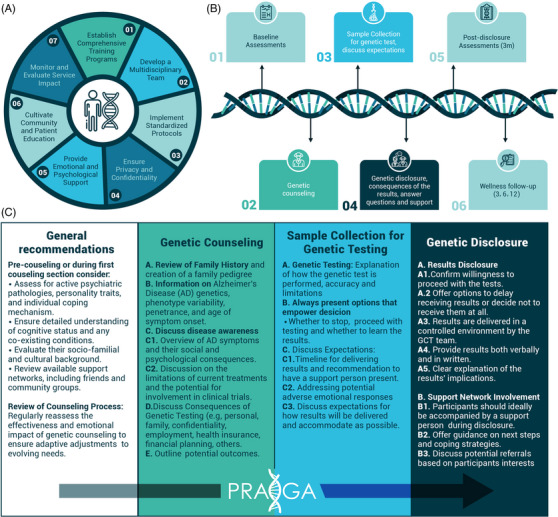
Overview of genetic counseling and testing protocol for ADAD in Latin America. (A) General recommendations at institutional level: foundational guidelines for centers and institutions initiating genetic counseling and testing (GCT) services. (B) Overview of PRAGA pilot program GCT protocol, Section 1: initial protocol assessment – evaluating readiness and requirements for GCT. Sections 2, 3, 4: core GCT process – detailed depiction of GCT sessions including sample collection, genetic disclosure, and post‐disclosure assessments. Section 5: final protocol assessment – assessing effectiveness of entire GCT protocol. Section 6: recommended follow‐up – conducted by a team member to discuss GCT process and assess further support needs. At an institutional level, this section serves to evaluate the overall emotional impact and effectiveness of the genetic counseling received. (C) General recommendations for GCT and considerations for encounters 2, 3, 4. Provides overarching guidelines and specific considerations for effectively managing the core sessions of the GCT process, ensuring consistency and adaptability to patient needs.
The first two sessions involve semi‐structured interviews, focusing on two main objectives: informing participants about their situation and the disease and assessing their mental health, socio‐familial context, and cultural background. These sessions serve to equip family members with essential information as they consider GCT services. During the pre‐test genetic counseling session, information is tailored to the family and participant's educational background and health literacy. Visual aids are utilized to explain the risk of ADAD based on personal and family history, as well as to provide education about Alzheimer's disease and potential legal implications. Additionally, a psychiatric evaluation is included in these sessions to mitigate potential adverse outcomes. The third session involves disclosing GS to those who opt to learn it. Participants are encouraged to bring a support person to these sessions for emotional and social support. Assistance is offered to help individuals understand and cope with the psychological, medical, and familial implications of the genetic contribution to the disease. Each session typically lasts between 45 and 60 mins (see Figure 1 for details).
2.3. Assessment and instruments
All participants were asked to complete a pre‐counseling baseline assessment prior to their first genetic counseling session and a post‐counseling assessment (in‐person or online) at approximately 3 months after disclosure. At baseline assessment, sociodemographic data, medical history, and family history were collected. Participants’ pre‐ and post‐genetic counseling measurements included the Montgomery–Åsberg Depression Rating Scale (MADRS), 25 the brief Zung Anxiety Rating (BZAR), 26 , 27 and the Short Health Anxiety Inventory (SHAI). 28 The scales used in this study were selected based on their proven effectiveness in local contexts, prior validations, and sensitivity to change over time. Clinically meaningful changes were determined using standardized thresholds, with higher scores indicating worse clinical outcomes. For the MADRS, a clinically significant change is considered to be an increase or decrease of around five points or more from baseline, with a threshold score of ≥19 indicating significant depressive symptoms. 25 , 29 , 30 Similarly, for the BZAR, clinically significant anxiety is identified by a score of ≥24, with changes of around five points from baseline deemed meaningful. 26 , 27 , 31 Lastly, for the SHAI, a score of ≥18 or a change from baseline of around five points marks a significant shift in health anxiety levels. 28
2.4. Statistical analysis
Descriptive statistics were calculated for sociodemographic characteristics, including age, gender, geographical location, marital status, education level, and education years. Continuous variables were summarized as means and standard deviations (SDs), while categorical variables were presented as frequencies and percentages. To compare sociodemographic characteristics between the test and control groups, we employed the Mann–Whitney U test for continuous variables (e.g., age, education years) and the chi‐squared test for categorical variables (e.g., gender, geographical location, marital status, education level). Distress measures included health‐related anxiety (measured by the SHAI scale), general anxiety (measured by the Zung Anxiety Scale), and depression (measured by the MADRS). These measures were assessed at baseline and 3 months after disclosure. The Mann–Whitney U test was used to compare baseline distress measures and post‐disclosure distress measures between the test and control groups. The Wilcoxon signed‐rank test was employed to evaluate changes in distress measures from baseline to 3 months after disclosure within each group (test group and control group). Within the test group, a subgroup analysis based on ADAD mutation status (mutation‐positive versus mutation‐negative) was performed using the Wilcoxon signed‐rank test to compare changes in distress measures from baseline to 3 months after disclosure. We also evaluated clinically meaningful changes from baseline within each group using Wilcoxon signed‐rank test to determine the significance of observed changes over time. Finally, a logistic regression analysis was performed to identify predictors of the decision to receive genetic disclosure. Statistical significance was set at p < 0.05. All statistical analyses and data visualization were conducted using R statistical computing program. 32
3. RESULTS
3.1. Context and setting
The study included families from Argentina and Colombia, carrying pathogenic PSEN1 and PSEN2 variants, detailed in Table S1. The Argentine cohort had families with two specific variants, while the Colombian cohort included a broader range of PSEN1 mutations. Collectively, these families demonstrate an average age at onset of dementia at approximately 46.7 years. Details about the family's pedigree and the pathogenicity of the variant have been published in previous studies. 17 , 33 , 34
3.2. Decision‐making: Characteristics of patients opting for genetic testing
A total of 132 first‐degree relatives of individuals with ADAD enrolled in the study. Of those eligible to receive GCT (n = 122), 97 out of 122 completed all the GCT sessions, and 87 participants (71.3%) chose to learn their GS (test group), and 35 did not learn their GS (control group). Details about study enrollment and reasons for dropping out are shown in Figure 2. Eligible participants in Argentina were significantly more likely to opt for learning their GS compared to those in Colombia, with rates of 96.9% (32/33) versus 61.1% (55/90), respectively. Overall, among the participants who received their genetic results, 56 out of 87 (64.4%) tested positive for ADAD.
FIGURE 2.
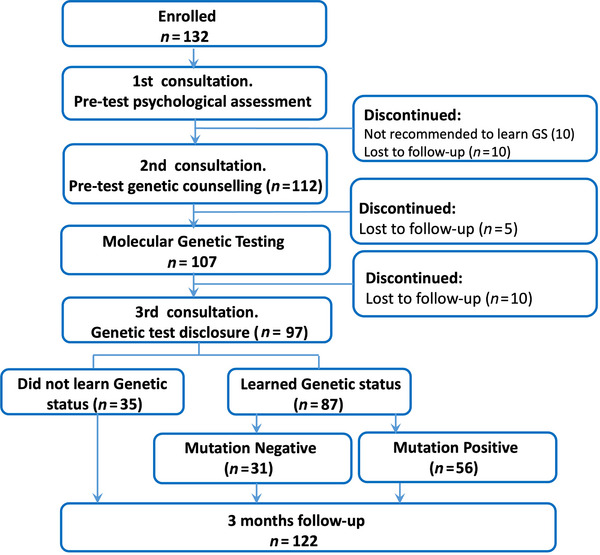
Participant flow diagram in study. The diagram illustrates the initial recruitment, various phases of the study, and the number of participants who discontinued the study due to being lost to follow‐up or not recommended for genetic testing.
Demographic characteristics for the two sample populations (Argentina and Colombia) are shown in Table 1. Differences in sociodemographic characteristics between participants who elected to undergo genetic testing and receive results (test group) and those who either did not complete genetic testing or chose not to receive results (control group) are detailed in Table 2. Participants in the test group exhibited sociodemographic characteristics similar to those of the control group, except for younger age (p = 0.04) and higher level of education in the test group (p = 0.01). With respect to baseline distress measures, participants in the control group demonstrated higher levels of health‐related anxiety and general anxiety compared to the test group, with mean scores of 15.1 (SD 6.2) versus 10.3 (SD 5.4), p < 0.001, and 8.4 (SD 5.5) versus 4.3 (SD 3.9), p < 0.001, respectively. Baseline depression scores were similar between the groups (p = 0.1).
TABLE 1.
Baseline sociodemographic characteristics (Argentina and Colombia).
| Argentina (n = 35) | Colombia (n = 97) | p value b | |
|---|---|---|---|
| Age mean ± SD a | 32.03 ± 9.81 | 44.64 ± 8.82 | <0.001 |
| Gender n (%) | 0.5 | ||
| Female | 19 (54%) | 65 (61%) | |
| Geographical location n (%) | |||
| Urban | 12 (60%) | 71 (67%) | 0.52 |
| Rural | 8 (40%) | 35 (33%) | |
| Marital status n (%) | 0.8 | ||
| Single | 8 (47.1%) | 8 (44.4%) | |
| Common‐law marriage | 9 (52.9%) | 9 (50.0%) | |
| Divorced | 0 (0.0%) | 1 (5.6%) | |
| Education level n (%) | 0.04 | ||
| Primary | 1 (2.9%) | 10 (9.4%) | |
| High school/technical degree | 23 (68%) | 83 (78%) | |
| University | 10 (29%) | 13 (12%) | |
Mean ± SD; n (%).
Wilcoxon rank sum test; Pearson's chi‐squared test; Fisher's exact test.
TABLE 2.
Baseline characteristics by study group.
| Variable | Control group n = 35 a | Test group n = 87 a | p value b |
|---|---|---|---|
| Age a | 45.49 ± 8.65 | 40.60 ± 10.92 | 0.04 |
| Gender | 0.6 | ||
| Female | 23 (66%) | 51 (59%) | |
| Geographical location | 0.4 | ||
| Rural | 12 (34%) | 21 (29%) | |
| Urban | 23 (66%) | 51 (71%) | |
| Marital status | 0.06 | ||
| Common‐law marriage | 22 (63%) | 44 (51%) | |
| Single/Divorced | 13 (36.0%) | 43 (49%) | |
| Education level | 0.01 | ||
| Primary | 4 (11%) | 4 (4.7%) | |
| High school/technical degree | 29 (83%) | 64 (74%) | |
| University | 2 (5.7%) | 18 (21%) | |
| Health related anxiety a | 15.17 ± 6.22 | 10.32 ± 5.38 | <.001 |
| General anxietya | 8.40 ± 5.55 | 4.26 ± 3.99 | <.001 |
| Depressiona | 9.92 ± 8.62 | 6.26 ± 5.04 | 0.10 |
Mean ± SD; n (%).
Kruskal–Wallis rank sum test; Fisher's exact test.
3.3. Impact of genetic testing and counseling (3 months)
We examined whether distress measures changed after receiving genetic disclosure or differed from the control group. Figure 3 shows the change in distress measures in the test group relative to the control group (Figure 3A–C) and within the test group ADAD mutation‐positive versus mutation‐negative (Figure 3D–F).
FIGURE 3.
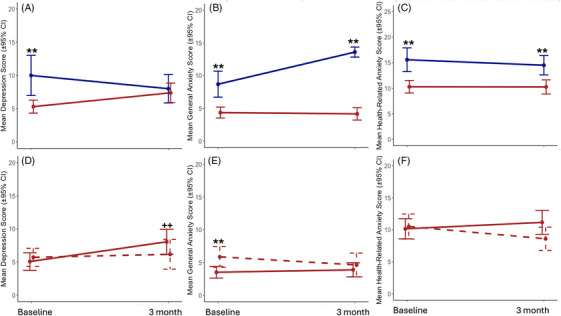
Change in distress measures in test group relative to control group and within the test troup by DIAD mutation status (A–F). (A–C) Changes in distress measures between the test group (red line) and control group (blue line) at baseline and 3 months after status disclosure. (A) Depression score. (B) General anxiety score. (C) Health‐related anxiety score. (D–F) Change in distress measures within test group: DIAD mutation‐positive (straight red line) versus mutation‐negative (dashed red line) at baseline and 3 months after status disclosure. (D) Depression score. (E) General anxiety score. (F) Health‐related anxiety score. ** Significant differences between groups; ++ significant within‐group difference relative to baseline. Depression scores were assessed using Montgomery–Åsberg Depression Rating Scale (MADRS). 25 MADRS severity thresholds are set as follows: 14 to 18 for mild depression, 19 to 23 for moderate, 24 to 36 for marked, 37 to 39 for severe, and 40 or higher for extreme depression. 25 , 29 General anxiety scores were evaluated using a brief version of the Zung Anxiety Scale, where a score of 24 or higher indicates clinically significant anxiety. 26 , 31 Health‐related anxiety was measured using the Short Health Anxiety Inventory (SHAI). 28 For the SHAI, a score of 18 or higher suggests a significant shift in health anxiety levels. 28 For all scales used, higher scores represent more severe clinical outcomes, and changes of approximately five points from baseline, even without surpassing the thresholds, are considered clinically meaningful.
At baseline, none of the participants showed clinically meaningful distress scores. However, the test group started with a more favorable psychological profile compared to the control group. Specifically, the test group exhibited lower levels of distress across all measured domains compared to the control group. Specifically, the mean general anxiety in the test group was 4.4 (SD = 3.9) compared to 8.7 (SD = 6.0) in the control group (p = 0.001). For health‐related anxiety, the test group had a mean score of 10.2 (SD = 5.8), whereas the control group had a mean score of 15.6 (SD = 7.0) (p = 0.001). At follow‐up (3 months after disclosure), the test group maintained significantly lower levels of general anxiety (p = 0.001) and health‐related anxiety (p = 0.03) compared to the control group. There was no significant difference in the depression scores across both groups at baseline (p = 0.1) or 3 months’ follow‐up (p = 0.5).
In addition, we assess the within‐group progression of distress measures from baseline to month 3. Overall, there were no clinically significant changes in the distress measures across groups from baseline to month 3 (Figure 3 and Table S2). The control group showed non‐significant change across all distress measures. The mean depression score slightly decreased from 10.0 (SD = 9.1) at baseline to 8.0 (SD = 6.48) at month 3 (p = 0.9). General anxiety mean scores increased from 8.7 (SD = 6.0) to 13.6 (SD = 2.32), p = 0.2. Health‐related anxiety decreased from a mean of 15.6 (SD = 7.0) to 14.5 (SD = 5.72), p = 0.44.
In the test group, we observed a statistically significant (p = 0.02) increase in mean depression scores from 5.3 (SD = 4.6) at baseline to 7.4 (SD = 6.98) at month 3. This change was predominantly driven by participants in the mutation‐positive subgroup, where depression scores increased from 5.07 at baseline to 8.06 at month 3 (p = 0.01). In contrast, the mutation‐negative subgroup did not show a significant change in depression scores, remaining 5.71 at baseline and changing to 6.17 at month 3. Despite this increase, the scores remained below the cut‐off point of >19, typically considered indicative of clinically significant depression.
Given the observed increase in overall depression scores among participants who learned of their mutation‐positive status, we conducted a subitem‐level analysis to identify the specific components driving this change. Significant increases were noted in reported sadness (p = 0.003) and inner tension (p = 0.004), indicating these were the primary contributors to the overall change. Subitems like suicidal and pessimistic thoughts did not show significant changes, suggesting that certain aspects of depressive affect, particularly more extreme components, remained stable despite the genetic disclosure.
Finally, the test group did not exhibit statistically significant changes in other distress measures, such as general anxiety and health‐related anxiety (p values of 0.3 and 0.9, respectively). The disclosure of genetic results, regardless of being mutation‐positive or mutation‐negative, was not associated with significant changes in general anxiety or health‐related anxiety for either subgroup. Details about changes in distress measures in the test group relative to the control group and within the test group by ADAD mutation status are provided in Tables S3 and S4.
A logistic regression analysis was conducted to explore factors influencing participants' decisions to receive genetic disclosure. The results revealed that higher levels of general anxiety were significantly associated with a decreased likelihood of opting to learn one's GS, with an odds ratio (OR) of 0.76 (95% confidence interval [CI]: 0.64, 0.87, p < 0.001). In addition, urban participants with higher education exhibited a higher, yet not statistically significant, propensity to seek genetic disclosure compared to their less educated and rural counterparts (OR = 2.7, 95% CI: 0.62, 11.6, p = 0.18). Similarly, higher levels of health‐related anxiety were associated with a slightly decreased likelihood of seeking disclosure, approaching but not achieving statistical significance (OR = 0.91, 95% CI: 0.83, 1.006, p = 0.07).
4. DISCUSSION
This pilot study represents a structured GCT protocol specifically tailored to individuals at risk of ADAD in LatAm. Our primary finding showed no clinically meaningful differences in distress‐related outcomes between individuals learning their GS relative to those who did not. Mutation‐positive carriers (MC) who learned their GS experienced a statistically significant increase in depression scores but remained below the cut‐off point considered indicative of clinically significant depression. MCs who learned their GS did not experience higher levels of distress relative to non‐MCs in other areas. Our findings confirm that genetic testing is well tolerated when using a protocol that provides screening, education, counseling, and follow‐up sessions for those who opt into the disclosure. In addition, we provide preliminary insights into the psychological impact and decision‐making processes associated with learning one's GS in familial AD, contributing significantly to the field of medical genetics in the region.
Our findings revealed differences in genetic testing engagement between Colombian and Argentine participants, with Argentinians showing greater willingness to learn their GS. Factors such as family context, education treatment options, religious beliefs, disease awareness, and caregiving experience may have contributed to this variation. 8 , 35 , 36 , 37 Moreover, the Argentine cohort's greater participation in genetic testing may stem from enhanced disease awareness and prior research exposure. Similarly, in Colombia, families well versed in research and disease awareness showed comparable response rates to their Argentine counterparts. Familiarity with research and deeper disease understanding likely influences genetic testing participation rates, though this was not fully explored here. Importantly, our results suggest that receiving GS information does not lead to increased clinically relevant psychological distress measures. Both groups – those who learned their GS and those who did not – exhibited anxiety and depression scores below clinically significant thresholds after disclosure. Of note, mutation carriers who learned their status exhibited a three‐point increase in depressive symptoms as measured by the MADRS. This increase, while clinically modest, denotes minimal depression symptoms, nearing the threshold of mild depression (7 to 18), and raises the question of whether regular psychological evaluations should be standard practice for individuals undergoing genetic testing for serious inherited conditions. A subitem‐level analysis indicated that “reported sadness” and “inner tension” were the main components driving the overall change. These findings suggest that the emotional impacts of GS affect both internal emotional states and responses to external stimuli. Other items on the MADRS showed no significant variations from baseline, indicating that the specific emotional responses to genetic disclosure may be focused on internalized experiences of sadness and tension rather than broader aspects of depressive affect. 38 , 39
A relevant aspect for consideration is that our follow‐up period was limited to 3 months after disclosure. This interval may not be sufficient to observe fully consolidated affective changes or to capture the evolution of depressive symptoms over time. Further follow‐up evaluations, extending to 6 to 12 months, will be essential to fully understand the trajectory of these depressive symptoms over a longer period.
Overall, our findings support the notion that with appropriate counseling, individuals can cope effectively with the knowledge of their genetic risk of ADAD. 10 , 12 , 40 Our experience suggests that it is crucial to conduct thorough psychological assessments prior to disclosing GS, ensuring individuals are prepared both cognitively and emotionally to receive potentially life‐altering information. In addition, there are key elements for success in the process, including facilitating informed decision‐making, enabling individuals to understand their condition, anticipating future needs, and engaging meaningfully with treatment options and research studies. Ultimately, the genetic counseling protocol seeks not only to inform but also to equip individuals with the necessary tools to proactively manage their health outcomes, ensuring they are supported in integrating this knowledge into their lives in a healthy and constructive manner.
Introducing and developing genetic counseling protocols in diverse populations requires careful consideration of numerous relevant factors. 40 , 41 Within the context of predictive genetic testing for individuals at high risk of ADAD, several ethical dilemmas arise. While many issues are critical, the PRAGA program has focused on security and access to information. This approach guarantees that the process will not bring unwanted consequences (non‐maleficence) and empower individuals to take ownership of their information and future. Future studies should continue to provide targeted recommendations for health professionals involved in genetic testing and support the development of tools to assess risks, barriers, and limitations inherent in the GCT process.
Results from this project may shed light on the need to enhance medical genetic services and family counseling in LatAm, leading to additional support from stakeholders and policymakers. The lack of significant clinical distress associated with GS disclosure underscores the effectiveness of the GCT protocol used, which included pre‐test education and post‐disclosure support. This protocol could serve as a model for other regions in LatAm, where similar cultural and economic dynamics may exist. It is essential, however, to continually adapt these protocols to local contexts, considering the diverse cultural and social fabrics of different LatAm countries.
While the findings are promising, the study's limitations must be acknowledged. Participants were considered as control or test group based on their preference to learn their GS. Consequently, the lack of randomization and the limited sample size, although adequate for a study in ADAD, limits the generalizability of the results. This non‐randomized approach primarily affects internal validity, as causality cannot be definitively established and may be influenced by various factors, including participants' preferences and baseline anxiety levels. In addition, it should be noted that the control group in our study displayed higher baseline scores for psychological factors compared to those who chose to receive their genetic test results. It is unclear whether those in the control group could have experienced even greater psychological distress had they opted to receive their test results. Therefore, the findings may predominantly reflect that individuals with minimal baseline psychological distress are more likely to tolerate the procedure well, and future studies should address these questions in those with higher scores for psychological distress measures and better ways to support this group. Larger studies across multiple LatAm countries are necessary to validate these findings and refine the GCT protocols further. In addition, our study did not collect reasons for opting out of genetic disclosure from the control group. Future research should address this gap to better understand and support this group's decisions.
5. CONCLUSIONS
This study provides preliminary evidence supporting the safe implementation of GCT for ADAD in LatAm. The positive reception and minimal psychological distress associated with learning GS highlight the readiness and resilience of at‐risk populations in confronting genetic information. Participants who wanted to know their GS cited hopes for new treatments and concerns for their offspring as their reasons. Future efforts should focus on expanding access to GCT services across LatAm.
CONFLICT OF INTEREST STATEMENT
The authors report no disclosures relevant to this manuscript. Author disclosures are available in the supporting information.
CONSENT STATEMENT
This study was conducted with the approval of the Institutional Review Boards at Fleni in Argentina and Hospital Pablo Tobon Uribe in Colombia. All participants were provided with detailed information about the study's aims, procedures, potential benefits, and risks associated with participating in GCT for ADAD. Written informed consent was obtained from each participant before enrollment, ensuring that they were fully aware of their rights to withdraw from the study at any point without consequences.
Supporting information
Supporting Information
Supporting Information
ACKNOWLEDGMENTS
We extend our deepest gratitude to all participants and their families for their invaluable contributions to this research. We also thank our colleagues and support staff who provided expertise and assistance throughout the project. Special thanks to the members of the PRAGA group for their feedback on protocol development and recommendations for genetic counseling and testing in Latin America. This project was supported by the McDonnell International Scholars Academy, the Foundation for Barnes‐Jewish Hospital, the Alzheimer's Association (SG‐20‐690363), and the National Institute on Aging (K01AG073526). The funding sources had no role in the design and conduct of the study, collection, management, analysis, and interpretation of the data, preparation, review, or approval of the manuscript, or decision to submit the manuscript for publication. The corresponding author had full access to the data in the study and was responsible for the decision to submit it for publication.
Bagnati PM, Londoño Castaño M, Fernández ML, et al. Impact of genetic counseling and testing in individuals at high risk of familial Alzheimer's disease from Latin America: a non‐randomized controlled trial. Alzheimer's Dement. 2025;17:e70102. 10.1002/dad2.70102
Pablo M. Bagnati and Marisol Londoño Castaño contributed equally and shared the first authorship.
REFERENCES
- 1. Mendez MF. Early‐onset Alzheimer's disease: nonamnestic subtypes and type 2 AD. Arch Med Res. 2012;43:677‐685. doi: 10.1016/j.arcmed.2012.11.009 [DOI] [PMC free article] [PubMed] [Google Scholar]
- 2. Smits LL, Pijnenburg YAL, Koedam ELGE, et al. Early onset Alzheimer's disease is associated with a distinct neuropsychological profile. J Alzheimers Dis. 2012;30:101‐108. doi: 10.3233/JAD-2012-111934 [DOI] [PubMed] [Google Scholar]
- 3. Mintun MA, Lo AC, Duggan Evans C, et al. Donanemab in early Alzheimer's disease. N Engl J Med. 2021;384:1691‐1704. doi: 10.1056/NEJMoa2100708 [DOI] [PubMed] [Google Scholar]
- 4. Tolar M, Abushakra SR, Hey JA, Porsteinsson AP, Sabbagh MN. Aducanumab, gantenerumab, BAN2401, and ALZ‐801—the first wave of amyloid‐targeting drugs for Alzheimer's disease with potential for near term approval. Alzheimers Res Ther. 2020;12:95. [DOI] [PMC free article] [PubMed] [Google Scholar]
- 5. Bateman RJ, Benzinger TL, Berry S, et al. The DIAN‐TU next generation Alzheimer's prevention trial: adaptive design and disease progression model. Alzheimers Dement. 2017;13:8‐19. doi: 10.1016/j.jalz.2016.07.005 [DOI] [PMC free article] [PubMed] [Google Scholar]
- 6. Hooper M, Grill JD, Rodriguez‐Agudelo Y, et al. The impact of the availability of prevention studies on the desire to undergo predictive testing in persons at risk for autosomal dominant Alzheimer's disease. Contemp Clin Trials. 2013;36:256‐262. doi: 10.1016/j.cct.2013.07.006 [DOI] [PMC free article] [PubMed] [Google Scholar]
- 7. Tibben A, Stevens M, de Wert GM, et al. Preparing for presymptomatic DNA testing for early onset Alzheimer's disease/cerebral haemorrhage and hereditary Pick disease. J Med Genet. 1997;34(1):63‐72. [DOI] [PMC free article] [PubMed] [Google Scholar]
- 8. Gooding HC, Linnenbringer EL, Burack J, Roberts JS, Green RC, Biesecker BB. Genetic susceptibility testing for Alzheimer disease: motivation to obtain information and control as precursors to coping with increased risk. Patient Educ Couns. 2006;64:259‐267. doi: 10.1016/j.pec.2006.03.002 [DOI] [PubMed] [Google Scholar]
- 9. Evers‐Kiebooms G, Decruyenaere M. Predictive testing for Huntington's disease: a challenge for persons at risk and for professionals. Patient Educ Couns. 1998;35(1):15‐26. [DOI] [PubMed] [Google Scholar]
- 10. Bocchetta M, Mega A, Bernardi L, et al. Genetic counseling and testing for Alzheimer's disease and Frontotemporal Lobar Degeneration: an Italian Consensus Protocol. Journal of Alzheimer's Disease. 2016;51:277‐291. doi: 10.3233/JAD-150849 [DOI] [PubMed] [Google Scholar]
- 11. Mega A, Galluzzi S, Bonvicini C, et al. Genetic counselling and testing for inherited dementia: single‐centre evaluation of the consensus Italian DIAfN protocol. Alzheimers Res Ther. 2020;12:152. doi: 10.1186/s13195-020-00720-4 [DOI] [PMC free article] [PubMed] [Google Scholar]
- 12. Goldman JS. New approaches to genetic counseling and testing for Alzheimer's disease and frontotemporal degeneration. Curr Neurol Neurosci Rep. 2012;12:502‐510. doi: 10.1007/s11910-012-0296-1 [DOI] [PMC free article] [PubMed] [Google Scholar]
- 13. Borle K, Morris E, Inglis AJ, Austin JC. Risk communication in genetic counseling: exploring uptake and perception of recurrence numbers, and their impact on patient outcomes. Clin Genet. 2018;94:239‐245. [DOI] [PubMed] [Google Scholar]
- 14. Organizaciόn Mundial de la Salud . Plan de acción sobre salud mental 2013‐2020. 2013.
- 15. World Health Organization . Medical Genetic Services in Developing Countries the Ethical, Legal and Social Implications of Genetic Testing and Screening Human Genetics Chronic Diseases and Health Promotion. World Health Organization. 2006. [Google Scholar]
- 16. Parra MA, Baez S, Sedeño L, et al. Dementia in Latin America: paving the way toward a regional action plan. Alzheimers Dement. 2021;17:295‐313. doi: 10.1002/alz.12202 [DOI] [PMC free article] [PubMed] [Google Scholar]
- 17. Llibre‐Guerra JJ, Li Y, Allegri RF, et al. Dominantly inherited Alzheimer's disease in Latin America: genetic heterogeneity and clinical phenotypes. Alzheimers Dement. 2021;17:653‐664. doi: 10.1002/alz.12227 [DOI] [PMC free article] [PubMed] [Google Scholar]
- 18. Taucher SC. Medical genetics and genomic medicine in Chile: opportunities for improvement. Mol Genet Genomic Med. 2015;3:243‐247. doi: 10.1002/mgg3.166 [DOI] [PMC free article] [PubMed] [Google Scholar]
- 19. Margarit SB, Alvarado M, Alvarez K, Lay‐Son G. Medical genetics and genetic counseling in Chile. J Genet Couns. 2013;22:869‐874. doi: 10.1007/s10897-013-9607-1 [DOI] [PubMed] [Google Scholar]
- 20. Prince M. World Alzheimer Report 2015: The Global Impact of Dementia. Alzheimer's Disease International; 2015. World Alzheimer's Report. [Google Scholar]
- 21. Alzheimer's Disease International . National Alzheimer and Dementia Plans Planned Policies and Activities Early Detection, Access to Diagnosis. Alzheimer's Disease International. 2012. [Google Scholar]
- 22. American Psychiatric Association . Diagnostic and Statistical Manual of Mental Disorders. Diagnostic and Statistical Manual of Mental Disorders; 2013. doi: 10.1176/APPI.BOOKS.9780890425596 [DOI] [Google Scholar]
- 23. American Psychiatric Association . Diagnostic and Statistical Manual of Mental Disorders. Diagnostic and Statistical Manual of Mental Disorders; 2022. doi: 10.1176/APPI.BOOKS.9780890425787 [DOI] [Google Scholar]
- 24. Goldman JS, Hahn SE, Catania JW, et al. Genetic counseling and testing for Alzheimer disease: joint practice guidelines of the American College of Medical Genetics and the National Society of Genetic Counselors. Genet Med. 2011;13:597‐605. doi: 10.1097/GIM.0b013e31821d69b8 [DOI] [PMC free article] [PubMed] [Google Scholar]
- 25. Müller MJ, Himmerich H, Kienzle B, Szegedi A. Differentiating moderate and severe depression using the Montgomery‐Åsberg Depression Rating Scale (MADRS). J Affect Disord. 2003;77:255‐260. doi: 10.1016/S0165-0327(02)00120-9 [DOI] [PubMed] [Google Scholar]
- 26. Zung WWK. A rating instrument for anxiety disorders. Psychosomatics. 1971;12:371‐379. doi: 10.1016/S0033-3182(71)71479-0 [DOI] [PubMed] [Google Scholar]
- 27. De S, Ossa LA, Martinez Y, Herazo E, Campo A. Estudio De La Consistencia Interna Y Estructura Factorial De Tres Versiones De La Escala De Zung Para Ansiedad*. Enero‐Marzo; 2009. [Google Scholar]
- 28. Österman S, Axelsson E, Lindefors N, et al. The 14‐item Short Health Anxiety Inventory (SHAI‐14) used as a screening tool: appropriate interpretation and diagnostic accuracy of the Swedish version. BMC Psychiatry. 2022;22:701. doi: 10.1186/S12888-022-04367-3 [DOI] [PMC free article] [PubMed] [Google Scholar]
- 29. Leucht S, Fennema H, Engel RR, Kaspers‐Janssen M, Lepping P, Szegedi A. What does the MADRS mean? Equipercentile linking with the CGI using a company database of mirtazapine studies. J Affect Disord. 2017;210:287‐293. doi: 10.1016/J.JAD.2016.12.041 [DOI] [PubMed] [Google Scholar]
- 30. Thase ME, Harrington A, Calabrese J, Montgomery S, Niu X, Patel MD. Evaluation of MADRS severity thresholds in patients with bipolar depression. J Affect Disord. 2021;286:58‐63. doi: 10.1016/J.JAD.2021.02.043 [DOI] [PubMed] [Google Scholar]
- 31. Dunstan DA, Scott N. Norms for Zung's self‐rating anxiety scale. BMC Psychiatry. 2020;20:90. doi: 10.1186/S12888-019-2427-6 [DOI] [PMC free article] [PubMed] [Google Scholar]
- 32. R Development Core Team . R Foundation for Statistical Computing. A Language and Environment for Statistical Computing 2012;3. [Google Scholar]
- 33. Ramirez Aguilar L, Acosta‐Uribe J, Giraldo MM, et al. Genetic origin of a large family with a novel PSEN1 mutation (Ile416Thr). Alzheimers Dement. 2019;15:709‐719. doi: 10.1016/j.jalz.2018.12.010 [DOI] [PMC free article] [PubMed] [Google Scholar]
- 34. Morelli L, Prat MI, Levy E, Mangone CA, Castaño EM. Presenilin 1 Met146Leu variant due to an A→T transversion in an early‐onset familial Alzheimer's disease pedigree from Argentina. Clin Genet. 1998;53:469‐473. doi: 10.1111/j.1399-0004.1998.tb02597.x [DOI] [PubMed] [Google Scholar]
- 35. Goldman JS, Hahn SE, Catania JW, et al. Genetic counseling and testing for Alzheimer disease: joint practice guidelines of the American College of Medical Genetics and the National Society of Genetic Counselors. Genet Med. 2011;13:597‐605. doi: 10.1097/GIM.0b013e31821d69b8 [DOI] [PMC free article] [PubMed] [Google Scholar]
- 36. Roberts JS. Anticipating response to predictive genetic testing for Alzheimer's disease: a survey of first‐degree relatives. Gerontologist. 2000;40:43‐52. doi: 10.1093/geront/40.1.43 [DOI] [PubMed] [Google Scholar]
- 37. Mastromauro C, Myers RH, Berkman B. Attitudes toward presymptomatic testing in Huntington disease. Am J Med Genet. 1986;26:271‐282. doi: 10.1002/ajmg.1320260205 [DOI] [PubMed] [Google Scholar]
- 38. Lobo A, Chamorro L, Luque A, et al. Validation of the Spanish versions of the Montgomery‐Asberg depression and Hamilton anxiety rating scales. Med Clin (Barc). 2002;118:493‐499. doi: 10.1016/S0025-7753(02)72429-9 [DOI] [PubMed] [Google Scholar]
- 39. Capodilupo G, Blattner R, Must A, Navarro SG, Opler M. A qualitative investigation of the Montgomery‐Åsberg Depression Rating Scale: discrepancies in rater perceptions and data trends in remote assessments of rapid‐acting antidepressants in treatment resistant depression. Front Psychiatry. 2024;15:1289630. doi: 10.3389/FPSYT.2024.1289630 [DOI] [PMC free article] [PubMed] [Google Scholar]
- 40. WHO . Medical Genetic Services in Developing Countries: The Ethical, Legal and Social Implications of Genetic Testing and Screening Human Genetics Chronic Diseases and Health Promotion. World Health Organization. 2006. [Google Scholar]
- 41. Zhong A, Darren B, Loiseau B, et al. Ethical, social, and cultural issues related to clinical genetic testing and counseling in low‐ and middle‐income countries: a systematic review. Genet Med. 2018;23(12):2270‐2280. doi: 10.1038/s41436-018-0090-9 [DOI] [PubMed] [Google Scholar]
Associated Data
This section collects any data citations, data availability statements, or supplementary materials included in this article.
Supplementary Materials
Supporting Information
Supporting Information